
Chapter 16—The General Ledger and Business Reporting (GL/BR)
Process Key
1. The GL/BR process is an interacting structure of people, equipment, activities, and controls that is designed
to accomplish both operations and information system functions with the purpose of generating accounting and
other reports.
2. The business reporting process comprises accumulating, classifying, and recording data, fueling the financial
reporting, business reporting, and other reporting subsystems.
3. The general ledger process is concerned with preparing external financial statements, ensuring they conform
to GAAP, generating Web-based forms of key financial statement and related business reporting via the
Internet, and supporting the generation of both ad hoc and predetermined business reports.
4. A feeder process is any business process that accumulates business event data that are then communicated to
and processed within the GL.
5. The managerial reporting officer is responsible for reporting GAAP financial statements.
6. The financial reporting officer is primarily responsible for budgeting.
7. The controller notifies the business reporting process of investing and financing transaction activities,

8. The financial statements contain detailed information of all of an organization’s business event data.
9. A performance report compares actual results with budgeted expectations.
10. Performance reports are often part of a managerial reporting system known as a responsibility
accounting/reporting system.
11. A journal voucher is an internal source document used to notify the GL to make an accounting entry.
12. The general ledger master data contains summarized information of all of an organization’s business event
data.
13. The source code field of each GL entry provides a beginning point of reference for developing a proper
chart of accounts.
14. Balanced scorecard is methodology for assessing an organization’s business performance via four
components: (1) financial, (2) external business process, (3) vendors, and (4) innovation and improvement
activities.
15. Business intelligence is the integration of statistical and analytical tools with decision support technologies
to facilitate complex analyses of data warehouses by managers and decision makers.

16. XBRL is an XML-based language consisting of a set of tags that are used to unify the presentation of
business reporting information into a single format that can be easily read by almost any software package and
can be easily searched by Web browsers.
17. XML is a generalized system for the customized tagging of data to enable the definition, transmission, and
interpretation of data over the Internet.
18. The intent of the Sarbanes-Oxley Act of 2002 is to protect the company by improving the accuracy and
reliability of all corporate disclosures made pursuant to the securities laws.
19. The driving force in constructing a chart of accounts is to add structure to the classification of financial
information.
20. As we move toward an enterprise system environment, the chart of accounts becomes increasingly more
important.
21. When implementing an ERP system, it is best to provide all users with access to all menu systems, so they
can see what is going on within the system.
22. The general ledger process comprises accumulating, classifying, and recording data, fueling the financial
reporting, business reporting, and other reporting subsystems.
23. The business reporting process is concerned with preparing external financial statements, ensuring they
conform to GAAP, generating Web-based forms of key financial statement and related business reporting via
the Internet, and supporting the generation of both ad hoc and predetermined business reports.

24. The financial reporting officer is responsible for reporting GAAP financial statements.
25. The managerial reporting officer is responsible for preparing performance reports.
26. The treasurer notifies the business reporting process of investing and financing transaction activities.
27. The source code field of each GL entry provides a beginning point of reference for developing a proper
audit trail.
28. Balanced scorecard is methodology for assessing an organization’s business performance via four
components: (1) financial, (2) internal business process, (3) customers, and (4) innovation and improvement
activities.
29. XML is an XBRL-based language consisting of a set of tags that are used to unify the presentation of
business reporting information into a single format that can be easily read by almost any software package and
can be easily searched by Web browsers.
30. The financial reporting officer typically prepares performance reports.
31. The financial reporting system is also known as the responsibility accounting/reporting system.
32. A limitation of the general ledger approach is that financial and non-financial information is combined and
business event source data is retained.

33. An instance document is an XBRL document that contains all information, at a given point in time,
including tags, about the occurrence of an item.
34. Convergence implies that GAAP and IFRS standards will blend together, with differences reconciled, and
ultimately we will have one set of standards that can be used world-wide.
35. Continuous assurance (continuous auditing) is the process by which assurance is provided through
monitoring of automated controls and business events in real time or near real time.
36. The general ledger process comprises all of the following except:
A. providing information for financial reporting
37. The business reporting process comprises all of the following except:
38. In contrast to the managerial reporting process, the financial reporting process prepares all of the following
financial statements except:
39. Typically, you would expect general ledger updates for financing and investing activities to be fed to the
GL/BR process by:
40. Typically, you would expect general ledger updates for periodic adjusting entries to be fed to the GL/BR
process by:
41. Which of the following individuals should possess the greatest knowledge of GAAP?
42. Which of the following usually would be responsible for preparing operating center budgets?
A. managerial reporting officer
43. Which of the following usually would be responsible for preparing operating center performance reports?
44. Normally, you would expect that business event updates would be sent to the GL/BR process by:
A. the controller
45. Performance reports to various cost center, profit center, and investment center managers are usually sent
by?
46. GAAP based financial statements are sent by:
47. A responsibility accounting/reporting system includes the following:
A. upward reporting of information
48. Adjusted trial balance figures are usually sent from the business reporting department to the:
49. Which of the following has responsibilities and expertise to preparing internal reports?
50. Finalized budget figures are sent to the GL/BR process by:

51. Which of the following advises and assists the cost center, profit center, and investment center managers in
preparing the budget?
52. Which of the following could be a journal voucher?
53. Which of the following statements related to journal vouchers is false for most ERP systems?
A. The person completing the adjustment will enter it directly into the computer.
54. Which of the following provides data to the GL/BR process?
A. the order entry/sales process
55. Inputs to a GL/BR process typically include all of the following except:
A. adjusting entry journal voucher
56. Limitations of the general ledger approach include the following:
57. The general ledger master data does not contain:
58. Tracing back to individual business events that have been aggregated into account balances is done by
means of a(n):
59. The coding system typically used in the general ledger chart of accounts is:
60. An account in the chart of accounts has the number 7111. Which of the following does the 7 likely
represent?
61. Which of the following items is not one of the four components of the balanced scoreboard methodology?
62. Which of the following statements related to XBRL is false?
A. is an XML-based language consisting of a set of tags that are used to unify the presentation of business
reporting information into a single format
63. The intent of the Sarbanes-Oxley Act of 2002 is to:
A. protect investors by improving the accuracy and reliability of corporate disclosures
64. Sarbanes-Oxley Act of 2002 may lead to:
65. Which of the following represent a typical coding scheme for a general ledger account?
66. Which of the following items is a component of the balanced scoreboard methodology?
A. Customers
67. An instance document:
68. GAAP and IFRS convergence will lead to:
A. the end of the FASB
69. Continuous assurance (continuous auditing) will lead to:
70. To be effectives business intelligence requires:
71. The ______________________________ process is an interacting structure of people, equipment,
activities, and controls that is designed to accomplish both operations and information system functions with the
purpose of generating accounting and other reports.
72. The ______________________________ process comprises accumulating, classifying, and recording data,
fueling the financial reporting, business reporting, and other reporting subsystems.
73. The ______________________________ process comprises preparing external financial statements,
ensuring they conform to GAAP, generating Web-based forms of key financial statement and related business
reporting information via the Internet, and supporting the generation of both ad hoc and predetermined business
reports.

74. A(n) ______________________________ process is any business process that accumulates business event
data that are then communicated to and processed within the GL.
75. The ______________________________ officer possesses expertise in generally accepted accounting
principles.
76. The ______________________________ officer possesses expertise in preparing internal management
reports.
77. The ______________________________ notifies the general ledger/business reporting process of investing
and financing transaction activities,
78. The ______________________________ is a list of all the accounts in the general ledger.
79. A(n) ______________________________ report compares actual results with budgeted expectations.
80. Often, performance reports are part of a managerial reporting system known as a(n)
______________________________ system.
81. A(n) ______________________________ is an internal source document used to notify the general ledger
to make an accounting entry.
82. The ______________________________ data contains summarized information of all an organization’s
business event data.
83. The source code field of each GL entry provides a beginning point of reference for developing a proper
______________________________.
84. Consider the GL account number “1132” where each successive digit is subordinate to the digit to its left
(e.g., 2 = cash in the bank and 3 = cash accounts). This scheme is known as
______________________________ coding.
85. ______________________________ is methodology for assessing an organization’s business performance
via four components: (1) financial, (2) internal business process, (3) customers, and (4) innovation and
improvement activities.
86. ______________________________ is the integration of statistical and analytical tools with decision
support technologies to facilitate complex analyses of data warehouses by managers and decision makers.
87. ______________________________ is an XML-based language consisting of a set of tags that are used to
unify the presentation of business reporting information into a single format, easily read by almost any software
package, and easily searched by Web browsers.
88. ______________________________ is a generalized system for the customized tagging of data to enable
the definition, transmission, and interpretation of data over the Internet. It uses predefined tags to let
information providers create uniform information for users.
89. The intent of the ______________________________ is to protect investors by improving the accuracy and
reliability of corporate disclosures made pursuant to the securities laws, and for other purposes.

90. Sarbanes-Oxley, Section 409 states that companies ”shall disclose to the public on a(n)
______________________________ and ______________________________ basis such additional
information concerning material changes in the financial condition or operations of the issuer….”
91. Sarbanes-Oxley Section 401 covers ______________________________ in financial reports.
92. ______________________________ is the process by which assurance is provided through monitoring of
automated controls and business events in real-time or near real time.
93. Changing account numbers and account structure can raise a significant information use problem called
______________________________.
94. The XBRL framework is based on the concept of a(n) ______________________________, a group of
definitions that together provide meaning to reporting concepts.
95. A(n) ______________________________ is an XBRL document that contains all information, at a given
point in time, including tags, about the occurrence of an item.
96. Sarbanes-Oxley Section 302 states that the ______________________________ and
______________________________ of an organization must certify that the statements neither contain
material untrue facts nor omit material facts.
97. In the balanced scorecard methodology the ______________________________ component focuses on
more traditional measures of business performance related to how shareholders view the organization’s
performance.
98. In the balanced scorecard methodology the ______________________________ component relates to the
organization’s ability to identify its core competencies and to assess how well it performs in these identified
areas of competency.
99. In the balanced scorecard methodology the ______________________________ component focuses on
identifying how customers perceive the organization in terms of the value that it is creating for them.
100. In the balanced scorecard methodology the ______________________________ component monitors and
assesses how the organization is continuing to improve and how it is creating additional value.
101. ______________________________ implies that Generally Accepted Accounting Principles (GAAP) and
International financial Reporting Standards (IFRS) will blend together, with differences reconciled, and
ultimately we will have one set of standards that can be used worldwide.
102. The ______________________________ is a standard-setting body, located in London, with the objective
of developing globally accepted international financial reporting standards (IFRS).
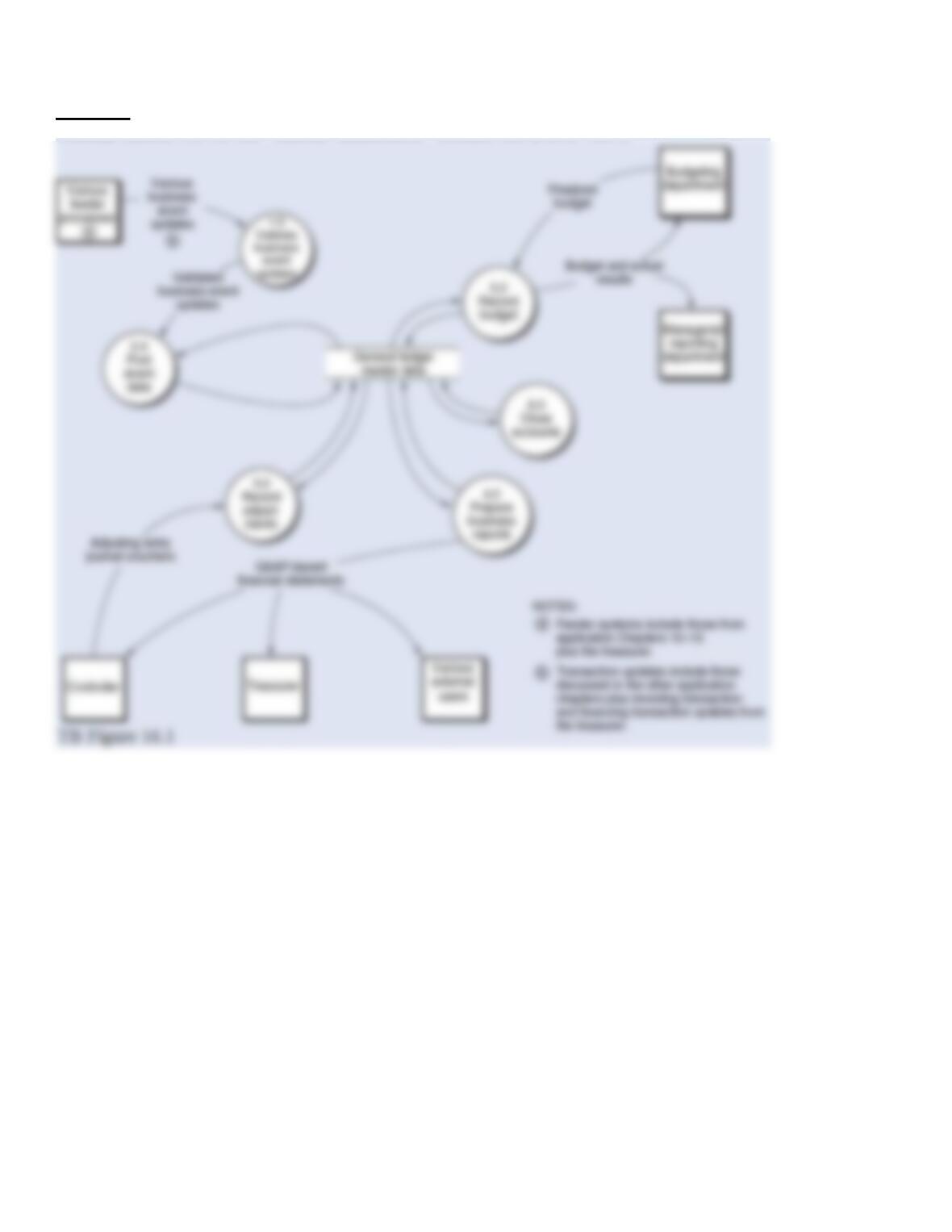
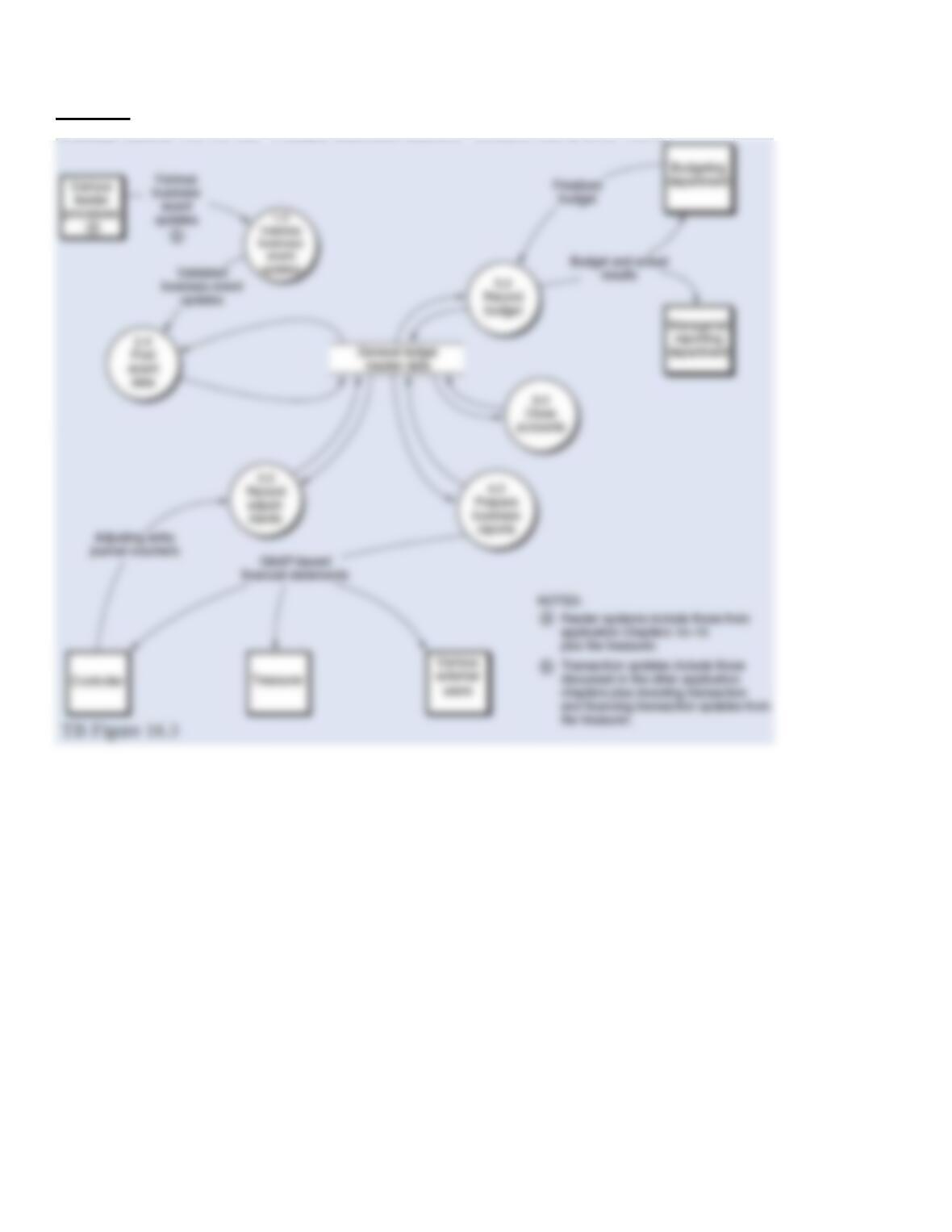
103. TB Figure 16.1 is a Level 0 DFD for the general ledger and financial reporting (GL/BR) process.
Required:
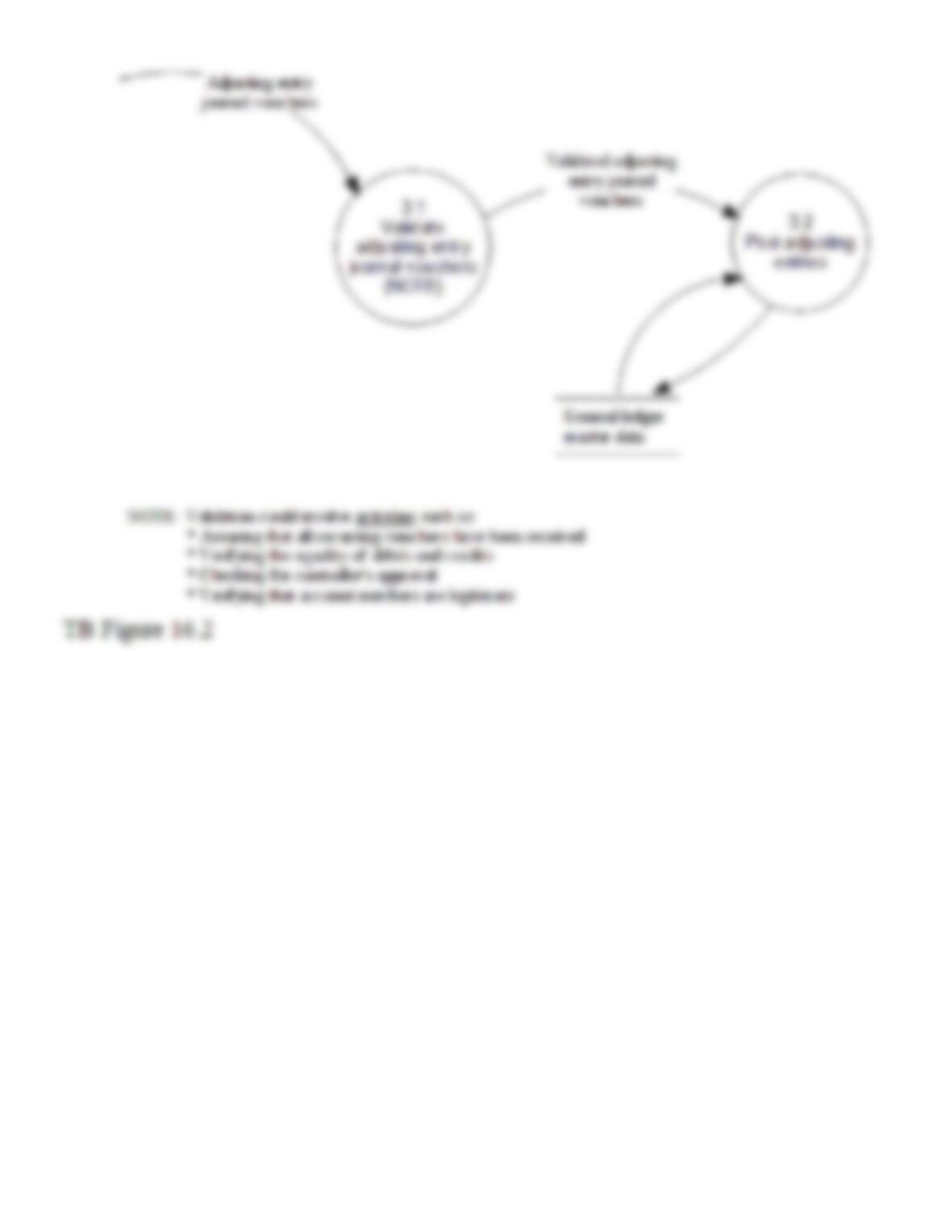
Explode bubble 3.0, for the “Record Adjustments” process into a level 1DFD
104. TB Figure 16.3 is a Level 0 DFD for the GL/BR process.
Required:
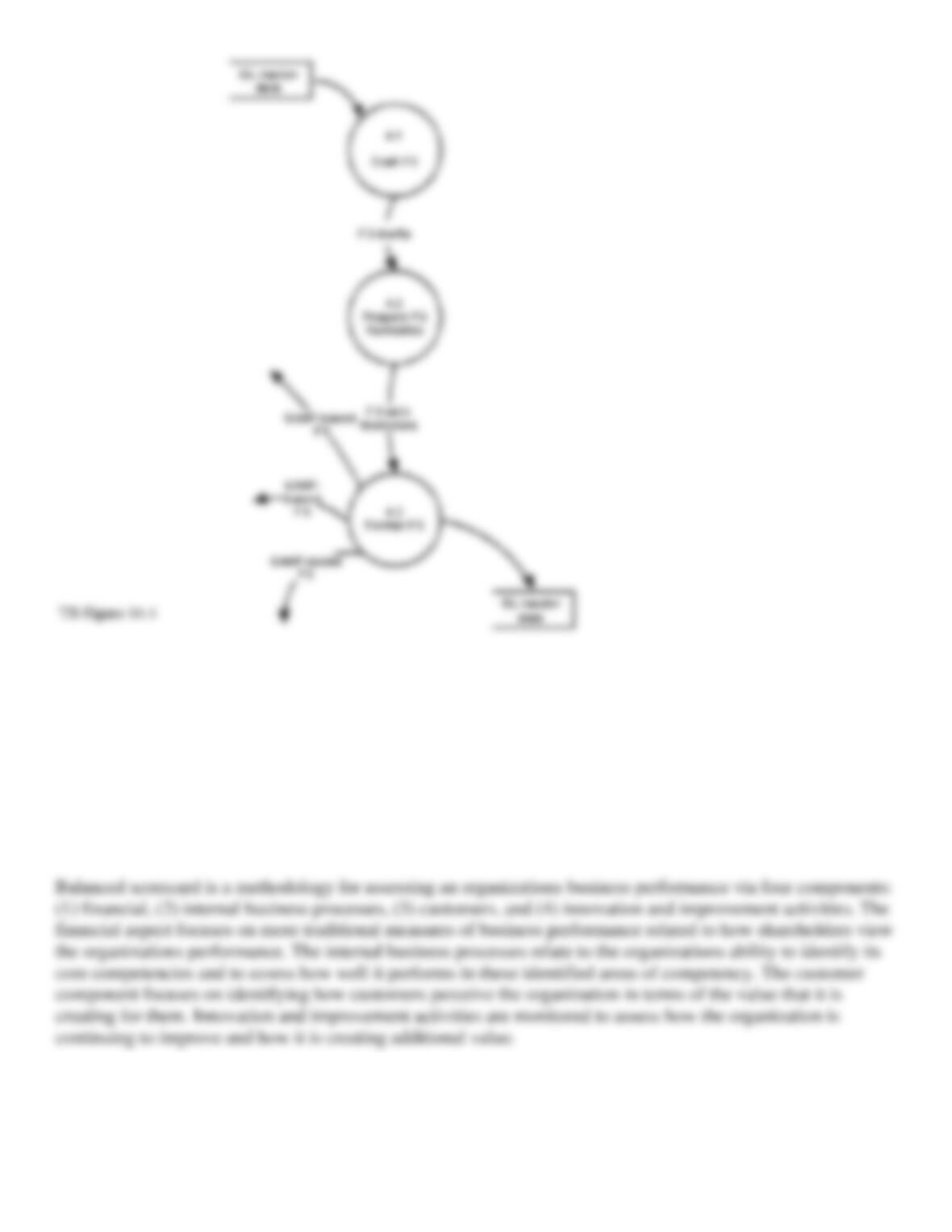
Explode bubble 4.0, for the “Prepare Business Reports” process into a level 1DFD
105. Discuss the following components of the balanced scorecard:
(1)
financial
(2)
internal business processes
(3)
customers
(4)
innovation and improvement activities
106. The important information services functions of the general ledger and business reporting (GL/BR) process
emphasized in chapter 16 included two categories: (1) general ledger activities and (2) other business reporting.
Briefly discuss what the general ledger (GL) process comprises and what comprises the business reporting
process.
107. Chapter 16 includes a discussion The Sarbanes Oxley Act of 2002. Describe the three sections of Sarbanes
Oxley that were discussed, and how these may impact financial reporting.