1. In essence, the terms “master budget” and “operating budget” mean the same thing and
can be used interchangeably.
2. Variances are the difference between actual results and budgeted results.
3. In general, and holding all other things constant, an unfavorable variance decreases
operating profits.
4. A favorable variance is not necessarily good, and an unfavorable variance is not
necessarily bad.
5. The terms “master budget” and “flexible budget” mean the same thing and can be used
interchangeably.
6. A flexible budget adjusts the static budget to reflect the actual activity level achieved
during the period.
7. If the budgeted activity level is greater than the actual activity level, then the total
budgeted costs of the master budget will be greater than the total budgeted costs of the flexible
budget.
8. The difference between operating profits in the master budget and operating profits in the
flexible budget is called a sales price variance.
9. The sales activity variance is the result of a difference between budgeted units sold and
actual units sold.
10. The sales price variance is the actual selling price per unit times the difference between
budgeted number of units and the actual number of units sold.
11. Production cost variances are input variances, while sales activity variances are output
variances.
12. The flexible and master budget amounts are the same for fixed marketing and
administrative costs.
13. The standard cost for a unit of output is the standard price per unit of input times the
standard number of inputs per one unit of output.
14. Both the actual material used and the standard quantity allowed for material is based on
the actual output attained.
15. It is possible to have a favorable direct material price variance and an unfavorable direct
material efficiency variance.
16. The materials price variance is computed by multiplying the difference between the actual
price and the standard price by the actual quantity of materials used in production.
17. The direct labor efficiency variance can be the result of poor supervision or poor
scheduling by divisional managers.
18. Variance analysis for fixed production costs is virtually the same as for variable production
costs.
19. The budget (or spending) variance for fixed production costs is the difference between the
actual fixed costs and the budgeted fixed costs on the master budget.
20. The production volume variance is the difference between fixed costs on the flexible
budget and the fixed costs on the master budget.
21. Which of the following statements is (are) true?
(A) A favorable variance is not necessarily good, and an unfavorable variance is not necessarily
bad.
(B) The master budget includes operating budgets (e.g., production budget) and financial budgets
(e.g., cash budget).
22. An operating budget would not include a:
23. A variance can best be described as:
24. The most fundamental variance analysis compares:
25. In general, the terms
favorable
and
unfavorable
are used to describe the effect of a
variance on:
26. Which of the following statements regarding variances is (are) false?
(A) In general and holding all other things constant, an unfavorable variance decreases operating
profits.
(B) A favorable variance is not always good, and an unfavorable variance is not always bad.
27. Which of the following variances will always be favorable when actual sales exceeds
budgeted sales?
28. The purpose of the flexible budget is to:
29. The basic difference between a master budget and a flexible budget is that a:
30. The slope of the flexible budget-line is the:
31. The intercept of the flexible budget-line is total:
32. When using a flexible budget, what will happen to variable costs on a per-unit basis as
production increases within the relevant range?
33. The difference between operating profits in the master budget and operating profits in the
flexible budget is called:
34. Which of the following statements is (are) true regarding the sales activity variance?
(A) The sales activity variance is the actual selling price per unit times the difference between the
budgeted units and actual units.
(B) If the sales activity variance for sales revenue is unfavorable, then the contribution margin
sales activity variance will be unfavorable.
35. The sales price variance is the difference between the actual sales revenues and the:
36. If the total materials variance for a given operation is favorable, why must this variance be
further evaluated as to price and usage?
37. Which department is customarily held responsible for an unfavorable materials quantity
variance?
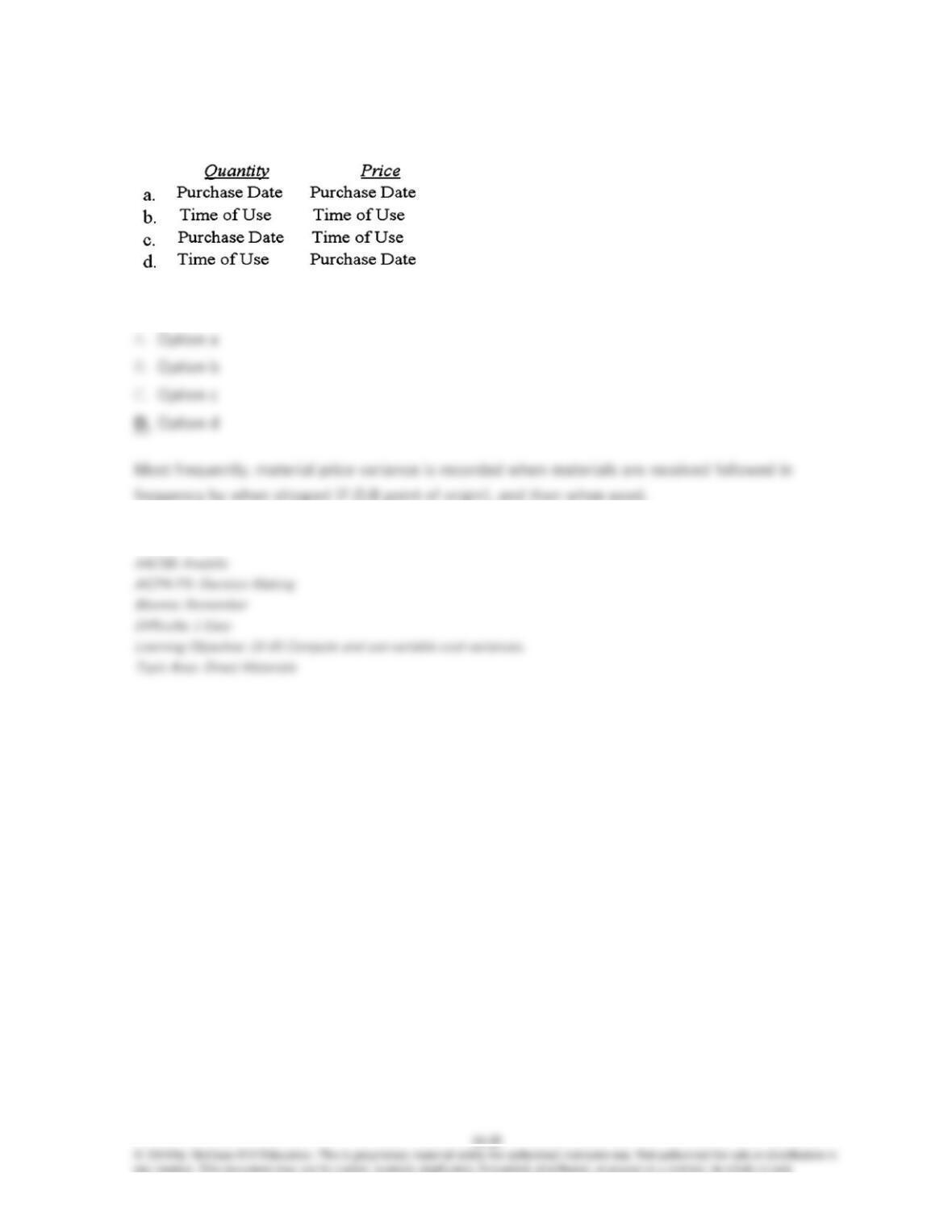
38. When are the following direct materials variances ideally reported?