Accounting, 9e (Horngren)
Chapter 16 Introduction to Management Accounting
Learning Objective 16-1
1) Managerial accounting’s focus is to provide information for internal planning and control.
2) Management accounting often requires forward-looking data because of the futuristic nature of many business
decisions.
3) Management accounting is influenced significantly by rules of GAAP and guidelines of the Securities Exchange
Commission.
4) Budget preparation is a part of the planning process.
5) Financial reporting is typically much more detailed than managerial accounting.
6) Which of the following is NOT an objective of management accounting?
A) To provide information to business managers to assist them in planning for their business
B) To provide information to business managers to assist them in controlling their business
C) To provide information to shareholders to assist them with their investment decisions
D) To assist business managers with respect to providing a return to the owners of the business
7) Which of the following statements is INCORRECT?
A) The primary users of management accounting are the company’s managers.
B) Management accounting information is used to help managers plan and control their operations.
C) Management accounting information does not require an external audit.
D) Management accounting information is required to comply with generally accepted accounting principles.
8) Which of the following statements is INCORRECT?
A) Managerial accounting is used to determine the cost of products and services.
B) Managerial accounting is used to plan and control business operations.
C) Managerial accounting is used to report the company’s financial position and results of operations to creditors
and investors.
D) Managerial accounting is used to prepare budgets.
9) Which of the following statements about financial accounting is CORRECT?
A) Financial accounting is oriented towards helping investors make decisions.
B) Financial accounting is forward-looking.
C) Financial accounting is focused on detailed reports on parts of the company.
D) Financial accounting is focused on planning and controlling operations.
10) Which of the following statements about managerial accounting is CORRECT?
A) Managerial accounting reports are audited annually by Certified Public Accountants.
B) Managerial accounting reports help investors make decisions.
C) Managerial accounting reports provide detailed information on parts of a company.
D) Managerial accounting reports must follow Generally Accepted Accounting principles (GAAP).
11) Management is accountable to its suppliers and vendors in which of the following ways?
A) Providing products to customers that are safe and free of defects
B) Repaying loans in a timely manner
C) Providing a return on the owner’s shareholders’ investment
D) Making timely payments and complying with contract terms
12) Management is accountable to its employees in which of the following ways?
A) Providing products that are safe and free of defects
B) Providing a safe workplace
C) Providing a return on the owner’s shareholders’ investment
D) Ensuring the business is environmentally responsible for impacts on the community
13) Management is accountable to various government bodies in which of the following ways?
A) Making timely payments to creditors
B) Making timely payments to vendors
C) Providing a return on the owner’s shareholders’ investment
D) Obeying laws and regulations, and paying taxes
14) Management is accountable to communities in which of the following ways?
A) Making timely payments to creditors
B) Ensuring the company’s environmental impact is not harmful to its area of operations
C) Providing a return on the owner’s shareholders’ investment
D) Obeying laws and paying taxes
15) Managerial accounting includes the planning function. Which of the following items would be part of the
planning function of a business’s managerial accounting?
A) Comparing actual performance to previously budgeted amounts
B) Creating detailed budgets
C) Implementing operational plans
D) Evaluating results of operations
16) Managerial accounting includes the controlling function. Which of the following items would be part of the
controlling function of a business’s managerial accounting?
A) Comparing actual performance to previously budgeted amounts
B) Creating detailed budgets
C) Devising marketing and production plans
D) Setting product prices
17) Managerial accounting is focused on which of the following objectives?
A) Providing information that managers need to make operational decisions
B) Providing historical data to investors and creditors
C) Providing summarized results of operations
D) Providing information to comply with laws and regulations of government bodies
18) Financial accounting is focused on which of the following objectives?
A) Providing information that managers need to make operational decisions
B) Providing summarized information on operational results to investors and creditors
C) Providing budgets for future periods
D) Providing highly detailed information on product lines, regions, divisions, etc.
19) Which of the following most accurately describes the term cost/benefit analysis?
A) Considering whether employees should be entitled to certain fringe benefits
B) Calculating the cost of holding fundraising benefits for charity
C) Considering whether the cost of products exceeds the market selling price
D) Considering whether the cost of calculating certain types of information provides a commensurate economic
benefit
Learning Objective 16-2
1) During the past century, many developed economies have shifted their focus from a service economy to a
manufacturing economy.
2) Increased global competition has resulted in many companies moving their operations to other countries to be
closer to new markets.
3) Which of the following is a philosophy of providing customers with superior products and services?
A) Just-in-time (JIT) inventory management
B) Enterprise resource planning (ERP)
C) Supply chain management
D) Total quality management
4) Which of the following describes a system in which suppliers deliver materials at the time they are needed and
finished units are completed when customer orders need to be filled?
A) Supply chain management
B) Just-in-time (JIT)
C) Enterprise resource planning
D) Total quality management
5) What is total quality management?
A) A philosophy of supplying customers with superior products and services
B) An exchange of information with suppliers and customers to create efficient and effective processes
C) A software system that integrates a company’s functions, departments and data into a single system
D) A system which speeds the transformation of raw materials into finished products.
6) What is the name given to software systems that can integrate all of a company’s worldwide functions,
departments and data into a single system?
A) Total quality management
B) Enterprise resource planning
C) E-Commerce
D) Just-in-time inventory management
7) Which of the following BEST describes just-in-time inventory management?
A) Production system that stores surplus goods at each stage of manufacture
B) Inventory purchasing process that gains purchase discounts by buying in large quantities
C) Production system that focuses on delivering materials and goods in exactly the right quantity when needed
D) Inventory system which stockpiles raw materials to protect against supply interruptions
8) Which of the following is NOT an advantage of just–in-time inventory management?
A) Surplus inventory is maintained to prevent production shut–down in case of supply interruption
B) Lower inventory levels reduce storage cost
C) Inventory kept for shorter periods of time reduces the amount of goods that become obsolete
D) Reduce the amount of insurance needed for lower levels of inventory
9) Which of the following is a management approach designed to set higher and higher goals in order to make
continuous improvement?
A) Supply chain management
B) Just-in-time (JIT)
C) Enterprise resource planning
D) Total quality management
10) Which of the following BEST describes the value chain?
A) A management information system which tracks the costs of products through the manufacturing process
B) The minimizing of inventory levels to reduce storage, insurance and finance costs
C) All activities that contribute to the continuous improvement of business operations
D) The whole sequence of activities that add value to the goods and services sold to end-users
Learning Objective 16-3
1) The IMA standards of ethical practice provide that accountants should continually develop their knowledge and
skills.
2) Maintaining confidentiality of company information is a key element of ethical professional practice.
3) The accountant for Spiral Supplies deliberately post-dated a check to pay for business expenses in order to record
a higher net income for the company. As long as the amount was not material, this would not be considered
unethical behavior.
4) The sales manager for Baker Products told the shipping department to ship an order to a customer on the last day
of December instead of the previously scheduled shipping date of January 2. This would allow the company to book
the sales revenue in the year just ended and boost year-end profit. Although done deliberately to boost income, the
action did not misrepresent any facts of the situation, and so it would not be considered unethical.
5) Baker products shipped an order to a customer on the second day of January. Later that day, the sales manager
told the accountant to record the sale as if it had taken place on the last day of December. This would allow the
company to book the sales revenue in the year just ended and boost year-end profit. Because the transaction was a
legitimate sale, the alteration of the date of sale alone would not be considered unethical.
6) Charleston Company was nearing year-end and the CEO wanted to report a high level of inventory on the balance
sheet. An order of raw materials was planned for early the next year, but the CEO asked the purchasing manager to
accelerate the shipment so that it would arrive before the end of the year. Because this action was taken
deliberately to affect the financial results of the company, it would be considered unethical.
7) Charleston Company was nearing year-end and the CEO wanted to report a high level of inventory on the balance
sheet. An order of raw materials was scheduled for delivery on January 2 of the next year, but the CEO asked the
accounting manager to record the shipment as being received on the last day of December. The shipment was
actually received on January 2nd, and although the dollar impact of the transaction was not affected in any way, the
misrepresentation of facts in the situation would make the behavior unethical.
8) Which of the following is NOT one of the key standards of ethical practice published by the IMA?
A) Competence
B) Environmental sensitivity
C) Integrity
D) Confidentiality
9) Which of the following events would NOT be considered unethical under IMA standards?
A) An inventory shipment was received on January 2, but was booked 3 days earlier in order to boost the year-end
inventory balance.
B) An accountant coded an expense to a fixed asset account so that the expense budget would not be overrun at
year-end.
C) A scheduled maintenance service originally planned for late December was delayed until the following year to
reduce expenses recorded in the year just ended.
D) A company shipped products to a customer on January 2, but recorded the transaction on the last day of
December to boost revenues in the year just ended.
10) Which of the following events would NOT be considered unethical under IMA standards?
A) An accountant told his friends about the bids his company had received from contractors for construction
contracts.
B) An accountant provided a list of his company’s foreign transactions to an investigative reporter who was working
on a story for the paper.
C) An accountant provided a list of his company’s qualified suppliers to a small businessman that wanted to set up a
similar business on his own.
D) An accountant provided a copy of his company’s published financial statements to a relative who owned a
business that was directly competing with the accountant’s company.
11) Which of the following events would NOT be considered unethical under IMA standards?
A) A bank hired a bookkeeper to review foreclosure documents who had no training or experience in the area.
B) An accountant was supposed to take continuing education courses but fell behind and was not current on
important new developments in his industry.
C) An accountant who had no background in internal control or finance was promoted to the position of controller.
D) An accountant who had just successfully completed an in-house training course in management accounting made
a large error in the year-end expense reports.
12) Your company is doing well and you tell your sister that the company will report earnings that are significantly
higher than the financial analysts’ estimated. Which IMA guideline has been violated?
A) Objectivity
B) Competence
C) Confidentiality
D) Integrity
13) You did not understand what the term accrual meant and failed to accrue the interest due at the end of the year
on the company’s bonds. Which IMA guideline has been violated?
A) Integrity
B) Confidentiality
C) Competence
D) Objectivity
Learning Objective 16-4
1) Product costs, such as direct materials, are expensed during the period that they were incurred.
2) A service company’s income statement does NOT include cost of goods sold.
3) Manufacturing businesses have inventory accounts, but service and merchandising businesses do not.
4) Both merchandising and manufacturing businesses produce their own products, but service businesses do not.
5) Which of the following is a characteristic of a service company?
A) It transforms raw materials into finished goods.
B) It makes a product.
C) It does not have tangible products intended for sale.
D) It has a single category of inventory.
6) Which of the following could be found on the income statement of a service company?
A) Rent expense
B) Cost of goods manufactured
C) Cost of goods sold
D) Manufacturing overhead
7) Which of the following is TRUE for a service company?
A) Expenses are all period costs.
B) Expenses are all product costs.
C) Income statement includes gross profit.
D) Balance sheet includes finished goods inventory.
8) Bainbridge Services reported the following information for the year 2012:
Service revenue $20,000
Operating expenses $15,750
Net income $4,250
Number of service calls for the year 21,000
How much was the unit cost per service call?
A) $0.95
B) $2.20
C) $0.75
D) $0.20
Learning Objective 16-5
1) Merchandising businesses resell goods which they purchase from a producer.
2) Which of the following applies to goods that are purchased from a producer and sold by a merchandising
company?
A) Materials inventory
B) Work in process inventory
C) Merchandise inventory
D) Finished goods inventory
3) Which of the following applies to goods that are produced by a manufacturing company and ready to sell?
A) Materials inventory
B) Work in process inventory
C) Merchandise inventory
D) Finished goods inventory
4) Which of the following applies to goods that are partially completed?
A) Materials inventory
B) Work in process inventory
C) Merchandise inventory
D) Finished goods inventory
5) Which of the following applies to the raw materials used by a manufacturing company?
A) Materials inventory
B) Work in process inventory
C) Merchandise inventory
D) Finished goods inventory
6) Which of the following is an inventory account for a merchandise company?
A) Work in process inventory
B) Manufacturing overhead inventory
C) Merchandise inventory
D) Finished goods inventory
7) The following information pertains to Bright Toy Company’s operating activities for 2012. The company sells
light box toys and sold 10,000 units in 2012.
Purchases
$126,000
Selling and Administrative Expenses
90,000
Merchandise inventory, 1/1/2012
14,000
Merchandise inventory, 12/31/2012
10,000
Sales Revenue
250,000
What is the cost of goods available for sale for 2012?
A) $140,000
B) $126,000
C) $104,000
D) $130,000
8) The following information pertains to Bright Toy Company’s operating activities for 2012. The company sells
light box toys and sold 10,000 units in 2012.
Purchases
$126,000
Selling and Administrative Expenses
90,000
Merchandise inventory, 1/1/2012
14,000
Merchandise inventory, 12/31/2012
10,000
Sales Revenue
250,000
What is the cost of goods sold for 2012?
A) $104,000
B) $124,000
C) $130,000
D) $140,000
9) The following information pertains to Bright Toy Company’s operating activities for 2012. The company sells
light box toys and sold 10,000 units in 2012.
Purchases
$126,000
Selling and Administrative Expenses
90,000
Merchandise inventory, 1/1/2012
14,000
Merchandise inventory, 12/31/2012
10,000
Sales Revenue
250,000
What is the gross profit for 2012?
A) $120,000
B) $130,000
C) $140,000
D) $136,000
10) The following information pertains to Bright Toy Company’s operating activities for 2012. The company sells
light box toys and sold 10,000 units in 2012.
Purchases
$126,000
Selling and Administrative Expenses
90,000
Merchandise inventory, 1/1/2012
14,000
Merchandise inventory, 12/31/2012
10,000
Sales Revenue
250,000
What is the operating income for 2012?
A) $250,000
B) $140,000
C) $30,000
D) $90,000
11) The following information pertains to Bright Toy Company’s operating activities for 2012. The company sells
light box toys and sold 10,000 units in 2012.
Purchases
$126,000
Selling and Administrative Expenses
90,000
Merchandise inventory, 1/1/2012
14,000
Merchandise inventory, 12/31/2012
10,000
Sales Revenue
250,000
What is the profit margin percentage?
A) 12%
B) 56%
C) 100%
D) 36%
12) The following information pertains to Bright Toy Company’s operating activities for 2012. The company sells
light box toys and sold 10,000 units in 2012.
Purchases
$126,000
Selling and Administrative Expenses
90,000
Merchandise inventory, 1/1/2012
14,000
Merchandise inventory, 12/31/2012
10,000
Sales Revenue
250,000
What is the gross profit percentage?
A) 48%
B) 56%
C) 36%
D) 100%
13) The following information pertains to Bright Toy Company’s operating activities for 2012. The company sells
light box toys and sold 10,000 units in 2012.
Purchases
$126,000
Selling and Administrative Expenses
90,000
Merchandise inventory, 1/1/2012
14,000
Merchandise inventory, 12/31/2012
10,000
Sales Revenue
250,000
What is the cost per unit sold?
A) $13.00
B) $12.40
C) $14.00
D) $10.40
14) Barrington Products is a merchandiser that sells a single type of specialized industrial chemical. Barrington
reported the following information for the year 2012:
Sales revenue $280,000
Cost of goods sold $126,000
Operating expenses $135,000
Net income $19,000
Number of units sold 90,000
How much was the unit cost per unit of product sold?
(Please round to nearest cent.)
A) $1.40
B) $1.71
C) $3.11
D) $0.21
19
15) Which of the following formulas represents cost of goods sold for a merchandising business?
A) Beginning inventory – ending inventory = cost of goods sold
B) Purchases and freight in – ending inventory = cost of goods sold
C) Ending inventory + purchases and freight in – beginning inventory = cost of goods sold
D) Beginning inventory + purchases and freight in – ending inventory = cost of goods sold
16) Excellent Company sells accounting textbooks. The following information summarizes Excellent’s operating
activities for 2012:
Merchandise inventory, January 1, 2012
$10,000
Merchandise inventory, December 31, 2012
$7,000
Purchases
$95,000
Selling and Administrative Expenses
$65,000
Sales Revenue
$180,000
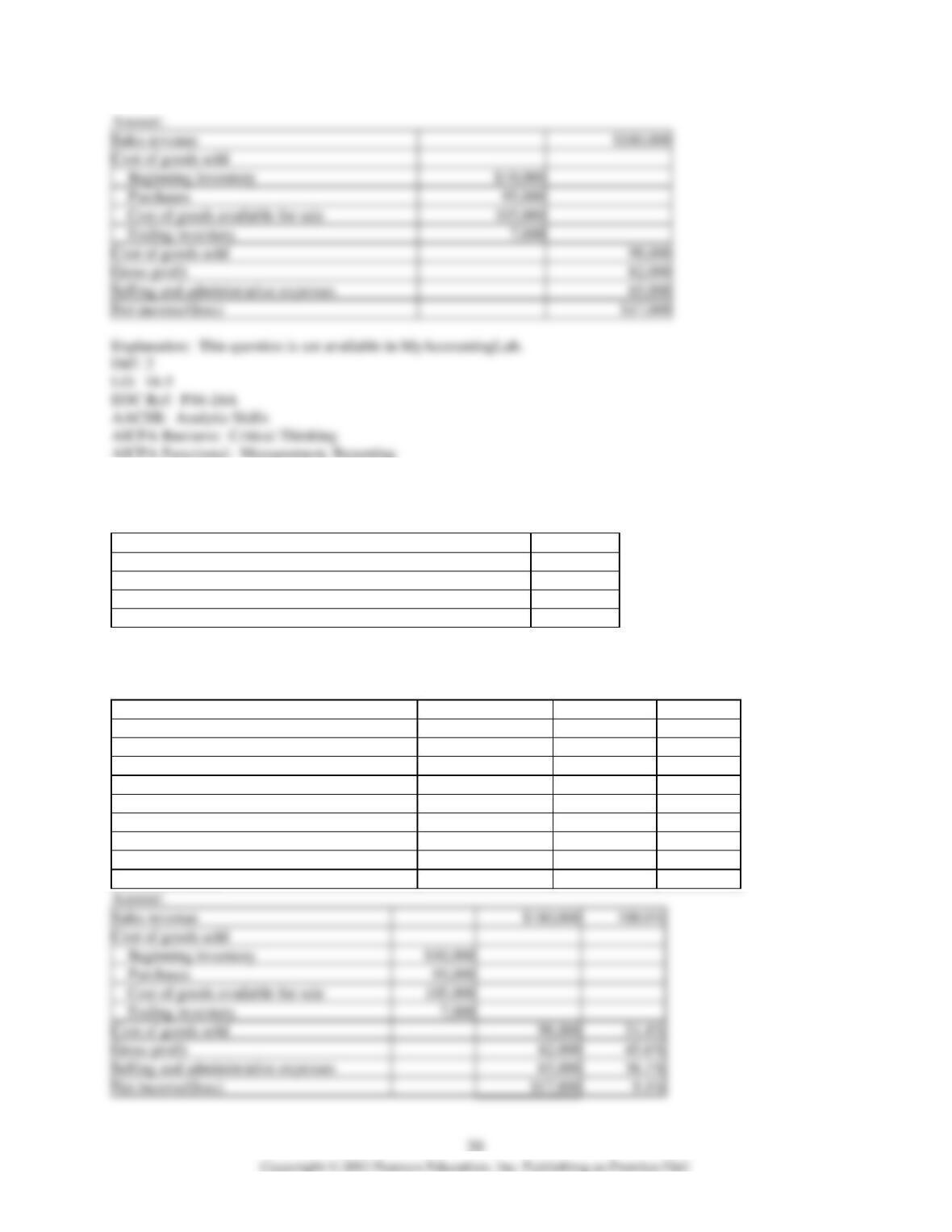
Required: Prepare an income statement for the year ended December 31, 2012. Please use the format provided
below:
Sales revenue
Cost of goods sold
Beginning inventory
Purchases
Cost of goods available for sale
Ending inventory
Cost of goods sold
Gross profit
Selling and administrative expenses
Net income/(loss)
Sales revenue
Beginning inventory
Purchases
Cost of goods available for sale
Ending inventory
Cost of goods sold
Gross profit
Selling and administrative expenses
Net income/(loss)
17) Excellent Company sells accounting textbooks. The following information summarizes Excellent’s operating
activities for 2012:
Merchandise inventory, January 1, 2012
$10,000
Merchandise inventory, December 31, 2012
$7,000
Purchases
$95,000
Selling and Administrative Expenses
$65,000
Sales Revenue
$180,000
Required: Prepare an income statement for the year ended December 31, 2012. Please use the format provided
below, and include a vertical analysis showing percentages rounded to the nearest tenth of a percent.
Sales revenue
Cost of goods sold
Beginning inventory
Purchases
Cost of goods available for sale
Ending inventory
Cost of goods sold
Gross profit
Selling and administrative expenses
Net income/(loss)
Sales revenue
Cost of goods sold
Beginning inventory
Purchases
Cost of goods available for sale
Ending inventory
Cost of goods sold
Gross profit