College Accounting, 14e (Slater)
Chapter 15 Accounting for Merchandise Inventory
15.1 Learning Objective 15-1
1) In a perpetual inventory system:
A) Merchandise Inventory is debited every time inventory is purchased.
B) Cost of Goods Sold is credited every time inventory is sold.
C) a physical inventory is never performed.
D) All of the above
2) Under the perpetual system, when merchandise is sold, the journal entry would include a:
A) debit to Merchandise Inventory; a credit to Accounts Payable or Cash.
B) debit to Cost of Goods Sold; a credit to Merchandise Inventory.
C) debit to Accounts Receivable or Cash and a credit to Sales.
D) Both B and C are correct.
3) The journal entry to record the purchase of inventory under the perpetual system includes:
A) a debit to Cost of Goods Sold and a credit to Merchandise Inventory.
B) a debit to Merchandise Inventory and a credit to Accounts Payable or Cash.
C) a debit to Accounts Receivable or Cash and a credit to Sales.
D) Both A and C are correct.
4) The journal entry to record a purchase of inventory on credit under the perpetual system includes:
A) a credit to Merchandise Inventory.
B) a debit to Cash.
C) a credit to Accounts Payable.
D) Both A and C are correct.
5) The journal entry to record the return of a purchase of inventory under the periodic system includes a:
A) debit to Sales.
B) credit to Purchases Returns and Allowances.
C) credit to Merchandise Inventory.
D) credit to Sales.
6) Which of the following would be used to record the payment for purchases under the periodic system?
A) Debit to Accounts Payable
B) Debit to Purchase Discounts
C) Credit to Accounts Payable
D) Debit to Cash
7) Which of the following accounts is used with a periodic inventory system?
A) Sales
B) Sales Discounts
C) Purchases Returns and Allowances
D) All of these answers are correct.
8) Under the perpetual inventory system, which of the following accounts is debited with a merchandise
purchase?
A) Sales
B) Purchases
C) Purchase Returns and Allowances
D) Merchandise Inventory
9) Sales Returns & Allowances is recorded on the:
A) Balance Sheet.
B) Statement of owner’s equity.
C) Income Statement.
D) None of these is correct.
10) Merchandise Inventory is recorded on the:
A) Balance Sheet.
B) Statement of owner’s equity.
C) Income Statement.
D) None of these is correct.
11) Under the perpetual inventory system, in addition to making the entry to record a return of goods
from a customer, a company would:
A) debit Merchandise Inventory and credit Cost of Goods Sold.
B) debit Cost of Goods Sold and credit Merchandise Inventory.
C) debit Sales and credit Cost of Goods Sold.
D) debit Purchases and credit Cost of Goods Sold.
12) A credit customer purchased $800 worth of items. Four days later, the customer returned $100 worth
of those items. The entry to record this under the perpetual inventory method would include:
A) a debit to Sales Returns and Allowances $100.
B) a credit to Merchandise Inventory at cost.
C) a debit to Cost of Goods Sold at cost.
D) a credit to Sales Returns and Allowances $100.
13) The perpetual inventory system is a system which:
A) updates inventory only at the end of each period.
B) uses only LIFO method.
C) needs a physical inventory taken.
D) Both A and B are correct.
14) The company returned $500 of damaged merchandise purchased on credit. The entry to record this
under the periodic inventory system is:
A) debit Cost of Goods Sold $500; credit Accounts Payable $500.
B) debit Merchandise Inventory $500; credit Accounts Payable $500.
C) debit Accounts Payable $500; credit Purchases Returns and Allowances $500.
D) debit Accounts Payable $500; credit Merchandise Inventory $500.
15) ______ accounts for merchandise inventory on a transaction–by-transaction basis.
A) A periodic inventory system
B) A perpetual inventory system
C) An inventory accounting system
D) Both A and B are correct.
16) Mack Industries uses the perpetual inventory system. What is the entry to record a $300 sale on
account to customer Jake Sanders, with a $100 cost of sale?
A) Debit Accounts Receivable for $300; credit Sales for $300; debit Cost of Goods Sold for $100; credit
Merchandise Inventory for $100.
B) Debit Accounts Receivable for $300; credit Sales for $100; debit Cost of Goods Sold for $300; credit
Merchandise Inventory for $100.
C) Debit Accounts Receivable for $300; credit Sales for $300.
D) Debit Sales for $300; credit Accounts Receivable for $300.
17) Mack Industries uses the periodic inventory system. What is the entry to record a $300 sale on account
to customer Jake Sanders, with a $100 cost of sale?
A) Debit Accounts Receivable for $300; credit Sales for $300; debit Cost of Goods Sold for $100; credit
Merchandise Inventory for $100.
B) Debit Accounts Receivable for $300; credit Sales for $100; debit Cost of Goods Sold for $300; credit
Merchandise Inventory for $100.
C) Debit Sales for $300; credit Accounts Receivable for $300.
D) Debit Accounts Receivable for $300; credit Sales for $300.
18) Mack Industries uses the perpetual inventory system. What is the entry to record a $450 merchandise
purchase on account from Nickel Corporation?
A) Debit Accounts Payable for $450; credit Sales for $450.
B) Debit Purchases for $450; credit Accounts Payable for $450.
C) Debit Purchases for $450; credit Merchandise Inventory for $450.
D) Debit Merchandise Inventory for $450; credit Accounts Payable for $450.
19) Mack Industries uses the periodic inventory system. What is the entry to record a $450 merchandise
purchase on account from Nickel Corporation?
A) Debit Accounts Payable for $450; credit Sales for $450.
B) Debit Purchases for $450; credit Accounts Payable for $450.
C) Debit Purchases for $450; credit Merchandise Inventory for $450.
D) Debit Merchandise Inventory for $450; credit Accounts Payable for $450.
20) Mack Industries uses the perpetual inventory system. What is the entry to record $250 of returned
merchandise, with a cost of $100, from customer Jake Sanders?
A) Debit Sales Returns & Allowances for $250; credit Accounts Receivable for $250.
B) Debit Sales Returns & Allowances for $250; credit Accounts Receivable for $250; debit Purchases for
$100; credit Purchase Returns & Allowances for $100.
C) Debit Sales Returns & Allowances for $250; credit Accounts Receivable for $250; debit Merchandise
Inventory for $100; credit Cost of Goods Sold for $100.
D) Debit Sales Returns & Allowances for $250; credit Cash for $100, credit Sales for $150.
21) Mack Industries uses the periodic inventory system. What is the entry to record $250 of returned
merchandise, with a cost of $100, from customer Jake Sanders?
A) Debit Sales Returns & Allowances for $250; credit Accounts Receivable for $250; debit Merchandise
Inventory for $100; credit Cost of Goods Sold for $100.
B) Debit Sales Returns & Allowances for $250; credit Accounts Receivable for $250; debit Purchases for
$100; credit Purchase Returns & Allowances for $100.
C) Debit Sales Returns & Allowances for $250; credit Cash for $100; credit Sales for $150.
D) Debit Sales Returns & Allowances for $250; credit Accounts Receivable for $250.
22) When using a periodic inventory system, a physical inventory is required.
23) In a perpetual inventory system, Merchandise Inventory is credited when recording the cost of a sale.
24) In a periodic inventory system, Purchases, Freight-In, and Purchases Returns and Allowances
accounts are used.
25) In a perpetual inventory system, Sales Returns and Allowances is credited when a sales return occurs.
26) When merchandise is sold, the periodic inventory system requires a debit to Cost of Goods Sold and a
credit to Merchandise Inventory.
27) Merchandise Inventory is a liability account.
28) Under a perpetual inventory system, inventory purchases are entered in the Merchandise Inventory
account at cost.
29) Under the ________ inventory system, cost of goods sold and the amount of merchandise inventory
on hand are updated at the end of the accounting period.
30) Under the perpetual or periodic inventory system, customer merchandise returns are recorded to
___________ and Accounts Receivable (or Cash).
31) Under the ________ inventory system, entries are made to the merchandise inventory or cost of goods
sold account during the year.
32) Under the _________ inventory system, every sale has a corresponding cost entry.
33) Under the periodic inventory method, purchases are debited to ________.
Given the following accounts:
[1] Cash
[2] Accounts receivable
[3] Merchandise inventory
[4] Supplies
[5] Accounts payable
[6] Sales
[7] Sales returns and allowances
[8] Sales discounts
[9] Cost of goods sold
[10] Purchases
[11] Purchase returns and allowances
[12] Purchase discounts
[13] Freight-in
Indicate the account(s) to be debited and credited to record the following transactions.
34) Purchased merchandise on credit; terms of 2/10, n/30. — Perpetual
Debit ________ Credit ________
35) Purchased merchandise on credit; terms of 2/10, n/30. — Periodic
Debit ________ Credit ________
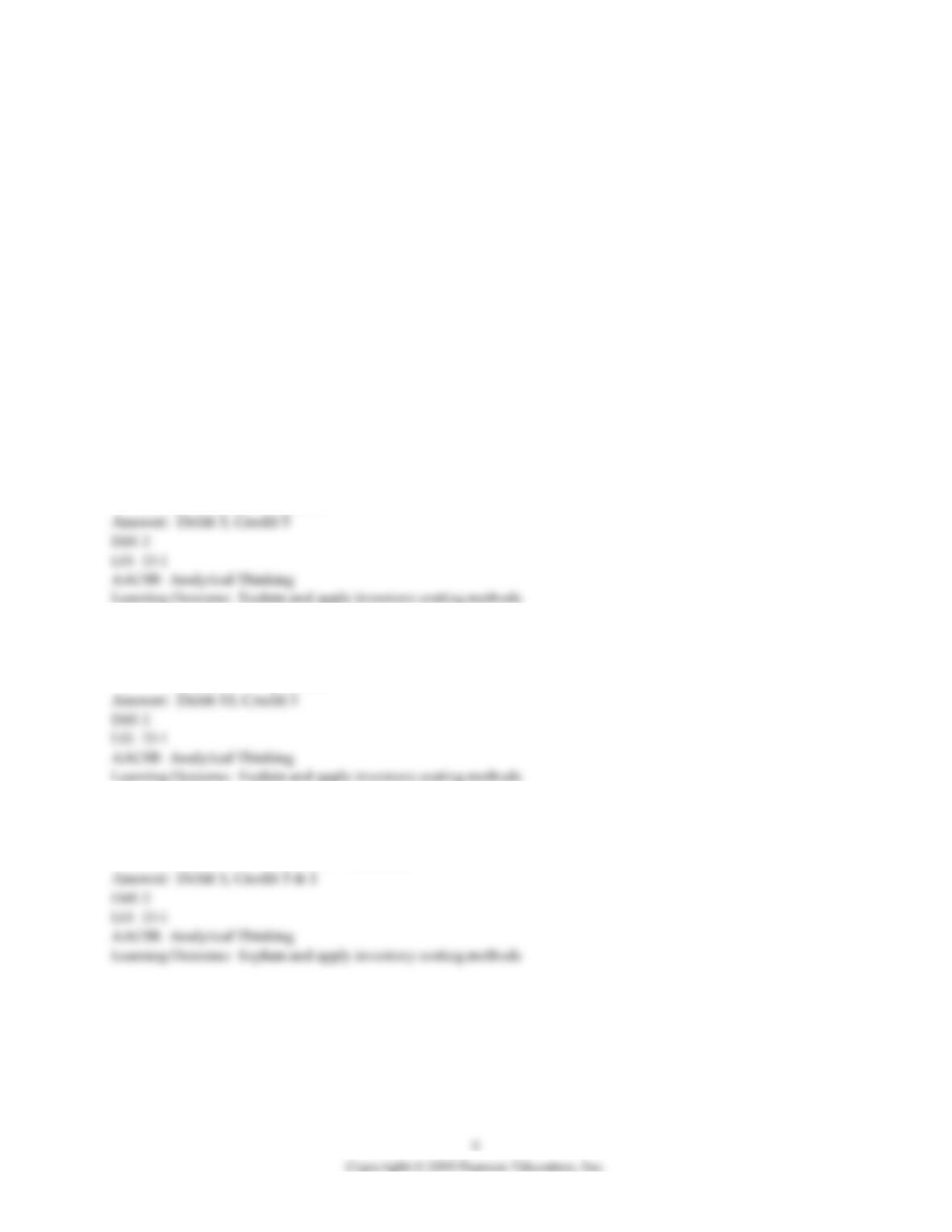
36) Paid for merchandise within the discount period. — Perpetual
Debit ________ Credit ________ & ________
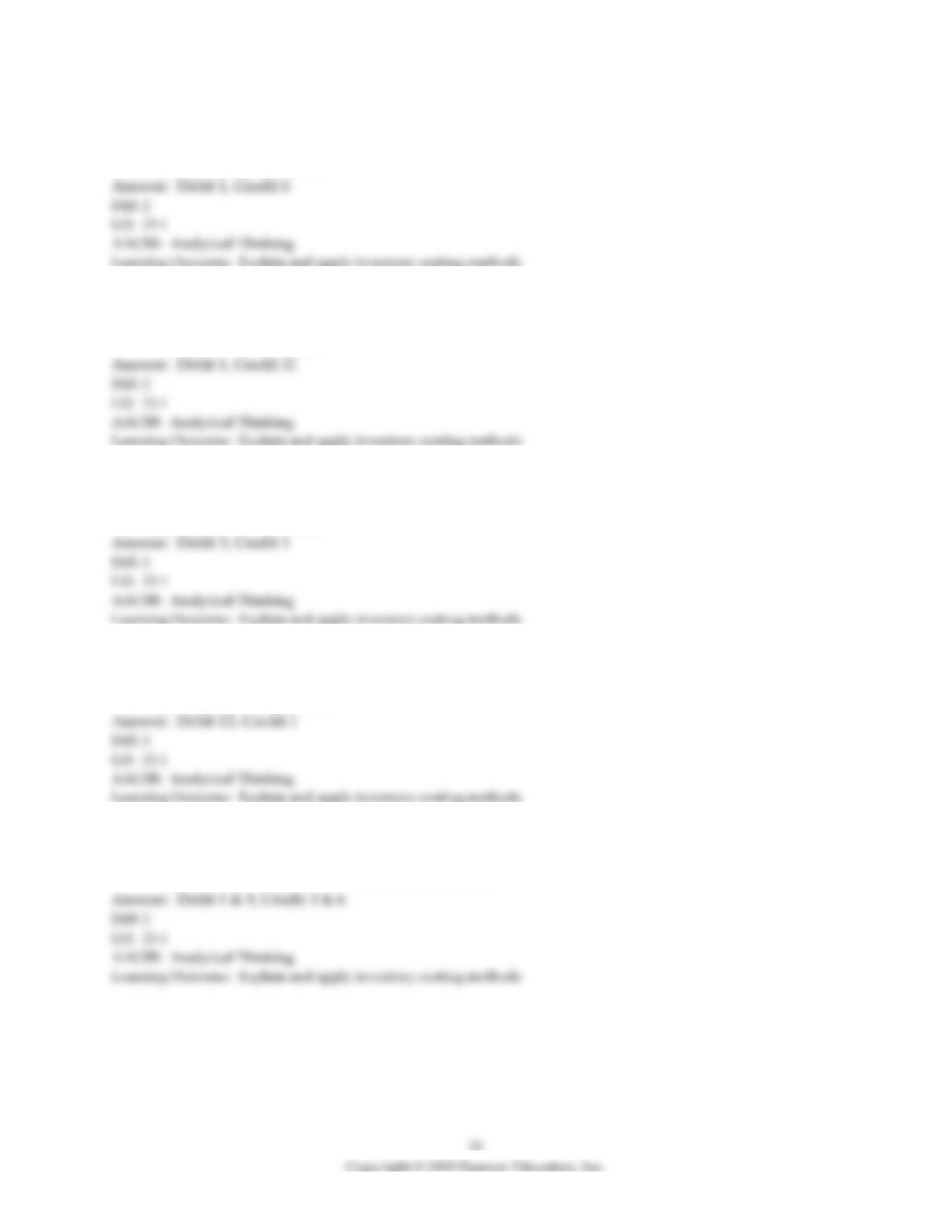
37) Sold merchandise in exchange for cash. — Periodic
Debit ________ Credit ________
38) Returned merchandise inventory for cash — Periodic
Debit ________ Credit ________
39) Paid for freight charges. — Perpetual
Debit ________ Credit ________
40) Paid for freight charges. — Periodic
Debit ________ Credit ________
41) Sold merchandise in exchange for cash. — Perpetual
Debit ________ & ________ Credit ________ & ________
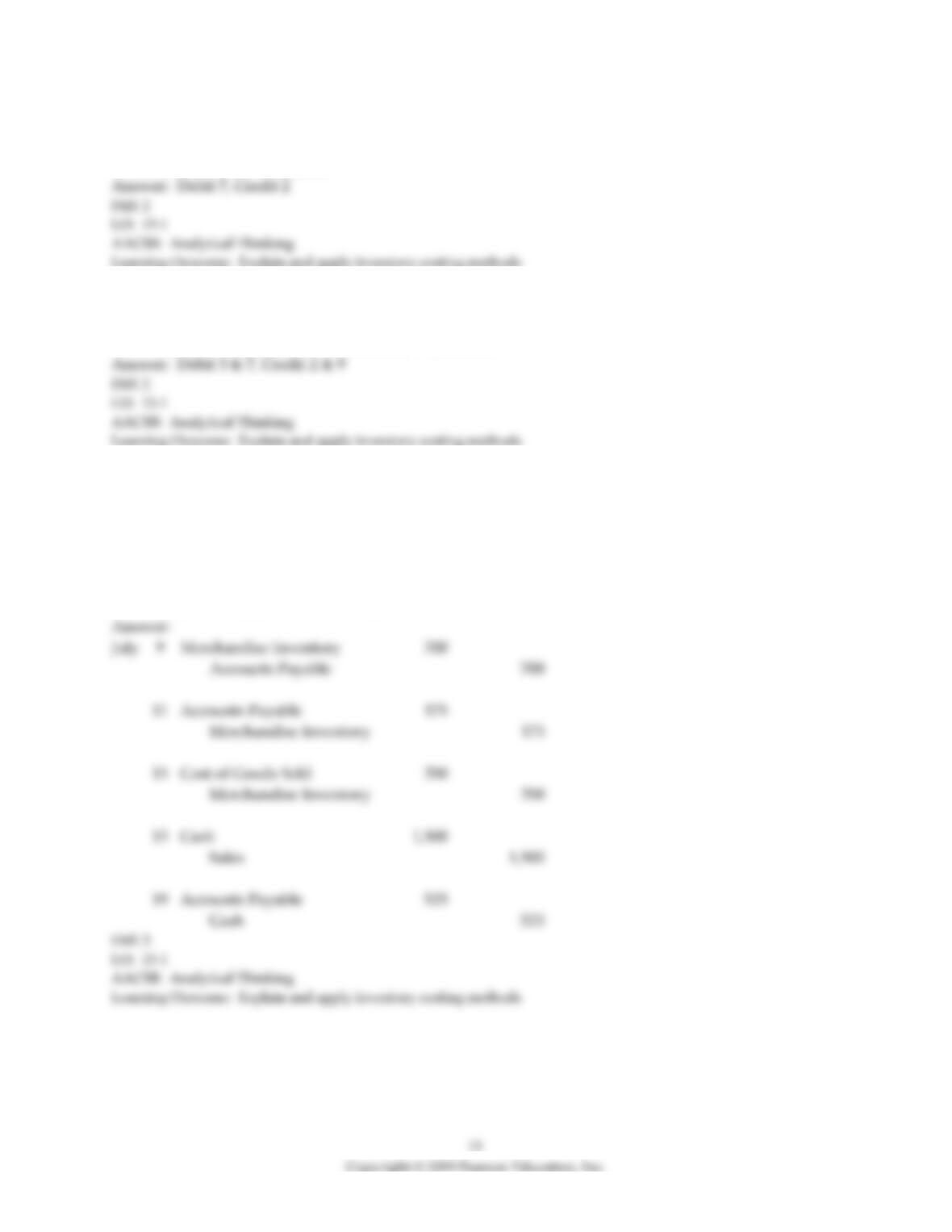
42) Customer returned goods purchased on credit — Periodic
Debit ________ Credit ________
43) Customer returned goods purchased on credit — Perpetual
Debit ________ & ________ Credit ________ & ________
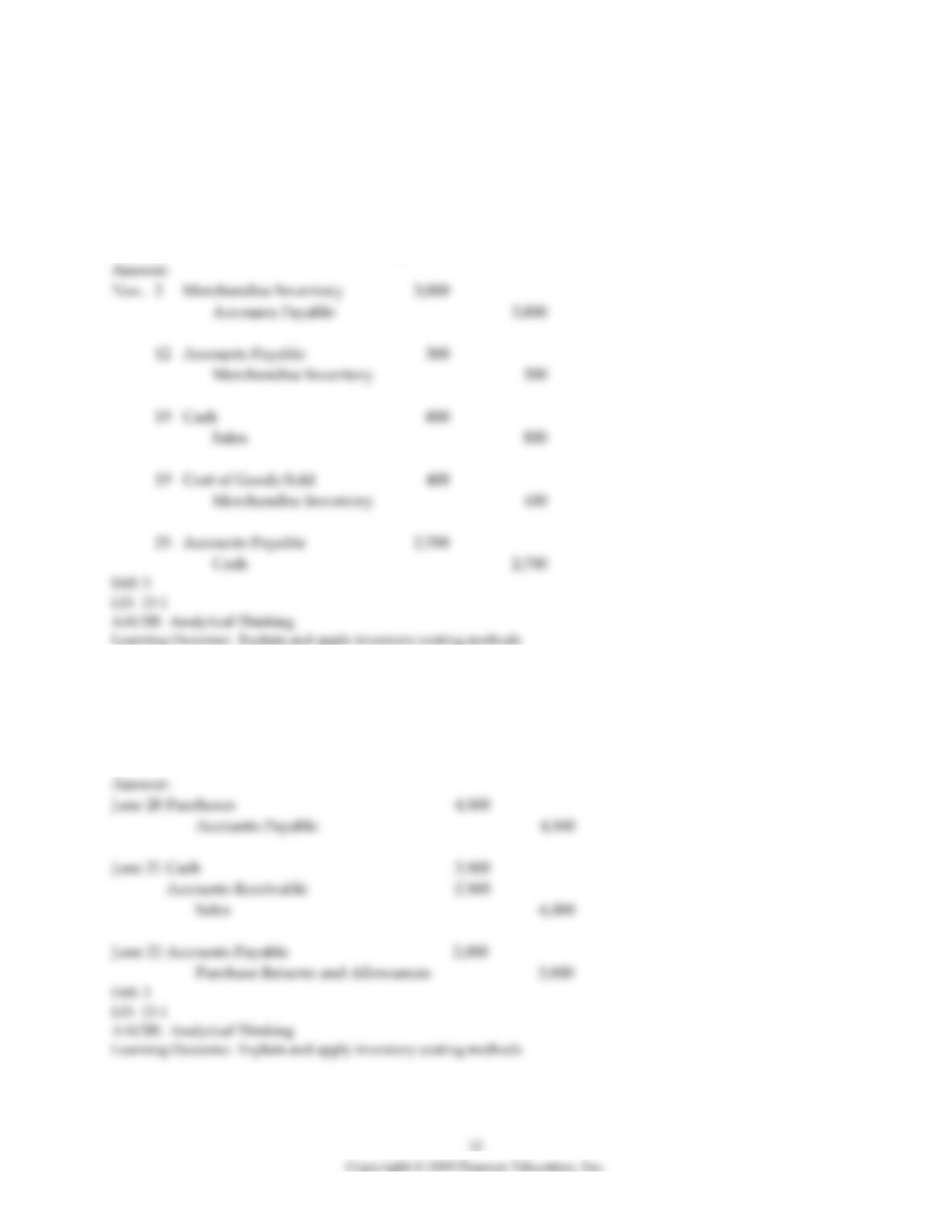
44) Prepare journal entries for the following transactions for Mark Machine Parts applying the perpetual
inventory system. Omit explanations.
July 9 Purchased on account 4 tires for $700.
11 Returned 1 tire for $175 credit.
15 Sold 2 tires for $1,500 cash, cost $350.
19 Paid the balance due on account.
45) Prepare journal entries for the following transactions for HO Train Shop applying the perpetual
inventory system. Omit explanations.
Nov. 2 Purchased on account 300 model engines for $3,000.
12 Returned 30 engines for full credit.
19 Sold 40 of the engines to R. Holmes for $800 cash.
25 Paid the balance due on the engines.
46) Journalize the following assuming periodic inventory.
June 20 Made purchases of inventory for $4,500 on account.
June 21 Made sales of $3,500 cash and $2,500 credit.
June 22 Returned $2,000 of purchases for defects.
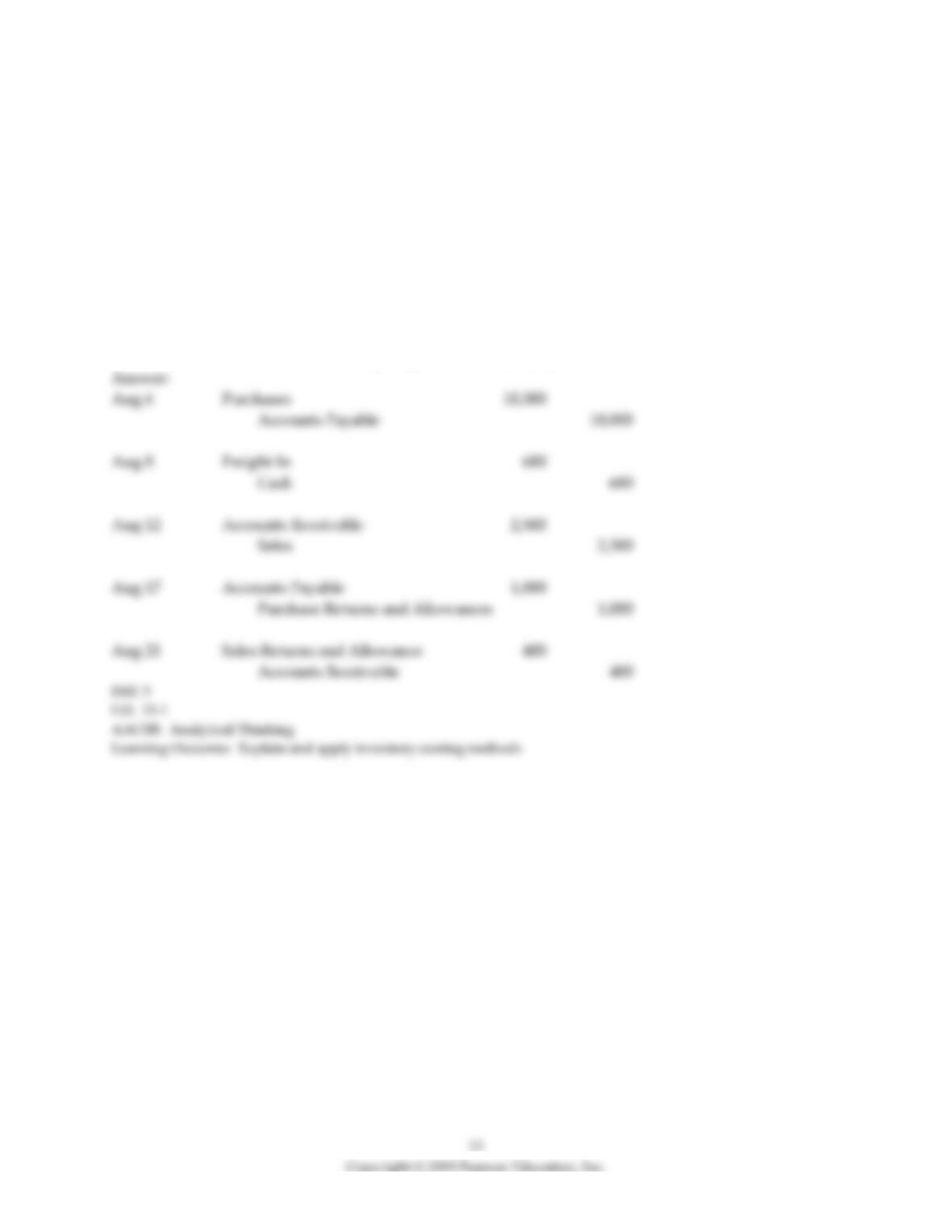
47) The following transactions took place during August of the current year for Roadhouse School
Supplies.
August 6 Purchased merchandise on account from Abe’s Papermill for $10,000.
August 8 Paid freight charges of $600 on merchandise purchased on the 6th.
August 12 Sold merchandise on account to Johnson Elementary for $2,500.
The cost of the merchandise was $500.
August 17 Received a credit memo from Abe’s Papermill for merchandise returned, $1,000
August 21 Issued a credit memo to Johnson Elementary for merchandise returned, $400.
The cost of the merchandise is $150.
Journalize the above transactions using the periodic inventory system.
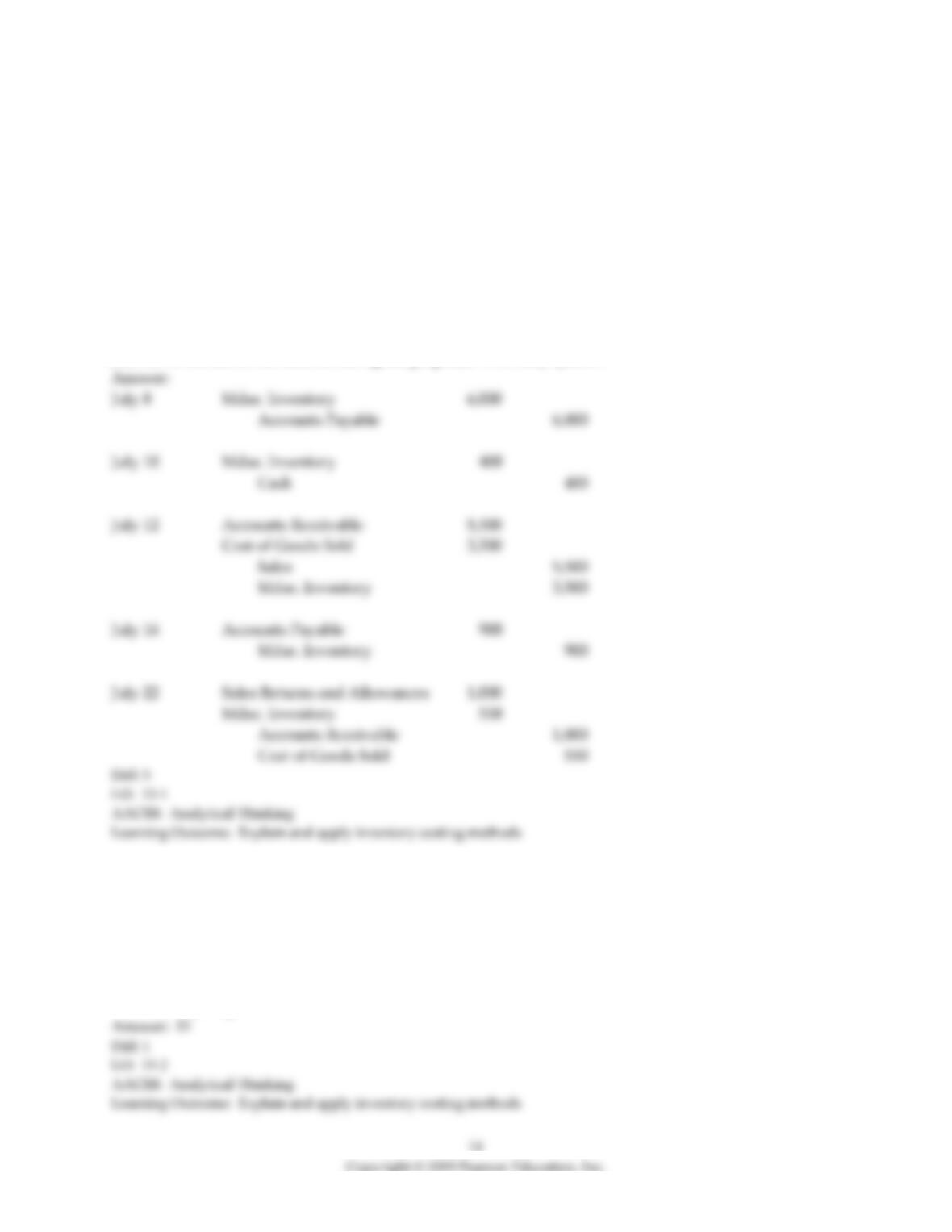
48) Joe owns an auto parts store called Joe’s Auto Care. The following transactions took place during July
of the current year.
July 8 Purchased merchandise on account from Wheeler Auto for $6,000
July 10 Paid freight charges of $400 on merchandise purchases on the 8th.
July 12 Sold merchandise on account to Lancaster Auto Sales for $5,500.
The cost of the merchandise was $3,500
July 16 Received a credit memo from Wheeler for merchandise returned, $900
July 22 Issued a credit memo to Lancaster Auto Sales for merchandise returned, $1,000.
The cost of the merchandise is $550.
Journalize the above transactions using the perpetual inventory system.
15.2 Learning Objective 15-2
1) Individual inventory items are tracked in the:
A) accounts receivable ledger.
B) purchases journal
C) accounts payable ledger.
D) inventory ledger.
2) When there is more than one product in inventory:
A) only one inventory record is used to track both inventory items.
B) a new inventory record tracks each individual product.
C) the inventory ledger is not updated.
D) the Accounts Payable will be less than the subsidiary ledger.
3) A purchases journal may be used to track inventory.
4) An inventory ledger is not used to track details of quantities and costs.
15.3 Learning Objective 15-3
1) The weighted-average method:
A) calculates an average unit cost by dividing the total cost of goods sold by the total units sold.
B) calculates an average unit cost by dividing the total cost of goods available for sale by the total units of
goods available for sale.
C) calculates an average unit cost by adding the total cost of goods available for sale to the total units of
goods available for sale.
D) None of these answers is correct.
2) A disadvantage of the LIFO method is that:
A) it doesn’t match physical flow of goods.
B) ending inventory is valued at very old costs.
C) it matches current selling prices and current costs.
D) Both A and B are correct.
3) This method assumes that the oldest goods are sold first.
A) LIFO
B) FIFO
C) Specific invoice method
D) Weighted-average method
4) The inventory method where the flow of goods and flow of costs are the same is:
A) LIFO.
B) specific invoice.
C) weighted-average.
D) FIFO.
5) The inventory method that matches most recently acquired costs with current selling prices is:
A) LIFO.
B) FIFO.
C) weighted-average.
D) specific invoice.
6) An advantage of the weighted-average method is that:
A) it assigns an equal cost to each unit so net income does not fluctuate as much as with other methods.
B) it takes into account the number of units purchased at each amount, not a simple average cost.
C) it matches current selling prices and current costs.
D) Both A and B are correct.
7) A disadvantage of the FIFO method is that:
A) recent sales are not matched with recent costs.
B) the cost flow tends to follow the physical flow.
C) the figure for ending inventory is made up of current costs on the income statement.
D) None of the above is correct.
8) The inventory method that assumes the recent goods are sold first is:
A) LIFO.
B) FIFO.
C) weighted-average.
D) specific invoice.
9) A disadvantage of the weighted-average method is that:
A) current prices have no more significance than prices of goods bought a month earlier.
B) net income will not fluctuate as much as with other methods.
C) it takes into account the number of units purchased at each amount, not a simple average cost.
D) All of the above is correct.
10) An advantage of the specific invoice method is that:
A) costs are matched with the sales they helped to produce.
B) it is simple to use if company has small amounts of high-cost goods.
C) flow of goods and flow of costs are the same.
D) All of the above is correct.
11) The principle of consistency states that:
A) changes in accounting methods should occur from one fiscal period to the next.
B) a company cannot change from one inventory valuation method to another.
C) a company should switch from LIFO to FIFO every other period.
D) by using the same inventory method from one fiscal period to another, the financial statements are
more meaningful.
12) The full disclosure principle says that if a change is made to the inventory valuation method, the
company should:
A) disclose the change.
B) show the effects of the change on profit and inventory valuation.
C) show justification for the change in a footnote on the financial reports.
D) All of these answers are correct.
13) An advantage of the FIFO method is that:
A) the figure for ending inventory is made up of current costs on the income statement.
B) the cost flow tends to follow the physical flow.
C) it matches current selling prices and current costs.
D) Both A and B are correct.
14) Which of the following items should NOT be included in merchandise inventory?
A) Goods that are damaged or obsolete
B) Goods that have been consigned to another company
C) Goods in transit shipped to another company FOB destination
D) All of the above
15) Barry’s Books uses a periodic inventory system. Barry’s Books sold 40 copies of Helpful Hints during
September. Other data for September include:
Sep. 1 Balance 10 books @ $20
8 Purchased 15 books @ $24
17 Purchased 20 books @ $28
25 Purchased 20 books @ $25
Ending inventory under the FIFO method is:
A) $500.
B) $560.
C) $640.
D) $625.
16) Barry’s Books uses a periodic inventory system. Barry’s Books sold 40 copies of Helpful Hints during
September. Other data for September include:
Sep. 1 Balance 10 books @ $18
8 Purchased 15 books @ $25
17 Purchased 20 books @ $28
25 Purchased 20 books @ $23
Cost of goods sold under the FIFO method is:
A) $720.
B) $975.
C) $1,575.
D) some other number.