
Chapter 15: Capital Investment Analysis
The management of London Corporation is considering the purchase of a new machine costing
$750,000. The company’s desired rate of return is 6%. The present value factors for $1 at
compound interest of 6% for 1 through 5 years are 0.943, 0.890, 0.840, 0.792, and 0.747,
respectively. In addition to this information, use the following data in determining the
acceptability in this situation:
Year
Income from Operations
Net Cash Flow
1
$37,500
$187,500
2
37,500
187,500
3
37,500
187,500
4
37,500
187,500
5
37,500
187,500
71. The cash payback period for this investment is:
a. 3 years.
b. 5 years.
c. 20 years.
d. 4 years.
72. The average rate of return for this investment is:
a. 5%.
b. 10%.
c. 25%.
d. 15%.
73. The net present value for this investment is:
a. positive $39,750.
b. positive $118,145.
c. negative $118,145.
d. negative $39,750.
74. The present value index for this investment is:
a. 1.00.
b. 0.95.
c. 1.25.
d. 1.05.

Chapter 15: Capital Investment Analysis
75. Which of the following is a present value method of analyzing capital investment proposals?
a. Average rate of return
b. Cash payback method
c. Accounting rate of return
d. Internal rate of return
76. The expected average rate of return for a proposed investment of $900,000 in a fixed asset,
with a useful life of five years, recognition is given to the effect of straight-line depreciation
on the investment, no residual value, and an expected total net income of $360,000 for the 5
years, is:
a. 18.5%.
b. 40%.
c. 12.5%.
d. 16%.
77. The amount of the average investment for a proposed investment of $70,000 in a fixed asset,
with a useful life of four years, recognition is given to the effect of straight-line depreciation
on the investment, no residual value, and an expected total net income of $21,600 for the 4
years, is:
a. $10,800.
b. $21,600.
c. $35,000.
d. $30,000.
78. The amount of the estimated average income for a proposed investment of $60,000 in a fixed
asset, giving effect to depreciation (straight-line method), with a useful life of four years, no
residual value, and an expected total income yield of $22,300, is:
a. $10,800.
b. $5,575.
c. $5,400.
d. $15,000.

Chapter 15: Capital Investment Analysis
79. Assuming that the desired rate of return is 6%, determine the present value of $10,000 to be
received in one year, using the following partial table of present value of $1 at compound
interest.
Year
6%
10%
12%
1
0.943
0.909
0.893
2
0.890
0.826
0.797
3
0.840
0.751
0.712
4
0.792
0.683
0.636
a. $9,430
b. $9,000
c. $9,090
d. $8,930
80. Using the following partial table of present value of $1 at compound interest, determine the
present value of $35,000 to be received three years hence, with earnings at the rate of 10% a
year.
Year
6%
10%
12%
1
0.943
0.909
0.893
2
0.890
0.826
0.797
3
0.840
0.751
0.712
4
0.792
0.683
0.636
a. $26,285
b. $29,400
c. $24,920
d. $23,905
a
81. Using the following partial table of present value of $1 at compound interest, determine the
present value of $20,000 to be received three years hence, with earnings at the rate of 10% a
year.
Year
6%
10%
12%
1
0.943
0.909
0.893
2
0.890
0.826
0.797
3
0.840
0.751
0.712
4
0.792
0.683
0.636
a. $14,240
b. $16,800
c. $15,020
d. $15,840

Chapter 15: Capital Investment Analysis
82. If the rate of earnings is 12% and the cash to be received in two years is $20,000, determine
the present value amount, using the following partial table of present value of $1 at compound
interest.
Year
6%
10%
12%
1
0.943
0.909
0.893
2
0.890
0.826
0.797
3
0.840
0.751
0.712
4
0.792
0.683
0.636
a. $16,520
b. $15,940
c. $14,240
d. $17,860
83. All of the following qualitative considerations may impact upon capital investments analysis
except:
a. manufacturing productivity.
b. manufacturing sunk cost.
c. manufacturing flexibility.
d. manufacturing control.
84. Which of the following is a qualitative consideration that influences capital investments
analysis?
a. Time value of money
b. Internal rate of return
c. Changes in price level
d. Manufacturing flexibility
85. Which of the following is a factor that complicates capital investment analysis?
a. Equal proposal lives
b. Certainty of estimates of revenues, expenses, and cash flows
c. Sunk cost
d. Leasing alternative

Chapter 15: Capital Investment Analysis
86. Which of the following provisions of the Internal Revenue Code can be used to reduce the
amount of the income tax expense arising from capital investment projects?
a. Interest deduction
b. Depreciation deduction
c. Minimum tax provision
d. Charitable contributions
87. Assume in analyzing alternative proposals that Proposal F has a useful life of six years and
Proposal J has a useful life of nine years. What is one widely used method that makes the
proposals comparable?
a. Adjust the life of Proposal F to a time period that is equal to that of Proposal J and add its
estimated residual value to the cash inflow at the end of year nine.
b. Adjust the life of Proposal J to a time period that is equal to that of Proposal F and add its
estimated residual value to the cash inflow at the end of year six.
c. Adjust the life of Proposal F and Proposal J to a time period equal to the average of six and
nine years (7.5 years) and add its estimated residual value to the cash inflow at the end of
operating life.
d. Adjust the life of Proposal J to a time period that is equal to that of Proposal F and deduct
last three years cash inflow of Proposal J from its total cash inflow.
88. Periods experiencing increase in price levels are known as periods of:
a. inflation.
b. recession.
c. depression.
d. deflation.
89. The process by which management allocates available investment funds among competing
investment proposals is called:
a. investment capital management.
b. capital budgeting.
c. cost-volume-profit analysis.
d. capital rationing.

Chapter 15: Capital Investment Analysis
90. In capital rationing, an initial screening of alternative proposals is usually performed by
establishing minimum standards. Which of the following evaluation methods are normally
used?
a. Cash payback method and average rate of return method
b. Average rate of return method and net present value method
c. Net present value method and cash payback method
d. Internal rate of return and net present value methods
91. In capital rationing, alternative proposals that survive initial screening and further analysis
using present value methods are normally evaluated in terms of:
a. net income.
b. qualitative factors.
c. maximum cost.
d. net cash flow.
92. Mars Corp. is choosing between two different capital investment proposals. Machine A has a
useful life of 4 years, and Machine B has a useful life of 6 years. Each proposal requires an
initial investment of $200,000, and the company desires a rate of return of 10%. Although
Machine B has a useful life of 6 years, it could be sold at the end of 4 years for $35,000.
Year
Present Value of
$1 at 10%
1
0.909
2
0.826
3
0.751
4
0.683
5
0.621
6
0.513
Machine A will generate net cash flow of $70,000 in each of the four years. Machine B will
generate $80,000 in year 1, $70,000 in year 2, $60,000 in year 3, and $40,000 per year for the
remaining 3 years of its useful life.
Which of the following statements portrays the most accurate analysis between the two
proposals?
a. Mars should invest in Machine A because the net present value of Machine A after 4 years
is higher than the net present value of Machine B after 4 years.
b. Mars should invest in Machine B because the net present value of Machine A after 4 years
is lower and the net present value of Machine B after 6 years.
c. Mars should invest in Machine B because the net present value of Machine A after 4 years
is lower than the net present value of Machine B after 4 years.
d. Mars should invest in Machine A because the net present value of Machine A after 4 years
is higher than the net present value of Machine B after 6 years.
Chapter 15: Capital Investment Analysis
93. One issue to consider when investing in assets in foreign countries is:
a. that local currency may weaken to the dollar causing adverse effects on the investment’s
return.
b. that the dollar may weaken to the local currency causing adverse effects on the investment’s
return.
c. that local currency may be difficult to exchange into dollars causing problems in receiving a
return on the investment.
d. that dollars may be difficult to exchange into local currency causing problems in receiving
any return on investment.
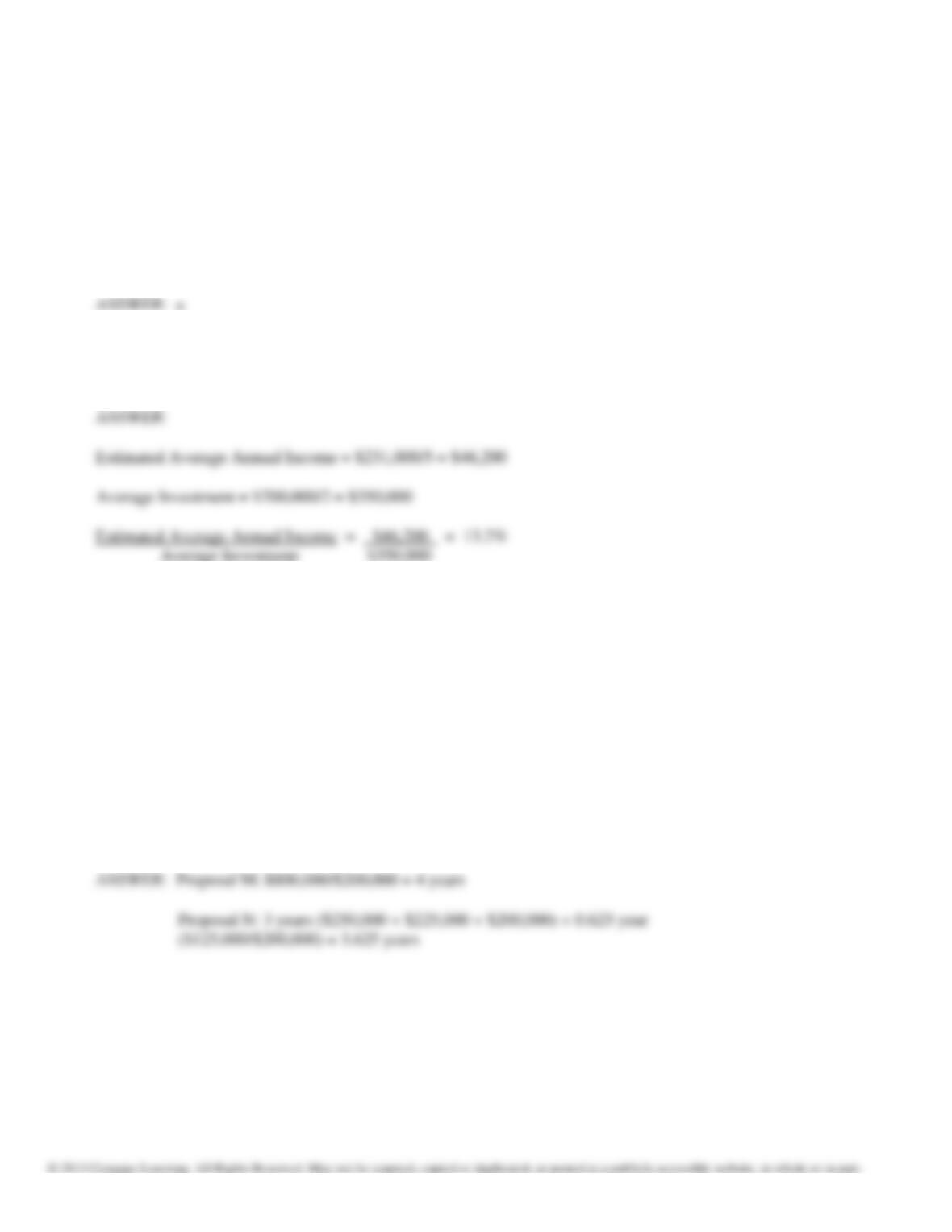
94. A 5-year project is estimated to cost $700,000 and have no residual value. If the straight-line
depreciation method is used and estimated total income is $231,000, determine the average
rate of return giving effect to depreciation on the investment.
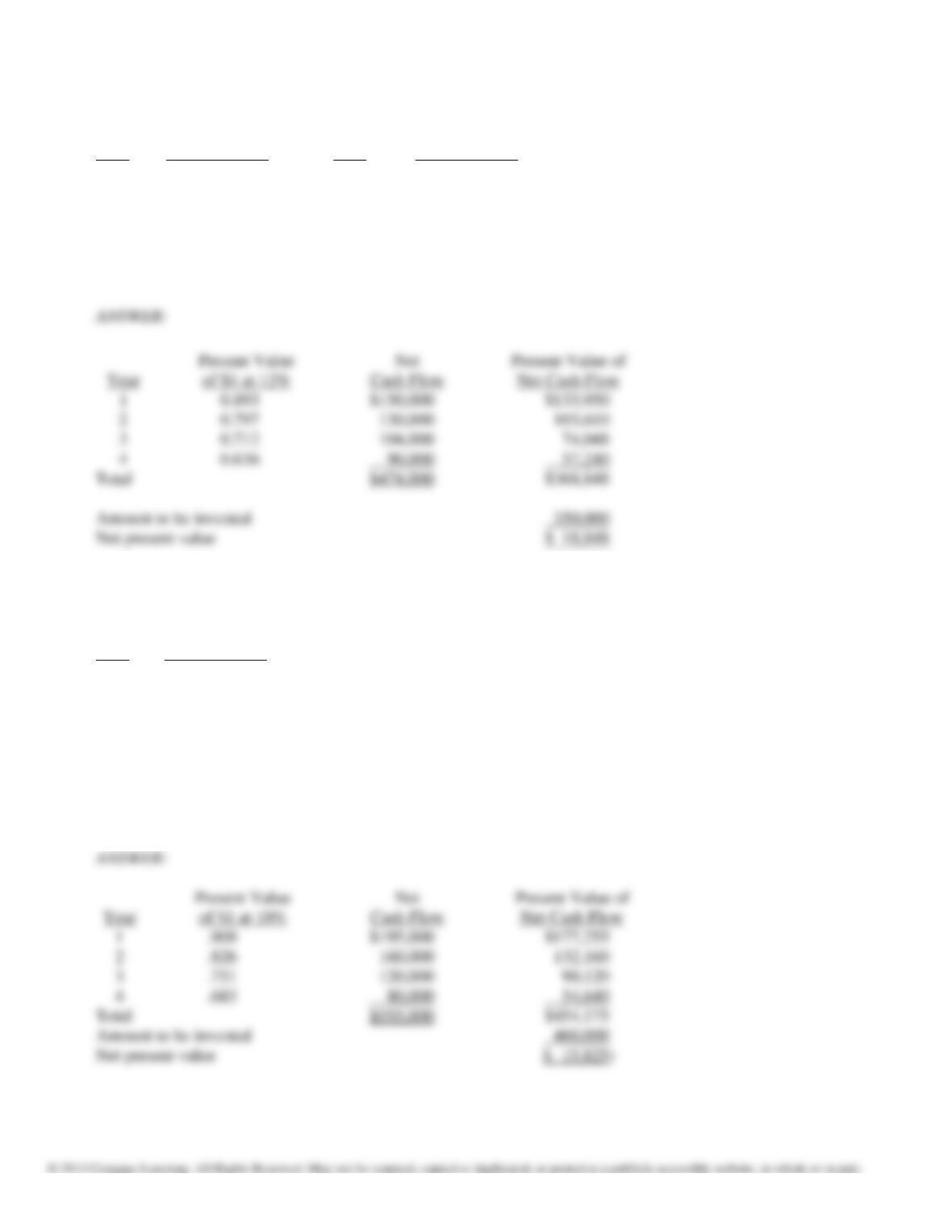
95. Both proposal M, and N cost $800,000, have a 6-year life, and have expected total cash flows
of $1,200,000. Proposal M is expected to provide equal annual net cash flows of $200,000,
while the net cash flows for Proposal N are as follows:
Year 1
$250,000
Year 2
$225,000
Year 3
$200,000
Year 4
$200,000
Year 5
$175,000
Year 6
$150,000
Determine the cash payback period for each proposal.
Chapter 15: Capital Investment Analysis
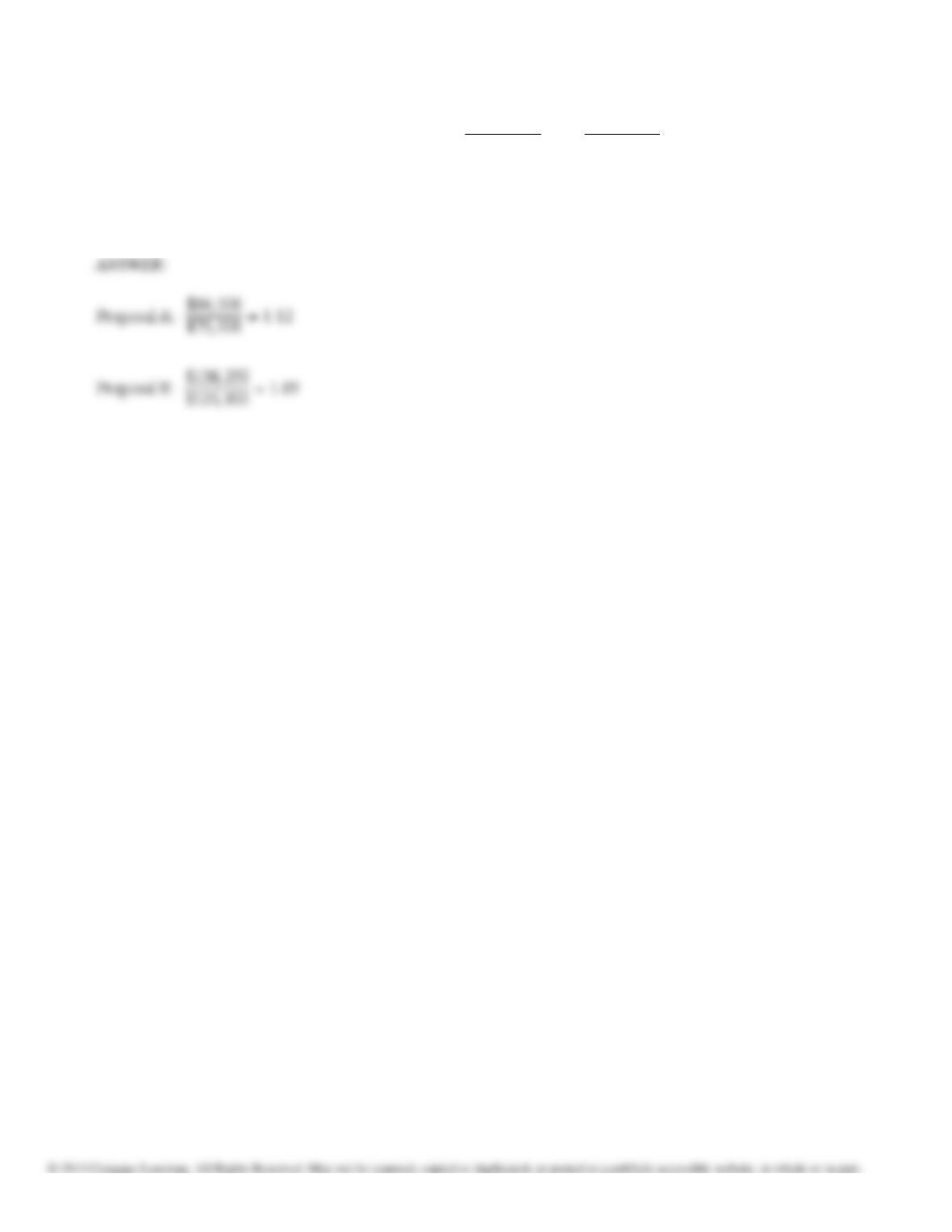
96. A $350,000 capital investment proposal has an estimated life of four years and no residual
value. The estimated net cash flows are as follows:
Year
Net Cash Flow
Year
Net Cash Flow
1
$150,000
3
$104,000
2
130,000
4
90,000
The minimum desired rate of return for net present value analysis is 12%. The present value of
$1 at compound interest of 12% for 1, 2, 3, and 4 years is 0.893, 0.797, 0.712, and 0.636,
respectively. Determine the net present value.
97. Heedy Inc. is considering a capital investment proposal that costs $460,000 and has an
estimated life of four years, and no residual value. The estimated net cash flows are as follows:
Year
Net Cash Flow
1
$195,000
2
160,000
3
120,000
4
80,000
The minimum desired rate of return for net present value analysis is 10%. The present value of
$1 at compound interest rates of 10% for 1, 2, 3, and 4 years is 0.909, 0.826, 0.751, and 0.683,
respectively. Determine the net present value.
Chapter 15: Capital Investment Analysis
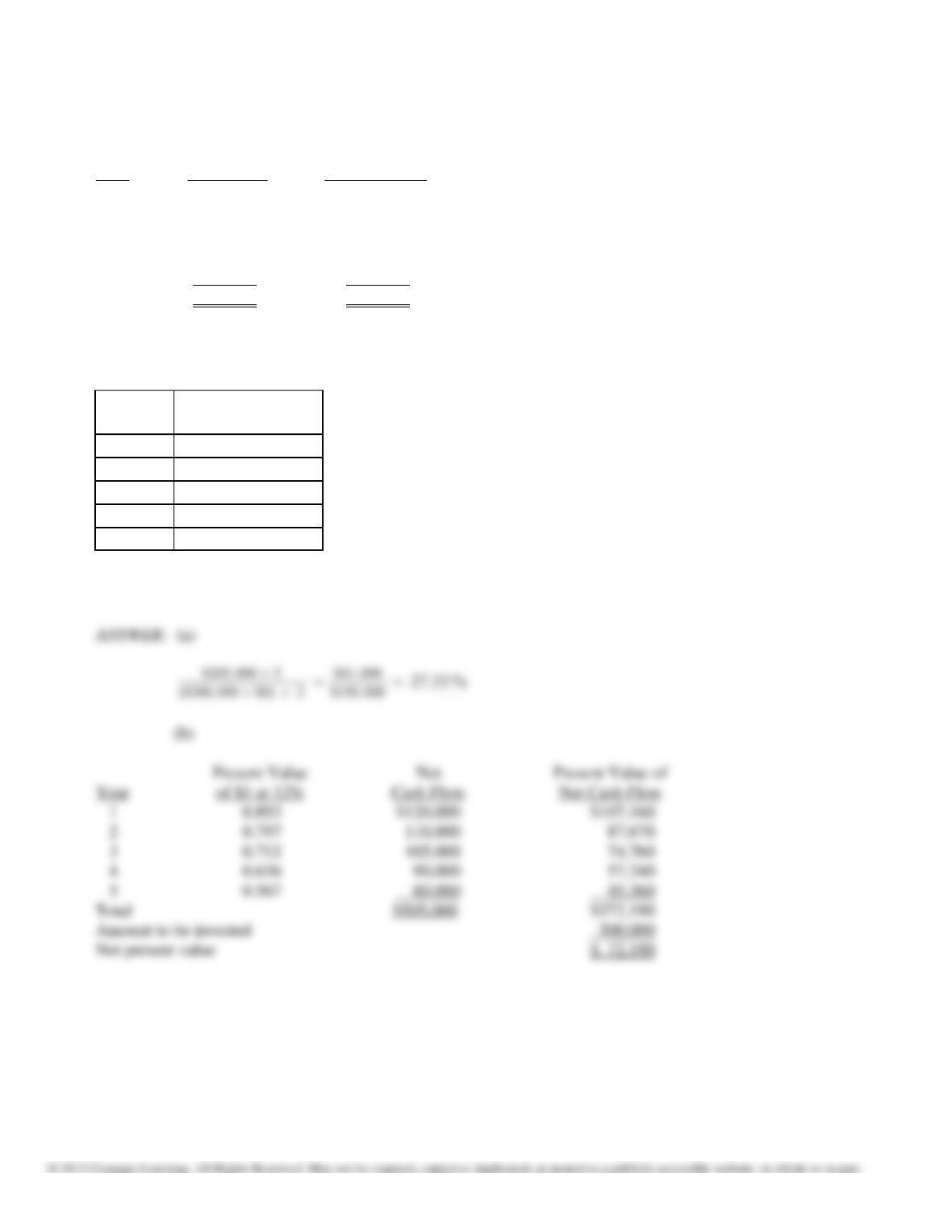
98. The net present value has been computed for Proposals A and B. Relevant data are as follows:
Proposal A
Proposal B
Amount to be invested
$75,000
$125,000
Total present value of net cash flow
84,000
136,250
Net present value
9,000
11,250
Determine the present value index for each proposal.
Chapter 15: Capital Investment Analysis
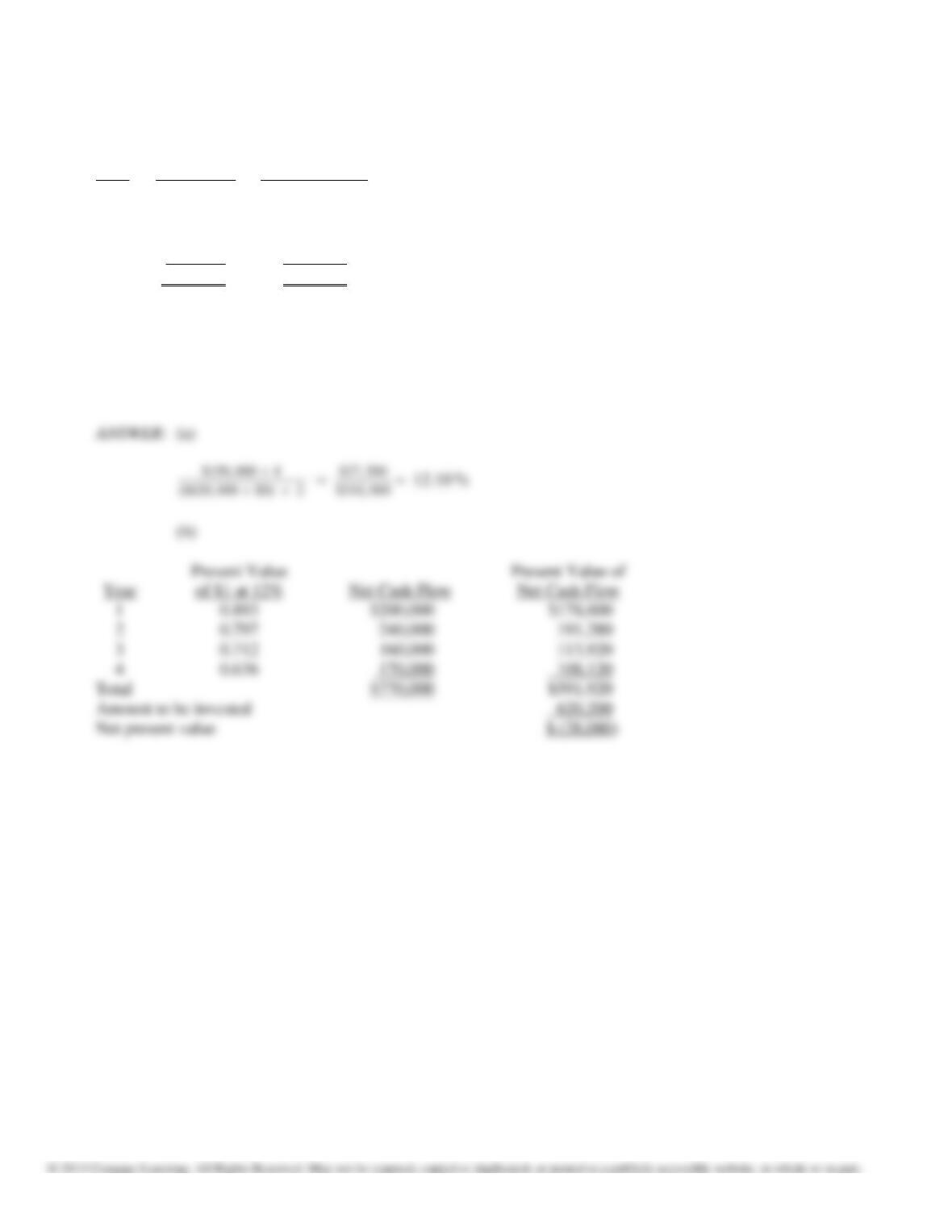
99. Sommers Company is evaluating a project requiring a capital expenditure of $300,000. The
project has an estimated life of 5 years and no salvage value. The estimated net income and net
cash flow from the project are as follows:
Year
Net Income
Net Cash Flow
1
$ 60,000
$120,000
2
50,000
110,000
3
45,000
105,000
4
30,000
90,000
5
20,000
80,000
$205,000
$505,000
The company’s minimum desired rate of return for net present value analysis is 12%. The
present value of $1 at compound interest of 12% is shown in the table below:
Year
Present Value
of $1 at 12%
1
0.893
2
0.797
3
0.712
4
0.636
5
0.567
Determine (a) the average rate of return on investment, giving effect to depreciation on the
investment, and (b) the net present value.
Chapter 15: Capital Investment Analysis
100. June Co. is evaluating a project requiring a capital expenditure of $620,000. The project has an
estimated life of four years and no salvage value. The estimated net income and net cash flow
from the project are as follows:
Year
Net Income
Net Cash Flow
1
$ 45,000
$200,000
2
85,000
240,000
3
5,000
160,000
4
15,000
170,000
$150,000
$770,000
The company’s minimum desired rate of return is 12%. The present value of $1 at compound
interest of 12% for 1, 2, 3, and 4 years is 0.893, 0.797, 0.712, and 0.636, respectively.
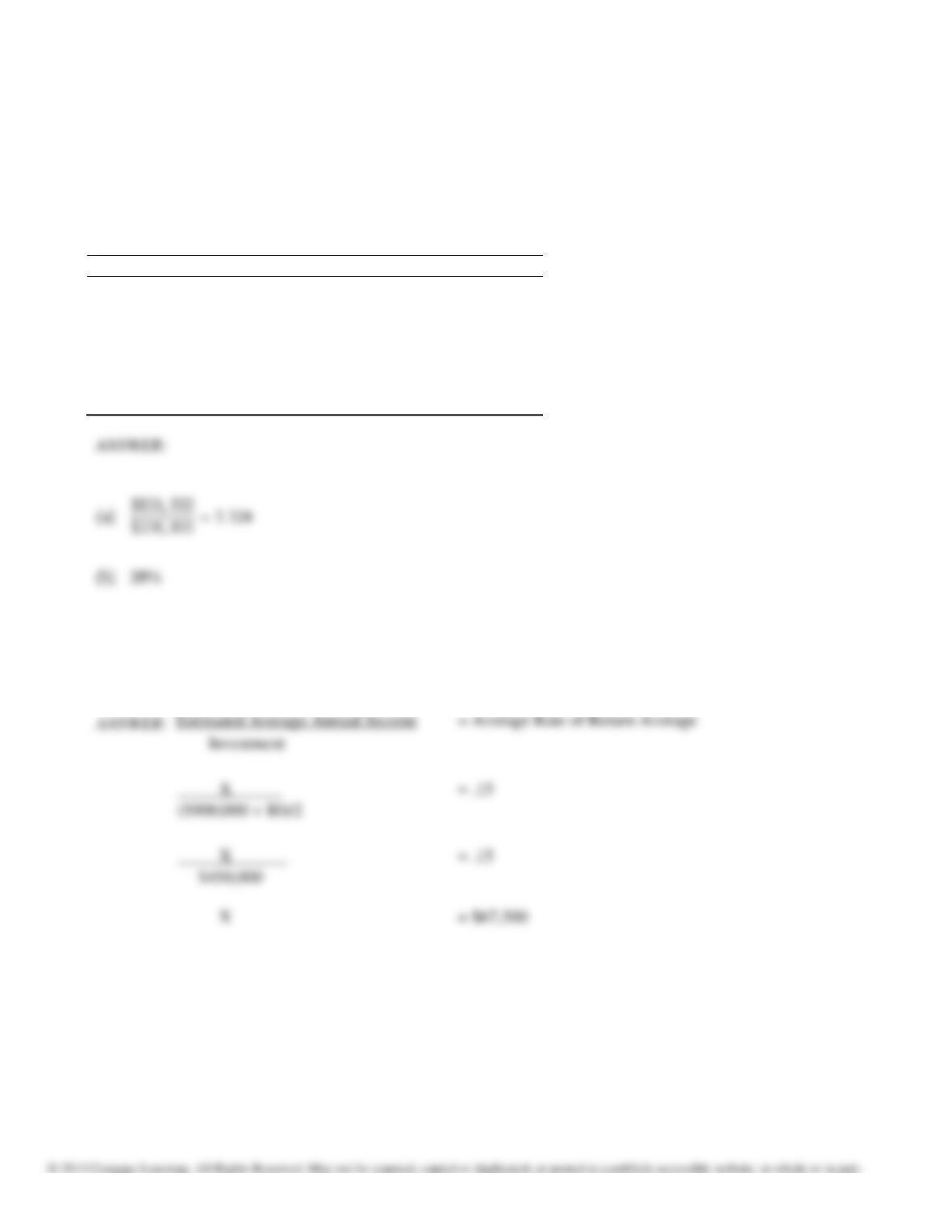
Determine: (a) the average rate of return on investment, giving effect to depreciation on the
investment, and (b) the net present value.
Chapter 15: Capital Investment Analysis
101. The internal rate of return method is used to analyze a $831,500 capital investment proposal
with annual net cash flows of $250,000 for each of the six years of its useful life.
(a)
Determine a present value factor for an annuity of $1, which can be used in
determining the internal rate of return.
(b)
Based on the factor determined in (a) and the portion of the present value of an
annuity of $1 table presented below, determine the internal rate of return for the
proposal.
Year
10%
15%
20%
1
0.909
0.870
0.833
2
1.736
1.626
1.528
3
2.487
2.283
2.106
4
3.170
2.855
2.589
5
3.791
3.353
2.991
6
4.355
3.785
3.326
7
4.868
4.160
3.605
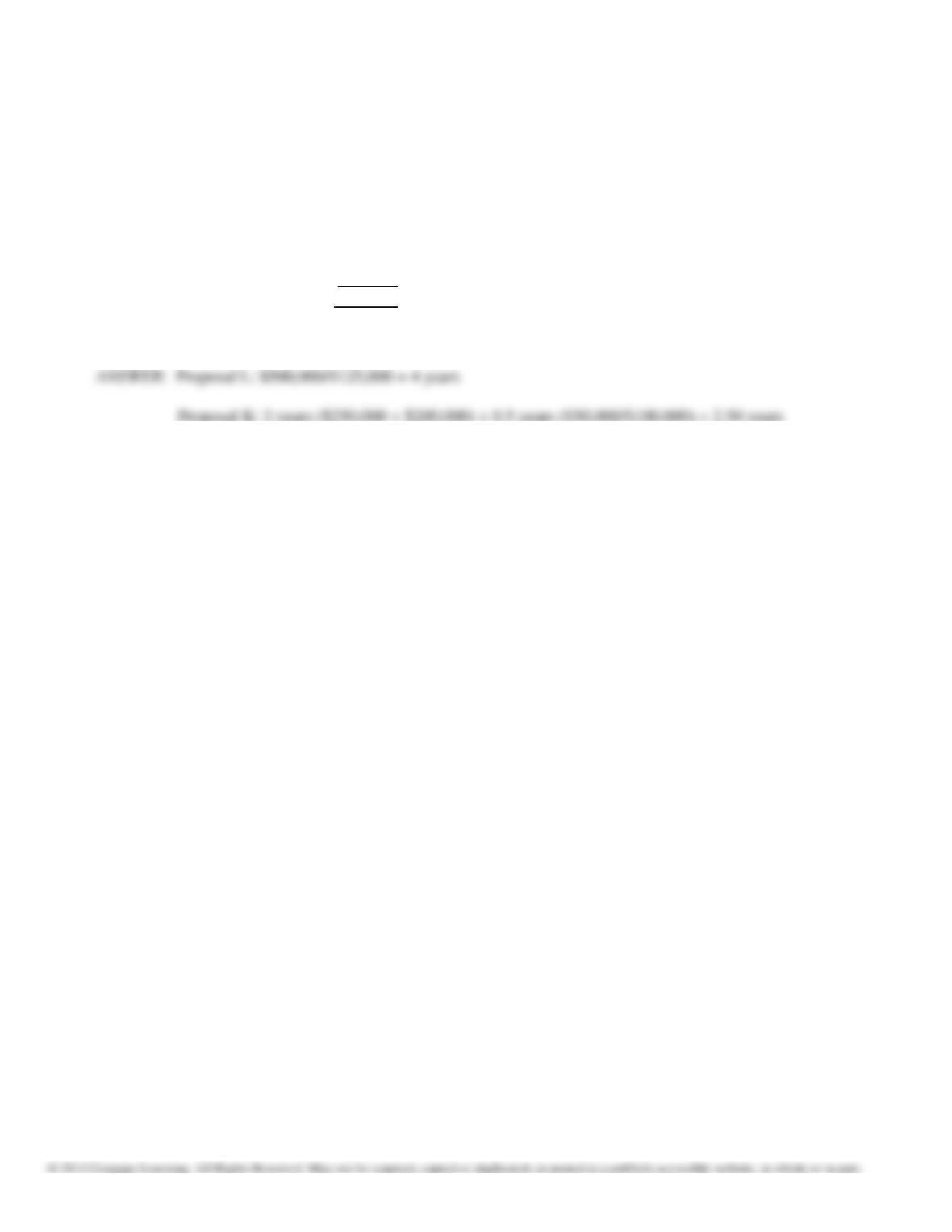
102. Harris Co. is considering a 12-year project that is estimated to cost $900,000 and has no
residual value. Harris seeks to earn an average rate of return of 15% on all capital projects.
Determine the necessary average annual income (using straight-line depreciation) that must be
achieved on this project for it to be acceptable to Harris Co.
Chapter 15: Capital Investment Analysis
103. Proposals L and K each cost $500,000, have 6-year lives, and have expected total cash flows
of $750,000. Proposal L is expected to provide equal annual net cash flows of $125,000, while
the net cash flows for Proposal K are as follows:
Year 1
$250,000
Year 2
200,000
Year 3
100,000
Year 4
90,000
Year 5
60,000
Year 6
50,000
$750,000
Determine the cash payback period for each proposal.