17) Prescott Plates uses a periodic inventory system. Prescott sold 35 dining sets during September. Other
data for September include:
Sep. 1 Balance 12 @ $220
6 Purchased 19 @ $270
12 Purchased 20 @ $350
Prescott sold 10 units from the Sept 1 balance, 15 from the Sept 6 purchase, and 10 from the Sept 12
purchase.
Cost of Goods Sold under the Specific Invoice method is:
A) $5,020.
B) $9,750.
C) $9,170.
D) $11,050.
18) Lois’s Furniture uses a periodic inventory system. Lois sold 60 tables during August. Other data for
August include:
Aug. 1 Balance 10 @ $140
9 Purchased 22 @ $180
18 Purchased 30 @ $210
Cost of Goods Sold under the LIFO method is:
A) $11,380.
B) $280.
C) $11,240.
D) $420.
19) Prescott Plates uses a periodic inventory system. Prescott sold 35 dining sets during September. Other
data for September include:
Sep. 1 Balance 12 @ $260
6 Purchased 19 @ $350
12 Purchased 20 @ $390
Prescott sold 10 units from the Sept 1 balance, 15 from the Sept 6 purchase, and 10 from the Sept 12
purchase.
Ending Inventory under the Specific Invoice method is:
A) $11,750.
B) $6,240.
C) $5,820.
D) $4,520.
20) Shayla’s Design uses a periodic inventory system. Shayla sold 33 artist kits during January. Other data
for January include:
Jan. 1 Balance 12 kits @ $27
11 Purchased 20 kits @ $34
25 Purchased 26 kits @ $40
Cost of Goods Sold under the LIFO method is:
A) $1,278.
B) $1,044.
C) $1,000.
D) $766.
21) Sterling Supply uses a periodic inventory system. Sterling Supply sold 35 globes during March. Other
data for March include:
Mar. 1 Balance 20 @ $11
11 Purchased 15 @ $19
25 Purchased 30 @ $9
Round per unit cost to two decimal places. Ending inventory under the weighted-average method is:
A) $358.
B) $270.
C) $417.
D) $505.
22) Lois’s Furniture uses a periodic inventory system. Lois sold 45 tables during August. Other data for
August include:
Aug. 1 Balance 10 @ $140
9 Purchased 22 @ $170
18 Purchased 30 @ $100
Ending inventory under the LIFO method is:
A) $6,440.
B) $5,550.
C) $2,590.
D) $1,700.
23) Hall Novelty Shop uses a periodic inventory system. It sold 55 balloons during April. Other data for
April include:
Apr. 1 Balance 45 @ $3
11 Purchased 50 @ $6
25 Purchased 30 @ $9
Cost of goods sold under the weighted-average method (rounded to the nearest dollar) is:
A) $395.
B) $705.
C) $310.
D) $165.
24) Goods that are consigned to another party:
A) belong to the other party because title has passed.
B) belong to the company that has consigned them.
C) belong to the consignee.
D) Both B and C are correct.
25) Which of the following should be included in inventory costs?
A) Goods that are not resalable
B) Goods on consignment to you
C) Goods for sale at a value that is greater than cost
D) Both A and B are correct.
26) The inventory method where unit cost is found by dividing the cost of goods available for sale by the
total number of units for sale is:
A) LIFO.
B) specific invoice.
C) FIFO.
D) weighted-average.
27) Which of the following goods should Blake Company include in its December 31, 201X, count?
A) Goods held on consignment for Goodson Automotive
B) Goods sold to Denning, F.O.B. destination, and arrival date scheduled for February 10
C) Goods in transit purchased F.O.B.
D) Goods that are not salable
28) The inventory method where items in the ending inventory will be valued at the costs shown on the
most recent invoices is:
A) LIFO.
B) specific invoice.
C) FIFO.
D) weighted-average.
29) Which is NOT a good reason to use the specific invoice method?
A) The flow of goods and flow of cost are the same.
B) It can be used with goods with large sales volume.
C) It is simple to use if there is a small amount of high-cost unique goods.
D) Costs are matched with the sales they helped to produce.
30) Under the specific invoice method, costs are matched with individual sale items.
31) The first-in-first-out method assumes the oldest goods are sold first.
32) The weighted-average method assumes each item is assigned a different unit cost.
33) LIFO reflects the oldest costs for inventory on the balance sheet.
34) LIFO provides an up-to–date ending inventory on the income statement because it uses the latest
purchases to calculate ending inventory.
35) A company should use the specific invoice method to value items that are in large quantities and are
low-cost goods.
36) In assigning a cost to ending inventory, the cost flow has to follow the physical flow.
37) If a change is made in the inventory valuation method, no disclosure is necessary.
38) The ________ is the one who consigns the merchandise.
39) The _________ method assumes the goods purchased first are sold first.
40) Items that are very similar, such as grains and fuels, would be costed using the ________ system of
inventory valuation.
41) A beginning inventory and purchases of computer parts follow:
Beginning inventory 30 @ $4
First purchase 16 @ $7
Second purchase 25 @ $12
The company sold 20 units from beginning inventory, 5 units from the first purchase, and 18 units from
the second purchase.
Required: Determine the (a) cost of an ending inventory and (b) Cost of Goods Sold under the specific
invoice method. Round to two decimal places if required.
42) A beginning inventory and purchases of desks follow:
Beginning inventory 15 @ $10
First purchase 22 @ $17
Second purchase 27 @ $23
The company sold 11 units from beginning inventory, 16 units from the first purchase, and 21 units from
the second purchase.
Required: Determine the (a) cost of an ending inventory and (b) Cost of Goods Sold under the specific
invoice method. Round to two decimal places if required.
43) Calculate the ending inventory under each of the following methods given the information below
about purchases and sales during the year. Assume a periodic inventory system. Round to four decimal
places.
April 1 Beginning inventory 60 units @ $30
11 Purchases 80 units @ $32
21 Purchases 30 units @ $35
Sales for April: 115 units
a) ________ FIFO
b) ________ LIFO
c) ________ Weighted-average
44) Calculate the cost of goods sold under each of the following methods given the information below
about purchases and sales during the year. Assume a periodic inventory system. Use four decimal places.
March 2 Beginning inventory 50 units @ $25
8 Purchases 65 units @ $30
12 Purchases 20 units @ $31
Sales for March: 95 units
a) ________ FIFO
b) ________ LIFO
c) ________ Weighted-average
15.4 Learning Objective 15-4
1) A method that uses average gross profit rate and net sales to compute inventory is:
A) the retail method.
B) the gross profit method.
C) the weighted-average method.
D) None of these answers is correct.
2) The retail method:
A) determines the value of the ending inventory using a cost-to-retail ratio.
B) is often used for interim financial reports.
C) determines the value of the ending inventory using a predetermined gross profit rate.
D) Both A and B are correct.
3) Hard Candy has a beginning inventory of $1,600 with a retail value of $2,000. June purchases were
$3,000, with a retail value of $5,000 and retail sales were $4,700. What is the June 30 estimated ending
inventory at cost under the retail method? (Round any percentages to two decimal places, X.XX%, and
your final answer to the nearest dollar.)
A) $2,300
B) $1,051
C) $3,088
D) $1,511
4) Inlet Inc. has a normal gross profit of 25%. The current year’s beginning inventory was $3,500,
purchases were $14,000, and retail sales were $20,000. The estimated ending inventory under the gross
profit method is:
A) $13,000.
B) $10,500.
C) $2,500.
D) $3,500.
5) An incorrect calculation of ending inventory affects:
A) cost of goods sold.
B) gross profit.
C) net income.
D) All of the above are correct.
6) Emile Landscaping had the following data for April:
Cost Price Retail Price
Beginning inventory $2,500 $4,400
Purchases 3,700 5,200
Sales 5,200
The cost of the estimated inventory on April 30 under the retail method is: (Round any percentages to
two decimal places, X.XX%, and your final answer to the nearest dollar.)
A) $4,400.
B) $3,358.
C) $2,842.
D) $1,000.
7) Chocolate Heaven had the following data for November:
Cost Price Retail Price
Beginning inventory $8,600 $13,700
Purchases 18,700 25,500
Sales 30,300
The cost of the estimated inventory on November 30 under the retail method is: (Round any percentages
to two decimal places, X.XX%, and your final answer to the nearest dollar.)
A) $6,198.
B) $8,900.
C) $21,101.
D) $3,000.
8) Compute the cost of ending inventory using the retail method when goods available for sale at cost are
$10,000, retail is $27,000, and sales at retail equal $23,000. What will the cost ratio be? What will the cost of
ending inventory be?
A) Cost ratio 37%; ending inventory $4,000
B) Cost ratio 43%; ending inventory $17,000
C) Cost ratio 85%; ending inventory $8,520
D) Cost ratio 37%; ending inventory $1,480
9) An understatement of ending inventory in one period results in:
A) an overstatement of net income for the next period.
B) no effect on net income for the next period.
C) an overstatement of the ending inventory for the next period.
D) an understatement of net income for the next period.
10) Bert Logistics has the following company information for August: goods available for sale at cost are
$19,000, retail is $28,500, and sales at retail equal $21,500. Bert has a normal gross profit of 35%. The cost
of estimated ending inventory under the retail method is: (Round any percentages to two decimal places,
X.XX%, and your final answer to the nearest dollar.)
A) $4,667.
B) $5,281.
C) $4,550.
D) $2,450.
11) Bert Logistics has the following company information for August: goods available for sale at cost are
$19,000, retail is $28,500, and sales at retail equal $21,500. Bert has a normal gross profit of 35%. The cost
of estimated ending inventory under the gross profit method is: (Round any percentages to two decimal
places, X.XX%, and your final answer to the nearest dollar.)
A) $7,000.
B) $11,475.
C) $4,550.
D) $5,025.
12) When ending inventory is understated:
A) cost of goods sold is overstated and profit is understated.
B) beginning inventory is overstated and profit is understated.
C) cost of goods sold is understated and profit is understated.
D) cost of goods sold is overstated and profit is overstated.
13) The beginning inventory of this year is understated. This error would cause:
A) the period’s net income to be overstated.
B) the period’s net income to be understated.
C) the period end assets to be understated.
D) None of these is correct.
14) American Lumber has the following company information for October: goods available for sale at cost
are $24,000, retail is $36,500, and sales at retail equal $28,500. Bert has a normal gross profit of 20%. The
cost of estimated ending inventory under the retail method is: (Round any percentages to two decimal
places, X.XX%, and your final answer to the nearest dollar.)
A) $5,260.
B) $6,246.
C) $6,400.
D) $1,600.
15) American Lumber has the following company information for October: goods available for sale at cost
are $24,000, retail is $38,400, and sales at retail equal $30,400. Bert has a normal gross profit of 30%. The
cost of estimated ending inventory under the gross profit method is: (Round any percentages to two
decimal places, X.XX%, and your final answer to the nearest dollar.)
A) $8,000.
B) $14,880.
C) $5,600.
D) $2,720.
16) A business uses the retail inventory method to estimate the value of the ending inventory. For the
month of June, the cost of goods available for sale is $15,900 at cost and $22,100 at retail. The cost ratio is:
A) 71.9%.
B) 28.05%.
C) 39%.
D) None of these is correct.
17) The ending inventory for this year is overstated. This error would cause:
A) the period’s net income to be overstated.
B) the period’s net income to be understated.
C) the period end assets to be understated.
D) None of these is correct.
18) A business has sales of $184,158 and a normal gross profit of 45%. The estimated cost of goods sold is:
(Round your answer to the nearest dollar.)
A) $184,158.
B) $82,871.
C) $101,287.
D) Cannot be determined.
19) The gross profit method:
A) determines the value of the ending inventory using a cost-to-retail ratio.
B) is often used for interim financial reports.
C) determines the value of the ending inventory using a predetermined gross profit rate.
D) Both A and B are correct.
20) To use the gross profit method to estimate inventory, you do not need to know the goods available for
sale at retail.
21) The gross profit method is used to determine the value of beginning inventory using a predetermined
gross profit rate.
22) The retail method is often used for interim financial reports.
23) The retail method is used by many manufacturing businesses to estimate the amount of sales.
24) An incorrect inventory figure will affect the balance sheet.
25) Determine the estimated cost of the ending inventory for Market Surplus as of September 30 by the
retail method from the following data (use four decimal places).
Cost Retail
Sep. 1 Beginning inventory $750 $1,000
September purchases 4,500 5,500
September sales 4,500
26) Tack Room Clothing uses the retail method to estimate cost of ending inventory for its interim
reports. From the following facts, estimate Tack Room’s ending inventory at cost at August 31.
August 1 inventory at cost $900
August 1 inventory at retail 1,200
Net purchases at cost 9,000
Net purchases at retail 12,000
Net sales at retail 12,500
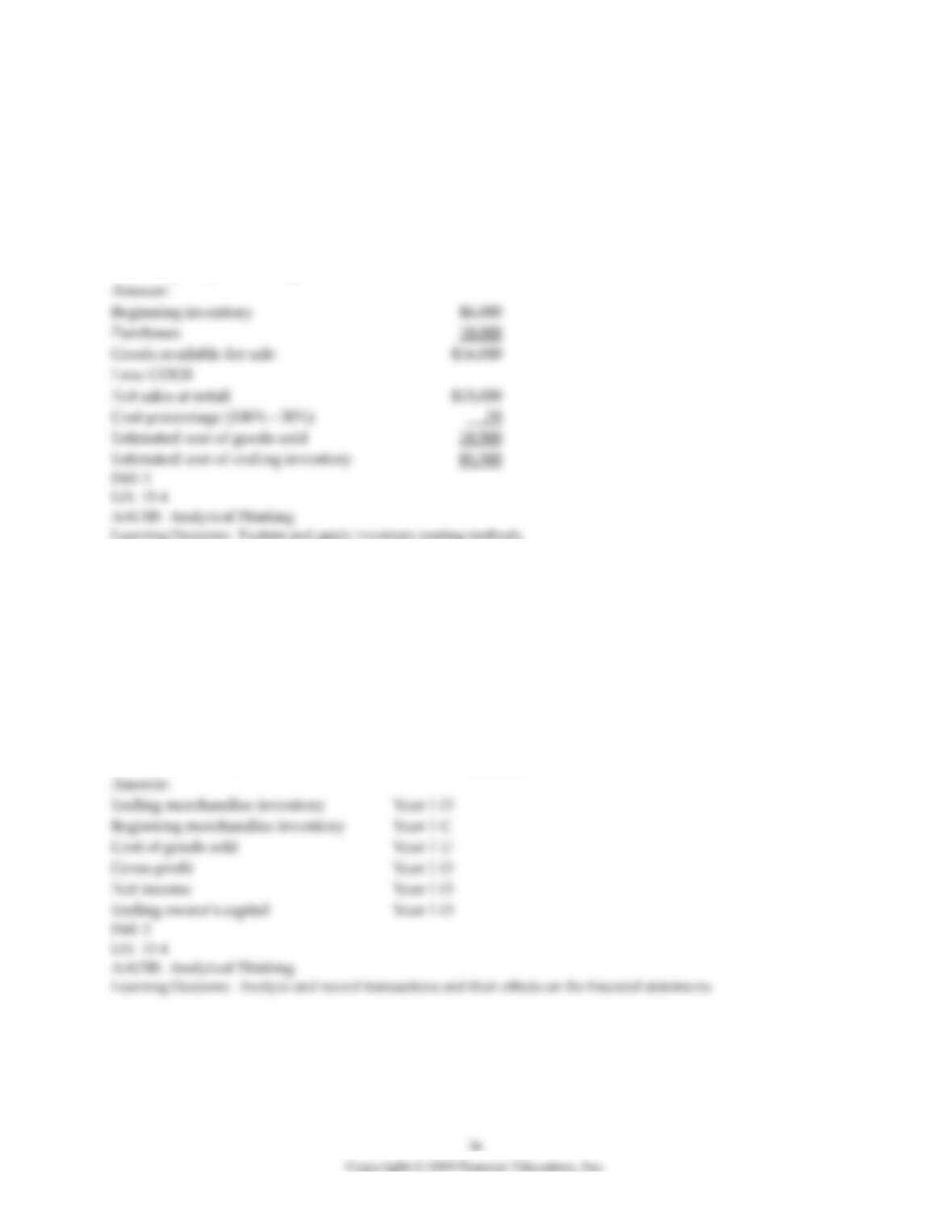
27) Nicki’s Pet Supply needs to estimate its ending inventory. Using the data below, compute Nicki’s
estimated cost of ending inventory for the month of April.
Beginning inventory April 1 $6,000
Purchases for April 10,000
Retail sales during April 15,000
Normal gross profit average 30%
28) Assume that in Year 1, the ending merchandise inventory is overstated by $30,000. If this is the only
error in Year 1, fill in the items below, indicating which items will be understated(U), overstated(O), or
correctly(C) stated for Year 1.
Ending merchandise inventory Year 1 ________
Beginning merchandise inventory Year 1 ________
Cost of goods sold Year 1 ________
Gross profit Year 1 ________
Net income Year 1 ________
Ending owner’s capital Year 1 ________
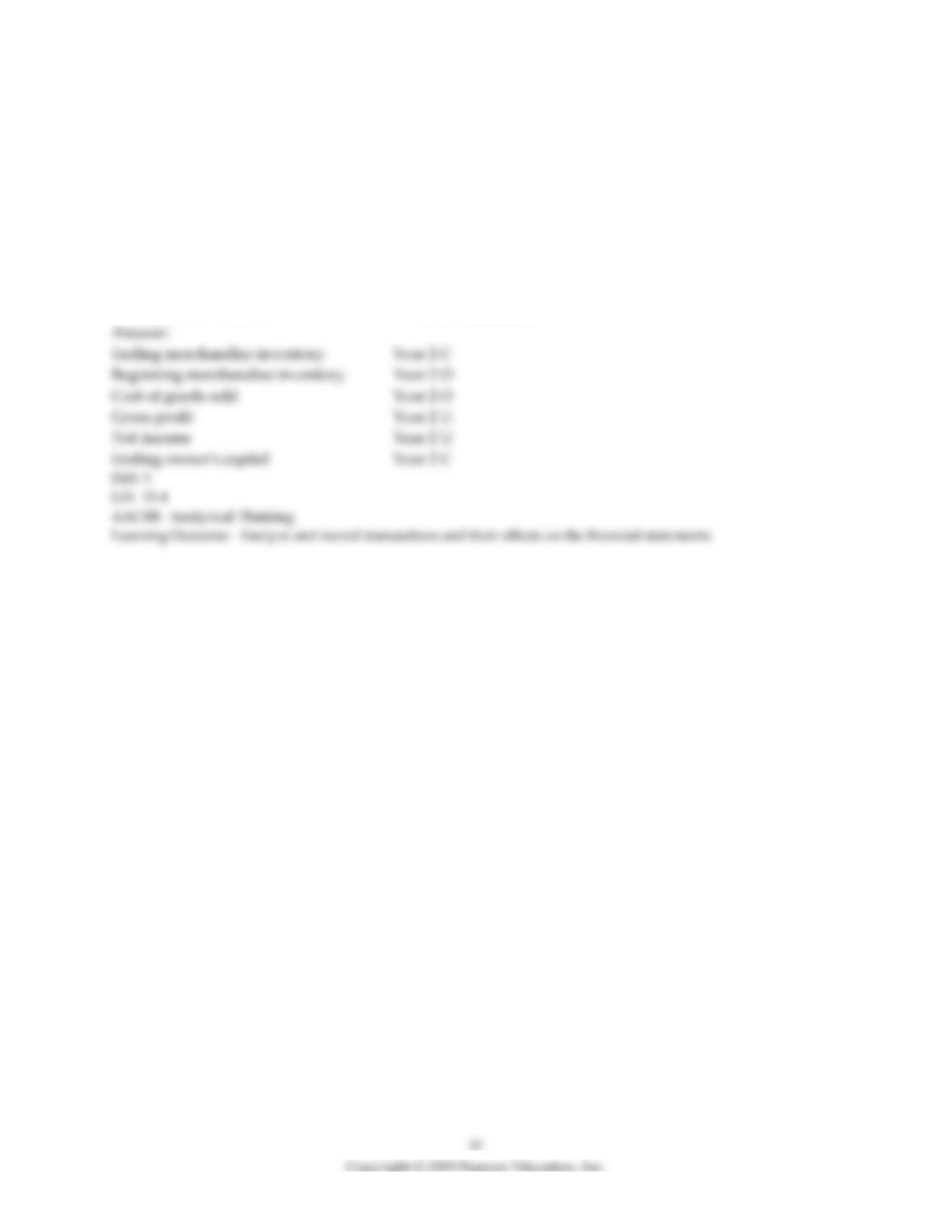
29) Assume that in Year 1, the ending merchandise inventory is overstated by $30,000. If this is the only
error in Years 1 and 2, fill in the items below, indicating which items will be understated(U),
overstated(O), or correctly(C) stated for Year 2.
Ending merchandise inventory Year 2 ________
Beginning merchandise inventory Year 2 ________
Cost of goods sold Year 2 ________
Gross profit Year 2 ________
Net income Year 2 ________
Ending owner’s capital Year 2 ________