Chapter 15: Fundamentals of Accounting
Multiple Choice
1. Which of the following formulations of the accounting equation is incorrect?
a. assets – liabilities = equity
b. assets = liabilities + equity
c. assets = liabilities + opening equity + (revenues – expenses) + (owner additions to –
withdrawals from equity)
d. assets = liabilities – equity
2. John pays cash to buy auto insurance for a three-year period starting January 1.What is
the accounting effect of this transaction on John’s records when he makes the payment?
a. An asset increases and an asset decreases
b. An asset increases and a liability increases
c. Equity increases and a liability decreases
d. An asset decreases and equity decreases
3. Veronica Lodge borrowed $15,000 from a bank on January 1, 2013 to finance her new
business. She agrees to repay the bank on December 31, 2013, with $750 interest on the
loan. In addition to increasing cash, what else should Veronica record on January 1,
2013?
a. an increase in a liability of $15,000
b. an increase in a liability of $15,750
c. an increase in equity of $15,000
d. an increase in a liability of $15,750, and a decrease in equity of $750
4. What is the accounting effect of using the accrual basis of accounting?
a. revenues and expenses are recognized when cash is received.
b. revenues are recognized when earned, and expenses are recognized when cash is paid
c. revenues are recognized when earned and expenses are recognized when they are
incurred
d. revenues are recognized when cash is received, and expenses are recognized when
incurred

5. Why would the accrual basis of accounting be preferable to the cash basis?
a. it is easier to keep records on the accrual basis than on the cash basis
b. it measures performance by comparing inflows and outflows of cash
c. it ignores the effect of the consumption of assets on the cost of doing business
d. it measures performance by comparing revenues earned with expenses incurred.
6. A hospital’s accounting year ends on June 30. Which of the following events requires the
hospital to record an expense accrual at June 30?
a. it hires nurses on June 28 and tells them to start working on July 5
b. it orders a new piece of equipment on June 20 for installation on July 10
c. its staff works during the week ended June 30, but is not paid until July 5
d. it receives a delivery of medicines on June 20, which are not used until July
7. A theater producer’s accounting year ends on June 30. Which of the following year-end
transactions or events results in an accounting entry referred to as a deferral?
a. actors work on June 29 and 30, but are not paid until July 5
b. electricity for the month of June is not paid because the bill is not received until July
c. “extras” are paid in cash on June 30 for the June 30 performance
d. theater-goers pay cash on June 30 for performances that will occur in July and August
8. Macky McClung uses accrual accounting to keep the records of her toy store. She paid
$15,000 on January 1 for rent for the three months January-March. To correctly report
her expenses for the month of January, what must her accounting entry accomplish?
a. increase expenses by $5,000 and decrease assets by $10,000
b. increase expenses by $5,000 and decrease assets by $5,000
c. increase expenses by $10,000 and decrease assets by $5,000
d. decrease expenses by $5,000 and increase assets by $5,000
9. A business borrows $100,000 from a bank on July 1, 2008. Under the agreement with the
bank, the loan must be repaid in full on June 30, 2009, with interest at 6% a year. The

business wants to prepare financial statements for the year ended December 31, 2008. How
much interest expense should it report for that year?
a. $0
b. $3,000
c. $6,000
d. $12,000
10. Robert Plant invests $50,000 of his own money in a business. What journal entry should be
made to record Robert’s investment in the business?
a. debit cash (business); and credit cash (personal)
b. debit cash; and credit Robert Plant, capital
c. debit cash; and credit loans payable
d. debit Robert Plant, capital; and credit cash
11. Suzy Queue hires a salesperson for her business. Suzy agrees to pay the salesperson a
commission of 10 percent of sales. By the end of the first month, the salesperson has
done $50,000 of sales. Suzy wants to prepare accurate financial statements at the end of
the month, but has not yet paid the salesperson. What journal entry should she make
before preparing her financial statements for the month?
a. debit commissions expense ($5,000); and credit commissions payable ($5,000)
b. debit prepaid commissions ($5,000); and credit commissions payable ($5,000)
c. debit commissions expense ($50,000); and credit cash ($50,000)
d. debit prepaid commissions ($5,000); and credit cash ($5,000)
12. Glen Turner purchases a high-speed copying machine on credit for his printing business.
The machine is expected to have a useful life of four years. What journal entry should be
made at the time the copying equipment is received?
a. debit equipment; and credit accounts payable
b. debit copying expenses; and credit accounts payable
c. debit cash; and credit equipment
d. debit depreciation expense – equipment; and credit equipment
13. What adjusting journal entry is made when an entity wants to prepare financial
statements, owes interest on a borrowing during the year, but hasn’t paid either the loan
or the interest?
a. debit prepaid interest; and credit interest expense
b. debit interest payable; and credit interest expense

c. debit interest expense; and credit interest payable
d. debit interest payable; and credit loans payable
14. What assurance do you have if you prepare a trial balance and the sum of the debits
equals the sum of the credits?
a. that all journal entries have been posted to the ledger accounts
b. that all journal entries have been posted to the correct ledger account
c. that both a. and b. have occurred
d. you cannot be assured that either a. or b. have occurred
15. Assume that an organization’s operations result in a net profit for the year. When the
books are closed, what is the accounting effect of the journal entry that closes out the net
profit?
a. it is added to the cash balance
b. it is subtracted from the cash balance
c. it is added to the opening balance of owner’s equity
d. it is subtracted from the liabilities
16. After you have closed an entity’s books, what happens to the account balances?
a. all asset accounts will have zero balances
b. none of the accounts will have zero balances
c. all liability accounts will have zero balances
d. the revenue and expense accounts will have zero balances
17. Which of the following statements is true about control accounts?
a. control accounts are used to control amounts spent during the year
b. control account totals must equal the total of the individual subsidiary accounts
c. control accounts are used to limit the amounts of liabilities incurred during the year
d. control accounts avoid the need for making postings to ledgers.
18. Alberta’s Appliances is a wholesaler that sells to retail stores on credit. Alberta’s sales for
the year were $250,000. During the year, it received payments of $220,000 from
customers. At year-end, it establishes an allowance for uncollectible accounts equal to 5%
of the unpaid receivables. How much should Alberta’s report as net accounts receivable at
December 31?
a. $30,000

b. $28,500
c. $12,500
d. $11,000
19. Alberta’s Appliances is a wholesaler that sells to retail stores on credit. To provide for
possible bad debts, Alberta established a $32,000 allowance for uncollectible accounts.
One of its customers goes bankrupt and Alberta decided to write off the account as
uncollectible. What journal entry should Alberta make to record the bankruptcy?
a. debit bad debts expense; and credit accounts receivable
b. debit bad debts expense; and credit allowance for uncollectible accounts
c. debit sales revenues; and allowance for uncollectible accounts
d. debit allowance for uncollectible accounts; and credit accounts receivable
20. Herman Appliance buys and sells refrigerators. Herman starts the year with an inventory of
$20,000. During the year, Herman buys refrigerators totaling $182,000. At year-end,
Herman takes inventory and finds that he has $28,000 of refrigerators on hand. During the
year, Herman’s sales revenue was $256,000. What was Herman’s gross profit on the sales
for the year?
a. $54,000
b. $66,000
c. $74,000
d. $82,000
21. An owner of a business withdraws cash from his business. Which of the following
accounts would need to be reduced to record this transaction?
a. accounts receivable
b. owner’s equity
c. expenses
d. accounts payable
22. Which of the following accounts is increased with debits?
a. assets and liabilities
b. liabilities and equity
c. assets and expenses
d. liabilities and expenses
23. Tina opens a business to do small printing jobs. Her first few transactions are
shown below. For each of them, state which two of the following six possibilities
occurred as a result of each transaction – an asset increased, an asset decreased, a
liability increased, a liability decreased, equity increased, or equity decreased:
a. Tina invested $25,000 of her personal cash in the business
b. Tina purchased a high-speed copying machine on credit; the machine should last 4
years
c. Tina paid cash to a student she hired to make deliveries for her that day.
24. These transactions relate to Rudy’s Garage, an auto repair shop. Which two of the
following six possibilities occurred as a result of each transaction – an asset
increased, an asset decreased, a liability increased, a liability decreased, equity
increased, or equity decreased:
a. Rudy bought 5 batteries on credit. He put the batteries in inventory
b. Rudy did a repair job for a customer, who paid in cash
c. In doing the repair job, Rudy used one of the batteries he had bought in transaction a
25. Elsie owns a small business. At the end of the month, Elsie needed to make
adjusting entries to prepare statements on the accrual basis. Which two of the
following six possibilities occurred as a result of each of the following adjustments
– an asset increased, an asset decreased, a liability increased, a liability decreased,
equity increased, or equity decreased:
a. An accrual for salaries that were due to an employee, but were not paid
b. An adjustment for depreciation on Elsie’s store fixtures
c. An adjustment for the expiration of prepaid insurance
d. An accrual for interest earned on a certificate of deposit that had not matured
26. State whether each of the following statements is true or false. Explain the true
statements and discuss why the false statements are false. Use illustrations in your
answer.
a. An asset cannot be created by incurring a liability.
b. One thing the accounting equation says is that assets are equal to the sources of the
assets.
c. If a transaction causes an asset to increase, another asset cannot simultaneously
decrease.
27. State whether each of the following statements is true or false. Explain the true
statements and discuss why the false statements are false.
a. A debit always results in increasing the balance in an account.
b. As expenses increase, the equity of an entity will decrease.
c. Posting is the process of copying information from ledgers to journals.
28. A business keeps its accounts on a calendar-year basis. On January 1, 2013, there is
a balance of $2,800 in the Prepaid insurance account. The insurance represented by
that amount expires on March 31, 2013, but the business makes no entry to record
the expiration of the insurance until its year-end. On April 1, 2013, the business
pays $16,000 for an insurance policy covering the period April 1, 2013 – March 31,
2014. Prepare the journal entry at December 31, 2013, to record the full amount of
insurance expense for the year.
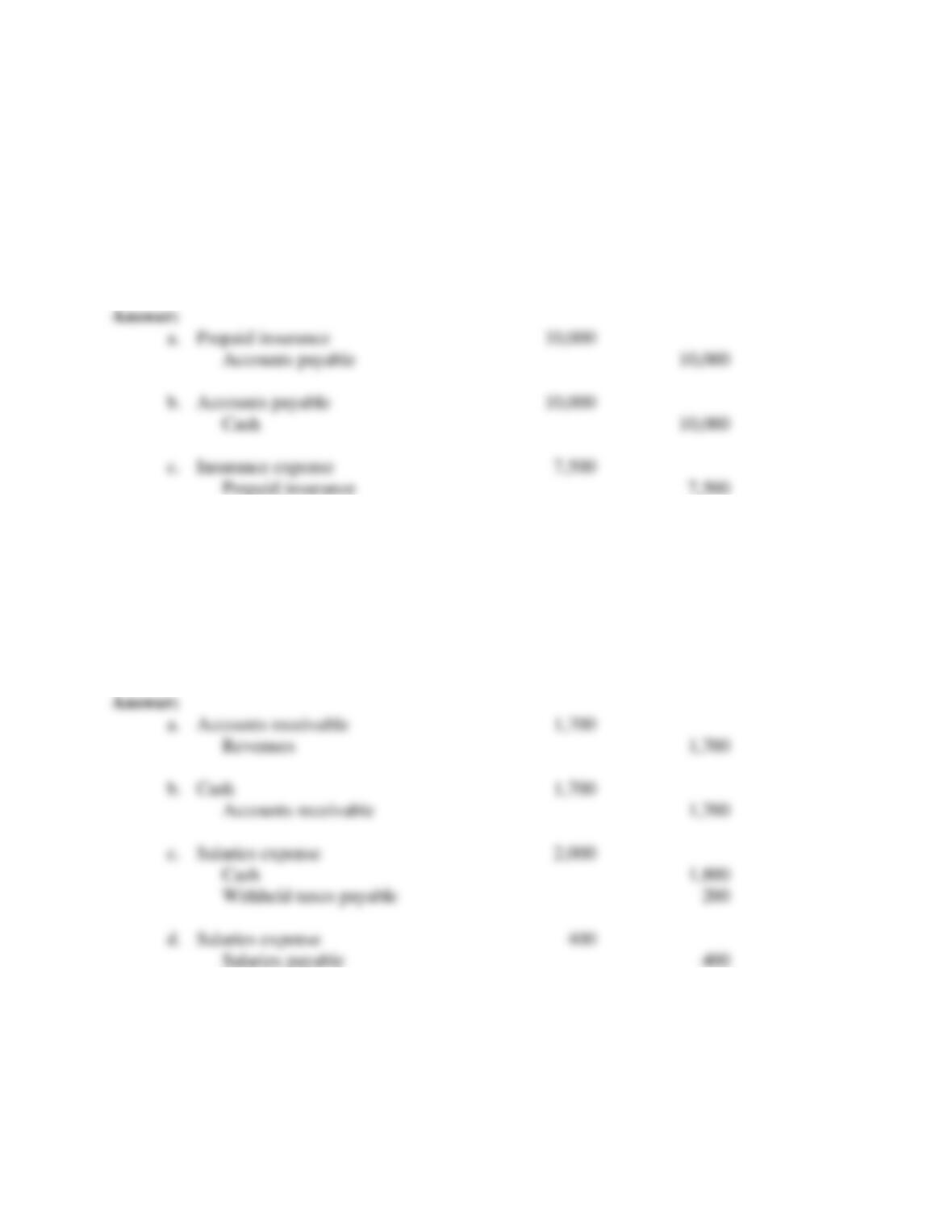
29. Prepare journal entries to record the following transactions regarding a fire
insurance policy purchased by Chang Electronics. Chang’s business operates on a
calendar-year basis.
a. April 1, 2013 – Chang arranges to buy fire insurance. He receives a bill for $10,000 for
an insurance policy that covers the period April 1, 2013 through March 31, 2014.
b. April 10 – Chang pays the insurance bill.
c. December 31- Chang prepares financial statements for the year ended. December 31,
2013. He prepares an adjusting entry regarding insurance.
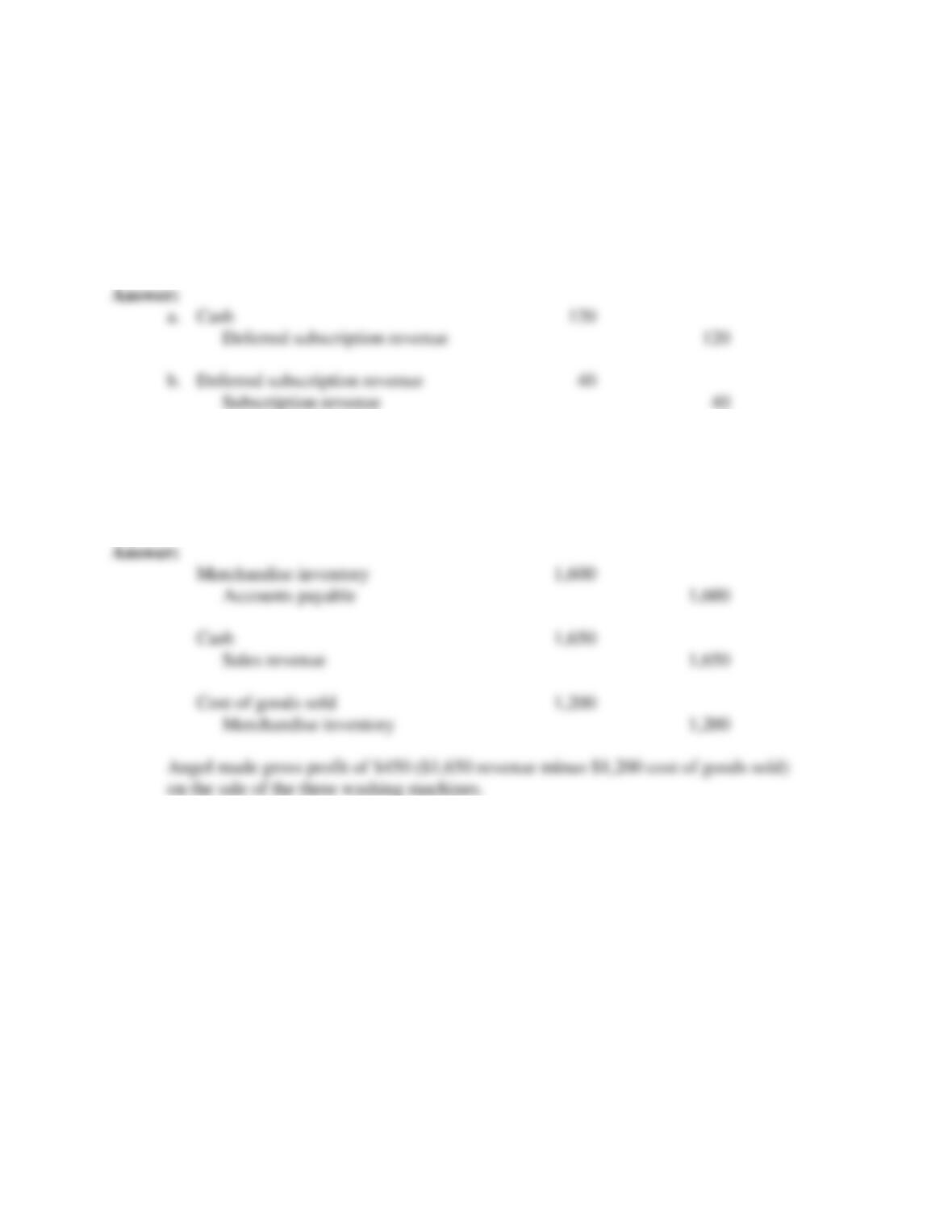
30. Prepare journal entries to record the following transactions for Ted’s Garage:
a. Ted does extensive body work on Jim’s auto, and sends Jim a bill for $1,700.
b. Ted receives Jim’s check for $1,700.
c. Ted’s mechanic earns $2,000 for a week’s work. Ted pays him $1,800 after deducting
$200 withholding taxes.
d. Ted prepares financial statements at the end of the month. He makes an accrual for
$400 for unpaid salaries.
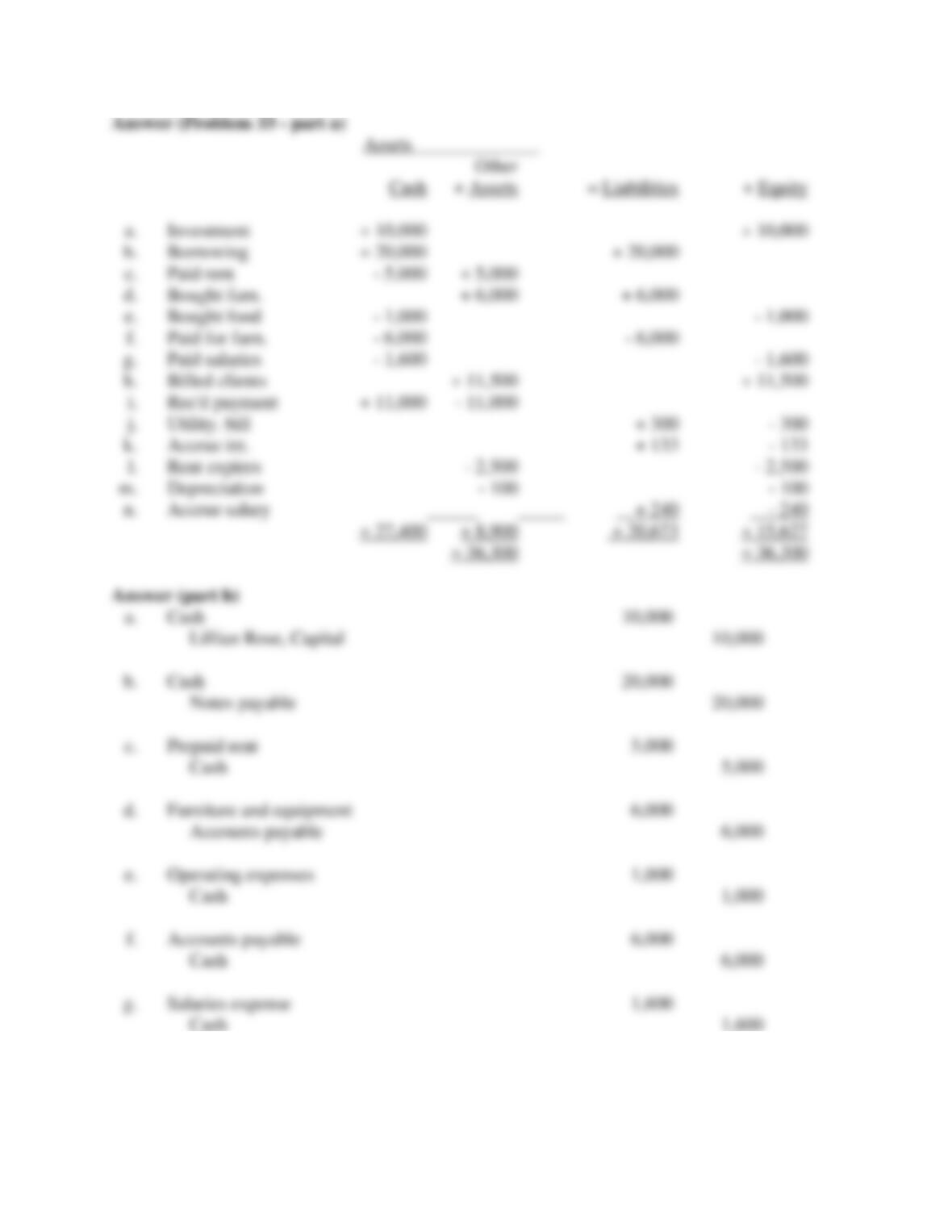
31. In August, 2013, a publisher receives a check for $120 from a subscriber for a one-
year subscription to “Willie,” a monthly magazine. The subscriber will receive the
first magazine in September. Prepare: (a) the journal entry to record the amount
received in August; and (b) the adjusting entry to be made as of December 31,
2013. (HINT: The publisher earns revenue only on delivery of magazines to the
subscribers. Receipt of cash before delivery results in a liability called “Deferred
subscription revenue.”)
32. Angel’s Appliances buys four washing machines for its inventory at a price of $400
each. It makes the purchase on credit. It then sells three of the machines for cash at
$550 each. Make journal entries to record these transactions. Then state how much
gross profit Angel made.
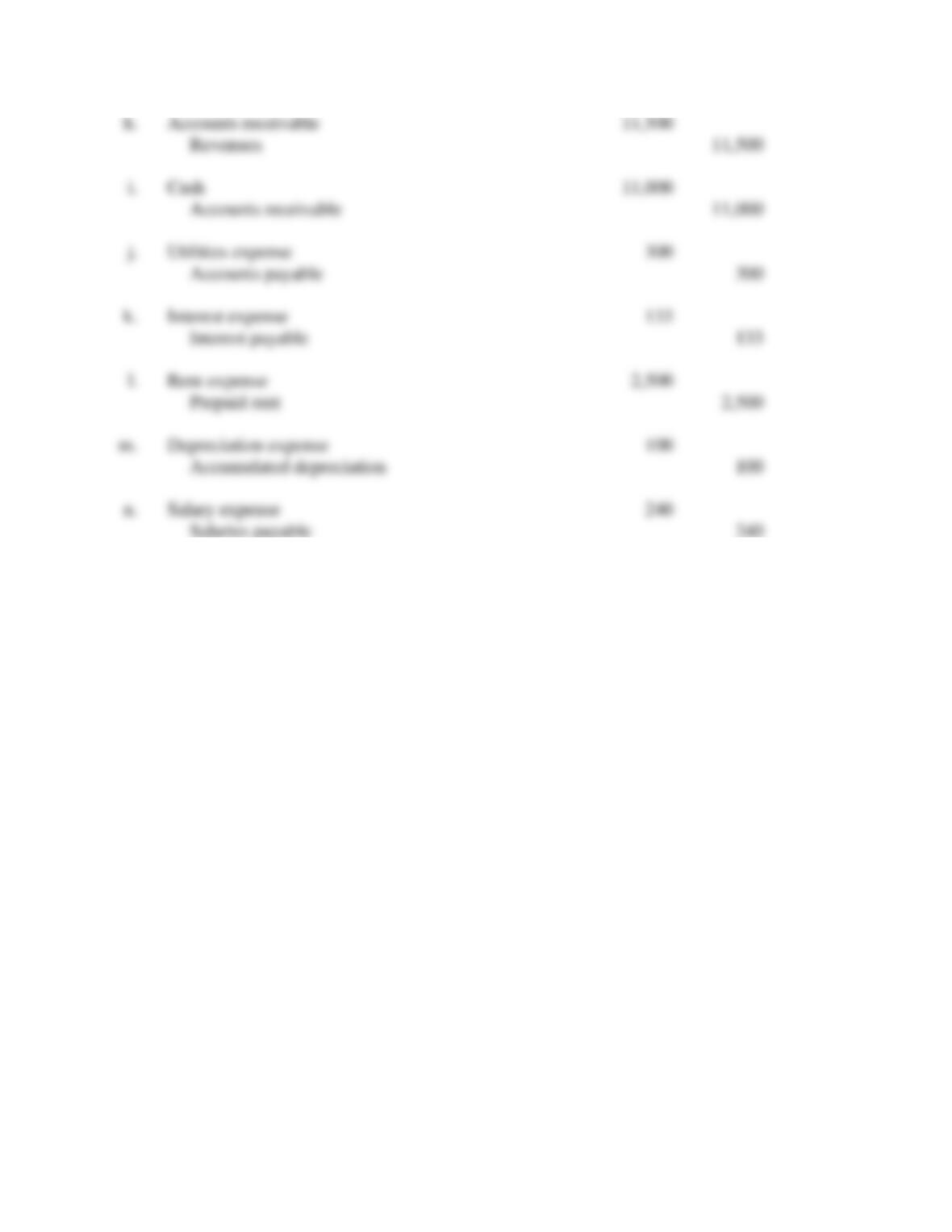
33. (Transaction analysis, journal entries, and adjusting journal entries)
Lillian Rose opened a facility to provide day care for children. The following
transactions occurred during the month of July 2013, the first month of business.
a. Lillian Rose invested $10,000 of her personal funds in a business, to be known as
LilyRose Day Care.
b. To provide additional funds for her business, she borrowed $20,000 from a bank. The
loan must be repaid at the end of year with interest at 8% per annum.
c. She rented a large house for one year. She paid rent of $5,000 in advance for the
months of July and August.
d. She bought furniture at a cost of $6,000, receiving an invoice that had to be paid in 10
days. She expected the equipment to last five years.
e. She paid $1,000 cash for food, toys and other operating supplies. (Because
these items are likely to be consumed in a few months, treat them as
Operating Expenses.)
f. She paid the invoice for $6,000, received in transaction d.
g. She paid her helper at the rate of $400 a week, a total of $1,600 for the
month.
h. She billed her clients $11,500 for day care services provided during the
month.
i. She received checks totaling $11,000 against the bills sent out in
transaction h.
j. She received a bill for utilities in the amount of $300.
Lillian wanted to prepare financial statements at the end of the month, so she made
adjusting journal entries for the following items.
k. To record interest for one month on the amount borrowed from the bank in
transaction b.
l. To recognize the expiration of rent for the month of July (transaction c).
m. To recognize one month’s depreciation on the equipment purchased in
transaction d.
n. To recognize salary of $240 owed to her helper for the last three days in
July.
Required:
a. Analyze the above transactions on a work sheet. The work sheet should show columns
for individual accounts classified as assets, liabilities, and equity. (Note to instructor:
You may wish to provide students with the four columns [for cash, other assets,
liabilities, and equity] suggested in the answer.)
b. Prepare journal entries to record the above transactions.
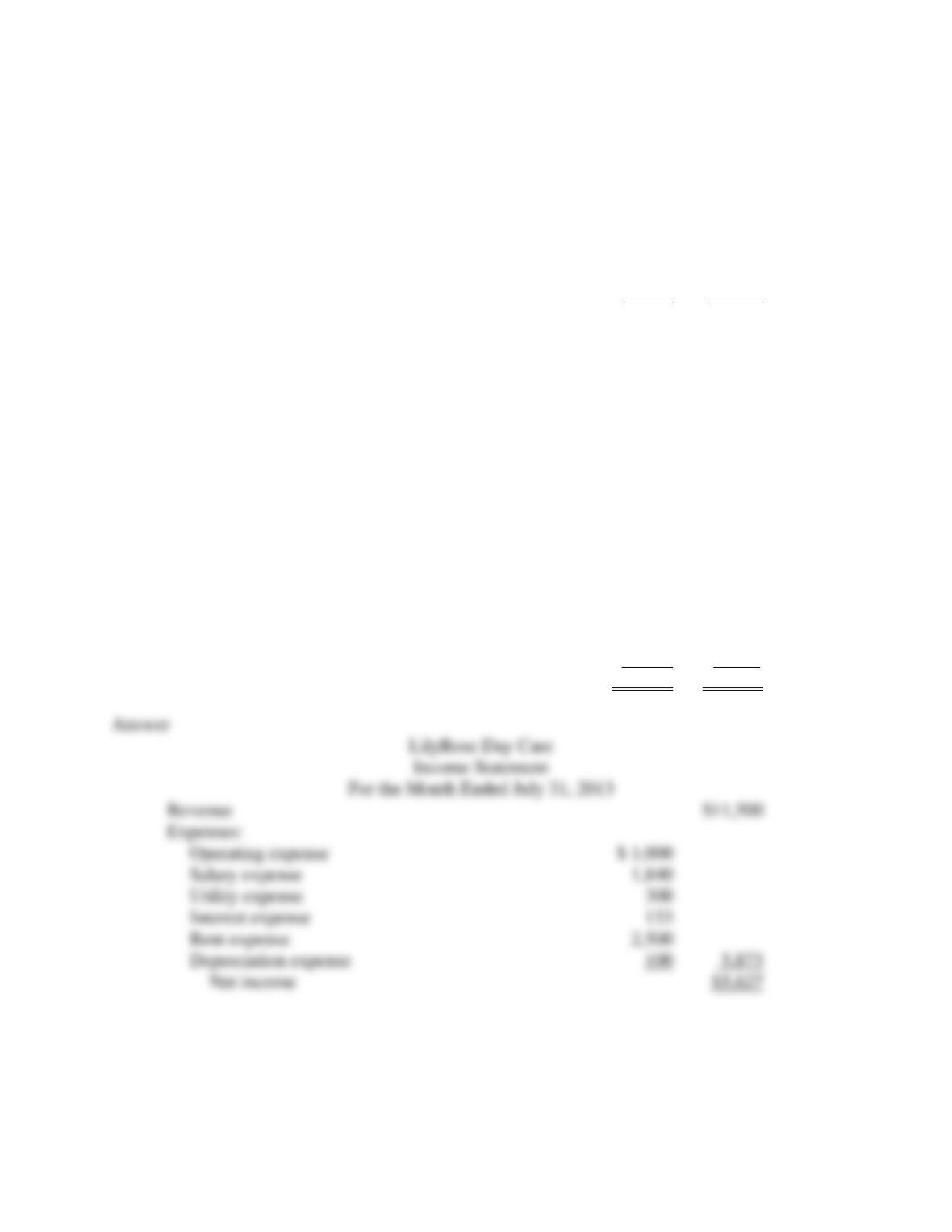
34. (Preparation of financial statements)
(This problem is based on the transactions for problem 33.)
Following is a trial balance for LilyRose Day Care, as of July 31, 2013, the end of
its first month of business. Based on the trial balance, prepare an income statement
for the month ended July 31, 2013, a statement of changes in owner’s equity for the
month ended July 31, 2013, and a balance sheet as of July 31, 2013.
Debits Credits
Cash $27,400
Accounts receivable 500
Prepaid rent 2,500
Equipment 6,000
Accumulated depreciation, equipment $100
Accounts payable 300
Salaries payable 240
Interest payable 133
Notes payable 20,000
L. Rose, Capital 10,000
Revenues 11,500
Operating expense 1,000
Salary expense 1,840
Utility expense 300
Interest expense 133
Rent expense 2,500
Depreciation expense 100
Totals $42,273 $42,273
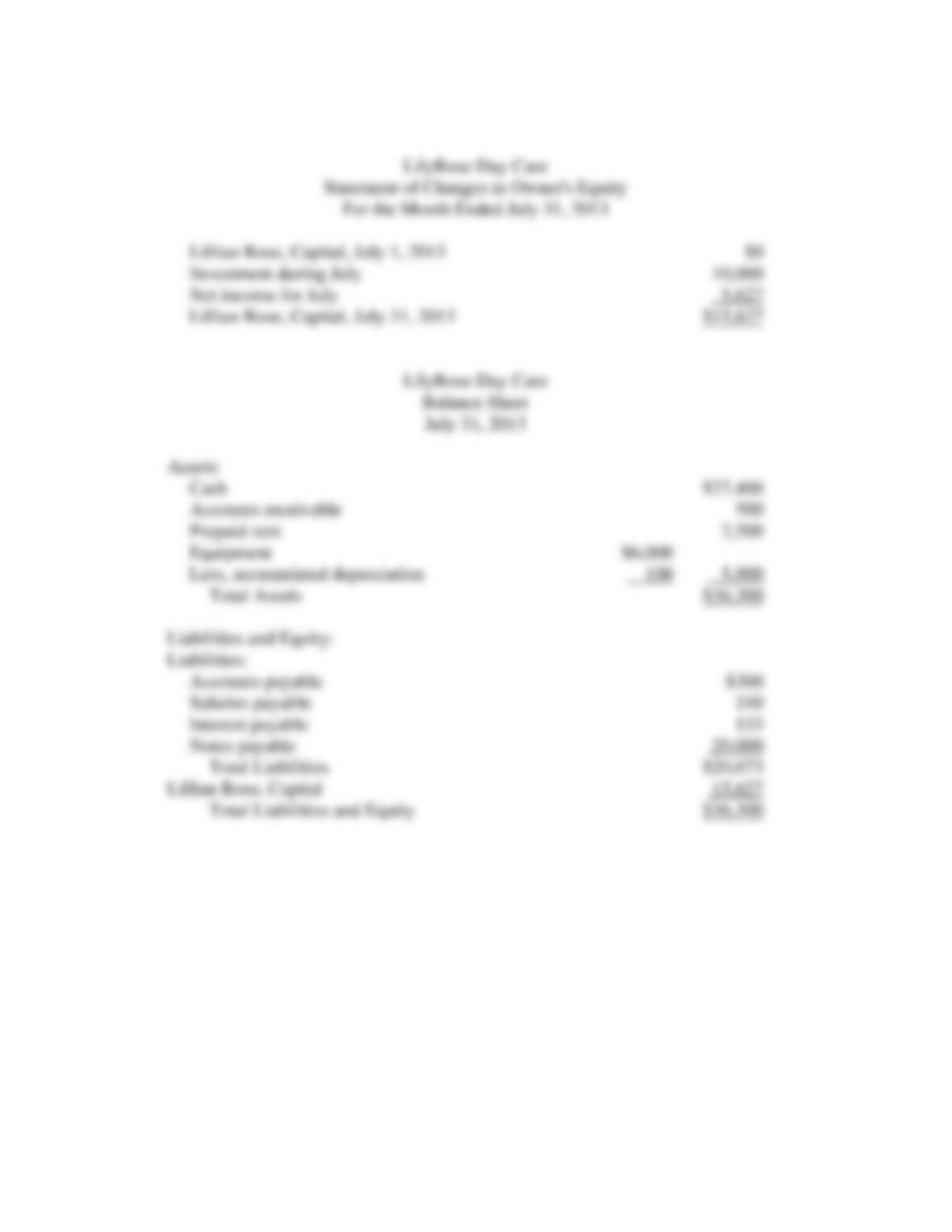
Answer (Problem 34 – continued)
35. (Transaction analysis, journal entries, and adjusting journal entries)
Ricardo Sanchez repairs automobiles. He started calendar year 2013 year with the
following account balances: Cash – $5,000; Accounts receivable – $30,000;
Allowance for uncollectible accounts – $3,000; Repair parts inventory – $23,000;
Equipment – $60,000; Accumulated depreciation – $25,000; Accounts payable –
$10,000; and R. Sanchez, Capital -$80,000. The following transactions occurred
during the month of January.
a. Ricardo paid rent of $8,000 for the months of January and February.
b. He purchased $10,000 of repair parts for inventory. The purchase was
made on credit.
c. He paid outstanding invoices in the amount of $12,000.
d. He billed customers a total of $35,000 for repair services.
e. In performing the repairs in transaction d., he used repair parts that cost
him $13,000.
f. He received $40,000 from his customers against previous billings for
repair work.
g. One of his customers, who owed him $2,000, went bankrupt. Ricardo
received $400 in cash and wrote off the remaining $1,600 as a bad debt.
h. He paid his mechanics $8,000 for four weeks’ salary.
i. He used $10,000 of his idle cash to purchase a short-term certificate of
deposit (CD). The CD pays interest at the rate of 3% a year.
j. He purchased new equipment for $5,000 on credit.
Ricardo wants financial statements at the end of the month. The following adjusting
journal entries are needed:
k. To recognize one month’s depreciation on the $60,000 of equipment on
hand at the beginning of the month. Ricardo assumes the equipment will
have a 10-year life.
l. To recognize estimated bad debts. Ricardo wants to provide for additional
bad debts at the rate of 2% of the month’s billings (see transaction d.)
m. To recognize unpaid salaries of $1,200 for the last few days in January.
n. To recognize interest earned for one-month on the CD purchased in
transaction i., above.
o. To recognize the expiration of one month’s rent paid in transaction a.
Required:
a. Analyze the above transactions on a work sheet. The work sheet should show columns
for individual accounts classified as cash, other assets, liabilities, and equity.
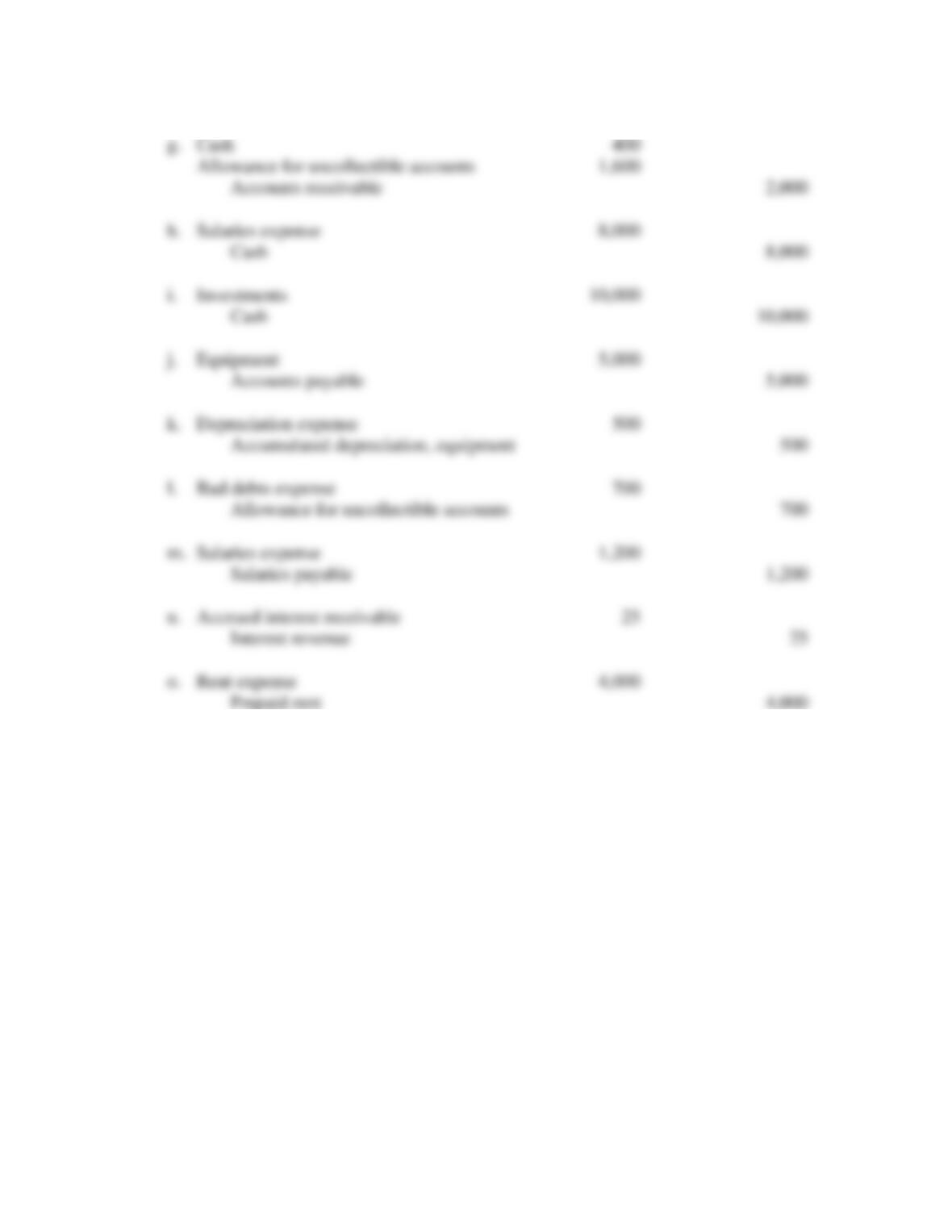
b. Prepare journal entries to record all of the above transactions.
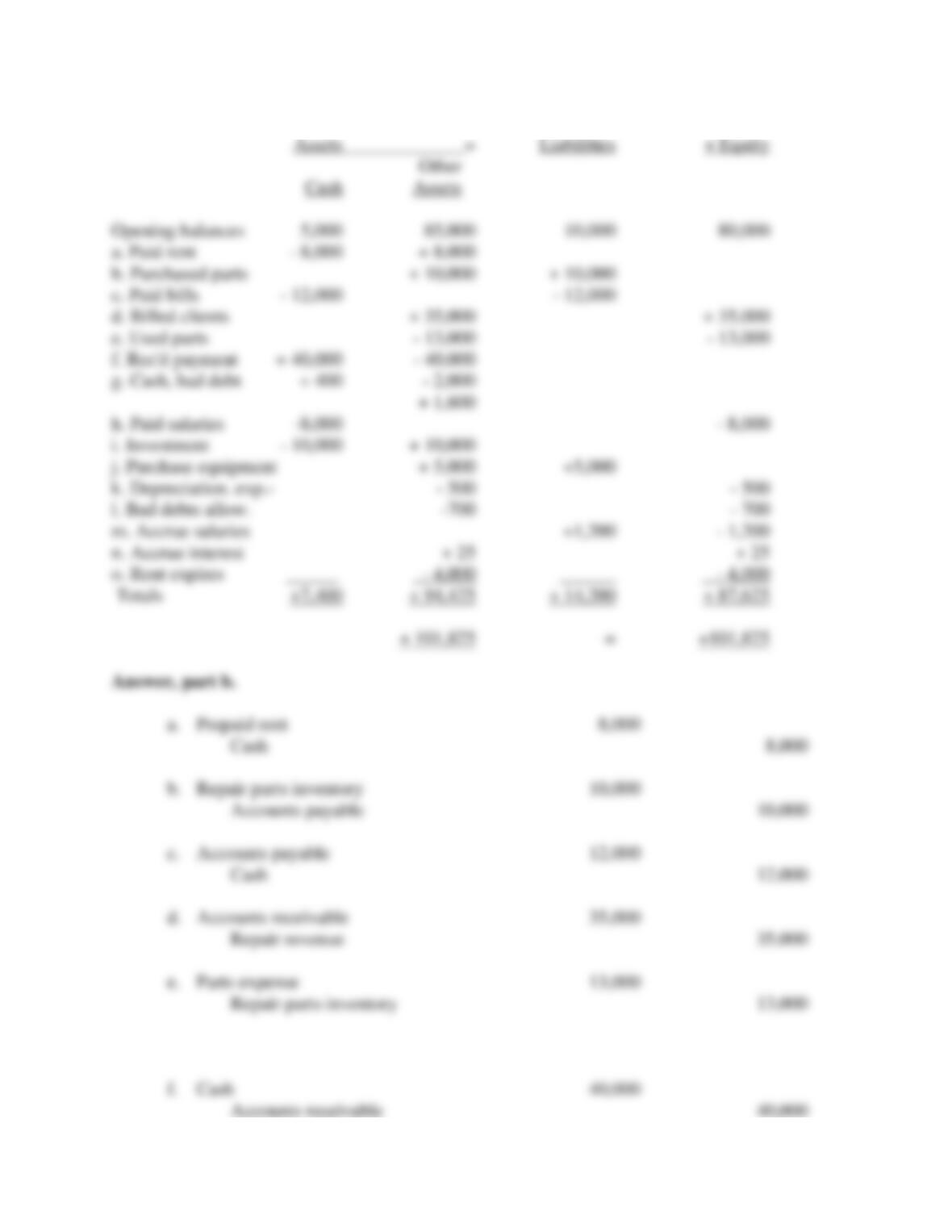
Answer (Problem 35, part a.)
36. (Preparation of financial statements)
(This problem is based on the transactions for problem 35.)
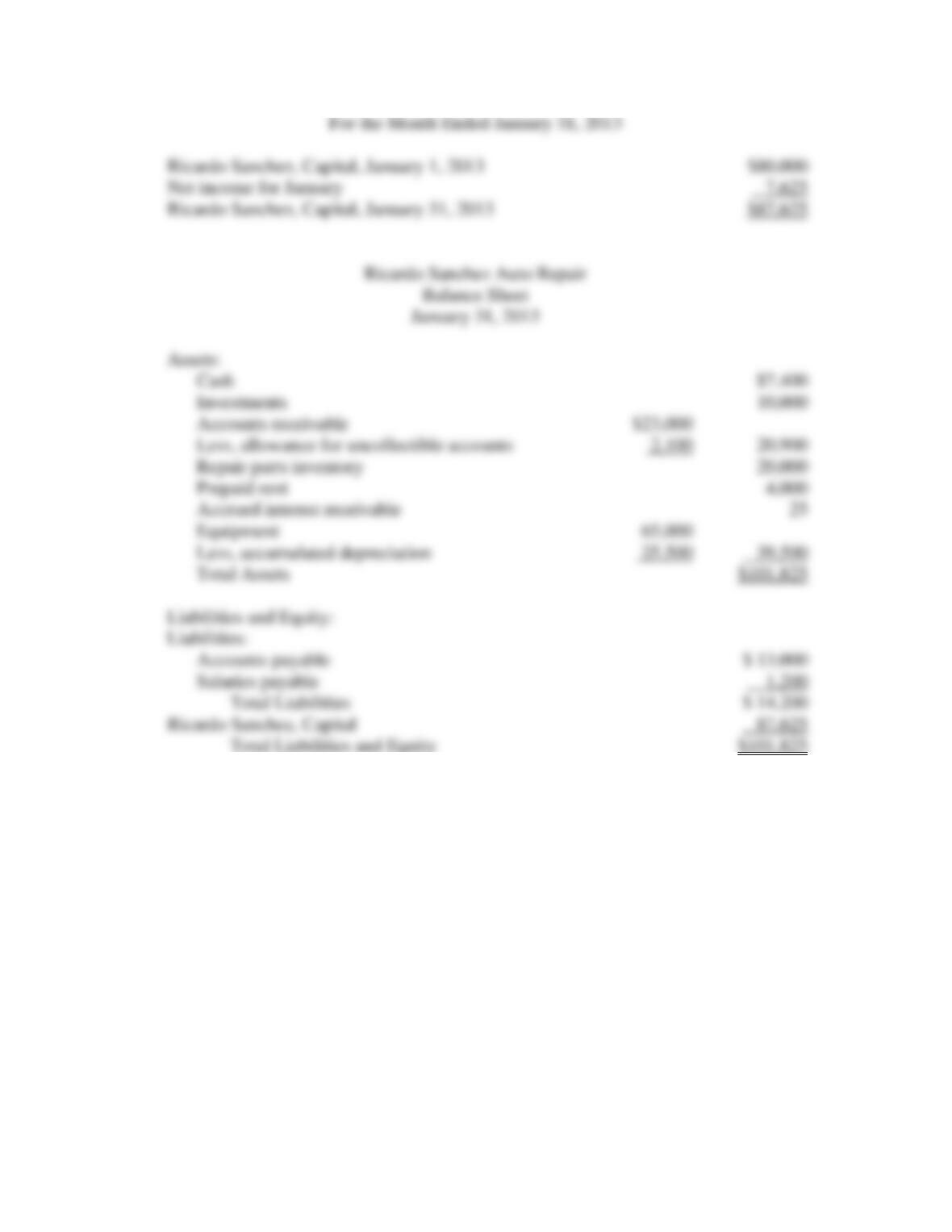
Following is a trial balance for Ricardo Sanchez’s Auto Repair as of January 31, 2013. Prepare
an (1) income statement and a (2) statement of changes in owner’s equity for the month ended
January 31, 2013, and a (3) balance sheet as of January 31, 2013.
Debits Credits
Cash $7,400
Investments 10,000
Accounts receivable 23,000
Accrued interest receivable 25
Allowance for uncollectible accounts $2,100
Repair parts inventory 20,000
Prepaid rent 4,000
Equipment 65,000
Accumulated depreciation, equipment 25,500
Accounts payable 13,000
Salaries payable 1,200
R. Sanchez, Capital 80,000
Repair revenue 35,000
Parts expense 13,000
Salaries expense 9,200
Rent expense 4,000
Bad debts expense 700
Depreciation expense 500
Interest revenue 25
Totals $156,825 $156,825