90. At December 31, 2010, Wilkerson had the following portfolio of equity securities available for sale:
Cost
Market Value
Bark Co. stock
$30
$32
Howl Co. stock
90
84
Required:
a.
Assuming any gain or loss is considered to be temporary, prepare the adjusting
entry required under current GAAP.
b.
Assuming that, in 2011, Wilkerson sold the Howl Co. stock for $83, record the
sale.
c.
Assuming that the portfolio at the end of 2011 is composed of the following
holdings, prepare any necessary entry.
Cost
Market Value
Bark Co. stock
$30
$32
Yelp Co. stock
70
59
d.
Assuming that the portfolio at the end of 2012 is composed of the following
holdings, prepare any necessary entry.
Cost
Market Value
Gnaw Co. bonds
$100
$95
Bark Co. stock
30
35
Yelp Co. bonds
70
63
e.
Assuming that, in 2013, the Gnaw Co. bonds were reclassified as held to maturity
when the market value was $94, prepare any necessary entry.
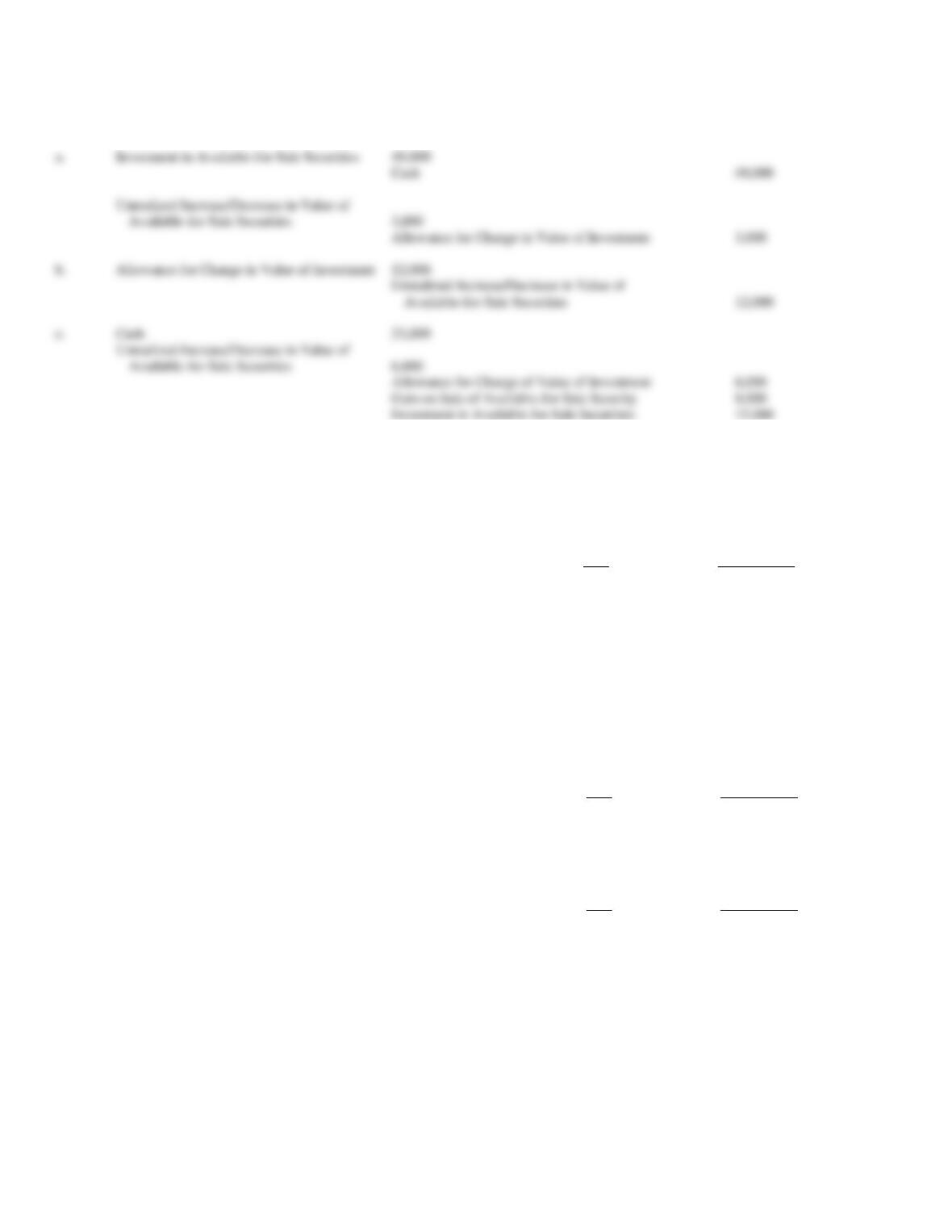
Investment in Available-for-Sale Securities
49,000
Cash
49,000
Unrealized Increase/Decrease in Value of
Available-for-Sale Securities
3,000
Allowance for Change in Value of Investment
3,000
b.
Allowance for Change in Value of Investment
12,000
Unrealized Increase/Decrease in Value of
Available-for-Sale Securities
12,000
Cash
23,000
Unrealized Increase/Decrease in Value of
Available-for-Sale Securities
6,000
Allowance for Change of Value of Investment
6,000
Gain on Sale of Available-for-Sale Security
8,000
Investment in Available-for-Sale Securities
15,000
91. On August 31, 2010, Merry Company acquired four $1,000 face value bonds with a 10% interest rate at face
value plus accrued interest. Interest on the bonds is paid semiannually on March 31 and September 30. At
December 31, 2010, the bonds are quoted at 96. The decline in value is deemed temporary. Assume that the
bonds were classified as available for sale.
Required:
a.
Prepare the journal entries to record Merry’s transactions in temporary investments in bonds for 2010.
b.
Now assume that the bonds were sold on December 31 at 96 plus accrued interest. Prepare the journal entry to reflect this transaction.
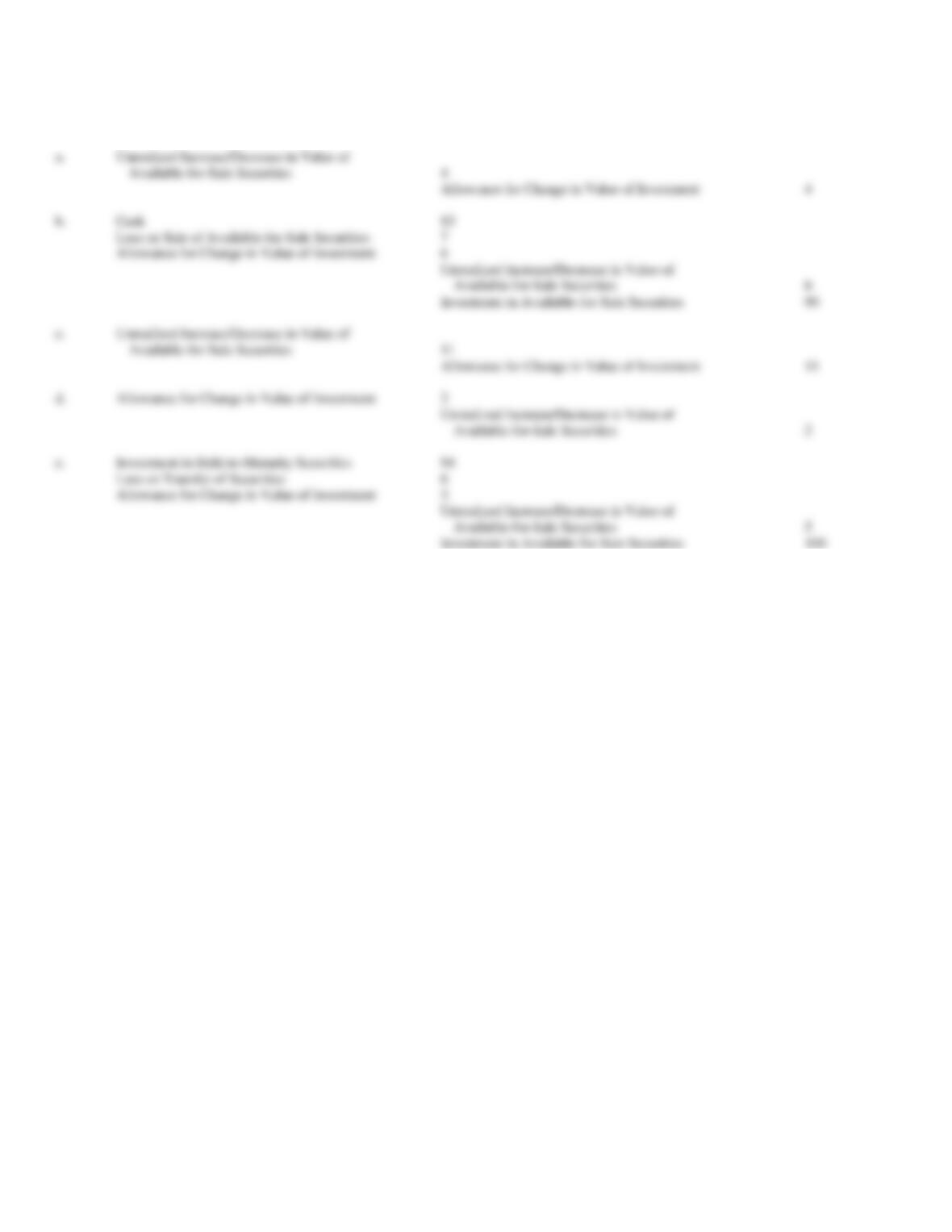
a.
Unrealized Increase/Decrease in Value of
Available-for-Sale Securities
4
b.
Cash
83
Loss on Sale of Available-for-Sale Securities
7
Unrealized Increase/Decrease in Value of
Available-for-Sale Securities
6
Investment in Available-for-Sale Securities
90
Available-for-Sale Securities
11
Allowance for Change in Value of Investment
11
Unrealized Increase/Decrease in Value of
Available-for-Sale Securities
2
Loss on Transfer of Securities
6
Allowance for Change in Value of Investment
5
Unrealized Increase/Decrease in Value of
Investment in Available-for-Sale Securities
100
92. On May 1, 2010, Edsel, Inc. bought 300 of DeSoto, Inc.’s $1,000, 10% bonds that pay interest on January 1
and July 1. They were bought at 101 plus accrued interest. On December 1, 2010, 60 of the bonds were sold at
106. Edsel classified the bonds as securities available for sale.
Required:
Journalize the sale on December 1, 2010.
93. In 2010, Buckeye Corporation, for the first time, invested some idle funds in a variety of securities classified
as available for sale, as described below:
Purchase
Per Unit
Sept. 30, 2010
Number of Shares
Security
Date
Cost
Quoted Market
or $1,000 Bonds
Common stock A
March 10
$ 26
$ 24
300
Common stock B
15
15
16
100
Common stock C
17
20
20
200
8% bonds
April 1
990
970
10
The company’s year ends on December 31 and the bonds pay interest semiannually on January 1 and July 1.
Required:
Answer each of the following questions about Buckeye Corporation’s investments:
a.
Calculate the balance that should be in Allowance for Change in Value of Investment to properly value the securities in the portfolio at
the end of the third quarter, and indicate whether the balance will be a debit or credit balance.
b.
What was the amount of the discount or premium involved in the company’s purchase of the bonds?
c.
Ignoring amortization, how much did Buckeye record as interest revenue on the bond investment during the third quarter of 2010?
d.
At what value should the 8% bonds be carried on Buckeye’s balance sheet prepared as of September 30 if the decline in value is deemed
temporary?
94. On January 3, 2010, Matthew Corporation purchased the following equity securities as an investment:
Number of
Cost of
Total
Company
Shares
Share
Cost
A
400
$20
$ 8,000
B
2,000
12
24,000
C
800
22
17,600
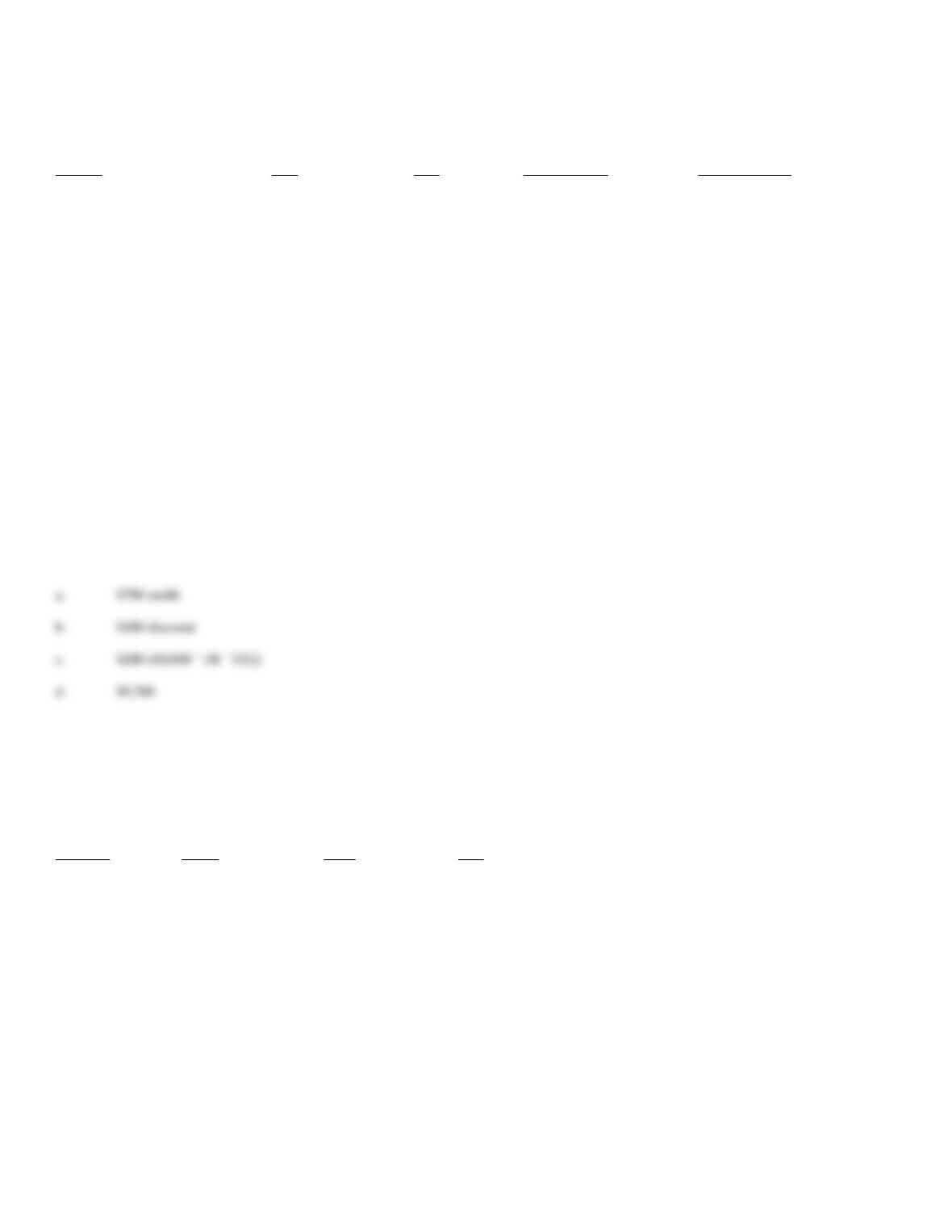
$700 credit
b.
$100 discount
$200 (10,000 ´ .08 ´ 3/12)
d.
$9,700
These securities are classified as available for sale.
Required:
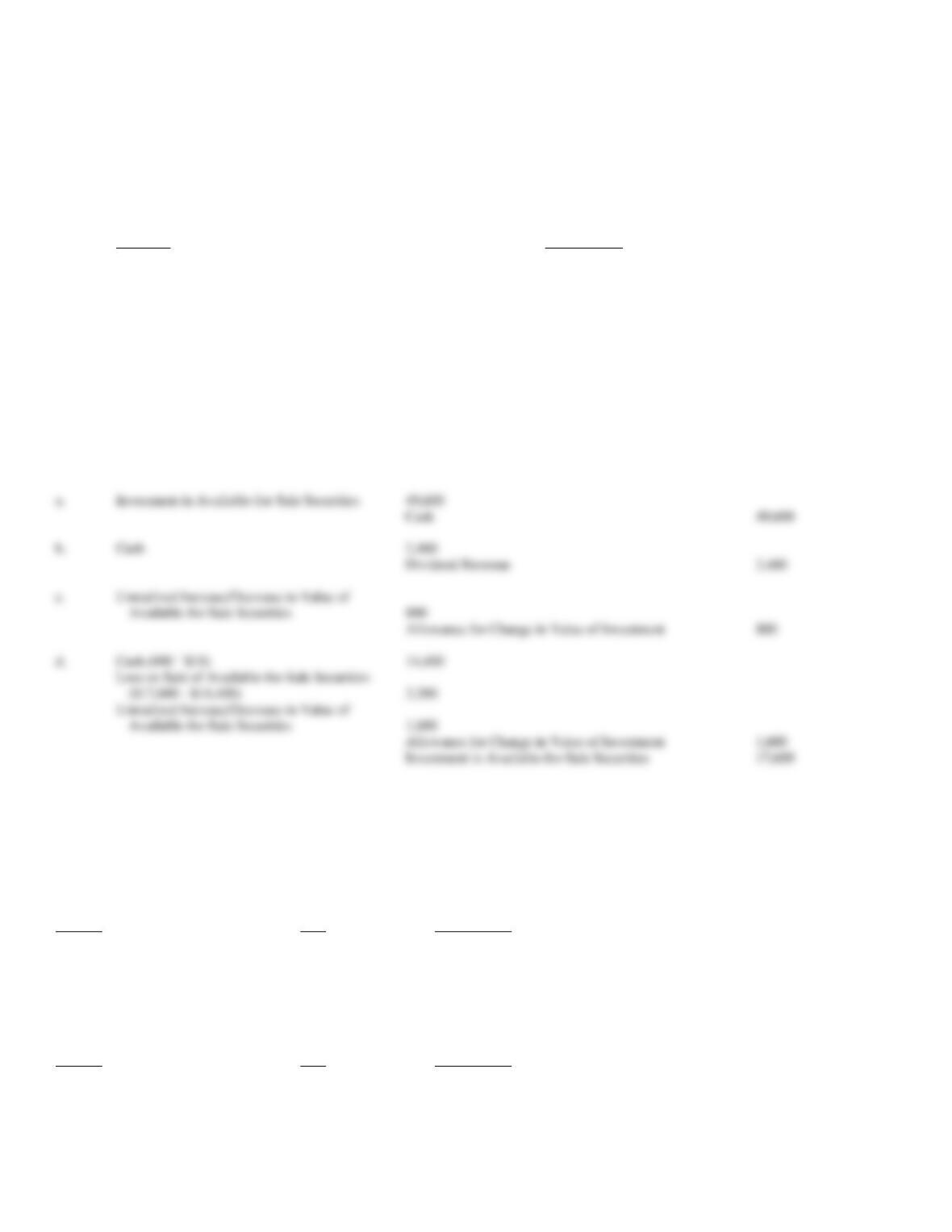
a.
Prepare the journal entry to record the acquisition of the stock.
b.
On June 30, 2010, C Company paid dividends of $3.00 per share. Prepare
the journal entry that would be used by Matthew to record the dividend
receipt.
c.
On December 31, 2010, the market values per share were:
Company
Market Value
A
$22
B
12
C
20
Prepare any journal entry or entries necessary to record these changes in
market value.
d.
On March 14, 2011, Matthew sold 800 shares of C Company for $18 per
share. Prepare the journal entry to record the sale.
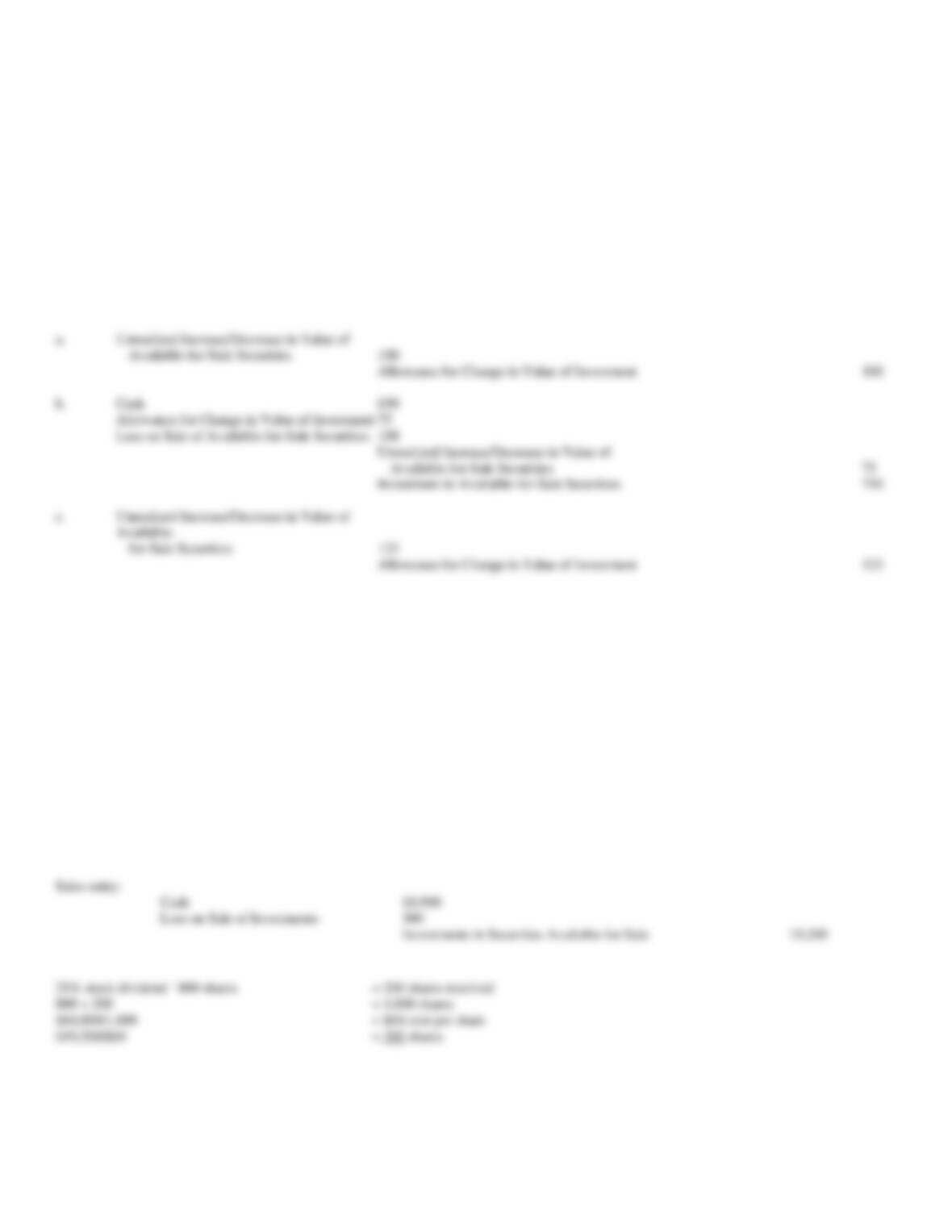
95. At December 31, 2010, Nuvi Co. held the following investments in stock that are classified as
available-for-sale securities. All investments were acquired in December 2010.
Security
Cost
Market Value
B
$1,500
$1,350
C
3,000
3,050
Changes in fair value were considered to be temporary. On March 1, 2011, half of the B Company stock was sold for $650. At December 31, 2011,
the following investments in stock were held by Nuvi:
Security
Cost
Market Value
B
$ 750
$ 550
C
3,500
3,850
a.
Investment in Available-for-Sale Securities
49,600
Cash
49,600
b.
Cash
2,400
Dividend Revenue
2,400
c.
Unrealized Increase/Decrease in Value of
Available-for-Sale Securities
800
Allowance for Change in Value of Investment
800
d.
Cash (800 ´ $18)
14,400
Loss on Sale of Available-for-Sale Securities
($17,600 – $14,400)
3,200
Unrealized Increase/Decrease in Value of
Available-for-Sale Securities
1,600
Allowance for Change in Value of Investment
1,600
Investment in Available-for-Sale Securities
17,600
Changes in fair value again were considered to be temporary.
Required:
Prepare journal entries for
a.
December 31, 2010
b.
March 1, 2011
c.
December 31, 2011
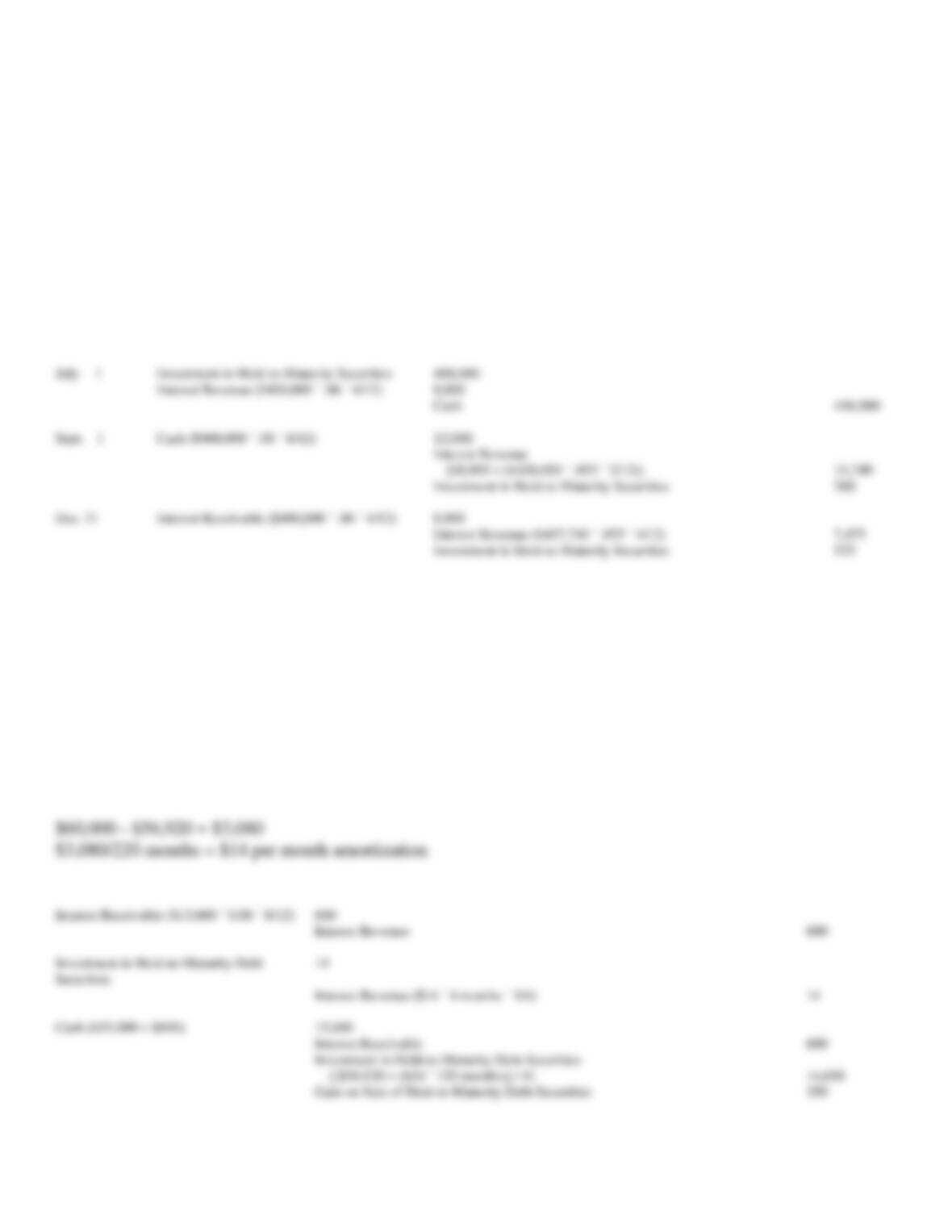
96. On January 1, 2010, Antlers, Inc. bought 800 shares (or 10%) of Buck Company’s stock at $80. On February
1, 2010, Buck Company declared a 25% stock dividend. On March 1, 2010, Antlers sold several shares of Buck
Company stock for $18,900, realizing a loss of $300.
Required:
Show the journal entry to record the sale, and compute the number of shares of Buck Company stock that
Antlers, Inc., sold.
Sales entry:
Cash
18,900
Loss on Sale of Investments
300
25% stock dividend ´ 800 shares
= 200 shares received
800 + 200
= 1,000 shares
$19,200/$64
a.
Unrealized Increase/Decrease in Value of
Allowance for Change in Value of Investment
b.
Cash
650
Loss on Sale of Available-for-Sale Securities
100
Unrealized Increase/Decrease in Value of
Available-for-Sale Securities
Allowance for Change in Value of Investment
97. On July 1, Smiley, Inc. purchased 400 of Queen Co.’s 6%, $1,000 bonds. The bonds, which pay interest on
March 1 and September 1, were purchased at 102 plus accrued interest to yield 5.5%. The investment was
classified as held-to-maturity securities.
Required:
Prepare journal entries for
a.
July 1
b.
September 1
c.
December 31
98. On September 1, 2005, Rutgers, Inc., bought $60,000 of Claremore Computers’ 20-year, 6% bonds dated
January 1, 2004, for $56,920 plus accrued interest. The bonds pay interest annually and are classified as held to
maturity. On September 1, 2015, Rutgers sold one-fourth of these bonds for $15,000 plus accrued interest. No
entries relating to the bonds had been made since December 31, 2014. Straight-line amortization was used.
Required:
Record the sale of these bonds.
Interest Receivable ($15,000 ´ 0.06 ´ 8/12)
Interest Revenue
600
Interest Revenue ($14 ´ 4 months ´ 1/4)
14
Cash ($15,000 + $600)
15,600
Interest Receivable
Investment in Held-to-Maturity Debt Securities
July 1
Investment in Held-to-Maturity Securities
408,000
Interest Revenue ($400,000 ´ .06 ´ 4/12)
8,000
Cash
Sept. 1
Cash ($400,000 ´ .06 ´ 6/12)
12,000
Interest Revenue
[$8,000 + ($408,000 ´ .055 ´ 2/12)]
Investment in Held-to-Maturity Securities
Dec. 31
Interest Receivable ($400,000 ´ .06 ´ 4/12)
8,000
Interest Revenue ($407,740 ´ .055 ´ 4/12)
Investment in Held-to-Maturity Securities
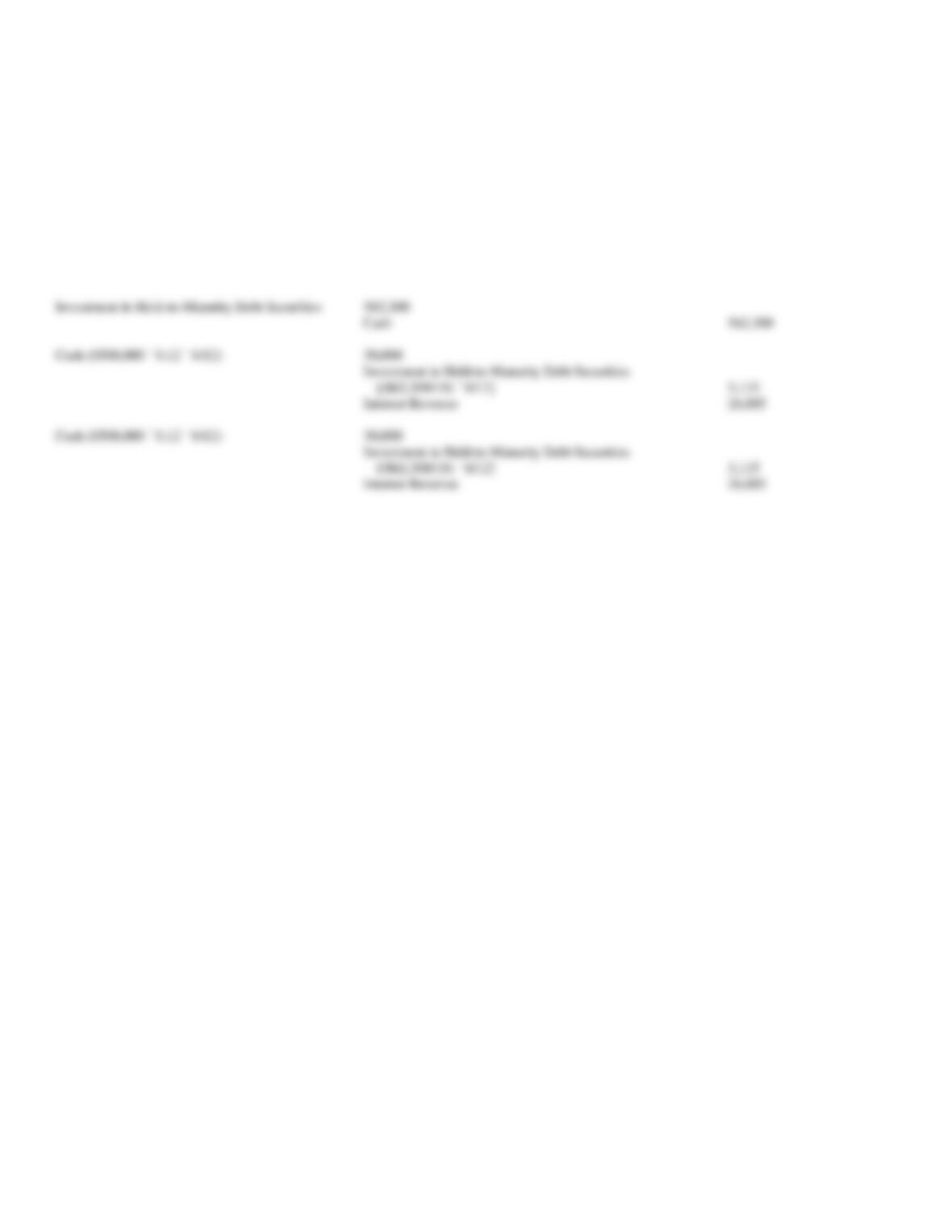
99. On January 2, 2010, Arrow Company acquired, as an investment, bonds with a face value of $500,000 for
$562,300 to be held to maturity. The bonds carry a stated interest rate of 12% and an effective yield of 10%.
Interest is paid on June 30 and December 31, and the bonds mature on December 31, 2019.
Required:
Prepare the journal entries necessary to record the purchase of the bonds and the first two interest receipts using
the straight-line method of amortization.
100. On May 1, 2010, Willie bought $40,000 of Rangel’s 12%, 10-year bonds for $40,308, which includes
accrued interest. The bonds pay interest semiannually, mature on June 30, 2013, and are classified as held to
maturity. Willie uses straight-line amortization.
Required:
a.
Record amortization at June 30, 2010.
b.
Record the sale of one half of the bonds at 101 plus accrued interest on November 1, 2011. Assume amortization was correctly recorded
each June 30 and December 31.
Investment in Held-to-Maturity Debt Securities
562,300
Cash
562,300
Investment in Held-to-Maturity Debt Securities
[($62,300/10) ´ 6/12]
3,115
Interest Revenue
26,885
Cash ($500,000 ´ 0.12 ´ 6/12)
30,000
Investment in Held-to-Maturity Debt Securities
[($62,300/10) ´ 6/12]
3,115
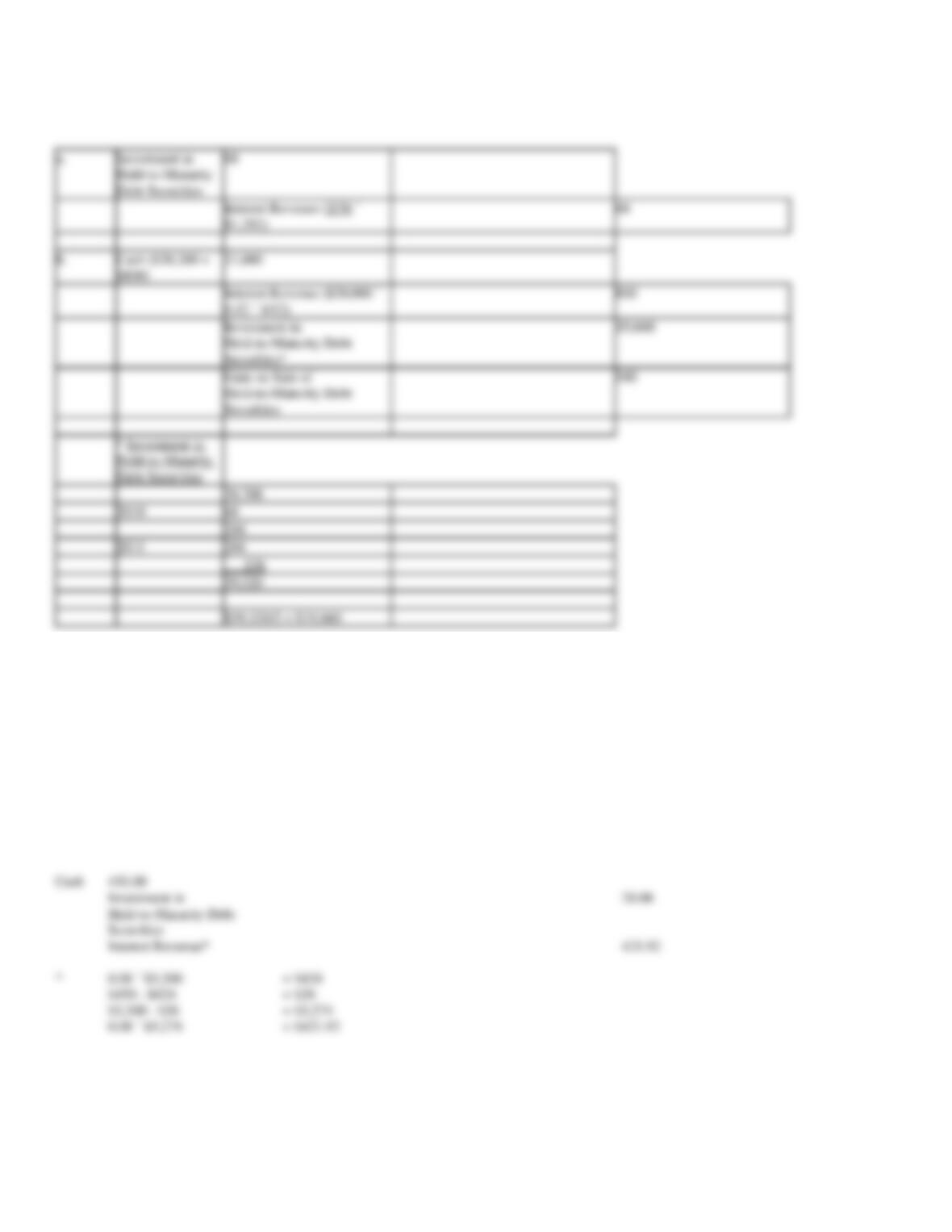
101. On January 1, 2010, Waterson Corp. bought $5,000 of Voltaire Co.’s 9% ten-year bonds for $5,300 to yield
8%. The bonds pay interest annually and are classified as held to maturity.
Required:
Using the effective interest method, journalize the receipt of the interest and amortization at December 31,
2011.
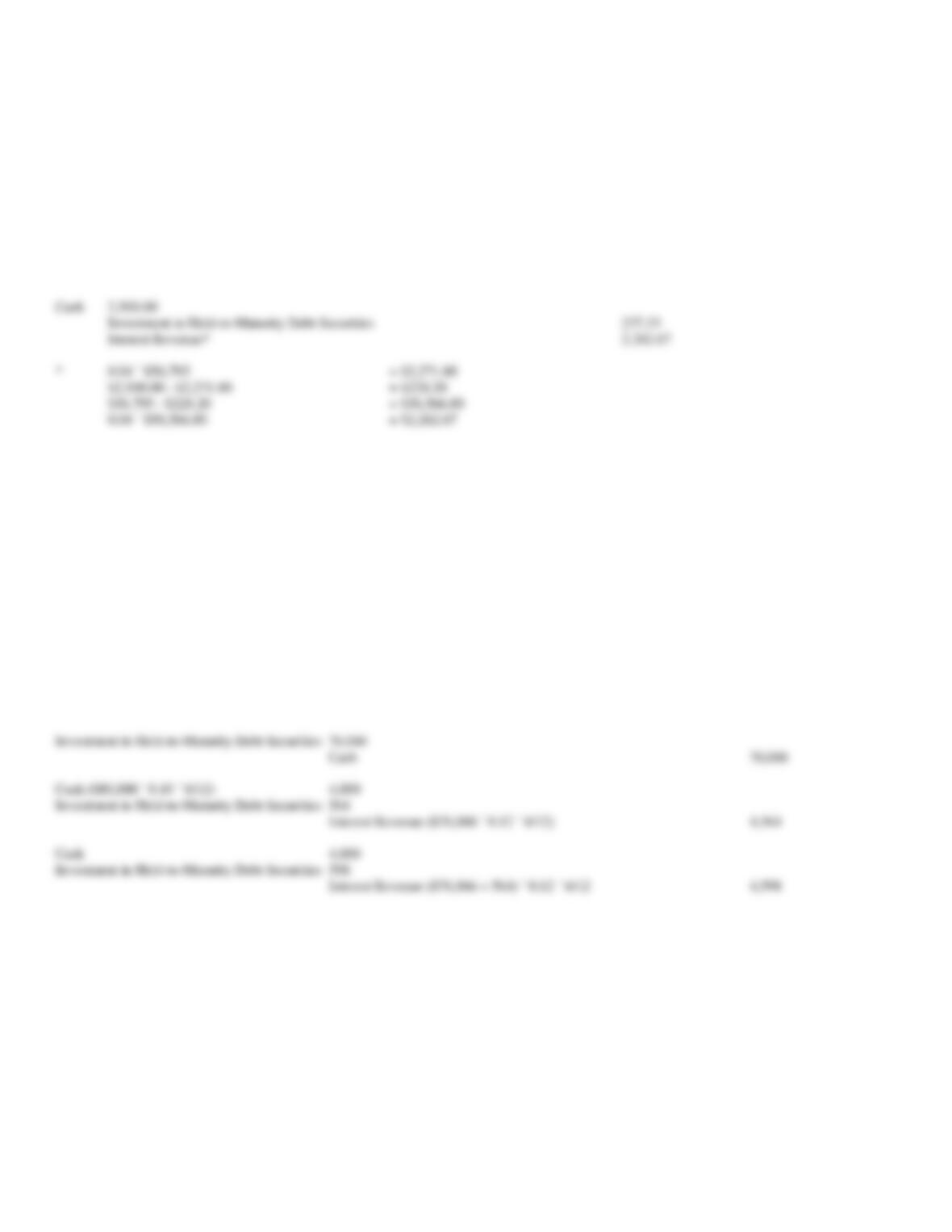
102. On January 1, 2010, Buster, Inc. bought $50,000 of 10% ten-year bonds of Brown Co. for $56,795 to yield
8% annually. The bonds pay interest semiannually and are classified as held to maturity. Interest is paid on June
30 and December 31.
Required:
Using the effective interest method, journalize the receipt of the interest and amortization at December 31,
2010.
103. On January 1, 2010, Gonzales Company acquired bonds with a face value of $80,000 for $76,066. The
bonds carry a stated interest rate of 10% and an effective yield of 12%. Interest is payable on June 30 and
December 31, the bonds mature on December 31, 2012, and they are classified as held to maturity.
Required:
Prepare the journal entries necessary by Gonzales to record the purchase of bonds and the first two interest
receipts using the effective interest method of amortization. Round to the nearest dollar.
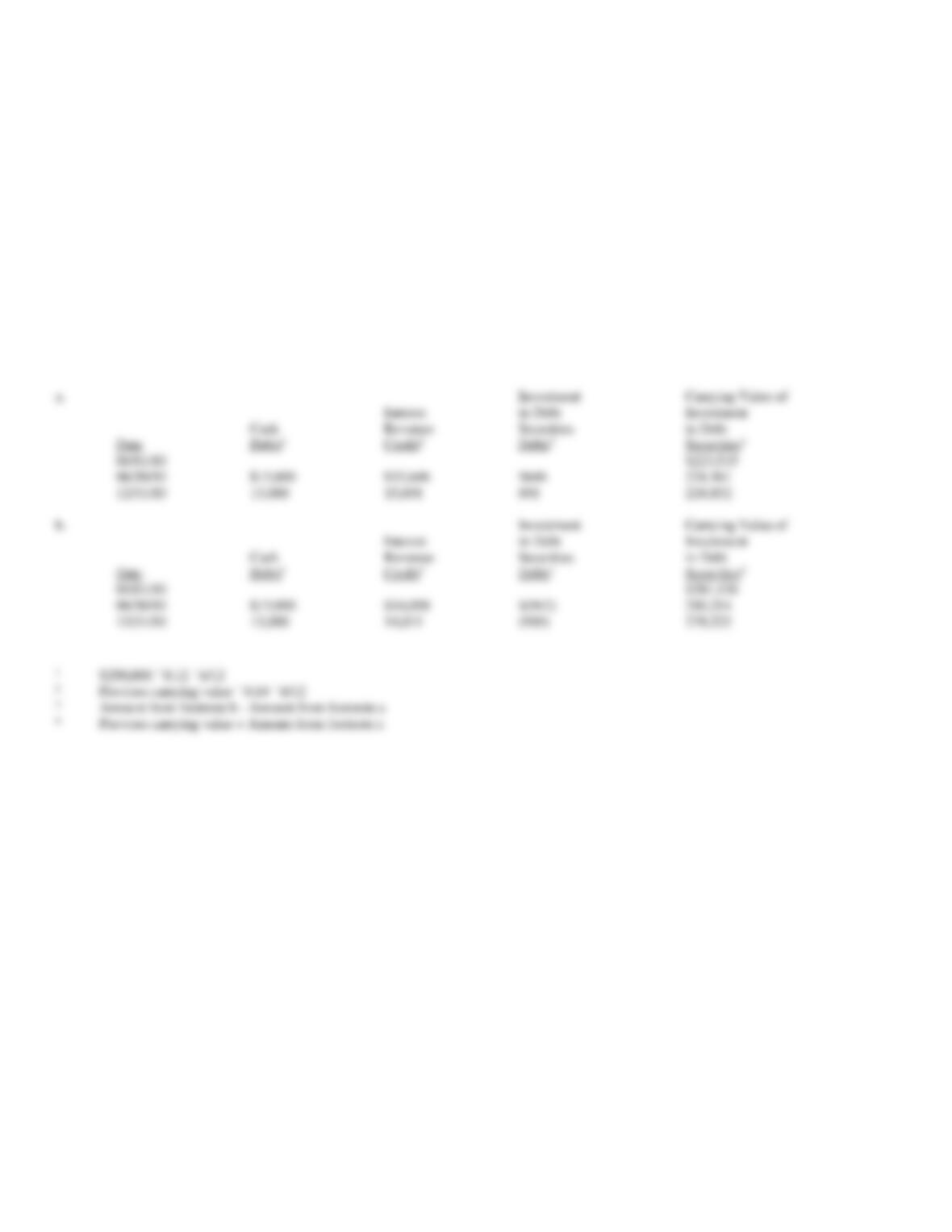
104. On January 1, 2010, the Wender Company acquired 12% bonds with a face value of $250,000 and
classified as held to maturity. The bonds pay interest on June 30 and December 31, and mature on December
31, 2019.
Required:
a.
Assume the bonds were acquired for $223,515 to yield 14%. Prepare an investment discount amortization schedule for the first year of
the investment, using the effective interest method. Round all calculations to the nearest dollar.
b.
Assume the bonds were acquired for $281,156 to yield 10%. Prepare an investment premium amortization schedule for the first year of
the investment using the effective interest method. Round all calculations to the nearest dollar.