112) The rate established at the beginning of a period that uses estimated overhead and an
allocation factor such as estimated direct labor, and that is used to assign overhead cost to jobs, is
the:
A) Predetermined overhead rate.
B) Overhead variance rate.
C) Estimated labor cost rate.
D) Chargeable overhead rate.
E) Miscellaneous overhead rate.
113) Kayak Company uses a job order costing system and allocates its overhead on the basis of
direct labor costs. Kayak Company’s production costs for the year were: direct labor, $30,000;
direct materials, $50,000; and factory overhead applied $6,000. The predetermined overhead rate
was:
A) 5.0%.
B) 12.0%.
C) 20.0%.
D) 500.0%.
E) 16.7%.
114) Lowden Company has a predetermined overhead rate of 160% and allocates overhead
based on direct material cost. During the current period, direct labor cost is $50,000 and direct
materials cost is $80,000. How much overhead cost should Lowden Company should apply in
the current period?
A) $31,250.
B) $50,000.
C) $80,000.
D) $128,000.
E) $208,000.
115) The overhead cost applied to a job during a period is recorded with a credit to Factory
Overhead and a debit to:
A) Jobs Overhead Expense.
B) Cost of Goods Sold.
C) Finished Goods Inventory.
D) Indirect Labor.
E) Work in Process Inventory.
116) CWN Company uses a job order costing system and last period incurred $80,000 of actual
overhead and $100,000 of direct labor. CWN estimates that its overhead next period will be
$75,000. It also expects to incur $100,000 of direct labor cost. If CWN bases applied overhead
on direct labor cost, its predetermined overhead rate for the next period should be:
A) 75%.
B) 80%.
C) 107%.
D) 125%.
E) 133%.
117) Cosi Company uses a job order costing system and allocates its overhead on the basis of
direct labor costs. Cosi expects to incur $800,000 of overhead during the next period, and
expects to use 50,000 labor hours at a cost of $10.00 per hour. What is Cosi
Company’s predetermined overhead rate?
A) 6.25%.
B) 62.5%.
C) 160%.
D) 1600%.
E) 67%.
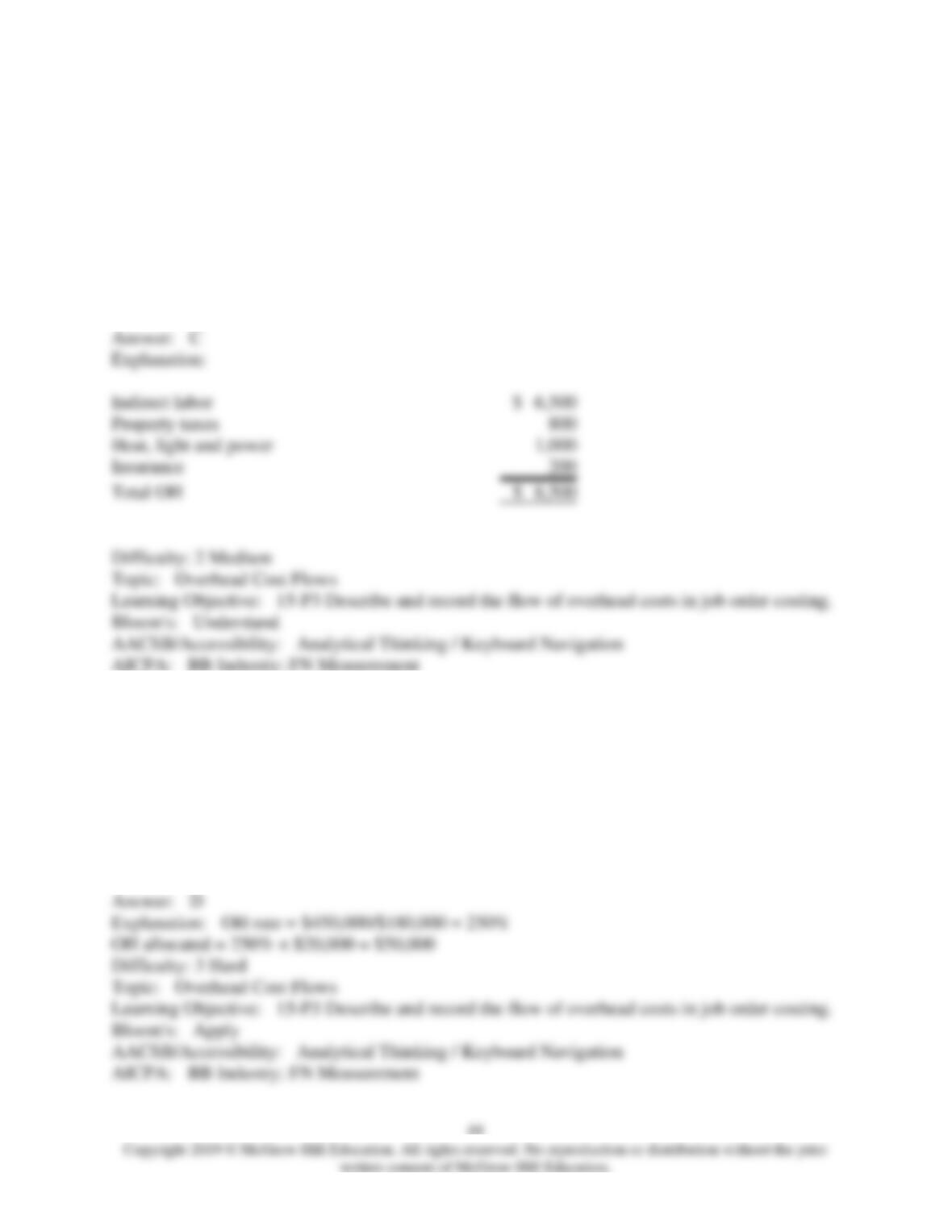
118) B&T Company’s production costs for May are: direct labor, $13,000; indirect labor, $6,500;
direct materials, $15,000; property taxes on production facility, $800; factory heat, lights and
power, $1,000; and insurance on plant and equipment, $200. B&T Company’s factory overhead
incurred for May is:
A) $2,000.
B) $6,500.
C) $8,500.
D) $21,500.
E) $36,500.
119) Mesa Corp. allocates overhead to production on the basis of direct labor costs. Mesa’s total
estimated overhead is $450,000 and estimated direct labor is $180,000. Determine the amount of
overhead applied to a job which used $20,000 of direct labor.
A) $8,000.
B) $20,000.
C) $70,000.
D) $50,000.
E) $90,000.
120) Dallas Company uses a job order costing system. The company’s executives estimated that
direct labor would be $2,000,000 (200,000 hours at $10/hour) and that factory overhead would
be $1,500,000 for the current period. At the end of the period, the records show that there had
been 180,000 hours of direct labor and $1,200,000 of actual overhead costs. Using direct labor
hours as a base, what was the predetermined overhead rate?
A) $6.00 per direct labor hour.
B) $7.50 per direct labor hour.
C) $6.67 per direct labor hour.
D) $8.33 per direct labor hour.
E) $7.08 per direct labor hour.
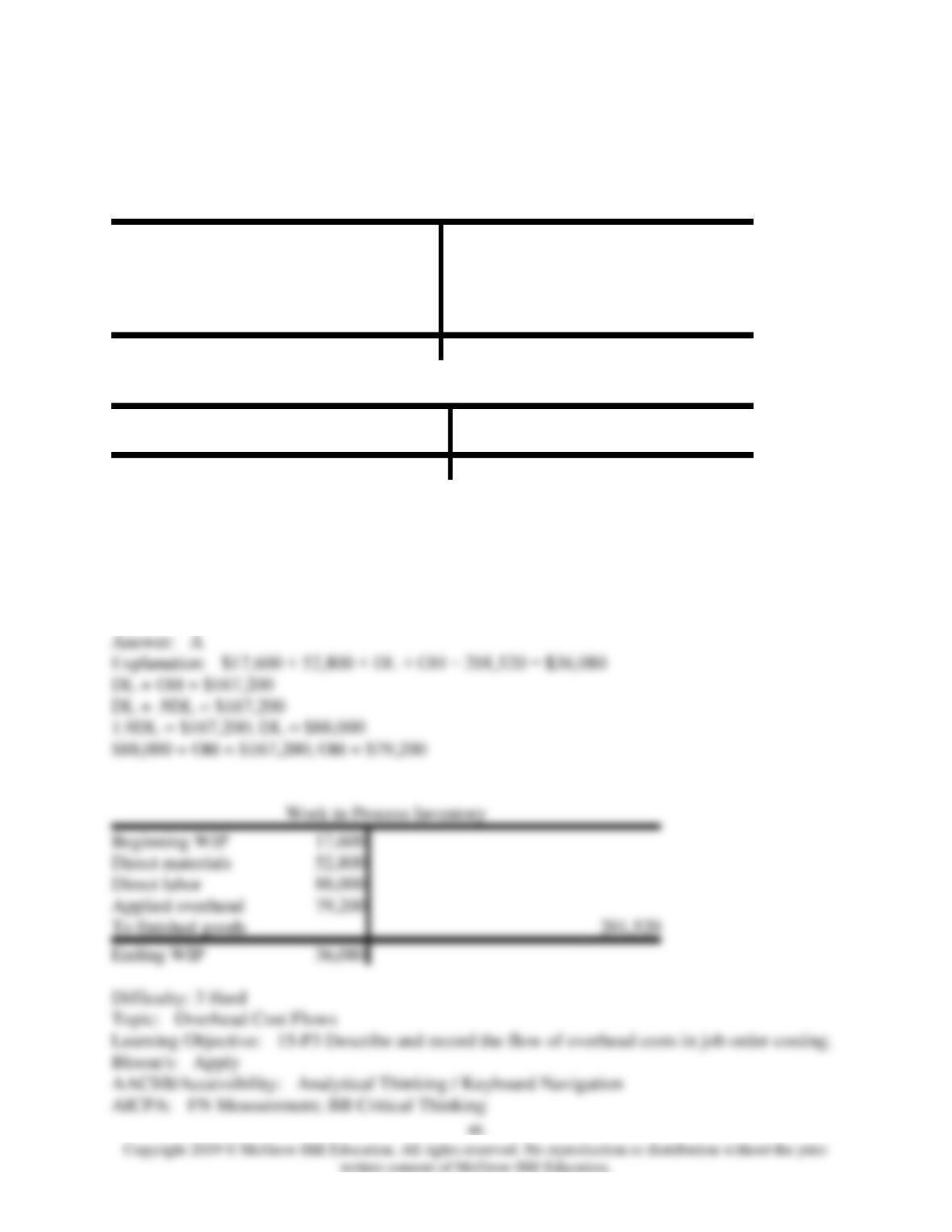
121) Using the following accounts and a predetermined overhead rate of 90% of direct labor
cost, determine the amount of applied overhead.
Work in Process Inventory
Beginning WIP
17,600
Direct materials
52,800
Direct labor
?
Applied overhead
?
To finished goods
?
Ending WIP
36,080
Finished Goods Inventory
Beginning FG
5,200
201,520
Ending FG
A) $79,200.
B) $167,200.
C) $34,320.
D) $88,000.
E) $35,376.
Beginning WIP
17,600
Direct materials
52,800
Direct labor
88,000
Applied overhead
79,200
To finished goods
201,520
Ending WIP
36,080
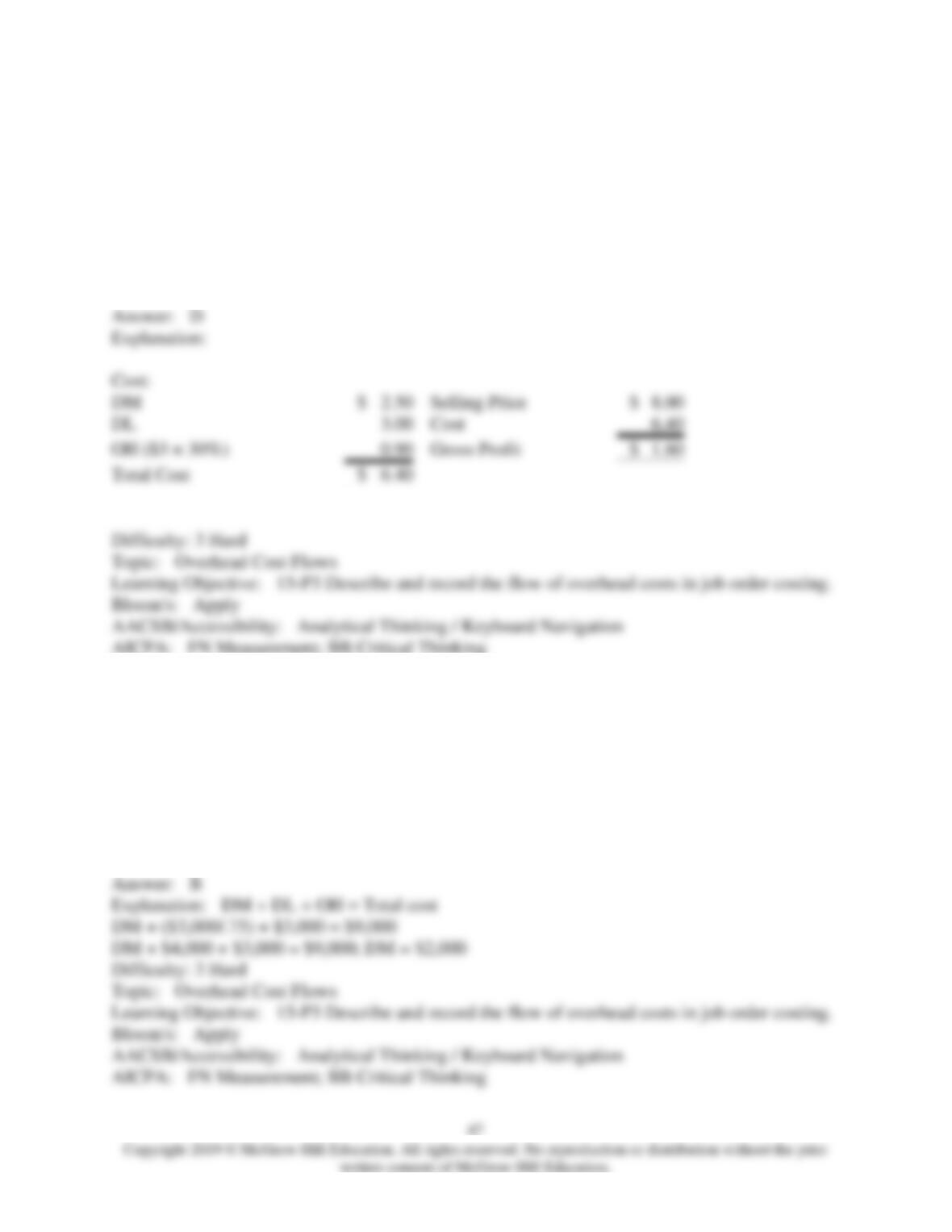
122) If one unit of Product Z2 used $2.50 of direct materials and $3.00 of direct labor, sold for
$8.00, and was assigned overhead at the rate of 30% of direct labor costs, how much gross profit
was realized from this sale?
A) $8.00.
B) $5.50.
C) $2.50.
D) $1.60.
E) $0.90.
123) The ending inventory of finished goods has a total cost of $9,000 and consists of 600 units.
If the overhead applied to these goods is $3,000, and the overhead rate is 75% of direct labor,
how much direct materials cost was incurred in producing these units?
A) $3,750.
B) $2,000.
C) $4,000.
D) $6,000.
E) $9,000.
124) At the current year-end, Ruiz Company found that its overhead was underapplied by
$2,500, and this amount was not considered material. Based on this information, Ruiz should:
A) close the $2,500 to Cost of Goods Sold.
B) close the $2,500 to Finished Goods Inventory.
C) do nothing about the $2,500, since it is not material, and it is likely that overhead will be
overapplied by the same amount next year.
D) carry the $2,500 to the income statement as “Other Expense”.
E) carry the $2,500 to the next period.
125) If overhead applied is less than actual overhead incurred, it is:
A) Fully applied.
B) Underapplied.
C) Overapplied.
D) Expected.
E) Normal.
126) The amount by which the overhead applied to jobs during a period exceeds the overhead
incurred during the period is known as:
A) Adjusted overhead.
B) Estimated overhead.
C) Predetermined overhead.
D) Underapplied overhead.
E) Overapplied overhead.
127) The amount by which overhead incurred during a period exceeds the overhead applied to
jobs is:
A) Balanced overhead.
B) Predetermined overhead.
C) Actual overhead.
D) Underapplied overhead.
E) Overapplied overhead.
128) If a company applies overhead to production with a predetermined overhead rate, a credit
balance in the Factory Overhead account at the end of the period means that:
A) The bookkeeper has made an error because the debits don’t equal the credits.
B) The balance will be carried forward to the next period as an overhead cost.
C) Actual overhead incurred was less than the overhead amount applied to production.
D) The overhead was underapplied for the period.
E) Actual overhead was greater than the overhead amount applied to production.
129) At year-end, Marshall Enterprise’s Factory Overhead account has a credit balance of
$5,000, which is not a material amount. What entry should Marshall make at year-end?
A) No entry is needed.
B) Debit Factory Overhead $5,000; credit Cost of Goods Sold $5,000.
C) Debit Cost of Goods Sold $5,000; credit Factory Overhead $5,000.
D) Debit Factory Overhead $5,000; credit Work in Process Inventory $5,000.
E) Debit Factory Overhead $5,000; credit Finished Goods Inventory $5,000.
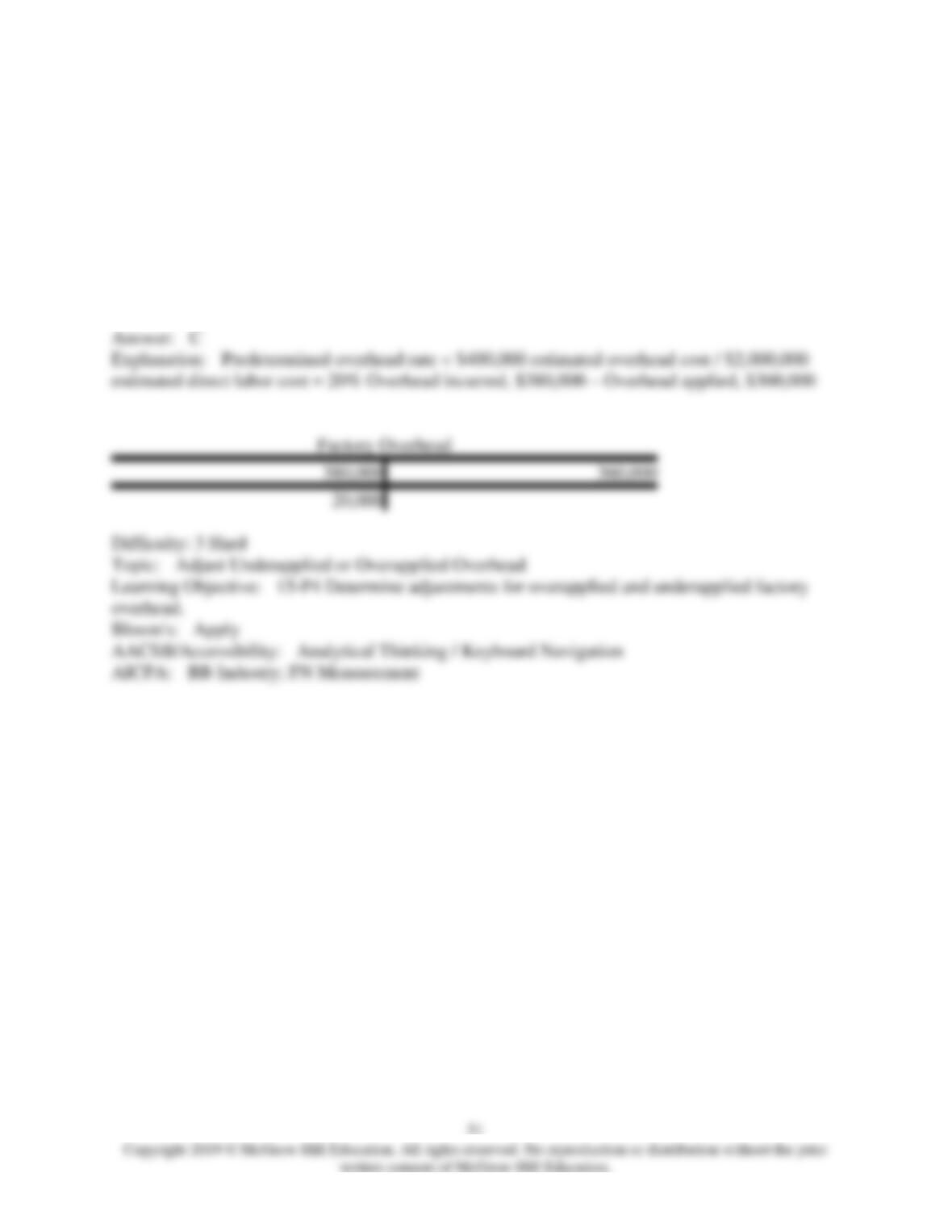
130) Morris Company applies overhead based on direct labor costs. For the current year, Morris
Company estimated total overhead costs to be $400,000, and direct labor costs to be $2,000,000.
Actual overhead costs for the year totaled $380,000, and actual direct labor costs totaled
$1,800,000. At year-end, the balance in the Factory Overhead account is a:
A) $380,000 Debit balance.
B) $360,000 Debit balance.
C) $20,000 Debit balance.
D) $400,000 Credit balance.
E) $20,000 Credit balance.
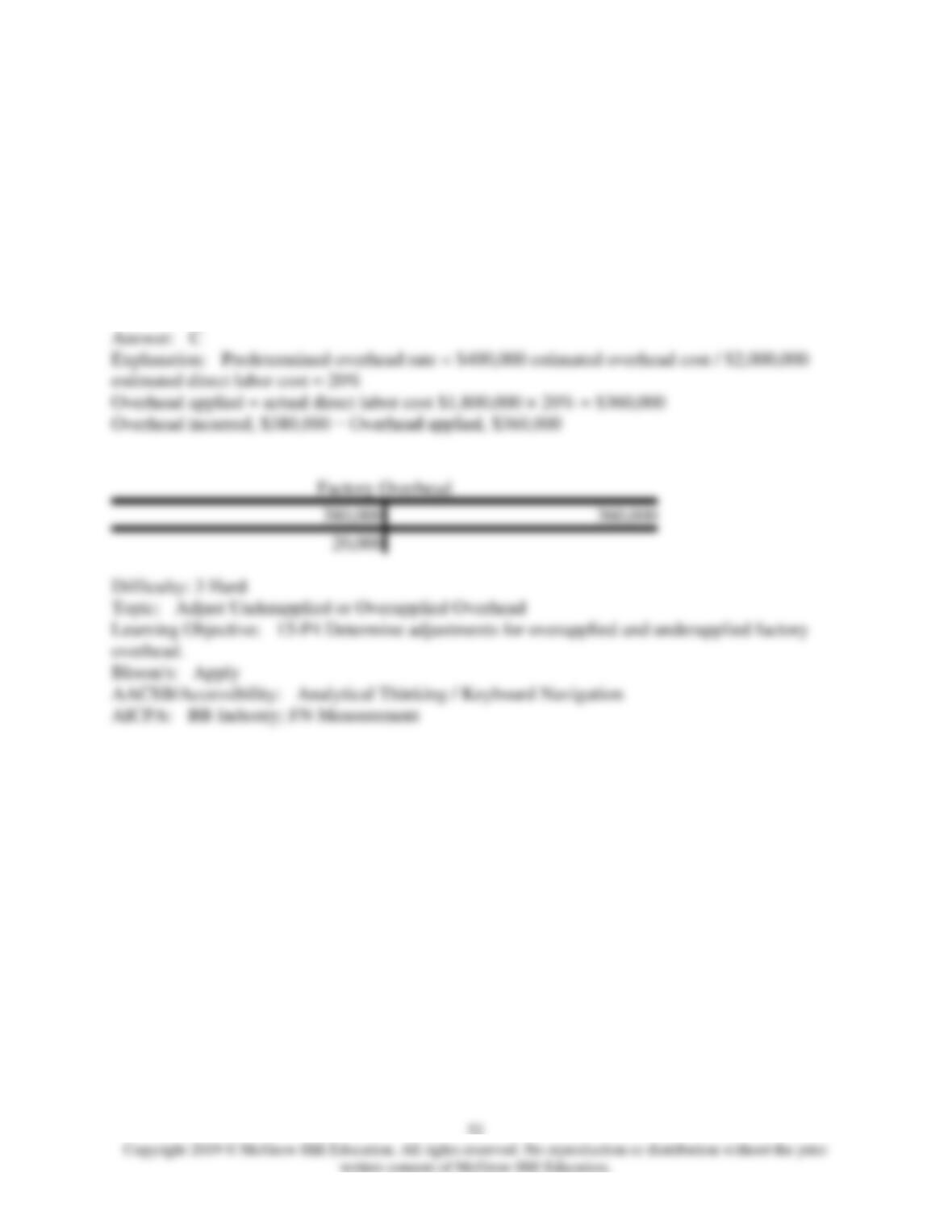
131) Morris Company applies overhead based on direct labor costs. For the current year, Morris
Company estimated total overhead costs to be $400,000, and direct labor costs to be $2,000,000.
Actual overhead costs for the year totaled $380,000, and actual direct labor costs totaled
$1,800,000. At year-end, Factory Overhead is:
A) Overapplied by $20,000.
B) Overapplied by $190,000.
C) Underapplied by $20,000.
D) Overapplied by $40,000.
E) Neither overapplied nor underapplied.
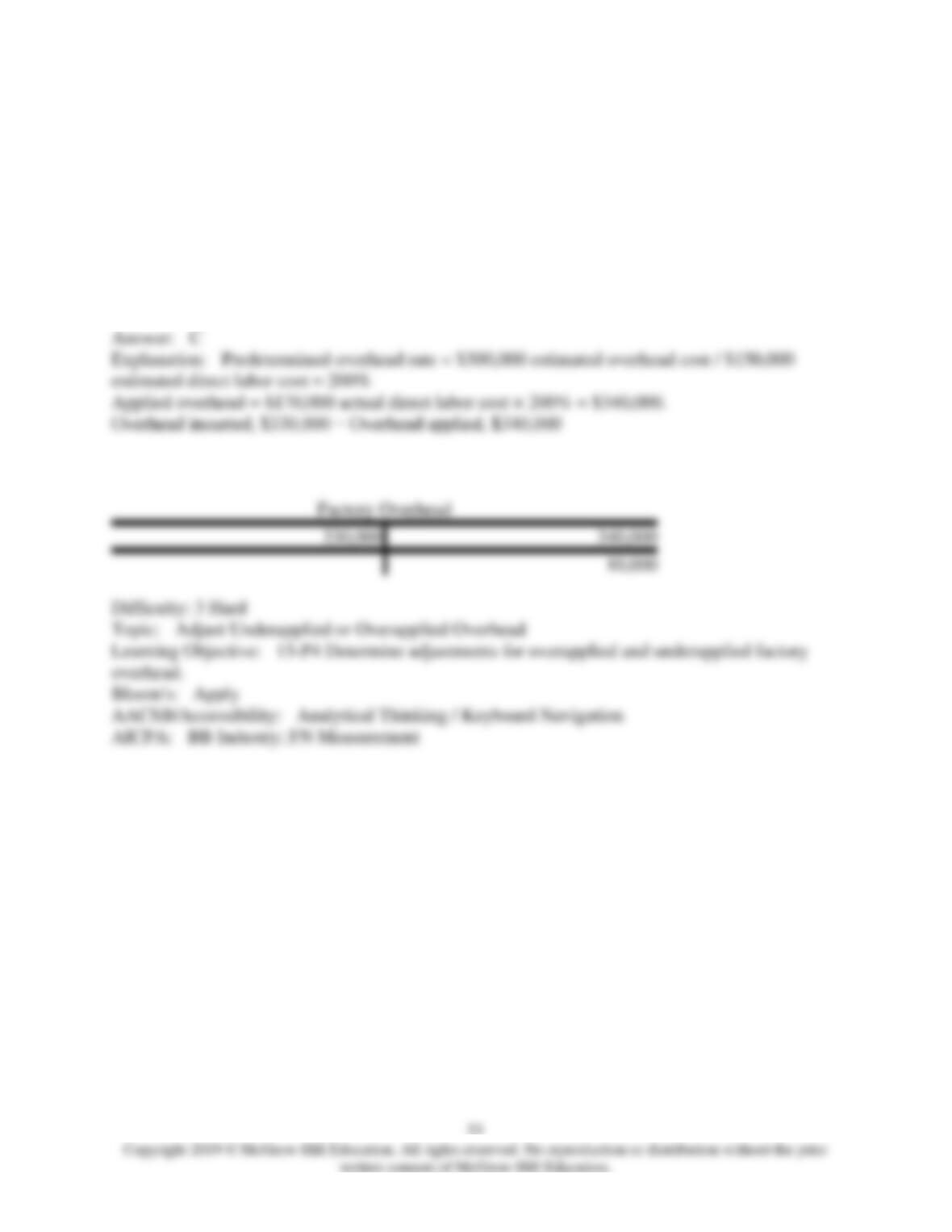
132) Mango Company applies overhead based on direct labor costs. For the current year, Mango
Company estimated total overhead costs to be $300,000, and direct labor costs to be $150,000.
Actual overhead costs for the year totaled $330,000, and actual direct labor costs totaled
$170,000. At year-end, the balance in the Factory Overhead account is a:
A) $330,000 Debit balance.
B) $170,000 Debit balance.
C) $10,000 Credit balance.
D) $340,000 Credit balance.
E) $10,000 Debit balance.
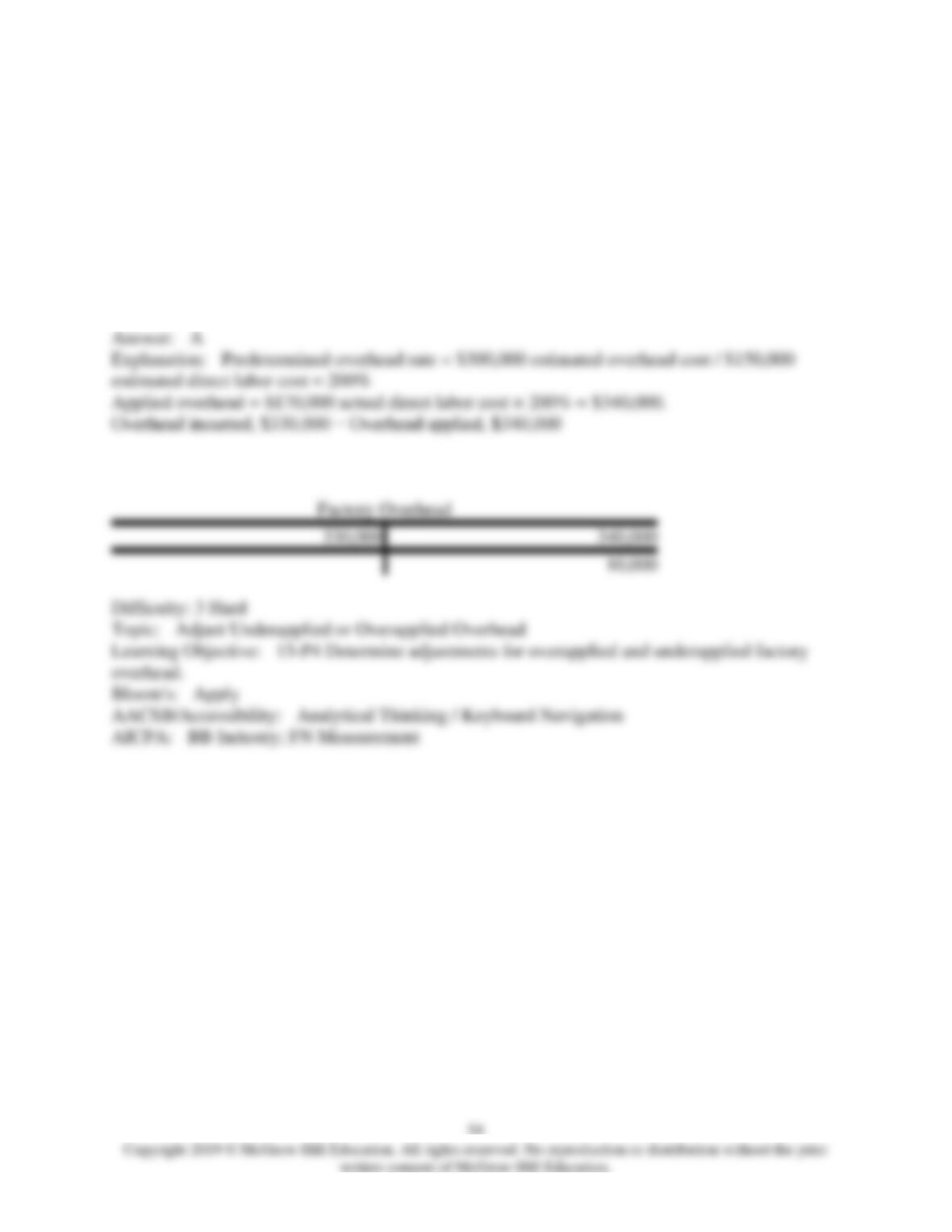
133) Mango Company applies overhead based on direct labor costs. For the current year, Mango
Company estimated total overhead costs to be $300,000, and direct labor costs to be $150,000.
Actual overhead costs for the year totaled $330,000, and actual direct labor costs totaled
$170,000. At year-end, Factory Overhead account is:
A) Overapplied by $10,000.
B) Overapplied by $170,000.
C) Underapplied by $10,000.
D) Overapplied by $20,000.
E) Neither overapplied nor underapplied.
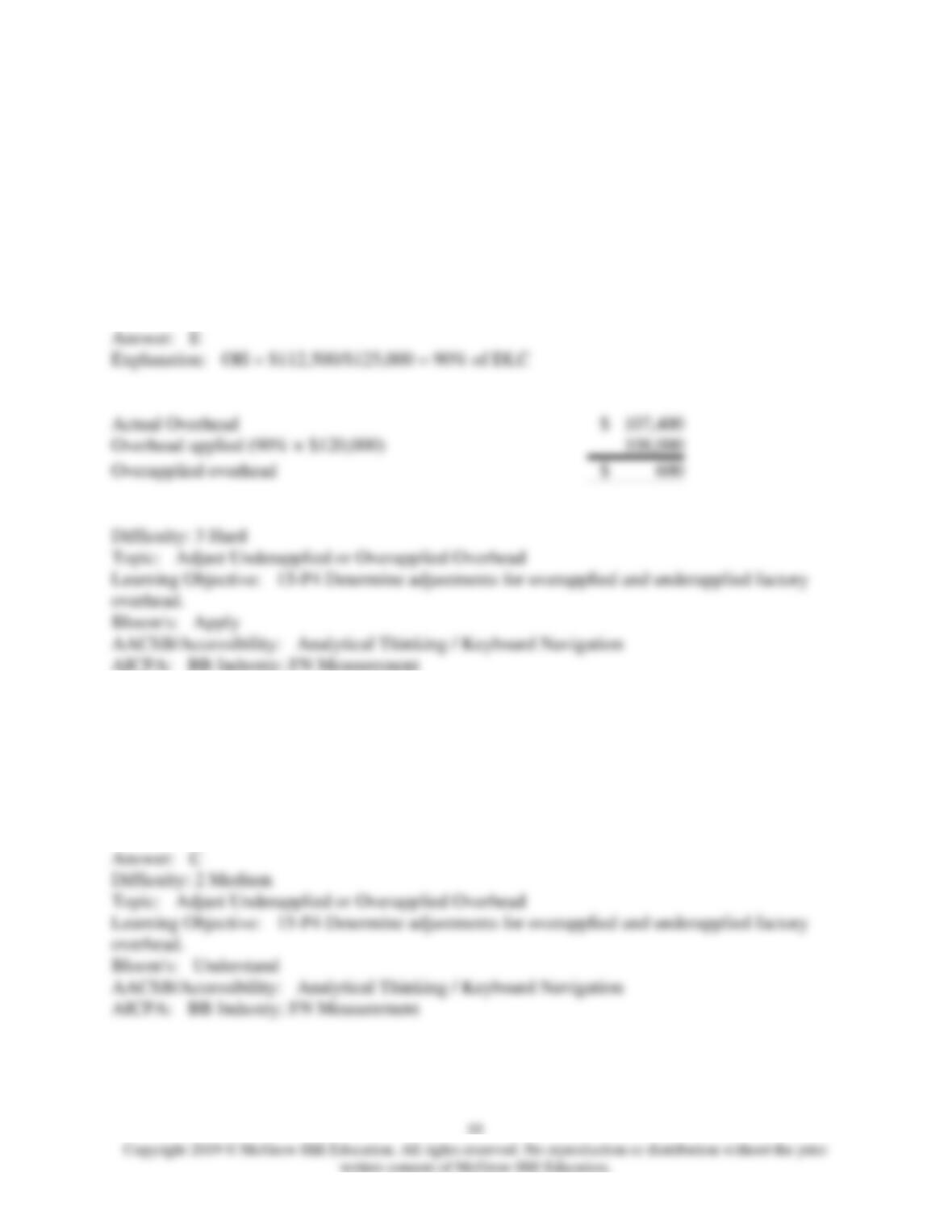
134) Clemmens Company applies overhead based on direct labor cost. Estimated overhead and
direct labor costs for the year were $112,500 and $125,000, respectively. During the year, actual
overhead was $107,400 and actual direct labor cost was $120,000. The entry to close the over- or
underapplied overhead at year-end, assuming an immaterial amount, would include
A) a debit to Cost of Goods Sold for $600.
B) a credit to Factory Overhead for $600.
C) a credit to Finished Goods Inventory for $600.
D) a debit to Work in Process Inventory for $600.
E) a credit to Cost of Goods Sold for $600.
135) If overhead is underapplied all of the following are true except:
A) The Factory Overhead account has a debit balance.
B) Jobs are undercosted.
C) Jobs are overcosted.
D) The adjusting journal entry requires a debit to Cost of Goods Sold.
E) The adjusting journal entry requires a credit to Factory Overhead.
136) Marina Corp. applied overhead to jobs during the period as follows:
Jobs finished and sold
$
46,000
Jobs started and in process
54,000
Jobs finished and unsold
100,000
The application of overhead has resulted in a $5,600 credit balance in the Factory Overhead
account. The entry to dispose of this remaining factory overhead balance is:
A) Debit Cost of Goods Sold $5,600; credit Factory Overhead $5,600.
B) Debit Factory Overhead $5,600; credit Cost of Goods Sold $5,600.
C) Debit Factory Overhead $5,600; credit Work in Process Inventory $5,600.
D) Debit Work in Process Inventory $5,600; credit Factory Overhead $5,600.
E) No entry is needed.
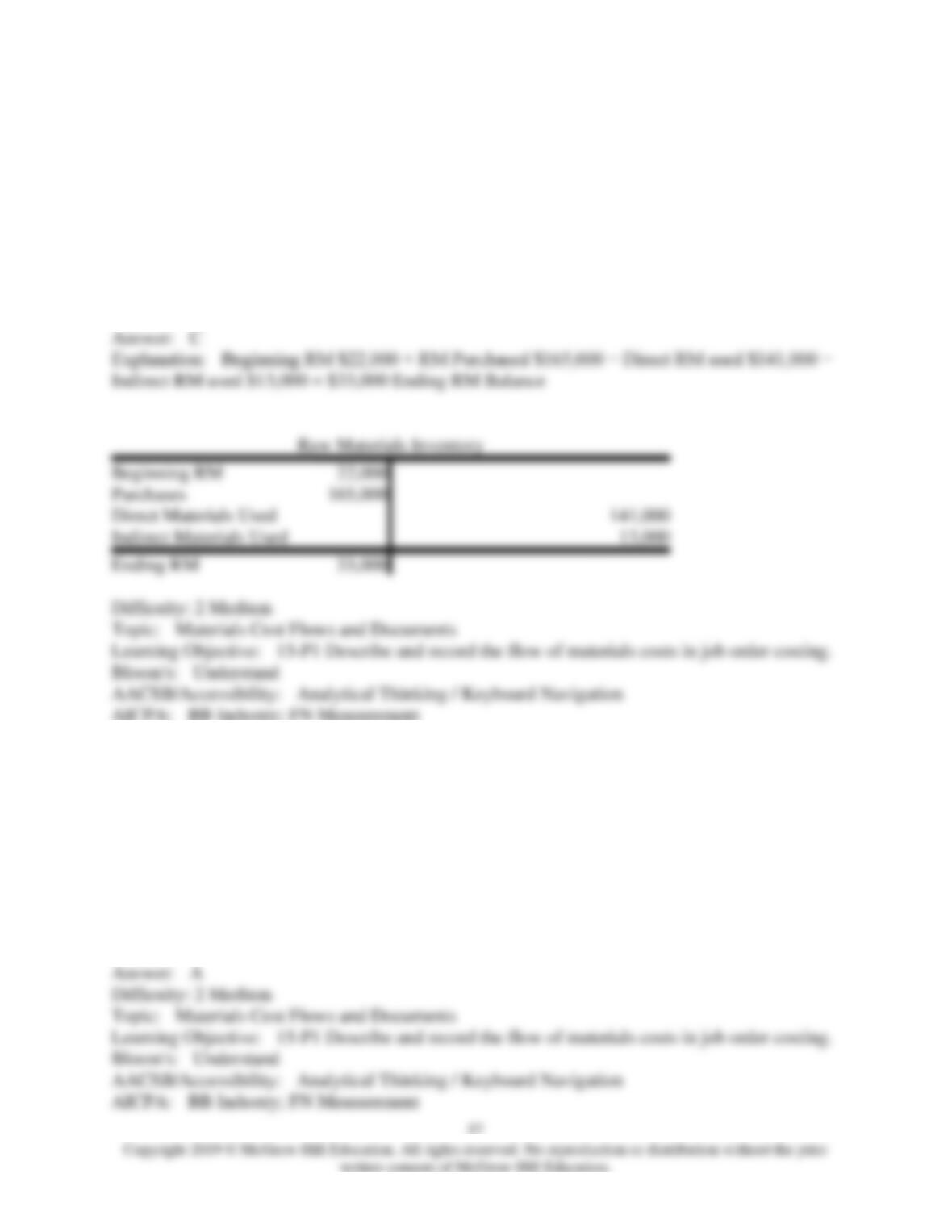
137) Andrew Industries purchased $165,000 of raw materials on account during the month of
March. The beginning Raw Materials Inventory balance was $22,000, and the materials used to
complete jobs during the month were $141,000 of direct materials and $13,000 of indirect
materials. What is the ending Raw Materials Inventory balance for March?
A) $46,000
B) $11,000
C) $33,000
D) $24,000
E) $9,000
138) Andrew Industries purchased $165,000 of raw materials on account during the month of
March. The beginning Raw Materials Inventory balance was $22,000, and the materials used to
complete jobs during the month were $141,000 direct materials and $13,000 indirect materials.
How should Andrews record the purchase of raw materials for March?
A) Debit Raw Materials Inventory $165,000; credit Accounts Payable $165,000
B) Debit Work in Process Inventory $165,000; credit Raw Materials Inventory $165,000
C) Debit Raw Materials Inventory $187,000; credit Cash $187,000
D) Debit Accounts Payable $165,000; credit Raw Materials Inventory $165,000
E) Debit Accounts Payable $187,000; credit Raw Materials Inventory $187,000
139) Andrew Industries purchased $165,000 of raw materials on account during the month of
March. The beginning Raw Materials Inventory balance was $22,000, and the materials used to
complete jobs during the month were $141,000 of direct materials and $13,000 of indirect
materials. What amount will Andrew debit to Work in Process Inventory for the month of
March?
A) $165,000
B) $154,000
C) $13,000
D) $141,000
E) $33,000
140) Andrew Industries purchased $165,000 of raw materials on account during the month of
March. The beginning Raw Materials Inventory balance was $22,000, and the materials used to
complete jobs during the month were $141,000 of direct materials and $13,000 of indirect
materials. What journal entry should Andrew use to account for direct materials used in March:
A) Debit Raw Materials Inventory $141,000; credit Accounts Payable $141,000.
B) Debit Work in Process Inventory $141,000; credit Raw Materials Inventory $141,000.
C) Debit Work in Process Inventory $141,000; credit Accounts Payable $141,000.
D) Debit Finished Goods Inventory $22,000; credit Raw Materials Inventory $22,000.
E) Debit Raw Materials Inventory $153,000; credit Work in Process Inventory $153,000.
141) Juarez Builders incurred $285,000 of labor costs for construction jobs completed during the
month of August, of which $212,000 was direct and $73,000 was indirect supervisory costs. The
correct journal entry to record the direct labor for the month is:
A) Debit Payroll Expense $212,000; credit Cash $212,000.
B) Debit Factory Wages Payable $285,000; credit Work in Process Inventory $212,000.
C) Debit Work in Process Inventory $212,000; credit Cash $285,000.
D) Debit Work in Process Inventory $285,000; credit Factory Wages Payable $285,000.
E) Debit Work in Process Inventory $212,000; credit Factory Wages Payable $212,000.
142) Juarez Builders incurred $285,000 of labor costs for construction jobs completed during the
month of August, of which $212,000 was direct and $73,000 was indirect supervisory costs. The
correct journal entry to record the $73,000 indirect labor for the month is:
A) Debit Supervisor Wage Expense; credit Factory Wages Payable.
B) Debit Factory Overhead; credit Factory Wages Payable.
C) Debit Supervisor Wage Expense; credit Factory Overhead.
D) Debit Factory Wages Payable; credit Factory Overhead.
E) Debit Factory Wage Expense; credit Cash.
143) Minstrel Manufacturing uses a job order costing system. During one month, Minstrel
purchased $198,000 of raw materials on credit; issued materials to production of $195,000 of
which $30,000 were indirect. Minstrel incurred a factory payroll of $150,000, of which $40,000
was indirect labor. Minstrel uses a predetermined overhead rate of 150% of direct labor cost. The
journal entry to record the purchase of materials is:
A) Debit Raw Materials Inventory $198,000; credit Accounts Payable $198,000.
B) Debit Work in Process Inventory $198,000; credit Accounts Payable $198,000.
C) Debit Raw Materials Inventory $198,000; credit Work in Process Inventory $198,000.
D) Debit Work in Process Inventory $195,000; credit Raw Materials Inventory $195,000.
E) Debit Raw Materials Inventory $198,000; credit Finished Goods Inventory $198,000.
144) Minstrel Manufacturing uses a job order costing system. During one month, Minstrel
purchased $198,000 of raw materials on credit; issued materials to production of $195,000 of
which $30,000 were indirect. Minstrel incurred a factory payroll of $150,000, of which $40,000
was indirect labor. Minstrel uses a predetermined overhead rate of 150% of direct labor cost. The
journal entry to record the issuance of materials to production is:
A) Debit Raw Materials Inventory $195,000; credit Accounts Payable $195,000.
B) Debit Work in Process Inventory $195,000; credit Raw Materials Inventory $195,000.
C) Debit Raw Materials Inventory $195,000; credit Work in Process Inventory $195,000.
D) Debit Work in Process Inventory $165,000; debit Factory Overhead $30,000; credit Raw
Materials Inventory $195,000.
E) Debit Finished Goods Inventory $195,000; credit Raw Materials Inventory $195,000.