77) Job order costing would be used for all of the following except:
A) Construction of a custom home.
B) Production of running shoes.
C) Production of a Pixar movie.
D) Production of wedding invitations.
E) Conducting an audit.
78) Compared to a general accounting system, a cost accounting system for a manufacturing
company emphasizes:
A) Periodic inventory counts.
B) Total costs.
C) Continually updating costs of materials, work in process, and finished goods inventories.
D) Products and average costs.
E) Large volume operations involving standardized products.
79) Features of job order production include all of the following except:
A) Diversity of products produced.
B) Mass production.
C) Heterogeneity.
D) Customization.
E) Separate manufacturing from other products.
80) The two basic types of cost accounting systems are:
A) Job order costing and perpetual costing.
B) Job order costing and customized product costing.
C) Job order costing and customized service costing.
D) Job order costing and process costing.
E) Job order costing and periodic costing.
81) The production activities for a customized product represent a(n):
A) Operation.
B) Job.
C) Unit.
D) Pool.
E) Process.
82) A job order costing system would best fit the needs of a company that makes:
A) Shoes and apparel.
B) Paint.
C) Cement.
D) Custom machinery.
E) Pencils and erasers.
83) Job order production is also known as:
A) Mass production.
B) Process production.
C) Unit production.
D) Customized production.
E) Standard costing.
84) Omega Construction manufactures homes to customer specifications. It most likely uses:
A) Process costing.
B) Periodic costing.
C) Unique costing.
D) Job order costing.
E) Activity-based costing.
85) A type of production that yields customized products or services for each customer is called:
A) Customer orientation production.
B) Job order production.
C) Just-in-time production.
D) Job lot production.
E) Process production.
86) A company that makes which of the following types of products would best be suited for a
job costing system?
A) Fruit juice
B) Swimming suits
C) Snack chips
D) Phone chargers
E) Custom jewelry
87) The target cost for a job using job costing is calculated as:
A) direct costs + desired profit.
B) direct costs − desired profit.
C) expected selling price − direct costs.
D) expected selling price − desired profit.
E) expected selling price + desired profit.
88) A job order production system would be appropriate for a company that produces which one
of the following items?
A) A landscaping design for a new hospital.
B) Seedlings for sale in a nursery.
C) Sacks of yard fertilizer.
D) Packets of flower seeds.
E) Small gardening tools, including rakes, shovels, and hoes.
89) Large aircraft manufacturers normally use:
A) Job order costing.
B) Process costing.
C) Mixed costing.
D) Full costing.
E) Simple costing.
90) A document in a job order costing system that is used to record the costs of producing a job
is a(n):
A) Job cost sheet.
B) Job lot.
C) Finished goods summary.
D) Process cost system.
E) Units-of-production sheet.
91) A job cost sheet shows information about each of the following items except:
A) The direct labor costs assigned to the job.
B) The name of the customer.
C) The costs incurred by the marketing department in selling the job.
D) The overhead costs assigned to the job.
E) The direct materials costs assigned to the job.
92) The job order cost sheets used by Greene Company revealed the following:
Job. No.
Bal., May 1
May Production Costs
134
$
1,700
$
0
135
1,200
300
136
0
900
Job No. 135 was completed during May and Jobs No. 134 and 135 were shipped to customers in
May. What was the company’s cost of goods sold for May and the balance of Work in Process
inventory on May 31?
A) $3,200; $900.
B) $2,900; $1,200.
C) $1,200; $2,900.
D) $1,700; $1,200.
E) $4,100; $0.
Cost of goods sold:
Job 134:
Job 135: ($1,200 + $300)
Work in process inventory:
Job 136:
93) Job A3B was ordered by a customer on September 25. During the month of September,
Jaycee Corporation requisitioned $2,500 of direct materials and used $4,000 of direct labor. The
job was not finished by the end of September, but needed an additional $3,000 of direct materials
and additional direct labor of $6,500 to finish the job in October. The company applies overhead
at the end of each month at a rate of 200% of the direct labor cost incurred. What is the balance
in the Work in Process account at the end of September relative to Job A3B?
A) $5,500
B) $11,500
C) $6,500
D) $9,500
E) $14,500
94) Job A3B was ordered by a customer on September 25. During the month of September,
Jaycee Corporation requisitioned $2,500 of direct materials and used $4,000 of direct labor. The
job was not finished by the end of September, but needed an additional $3,000 of direct materials
and additional direct labor of $6,500 to finish the job in October. The company applies overhead
at the end of each month at a rate of 200% of the direct labor cost incurred. What is the total cost
of the job when it is completed in October?
A) $16,000
B) $22,500
C) $37,000
D) $26,500
E) $32,000
95) Job A3B was ordered by a customer on September 25. During the month of September,
Jaycee Corporation requisitioned $2,500 of direct materials and used $4,000 of direct labor. The
job was not finished by the end of September, but needed an additional $3,000 of direct materials
in October and additional direct labor of $6,500 to finish the job. The company applies overhead
at the end of each month at a rate of 200% of the direct labor cost. What is the amount of job
costs added to Work in Process Inventory during October?
A) $16,000
B) $22,500
C) $37,000
D) $26,500
E) $32,000
96) A job cost sheet includes:
A) Direct materials, direct labor, and operating costs.
B) Direct materials, estimated overhead, and administrative costs.
C) Direct labor, actual overhead, and selling costs.
D) Direct material, direct labor, and applied overhead.
E) Direct materials, direct labor, and selling costs.
97) The balance in the Work in Process Inventory at any point in time equals
A) the costs for jobs finished during the period but not yet sold.
B) the manufacturing cost of jobs ordered but not yet started into production.
C) the sum of the manufacturing costs for all jobs in process but not yet completed.
D) the manufacturing costs of all jobs started during the period, completed or not.
E) the sum of the materials, labor and overhead costs paid during the period.
98) The Work in Process Inventory account of a manufacturing company has a $3,200 debit
balance. The company applies overhead using direct labor cost. The cost sheet of the only job
still in process shows direct material cost of $1,400 and direct labor cost of $800. Therefore, the
amount of applied overhead is:
A) $1,800.
B) $2,200.
C) $1,000.
D) $800.
E) $2,400.
99) The Work in Process Inventory account of a manufacturing company has a $4,400 debit
balance. The company applies overhead using direct labor cost. The cost sheet of the only job
still in process shows direct material cost of $2,000 and direct labor cost of $800. Therefore, the
company’s predetermined overhead rate is:
A) 40% of direct labor cost.
B) 50% of direct labor cost.
C) 80% of direct labor cost.
D) 200% of direct labor cost.
E) 300% of direct labor cost.
100) A perpetual record of a raw materials item that records data on the quantity and cost of units
purchased, units issued for use in production, and units that remain in the raw materials
inventory, is called a(n):
A) Materials ledger card.
B) Materials requisition.
C) Purchase order.
D) Materials voucher.
E) Purchase ledger.
101) A source document that production managers use to request materials for production and
that is used to assign materials costs to specific jobs or to overhead is a:
A) Job cost sheet.
B) Production order.
C) Materials requisition.
D) Materials purchase order.
E) Receiving report.
102) A company that uses a job order costing system would make the following entry to record
the flow of direct materials into production:
A) debit Work in Process Inventory, credit Cost of Goods Sold.
B) debit Work in Process Inventory, credit Raw Materials Inventory.
C) debit Work in Process Inventory, credit Factory Overhead.
D) debit Factory Overhead, credit Raw Materials Inventory.
E) debit Finished Goods Inventory, credit Raw Materials Inventory.
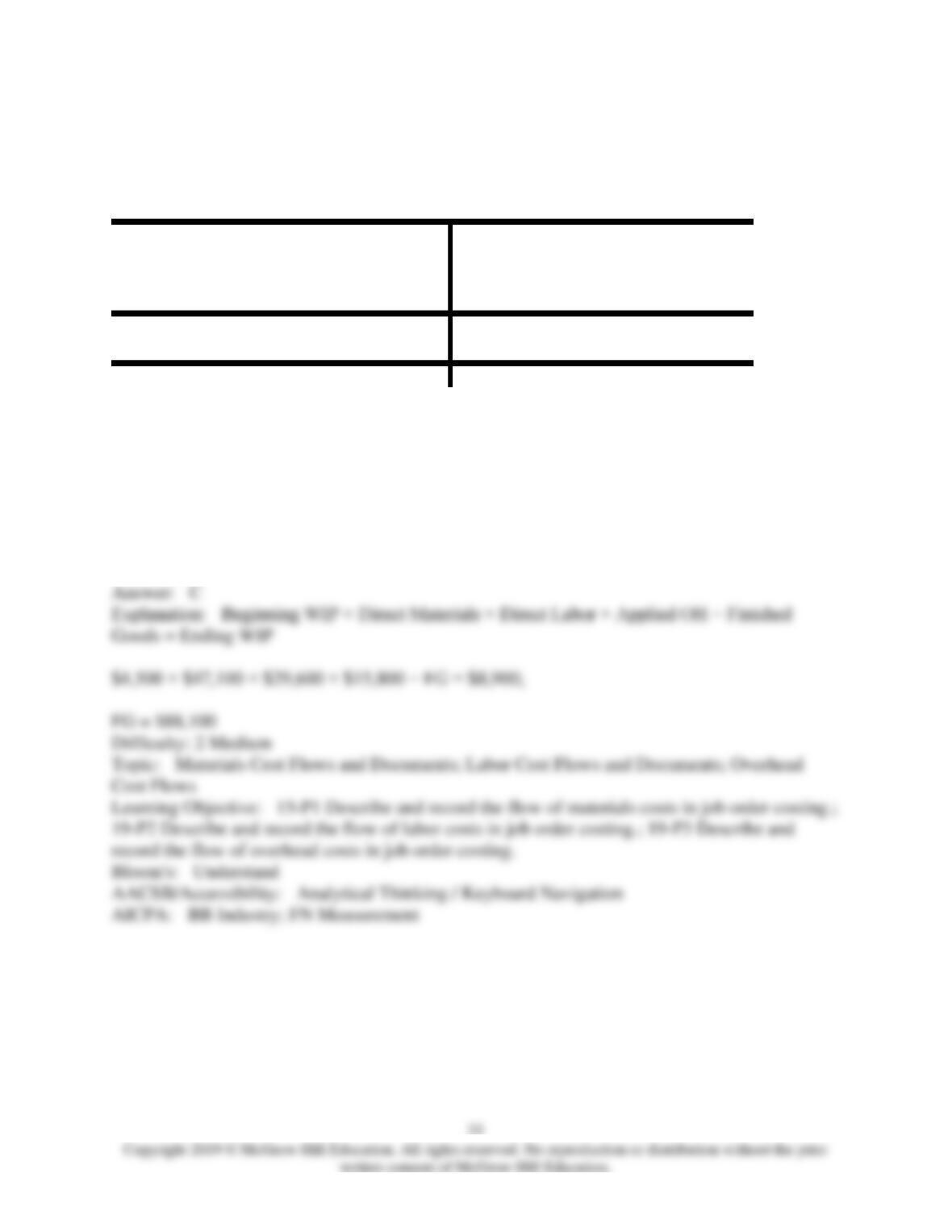
103) The Work in Process Inventory account for DG Manufacturing follows. Compute the cost
of jobs completed and transferred to Finished Goods Inventory.
Work in Process Inventory
Beginning WIP
4,500
Direct materials
47,100
Direct labor
29,600
Applied overhead
15,800
Total Mfg. costs
97,000
To finished goods
?
Ending WIP
8,900
The cost of jobs transferred to finished goods is:
A) $97,000.
B) $105,900.
C) $88,100.
D) $95,200.
E) $92,500.
34
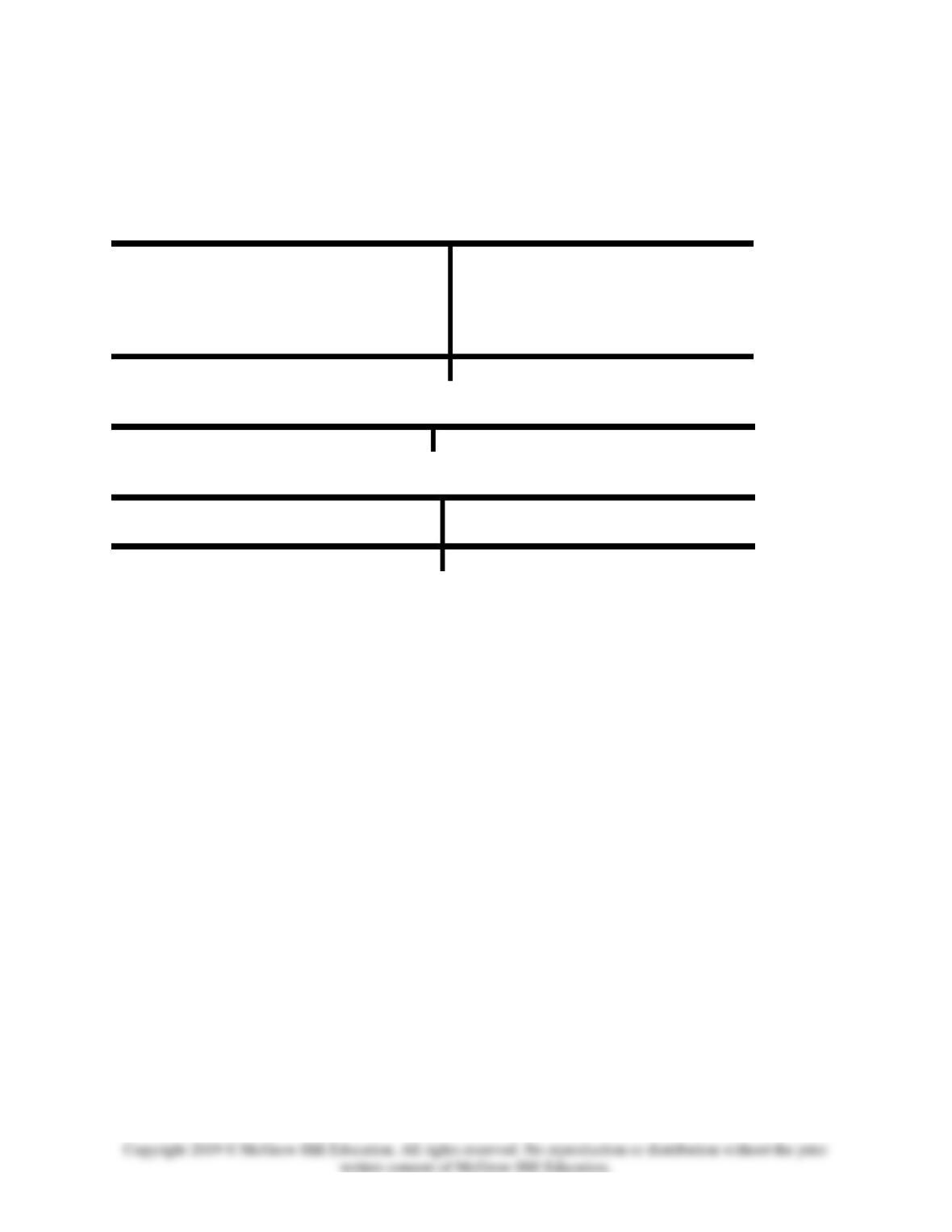
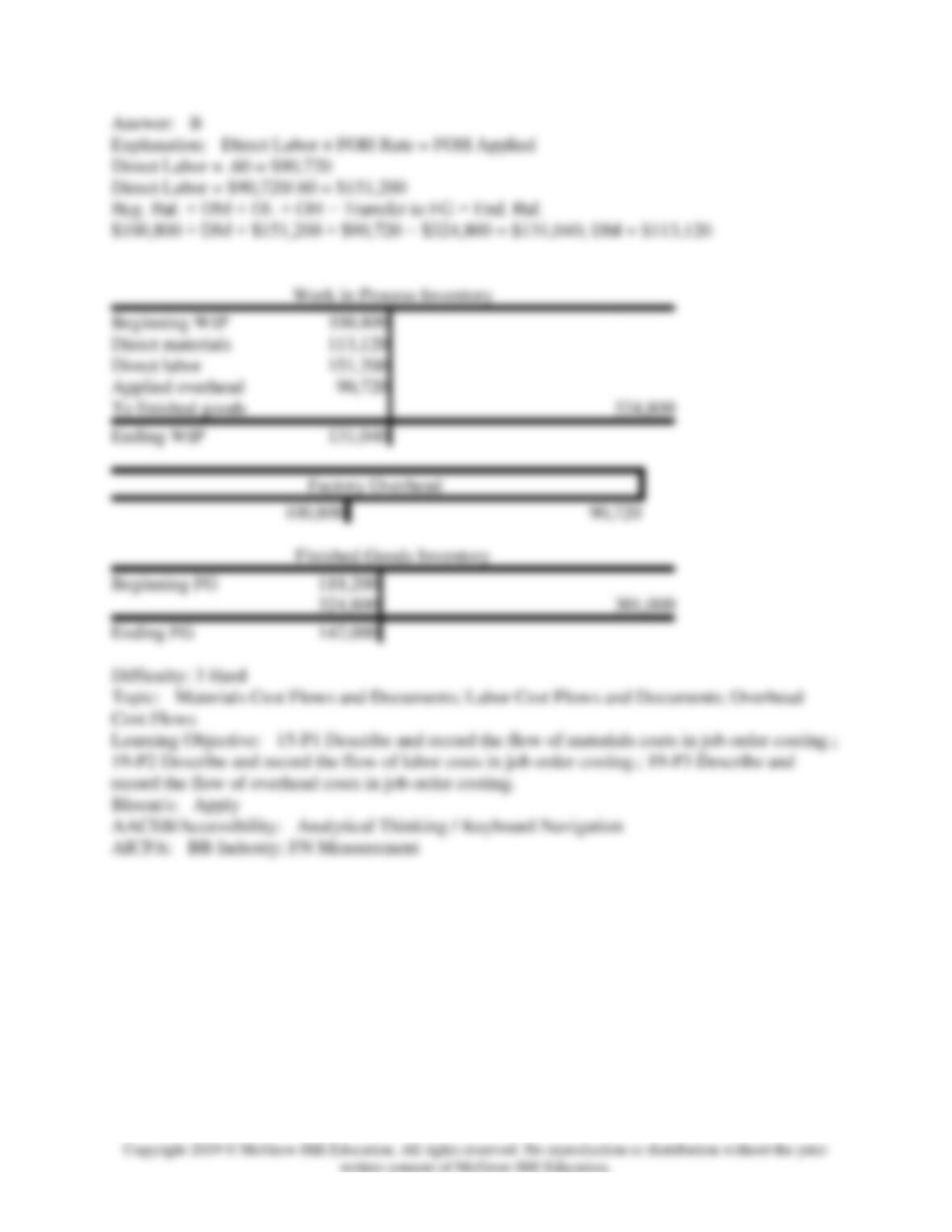
104) A company’s overhead rate is 60% of direct labor cost. Using the following incomplete
accounts, determine the cost of direct materials used.
106,400.
Work in Process Inventory
Beginning WIP
100,800
Direct materials
?
Direct labor
?
Applied overhead
?
To finished goods
?
Ending WIP
131,040
Factory Overhead
100,800
90,720
Finished Goods Inventory
Beginning FG
118,200
324,800
301,000
Ending FG
142,000
A) $106,400.
B) $113,120.
C) $30,240.
D) $211,680.
E) $324,800.
35
36
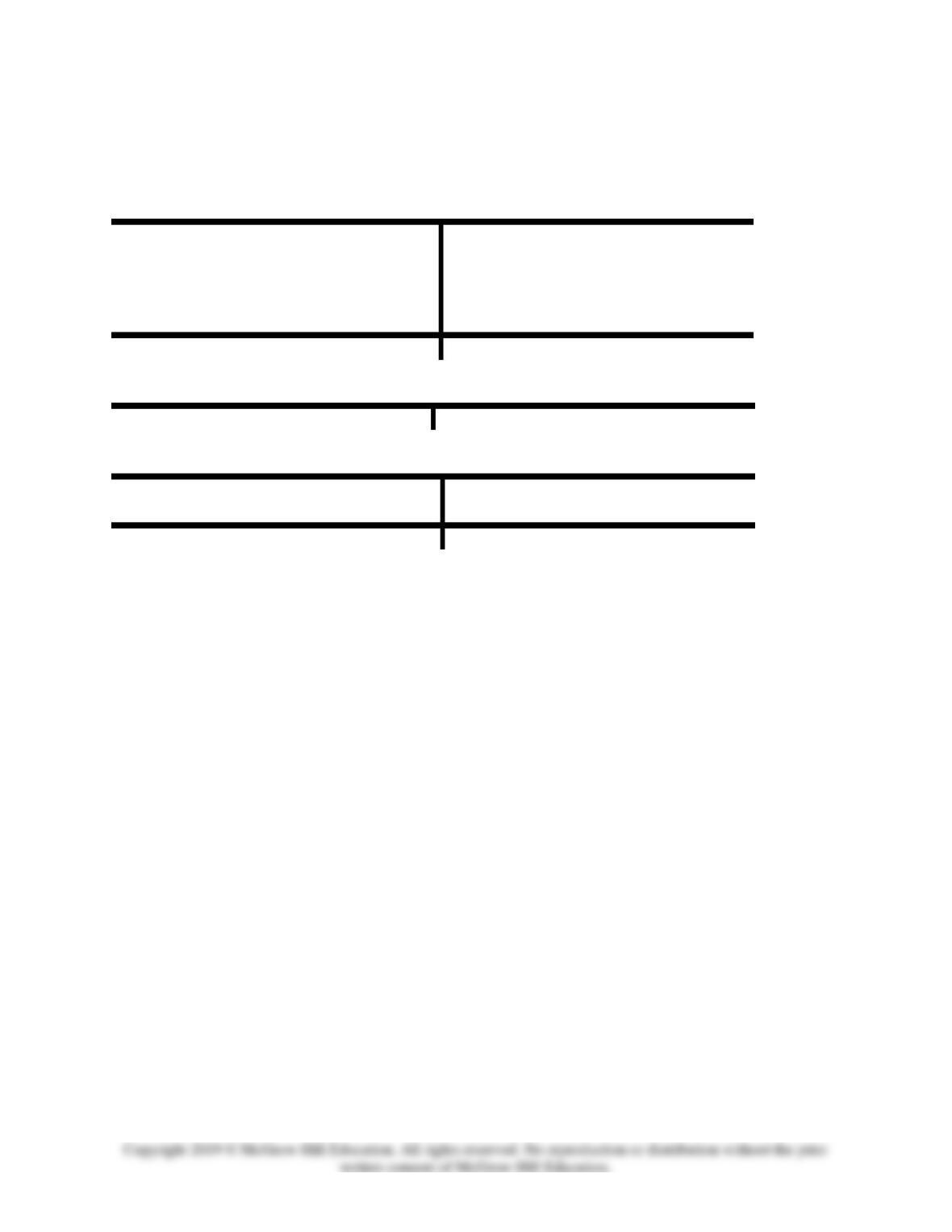
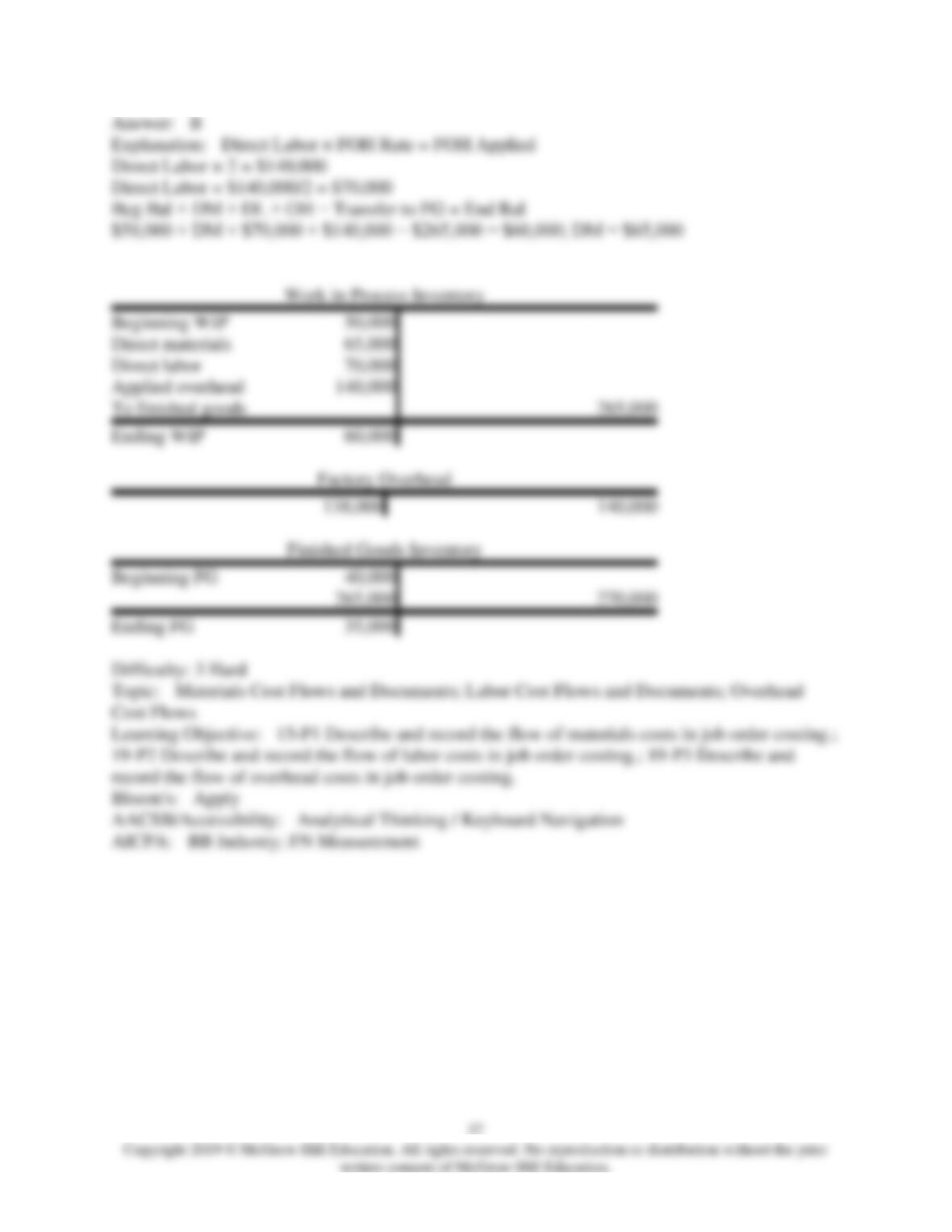
105) A company’s overhead rate is 200% of direct labor cost. Using the following incomplete
accounts, determine the cost of direct materials used.
Work in Process Inventory
Beginning WIP
50,000
Direct materials
?
Direct labor
?
Applied overhead
?
To finished goods
?
Ending WIP
60,000
Factory Overhead
138,000
140,000
Finished Goods Inventory
Beginning FG
40,000
265,000
270,000
Ending FG
35,000
A) $130,000.
B) $65,000.
C) $270,000.
D) $265,000.
E) $280,000.
106) A source document that an employee uses to report how much time was spent working on a
job or on overhead activities and that is used to determine the amount of direct labor to charge to
the job or to determine the amount of indirect labor to charge to factory overhead is called a:
A) Payroll Register.
B) Factory payroll record.
C) General Ledger.
D) Time ticket.
E) Factory Overhead Ledger.
107) When direct labor costs are recorded in a job costing:
A) Factory Wages Payable is debited and Work in Process Inventory is credited.
B) Work in Process Inventory is debited and Factory Wages Payable is credited.
C) Cost of Goods Manufactured is debited and Direct Labor is credited.
D) Direct Labor and Indirect Labor are debited and Factory Wages Payable is credited.
E) Work in Process Inventory is debited and Factory Overhead is credited.
108) Oxford Company uses a job order costing system. In the last month, the system
accumulated labor time tickets total $24,600 for direct labor and $4,300 for indirect labor. How
are these costs recorded?
A) Debit Payroll Expense $28,900; credit Cash $28,900.
B) Debit Payroll Expense $24,600; debit Factory Overhead $4,300; credit Factory Wages
Payable $28,900.
C) Debit Work in Process Inventory $24,600; Debit Factory Overhead $4,300; Credit Factory
Wages Payable $28,900.
D) Debit Work in Process Inventory $24,600; credit Factory Wages Payable $28,900.
E) Debit Work in Process Inventory $28,900; credit Factory Wages Payable $28,900.
109) Labor costs in production can be:
A) Direct or indirect.
B) Indirect or sunk.
C) Direct or payroll.
D) Indirect or payroll.
E) Direct or sunk.
110) An example of direct labor cost is:
A) Supervisor salary
B) Maintenance worker wages
C) Janitor wages
D) Product assembler wages
E) Accountant salary
111) A company has an overhead application rate of 125% of direct labor costs. How much
overhead would be allocated to a job if it required direct labor costing $20,000?
A) $5,000.
B) $16,000.
C) $25,000.
D) $125,000.
E) $250,000.