Chapter 15—Investments Key
1. Investments in debt and equity securities that are held for current resale by banks and stockbrokerage firms
are termed
2. Investments that are typically held for short periods of time and sold by the company in the expectation of a
profit on the short-term differences in price are classified as
3. Which of the following categories of investments are reported at their fair values on the balance sheet and
have unrealized holding gains and losses included as a separate component of stockholders’ equity?
4. Which of the following securities are reported at their amortized cost on the balance sheet date?
5. Investments in debt securities include all of the following except
6. Investments in equity securities include all of the following except
7. Which of the following methods of accounting for investments is appropriate when the investor has
significant influence over the investee?
8. With consolidation, control generally occurs when the investor owns what percentage of the voting stock of
the investee?
9. Which of the following methods of accounting for investments is appropriate when the investor controls the
investee?
10. Unrealized holding gains and losses on debt securities affect net income when the securities are classified as
Trading
Available-for-Sale
Held-to-Maturity
I.
Yes
No
No
II.
Yes
Yes
No
III.
No
Yes
Yes
IV.
No
No
Yes
11. Each of the three categories of investments in debt and equity securities has similar accounting for all of the
following transactions except
12. The generally accepted accounting principles for trading securities include all of the following except
13. Which of the following regarding trading securities is correct?
14. Unrealized gains and losses on investments in trading securities are reported
15. When bonds are purchased between interest dates, the accrued interest should be
16. Dividends that are declared at year-end but not received on investments in securities held for sale or trading
should be recognized when
17. The Rolla Company purchased 10%, $800,000 bonds of the Batter Up Company at par plus accrued interest
on April 1, 2010, as an investment in available-for-sale securities. The bonds pay interest on June 30 and
December 31 each year. The entry by Rolla on April 1, 2010, would include a
18. In its first year of operations, Rodolfo Company purchased available-for-sale securities at a total cost of
$53,000. On December 31, the end of Rodolfo’s fiscal year, the fair market value of those investments totaled
$57,000. As a result of these investments, Rodolfo Company will report
19. Charlie Company purchased available-for-sale equity investments in 2010 at a cost of $200,000. Their
market values totaled $250,000 and $230,000 on December 31, 2010, and December 31, 2011, respectively.
The entry required on December 31, 2011, would include a
20. Which of the following regarding available-for-sale securities is correct?
21. Realized gains and losses on investments available for sale are reported
22. The entry to record a sale of available-for-sale securities for $65,000 on January 3, 2011, that were
purchased for $52,000 on November 21, 2010, and had a fair value on December 31, 2010, of $57,000 would
include a
23. A realized gain or loss on the sale of an available-for-sale security is determined by comparing
24. The carrying value of available-for-sale debt and equity securities is
25. Withers Company has available-for-sale debt and equity securities that on December 31, 2010, had a cost of
$105,000 and a market value of $102,000. The market value rose to $117,000 by December 31, 2011. What
accounting action is required on December 31, 2011?
26. Nixon Company purchased 10,000 shares of Kostas Company as an available-for-sale security at $45 per
share. Brokerage fees amounted to $1,000 and transfer taxes were $750. The investment should be recorded at
27. Ling Company purchased several investments in December 2010. Costs and market values of those
investments on December 31, 2010, are presented below:
Cost
Market Value
XYZ stock
$200,000
$180,000
ABC stock
400,000
420,000
DEF stock
600,000
540,000
Assuming all of the securities are classified as available for sale, the journal entry required on December 31, 2010, the end of Ling’s fiscal year,
would include a
28. Barchak Corporation began operations on January 1, 2010. At December 31, 2010, Barchak appropriately
had a credit balance in Allowance for Change in Value of Investments of $30. No transactions related to these
investments occurred during 2011, and the cost and market values on December 31, 2011, are as follows:
Investment
Cost
Market Value
A Company
$650
$680
B Company
115
110
C Company
445
420
D Company
80
100
In the December 31, 2011 adjusting entry, there will be a
29. Premiums or discounts associated with available-for-sale debt securities are
30. On July 1, 2010, Iris Company purchased 800 bonds having $1,000 face value and an 8% interest rate.
Interest is paid on June 30 and December 31. The purchase price was 97. The bonds are classified by Iris as
available for sale. The market value of the bonds on December 31, 2010, was $789,000. Ignoring amortization,
the income statement for the year ended December 31, 2010, would report income (loss) related to this
investment in the amount of
31. All of the following statements regarding available-for-sale debt securities are true except
32. For available-for-sale equity securities, the receipt of a cash dividend would be reported as
33. On January 1, 2010, the Timber Company acquired a 5% interest in the Twig Corporation through the
purchase of 100,000 shares of Twig’s common stock for $540,000. During 2010, Twig paid $40,000 in
dividends and reported net income of $100,000. The market price of Twig’s common stock was $5.20 per share
on December 31, 2010. Timber should report the investment in the Twig Corporation on its December 31, 2010,
balance sheet at
34. Which of the following statements regarding available-for-sale equity investments is true?
35. When the market value of a company’s available-for-sale investments is lower than its cost, the difference
should be
36. On January 6, 2010, Miller Company acquired 4,000 shares (or 10%) of Little Corporation’s common stock
at $28 per share. The securities are classified as available-for-sale investments. On October 24, 2010, Little
declared and paid a cash dividend of $1 per share. On December 31, 2010, the market value of Little’s common
stock was $32 per share. Little also reported a net income of $200,000 for 2010. At what value should Miller
report the investment in Little’s common stock on its December 31, 2010 balance sheet?
37. How is the premium or discount on held-to-maturity bond investments presented on the balance sheet?
38. On January 1, 2010, Martin Company purchased Jetson Company’s 9% bonds with a face amount of
$200,000 for $213,420 to yield 8%. The bonds mature on January 1, 2020, and Martin has both the intent and
ability to hold these bonds to maturity. The bonds pay interest annually on December 31. Assuming Martin uses
the effective interest method of amortizing the bond premium, interest revenue reported on the December 31,
2010, balance sheet would be
39. On July 1, 2010, Richmond Company purchased 8% bonds of Commonwealth Corporation with a par value
of $400,000 for $350,000 to yield 10%. The bonds are to be held to maturity and pay interest semiannually on
June 30 and December 31. The market value of the bonds on December 31, 2010, was $380,000. Richmond
should report the bond investment at December 31, 2010, at
40. On October 1, 2010, the Stu Company acquired 8% bonds of Jackson Company with a face value of
$300,000 for $312,000 plus accrued interest. Interest is payable on June 30 and December 31. How would Stu
record the initial bond investment to be held to maturity?
41. On July 1, 2010, Tom Company purchased $60,000 of ten-year 6% bonds of Sawyer, Inc., for $51,850, to
be held to maturity. Interest is payable semiannually on June 30 and December 31. The effective yield on the
investment is 8%. What amount of interest revenue should Tom record for the six-month period ended
December 31, 2010?
42. On January 1, 2010, New Company purchased $200,000 of ten-year 10% bonds of Old Company for
$226,840. Interest is payable annually. The effective yield on the investment is 8%. What is the balance in
New’s investment in held-to-maturity bonds account (rounded to the nearest dollar, if necessary) at December
31, 2011?
43. On July 1, 2010, Triangle, Inc. purchased Circle Company’s five-year 12% bonds with a face value of
$500,000 for $569,000, which included $25,000 of accrued interest. The bonds, which mature on February 1,
2015, are to be held to maturity and pay interest on February 1 and August 1. Triangle uses the straight-line
method of amortization. The amount of income that Triangle would report for the calendar year 2010 as a result
of this long-term investment would be
44. On July 1, 2010, Mark Company purchased Robert Company’s six-year 9% bonds with a face value of
$200,000 for $196,000, which included $6,000 of accrued interest. The bonds, which mature on March 1, 2016,
are to be held to maturity and pay interest semiannually on March 1 and September 1. Mark uses the
straight-line method of amortization. The amount of income Mark should report for the calendar year 2010 as a
result of this investment would be
45. The use of the effective interest method to amortize a discount associated with the acquisition of an
investment in bonds results in
46. All of the following statements regarding held-to-maturity debt securities are true except
47. The carrying value of held-to-maturity debt securities is the
48. A transfer of a security between categories is accounted for at the
49. When transferring investments between categories, unrealized holding gains for securities transferred from
trading to available-for-sale must be
50. Permanent value declines in available-for-sale securities should be
51. The Copper Company has a bond investment classified as held to maturity, which has a carrying value of
$62,000 and a fair value of $24,000. The decline in value is considered as other than temporary. Copper should
record the decline as
52. Which of the following disclosures is not required for investments in securities by current GAAP?
53. Which type of investment in securities must always be classified as a current asset?
54. For available-for-sale securities, a decline in value due to a temporary decline in market value below cost is
55. The fair value method of accounting for investments was proposed to overcome which issues associated
with the prior use of lower of cost or market?
56. A major controversy surrounding fair value accounting for investments is that
57. When selecting the appropriate accounting for held-to-maturity securities, the company must
58. Unrealized holding gains and losses occur because a company
59. Investment securities are classified based upon management’s intent. This may present difficulties to readers
of financial statements because
60. Acquisition of greater than 20% of the outstanding stock of a company normally suggests the use of the
61. With the equity method, the investor recognizes its share of the earnings of the subsidiary when the
62. Under the equity method, dividends received by the investor should be recorded as
63. Under the equity method, a receipt of cash dividends by the investor would
64. David Company owns 30% of Ralph Company. During 2010, Ralph reported earnings of $500,000 and paid
cash dividends of 320,000. What effect would this have on David’s investment account and net income?
Investment Account
Net Income
I.
+$150,000
+$ 96,000
II.
—
+$ 96,000
III.
+$ 54,000
+$ 96,000
IV.
+$ 54,000
+$150,000
65. Exhibit 15-1
On January 1, 2010, Circle Corporation paid $900,000 for 80,000 shares of Birch Company’s common stock,
which represents 40% of Birch’s outstanding common stock. Birch reported income of $300,000 and paid a cash
dividend of $100,000 during 2010.
66. Exhibit 15-1
On January 1, 2010, Circle Corporation paid $900,000 for 80,000 shares of Birch Company’s common stock,
which represents 40% of Birch’s outstanding common stock. Birch reported income of $300,000 and paid a cash
dividend of $100,000 during 2010.
Refer to Exhibit 15-1. Circle should report the investment in Birch Company on its December 31, 2010,
balance sheet at
67. Exhibit 15-2
On January 1, 2010, the Clumzee Company purchased 30% of the 1,000,000 shares of Nimble’s common stock
for $15,000,000 when 30% of Nimble’s net assets totaled $12,000,000. The excess purchase price over the
underlying assets was attributable to undervalued depreciable plant assets with a remaining useful life of ten
years. Nimble reported net income of $8,000,000 and paid cash dividends of $2,000,000 during 2010.
Refer to Exhibit 15-2. The income reported by Clumzee during 2010 from its investment in the Nimble
Company should be
68. Exhibit 15-2
On January 1, 2010, the Clumzee Company purchased 30% of the 1,000,000 shares of Nimble’s common stock
for $15,000,000 when 30% of Nimble’s net assets totaled $12,000,000. The excess purchase price over the
underlying assets was attributable to undervalued depreciable plant assets with a remaining useful life of ten
years. Nimble reported net income of $8,000,000 and paid cash dividends of $2,000,000 during 2010.
Refer to Exhibit 15-2. The investment in Nimble Company stock should be reported on Clumzee’s December
31, 2010, balance sheet at
69. The Waco Company acquired an 18% interest in the outstanding common stock of the Springfield
Company. The Waco Company can exercise significant influence over the operating and financial policies of
the Springfield Company. The Waco Company should account for its investment in the Springfield Company
by using the
70. When an investor currently using the fair market value method acquires significant influence over the
investee at mid-year, the investor should
71. The method of accounting for long-term investments in equity securities that most closely fits the
requirements of accrual accounting is the

72. The Mason Company acquired a 30% interest in the Dixon Company on January 2, 2010, for $1,000,000.
Mason Company recorded $80,000 of purchased goodwill on the transaction. During 2010, Dixon Company
paid $100,000 in dividends and reported net income of $170,000. At the end of 2010, the balance in Investment
in Dixon Company should be
73. On January 1, 2010, Pinnacle, Inc. purchased 40% of the common stock of Valley Company for $61,000. At
the date of acquisition, the following information for Valley Company was available:
Fair Market
Book Value
Value
Depreciable assets (remaining life, 10 years)
$100,000
$105,000
Land
50,000
60,000
Total
$150,000
$165,000
Liabilities
$ 25,000
$ 25,000
Common stock
75,000
Retained earnings
50,000
Total
$150,000
In 2010, Valley earned $18,000 of net income and distributed $12,500 of dividends. How much investment income would Pinnacle record in 2010?
74. Doug, Inc. used the equity method of accounting for its investment in Russ Company. At December 31,
2010, the investment balance was $4,500 after all adjustments were recorded. The following is additional
information:
Doug’s share of Russ’ 2010 net income
$2,300
Doug’s share of 2010 depreciation of Russ equipment
100
Doug’s dividends received from Russ in 2010
700
What was the January 1, 2010 balance in Investment in Russ Company?
75. On January 1, 2010, Danforth Company purchased 30% of the common stock of Farley Company for
$80,000. The purchase was made at book value. Additional information for Farley Company follows:
Year
Net Income
Dividends Paid
2010
$20,000
$24,000
2011
60,000
42,000
On Danforth’s books, what would be the balance of Investment in Farley Company at December 31, 2011?
76. William, Inc. purchased a $400,000 life insurance policy on the company president on January 1, 2010. The
premium that was paid on January 1 amounted to $11,600. In the first year, cash surrender value increased by
$900 and dividends received by William from the insurance company for the year amounted to $300. What was
William’s insurance expense for 2010?
77. Park has life insurance policies on its officers’ lives. Annual premiums amount to $5,000. At the end of
2010, cash surrender value of the policies totaled $18,200. Dividends received by Park from the insurance
company amounted to $500 in 2010. The insurance expense recognized by Park in 2010 was $3,500. What was
the amount of cash surrender value of these policies on January 1, 2010?
78. The cash surrender value of the insurance policy on the corporation’s president would be presented on the
balance sheet as
79. Which of the following is not a derivative?
80. An interest rate swap in which a company has a fixed rate of interest and pays a variable rate is called a
81. A derivative may be
82. In a matched swap, the actual loan amount is
83. Current GAAP requires a company to recognize in its current net income any gain or loss from a change in
the fair value of the derivative for a
Fair Value Hedge
Cash Flow Hedge
I.
yes
yes
II.
yes
no
III.
no
no
IV.
no
yes
84. In a perfectly matched hedge of fixed-rate debt using an interest rate swap, the effect of a change in fair
value of the derivative on the income statement
85. An unconsolidated investee is referred to under IFRS and GAAP as an
IFRS
GAAP
I.
associate
equity method investee
II.
equity method investee
associate
III.
associate
associate
IV.
equity method investee
equity method investee
86. Loans and receivables can be classified and accounted for as available-for-sale under
IFRS
GAAP
I.
yes
yes
II.
yes
no
III.
no
yes
IV.
no
no
87. Reversals of impairment losses on held-to-maturity and available-for-sale securities are recognized in
income under
IFRS
GAAP
I.
yes
yes
II.
no
yes
III.
yes
no
IV.
no
no
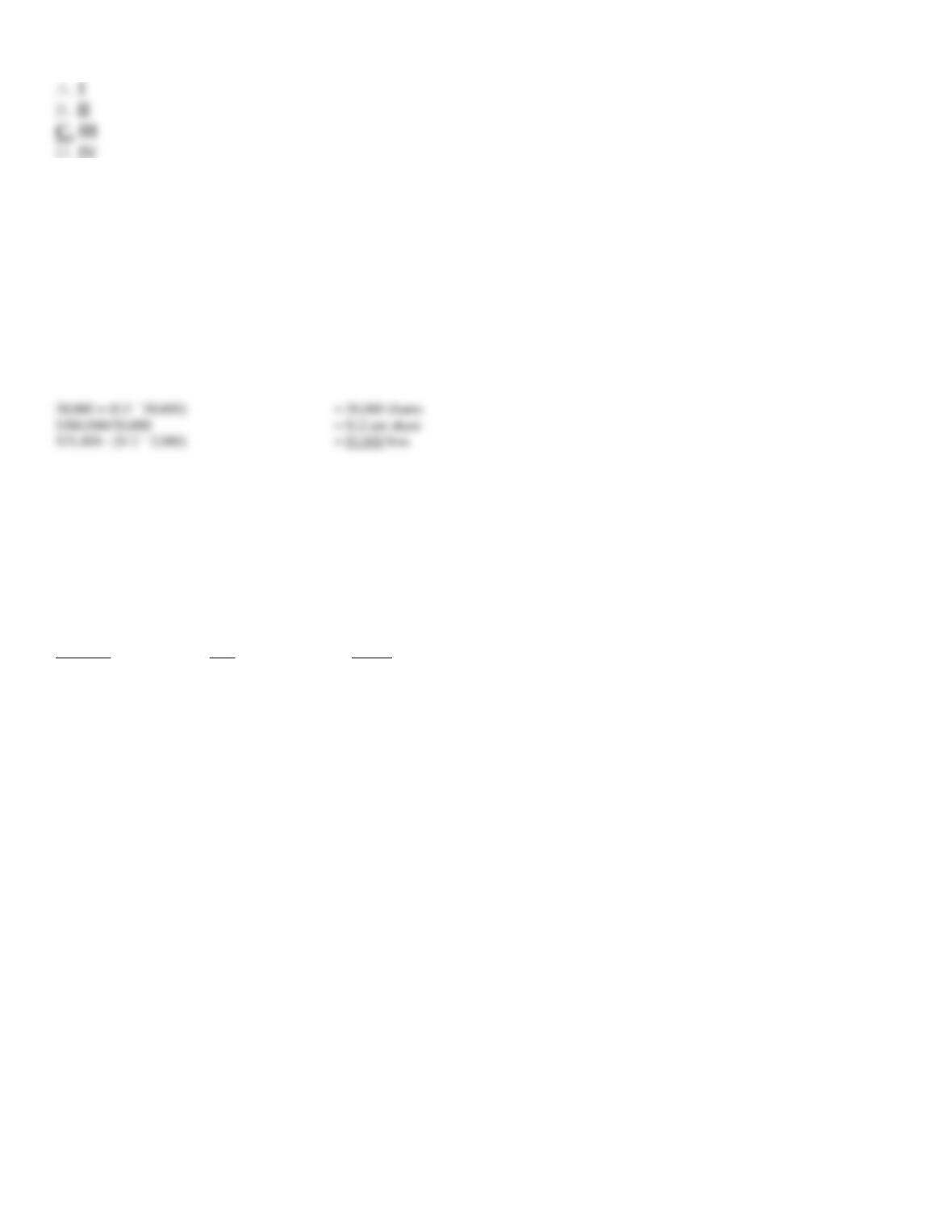
88. On January 1, 2010, Lightner bought 20,000 shares (5% ownership) of Winter Corp. common stock for
$360,000. On May 3, 2010, Winter declared and distributed a 50% stock dividend. On September 1, 2010,
Lightner sold 2,000 shares of its investment in Winter stock for $21,400.
Required:
Compute the amount of gain (loss) on the sale of this stock.
20,000 + (0.5 ´ 20,000)
= 30,000 shares
$360,000/30,000
= $12 per share
$21,400 – ($12 ´ 2,000)
89. During January 2010, Foxy Corporation for the first time decided to acquire some equity securities as a
means of putting some of its idle cash to work. The securities are classified as investments available for sale. At
March 31, when Foxy prepares its first quarter financial statements, the following information about the
acquired securities is available:
Securities
Cost
Market
A
$22,000
$20,000
B
12,000
9,000
C
15,000
17,000
Required:
a.
Prepare the journal entries to record the acquisition in January and valuation at the end of the first quarter of 2010.
b.
Assume that on June 30, 2010, the company still has this same portfolio. The market value of A is $27,000, B is $10,000, and C is
$21,000. What journal entry, if any, should be prepared at the end of the second quarter?
c.
On August 15, 2010, Foxy Corporation sold Security C for $23,000. Prepare the journal entry to record this transaction.