145) Minstrel Manufacturing uses a job order costing system. During one month, Minstrel
purchased $198,000 of raw materials on credit; issued materials to production of $195,000 of
which $30,000 were indirect. Minstrel incurred a factory payroll of $150,000, of which $40,000
was indirect labor. Minstrel uses a predetermined overhead rate of 150% of direct labor cost. The
journal entry to record the factory payroll is:
A) Debit Work in Process Inventory $150,000; debit Factory Overhead $40,000; credit Factory
Wages Payable $190,000.
B) Debit Work in Process Inventory $150,000; credit Cash $150,000.
C) Debit Work in Process Inventory $110,000; debit Factory Overhead $40,000; credit Factory
Wages Payable $150,000.
D) Debit Work in Process Inventory $150,000; credit Factory Overhead $40,000; credit Factory
Wages Payable $110,000.
E) Debit Work in Process Inventory $110,000; credit Factory Overhead $40,000; credit Factory
Wages Payable $150,000.
146) Minstrel Manufacturing uses a job order costing system. During one month, Minstrel
purchased $198,000 of raw materials on credit; issued materials to production of $195,000 of
which $30,000 were indirect. Minstrel incurred a factory payroll of $150,000, of which $40,000
was indirect labor. Minstrel uses a predetermined overhead rate of 150% of direct labor cost. The
journal entry to record the payment of the factory payroll is:
A) Debit Work in Process Inventory $150,000; credit Factory Wages Payable $150,000.
B) Debit Work in Process Inventory $150,000; credit Cash $150,000.
C) Debit Factory Wages Payable $150,000; credit Cash $150,000.
D) Debit Factory Overhead $40,000; credit Factory Wages Payable $40,000.
E) Debit Work in Process Inventory $110,000; credit Cash $150,000.
147) Minstrel Manufacturing uses a job order costing system. During one month Minstrel
purchased $198,000 of raw materials on credit; issued materials to production of $195,000 of
which $30,000 were indirect. Minstrel incurred a factory payroll of $150,000, of which $40,000
was indirect labor. Minstrel uses a predetermined overhead rate of 150% of direct labor cost. The
journal entry to record the application of factory overhead to production is:
A) Debit Work in Process Inventory $225,000; credit Factory Overhead $225,000.
B) Debit Work in Process Inventory $165,000; credit Factory Overhead $165,000.
C) Debit Factory Payroll $150,000; credit Work in Process Inventory $150,000.
D) Debit Factory Overhead $165,000; credit Work in Process Inventory $165,000.
E) Debit Work in Process Inventory $165,000; credit Factory Payroll $165,000.
148) Minstrel Manufacturing uses a job order costing system. During one month, Minstrel
purchased $198,000 of raw materials on credit; issued materials to production of $195,000 of
which $30,000 were indirect. Minstrel incurred a factory payroll of $150,000, of which $40,000
was indirect labor. Minstrel uses a predetermined overhead rate of 150% of direct labor cost. The
total manufacturing costs added during the period is:
A) $440,000.
B) $470,000.
C) $500,000.
D) $570,000.
E) $540,000.
149) Minstrel Manufacturing uses a job order costing system. During one month, Minstrel
purchased $198,000 of raw materials on credit; issued materials to production of $195,000 of
which $30,000 were indirect. Minstrel incurred a factory payroll of $150,000, of which $40,000
was indirect labor. Minstrel uses a predetermined overhead application rate of 150% of direct
labor cost. If Minstrel incurred total overhead costs of $167,800 during the month, compute the
amount of under- or overapplied overhead:
A) $2,800 overapplied.
B) $17,800 underapplied.
C) $2,800 underapplied.
D) $17,800 overapplied.
E) $57,200 overapplied.
150) Minstrel Manufacturing uses a job order costing system. During one month, Minstrel
purchased $198,000 of raw materials on credit; issued materials to production of $195,000 of
which $30,000 were indirect. Minstrel incurred a factory payroll of $150,000, of which $40,000
was indirect labor. Minstrel uses a predetermined overhead application rate of 150% of direct
labor cost. Minstrel’s beginning and ending Work in Process Inventory are $15,500 and $27,000
respectively. Compute the cost of jobs transferred to Finished Goods Inventory.
A) $558,500.
B) $440,000.
C) $413,000.
D) $428,500.
E) $415,000.
151) Finished goods inventory is $190,000. If overhead applied to these goods is $72,000, and
the overhead rate is 120% of direct labor, how much direct materials cost was incurred in
producing the inventory?
A) $31,600.
B) $58,000.
C) $56,000.
D) $60,000.
E) $86,400.
152) Adams Manufacturing allocates overhead to production on the basis of direct labor costs.
At the beginning of the year, Adams estimated total overhead of $396,000; materials of $410,000
and direct labor of $220,000. During the year Adams incurred $418,000 in materials costs,
$413,200 in overhead costs and $224,000 in direct labor costs. Compute the predetermined
overhead rate.
A) 180%.
B) 55.6%.
C) 186%.
D) 184%.
E) 96.6%.
153) Adams Manufacturing allocates overhead to production on the basis of direct labor costs.
At the beginning of the year, Adams estimated total overhead of $396,000; materials of $410,000
and direct labor of $220,000. During the year Adams incurred $418,000 in materials costs,
$413,200 in overhead costs and $224,000 in direct labor costs. Compute the amount of overhead
applied to jobs during the year.
A) $396,000.
B) $424,450.
C) $413,190.
D) $413,200.
E) $403,200.
154) Adams Manufacturing allocates overhead to production on the basis of direct labor costs.
At the beginning of the year, Adams estimated total overhead of $396,000; materials of $410,000
and direct labor of $220,000. During the year Adams incurred $418,000 in materials costs,
$413,200 in overhead costs and $224,000 in direct labor costs. Compute the amount of under- or
overapplied overhead for the year.
A) $10,000 overapplied.
B) $17,200 overapplied.
C) $10,000 underapplied.
D) $17,200 underapplied.
E) $4,800 underapplied.
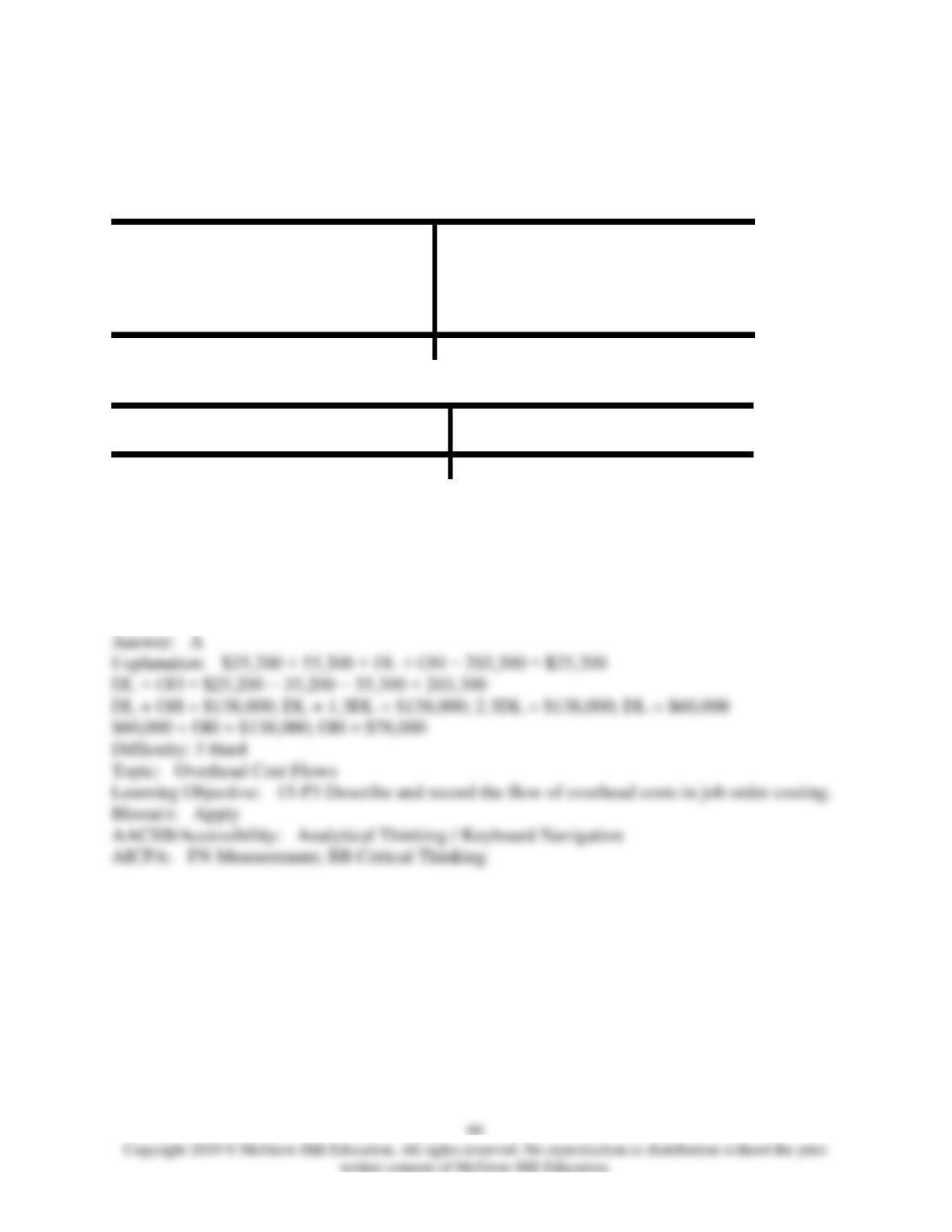
155) Using the following accounts and a predetermined overhead rate of 130% of direct labor
cost, compute the amount of applied overhead.
Work in Process Inventory
Beginning WIP
35,200
Direct materials
55,300
Direct labor
?
Factory overhead
?
To finished goods
203,300
Ending WIP
25,200
Finished Goods Inventory
Beginning FG
5,200
Cost of Goods Mfg’d
203,300
A) $78,000.
B) $60,000.
C) $138,000.
D) $71,890.
E) $90,500.
156) Portside Watercraft uses a job order costing system. During one month Portside purchased
$173,000 of raw materials on credit; issued materials to production of $164,000, of which
$24,000 were indirect. Portside incurred a factory payroll cost of $95,000, of which $25,000 was
indirect labor. Portside uses a predetermined overhead rate of 170% of direct labor cost. The
journal entry to record the issuance of materials to production is:
A) Debit Raw Materials Inventory $153,000; credit Accounts Payable $153,000.
B) Debit Work in Process Inventory $140,000; debit Factory Overhead $24,000; credit Raw
Materials Inventory $164,000.
C) Debit Raw Materials Inventory $195,000; credit Work in Process Inventory $195,000.
D) Debit Work in Process Inventory $140,000; debit Raw Materials Inventory $24,000; credit
Materials Inventory $164,000.
E) Debit Finished Goods Inventory $140,000; credit Raw Materials Inventory $140,000.
157) Portside Watercraft uses a job order costing system. During one month Portside purchased
$173,000 of raw materials on credit; issued materials to production of $164,000, of which
$24,000 were indirect. Portside incurred a factory payroll cost of $95,000, of which $25,000 was
indirect labor. Portside uses a predetermined overhead rate of 170% of direct labor cost. The
journal entry to record the allocation of factory wages to production is:
A) Debit Work in Process Inventory $95,000; credit Factory Wages Payable $95,000.
B) Debit Work in Process Inventory $95,000; credit Cash $95,000.
C) Debit Factory Wages Payable $95,000; credit Cash $95,000.
D) Debit Work in Process Inventory $70,000; debit Factory Overhead $25,000; credit Factory
Wages Payable $95,000.
E) Debit Work in Process Inventory $70,000; debit Factory Overhead $25,000; credit Cash
$95,000.
158) Portside Watercraft uses a job order costing system. During one month Portside purchased
$153,000 of raw materials on credit; issued materials to production of $164,000, of which
$24,000 were indirect. Portside incurred a factory payroll cost of $95,000, of which $25,000 was
indirect labor. Portside uses a predetermined overhead rate of 170% of direct labor cost. The
journal entry to record the application of factory overhead to production is:
A) Debit Work in Process Inventory $55,800; credit Factory Overhead $55,800.
B) Debit Work in Process Inventory $161,500; credit Factory Overhead $161,500.
C) Debit Work in Process Inventory $119,000; credit Factory Overhead $119,000.
D) Debit Factory Overhead $119,000; credit Work in Process Inventory $119,000.
E) Debit Work in Process Inventory $95,000; credit Factory Payroll $95,000.
159) Copy Center pays an average wage of $12 per hour to employees for printing and copying
jobs, and allocates $18 of overhead for each employee hour worked. Direct materials are
assigned to each job according to actual cost. If Job M-47 used $350 of direct materials and took
20 direct labor hours of labor to complete, what is the total cost that should be assigned to the
job?
A) $590
B) $600
C) $380
D) $950
E) $710
160) Copy Center pays an average wage of $12 per hour to employees for printing and copying
jobs, and allocates $18 of overhead for each employee hour worked. Direct materials are
assigned to each job according to actual cost. Jobs are marked up 20% above total manufacturing
cost to determine the selling price. If Job M-47 used $350 of direct materials and took 20 direct
hours of labor to complete, what is the selling price of the job?
A) $852
B) $1,140
C) $456
D) $720
E) $708

70
161) Match the following terms to the appropriate definition.
A. Cost accounting system
B. Time ticket
C. Finished Goods Inventory
D. Materials requisition
E. Underapplied overhead
F. Work in Process Inventory
G. Overapplied overhead
H. Job cost sheet
I. Job order production
J. Predetermined overhead rate
K. Materials ledger card
________ 1. The production of products in response to special orders; also called customized
production.
________ 2. Accumulates production costs and assigns them to products and services.
________ 3. The amount by which the overhead applied to jobs in a period with the
predetermined overhead rate exceeds the actual overhead incurred in a period.
________ 4. An asset account where costs are accumulated while jobs are being produced.
________ 5. The rate established prior to the beginning of a period that relates estimated
overhead to an activity base such as estimated direct labor and is used to assign overhead cost to
a job.
________ 6. An asset account where costs of completed jobs are kept until the jobs are delivered
to customers.
________ 7. A source document that production managers use to request materials needed for
manufacturing and that is used to assign materials costs to specific jobs or to overhead.
________ 8. A perpetual record that is updated each time units of raw material are purchased and
issued for use in production.
________ 9. A source document that is used to report how much time an employee spent
working on a job or on overhead activities and the labor costs to assign to jobs or overhead.
________10. The amount by which actual overhead incurred in a period exceeds the overhead
applied to jobs with the predetermined overhead rate.
________11. A cost record maintained for each job in a job order costing system; it shows the
costs of direct materials, direct labor, and overhead for each job.
162) What is a cost accounting system? What are the two basic types of cost accounting
systems?
163) Describe the purpose of a job cost sheet, and explain what information is found on the job
cost sheet.
164) Explain how a service firm, such as an advertising agency, might use job order costing.
165) Describe how materials flow through a job order costing system, and identify the key
documents in the system.
166) Describe the flow of the raw materials, both direct and indirect, through the inventory
accounts from purchase to use.
167) Describe the flow of labor costs in a job order costing system, and identify the documents
used in the system.
168) Describe the flow of the employee labor, both direct and indirect, through the inventory
accounts.
169) Explain what a predetermined overhead rate is, how it is calculated, and why it is used.
170) Explain why the Factory Overhead account for a company may have a difference between
the amount debited and the amount credited, resulting in an end of period balance prior to
adjustment.
171) How do manufacturing firms adjust the overapplied or underapplied factory overhead
account at the end of an accounting period?

75
172) Merker Manufacturing Company has the following job cost sheets on file. They represent
jobs that have been worked on during April of the current year. This table summarizes
information provided on each sheet:
Number
Total Cost Incurred
Status of Job
544
$15,050
Finished and delivered
545
$22,400
Finished and delivered
546
$ 7,500
Finished and unsold
547
$ 4,300
Finished and delivered
548
$33,000
Unfinished
549
$62,000
Finished and unsold
550
$14,600
Unfinished
551
$22,200
Finished and delivered
552
$ 3,600
Finished and unsold
553
$ 1,000
Unfinished
(a) What is the cost of goods sold for the month of April?
(b) What is the cost of the Work in Process inventory on April 30?
(c) What is the cost of the finished goods inventory on April 30?

77
173) Luna Manufacturing Company has the following job cost sheets on file. They represent jobs
that have been worked on during September of the current year. This table summarizes
information provided on each sheet:
Number
Total Cost Incurred
Status of Job
951
$ 4,200
Finished and delivered
952
$ 7,700
Unfinished
953
$ 9,300
Finished and unsold
954
$ 11,100
Finished and delivered
955
$ 3,000
Finished and unsold
956
$ 5,500
Finished and delivered
957
$ 35,000
Unfinished
958
$ 3,200
Finished and delivered
959
$ 500
Unfinished
960
$ 22,110
Unfinished
961
$ 7,200
Finished and delivered
962
$ 8,500
Unfinished
963
$ 11,200
Finished and unsold
(a) What is the cost of the Work in Process inventory on September 30?
(b) What is the cost of the finished goods inventory on September 30?
(c) What is the cost of goods sold for the month of September?
79
174) Chung Corporation uses a job order costing system. Five jobs were worked on during the
current year. The predetermined overhead rate is 20% of direct labor costs. The following cost
information is available (all materials and time ticket information applies to direct costs):
Job
Materials Requisitions
Time Tickets
101
$66,000
$32,000
102
$63,000
$74,000
103
$39,000
$50,000
104
$32,000
$36,000
105
$53,000
$68,000
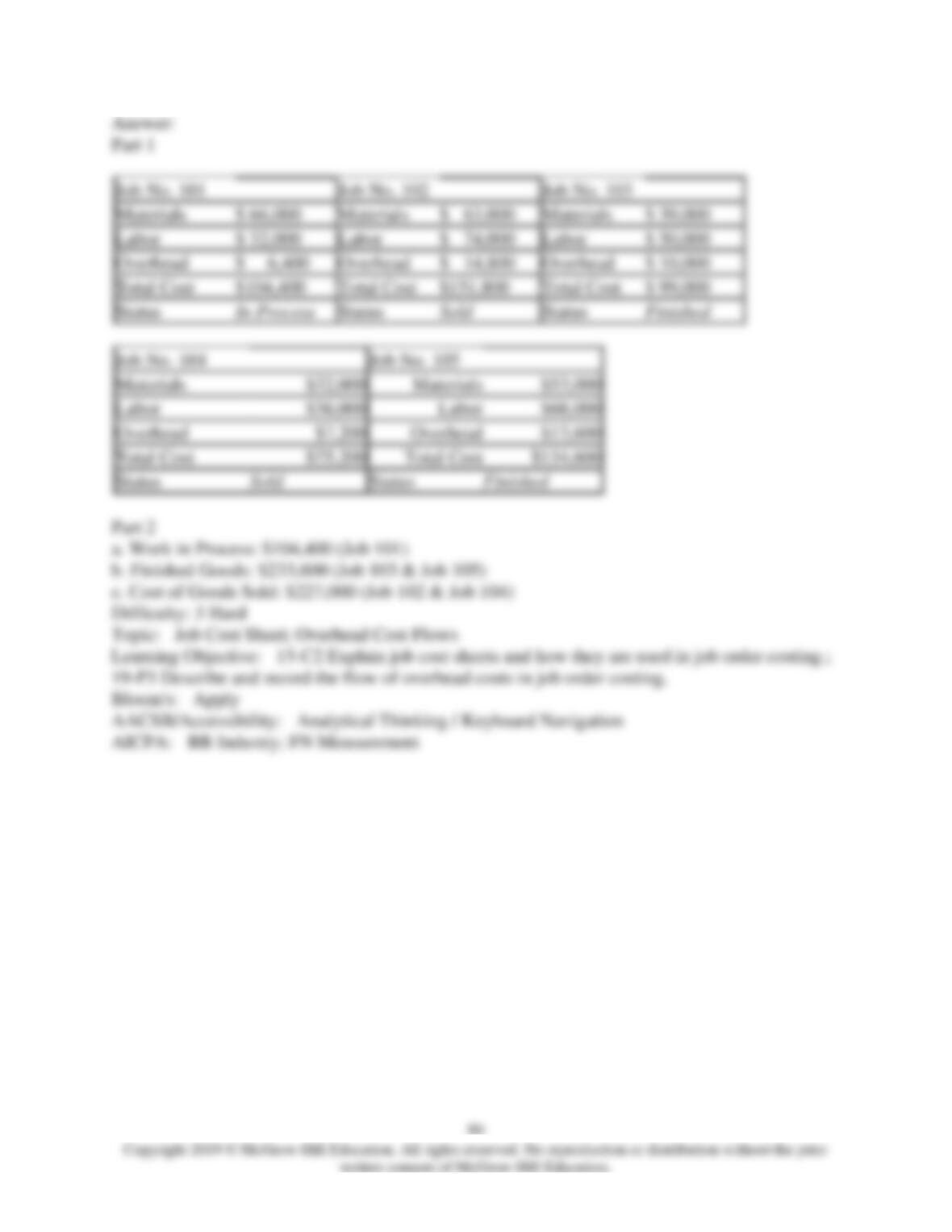
Part 1—Complete job cost sheets for each job.
Job No. 101
Job No. 102
Job No. 103
Materials
Materials
Materials
Labor
Labor
Labor
Overhead
Overhead
Overhead
Total Cost
Total Cost
Total Cost
Status
In Process
Status
Sold
Status
Finished
Job No. 104
Job No. 105
Materials
Materials
Labor
Labor
Overhead
Overhead
Total Cost
Total Cost
Status
Sold
Status
Finished
Part 2—Identify the amounts of each of the following accounts at the end of the period
a. Work in Process________
b. Finished Goods________
c. Cost of Goods Sold________