
Name:
Class:
Date:
chapter 15
Indicate whether the statement is true or false.
1. If 800 shares of $40 par common stock are sold for $43,000, the $43,000 would be reported in the cash flows from
financing activities section of the statement of cash flows.
a.
True
b.
False
2. Cash flows from operating activities, as part of the statement of cash flows, include cash flow from transactions that
enter into the determination of net income.
a.
True
b.
False
3. If a business issued bonds payable in exchange for land, the transaction would be reported in a separate schedule on the
statement of cash flows.
a.
True
b.
False
4. Cash paid to acquire treasury stock should be shown on the statement of cash flows under investing activities.
a.
True
b.
False
5. There is no difference in the investing and financing sections of the statement of cash flows using the indirect and direct
method.
a.
True
b.
False
6. The declaration and issuance of a stock dividend would be reported on the statement of cash flows.
a.
True
b.
False
7. To determine cash payments for operating expenses for the statement of cash flows using the direct method, a decrease
in prepaid expenses is added to operating expenses other than depreciation.
a.
True
b.
False
8. Cash flows from investing activities, as part of the statement of cash flows, would include any receipts from the
issuance of bonds payable.
a.
True
b.
False
9. There are two alternatives to reporting cash flows from operating activities in the statement of cash flows: (1) the direct
method and (2) the indirect method.
a.
True
b.
False
10. The statement of cash flows reports a firm’s major sources of cash receipts and major uses of cash for a period of time.
a.
True

Name:
Class:
Date:
chapter 15
b.
False
11. Free cash flow is the measure of operating cash flow available for corporate purposes after providing sufficient fixed
asset additions to maintain current operations.
a.
True
b.
False
12. Net income was $51,000 for the year. The accumulated depreciation balance increased by $14,000 over the
year. There were no sales of fixed assets or changes in noncash current assets or liabilities. Under the indirect method,
the cash flow from operations is $37,000.
a.
True
b.
False
13. Purchasing equipment by issuing a six-month note should be shown on the statement of cash flows under the investing
activities section.
a.
True
b.
False
14. Under the indirect method, expenses that do not affect cash are added to net income in the operating activities section
of the statement of cash flows.
a.
True
b.
False
15. Cash, as the term is used for the statement of cash flows, could indicate either cash or cash equivalents.
a.
True
b.
False
16. In determining the cash flows from operating activities for the statement of cash flows by the indirect method, the
depreciation expense for the period is added to the net income for the period.
a.
True
b.
False
17. The acquisition of land in exchange for common stock is an example of noncash investing and financing activity.
a.
True
b.
False
18. Rarely will the cash flows from operating activities, as reported on the statement of cash flows, be the same as the net
income reported on the income statement.
a.
True
b.
False
19. In preparing the statement of cash flows, the correct order of reporting cash activities is financing, operating, and
investing.
a.
True
b.
False
20. Cash flows from investing activities, as part of the statement of cash flows, include payments for the acquisition of

Name:
Class:
Date:
chapter 15
fixed assets.
a.
True
b.
False
21. To determine cash payments for merchandise for the statement of cash flows using the direct method, a decrease in
accounts payable is added to the cost of goods sold. Assume all accounts payable are owed to merchandise suppliers.
a.
True
b.
False
22. If $475,000 of bonds payable are sold at 101, $475,000 would be reported in the cash flows from financing activities
section of the statement of cash flows.
a.
True
b.
False
23. In preparing the cash flows from operating activities section of the statement of cash flows by the indirect method, the
net decrease in inventories from the beginning to the end of the period is added to net income for the period.
a.
True
b.
False
24. The statement of cash flows is an optional financial statement.
a.
True
b.
False
25. Cash flows from investing activities, as part of the statement of cash flows, would include any payments for the
purchase of treasury stock.
a.
True
b.
False
26. Cash outflows from financing activities include the payment of cash dividends, the acquisition of treasury stock, and
the repayment of amounts borrowed.
a.
True
b.
False
27. The direct method of preparing the operating activities section of the statement of cash flows reports major classes of
cash receipts and cash payments related to the day-to–day operations of the business.
a.
True
b.
False
28. To determine cash payments for income taxes for the statement of cash flows using the direct method, an increase in
income taxes payable is added to the income tax expense.
a.
True
b.
False
29. The main disadvantage of the direct method of reporting cash flows from operating activities is that the necessary data
are often costly to accumulate.
a.
True
b.
False

Name:
Class:
Date:
chapter 15
30. Sales reported on the income statement were $372,000. The accounts receivable balance declined $4,500 over the
year. The amount of cash received from customers was $367,500.
a.
True
b.
False
31. Cash flows from financing activities, as part of the statement of cash flows, would include any payments for
dividends.
a.
True
b.
False
32. A cash flow per share amount should be reported on the statement of cash flows.
a.
True
b.
False
33. The manner of reporting cash flows from investing and financing activities will be different under the direct method as
compared to the indirect method.
a.
True
b.
False
34. Repayments of bonds would be shown as a cash outflow in the investing section of the statement of cash flows.
a.
True
b.
False
35. The statement of cash flows is not one of the basic financial statements.
a.
True
b.
False
36. To arrive at cash flows from operations, it is necessary to convert the income statement from an accrual basis to the
cash basis of accounting.
a.
True
b.
False
37. In preparing the cash flows from operating activities section of the statement of cash flows by the indirect method, the
amortization of bond discount for the period is deducted from the net income for the period.
a.
True
b.
False
38. Under the direct method of reporting cash flows from operations, the primary source of cash is cash received from
customers.
a.
True
b.
False
39. To determine cash payments for operating expenses for the statement of cash flows using the direct method, a
decrease in accrued expenses is added to operating expenses other than depreciation.
a.
True
b.
False

Name:
Class:
Date:
chapter 15
40. If land costing $145,000 was sold for $205,000, the $60,000 gain on the sale would be added to net income in the
operating activities section of the statement of cash flows (prepared by the indirect method).
a.
True
b.
False
41. A building with a cost of $153,000 and accumulated depreciation of $42,000 was sold for an $11,000 gain. When
using the indirect method, the cash generated from this investing activity was $121,000.
a.
True
b.
False
42. Net income for the year was $29,500. Accounts receivable increased $2,500, and accounts payable increased $5,400.
There were no other changes in noncash current assets and liabilities. Under the indirect method, the cash flow from
operations is $32,400.
a.
True
b.
False
43. Using the indirect method, if land costing $85,000 was sold for $145,000, the amount reported in the financing
activities section of the statement of cash flows would be $85,000.
a.
True
b.
False
44. Cash flows from investing activities, as part of the statement of cash flows, would include any receipts from the sale
of land.
a.
True
b.
False
45. Under the direct method of preparing a statement of cash flows, the gain on the sale of land is not adjusted or reported
as part of cash flows from operating activities.
a.
True
b.
False
46. When using the spreadsheet (work sheet) method to analyzing noncash accounts, no order of analysis is required, but
it is more efficient to start with Retained Earnings and proceed upward in the account listing.
a.
True
b.
False
47. A major disadvantage of the indirect method of reporting cash flows from operating activities is that the difference
between the net amount of cash flows from operating activities and net income is emphasized.
a.
True
b.
False
48. If cash dividends of $135,000 were paid during the year and the company sold 1,000 shares of common stock at $30
per share, the statement of cash flows would report net cash flow from financing activities as $165,000.
a.
True
b.
False

Name:
Class:
Date:
chapter 15
49. Cash inflows and outflows are not netted in the investing or financing sections of the statement of cash flows but are
separately disclosed to give the reader full information.
a.
True
b.
False
50. The statement of cash flows shows the effects on cash of a company’s operating, investing, and financing activities.
a.
True
b.
False
Indicate the answer choice that best completes the statement or answers the question.
51. Cash receipts received from the issuance of a mortgage notes payable would be classified as a(n)
a.
investing activity
b.
operating activity
c.
noncash investing and financing activity
d.
financing activity
52. On the statement of cash flows, the cash flows from financing activities section would include
a.
receipts from the sale of investments
b.
payments for the acquisition of investments
c.
receipts from a note receivable
d.
receipts from the issuance of common stock
53. Which of the following does not represent an outflow of cash and therefore would not be reported on the statement of
cash flows as a use of cash?
a.
purchase of noncurrent assets
b.
purchase of treasury stock
c.
discarding an asset that had been fully depreciated
d.
payment of cash dividends
54. Which of the following can be found on the statement of cash flows?
a.
cash flows from operating activities
b.
total assets
c.
total changes in stockholders’ equity
d.
changes in retained earnings
55. The operating cash flow available for company use after purchasing the fixed assets that are necessary to maintain
current operations is called the
a.
free cash flow
b.
modified cash flow
c.
PPE cash flow
d.
restricted cash flow
56. The order of presentation of activities on the statement of cash flows is
a.
operating, investing, and financing

Name:
Class:
Date:
chapter 15
b.
operating, financing, and investing
c.
financing, operating, and investing
d.
financing, investing, and operating
57. Which of the following increases cash?
a.
depreciation expense
b.
acquisition of treasury stock
c.
borrowing money by issuing a six-month note
d.
the declaration of a cash dividend
58. On the statement of cash flows prepared by the indirect method, a $50,000 gain on the sale of investments would be
a.
deducted from net income in converting the net income reported on the income statement to cash flows from
operating activities
b.
added to net income in converting the net income reported on the income statement to cash flows from
operating activities
c.
added to dividends declared in converting the dividends declared to the cash flows from financing activities
related to dividends
d.
deducted from dividends declared in converting the dividends declared to the cash flows from financing
activities related to dividends
59. If accounts payable have increased during a period,
a.
revenues on an accrual basis are less than revenues on a cash basis
b.
expenses on an accrual basis are less than expenses on a cash basis
c.
expenses on an accrual basis are the same as expenses on a cash basis
d.
expenses on an accrual basis are greater than expenses on a cash basis
60. Which of the following should be deducted from net income in calculating net cash flow from operating activities
using the indirect method?
a.
depreciation expense
b.
gain on sale of land
c.
a loss on the sale of equipment
d.
dividends declared and paid
61. The statement of cash flows is not useful for
a.
planning future investing and financing activities
b.
determining a company’s ability to pay its debts
c.
determining a company’s ability to pay dividends
d.
calculating the net worth of a company
62. Cash paid for equipment would be reported on the statement of cash flows in
a.
the cash flows from operating activities section
b.
the cash flows from financing activities section
c.
the cash flows from investing activities section
d.
a separate schedule

Name:
Class:
Date:
chapter 15
63. Preferred stock issued in exchange for land would be reported in the statement of cash flows in
a.
the cash flows from financing activities section
b.
the cash flows from investing activities section
c.
a separate schedule
d.
the cash flows from operating activities section
64. Which of the following is a noncash investing and financing activity?
a.
payment of a cash dividend
b.
payment of a six-month note payable
c.
purchase of inventory on account
d.
issuance of common stock to acquire land
65. Cash dividends paid on common stock would be reported in the statement of cash flows in
a.
the cash flows from financing activities section
b.
the cash flows from investing activities section
c.
a separate schedule
d.
the cash flows from operating activities section
66. A building with a book value of $54,000 is sold for $63,000 cash. Using the indirect method, this transaction should
be shown on the statement of cash flows as follows:
a.
an increase of $54,000 from investing activities
b.
an increase of $63,000 from investing activities and a deduction from net income of $9,000
c.
an increase of $9,000 from investing activities
d.
an increase of $54,000 from investing activities and an addition to net income of $9,000
67. The following information is available from the current period financial statements:
Net income
$175,000
Depreciation expense
28,000
Increase in accounts receivable
16,000
Decrease in accounts payable
21,000
The net cash flow from operating activities using the indirect method is
a.
$166,000
b.
$184,000
c.
$110,000
d.
$240,000
68. If a gain of $11,000 is realized in selling (for cash) office equipment having a book value of $55,000, the total amount
reported in the cash flows from investing activities section of the statement of cash flows is
a.
$44,000
b.
$11,000
c.
$55,000
d.
$66,000
69. Free cash flow is cash from operations less cash used for

Name:
Class:
Date:
chapter 15
a.
investments in PP&E needed to maintain current operations
b.
dividends and cash to redeem bonds payable
c.
investments in PP&E needed to achieve desired future operations
d.
fixed assets needed to maintain current operations and cash to redeem bonds payable
70. Cash paid for preferred stock dividends should be shown on the statement of cash flows under
a.
investing activities
b.
financing activities
c.
noncash investing and financing activities
d.
operating activities
71. On the statement of cash flows, a $7,500 gain on the sale of fixed assets would be
a.
added to net income in converting the net income reported on the income statement to cash flows from
operating activities
b.
deducted from net income in converting the net income reported on the income statement to cash flows from
operating activities
c.
added to dividends declared in converting the dividends declared to the cash flows from financing activities
related to dividends
d.
deducted from dividends declared in converting the dividends declared to the cash flows from financing
activities related to dividends
72. The comparative balance sheets of Posner Company, for Years 1 and 2 ended December 31, appear below in
condensed form:
Year 2
Year 1
Cash
$53,000
$50,000
Accounts receivable (net)
37,000
48,000
Inventories
108,500
100,000
Investments
—
70,000
Equipment
573,200
450,000
Accumulated depreciation—equipment
(142,000)
(176,000)
$629,700
$542,000
Accounts payable
$62,500
$43,800
Bonds payable, due Year 2
—
100,000
Common stock, $10 par
325,000
285,000
Paid-in capital in excess of par—common stock
80,000
55,000
Retained earnings
162,200
58,200
$629,700
$542,000
The income statement for the current year is as follows:
Sales
$625,700
Cost of goods sold
340,000
Gross profit
$285,700
Name:
Class:
Date:
chapter 15
Operating expenses:
Depreciation expense
$26,000
Other operating expenses
68,000
Total operating expenses
94,000
Income from operations
$191,700
Other income:
Gain on sale of investment
$4,000
Other expense:
Interest expense
6,000
(2,000)
Income before income tax
$189,700
Income tax
60,700
Net income
$129,000
Additional data for the current year are as follows:
(a)
Fully depreciated equipment costing $60,000 was scrapped, no salvage, and
new equipment was purchased for $183,200.
(b)
Bonds payable for $100,000 were retired by payment at their face amount.
(c)
5,000 shares of common stock were issued at $13 for cash.
(d)
Cash dividends declared and paid, $25,000.
What are the net cash flows from operating, investing, and financing activities for Year 2?
a.
operating: $108,000; investing: ($105,200); financing: ($60,000)
b.
operating: $151,800; investing: ($84,200); financing: ($64,600)
c.
operating: $122,200; investing: ($84,200); financing: ($35,000)
d.
operating: $172,200; investing: ($109,200); financing: ($60,000)
73. Which of the following should be deducted from net income in calculating net cash flow from operating activities
using the indirect method?
a.
a decrease in inventory
b.
a decrease in accounts payable
c.
preferred dividends declared and paid
d.
a decrease in accounts receivable
74. Baxter Company reported a net loss of $13,000 for the year ended December 31. During the year, accounts receivable
decreased by $5,000, inventory increased by $8,000, accounts payable increased by $10,000, and depreciation expense of
$4,000 was recorded. During the year, operating activities
a.
provided net cash of $8,000
b.
provided net cash of $2,000
c.
used net cash of $8,000
d.
used net cash of $2,000
75. Which of the following should be added to net income in calculating net cash flow from operating activities using the
indirect method?
a.
depreciation expense

Name:
Class:
Date:
chapter 15
b.
an increase in inventory
c.
a gain on the sale of equipment
d.
dividends declared and paid
76. Cash dividends of $50,000 were declared during the year. Cash dividends payable were $10,000 and $5,000 at the
beginning and end of the year, respectively. The amount of cash for the payment of dividends during the year is
a.
$55,000
b.
$50,000
c.
$65,000
d.
$60,000
77. Norris Company declared cash dividends of $60,000 during the year. Cash dividends payable were $20,000 at the
beginning of the year and $25,000 at the end of the year. The amount of cash Norris Co. used for payment of dividends
during the year was
a.
$55,000
b.
$80,000
c.
$105,000
d.
$65,000
78. A company had net income of $252,000. Depreciation expense is $26,000. During the year, accounts receivable and
inventory increased by $15,000 and $40,000, respectively. Prepaid expenses and accounts payable decreased by $2,000
and $4,000, respectively. There was also a loss on the sale of equipment of $3,000. How much was the net cash flow
from operating activities on the statement of cash flows using the indirect method?
a.
$217,000
b.
$224,000
c.
$284,000
d.
$305,000
79. Cash dividends of $45,000 were declared during the year. Cash dividends payable were $10,000 at the beginning of
the year and $15,000 at the end of the year. The amount of cash for the payment of dividends during the year is
a.
$50,000
b.
$40,000
c.
$55,000
d.
$35,000
80. Financing activities include
a.
lending money
b.
acquiring investments
c.
issuing debt
d.
acquiring long-lived assets
81. Which of the following represents an inflow of cash and therefore would be reported on the statement of cash flows?
a.
retirement of bond payable
b.
acquisition of treasury stock
c.
declaration of stock dividends

Name:
Class:
Date:
chapter 15
d.
issuance of long-term debt
82. The following data for Larson Co. for the year ending December 31, Year 2, and the preceding year ended December
31, Year 1, are available:
Year 2
Year 1
Cash
$100,000
$78,000
Accounts receivable (net)
78,000
85,000
Inventories
101,500
90,000
Equipment
410,000
370,000
Accumulated depreciation
(150,000)
(158,000)
$539,500
$465,000
Accounts payable (merchandise creditors)
$58,500
$55,000
Cash dividends payable
5,000
4,000
Common stock, $10 par
200,000
170,000
Paid-in capital in excess of par—common stock
62,000
60,000
Retained earnings
214,000
176,000
$539,500
$465,000
In addition to the balance sheet data, assume that:
• Equipment costing $125,000 was purchased for cash.
• Equipment costing $85,000 with accumulated depreciation of $65,000 was sold for $15,000.
• The stock was issued for cash.
• The only entries in the retained earnings account were net income of $51,000 and cash dividends declared of
$13,000.
What are the net cash flows from operating, investing, and financing activities for Year 2?
a.
operating: $112,000; investing: $110,000; financing: $20,000
b.
operating: $112,000; investing: ($110,000); financing: $20,000
c.
operating: $61,000; investing: ($110,000); financing: $71,000
d.
operating: $144,000; investing: ($110,000); financing: ($12,000)
83. On the statement of cash flows, the cash flows from financing activities section would include all of the following
except
a.
receipts from the sale of bonds payable
b.
payments for dividends
c.
payments for purchase of treasury stock
d.
payments of interest on bonds payable
84. A corporation uses the indirect method for preparing the statement of cash flows. A fixed asset has been sold for
$25,000 representing a gain of $4,500. The value in the operating activities section regarding this event would be
a.
$25,000
b.
$(4,500)
c.
$29,500

Name:
Class:
Date:
chapter 15
d.
$4,500
85. When using the spreadsheet (work sheet) method for the statement of cash flows, indirect method, entries made on the
spreadsheet are
a.
not recorded in the journal or posted to the ledger
b.
recorded in the journal and posted to the ledger
c.
recorded in the journal but not posted to the ledger
d.
not recorded in to the journal but are posted to the ledger
86. Equipment with an original cost of $75,000 and accumulated depreciation of $20,000 was sold at a loss of $7,000. As
a result of this transaction, cash would
a.
increase by $48,000
b.
decrease by $7,000
c.
increase by $55,000
d.
decrease by $27,000
87. Free cash flow is
a.
all cash in the bank
b.
cash from operations
c.
cash from financing less cash used to purchase fixed assets to maintain productive capacity and cash used for
dividends
d.
cash flow from operations less cash used to purchase fixed assets to maintain productive capacity
88. Which of the following would not be on the statement of cash flows?
a.
cash flows from investing activities
b.
cash flows from financing activities
c.
cash flows from operating activities
d.
cash flows from contingent activities
89. On the statement of cash flows, the cash flows from operating activities section would include
a.
receipts from the issuance of common stock
b.
payment for interest on short-term notes payable
c.
payments for the purchase of investments
d.
payments for cash dividends
90. On the statement of cash flows prepared by the indirect method, the cash flows from operating activities section would
include
a.
receipts from the sale of investments
b.
amortization of premium on bonds payable
c.
payments for cash dividends
d.
receipts from the issuance of common stock
91. Cash flow per share is
a.
required to be reported on the balance sheet
b.
required to be reported on the income statement

Name:
Class:
Date:
chapter 15
c.
required to be reported on the statement of cash flows
d.
not required to be reported on any statement
92. Which of the following should be shown on a statement of cash flows under the financing activities section?
a.
the purchase of a long-term investment in the common stock of another company
b.
the payment of cash to retire a long-term note
c.
the proceeds from the sale of a building
d.
the issuance of a long-term note to acquire land
93. The last item on the statement of cash flows prior to the schedule of noncash investing and financing activities reports
a.
the change in cash
b.
cash at the end of the period
c.
net cash flow from investing activities
d.
net cash flow from financing activities
94. Accounts receivable resulting from sales to customers amounted to $40,000 and $31,000 at the beginning and end of
the year, respectively. Net income reported on the income statement for the year was $120,000. Exclusive of the effect of
other adjustments, the net cash flows from operating activities to be reported on the statement of cash flows using the
indirect method is
a.
$120,000
b.
$129,000
c.
$151,000
d.
$111,000
95. Which of the following is not one of the four basic financial statements?
a.
balance sheet
b.
statement of cash flows
c.
statement of changes in financial position
d.
income statement
96. Which of the following would not be found in a schedule of noncash investing and financing activities, reported at the
end of a statement of cash flows?
a.
equipment acquired in exchange for a note payable
b.
bonds payable exchanged for common stock
c.
purchase of treasury stock
d.
common stock issued to acquire fixed assets
97. The current period statement of cash flows includes the following:
Cash balance at the beginning of the period
$310,000
Net cash flow from operating activities
185,000
Net cash flow used for investing activities
43,000
Net cash flow used for financing activities
97,000
The cash balance at the end of the period is
a.
$45,000

Name:
Class:
Date:
chapter 15
b.
$635,000
c.
$355,000
d.
$125,000
98. Which of the following types of transactions would be reported as a cash flow from investing activity on the statement
of cash flows?
a.
issuance of bonds payable
b.
issuance of common stock
c.
purchase of treasury stock
d.
purchase of long-term assets
99. Accounts receivable from sales transactions were $51,000 at the beginning of the year and $64,000 at the end of the
year. Net income reported on the income statement for the year was $105,000. Exclusive of the effect of other
adjustments, the cash flows from operating activities to be reported on the statement of cash flows prepared by the indirect
method is
a.
$105,000
b.
$118,000
c.
$92,000
d.
$169,000
100. On the statement of cash flows, the cash flows from operating activities section would include
a.
receipts from the issuance of common stock
b.
receipts from the sale of investments
c.
payments for the acquisition of investments
d.
cash receipts from sales of merchandise
101. Depreciation on factory equipment would be reported in the statement of cash flows prepared by the indirect method
in
a.
the cash flows from financing activities section
b.
the cash flows from investing activities section
c.
a separate schedule
d.
the cash flows from operating activities section
102. The net income reported on the income statement for the current year was $250,000. Depreciation recorded on fixed
assets and amortization of patents for the year were $40,000, and $9,000, respectively. Balances of current asset and
current liability accounts at the end and at the beginning of the year are as follows:
End
Beginning
Cash
$ 50,000
$ 60,000
Accounts receivable
112,000
108,000
Inventories
105,000
93,000
Prepaid expenses
4,500
6,500
Accounts payable (merchandise creditors)
75,000
89,000
What is the amount of cash flows from operating activities reported on the statement of cash flows prepared by the
indirect method?
a.
$271,000

Name:
Class:
Date:
chapter 15
b.
$279,000
c.
$327,000
d.
$256,000
103. Cash paid to purchase long-term investments would be reported in the statement of cash flows in
a.
the cash flows from operating activities section
b.
the cash flows from financing activities section
c.
the cash flows from investing activities section
d.
a separate schedule
104. A company purchases equipment for $32,000 cash. This transaction should be shown on the statement of cash flows
under
a.
investing activities
b.
financing activities
c.
noncash investing and financing activities
d.
operating activities
105. Changes in current assets and current liabilities are reported on the statement of cash flows, indirect method, in the
a.
operating activities
b.
financing activities
c.
investing activities
d.
separate schedule of noncash activities
106. Under GAAP, cash receipts from interest and dividends are classified as
a.
financing activities
b.
operating activities
c.
investing activities
d.
either financing or investing activities
107. Which of the following should be added to net income in calculating net cash flow from operating activities using the
indirect method?
a.
a gain on the sale of land
b.
a decrease in accounts payable
c.
an increase in accrued expenses
d.
dividends paid on common stock
108. Zenith Corporation sells some of its used store fixtures. The acquisition cost of the fixtures is $12,500, and the
accumulated depreciation on these fixtures is $9,750 at the time of sale. The fixtures are sold for $5,300. The value of this
transaction in the investing section of the statement of cash flows is
a.
$12,500
b.
$5,300
c.
$2,750
d.
$2,550
109. The cost of goods sold during the year was $45,000. Inventories were $13,500 and $10,500 at the beginning and end

Name:
Class:
Date:
chapter 15
of the year, respectively. Accounts payable (all owed to merchandise suppliers) were $7,000 and $5,000 at the beginning
and end of the year, respectively. Using the direct method of reporting cash flows from operating activities, cash
payments for merchandise total
a.
$46,000
b.
$44,000
c.
$50,000
d.
$40,000
110. A ten-year bond was issued at par for $250,000 cash. This transaction should be shown on a statement of cash flows
under
a.
investing activities
b.
financing activities
c.
noncash investing and financing activities
d.
operating activities
111. Income tax expense was $175,000 for the year. Income tax payable was $30,000 and $40,000 at the beginning and
end of the year, respectively. Cash payments for income tax reported on the statement of cash flows using the direct
method is
a.
$175,000
b.
$165,000
c.
$205,000
d.
$215,000
112. Firefly Inc. sold land for $225,000 cash. The land had been purchased five years earlier for $275,000. The loss on the
sale was reported on the income statement. On the statement of cash flows, what amount should Firefly report as an
investing activity from the sale of the land?
a.
$225,000
b.
$275,000
c.
$50,000
d.
$500,000
113. When using the spreadsheet (work sheet) method to analyze noncash accounts, it is best to start with
a.
cash
b.
net income
c.
retained earnings
d.
revenue
114. Accounts receivable from sales to customers amounted to $40,000 and $32,000 at the beginning and end of the year,
respectively. Income reported on the income statement for the year was $110,000. Exclusive of the effect of other
adjustments, the net cash flows from operating activities to be reported on the statement of cash flows using the indirect
method is
a.
$118,000
b.
$110,000
c.
$102,000
d.
$150,000

Name:
Class:
Date:
chapter 15
The following selected account balances appeared on the financial statements of the Washington Company. Use these
balances to answer the questions that follow.
Accounts receivable, Jan. 1
$13,000
Accounts receivable, Dec. 31
9,000
Accounts payable, Jan. 1
4,000
Accounts payable, Dec. 31
7,000
Inventory, Jan. 1
10,000
Inventory, Dec. 31
15,000
Sales
56,000
Cost of goods sold
31,000
The Washington Company uses the direct method to calculate net cash flow from operating activities. Assume that all
accounts payable are owed to merchandise suppliers.
115. Cash payments for merchandise were
a.
$39,000
b.
$33,000
c.
$29,000
d.
$23,000
116. Which of the following should be added to net income in calculating net cash flow from operating activities using the
indirect method?
a.
an increase in inventory
b.
a decrease in accounts payable
c.
preferred dividends declared and paid
d.
a decrease in accounts receivable
117. Land costing $71,000 was sold for $50,000 cash. The loss on the sale was reported on the income statement as other
expense. On the statement of cash flows, what amount should be reported as an investing activity from the sale of land?
a.
$50,000
b.
$71,000
c.
$121,000
d.
$21,000
118. Land costing $140,000 was sold for $173,000 cash. The gain on the sale was reported on the income statement as
other income. On the statement of cash flows, what amount should be reported as an investing activity from the sale of
land?
a.
$173,000
b.
$140,000
c.
$313,000
d.
$33,000
119. The net income reported on the income statement for the current year was $275,000. Depreciation recorded on fixed
assets and amortization of patents for the year were $40,000 and $9,000, respectively. Balances of current asset and
current liability accounts at the end and at the beginning of the year are as follows:

Name:
Class:
Date:
chapter 15
Cash
$50,000
$60,000
Accounts receivable
112,000
108,000
Inventories
105,000
93,000
Prepaid expenses
4,500
6,500
Accounts payable (merchandise creditors)
75,000
89,000
What is the amount of cash flows from operating activities reported on the statement of cash flows prepared by the
indirect method?
a.
$198,000
b.
$324,000
c.
$352,000
d.
$296,000
120. Which of the following would not be classified as an operating activity?
a.
payment of accrued interest expense
b.
payment of accrued income taxes
c.
payment of dividends
d.
payment of accrued selling expenses
121. In calculating cash flows from operating activities using the indirect method, a gain on the sale of equipment is
a.
added to net income
b.
deducted from net income
c.
ignored because it does not affect cash
d.
reported supplementally as a noncash investing and financing activity
122. Net income for the year was $45,500. Accounts receivable increased $5,500, and accounts payable increased by
$11,200. Under the indirect method, the cash flow from operations is
a.
$51,200
b.
$45,500
c.
$62,200
d.
$28,800
123. Rogers Company reported net income of $35,000 for the year. During the year, accounts receivable increased by
$7,000, accounts payable decreased by $3,000 and depreciation expense of $8,000 was recorded. Net cash provided by
operating activities for the year is
a.
$53,000
b.
$47,000
c.
$33,000
d.
$37,000
124. The comparative balance sheet of Barry Company for Years 1 and 2 ended December 31 appears below in condensed
form:
Year 2
Year 1
Cash
$72,000
$42,500
Accounts receivable (net)
61,000
70,200

Name:
Class:
Date:
chapter 15
Inventories
121,000
105,000
Investments
—
100,000
Equipment
515,000
425,000
Accumulated depreciation—equipment
(153,000)
(175,000)
$616,000
$567,700
Accounts payable
$59,750
$47,250
Bonds payable
—
75,000
Common stock, $20 par
375,000
325,000
Premium on common stock
50,000
25,000
Retained earnings
131,250
95,450
$616,000
$567,700
Additional data for the current year are as follows:
(a)
Net income, $75,800.
(b)
Depreciation reported on income statement, $38,000.
(c)
Fully depreciated equipment costing $60,000 was scrapped, no salvage, and
equipment was purchased for $150,000.
(d)
Bonds payable for $75,000 were retired by payment at their face amount.
(e)
2,500 shares of common stock were issued at $30 for cash.
(f)
Cash dividends declared and paid, $40,000.
(g)
Investments of $100,000 were sold for $125,000.
What are the net cash flows from operating, investing, and financing activities for Year 2?
a.
operating: $94,500; investing: ($25,000); financing: ($40,000)
b.
operating: $54,500; investing: ($25,000); financing: $0
c.
operating: $94,500; investing: ($150,000); financing: $85,000
d.
operating: $134,200; investing: ($63,000); financing: ($40,000)
125. On the statement of cash flows, the cash flows from investing activities section would include
a.
receipts from the issuance of common stock
b.
payments for dividends
c.
payments for retirement of bonds payable
d.
receipts from the sale of investments
126. The following information is available from the current period financial statements:
Net income
$165,000
Depreciation expense
28,000
Increase in accounts receivable
16,000
Decrease in accounts payable
21,000
The net cash flow from operating activities using the indirect method is
a.
$230,000
b.
$188,000
c.
$198,000

Name:
Class:
Date:
chapter 15
d.
$156,000
The following selected account balances appeared on the financial statements of the Washington Company. Use these
balances to answer the questions that follow.
Accounts receivable, Jan. 1
$13,000
Accounts receivable, Dec. 31
9,000
Accounts payable, Jan. 1
4,000
Accounts payable, Dec. 31
7,000
Inventory, Jan. 1
10,000
Inventory, Dec. 31
15,000
Sales
56,000
Cost of goods sold
31,000
The Washington Company uses the direct method to calculate net cash flow from operating activities. Assume that all
accounts payable are owed to merchandise suppliers.
127. Cash collections from customers were
a.
$56,000
b.
$52,000
c.
$60,000
d.
$45,000
128. A business issues 20-year bonds payable in exchange for preferred stock. This transaction would be reported on the
statement of cash flows in
a.
a separate schedule
b.
the cash flows from financing activities section
c.
the cash flows from investing activities section
d.
the cash flows from operating activities section
129. Sales for the year were $600,000. Accounts receivable were $100,000 and $80,000 at the beginning and end of the
year, respectively. Cash received from customers to be reported on the statement of cash flows using the direct method is
a.
$700,000
b.
$600,000
c.
$580,000
d.
$620,000
130. The cost of merchandise sold during the year was $50,000. Merchandise inventories were $12,500 and $10,500 at
the beginning and end of the year, respectively. Accounts payable (all owed to merchandise suppliers) were $6,000 and
$5,000 at the beginning and end of the year, respectively. Using the direct method of reporting cash flows from operating
activities, cash payments for merchandise total
a.
$49,000
b.
$47,000
c.
$51,000
d.
$53,000

Name:
Class:
Date:
chapter 15
Identify the section of the statement of cash flows (a–d) where each of the following items would be reported.
a.
Operating activities
b.
Financing activities
c.
Investing activities
d.
Schedule of noncash financing and investing
131. Increase in income taxes payable
132. Dividends received on investment
133. Sale of machinery held for use by the company
134. Issuance of bond payable
135. Purchase of the stock of another company as investment
136. Decrease in inventory
137. Exchange of land for note payable
138. Payment of dividends to stockholders
139. Increase in accounts receivable
140. Loss on sale of equipment
For each of the following activities that may take place during the accounting period, indicate the effect (a–g) on the
statement of cash flows prepared using the indirect method. Choices may be selected as the answer for more than one
question.
a.
Increase cash from operating activities
b.
Decrease cash from operating activities
c.
Increase cash from investing activities
d.
Decrease cash from investing activities
e.
Increase cash from financing activities
f.
Decrease cash from financing activities
g.
Noncash investing and financing activity
141. Purchase of equipment
142. Repayment of long-term note payable
143. Amortization of intangible assets
144. Exchange of land for common stock
145. Payment of dividends
146. Sale of land
Name:
Class:
Date:
chapter 15
147. Gain on sale of investments
148. Acquisition of treasury stock
149. Increase in accounts receivable balance
150. Decrease in accounts payable balance
151. Selected data for the current year ended December 31 are as follows:
Balance
Balance
December 31
January 1
Accrued expenses (operating expenses)
$29,500
$ 22,000
Accounts payable (merchandise creditors)
90,000
135,000
Inventories
42,500
68,000
Prepaid expenses
23,000
20,000
During the current year, the cost of goods sold was $620,000 and the operating expenses other than depreciation were
$142,000. The direct method is used for presenting the cash flows from operating activities on the statement of cash
flows.
Determine the amount reported on the statement of cash flows for (a) cash payments for merchandise and (b) cash
payments for operating expenses.
152. On the basis of the following data for Branch Co. for the current and preceding years ended December 31, prepare a
statement of cash flows for the current year using the indirect method.
Assume that equipment costing $125,000 was purchased for cash and the land was sold for $15,000. The stock was issued
for cash and the only entries in the retained earnings account were for net income of $56,000 and cash dividends declared
and paid of $18,000.
Current year
Prior year
Cash
$ 65,000
$ 54,000
Accounts receivable (net)
78,000
85,000
Inventories
106,500
90,000
Land
—
20,000
Equipment
495,000
370,000
Accumulated depreciation
(215,000)
(158,000)
$529,500
$461,000
Accounts payable (merchandise creditors)
$ 53,500
$ 55,000
Common stock, $10 par
200,000
170,000
Paid-in capital in excess of par—common stock
62,000
60,000
Retained earnings
214,000
176,000
$529,500
$461,000
153. The board of directors declared cash dividends total $168,000 during the year. The comparative balance sheet
indicated dividends payable of $46,000 at the beginning of the year and $42,000 at the end of the year. What was the
amount of cash payments to stockholders during the year?
154. Cost of goods sold reported on the income statement was $155,000. The accounts payable balance increased $8,000,

Name:
Class:
Date:
chapter 15
and the inventory balance increased by $21,000 over the year. Determine the amount of cash paid for merchandise.
155. The comparative balance sheet of ConnieJo Company, for December 31, Years 1 and 2 ended December 31 appears
below in condensed form:
Year 2
Year 1
Cash
$ 45,000
$ 53,500
Accounts receivable (net)
51,300
58,000
Inventories
147,200
135,000
Investments
0
60,000
Equipment
493,000
375,000
Accumulated depreciation—equipment
(113,700)
(128,000)
$622,800
$553,500
Accounts payable
$61,500
$42,600
Bonds payable, due Year 4
0
100,000
Common stock, $10 par
250,000
200,000
Paid-in capital in excess of par—common stock
75,000
50,000
Retained earnings
236,300
160,900
$622,800
$553,500
The income statement for the current year is as follows:
Sales
$629,700
Cost of goods sold
341,800
Gross profit
$287,900
Operating expenses:
Depreciation expense
$24,700
Other operating expenses
75,300
Total operating expenses
100,000
Income from operations
$187,900
Other income:
Gain on sale of investment
$ 5,000
Other expense:
Interest expense
12,000
(7,000)
Income before income tax
$180,900
Income tax
64,100
Net income
$116,800
Additional data for the current year are as follows:
(a)
Fully depreciated equipment costing $39,000 was scrapped, no salvage, and
equipment was purchased for $157,000.
(b)
Bonds payable for $100,000 were retired by payment at their face amount.
(c)
5,000 shares of common stock were issued at $15 for cash.
(d)
Cash dividends declared were paid $41,400.
(e)
All sales are on account.
Prepare a statement of cash flows, using the direct method of reporting cash flows from operating activities.
156. Identify which section the statement of cash flows (using the indirect method) would present information regarding
the following activities. (Use O for operating, I for investing, or F for financing).
Name:
Class:
Date:
chapter 15
a. Issued common stock
b. Redeemed bonds
c. Issued preferred stock
d. Purchased patents
e. Net income
f. Paid cash dividends
g. Purchased treasury stock
h. Sold long-term investment
i. Sold equipment
j. Purchased buildings
k. Issued bonds
157. An analysis of the general ledger accounts indicates that equipment, with an original cost of $200,000 and
accumulated depreciation of $170,000 on the date of sale, was sold for $20,000 during the year. Using this information,
indicate the items to be reported on the statement of cash flows using the indirect method.
158. Kennedy, Inc. reported the following data:
Net income
$118,000
Depreciation expense
15,000
Loss on disposal of equipment
(10,000)
Gain on sale of building
20,000
Increase in accounts receivable
7,000
Decrease in accounts payable
(2,000)
Prepare the cash flows from operating activities section of the statement of cash flows using the indirect method.
159. For each of the following, identify whether it would be disclosed as an operating (O), financing (F), or investing (I)
activity on the statement of cash flows under the indirect method.
a.
Purchased treasury stock
b.
Sold equipment at book value
c.
Net income
d.
Sold long-term investments
e.
Issued common stock
f.
Depreciation expense
160. For each of the following, identify whether it would be disclosed as an operating (O), financing (F), or investing (I)
activity on the statement of cash flows under the indirect method.
a.
Received dividends
b.
Paid of dividends
c.
Purchase of equipment
d.
Net income
e.
Issued company’s common stock
f.
Amortization expense
161. The comparative balance sheet of Barry Company for Years 1 and 2 ended December 31 appears below in condensed
form:
Year 2
Year 1
Cash
$ 72,000
$ 42,500
Accounts receivable (net)
61,000
70,200
Name:
Class:
Date:
chapter 15
Inventories
121,000
105,000
Investments
—
100,000
Equipment
515,000
425,000
Accumulated depreciation—equipment
(153,000)
(175,000)
$616,000
$567,700
Accounts payable
$ 59,750
$ 47,250
Bonds payable
—
75,000
Common stock, $20 par
375,000
325,000
Premium on common stock
50,000
25,000
Retained earnings
131,250
95,450
$616,000
$567,700
Additional data for the current year are as follows:
(a)
Net income, $75,800.
(b)
Depreciation reported on income statement, $38,000.
(c)
Fully depreciated equipment costing $60,000 was scrapped, no salvage, and
equipment was purchased for $150,000.
(d)
Bonds payable for $75,000 were retired by payment at their face amount.
(e)
2,500 shares of common stock were issued at $30 for cash.
(f)
Cash dividends declared and paid, $40,000.
(g)
Investments of $100,000 were sold for $125,000.
Prepare a statement of cash flows using the indirect method.
162. Durrand Corporation’s accumulated depreciation increased by $12,000, while patents decreased by $2,200 between
consecutive balance sheet dates. There were no purchases or sales of depreciable or intangible assets during the year. In
addition, the income statement showed a gain of $4,300 from sale of land. Reconcile a net income of $65,000 to net cash
flow from operating activities.
163. The comparative balance sheets of Posner Company, for Years 1 and 2 ended December 31, appear below in
condensed form:
Year 2
Year 1
Cash
$ 53,000
$ 50,000
Accounts receivable (net)
37,000
48,000
Inventories
108,500
100,000
Investments
—
70,000
Equipment
573,200
450,000
Accumulated depreciation—equipment
(142,000)
(176,000)
$629,700
$542,000
Accounts payable
$ 62,500
$ 43,800
Bonds payable, due Year 2
—
100,000
Common stock, $10 par
325,000
285,000
Paid-in capital in excess of par—common stock
80,000
55,000
Retained earnings
162,200
58,200
$629,700
$542,000
The income statement for the current year is as follows:
Sales
$625,700
Name:
Class:
Date:
chapter 15
Cost of goods sold
340,000
Gross profit
$285,700
Operating expenses:
Depreciation expense
$26,000
Other operating expenses
68,000
Total operating expenses
94,000
Income from operations
$191,700
Other income:
Gain on sale of investment
$ 4,000
Other expense:
Interest expense
6,000
(2,000)
Income before income tax
$189,700
Income tax
60,700
Net income
$129,000
Additional data for the current year are as follows:
(a)
Fully depreciated equipment costing $60,000 was scrapped, no salvage, and
new equipment was purchased for $183,200.
(b)
Bonds payable for $100,000 were retired by payment at their face amount.
(c)
5,000 shares of common stock were issued at $13 for cash.
(d)
Cash dividends declared and paid, $25,000.
Prepare a statement of cash flow, using the indirect method of reporting cash flows from operating activities.
164. Balances of the current asset and current liability accounts at the end and beginning of the year are as follows:
End
Beginning
Cash
$ 67,000
$73,000
Accounts receivable (net)
73,000
60,000
Inventories
54,000
47,000
Accounts payable (merchandise creditors)
43,000
37,000
Salaries payable
2,800
3,800
Sales (on account)
210,000
Cost of goods sold
70,000
Operating expenses other than depreciation
67,000
Use the direct method to prepare the cash flows from operating activities section of a statement of cash flows.
165. The income statement disclosed the following items for the current year:
Depreciation expense
$ 36,000
Gain on disposal of equipment
21,000
Net income
317,500
Balances of the current assets and current liabilities accounts changed between December 31, last year, and December 31,
this year, as follows:
Increase in accounts receivable
$5,600
Decrease in inventory
3,200
Decrease in prepaid insurance
1,200
Decrease in account payable
3,800
Increase in income taxes payable
1,200
Name:
Class:
Date:
chapter 15
Increase in dividends payable
850
Prepare the cash flows from operating activities section of the statement of cash flows using the indirect method.
166. The cash flows from operating activities are reported by the direct method on the statement of cash flows. Determine
the following:
(a)
If sales for the current year were $375,000 and accounts receivable increased by $29,000
during the year, what was the amount of cash received from customers?
(b)
If income tax expense for the current year was $39,000 and income tax payable decreased
by $21,000 during the year, what was the amount of cash payments for income tax?
167. Balances of the current asset and current liability accounts at the end and beginning of the year are as follows:
End
Beginning
Cash
$ 62,000
$73,000
Accounts receivable (net)
75,000
60,000
Inventories
54,000
47,000
Accounts payable
(merchandise creditors)
43,000
37,000
Salaries payable
2,800
3,800
Sales (on account)
210,000
Cost of goods sold
70,000
Operating expenses other than depreciation
67,000
Use the direct method to prepare the cash flows from operating activities section of a statement of cash flows.
168. On the basis of the following data for Garrett Co. for Years 1 and 2 ended December 31, prepare a statement of cash
flows using the indirect method of reporting cash flows from operating activities. Assume that equipment costing
$125,000 was purchased for cash and equipment costing $85,000 with accumulated depreciation of $65,000 was sold for
$15,000; that the stock was issued for cash; and that the only entries in the retained earnings account were for net income
of $56,000 and cash dividends declared of $18,000.
Year 2
Year 1
Cash
$ 90,000
$ 78,000
Accounts receivable (net)
78,000
85,000
Inventories
106,500
90,000
Equipment
410,000
370,000
Accumulated depreciation
(150,000)
(158,000)
$534,500
$465,000
Accounts payable (merchandise creditors)
$ 53,500
$ 55,000
Cash dividends payable
5,000
4,000
Common stock, $10 par
200,000
170,000
Paid-in capital in excess of par—common stock
62,000
60,000
Retained earnings
214,000
176,000
$534,500
$465,000
169. Samuel Company’s accumulated depreciation—equipment increased by $6,000, while patents decreased by $2,200
between balance sheet dates. There were no purchases or sales of depreciable or intangible assets during the year. In
addition, the income statement showed a loss of $3,200 from the sale of investments. Assume no changes in noncash
current assets and liabilities.
Name:
Class:
Date:
chapter 15
Reconcile a net income of $92,000 to net cash flow from operating activities.
170. The net income reported on the income statement for the current year was $210,000. Depreciation recorded on
equipment and a building amount to $62,500 for the year. Balances of the current asset and current liabilities accounts at
the beginning and end of the year are as follows:
End of Year
Beginning of Year
Cash
$ 56,000
$ 59,500
Accounts receivable (net)
71,000
73,400
Inventories
140,000
126,500
Prepaid expenses
7,800
8,400
Accounts payable (merchandise creditors)
62,600
66,400
Salaries payable
9,000
8,250
(a)
Prepare the cash flows from operating activities section of the statement of
cash flows, using the indirect method.
(b)
If the direct method had been used, would the net cash flow from operating
activities have been the same? Explain.
171. On the basis of the details of the common stock account presented below, calculate the total amount to be recorded in
financing section of the statement of cash flows. Assume any stock issues were at par.
Indicate whether the amount results in an increase or decrease in cash.
Common Stock, $10 Par
Balance
Date
Item
Debit
Credit
Debit
Credit
Jan. 1
Balance, 50,000 shares
—
—
—
$500,000
Mar. 7
5,000 shares issued at
par for cash
—
—
$50,000
550,000
Sept. 20
2,500-share stock
dividend
—
—
25,000
575,000
Dec. 10
2,000 shares issued at
$20 for cash
—
—
40,000
615,000
172. Selected data taken from the accounting records of Laser Inc. for the current year ended December 31 are as follows:
Balance,
December 31
Balance,
January 1
Accrued operating expenses
$ 5,590
$ 6,110
Accounts payable (merchandise creditors)
41,730
46,020
Inventories
77,350
84,110
Prepaid expenses
3,250
3,900
During the current year, the cost of goods sold was $448,500, and the operating expenses other than depreciation were
$78,000. The direct method is used for presenting the cash flows from operating activities on the statement of cash flows.
Required:
Determine the amount reported on the statement of cash flows for:
(a) Cash payments for merchandise
(b) Cash payments for operating expenses
173. Fortune Corporation’s comparative balance sheet for current assets and liabilities was as follows:
Name:
Class:
Date:
chapter 15
Dec. 31, Year 2
Dec. 31, Year 1
Accounts receivable
$ 7,500
$ 5,200
Inventory
11,500
16,000
Accounts payable
4,300
5,200
Dividends payable
4,000
3,000
Adjust Year 2 net income of $65,000 for changes in operating assets and liabilities to arrive at cash flows from operating
activities using the indirect method.
174. Based on the following, what is free cash flow?
Net cash flow from operating activities
$318,000
Net cash flow used for investing activities
(30,000)
Net cash flow from financing activities
30,000
Cash flows from investing include the purchase of a replacement asset for $100,000 and the sale of the one used in
production, which is now obsolete, for $70,000. Cash flows from financing include $70,000 of borrowing.
175. Indicate whether each of the following would be added to or deducted from net income in determining net cash flow
from operating activities by the indirect method:
(a)
Increase in prepaid expenses
(b)
Amortization of patents
(c)
Increase in salaries payable
(d)
Gain on sale of fixed assets
(e)
Decrease in accounts receivable
(f)
Increase in notes receivable due in 60 days
(g)
Amortization of discount on bonds payable
(h)
Decrease in inventory
(i)
Depreciation of fixed assets
(j)
Loss on retirement of long-term debt
(k)
Decrease in accounts payable
(l)
Increase in notes payable due in 30 days
(m)
Increase in income taxes payable
176. The board of directors of Kendall Co. declared cash dividends totaling $390,000 during the current year. The
comparative balance sheet indicates dividends payable of $58,000 at the beginning of the year and $73,000 at the end of
the year. What was the amount of cash payments Kendall Co. made to stockholders during the year?
177. Connor Designs Company has cash flows for operating activities of $425,000. Cash flows used for investments in
property, plant, and equipment totaled $65,000, of which 70% of this investment was used to replace machinery to
maintain its current operations.
What is the free cash flow for Connor Designs?
178. Indicate the section (operating activities, investing activities, financing activities, or none) in which each of the
following would be reported on the statement of cash flows prepared by the indirect method:
(a)
Gain on sale of fixed assets
(b)
Net income
(c)
Retirement of long-term debt
(d)
Sale of common stock
(e)
Distribution of stock dividends

Name:
Class:
Date:
chapter 15
(f)
Payment of cash dividends
(g)
Purchase of fixed assets
(h)
Sale of fixed assets
(i)
Receipt of interest revenue
(j)
Payment of interest expense
179. The cash flows from operating activities are reported by the direct method on the statement of cash flows. Determine
the following:
(a)
If sales for the current year were $695,000 and accounts receivable decreased
by $43,500 during the year, what was the amount of cash received from
customers?
(b)
If income tax expense for the current year was $56,000 and income tax payable
decreased by $5,200 during the year, what was the amount of cash payments of
income tax?
180. The net income reported on an income statement for the current year was $63,000. Depreciation recorded on fixed
assets for the year was $24,000. Balances of the current asset and current liability accounts at the end and beginning of
the year are listed below. Prepare the Cash Flows from Operating Activities section of the statement of cash flows using
the indirect method.
End
Beginning
Cash
$65,000
$ 70,000
Accounts receivable (net)
70,000
57,000
Inventories
86,000
102,000
Prepaid expenses
4,000
4,500
Accounts payable (merchandise creditors)
51,000
58,000
Cash dividends payable
4,500
6,500
Salaries payable
6,000
7,500
181. The Dickinson Company reported net income of $155,000 for the current year. Depreciation recorded on buildings
and equipment amounted to $65,000 for the year. In addition, a building with an original cost of $250,000 and
accumulated depreciation of $190,000 on the date of the sale, was sold for $75,000. Balances of the current asset and
current liability accounts at the beginning and end of the year are as follows:
End of Year
Beginning of Year
Cash
$20,000
$15,000
Accounts receivable
19,000
32,000
Inventories
50,000
65,000
Accounts payable
12,000
18,000
Prepare the cash flows from the operating activities section of the statement of cash flows using the indirect method.
182. Sales reported on the income statement were $690,000. The accounts receivable balance declined $39,000 over the
year. Determine the amount of cash received from customers.
183. On the basis of the following data for Larson Co. for the year ending December 31 Year 2, and the preceding year
ended December 31 Year 1, prepare a statement of cash flows. Use the indirect method of reporting cash flows from
operating activities. In addition to the balance sheet data, assume that:
Equipment costing $125,000 was purchased for cash.
Equipment costing $85,000 with accumulated depreciation of $65,000 was sold for $15,000.
The stock was issued for cash.
The only entries in the retained earnings account were net income of $51,000 and cash dividends declared of $13,000.
Name:
Class:
Date:
chapter 15
3.
Issued bonds payable for cash
Year 2
Year 1
Cash
$100,000
$ 78,000
Accounts receivable (net)
78,000
85,000
Inventories
101,500
90,000
Equipment
410,000
370,000
Accumulated depreciation
(150,000)
(158,000)
$539,500
$465,000
Accounts payable (merchandise creditors)
$ 58,500
$ 55,000
Cash dividends payable
5,000
4,000
Common stock, $10 par
200,000
170,000
Paid-in capital in excess of par—common stock
62,000
60,000
Retained earnings
214,000
176,000
$539,500
$465,000
184. On the basis of the following data for Breach Co. for the current and preceding years ended December 31, prepare a
statement of cash flows for the current year using the indirect method.
Assume that equipment costing $25,000 was purchased for cash and no long term assets were sold during the period.
Stock was issued for cash—3,200 shares at par.
Net income for the current year was $76,000.
Cash dividends declared and paid were $13,000.
Current year
Prior year
Cash
$ 170,000
$ 74,000
Accounts receivable (net)
78,000
85,000
Inventories
106,500
90,000
Equipment
395,000
370,000
Accumulated depreciation
(195,000)
(158,000)
$ 554,500
$ 461,000
Accounts payable (merchandise creditors)
$ 51,000
$ 50,000
Taxes payable
2,500
5,000
Common stock, $10 par
262,000
230,000
Retained earnings
239,000
176,000
$554,500
$ 461,000
185. Each of the events below may have an effect on the statement of cash flows. Designate how the event should be
reported within the statement of cash flows using the codes provided below. Codes may be used more than once, or not at
all.
Codes:
I +
investing activity; cash inflow
I –
investing activity; cash outflow
F +
financing activity; cash inflow
F –
financing activity; cash outflow
O +
operating activity; cash inflow
O –
operating activity; cash outflow
NC
noncash investing and financing activity
Events:
1.
Paid the weekly payroll
2.
Paid an account payable
Name:
Class:
Date:
chapter 15
4.
Declared and paid a cash dividend
5.
Paid cash for a new piece of equipment
6.
Purchased treasury stock for cash
7.
Paid cash for stock in another company
8.
Received interest on a long-term bond investment
9.
Received cash for sales
10.
Sold a long-term stock investment for cash at book value
186. State the section(s) of the statement of cash flows prepared by the indirect method (operating activities, investing
activities, financing activities, or not reported) and the amount that would be reported for each of the following
transactions:
(a)
Received $120,000 from the sale of land costing $70,000
(b)
Purchased investments for $75,000
(c)
Declared $35,000 cash dividends on stock. $5,000 dividends were payable at the beginning
of the year, and $6,000 were payable at the end of the year
(d)
Acquired equipment for $64,000 cash
(e)
Declared and issued 100 shares of $20 par common stock as a stock dividend, when the
market price of the stock was $32 a share
(f)
Recognized depreciation for the year, $37,000
(g)
Issued 85,000 shares of $10 par common stock for $25 a share, receiving cash
(h)
Issued $500,000 of 20-year, 10% bonds payable at 99
(i)
Borrowed $43,000 from Regional Bank, issuing a 5-year, 8% note for that amount
187. For each of the following, identify whether it would be disclosed as an operating (O), financing (F), or investing (I)
activity on the statement of cash flows under the indirect method.
a.
purchased buildings
b.
sold patents
c.
net income
d.
issued common stock
e.
paid cash dividends
f.
depreciation expense
188. Dorman Company reported the following data:
Net income
$225,000
Depreciation expense
25,000
Gain on disposal of equipment
20,500
Decrease in accounts receivable
14,000
Decrease in account payable
3,600
Prepare the cash flows from operating activities section of the statement of cash flows using the indirect method.
189. The following two scenarios are independent of one another.
(a)
An analysis of the general ledger accounts indicates that office equipment was
sold for $39,600 during the year. The equipment originally cost $68,000 and
had accumulated depreciation of $22,500 on the date of sale. Indicate how the
elements of this transaction would be reported on the statement of cash flows
using the indirect method.
(b)
An analysis of the general ledger accounts indicates that delivery equipment,
which cost $97,000 and on which accumulated depreciation totaled $42,100 on
Name:
Class:
Date:
chapter 15
the date of sale, was sold for $57,500 during the year. Using this information,
indicate the items to be reported on the statement of cash flows.
190. Complete each of the columns on the table below, indicating in which section each item would be reported on the
statement of cash flows (operating, investing, or financing), the amount that would be reported, and whether the item
would create an increase or decrease in cash. For item that affect more than one section of the statement, indicate all
affected. Assume the indirect method of reporting cash flows from operating activities.
The first item has been completed as an example.
Item
Statement
Section
Amount
to Report
+/– Effect
on Cash
Depreciation of $15,000 for the
period
Operating
$15,000
Increase
Issuance of common stock for
$35,000
Increase in accounts payable of
$7,000
Retirement of bonds at face value of
$100,000
Purchase of long-term investments for
$94,500
Dividends declared and paid of
$8,300
Increase in prepaid rent of $4,500
Decrease in Inventory of $5,300
Purchase of equipment for $17,600
cash
Sale of land originally costing
$134,000 for $130,000
Decrease in taxes payable of $2,100
191. The net income reported on the income statement for the current year was $58,000. Depreciation recorded on fixed
assets for the year was $24,000. In addition, equipment with an original cost of $130,000 and accumulated depreciation
of $115,000 on the date of the sale, was sold for $20,000. Balances of the current asset and current liability accounts at
the end and beginning of the year are listed below. Prepare the cash flows from operating activities section of a statement
of cash flows using the indirect method.
End
Beginning
Cash
$65,000
$ 70,000
Accounts receivable (net)
70,000
63,000
Inventories
85,000
102,000
Prepaid expenses
4,000
4,500
Accounts payable (merchandise creditors)
50,000
58,000
Cash dividends payable
4,500
6,500
Salaries payable
6,000
7,500
192. Lamar Corporation purchased land for $150,000. Later in the year, the company sold land with a book value of
$190,000 for $200,000. Show how the effects of these transactions are reported on the statement of cash flows using the
indirect method.
Name:
Class:
Date:
chapter 15
193. The comparative balance sheet of ConnieJo Company, for December 31, Years 1 and 2 ended December 31 appears
below in condensed form:
Year 2
Year 1
Cash
$45,000
$53,500
Accounts receivable (net)
51,300
58,000
Inventories
147,200
135,000
Investments
0
60,000
Equipment
493,000
375,000
Accumulated depreciation—equipment
(113,700)
(128,000)
$622,800
$553,500
Accounts payable
$61,500
$42,600
Bonds payable, due Year 4
0
100,000
Common stock, $10 par
250,000
200,000
Paid-in capital in excess of par—common stock
75,000
50,000
Retained earnings
236,300
160,900
$622,800
$553,500
The income statement for the current year is as follows:
Sales
$629,700
Cost of goods sold
341,800
Gross profit
$287,900
Operating expenses:
Depreciation expense
$24,700
Other operating expenses
75,300
Total operating expenses
100,000
Income from operations
$187,900
Other income:
Gain on sale of investment
$5,000
Other expense:
Interest expense
12,000
(7,000)
Income before income tax
$180,900
Income tax
64,100
Net income
$116,800
Additional data for the current year are as follows:
(a)
Fully depreciated equipment costing $39,000 was scrapped, no salvage, and
equipment was purchased for $157,000.
(b)
Bonds payable for $100,000 were retired by payment at their face amount.
(c)
5,000 shares of common stock were issued at $15 for cash.
(d)
Cash dividends declared were paid $41,400.

Name:
Class:
Date:
chapter 15
(e)
All sales are on account.
Prepare a statement of cash flows, using the indirect method of reporting cash flows from operating activities.
Name:
Class:
Date:
chapter 15
Answer Key
Name:
Class:
Date:
chapter 15
Name:
Class:
Date:
chapter 15
Name:
Class:
Date:
chapter 15
Name:
Class:
Date:
chapter 15
Name:
Class:
Date:
chapter 15
Name:
Class:
Date:
chapter 15
Copyright Cengage Learning. Powered by Cognero.
Page 43
Name:
Class:
Date:
chapter 15
Name:
Class:
Date:
chapter 15
Name:
Class:
Date:
chapter 15
Name:
Class:
Date:
chapter 15
Name:
Class:
Date:
chapter 15
Name:
Class:
Date:
chapter 15
Name:
Class:
Date:
chapter 15
Name:
Class:
Date:
chapter 15
Name:
Class:
Date:
chapter 15
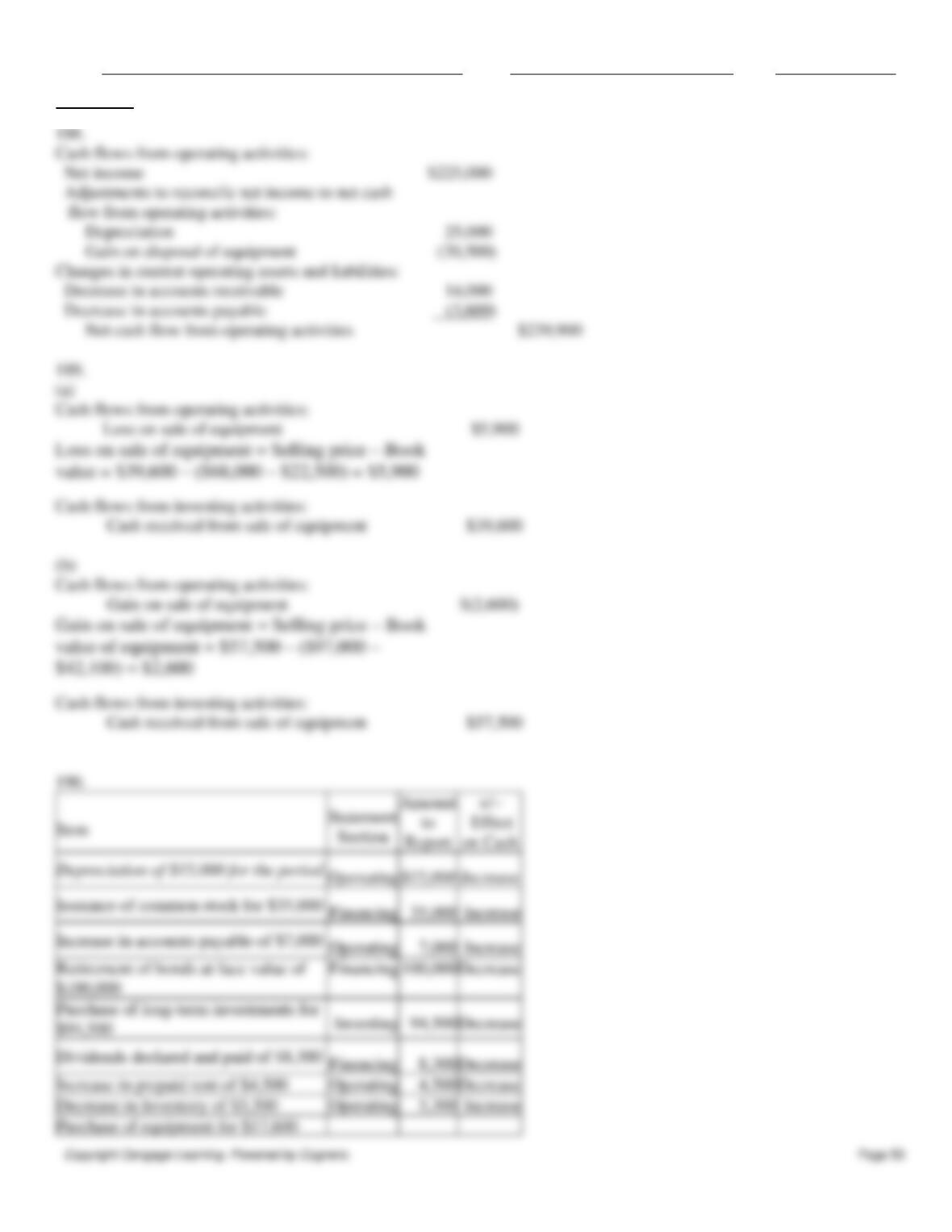
Name:
Class:
Date:
chapter 15
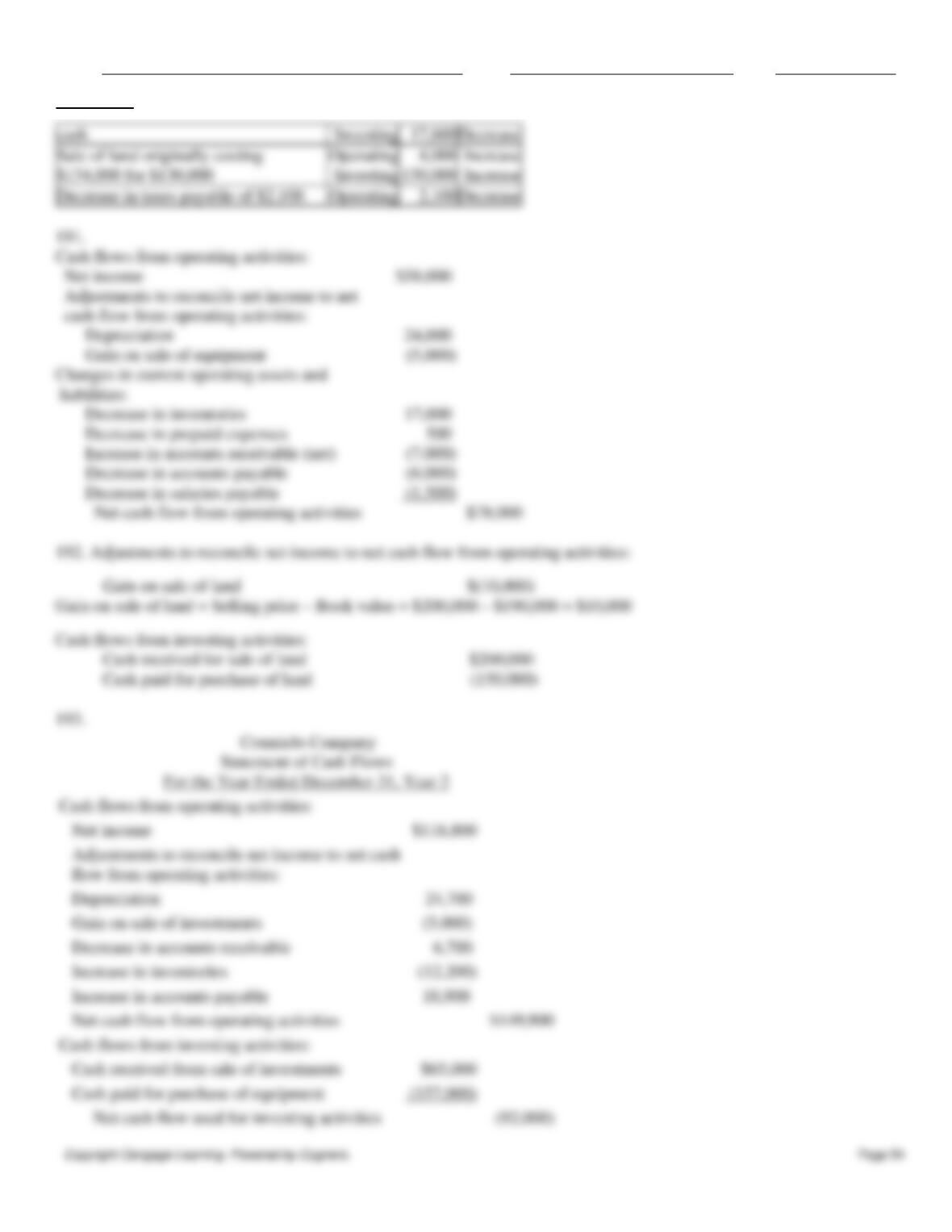
Name:
Class:
Date:
chapter 15
Name:
Class:
Date:
chapter 15