Intermediate Accounting, 9e (Spiceland)
Chapter 15 Leases
1) At the beginning of a lease agreement, a lessee’s debt to equity ratio and rate of return on
assets are both affected regardless of whether the lease is classified as a finance lease or as an
operating lease.
2) Finance leases are agreements that are formulated outwardly as leases, but are installment
purchases in substance.
3) If the lease begins “at or near the end” of an asset’s economic life, the criterion of the lease
term being for the major part of the economic life does not apply when classifying the type of
lease. This is consistent with the basic premise of this criterion that most of the risks and rewards
of ownership occur prior to that time.
4) In accounting for operating leases, the lessee will recognize amortization on the leased asset.
5) If the underlying asset is of such a specialized nature that it is expected to have no alternative
use to the lessor at the end of the lease term, then it must be considered to be an operating lease.
6) A bargain purchase option is defined as the option of purchasing leased property at a price that
is equal to the expected fair value of a leased asset.
7) When the lessee guarantees an estimated residual value of $75,000, the amount the lessee
records as a right-of-use asset and as a lease liability is increased by $75,000.
8) If the lessee is expected to take ownership of a leased asset at the end of the lease term, the
lessor must use an estimated residual value when calculating the lease payments necessary to
achieve a desired rate of return.
9) On a transaction that qualifies for sale-leaseback accounting, any gain on the “sale” portion of
the transaction is recognized immediately.
10) GAAP requires that some lease agreements be accounted for as purchases of assets. The
theoretical justification for this treatment is that a lease of this type:
A) Complies with the concept of form over substance.
B) Reflects the relationship of cause and effect.
C) Satisfies the concept of historical cost.
D) Conveys most of the benefits of property ownership.
11) From the perspective of the lessee, leases may be classified as either:
A) Sales-type without selling profit or sales-type with selling profit.
B) Finance or sales-type without selling profit.
C) Finance or operating.
D) Sales-type or operating.
12) From the perspective of the lessor, two possible lease classifications are:
A) Financing or sales-type.
B) Operating or financing.
C) Sales-type or indirect financing.
D) Operating or sales-type.
13) Distinguishing between operating and finance leases is due in large part to the accounting
concept of:
A) Conservatism.
B) Materiality.
C) Substance over form.
D) Historical cost.
14) When the total expenses over the life of an operating lease are compared to the total
expenses over the life of a finance lease, one will find that:
A) The expenses of a finance lease are greater than the expenses of the operating lease.
B) The expenses of the finance lease and operating lease are equal.
C) The expenses of an operating lease are greater than the expenses of a finance lease.
D) No meaningful comparison can be made.
15) The five criteria provided in GAAP for distinguishing a finance lease from an operating lease
do not include:
A) The agreement specifies that ownership transfers at the end of the lease term.
B) The collectibility of the lease payments must be reasonably predictable.
C) The agreement grants the lessee an option to purchase the underlying asset that the lessee is
reasonably certain to exercise.
D) The noncancelable lease term is for the major part of the remaining economic life of the
leased asset.
16) One of the five criteria for a finance lease specifies that the lease term be equal to or greater
than:
A) the major part of the remaining economic life of the leased property.
B) the entire amount of the remaining economic life of the leased property.
C) a meaningful part of the remaining economic life of the leased property.
D) a non-insignificant part of the remaining economic life of the leased property.
17) One of the five criteria for a finance lease specifies that the present value of the lease
payments be equal to or greater than:
A) substantially all of the cost of the asset.
B) the major part of the fair value of the asset.
C) substantially all of the fair value of the asset.
D) the major part of the cost of the asset.
18) For the lessee to account for a lease as a finance lease, the lease must meet:
A) All five of the criteria specified by GAAP regarding accounting for leases.
B) Any one of the six criteria specified by GAAP regarding accounting for leases.
C) Any two of the criteria specified by GAAP regarding accounting for leases.
D) Any one of the five criteria specified by GAAP regarding accounting for leases.
19) For the lessor to account for a lease as a sales-type lease, the lease must meet:
A) Any one of first five classification criteria and both of the last two additional conditions
specified by GAAP regarding accounting for leases.
B) More than one of the five criteria specified by GAAP regarding accounting for leases.
C) All five of the criteria specified by GAAP regarding accounting for leases.
D) Any one of the five criteria specified by GAAP regarding accounting for leases.
20) Which of the following is not among the criteria for classifying a lease as a finance lease?
A) The agreement specifies that ownership of the asset transfers to the lessee.
B) The agreement contains an option to purchase the underlying asset that the lessee is
reasonably certain to exercise.
C) The lease term is for substantially all of the remaining economic life of the underlying asset.
D) The present value of the sum of the lease payments and any residual value guaranteed by the
lessee that isn’t already reflected in the lease payments equals or exceeds substantially all of the
fair value of the underlying asset.
21) Of the five criteria for a finance lease, which one is not applied if the lease begins “at or near
the end” of the economic life of the underlying asset?
A) A purchase option is reasonably certain to be exercised.
B) The economic life test.
C) The present value of lease payments greater or equal to substantially all of fair value test.
D) The passage of title criteria.
22) A short-term lease:
A) Must be accounted for by the short-cut method if using U.S. GAAP.
B) Is defined as having a value of $10,000 or less.
C) Is defined as having a lease term of fifteen months or less.
D) Not required to be accounted for by the short-cut method if using IFRS.
Use the information below to answer the following questions.
Technoid Inc. sells computer systems. Technoid leases computers to Lone Star Company on
January 1, 2018. The manufacturing cost of the computers was $12 million.
This noncancelable lease had the following terms:
• Lease payments: $2,466,754 semiannually; first payment at January 1, 2018;
remaining payments at June 30 and December 31 each year through June 30, 2022.
• Lease term: five years (10 semiannual payments).
• No residual value; no purchase option.
• Economic life of equipment: five years.
• Implicit interest rate and lessee’s incremental borrowing rate: 5% semiannually.
• Fair value of the computers at January 1, 2018: $20 million.
23) Technoid would account for this as:
A) A finance lease.
B) A sales-type lease without selling profit.
C) A sales-type lease with selling profit.
D) An operating lease.
24) Lone Star Company would account for this as:
A) A finance lease.
B) A sales type lease without selling profit.
C) A sales type lease with selling profit.
D) An operating lease.
25) What is the outstanding balance of the lease liability in Lone Star’s June 30, 2018, balance
sheet? (Round your answer to the nearest dollar.)
A) $15,943,154.
B) $17,533,246.
C) $21,000,000.
D) None of these answer choices is correct.
26) What is the interest revenue that Technoid would report for this lease in its 2018 income
statement?
A) $0.
B) $1,673,820.
C) $876,662.
D) None of these answer choices is correct.
Use the information below to answer the following questions.
On December 31, 2017, Reagan Inc. signed a lease with Silver Leasing Co. for some equipment
having a seven-year useful life. The lease payments are made by Reagan annually, beginning at
signing date. Title does not transfer to the lessee, so the equipment will be returned to the lessor
on December 31, 2023. There is no purchase option, and Reagan guarantees a residual value to
the lessor on termination of the lease.
Reagan’s lease amortization schedule appears below:
Dec. 31
Payments
Interest
Decrease in
Balance
Outstanding
Balance
2017
$
519,115
2017
$
90,000
$
90,000
429,115
2018
$
90,000
$
17,165
72,835
356,280
2019
$
90,000
14,251
75,749
280,531
2020
$
90,000
11,221
78,779
201,752
2021
$
90,000
8,070
81,930
119,822
2022
$
90,000
4,793
85,207
34,615
2023
$
36,000
1,385
34,615
0
27) In this situation, Reagan:
A) is the lessee in a sales-type lease.
B) is the lessee in a finance lease.
C) is the lessor in a finance lease.
D) is the lessor in a sales-type lease.
28) What is the balance of the lease liability on Reagan’s December 31, 2019, balance sheet
(after the third lease payment is made)?
A) $280,531.
B) $190,530.
C) $266,280.
D) $356,280.
29) At what amount would Reagan record the right-of-use asset at the beginning of the
agreement?
A) $519,115.
B) $429,115.
C) $540,000.
D) $576,000.
30) What is the effective annual interest rate charged to Reagan on this lease?
A) 4%.
B) 6%.
C) 8%.
D) 17%.
31) What is the amount of residual value guaranteed by Reagan to the lessor?
A) $1,385.
B) $34,615.
C) $36,000.
D) Cannot be determined from the given information.
32) The appropriate asset value reported in the balance sheet by the lessee for an operating lease
is:
A) Present value of the lease payments.
B) Sum of the lease payments.
C) The lessor’s book value of the asset at the beginning of the lease.
D) Zero, unless a prepayment or accrual is involved.
33) Which of the following statements characterizes an operating lease?
A) The lessee reports cash outflows as financing activities.
B) The lessor records depreciation and lease revenue.
C) The lessor transfers title at the end of the lease term.
D) The lessee has an option to purchase the leased assets and is reasonably sure to exercise the
option.
34) Crystal Corporation makes $2,000 payments every month for leasing office equipment.
Crystal recorded a lease payment as follows:
Lease payable
1,200
Interest expense
800
Cash
2,000
Amortization expense
1,200
Right-of-use asset
1,200
Crystal must have a(n):
A) Operating lease.
B) Leveraged lease.
C) Finance lease.
D) Sales-type lease without selling profit.
35) If the lessor records deferred rent revenue at the beginning of a lease term, the lease must:
A) Be a financing lease.
B) Be a sales-type lease.
C) Contain a bargain renewal option.
D) Be an operating lease.
36) Advance payments made by the lessee on an operating lease are considered to be:
A) Lease expense.
B) Amortization of the right-of-use asset.
C) Deferred revenue to the lessor.
D) A prepayment of interest expense.
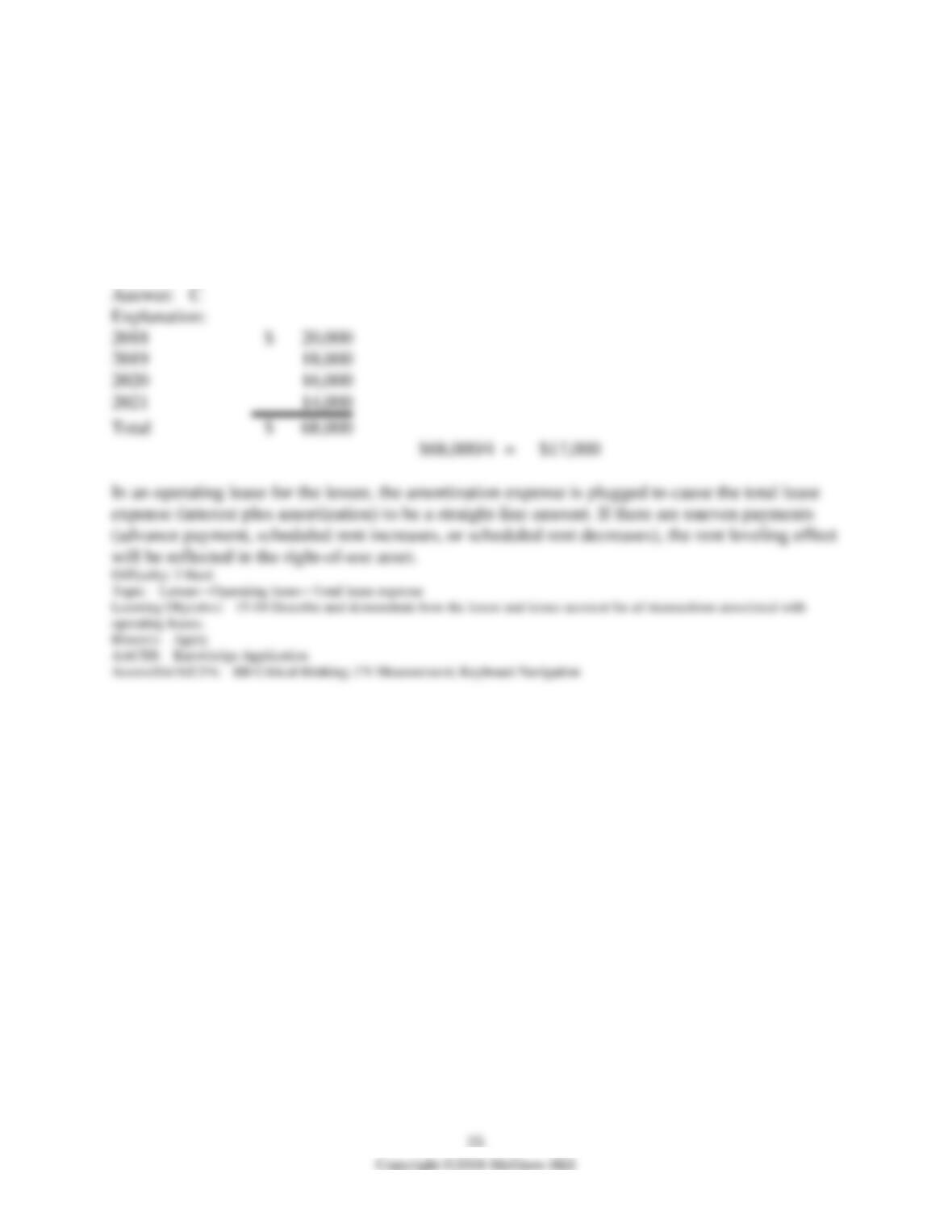
37) On January 1, 2018, Gibson Corporation entered into a four-year operating lease. The
payments were as follows: $20,000 for 2018, $18,000 for 2019, $16,000 for 2020, and $14,000
for 2021. What is the correct amount of total lease expense for 2019?
A) $20,500.
B) $19,000.
C) $17,000.
D) $18,000.
38) On January 1, 2018, Wellburn Corporation leased an asset from Tabitha Company. The asset
originally cost Tabitha $300,000. The lease agreement is an operating lease that calls for four
annual payments beginning on January 1, 2018, in the amount of $36,000. The other three
remaining payments will be made on January 1 of each subsequent year. Which of the following
journal entries should Tabitha record on January 1, 2018?
A)
Cash
36,000
Lease receivable
36,000
B)
Cash
36,000
Deferred rent revenue
36,000
C)
Cash
36,000
Rent revenue
36,000
D)
Cash
36,000
Rent expense
36,000
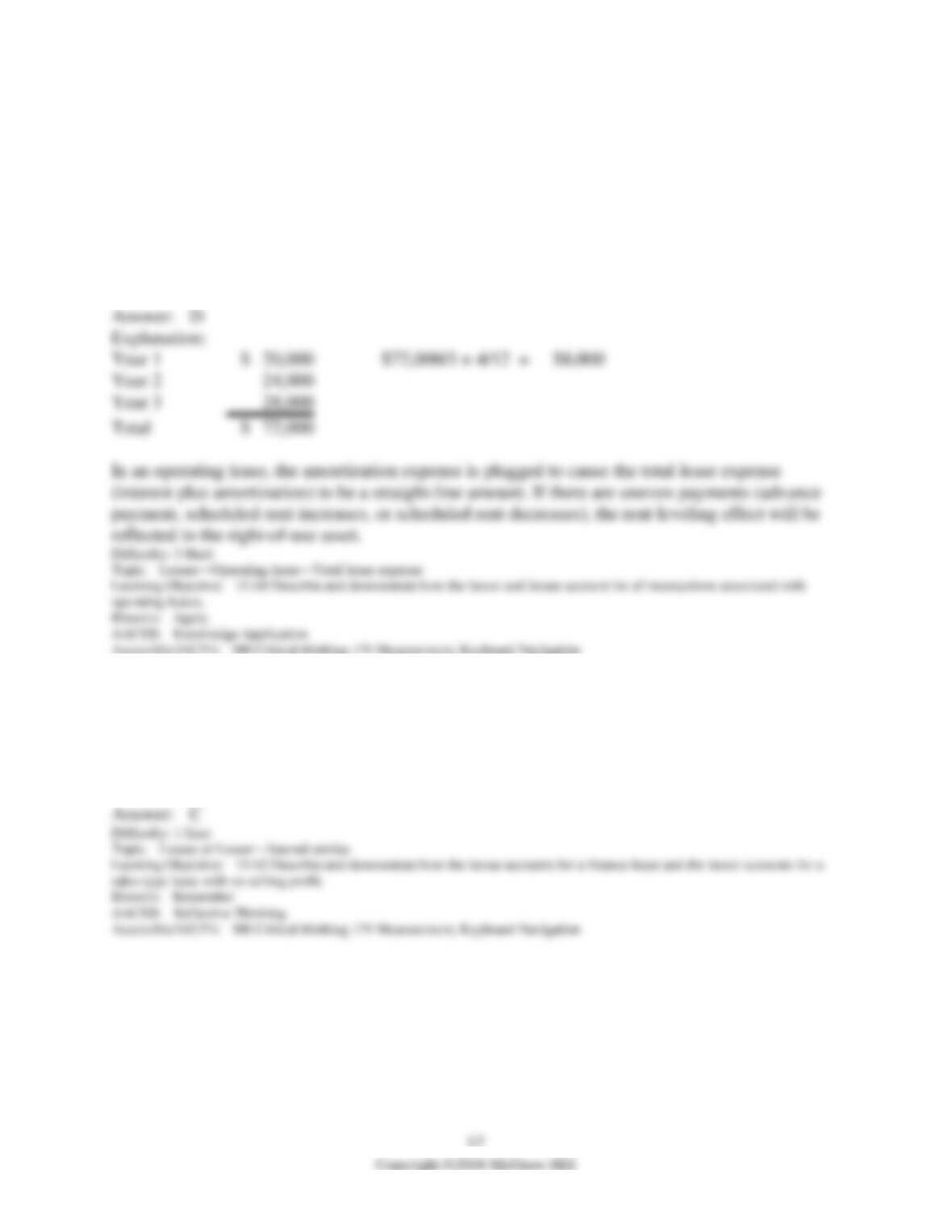
39) On September 1, 2018, Custom Shirts Inc. entered into a lease agreement appropriately
classified as an operating lease. The lease term is three years. The annual payments by Custom
Shirts are (a) $20,000 for year 1, (b) $24,000 for year 2, and (c) $28,000 for year 3. How much
total lease expense will Custom Shirts recognize for 2018?
A) $6,667.
B) $24,000.
C) $20,000.
D) $ 8,000.
40) The lessee normally measures the lease liability to be recorded as the:
A) Future value of the lease payments.
B) Sum of the cash payments over the term of the lease.
C) Present value of the lease payments.
D) Book value of the leased asset.
41) Leasehold improvements usually are classified in a balance sheet as:
A) Property, plant, and equipment.
B) Other long-term assets.
C) Investments.
D) Expenses.
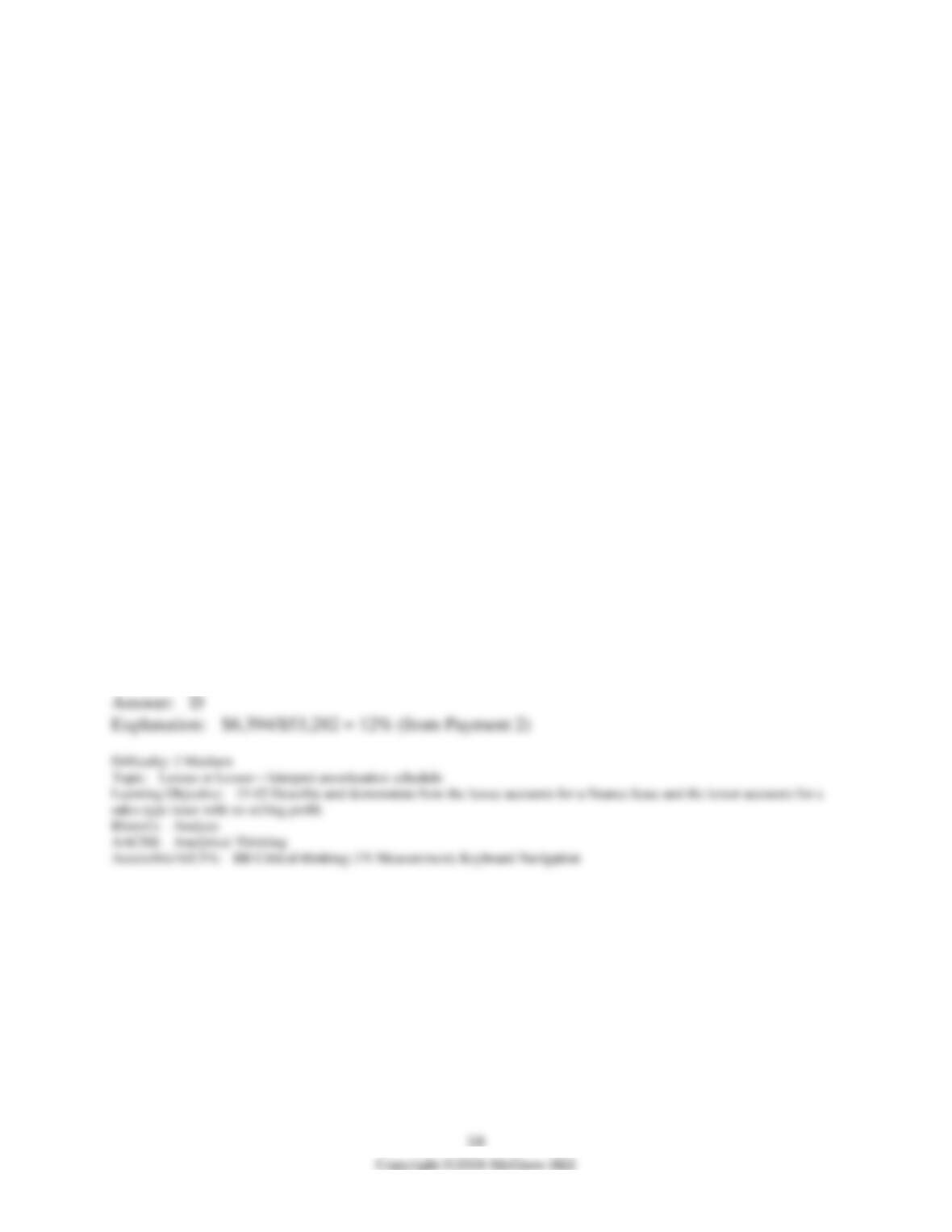
Use the information below to answer the following questions.
Refer to the following lease amortization schedule. The 10 payments are made annually starting
with the beginning of the lease. Title does not transfer to the lessee and there is no purchase
option or guaranteed residual value. The asset has an expected economic life of 12 years. The
lease is noncancelable.
Payment
Cash
Payment
Effective
Interest
Decrease
in balance
Outstanding
Balance
63,282
1
10,000
0
10,000
53,282
2
10,000
6,394
3,606
49,676
3
10,000
5,961
4,039
45,638
4
10,000
5,477
4,523
41,114
5
10,000
4,934
5,066
36,048
6
10,000
4,326
5,674
30,373
7
10,000
3,645
6,355
24,018
8
10,000
2,882
7,118
16,901
9
10,000
?
?
?
10
10,000
?
?
?
42) What is the effective annual interest rate?
A) 9%.
B) 10%.
C) 11%.
D) 12%.
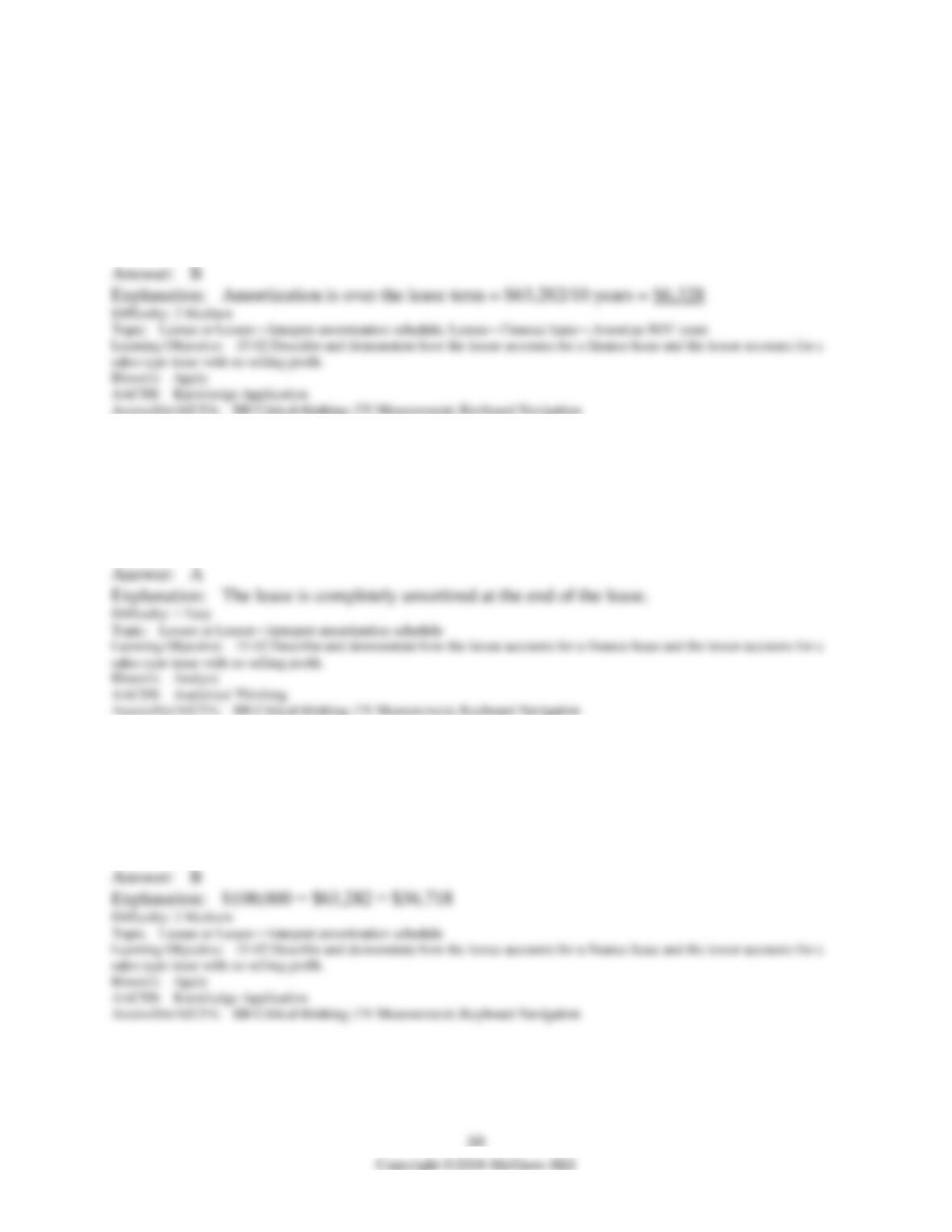
43) What amount would the lessee record as annual amortization on the right-of-use asset using
the straight-line method?
A) $5,328.
B) $6,328.
C) $6,392.
D) $10,000.
44) What would be the outstanding balance after payment 10?
A) $0.
B) $2,028.
C) $8,929.
D) $10,000.
45) What is the total effective interest paid over the term of the lease?
A) $100,000.
B) $36,718.
C) $53,282.
D) $63,282.