
15-120
134. Division X has asked Division K of the same company to supply it with 5,000 units of part
L433 this year to use in one of its products. Division X has received a bid from an outside supplier
for the parts at a price of $26.00 per unit. Division K has the capacity to produce 30,000 units of
part L433 per year. Division K expects to sell 26,000 units of part L433 to outside customers this
year at a price of $30.00 per unit. To fill the order from Division X, Division K would have to cut
back its sales to outside customers. Division K produces part L433 at a variable cost of $21.00 per
unit. The cost of packing and shipping the parts for outside customers is $2.00 per unit. These
packing and shipping costs would not have to be incurred on sales of the parts to Division X.
Required:
a. What is the range of transfer prices within which both the Divisions’ profits would increase as a
result of agreeing to the transfer of 5,000 parts this year from Division X to Division K?
b. Is it in the best interests of the overall company for this transfer to take place? Explain.

15-122
135. Leontif Corporation has a Parts Division that does work for other Divisions in the company
as well as for outside customers. The company’s Equipment Division has asked the Parts Division
to provide it with 2,000 special parts each year. The special parts would require $17.00 per unit in
variable production costs.
The Equipment Division has a bid from an outside supplier for the special parts at $28.00 per unit.
In order to have time and space to produce the special part, the Parts Division would have to cut
back production of another part – the J789 that it presently is producing. The J789 sells for $34.00
per unit, and requires $22.00 per unit in variable production costs. Packaging and shipping costs
of the J789 are $4.00 per unit. Packaging and shipping costs for the new special part would be
only $0.50 per unit. The Parts Division is now producing and selling 10,000 units of the J789 each
year. Production and sales of the J789 would drop by 10% if the new special part is produced for
the Equipment Division.
Required:
a. What is the range of transfer prices within which both the Divisions’ profits would increase as a
result of agreeing to the transfer of 2,000 special parts per year from the Parts Division to the
Equipment Division?
b. Is it in the best interests of Leontif Corporation for this transfer to take place? Explain.
136. Why is transfer pricing only a concern for profit or investment centers and not for cost or
revenue centers?
137. Explain the general principle for determining the optimal transfer price.
138. What is meant by a dual transfer pricing system? What are some advantages and
disadvantages of it?
139. What are the limitations of market-based transfer prices?
140. What are the advantages and disadvantages of using a negotiated transfer price?
141. Watts Company has used market price as its transfer price for Division Z for many years
with no problems. This year, because of changes in the economy, the demand for its final product
has dropped along with the price.
Required:
Explain the problems of basing the transfer prices on distress market prices and possible
solutions to the problems.
142. Litwak Inc. has two divisions: production and marketing, which it treats as profit centers.
Because the production division has no marketing capabilities, it does not have a traditional
market price to consider and the company does not want to use negotiation.
Required:
Discuss the following cost-based transfer prices along with problems that might exist for each.
1) Standard unit-level cost.
2) Absorption (full) cost.
3) Actual cost.
143. Briefly discuss some of the general issues of multinational transfer pricing.
15-130
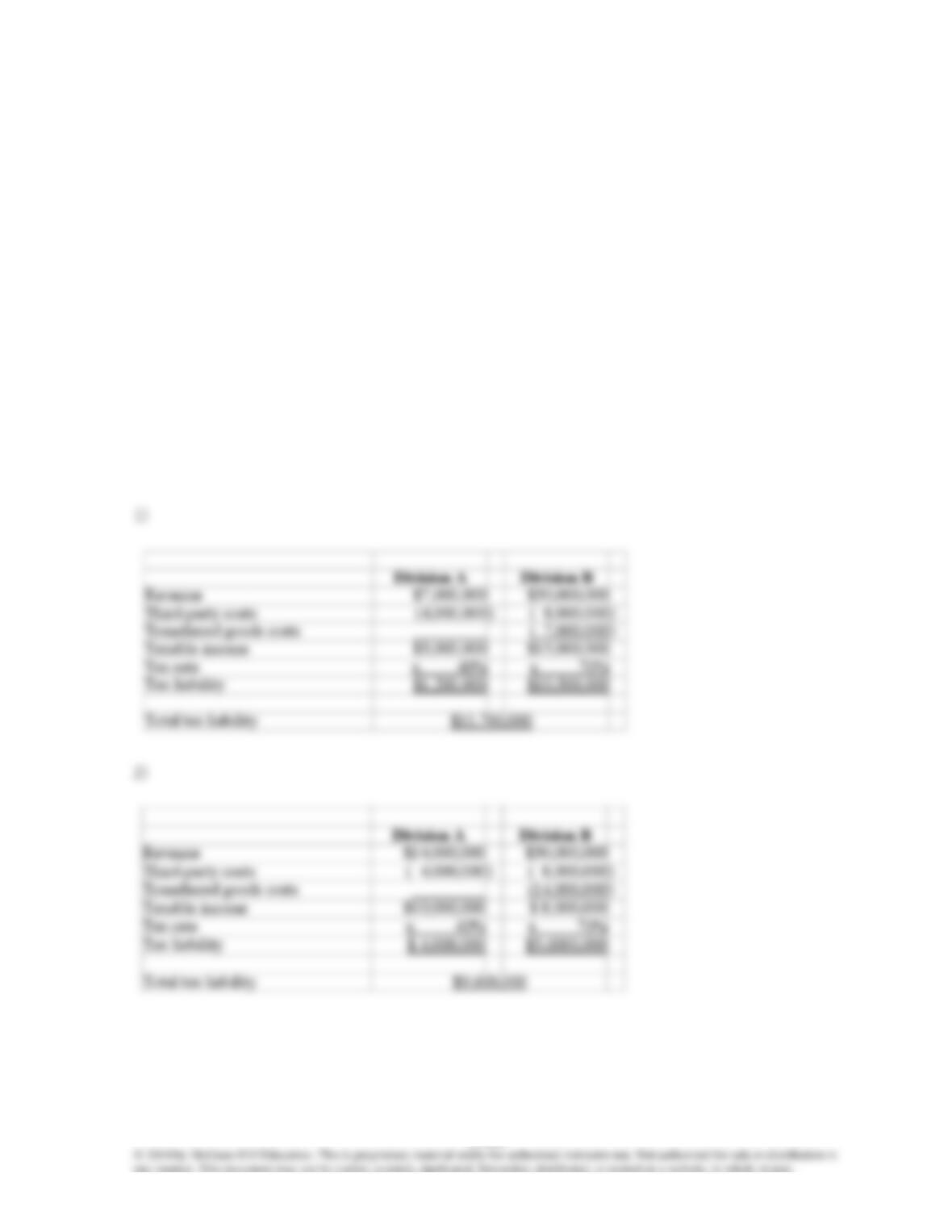
144. During the current year Ruby Company’s foreign division A incurred production costs of $4
million for units that are transferred to its other foreign division, B. Costs in Division B, outside of
the costs of production of the final product are $8 million. These are third-party costs. Sales
revenue for the final product for Division B is $30 million. Other companies in the same country
import a similar type of part as Division B at a cost of $7 million. Ruby has set its transfer price at
$14 million, justifying this price because of the special controls it has on the operations in Division
A as well as its special manufacturing method. The tax rate in the country where Division A is
located is 40% while the tax rate for Division B’s country is 70%.
Required:
1) What would Ruby’s total tax liability for both divisions be if it used the $7 million transfer price?
2) What would the liability be if it used the $14 million transfer price?
145. How do import duties affect transfer pricing?
146. Briefly discuss transfer prices in relation to external segment reporting under GAAP.
15-133
147. Mr. Dessler, the Production V.P. is looking at two of the Divisions that report to him.
These divisions are viewed as profit centers by the company. He has called in the head of Division
A, which provides a part used by Division M, because he has noticed that Division M is going to an
external supplier for the part. Mr. Araz, the head of Division A, tells him that he has set the
transfer price at $38 per part even though the external price is $33 per part. The standard unit–
level cost is $22. “I have set the $38 price because I am operating with no excess capacity and do
not want to have the internal transfer to Division M. I have some good external customers and do
not want to lose them by selling internally. If I had excess capacity, I would be willing sell to
Division M at a lower price.”
Mr. Dessler says that he has to think about this situation because something doesn’t seem right
to him. After Mr. Araz leaves the office, he calls his friend in the controller’s department for some
help.
Required:
You are that friend. Explain to Mr. Dessler the differences in transfer pricing when there is no
excess capacity and when there is excess capacity and what Mr. Araz is doing wrong.
148. Ms. Marwan, one of the marketing managers, has come to the meeting with a number of
reports about one of her products. The Marketing V.P. sees her agitation and asks her what the
problem is. “Well, the product made by the East Coast Division is losing sales even after the price
had been lowered drastically. The manager of the division is threatening to close because of the
reduced demand.”
The Marketing V.P. asks why the lowered prices are a problem and Ms. Marwan says that,
according to the manager, the price used to transfer the goods to Southern Division are based on
market price and, with the lowered market price, the unit-level costs are no longer being covered
and he is losing money on every transfer as well as every third-party sale.
Required: Explain further to the Marketing V.P. the issues involved in transfer pricing when there
are distressed market prices.
149. Whey Inc. has just purchased a foreign subsidiary that makes a component used by one of
the domestic divisions. Ms. Bierko, the controller, has been asked about issues that should be
considered in establishing a transfer price for the new subsidiary. Since this is Wheys’ first foray
into the multinational arena, there is little to no expertise in international issues in the company.
Ms. Bierko has told her boss that she will get back to him with a report as to the issues to be
considered. She then calls a friend of hers at a branch of one of the big-4 CPA firms that deals
with international issues for some help.
Required: What is the basic information that Ms. Bierko will be given by her friend?
150. Mr. Cummings, the controller, and Ms. Trevino, the CPA, are going over the final versions
of the financial statements before the audit is completed. The last part of the work being
discussed is the segment reporting section. Mr. Clark is questioning the comments made by Ms.
Trevino regarding the use of negotiated transfer prices by the firm for the major segments being
shown.
Required: Explain to Mr. Cummings the issue according to the FASB (SFAS 14).