15–81
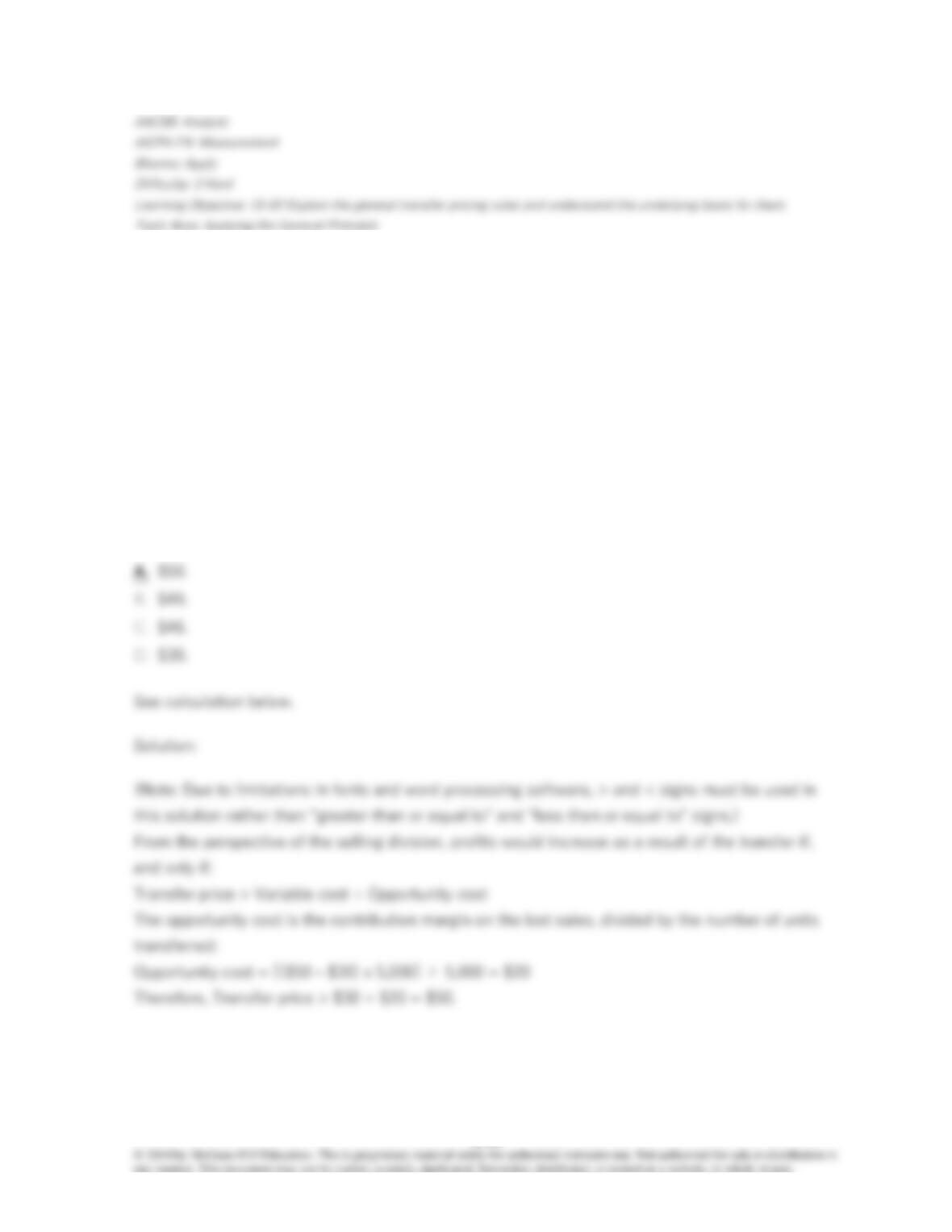
103. Division X makes a part that it sells to customers outside of the company. Data
concerning this part appear below:
Selling price to outside customers $50
Variable cost per unit $30
Total fixed costs $400,000
Capacity in units 25,000
Division Y of the same company would like to use the part manufactured by Division X in one of
its products. Division Y currently purchases a similar part made by an outside company for $49
per unit and would substitute the part made by Division X. Division Y requires 5,000 units of the
part each period. Division X can sell all of the units it makes to outside customers. What is the
lowest acceptable transfer price from the standpoint of the selling division?
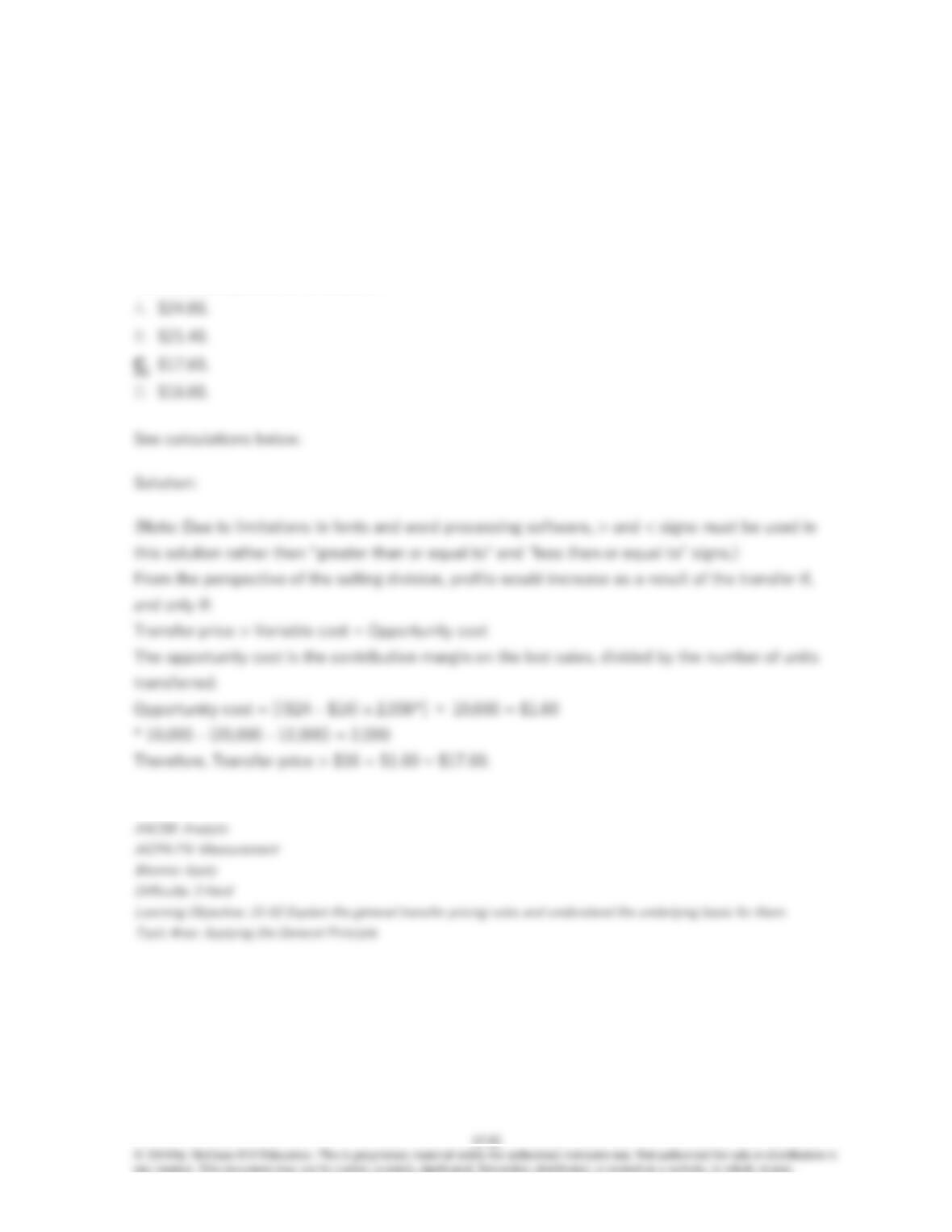
104. Division X of Charter Corporation makes and sells a single product which is used by
manufacturers of fork lift trucks. Presently it sells 12,000 units per year to outside customers at
$24 per unit. The annual capacity is 20,000 units and the variable cost to make each unit is $16.
Division Y of Charter Corporation would like to buy 10,000 units a year from Division X to use in its
products. There would be no cost savings from transferring the units within the company rather
than selling them on the outside market. What should be the lowest acceptable transfer price
from the perspective of Division X?
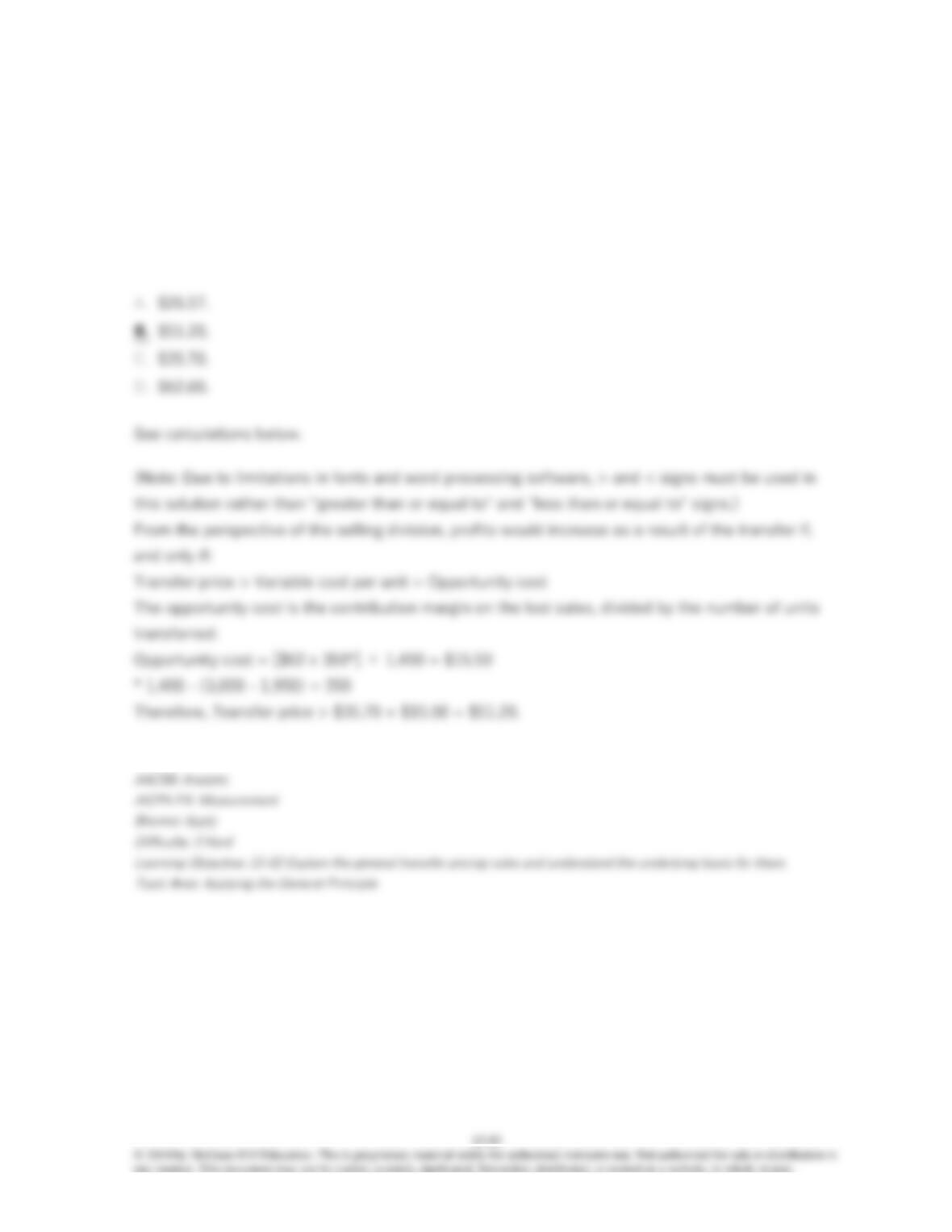
105. Division A of Harkin Company has the capacity for making 3,000 motors per month and
regularly sells 1,950 motors each month to outside customers at a contribution margin of $62 per
motor. The variable cost per motor is $35.70. Division B of Harkin Company would like to obtain
1,400 motors each month from Division A. What should be the lowest acceptable transfer price
from the perspective of Division A?
106. Baldwin Corp. manufactures RD34 in its Webb Division. This output is sold to the Roberts
Division as raw material in Robert‘s product. Webb also further processes the RD34 into RD35,
and then sells it to other companies.
The Webb Division’s variable costs for the basic ingredient are $15 per unit. The Robert Division’s
variable costs are $5 per unit in addition to what it pays the Webb Division. The Roberts Division
has a capacity of 400,000 units and it can sell everything it produces. The market price for the
finished additive is $40 per unit. If the Webb Division converts the RD34 into RD35, it can receive
$25 per unit on the open market, but it incurs an additional $4 per unit for this processing.
Required:
a. What is the lowest price the Webb Division should be willing to transfer RD34 to the Roberts
Division, assuming the Webb Division is not at full capacity?
b. What is the lowest price the Webb Division should be willing to transfer RD34 to the Roberts
Division, assuming the Webb Division is at full capacity?
c. Ignore parts (a) and (b). Assume that the Webb Division has a capacity of 500,000 units, but
can only sell 300,000 on the open market. How many units should the Webb Division sell
externally and how many units should it sell to Roberts Division at a transfer price of $20?
107. Dock Industries is a decentralized company that evaluates its divisions based on ROI. The
Wilson Division has the capacity to produce 2,000 units of a component. The Wilson Division’s
variable costs are $85 per unit; fixed costs are $70 per unit.
The Becker Division can use the product as a component in one of its products. The Becker
Division would incur $65 of variable costs to convert the component into its own product which
sells for $310.
Required (consider each question independent of each other):
a. Assume the Wilson Division can sell all that it produces for $185 each. The Becker Division
needs 100 units. What is the appropriate transfer price?
b. Assume the Wilson Division can sell 1,800 units at $265. Any excess capacity will be unused
unless the units are purchased by the Becker Division (which can use up to 100 units). What are
the minimum and maximum transfer prices?
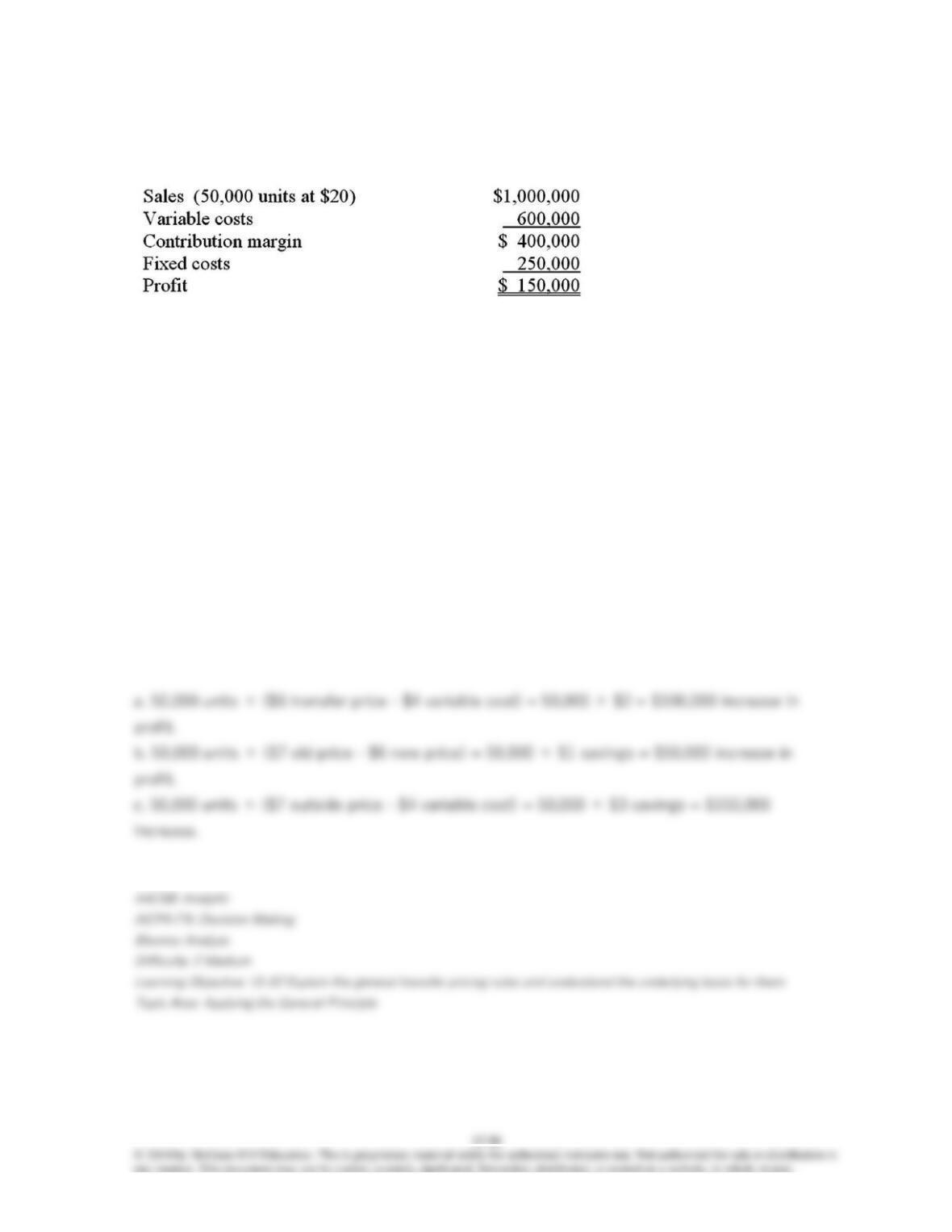
108. Howard Company operates several investment centers. The manager of Genco Division
expects the following results for the coming year.
Included in Genco’s variable cost is $7 for a component it buys from an outside supplier. One of
these components is required in each unit of Genco’s product. The manager of Genco has just
found that she can buy the component from Danner Division, another division of Howard
Company. Danner sells 300,000 units of the component to outsiders at $8 and its variable cost is
$4 per unit. Danner offers to sell the component to Genco at a price of $6. Danner is operating
well below capacity
Required:
a. If Genco accepts the offer, what will happen to the income of Danner Division?
b. If Genco accepts the offer, what will happen to the income of Genco Division?
c. If Genco accepts the offer, what will happen to the income of Howard Company?
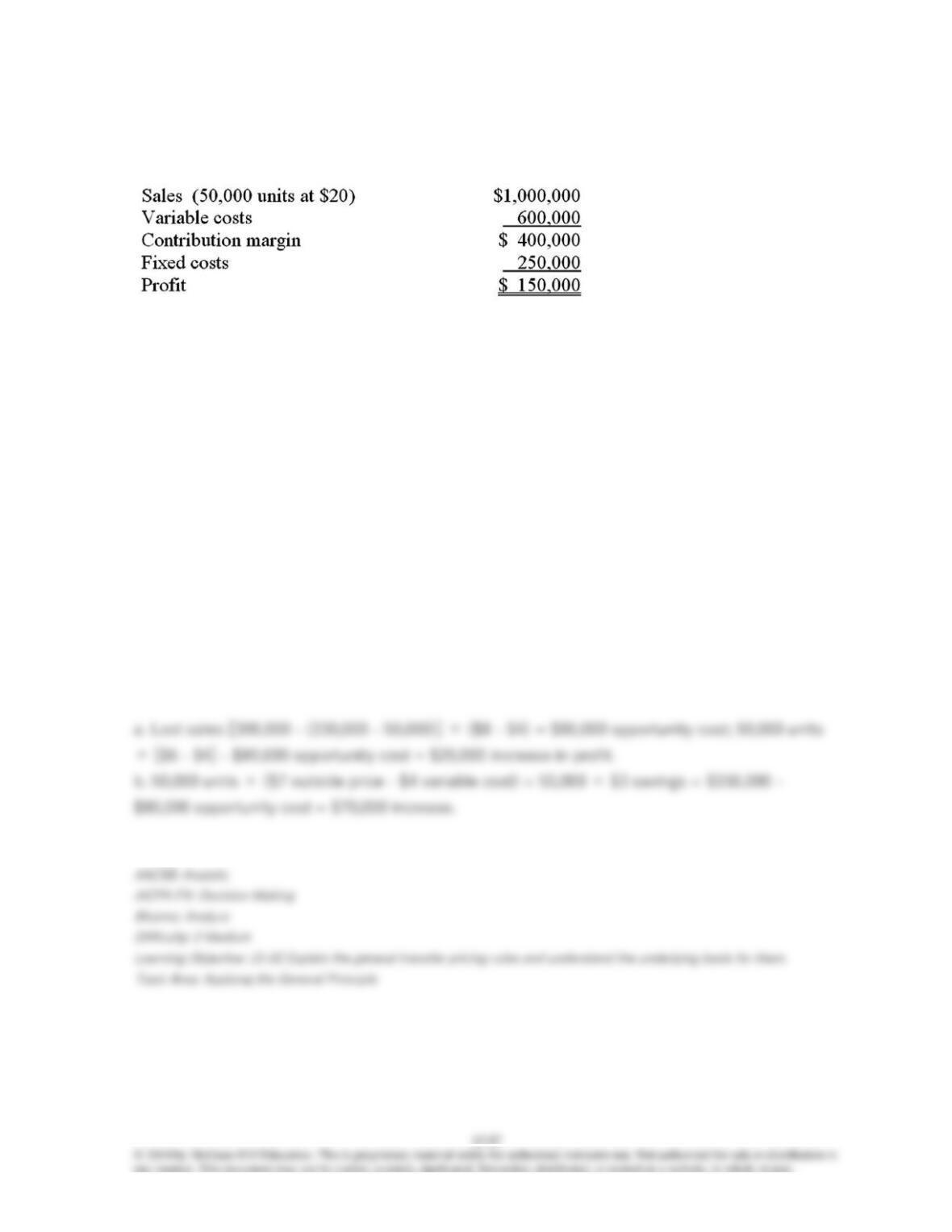
109. Howard Company operates several investment centers. The manager of Genco Division
expects the following results for the coming year.
Included in Genco’s variable cost is $7 for a component it buys from an outside supplier. One of
these components is required in each unit of Genco’s product. The manager of Genco has just
found that she can buy the component from Danner Division, another division of Howard
Company. Danner sells 300,000 units of the component to outsiders at $8 and its variable cost is
$4 per unit. Danner offers to sell the component to Genco at a price of $6.
Danner has a capacity of 330,000 units. Assume that Genco wants to buy all of its needs from one
source, so that Danner must supply all or none of Genco’s need for 50,000 units.
Required:
a. Determine the change in income of Danner Division of supplying the component to Genco at $6
as opposed to not supplying Genco.
b. Determine the change in income of Howard Company if Danner supplies Genco at $6.
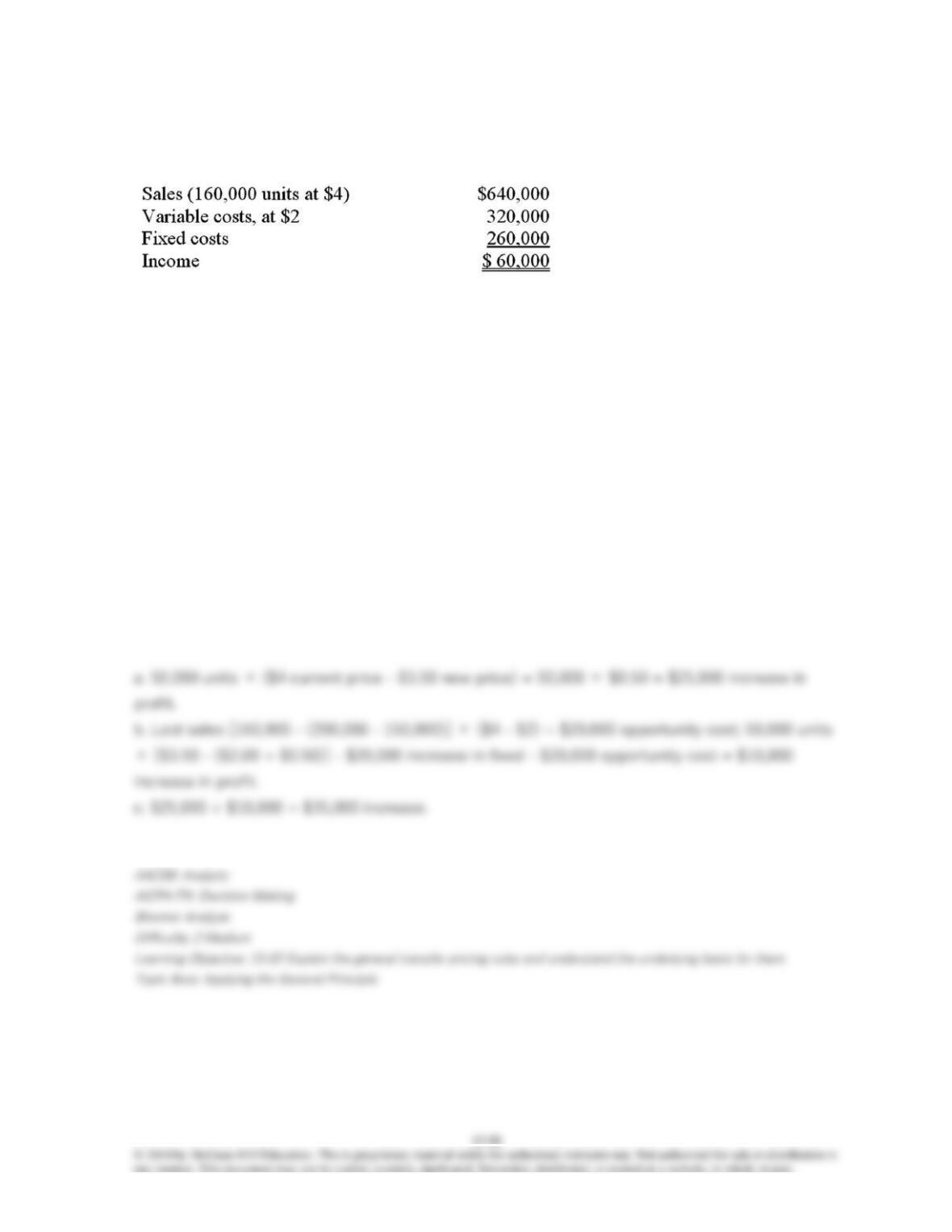
110. Bayfield Division of Ashland Inc. has a capacity of 200,000 units and expects the following
results.
Washburn Division of Ashland Inc. currently purchases 50,000 units of a part for one of its
products from an outside supplier for $4 per unit. Washburn’s manager believes he could use a
minor variation of Bayfield’s product instead, and offers to buy the units from Bayfield at $3.50.
Making the variation desired by Washburn would cost Bayfield an additional $0.50 per unit and
would increase Bayfield’s annual cash fixed costs by $20,000. Bayfield’s manager agrees to the
deal offered by Washburn’s manager.
Required:
a. What is the effect of the deal on Washburn’s income?
b. What is the effect of the deal on Bayfield’s income?
c. What is the effect of the deal on the income of Ashland Inc. as a whole?
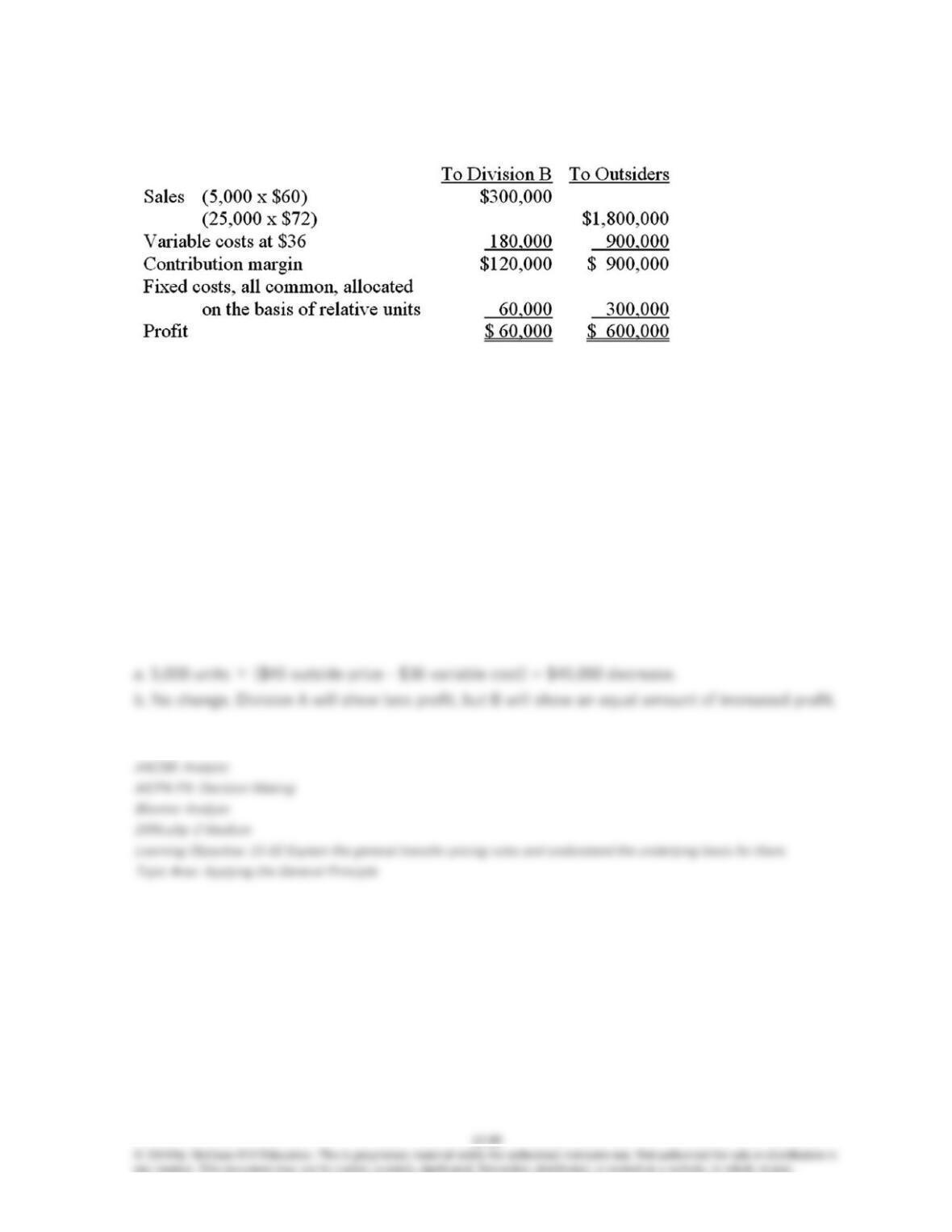
111. Division A of Stills Company expects the following results:
Division B has the opportunity to buy its needs of 5,000 units from an outside supplier at $45
each.
Required (consider each question independent of each other):
a. Division A refuses to meet the $45 price, sales to outsiders cannot be increased, and Division B
buys from the outside supplier. Compute the effect on the income of Stills.
b. Division A cannot increase its sales to outsiders, does meet the $45 price, and Division B
continues to buy from A. Compute the effect on the income of Stills.
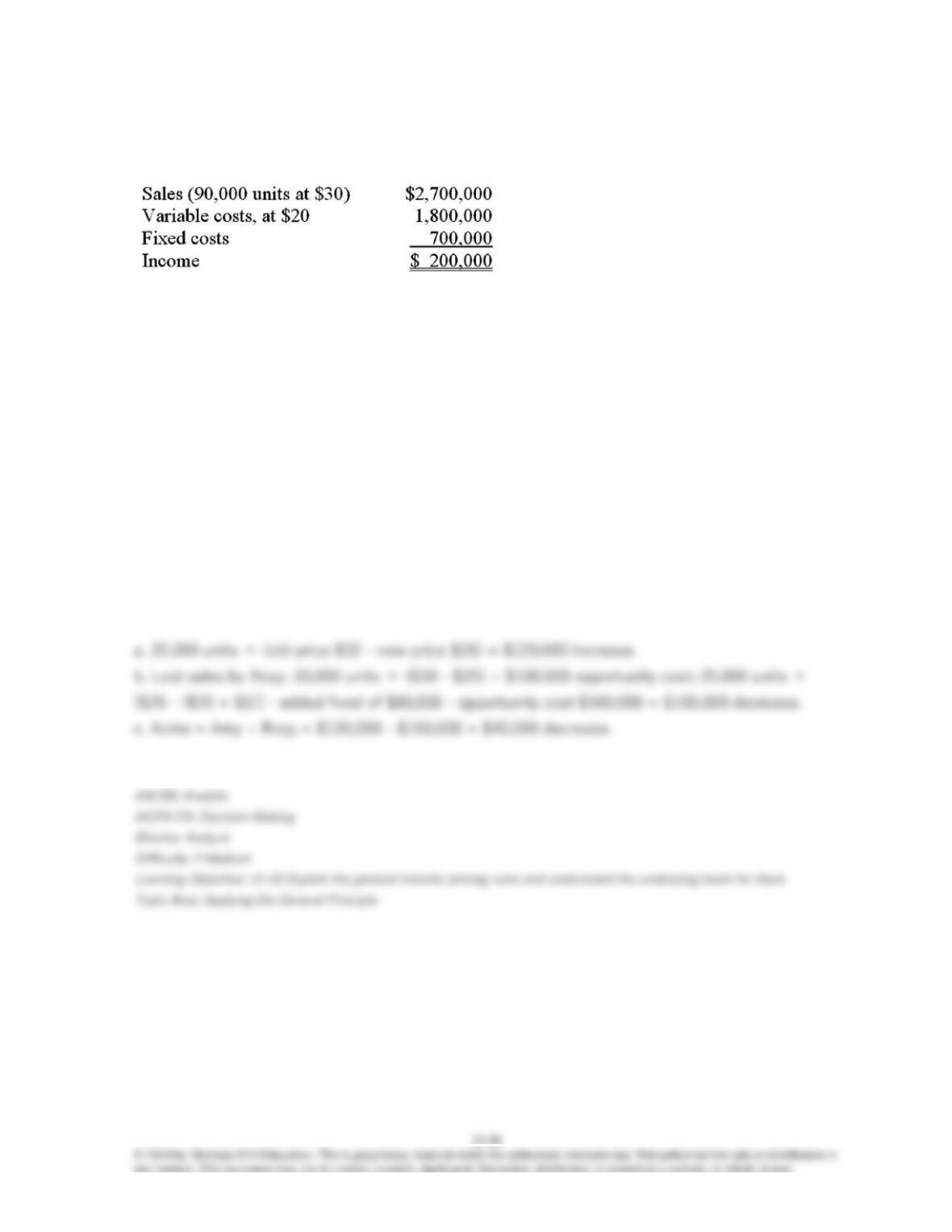
112. Rosy Division of Acme Inc. has a capacity of 100,000 units and expects the following
results for the year.
Amy Division of Acme Inc. currently purchases 20,000 units of a part for one of its products from
an outside supplier at $32 per unit. Amy’s manager believes she could use a minor variation of
Rosy’s product instead, and offers to buy the units from Rosy at $26. Making the variation desired
by Amy would cost Rosy an additional $5 per unit and would increase Rosy’s annual cash fixed
costs by $80,000. Rosy’s manager agrees to the deal offered by Amy’s manager.
Required:
a. Find the effect of the deal on Amy’s income.
b. Find the effect of the deal on Rosy’s income.
c. Find the effect of the deal on the income of Acme Inc. as a whole.
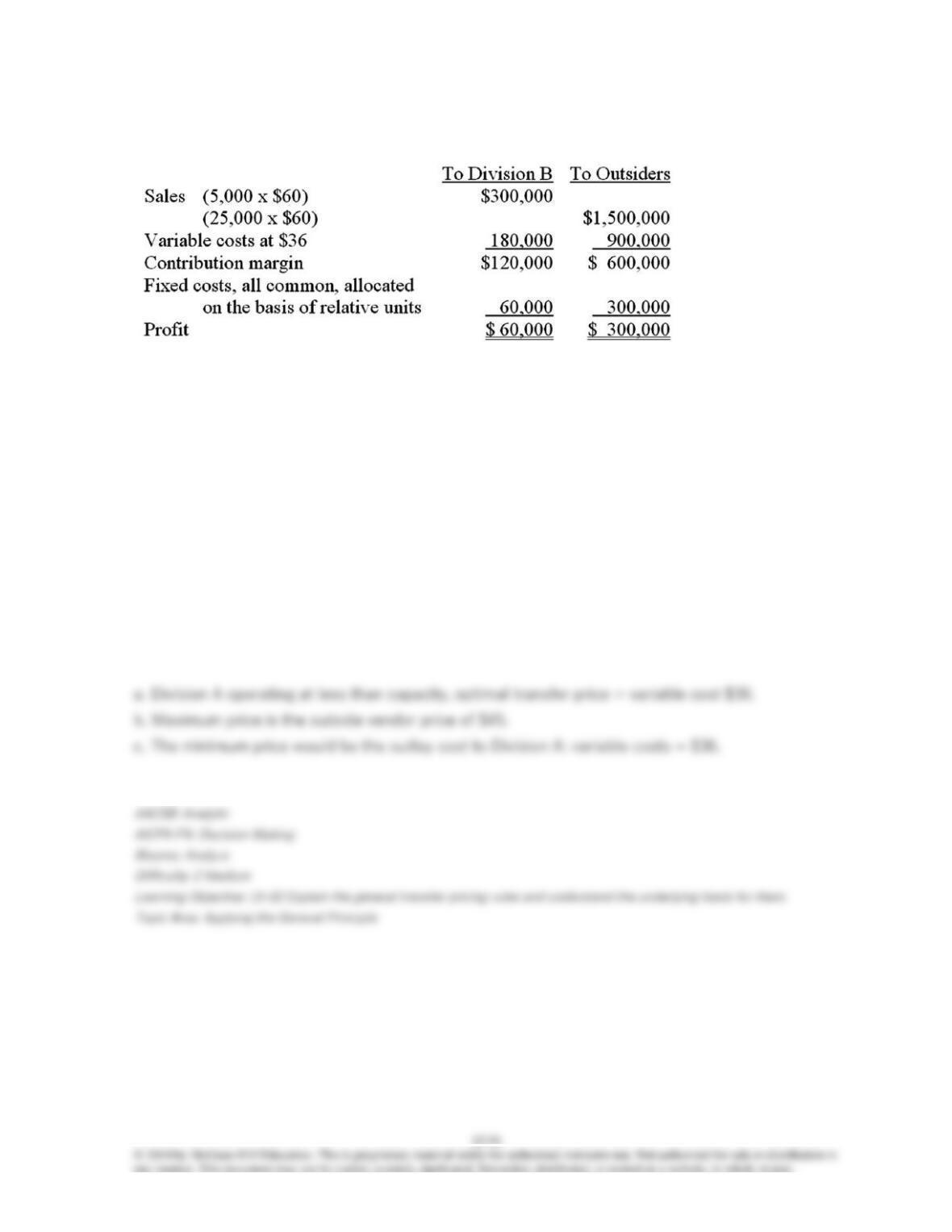
113. Division A of Stills Company expects the following results:
Division B has the opportunity to buy its needs of 5,000 units from an outside supplier at $45
each. Assume that Division A cannot increase sales to outsiders.
Required:
a. What would be the optimal transfer price?
b. Assume that Stills allows the divisional managers to negotiate transfer prices. What would the
maximum transfer price be?
c. Assume that Stills allows the divisional managers to negotiate transfer prices. What would the
minimum transfer price be?
114. Woodville Industries evaluates its divisions based on residual income. The Hilton Division
has the capacity to produce 20,000 units of a component. The Hilton Division’s variable costs are
$150 per unit; fixed costs are $110 per unit.
The Sutton Division can use the product as a component in one of its products. The Sutton
Division would incur $75 of variable costs to convert the component into its own product which
sells for $300.
Required (consider each question independent of each other):
a. Assume the Hilton Division can sell all that it produces for $285 each. The Sutton Division
needs 1,000 units. What is the appropriate transfer price?
b. Assume the Hilton Division can sell 18,000 units at $285. Any excess capacity will be unused
unless the units are purchased by the Sutton Division (which can use up to 1,000 units). What are
the minimum and maximum transfer prices?
115. Toledo Shipping, Inc., operates two divisions: (1) a shipping division that owns and
manages bulk carriers on the Great Lakes and (2) a repair division that operates a dry dock in Port
Huron, Michigan. The repair division works on company ships, as well as other large-hull ships.
The repair division has an estimated variable cost of $45 per labor-hour. The repair division has a
backlog of work for outside ships. They charge $125 per hour for labor & overhead, which is
standard for this type of work. The management division complained that it could hire its own
repair workers for $85 per hour, including leasing an adequate work area.
Required:
a. What is the minimum transfer price per hour that the repair division should obtain for its
services, assuming it is operating at capacity?
b. What is the maximum transfer price per hour that the shipping division should pay?
c. If the repair division had idle capacity, what is the minimum transfer price that the repair
division should obtain?
116. Stearns Division can sell externally for $60 per unit. Its variable manufacturing costs are
$35 per unit, and its fixed costs are $12 per unit.
Required:
a. What is the optimal transfer price for transferring internally, assuming the division is operating
at capacity?
b. What is the optimal transfer price for transferring internally, assuming the division is operating
at well below capacity?
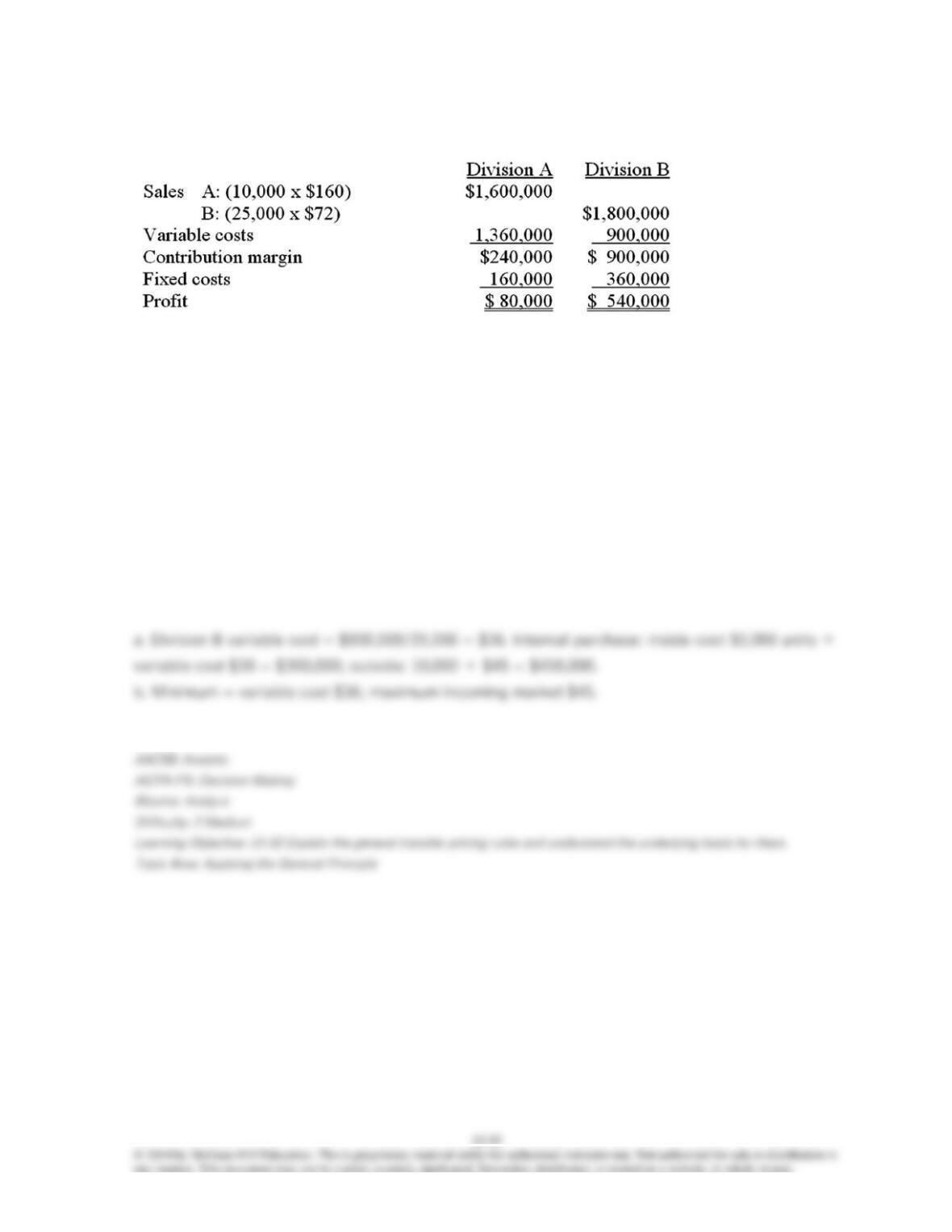
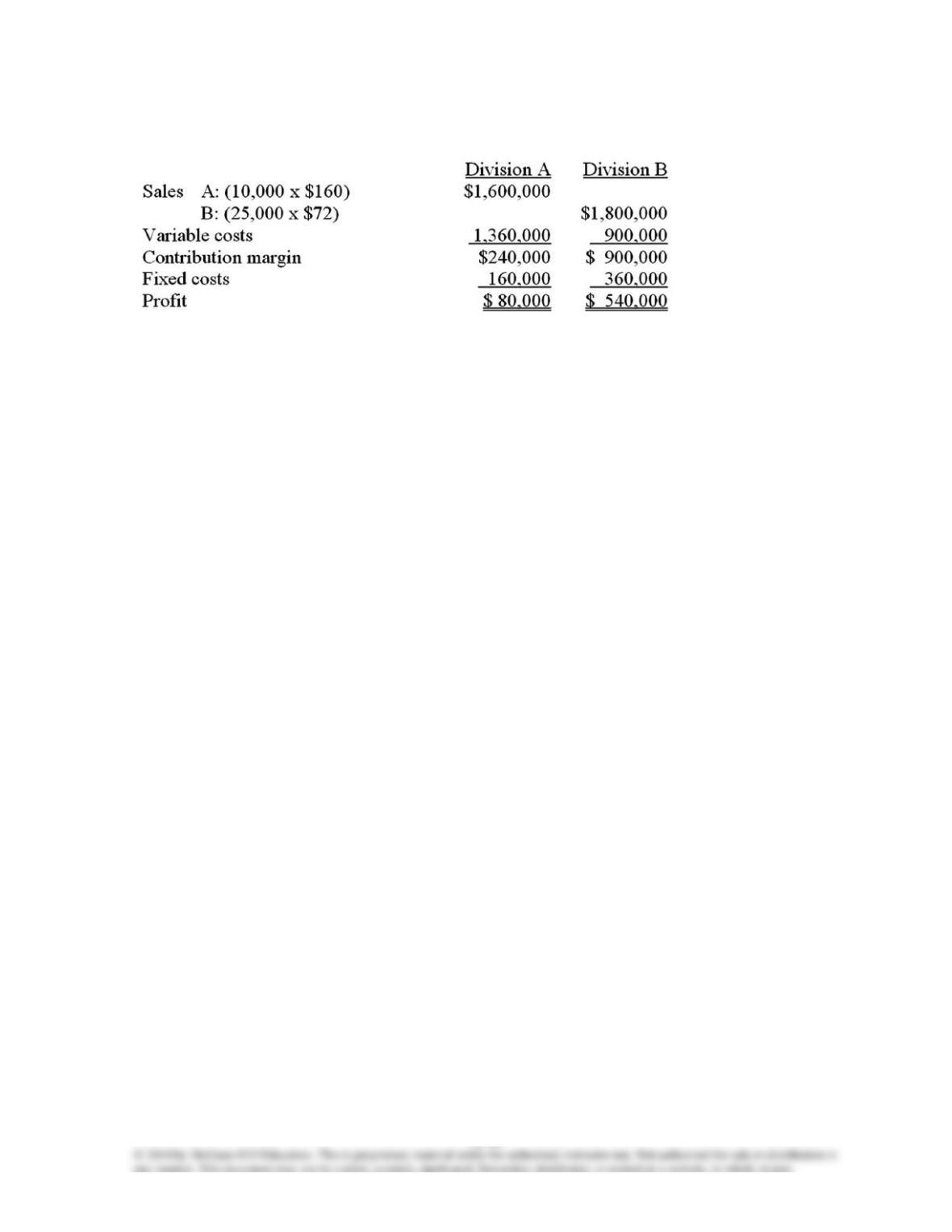
117. Stills Company expects the following results:
Included in Division A‘s costs are 10,000 units of a subcomponent purchased from an outside
supplier for $45. The managers have recently initiated negotiations for Division B to supply the
components to Division A. Division B has a total capacity of 40,000 units.
Required:
a. Would Stills Company prefer the subcomponent used by A to be purchased internally from B or
from the outside vendor?
b. What would be the maximum and minimum transfer prices?
15–96
118. Stills Company expects the following results:
Included in Division A‘s costs are 10,000 units of a subcomponent purchased from an outside
supplier for $45. The managers have recently initiated negotiations for Division B to supply the
components to Division A. Division B has a total capacity of 40,000 units.
Required:
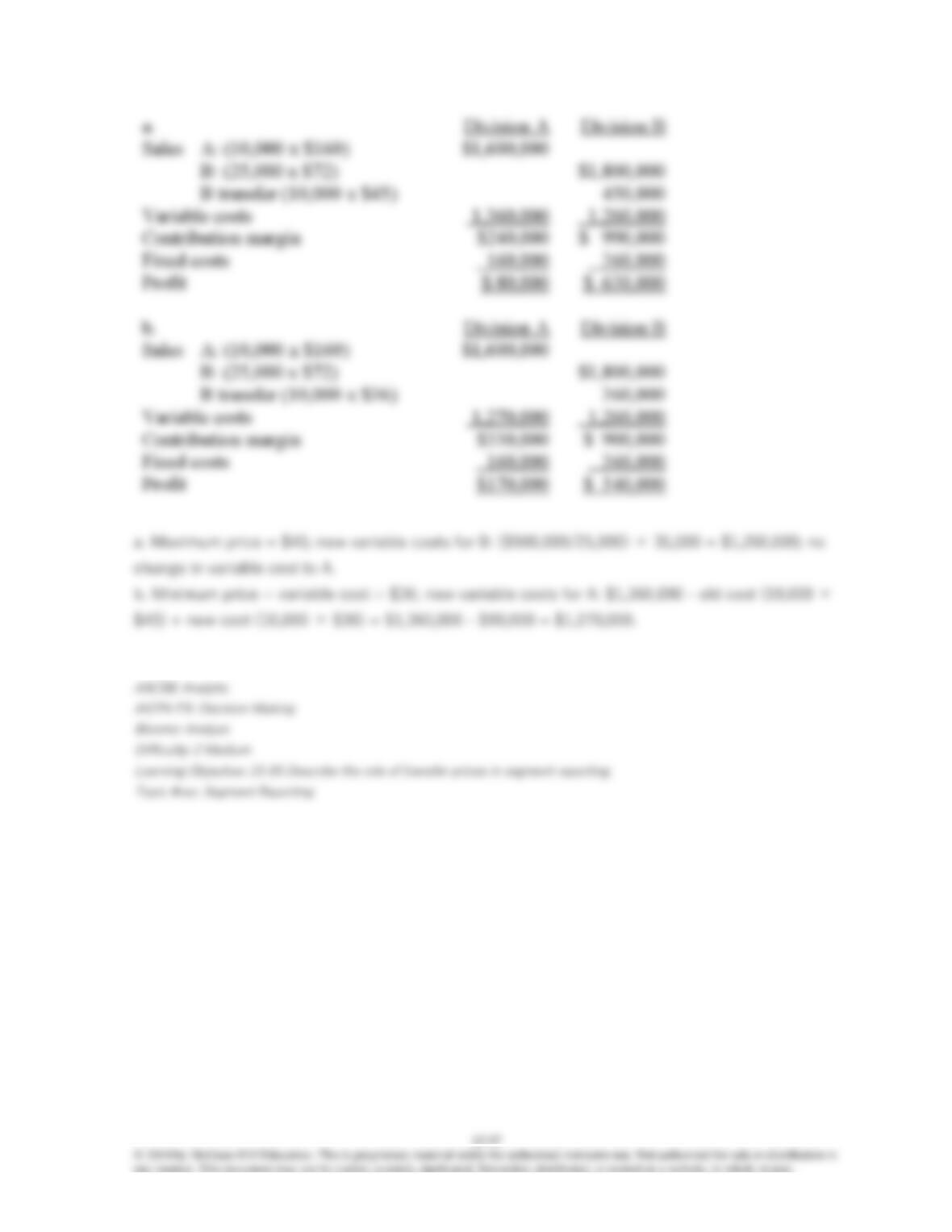
a. Prepare a new segment reporting statement for Stills, assuming an internal transfer at the
maximum transfer price.
b. Prepare a new segment reporting statement for Stills, assuming an internal transfer at the
minimum transfer price.
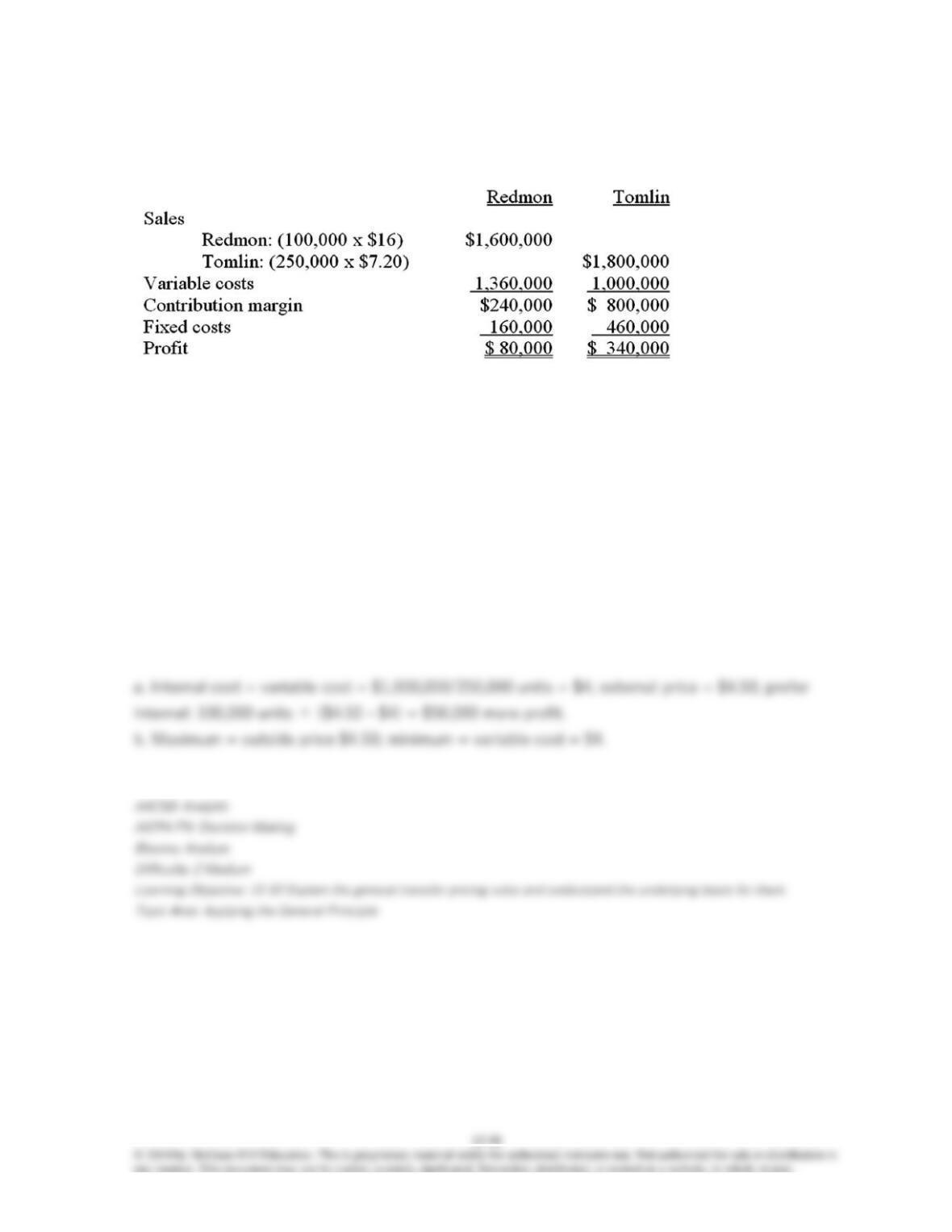
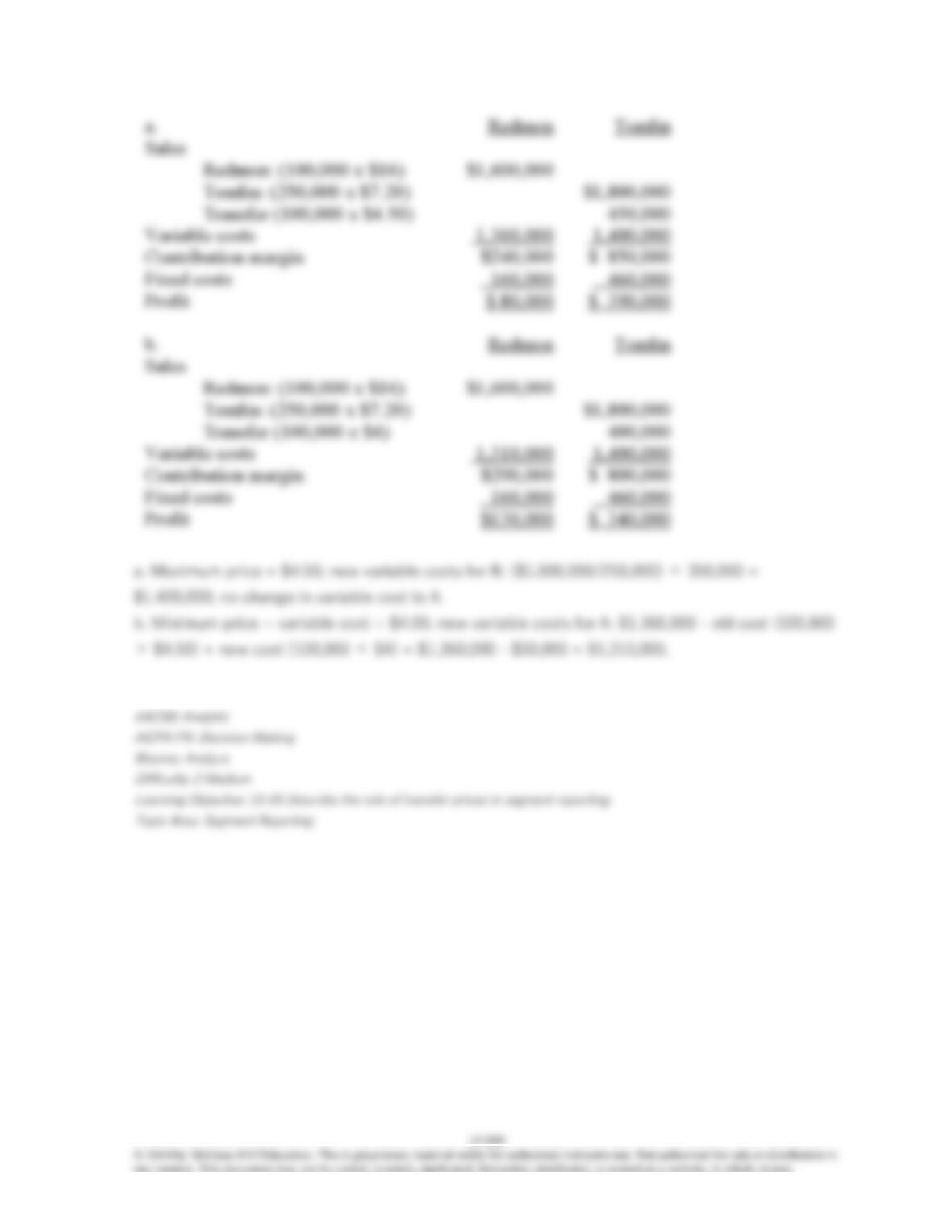
119. Ryman Company has two divisions organized as profit centers: Redmon and Tomlin.
Ryman expects the following results:
Included in Redmon’s costs are 100,000 units of a subcomponent purchased from an outside
supplier for $4.50. The managers have recently initiated negotiations for Tomlin to supply the
components to Redmon. Tomlin has a total capacity of 400,000 units.
Required:
a. Would Ryman Company prefer the subcomponent used by Redmon to be purchased internally
from Tomlin or from the outside vendor? What would be the profit impact?
b. What would be the maximum and minimum transfer prices?
15–99
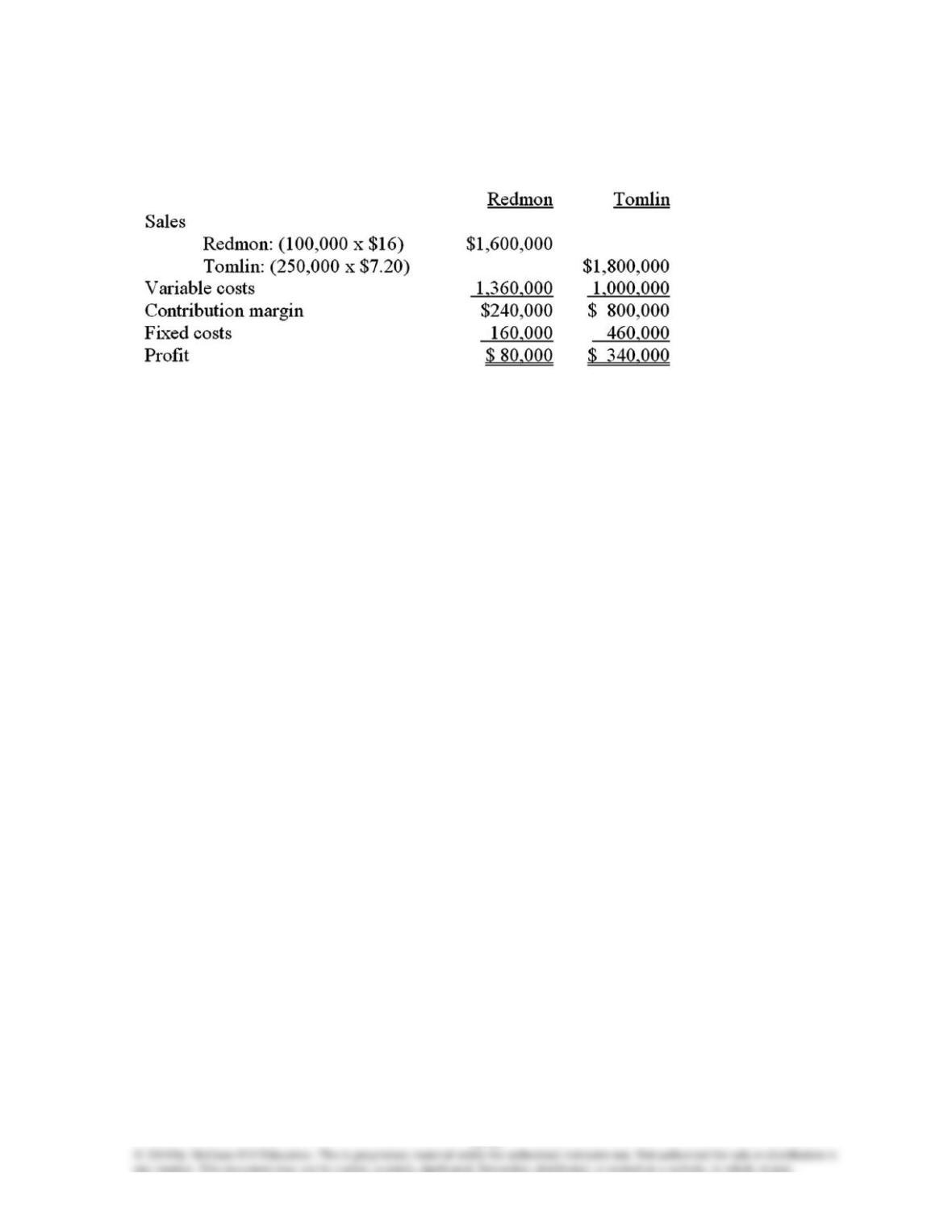
120. Ryman Company has two divisions organized as profit centers: Redmon and Tomlin.
Ryman expects the following results:
Included in Redmon’s costs are 100,000 units of a subcomponent purchased from an outside
supplier for $4.50. The managers have recently initiated negotiations for Tomlin to supply the
components to Redmon. Tomlin has a total capacity of 400,000 units.
Required:
a. Prepare a new segment reporting statement for Ryman, assuming an internal transfer at the
maximum transfer price.
b. Prepare a new segment reporting statement for Ryman, assuming an internal transfer at the
minimum transfer price.