113) Salamander Company expects the following results in the coming period:
Division A
Division B
Sales A: (10,000 × $160)
$
1,600,000
B: (25,000 × $72)
$
1,800,000
Variable costs
1,360,000
900,000
Contribution margin
$
240,000
$
900,000
Fixed costs
160,000
360,000
Profit
$
80,000
$
540,000
Included in Division A’s costs are 10,000 units of a subcomponent purchased from an outside
supplier for $45. The managers have recently initiated negotiations for Division B to supply the
components to Division A. Division B has a total capacity of 40,000 units.
Required:
(a) Would the Salamander Company prefer the subcomponent used by A to be purchased
internally from B or from the outside vendor?
(b) What would be the maximum and minimum transfer prices?
82
114) The following segment reporting statement includes Salamander Company’s expected
results for the coming period:
Salamander Company
Segment Reporting Statement
Division A
Division B
Sales A: (10,000 × $160)
$
1,600,000
B: (25,000 × $72)
$
1,800,000
Variable costs
1,360,000
900,000
Contribution margin
$
240,000
$
900,000
Fixed costs
160,000
360,000
Profit
$
80,000
$
540,000
Included in Division A’s costs are 10,000 units of a subcomponent purchased from an outside
supplier for $45. The managers have recently initiated negotiations for Division B to supply the
components to Division A. Division B has a total capacity of 40,000 units.
Required:
(a) Prepare a new segment reporting statement for the Salamander Company, assuming an
internal transfer at the maximum transfer price.
(b) Prepare a new segment reporting statement for the Salamander Company, assuming an
internal transfer at the minimum transfer price.
115) Thai Company has two divisions organized as profit centers: Redmon and Tomlin. Thai
expects the following results in the coming period:
Redmon
Tomlin
Sales
Redmon: (10,000 × $16)
$
1,600,000
Tomlin: (250,000 × $7.20)
$
1,800,000
Variable costs
1,360,000
1,000,000
Contribution margin
$
240,000
$
800,000
Fixed costs
160,000
460,000
Profit
$
80,000
$
340,000
Included in Redmon’s costs are 100,000 units of a subcomponent purchased from an outside
supplier for $4.50 per unit. The managers have recently initiated negotiations for Tomlin to
supply the components to Redmon. Tomlin has a total capacity of 400,000 units.
Required:
(a) Would Thai Company prefer the subcomponent used by Redmon to be purchased internally
from Tomlin or from the outside vendor? What would be the profit impact of this decision?
(b) What would be the maximum and minimum transfer prices?

85
116) Macon Motor Works has just acquired a new Battery Division. The Battery Division
produces a standard 12-volt battery that it sells to retail outlets at a competitive price of $20. The
retail outlets purchase about 800,000 batteries a year. Since the Battery Division has a capacity
of 1,000,000 batteries per year, top management is thinking that it might be wise for the
company’s Automotive Division to start purchasing batteries from the newly acquired Battery
Division.
The Automotive Division now purchases 300,000 batteries per year from an outside supplier at a
price of $18 per battery. The discount from the competitive $20 price is a result of the large
quantity purchased.
The Battery Division’s cost per battery is shown below:
Direct materials
$
8
Direct labor
4
Variable overhead
2
Fixed overhead
2
Total cost
$
16
Fixed costs are based on 1,000,000 batteries.
Both divisions are to be treated as investment centers, and their performance is to be evaluated
by the ROI formula.
Required:
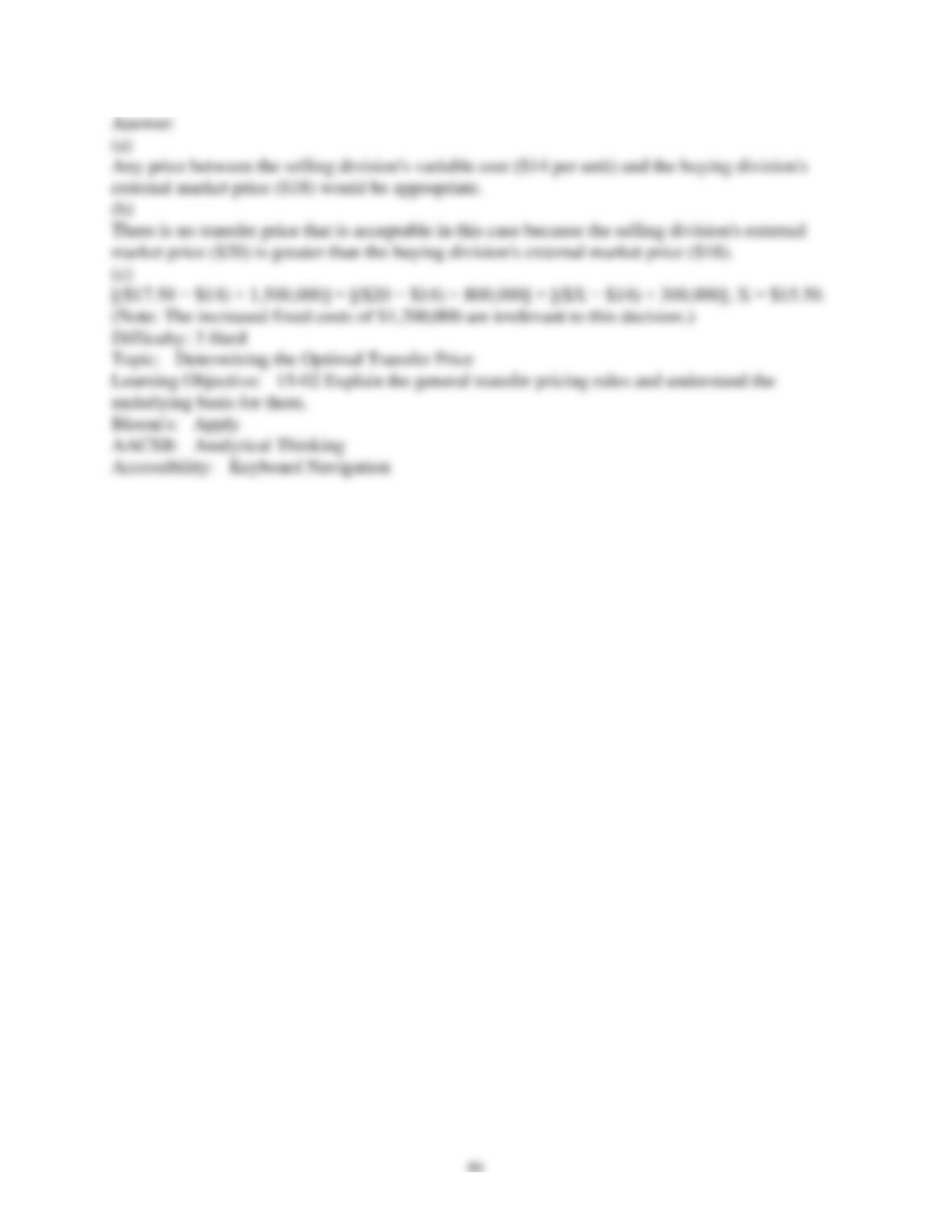
(a) What transfer price would you recommend and why?
(b) What transfer price would you recommend if the Battery Division is now selling 1,000,000
batteries a year to retail outlets?
(c) Suppose the manager of the Battery Division can increase its capacity to 1,500,000 units for
$1,200,000. She then has the option of (c1) cutting the retail price to $17.50 with the certainty
that sales will increase to 1,500,000 batteries, or (c2) maintaining the outside price of $20.00 for
the 800,000 batteries and transferring the 300,000 batteries to the Automotive Division at some
price that would produce the same income for the Battery Division as option (c1). What is the
minimum transfer price you would recommend in the (c2) option?
87
117) Chattanooga, Incorporated, has two divisions for its metal fabrication business. The Stamp
Division stamps the objects and then transfers them to the Finish Division, which finishes and
sells them. Last year, the Stamp Division had administrative expenses of $40,000. The Finish
Division incurred additional production costs of $120,000 (exclusive of amounts paid to the
Stamp Division for the stamped steel) to process 120,000 units. The Finish Division sold the
finished goods for $500,000 and incurred $80,000 in variable selling and administrative
expenses.
Required:
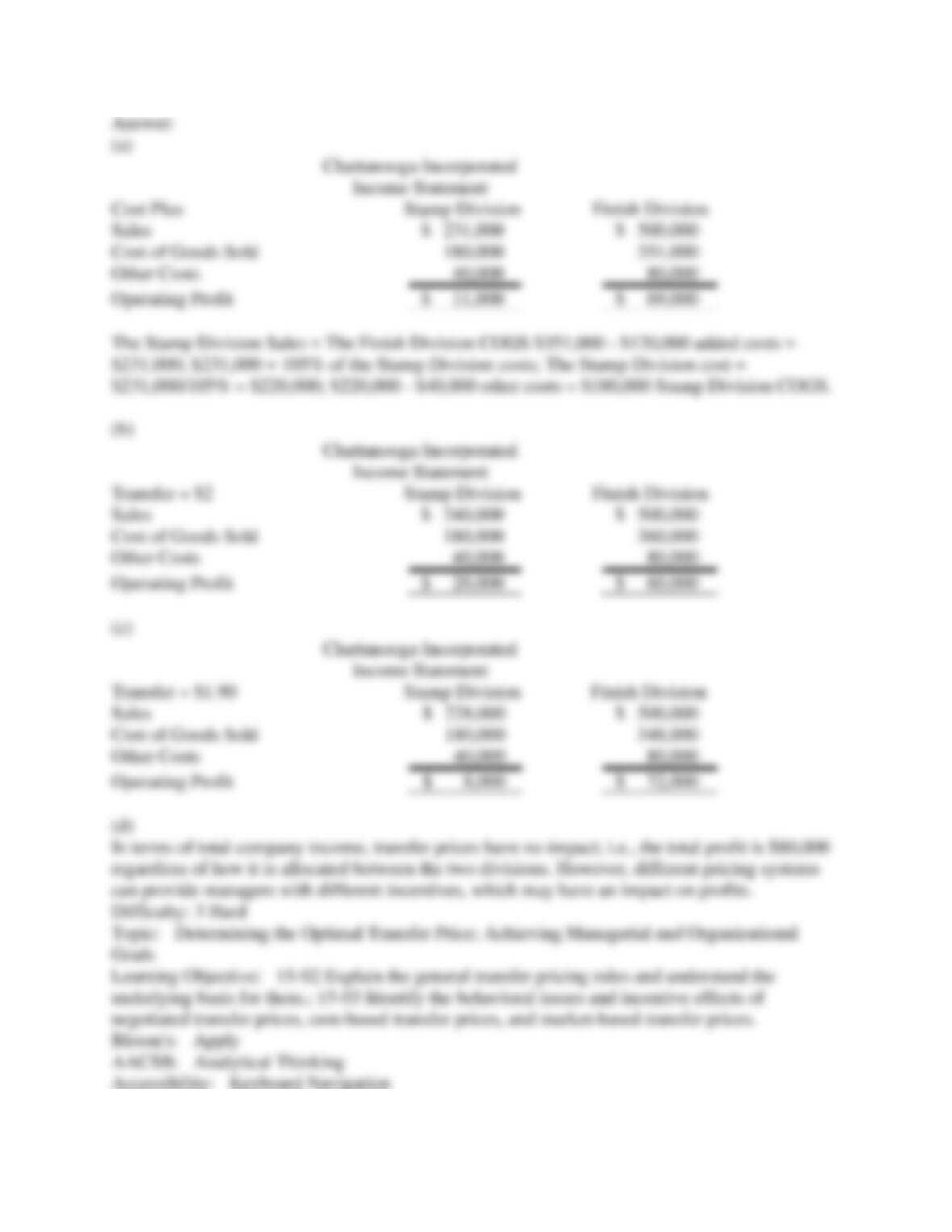
(a) Prepare income statements for each division. Use a transfer price of the Stamp Division’s
total cost plus 5%. Assume Cost of Goods Sold for the Finish Division is $351,000.
(b) Repeat (a), using a transfer price of $2.00 per unit; this is also the market price.
(c) Repeat (a), using a negotiated transfer price of $1.90 per unit.
(d) Which transfer price results in higher income to Chattanooga Incorporated?
88
118) Division S sells its product to unrelated parties at a price of $20 per unit. It incurs variable
costs of $7 per unit and has fixed costs of $50,000 per month. Monthly production is generally
10,000 units.
Division B uses Division S’s product in its operations. It can purchase the units from Division S
at $20 per unit but must pay $1.50 per unit in shipping costs. Alternatively, Division B can buy
from Division S’s competition at a delivered price of $21 per unit.
Required:
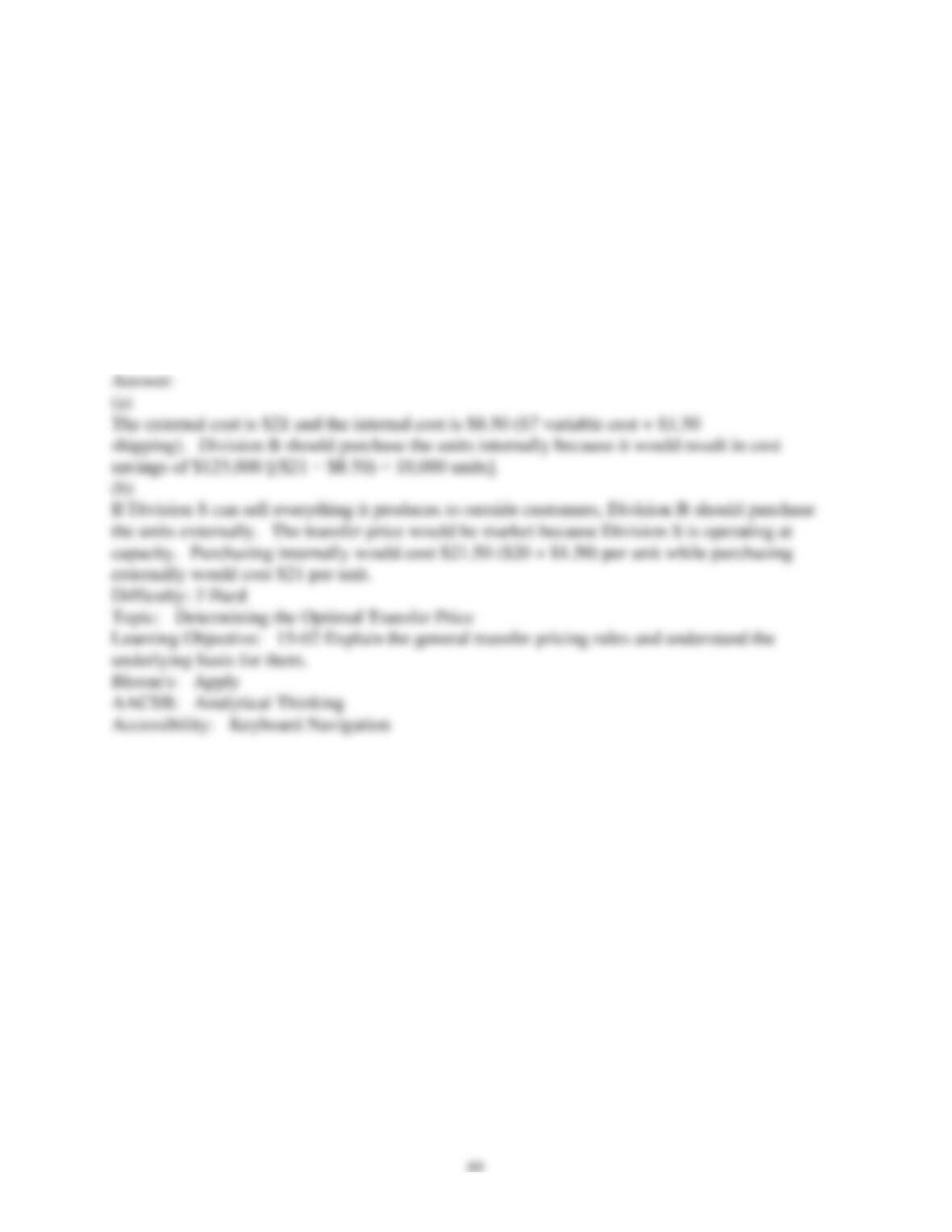
(a) From the company’s perspective, should Division B purchase the units internally or
externally? Assume Division S has ample capacity to handle all of Division B’s needs.
(b) Would your answer change if Division S can sell everything it produces to outside
customers?
119) Calvin Machinery Company manufactures heavy-duty equipment used in foundries, mining
operations, and similar operations. The company is decentralized, with various division
managers having control over capital investments and most production decisions. The Cylinder
Division fabricates a component which is used by the Press Division in its production of metal
presses. The Cylinder Division has been selling to the Press Division at a price of $3,000 per
unit. Because of a cost increase, the Cylinder Division wants to increase its price to $3,200, even
though the Press Division can still purchase an equivalent component externally for $3,000. The
following information has been gathered regarding this issue:
Press Division’s annual purchases
100
units
Cylinder Division’s variable costs
$
2,400
per unit
Cylinder Division’s fixed costs
$
600
per unit
Required: (support your answers with appropriate calculations)
(a) If the Press Division buys its units externally, the Cylinder Division will have idle capacity
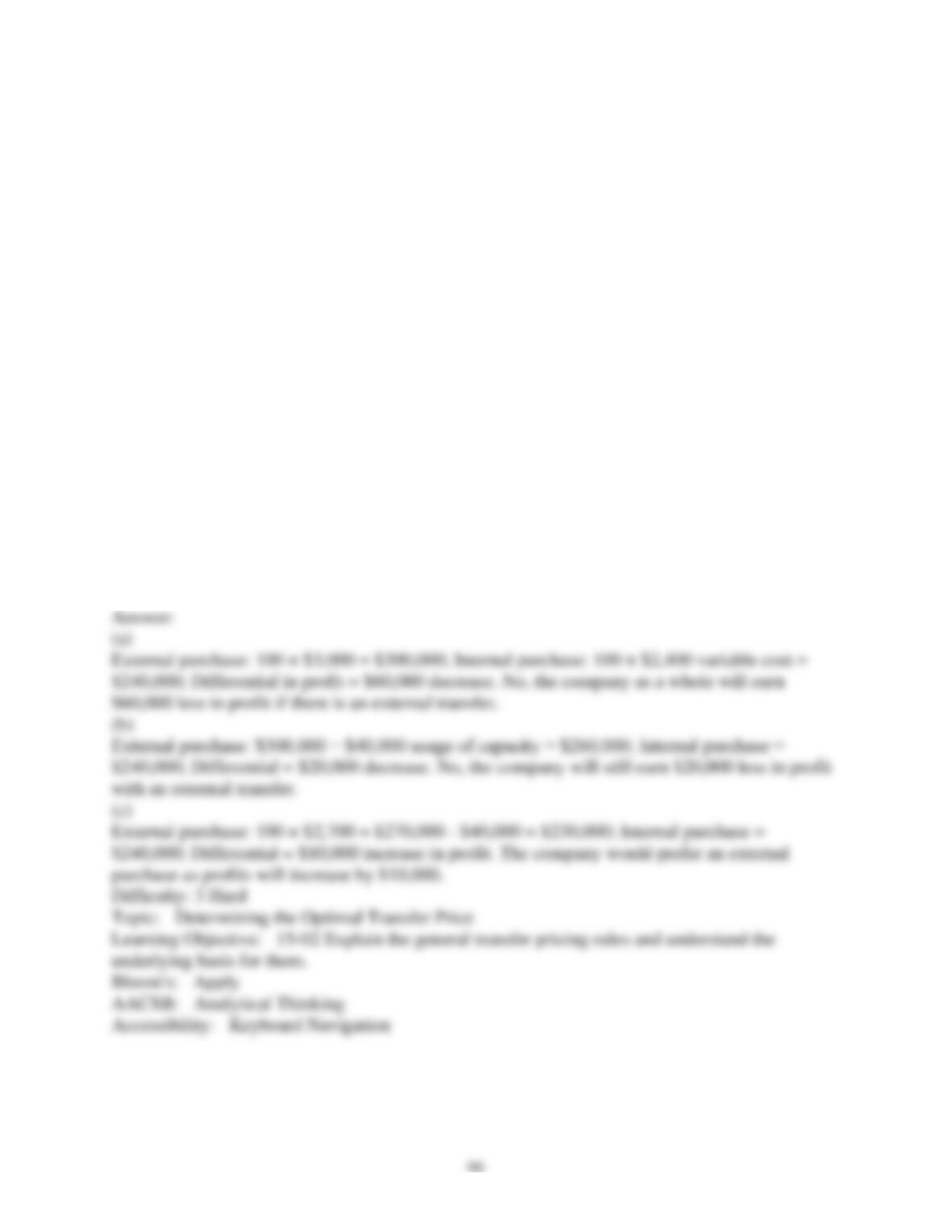
for which there are no alternative uses. Will the company as a whole benefit if the Press Division
purchases its units externally for $3,000 per unit?
(b) If the Press Division buys its units externally, the Cylinder Division will have idle capacity
which can be used to generate a positive cash flow of $40,000. Will the company as a whole
benefit if the Press Division purchases its units externally for $3,000 per unit?
(c) Refer to (b). Will your answer change if the price at which the Press Division can buy
externally decreases to $2,700 per unit?
91
120) The GrowPro Manufacturing Company has a division (Division P) that produces an
essential ingredient used by the Lawn Division in making lawn fertilizer. Historically, 75% of
Division P’s output has been purchased by Division L and 25% has been sold to other fertilizer
companies. The transfer price between Division P and Division L has been based on the outside
sales price less selling and administrative expenses directly applicable to the outside sales. Last
year, the transfer price was $35 per ton and Division P would like the same transfer price this
year. However, the general manager of Division L has found an outside supplier who will sell the
ingredient for $30 per ton. She would like to continue buying from Division P, but Division P’s
manager does not want to match the $30 price because he thinks that the margin is too small.
Top management does not get involved in transfer pricing disputes, but rather, allows division
managers to make their own decisions concerning internal or external purchases and sales.
The following information has been gathered regarding Division P’s operations last year:
Sales to L
External
Sales
$
4,200,000
$
2,000,000
Variable costs
3,000,000
1,000,000
Fixed costs
360,000
120,000
The information presented above is based on selling 120,000 tons internally and 40,000 tons
externally.
Required:
(a) If Division L buys externally, Division P can increase its current external sales by only
20,000 tons. What arguments can the general manager of Division L make to help Division P to
match the $30 price?
(b) Division L wants to use only one supplier, so Division P will either sell 120,000 tons to
Division L or nothing. If Division L’s capacity is 160,000 tons, how many units does Division P
need to sell to outsiders at $50 per ton before it is better off selling to outsiders? Ignore any
additional marketing costs which would be incurred to increase sales.
121) The Measurement Division of Flow Company produces pumps which it sells for $20 each
to outside customers. The Measurement Division’s cost per pump, based on normal volume of
500,000 units per period, is shown below:
Variable costs
$
12
Fixed overhead
3
Total
$
15
Flow has recently purchased a small company which makes sprinkler systems. This new
company is presently purchasing 100,000 pumps each year from another manufacturer. Since the
Measurement Division has a capacity of 600,000 pumps per year and is now selling only
500,000 pumps to outside customers, management would like the new Sprinkler Division to
begin purchasing its pumps internally. The Sprinkler Division is now paying $20 per pump, less
a 10% quantity discount. The Measurement Division could avoid $1 per unit in variable costs on
any sales to the Sprinkler Division.
Required:
(a) Treating each division as an independent profit center, within what price range should the
internal sales price fall?
(b) Now assume that the Measurement Division is selling 600,000 pumps per year on the
outside. Determine the appropriate transfer price. Show all computations.
122) Finnish Corporation has a Supply Division that does work for other divisions in the
company as well as for outside customers. The company’s Custodial Products Division has asked
the Supply Division to provide it with 10,000 special parts each year. The special parts would
require $15.00 per unit in variable production costs.
The Custodial Products Division has a bid from an outside supplier for the special parts at $29.00
per unit. In order to have time and space to produce the special parts, the Supply Division would
have to cut back production of another product – the H56 that it is currently producing. The H56
sells for $32.00 per unit and requires $19.00 per unit in variable production costs. Packaging and
shipping costs of the H56 are $3.00 per unit. Packaging and shipping costs for the new special
part would be only $1.00 per unit. The Supply Division is currently producing and selling 40,000
units of the H56 each year. Production and sales of the H56 would drop by 20% if the new
special part is produced for the Custodial Products Division.
Required:
(a) What is the range of transfer prices within which both the Divisions’ profits would increase as
a result of agreeing to the transfer of 10,000 special parts per year from the Supply Division to
the Custodial Products Division?
(b) Is it in the best interests of Finnish Corporation for this transfer to take place? Explain.
95
123) Division N has asked Division M of the same company to supply it with 10,000 units of
part P782 this year to use in one of its products. Division N has received a bid from an outside
supplier for the parts at a price of $25.00 per unit. Division M has the capacity to produce 50,000
units of part P782 per year. Division M expects to sell 46,000 units of part P782 to outside
customers this year at a price of $26.00 per unit. To fill the order from Division N, Division M
would have to cut back its sales to outside customers. Division M produces part P782 at a
variable cost of $17.00 per unit. The cost of packing and shipping the parts for outside customers
is $1.00 per unit. These packing and shipping costs would not have to be incurred on sales of the
parts to Division N.
Required:
(a) What is the range of transfer prices within which both divisions’ profits would increase as a
result of agreeing to the transfer of 10,000 parts this year from Division M to Division N?
(b) Is it in the best interest of the overall company for this transfer to take place? Explain.

97
124) Farris Yard Equipment Corporation manufactures lawn mowers and snow blowers. It also
manufactures engines that are used by the Lawn Mower Assembly Division (LMAD). The
Engine Division (ED) also sells about 40% of its output to the outside market (these are
multipurpose engines). ED’s annual capacity is 155,000 units and annual output is currently
135,000 units. All engines sold internally to the LMAD are priced at cost plus 20% markup.
In January 2020, the Snow Blower Assembly Division (SBAD) approached the ED to ‘buy’
20,000 engines. Diane Rogers, the controller of ED, computed the costs of manufacturing these
engines as follows:
Total
Per unit
Materials
$
300,000
$
15.00
Labor
400,000
20.00
Special equipment
36,000
1.80
Quality inspection
24,000
1.20
Other manufacturing costs
350,000
17.50
Total costs
$
1,110,000
$
55.50
Rogers quoted a price of $66.60 for each engine transferred to the SBAD. Jackson White, the
manager of SBAD, was furious to note that the ED was “trying to make money off a sister
division.” He argued that the price must include only the cost of materials, as all other costs will
be incurred irrespective of whether or not SBAD places the order for 20,000 engines. Morton
Downey, the production manager of ED, pointed out that the special equipment will be
purchased only for fulfilling this internal order. Moreover, he argued that inspection must also be
done just like on all other engines; therefore, the inspection costs must also be included. Labor is
paid a flat monthly salary. Other manufacturing costs include both variable and fixed
components (in roughly equal proportion).
Required:
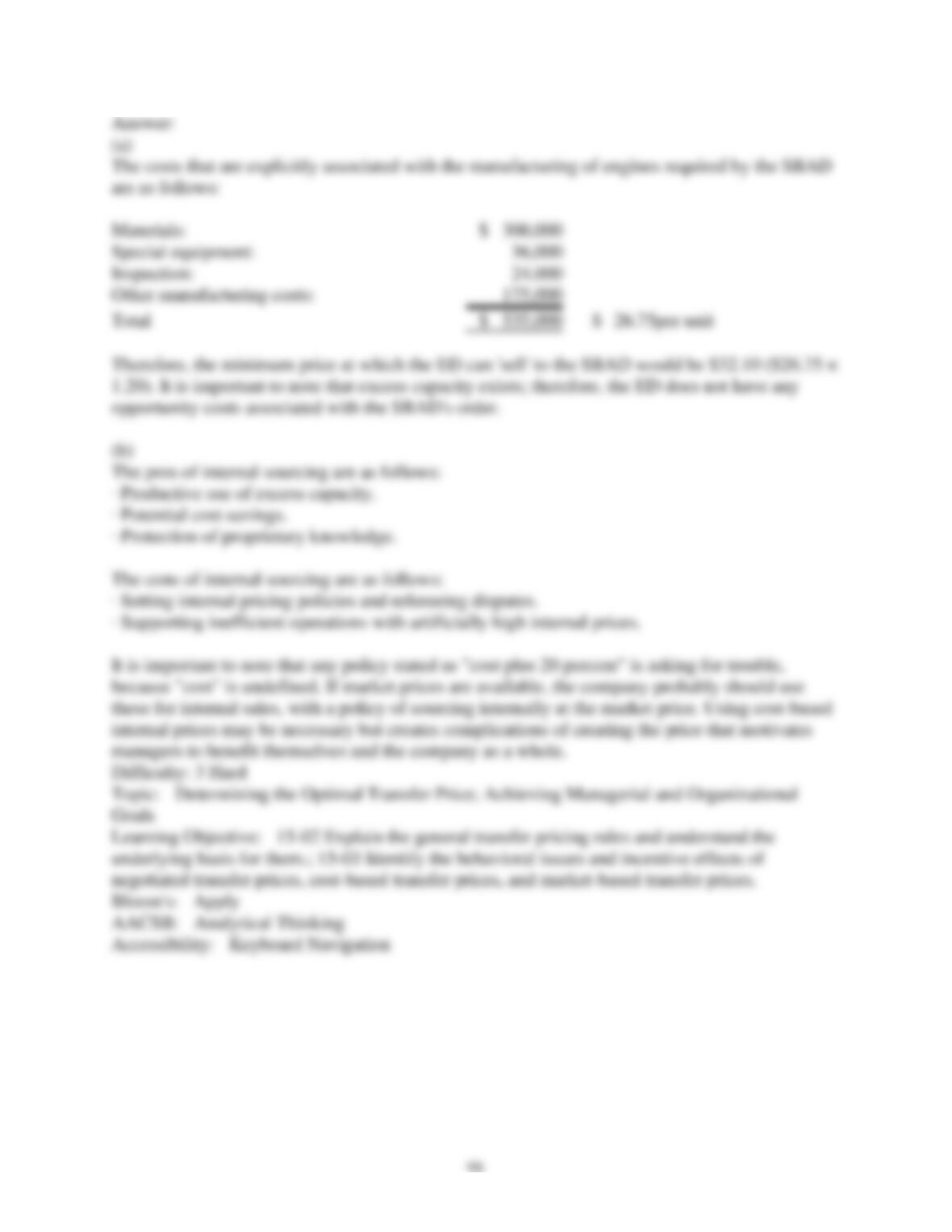
(a) Given that excess capacity exists, what is the minimum price that the ED must charge to the
SBAD?
(b) What are the pros and cons of internal sourcing?
99
125) Allentown Division of Sparks Incorporated transfers its product to the Youngstown
Division. The Youngstown Division can either buy the item internally or externally. The cost of
purchasing the item externally is $73 per unit. The Allentown Division has just completed its
annual cost update as follows:
Direct materials
$
25.00
Direct labor
18.00
Variable manufacturing overhead
6.00
Fixed manufacturing overhead
3.50
Variable selling expenses
4.00
Fixed selling and administrative expenses
8.50
Total costs
$
65.00
Desired return
14.00
Sales price
$
79.00
The Allentown Division is operating at 60 percent of its 400,000 unit capacity.
Required:
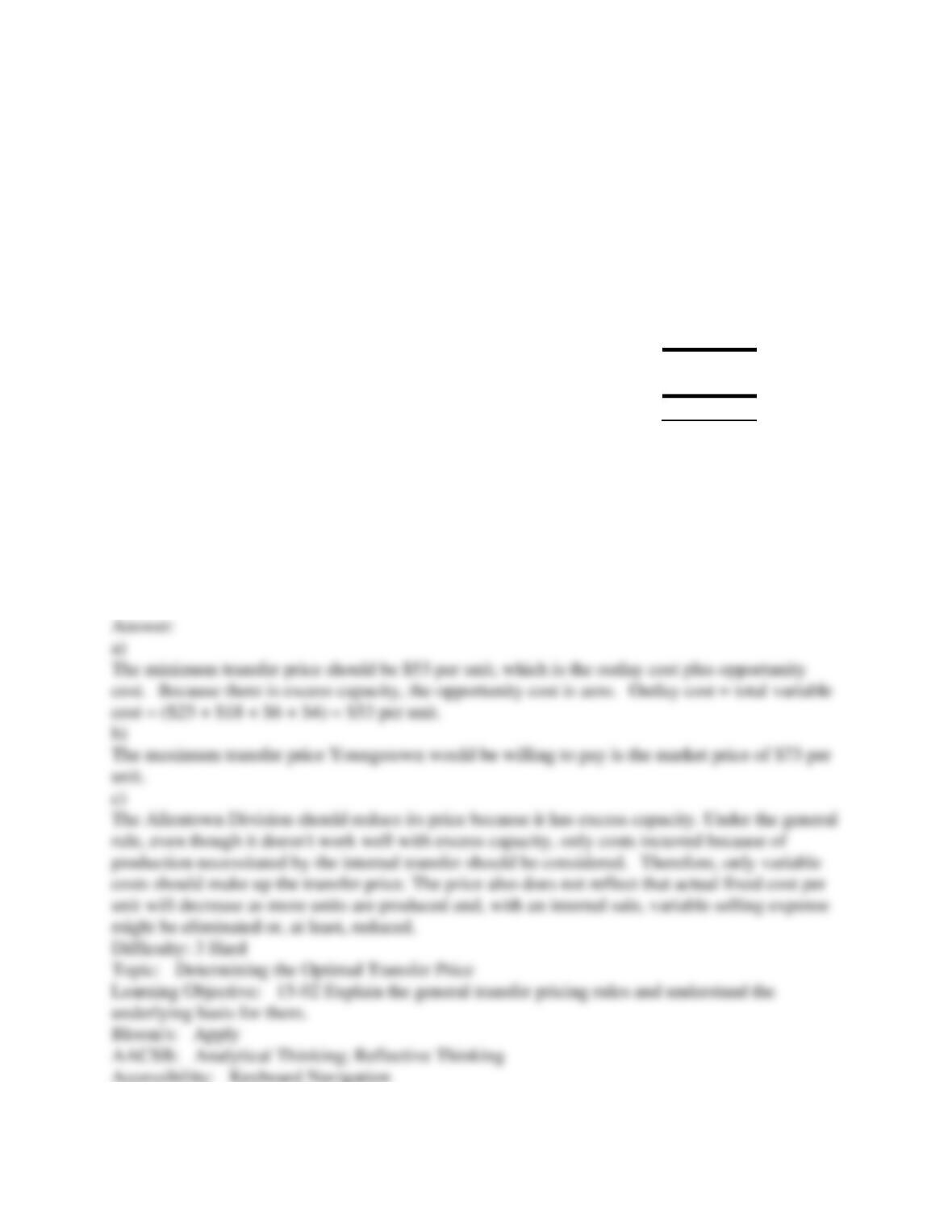
a) What is the minimum transfer price the Allentown Division should charge for internal
transfers?
b) What is the maximum price the Youngstown Division would be willing to pay?
c) Why should the Allentown Division reduce its price to the Youngstown Division?
126) The following costs exist for the Wiring Division of Coriander Corporation:
Direct materials
$
67,500
Direct labor
45,000
Manufacturing overhead (25% variable)
45,000
Operating expenses (30% variable)
75,000
Output
30,000
units
The output of the Wiring Division, which sells for $10 per unit externally, is used by the
Electrical Harness Division.
Required:
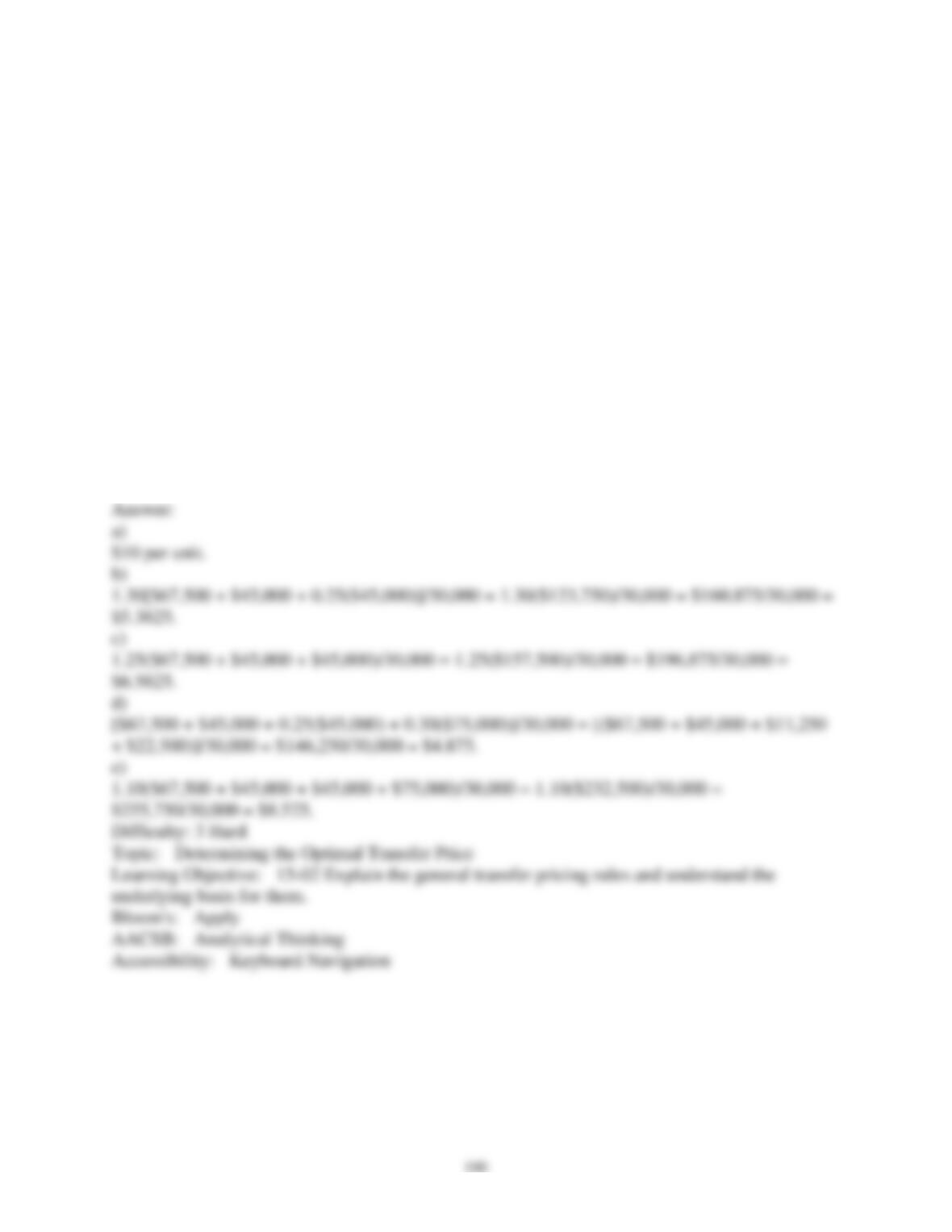
Compute the transfer price for a unit of the Wiring Division’s output using:
a) market price.
b) variable production cost plus 30%.
c) absorption cost plus 25%.
d) variable cost.
e) total cost plus 10%.