Chapter 15 – Target Costing and Cost Analysis for Pricing Decisions
15–60
104. Buffington, Inc. produces a number of components that are used in home theater
systems. Mike Boston, head of the company’s market research department, has identified the
need for a new component that will most likely sell for $75. Projected volume levels are
anticipated to reach 28,000 units in the first year, as several firmly entrenched competitors
will be introducing a similar product in the not-too-distant future.
Conversations with Buffington’s engineers and reviews of cost accounting data related to
similar products that the company manufactures resulted in the following cost estimates for
the new component:
Direct materials
$18
Direct labor
36
Manufacturing overhead
16
Selling and administrative
5
Buffington currently uses cost-plus pricing and adds a 20% markup on total production cost to
arrive at what is normally a competitive selling price.
Required:
A. What is the anticipated selling price of the new component if Buffington uses its current
pricing policy? What difficulties, if any, might the company face in the marketplace?
B. Assume that Buffington decides to switch to target costing. What price would the company
charge for the new component?
C. With the switch to target costing, what would Buffington have to do to the component’s
manufacturing cost to achieve the normal profit margin on sales? Be specific and show
calculations.
15–62
105. Allred Furniture manufactures easy-to-assemble wooden furniture for home and office.
The firm is considering modification of a bookcase, and the company’s marketing department
surveyed potential buyers regarding five proposed changes (A-E). The buyers’ responses, in
order of preference, along with Allred’s related unit costs for the modifications, follow.
Order of Preference
Change
Cost
1
A
$7.50
2
D
5.00
3
B
4.00
4
C
1.50
5
E
5.50
The bookcase currently costs $81 to produce and distribute, and Allred’s selling price for
this unit averages $108. An analysis of competitive products in the marketplace revealed a
variety of features, with some models having all of the changes that Allred is considering
and other models having only a few. The current manufacturers’ selling prices on these
bookcases average $120.
Required:
A. Why is there a need in target costing to (a) focus on the customer and (b) have a
marketing team become involved with product design?
B. Management desires to earn approximately the same rate of profit on sales that is being
earned with the current design.
1. If Allred uses target costing and desires to meet the current competitive selling price,
what is the maximum cost of the modified bookcase?
2. Which of the modifications should Allred consider?
C. Assume that Allred wanted to add a modification or two that you excluded in your
answer to requirement “B2.” What process might management adopt to allow the company
to make its target profit for the bookcase? Briefly explain.
Chapter 15 – Target Costing and Cost Analysis for Pricing Decisions
Solution:
15–64
106. The controller for Rich Photographic Supply has established the following cost pools and
cost drivers:
Activity Cost Pool
Budgeted
Overhead
Cost
Cost Driver
Budgeted
Level for
Driver
Pool Rate
Machine setups
$200,000
Number of setups
100
$2,000 per setup
Material handling
100,000
Pounds of raw material
50,000
$2 per pound
Hazardous waste control
50,000
Pounds of hazardous
chemicals
10,000
$5 per pound
Quality control
75,000
Number of inspections
1,000
$75 per inspection
Other overhead costs
200,000
Machine hours
20,000
$10 per machine hr.
Total
$625,000
An order for 1,200 boxes of film-development chemicals has the following production
requirements:
Machine setups
8
Pounds of raw materials
16,000
Pounds of hazardous chemicals
None
Inspections
4
Machine hours
400
Direct materials and labor cost
$24,000
Rich established a target price by adding a 40% markup to total manufacturing cost.
Required:
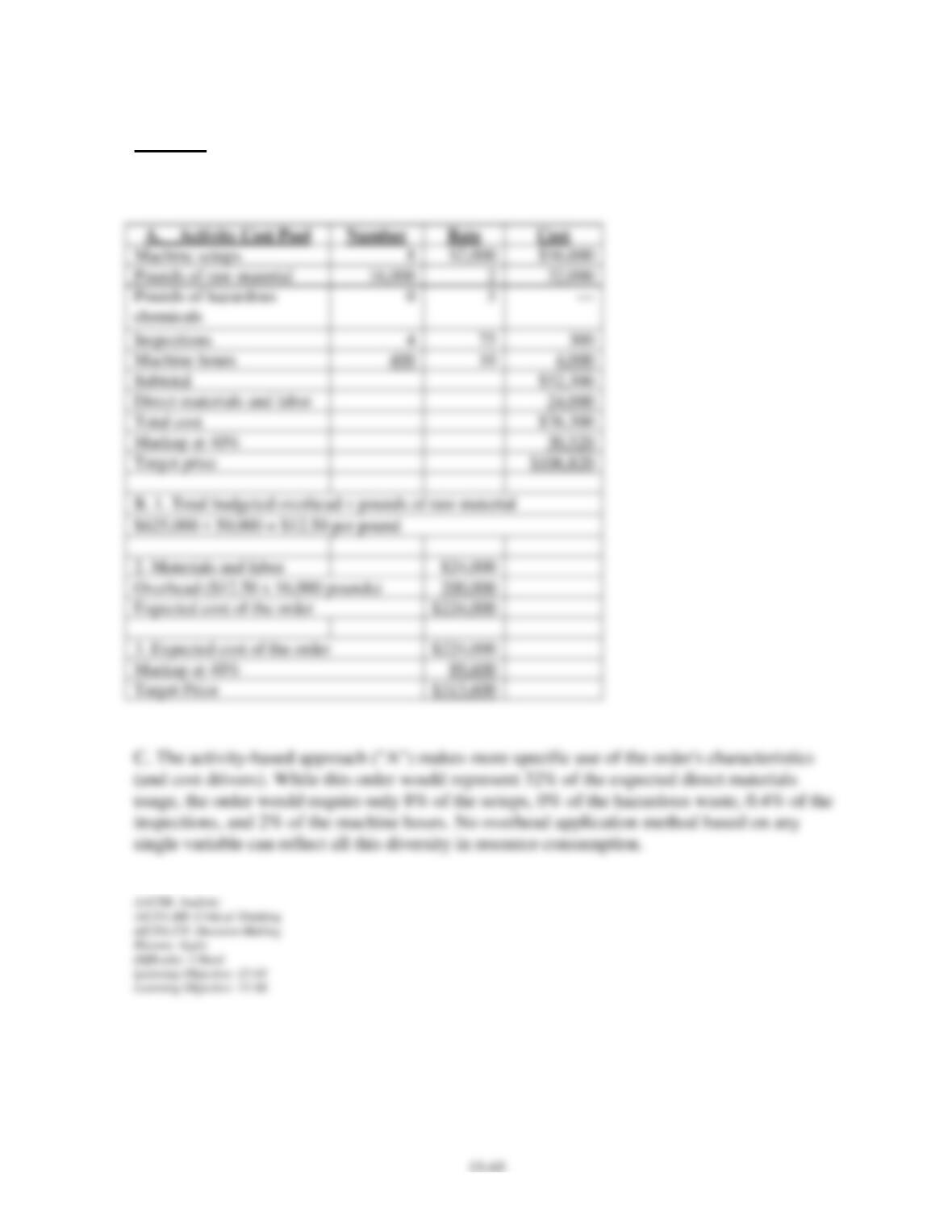
A. Determine the order’s target price by using the activity-cost pools.
B. Assume that Rich used a single, combined overhead rate based on weight of raw materials.
1. Determine the predetermined overhead rate.
2. Determine the expected cost of the order.
3. Determine the target price.
C. Which approach above (“A” or “B”) seems to be a more reasonable method to establish
target prices? Explain.
Chapter 15 – Target Costing and Cost Analysis for Pricing Decisions
Solution:
107. Shocker Electrical, which installs sophisticated electronic-control systems in new homes,
prices jobs by using the time-and-materials method. The following data apply to a job for
ABC Builders:
Labor hours: 180
Materials cost: $48,000
The following predictions, based on 30,000 direct labor hours, pertain to the company’s
operations for the year:
Annual overhead costs:
Material handling and storage
$ 40,000
Other overhead costs
360,000
Annual cost of materials used
500,000
Labor rate per hour, including fringe
benefits
34
Shocker Electrical adds a markup of $15 per hour on its time charges, but there is no profit
markup on material costs.
Required:
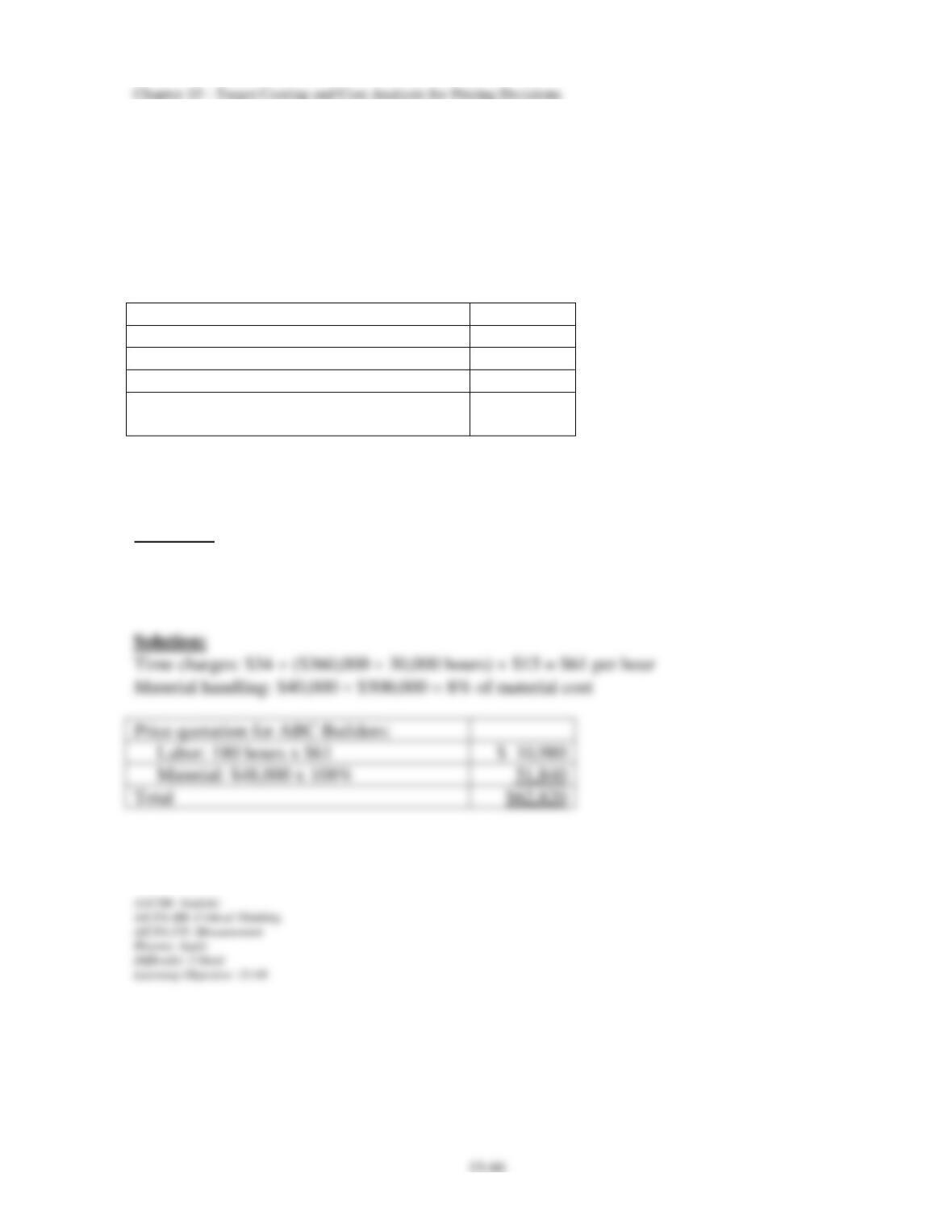
Calculate the price for the ABC Builders’ job.
Price quotation for ABC Builders:
Labor: 180 hours x $61
Material: $48,000 x 108%
Total
$62,820
108. Exquisite Exteriors installs stucco on high-priced custom homes, using the time-and-
materials method to price jobs for individual builders. Exquisite anticipates using $250,000 of
materials during the year and will incur $15,000 for material handling and storage. Other
overhead costs, which are driven by the company’s 18,000 direct labor hours, will total
$360,000. Exquisite pays construction crews $17 per labor hour and adds a markup of $19 per
hour on its time charges. There is no profit markup on material cost.
During the first quarter of the year, Exquisite performed 24 jobs for Don Henderson Builders,
using 3,100 labor hours and $72,000 of materials.
Required:
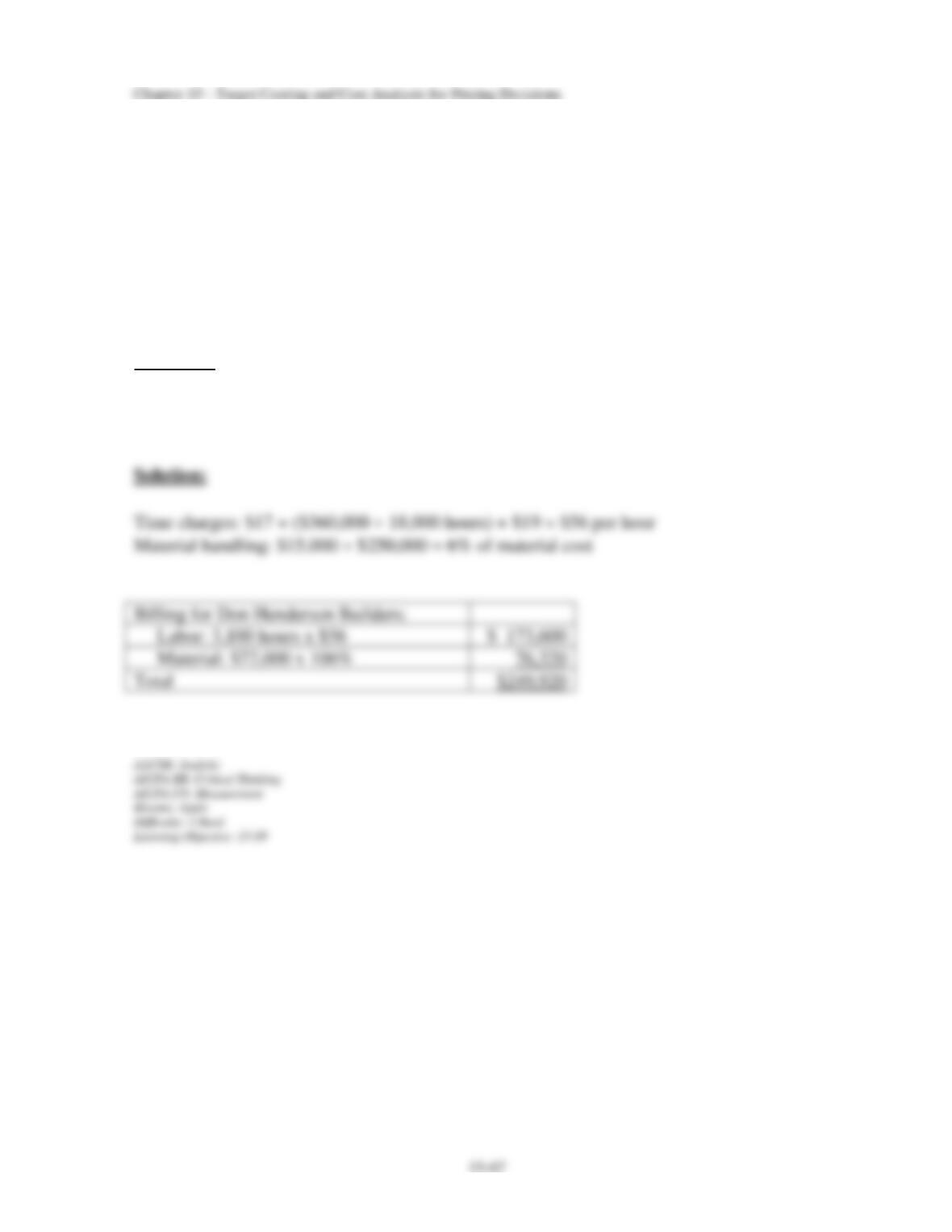
Calculate the amount that Exquisite would bill Don Henderson Builders for work performed.
109. Aerial Roofing performs roofing services for commercial clients. The company recently
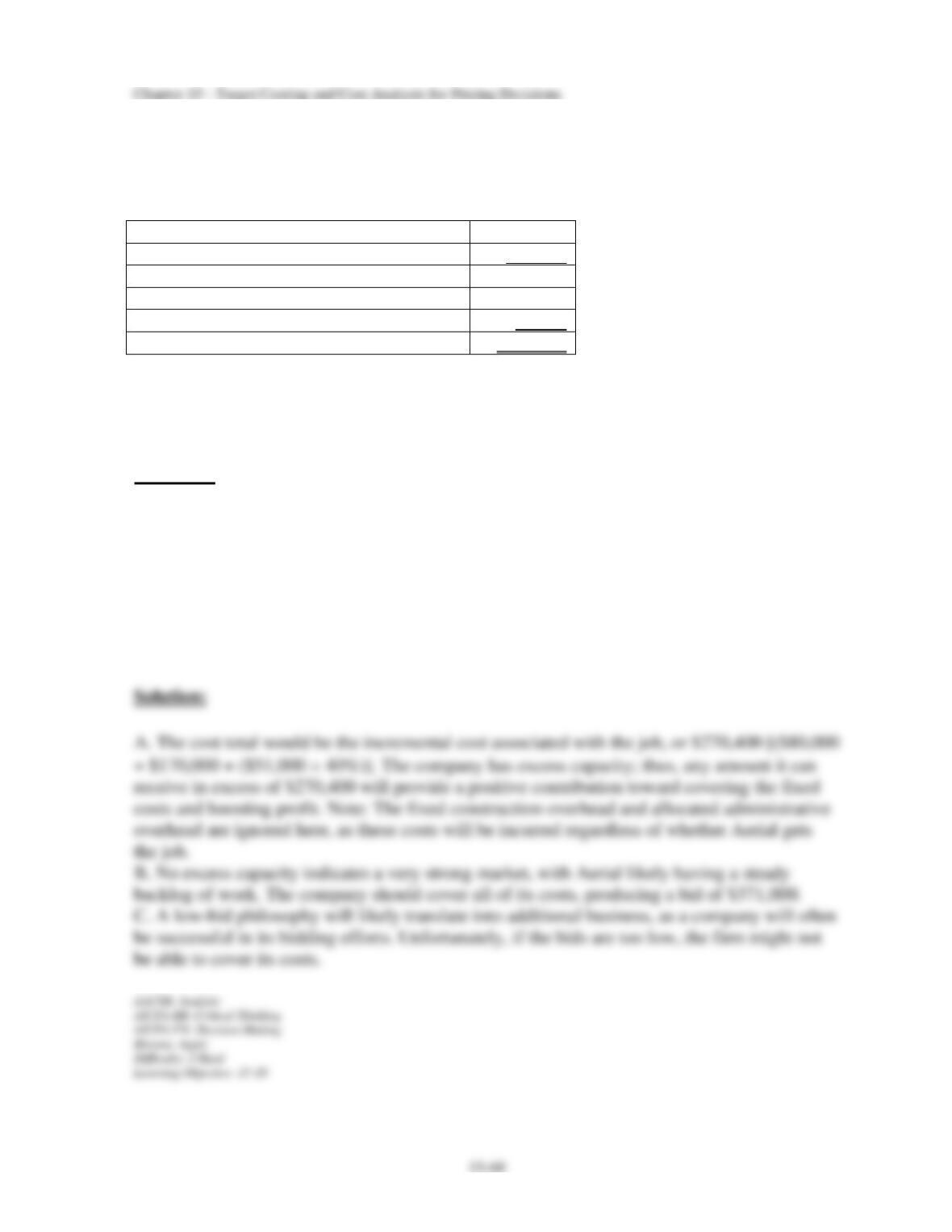
submitted a bid of $371,000 to the Ponca School System, computed as follows:
Construction materials
$80,000
Labor costs
170,000
Total direct costs
$250,000
Construction overhead – 30% of labor
51,000
Allocated administrative overhead
20,000
Total cost
$321,000
Aerial adds a 20% profit margin to all jobs, computed on the basis of total direct cost. In
Ponca’s case the profit margin amounted to $50,000 ($250,000 20%), producing a bid price
of $371,000. Assume that 60% of construction overhead is fixed.
Required:
A. If Aerial had excess capacity, what would be the lowest cost total that the company should
use when figuring its bid for the district? How can High justify this amount?
B. If Aerial had no excess capacity, what would be the lowest price that the company should
charge?
C. What is the primary benefit and problem of approaching a competitive bid situation with a
low-bid philosophy?
15–69
110. Frontage Corporation, which has a maximum labor capacity of 30,000 hours per month,
has considerable flexibility with its customers when it comes to project completion dates.
Management is considering the submission of a bid for a job to be performed for the city of
Carthage. Costs for the job are as follows:
Raw materials
$ 140,000
Labor costs
330,000
Variable overhead (20% of labor)
66,000
Fixed overhead (45% of labor)
148,500
Allocated administrative cost
48,000
Total cost
$732,500
Frontage’s labor force is paid an average of $22 per hour and if the company wins the bid,
it will have three months to complete the work. Management adds a 30% profit margin to
all jobs, computed on the basis of total variable cost.
Required:
A. Compute the lowest total cost that the company would use when figuring its bid,
assuming that Frontage has excess capacity.
B. Compute Frontage’s bid if the company has no excess capacity.
C. Assume that Frontage is currently working at 85% of capacity. Does the firm have
sufficient time to complete the job? If not, what could the company do if it desires to do
business with Carthage?
Chapter 15 – Target Costing and Cost Analysis for Pricing Decisions
Solution:
15–71
111. Riverview Manufacturing, which produces electrical components, is contemplating
submitting a bid for 30,000 units of item no. 54. The bid’s cost will be follows:
Raw materials
$ 75,000
Direct Labor
120,000
Manufacturing overhead
150,000
Additional set-up costs
3,000
Special device
5,000
Allocated administrative overhead
12,000
Total cost
$365,000
The special device will be purchased for this job and once the job is completed, the device
will be discarded.
Riverview applies total manufacturing overhead of $5 to each unit (0.5 machine hours at $10
per hour). This figure is based, in part, on budgeted yearly fixed overhead of $1,440,000 and
an anticipated volume of 480,000 machine hours (40,000 per month). Riverview is presently
working at 85% of capacity, and the client needs the order in two months.
Required:
A. Is Riverview’s current operating environment one of excess capacity or no excess
capacity? Briefly explain.
B. If Riverview had excess capacity, what would be the lowest cost total that the company
should use when figuring its bid for the order?
C. Can Riverview produce this order in the required time frame of two months? Explain.
D. Suppose that Riverview is in marginal financial health. Explain the benefits and problems
of approaching the bidding procedure with (1) a low bid or (2) a high bid.
Chapter 15 – Target Costing and Cost Analysis for Pricing Decisions
Solution:
112. The following questions explore the relationships between total and marginal functions
in the economic profit-maximizing (EPM) model:
Required:
A. The total revenue function rises over the range of operating activity portrayed in the text.
Why does the marginal revenue function decrease?
B. What is the behavior of the marginal cost curve?
C. In the EPM model, where is the profit-maximizing volume level? Explain.
Solution:
113. When pricing products, many companies use target costing and/or cost-plus pricing
methods.
Required:
A. Briefly explain how target costing is applied to new products.
B. How does target costing differ from cost-plus pricing?
C. Can an activity-based costing system be used with target costing? Explain
Solution:
114. When introducing new products, some companies use price skimming whereas others
use penetration pricing.
Required:
A. Distinguish between price skimming and penetration pricing.
B. Is price skimming a viable alternative for most new products? Explain.
Solution:
115. Austin Company, which experiences considerable seasonal variation in its activity and
has a high level of fixed costs, is preparing a bid for a project. This particular project will be
done during a slack period of the year.
Required:
A. How should the fixed costs be handled in the bidding approach to this project?
B. Assume that the company wins the bid and performs the job on a profitable basis,
consistent with the results as projected in the bid. Several months later, the customer contacts
Austin and requests a bid to do another job. This project, however, must be done during a
peak season. How should Austin’s management respond? How do you think the customer will
respond?
Solution:
116. A number of antitrust laws have been enacted that affect product pricing.
Required:
A. Define price discrimination and predatory pricing.
B. Assume that a company has been charged with price discrimination. What role can cost
information play in defending the firm’s pricing practices?
Solution: