Chapter 15 – Target Costing and Cost Analysis for Pricing Decisions
80. Which of the following cost-reduction and process-improvement techniques is often used
in conjunction with target costing?
81. Consider the following statements about time and material pricing:
I. The time charge includes the direct cost of an employee’s time.
II. The time charge includes an amount to cover various overhead costs.
III. The material charge includes a handling charge for material.
82. Under the time and material pricing method, a customer would be charged for:
Material Costs
Labor Costs
Overhead Costs
Profit Margin
83. With the time and material pricing method, the hourly time charge is typically set equal
to:
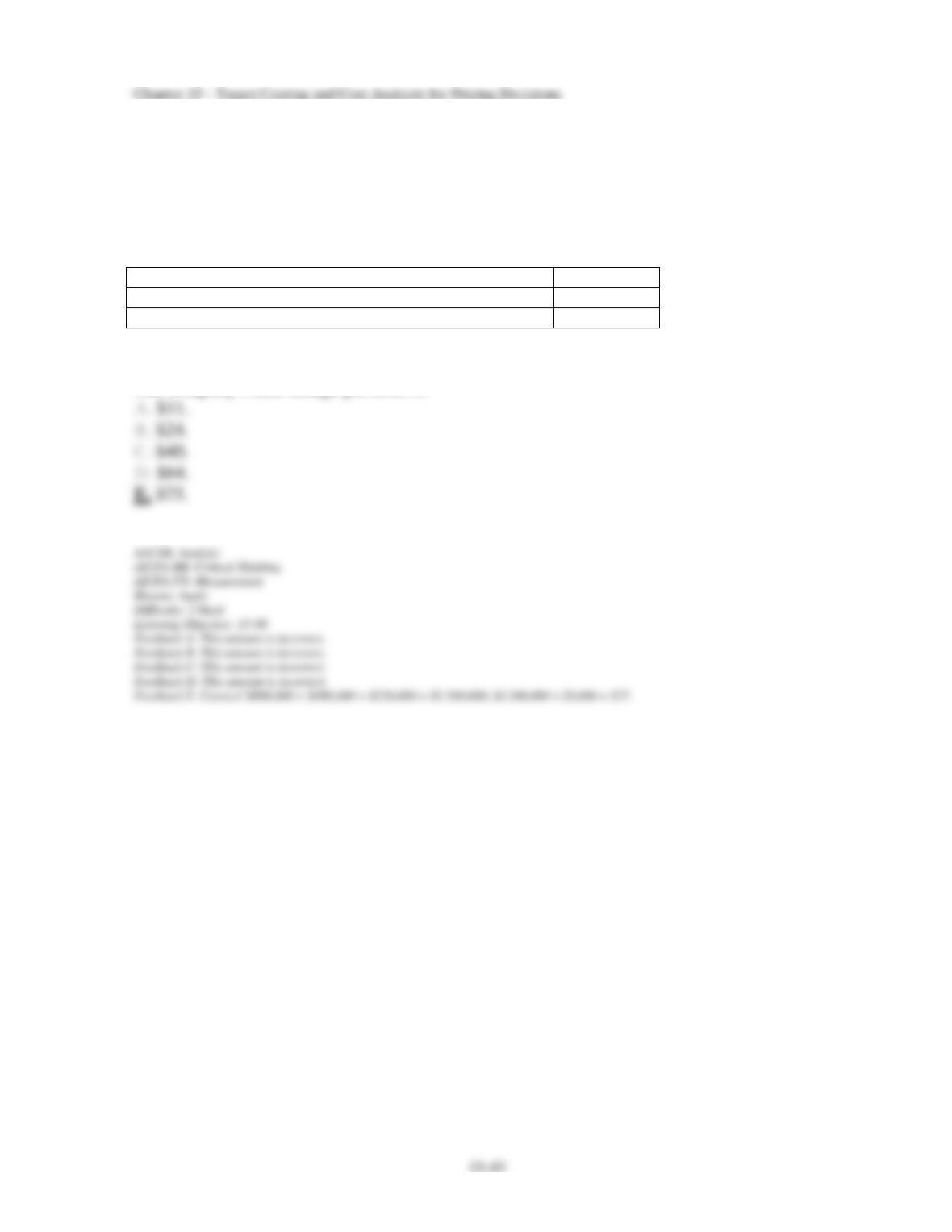
84. Inse Corporation uses time and material pricing. The repair department expects 20,000
direct labor hours of activity and has the following selected data:
Labor and fringe benefit costs
$800,000
Overhead Costs (excludes material handling and storage)
480,000
Target profit
220,000
The company’s time charge per hour is:
Chapter 15 – Target Costing and Cost Analysis for Pricing Decisions
Use the following information to answer Questions 85 – 87.
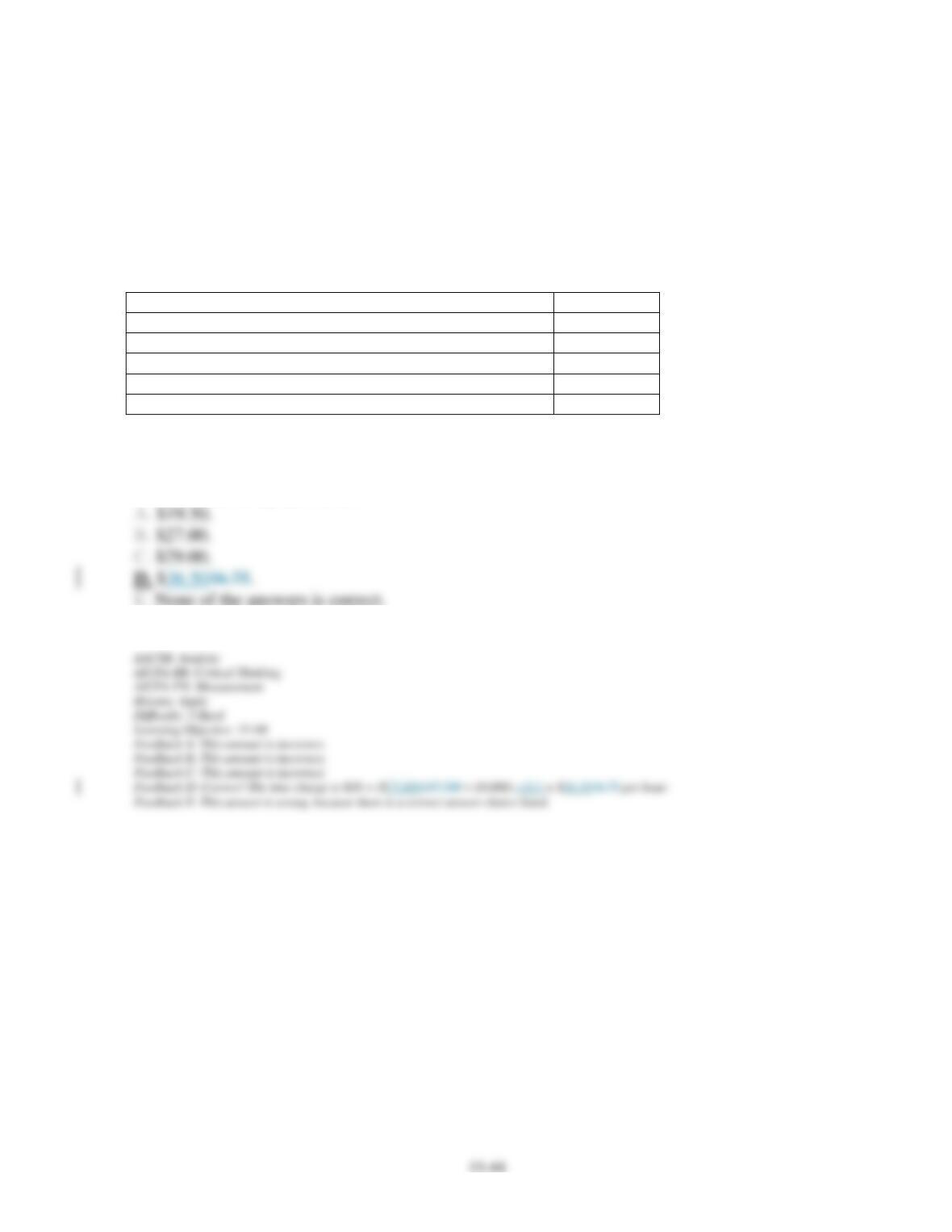
Ralph’s Auto Repair uses time and material pricing. The body shop, which anticipates 10,000
direct labor hours of activity, has the following data:
Annual overhead costs:
Material handling and storage
$15,000
Other overhead costs
75,000
Annual cost of materials used
187,500
Labor rate per hour, including fringe benefits
18
Hourly charge to achieve profit margin
11
85. The time charge per hour is:
86. Assuming there is no profit markup on material cost, the amount to be added to each
dollar of material cost to obtain the total material charge is:
87. If a particular job takes 20 hours of labor and $800 of materials, the price charged for the
job is:
88. Consider the following statements about competitive bidding:
I. The higher the price that a company bids, the greater the profit if the firm gets the contract.
II. Bidding a higher price increases the probability of obtaining a contract.
III. A company that bids low to ensure acceptance of a contract may actually wind up bidding
too low to make an acceptable profit.
Which of the above statements is (are) true?
89. If a company has excess capacity, which of the following is a sensible bidding strategy?
90. If a firm has no excess capacity, which of the following is a sensible bidding strategy?
91. Harlen Company is involved in a competitive bidding situation. The following costs are
anticipated for a project to be bid with the City of Crimson:
Direct material
$340,000
Direct labor
610,000
Allocated variable overhead
420,000
Allocated fixed cost
110,000
Which of the following cost figures should be used in setting a minimum bid price if Harlen
has excess capacity?
92. Gypsum Park Recreation is exploring a competitive bidding situation. The firm, which
currently has no excess capacity, estimates the following costs for a project to be performed
for the Talent School District:
Direct material
$220,000
Direct labor
130,000
Allocated variable overhead
91,000
Allocated fixed cost
40,000
Which of the following cost figures would be used in determining a minimum price if
Gypsum Park decides to bid on the Talent project?
93. Polson Pool Company is involved in a number of competitive bidding situations. The
following costs are anticipated for a project to be bid for Terrance Manufacturing:
Direct material
$680,000
Direct labor
2,450,000
Allocated variable overhead
570,000
Allocated fixed cost
230,000
Which of these costs would be treated differently if Polson had either excess capacity or no
excess capacity?
94. Emporia Shipping Company is involved in a competitive bidding situation. Variable costs
related to the project total $520,000, and allocated fixed cost is $95,000. Which of the
following cost figures should be used in setting a minimum bid price if Emporia has (1)
excess capacity and (2) no excess capacity?
Excess Capacity
No Excess Capacity
95. Consider the following statements about pricing and the law:
I. American antitrust laws restrict certain types of pricing behavior.
II. The term “price discrimination” involves charging different prices to different customers
for the same goods and services.
III. Charging different prices to different customers for the same goods is permissible if price
differences are based on cost differences of producing and/or selling the good.
96. Which of the following pricing practices is illegal?
Chapter 15 – Target Costing and Cost Analysis for Pricing Decisions
Essay Questions
97. The following data pertain to Arctic Company’s commercial snow thrower:
Variable manufacturing cost
$400
Applied fixed manufacturing cost
160
Variable selling and administrative cost
60
Allocated fixed selling and administrative cost
25
Required:
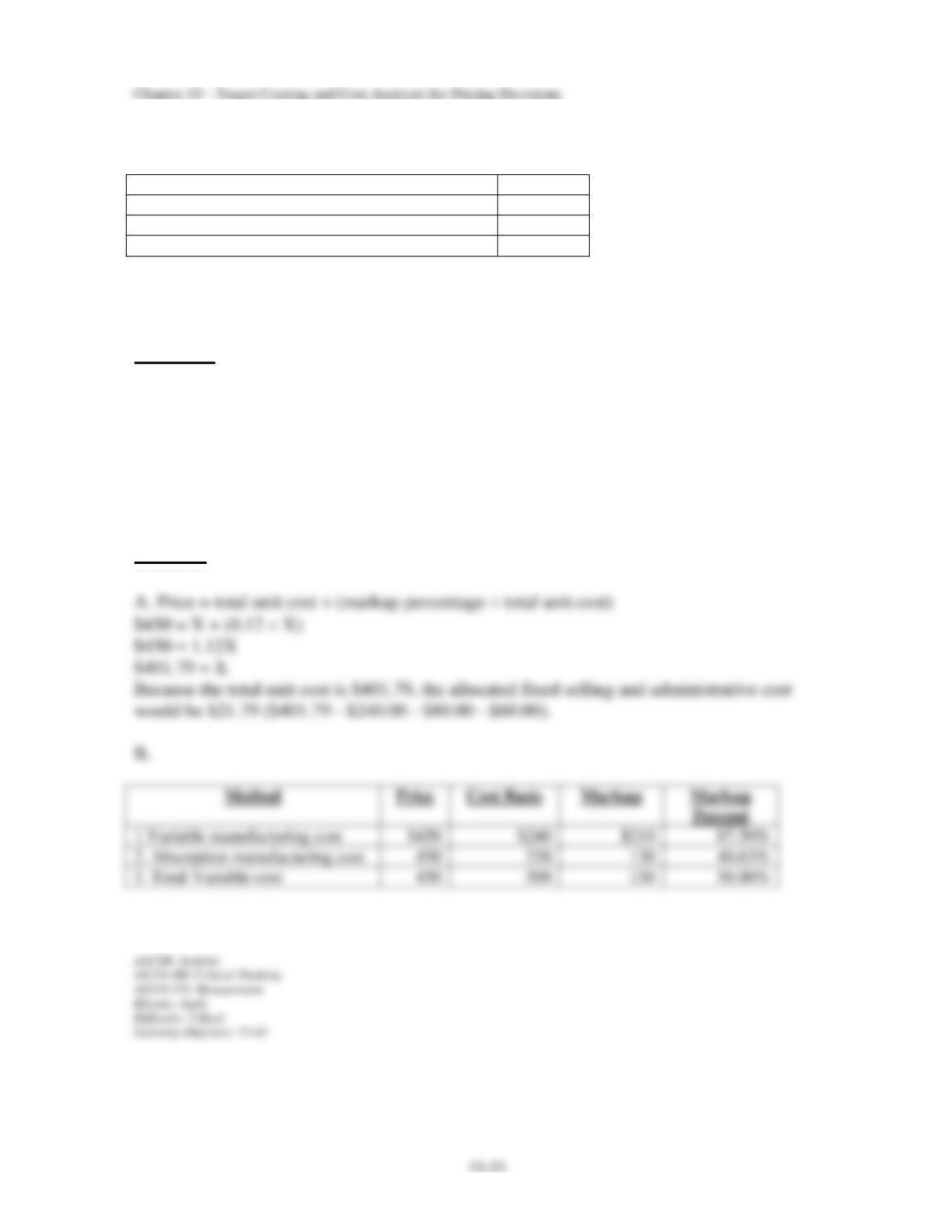
For each of the following cost bases, determine the appropriate percentage markup that will
result in a price of $980 for the snow thrower. (Round percentages to nearest one-hundredth
of a percent.)
A. Variable manufacturing cost.
B. Absorption manufacturing cost.
C. Total cost.
D. Total variable cost.
Solution:
Variable manufacturing cost per unit
Markup ($400 x 145%)
Price
Absorption manufacturing cost ($400 + $160)
Markup ($560 x 75%)
Price
Total cost ($400 + $160 + $60 + $25)
Markup ($645 x 51.94%)
Price
Total variable cost ($400 + $60)
Markup ($460 X 113.04%)
Price
98. The following data pertain to Tannebaum Corporation’s residential humidifier:
Variable manufacturing cost
$240
Applied fixed manufacturing cost
80
Variable selling and administrative cost
60
Allocated fixed selling and administrative cost
?
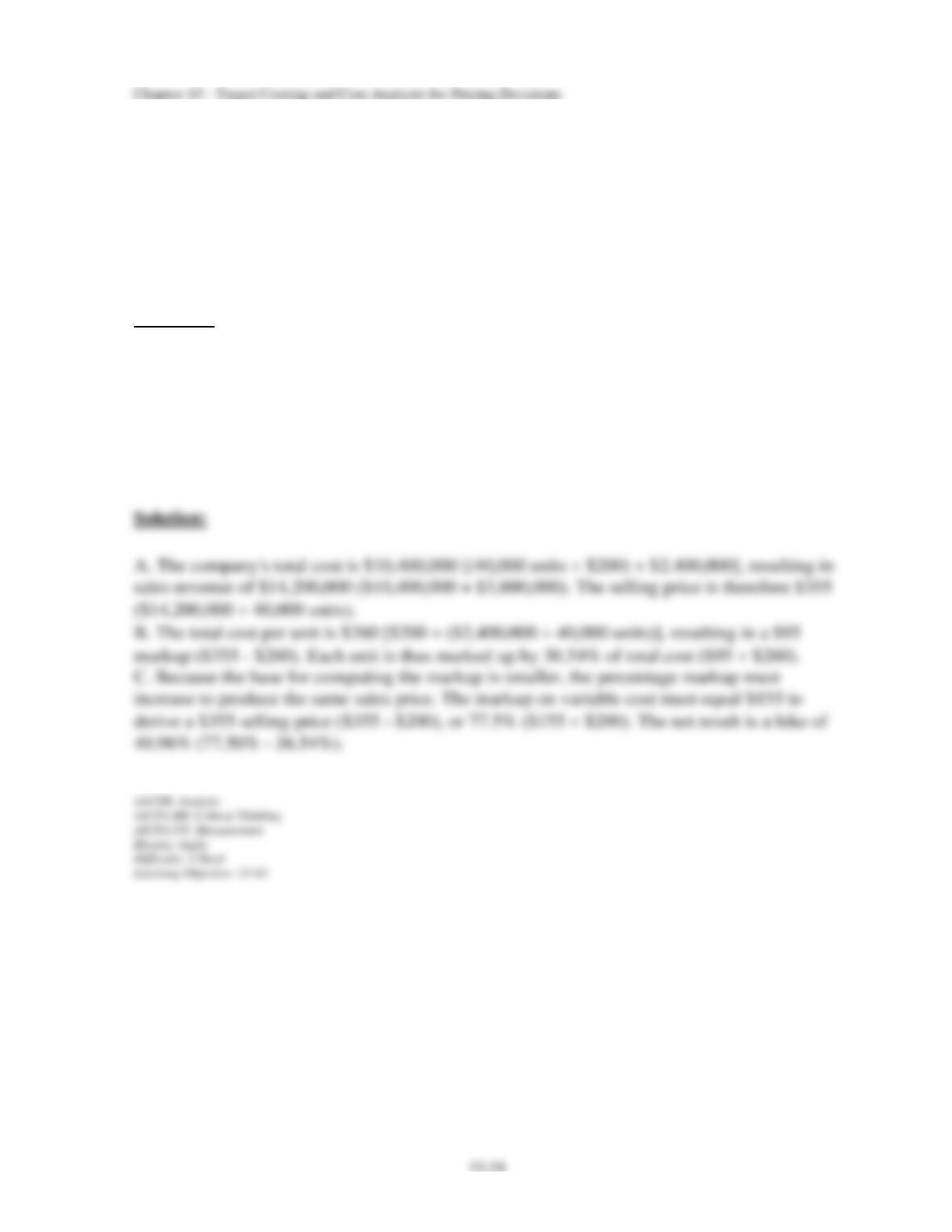
To achieve a target price of $450 per humidifier, the markup percentage on total unit cost is
12%.
Required:
A. Calculate the fixed selling and administrative cost allocated to each humidifier.
B. For each of the following bases, determine the appropriate percentage markup on cost that
will result in a target price of $450 per humidifier: (1) variable manufacturing cost, (2)
absorption manufacturing cost, and (3) total variable cost. (Round percentages to the nearest
one-hundredth of a percent.)
Solution:
1.Variable manufacturing cost
2. Absorption manufacturing cost
3. Total Variable cost
300
99. Alpine, Inc. sells a single product. The following information relates to the year just
ended:
Number of units sold: 40,000
Variable cost per unit: $200
Total fixed cost: $2,400,000
Operating income: $3,800,000
Required:
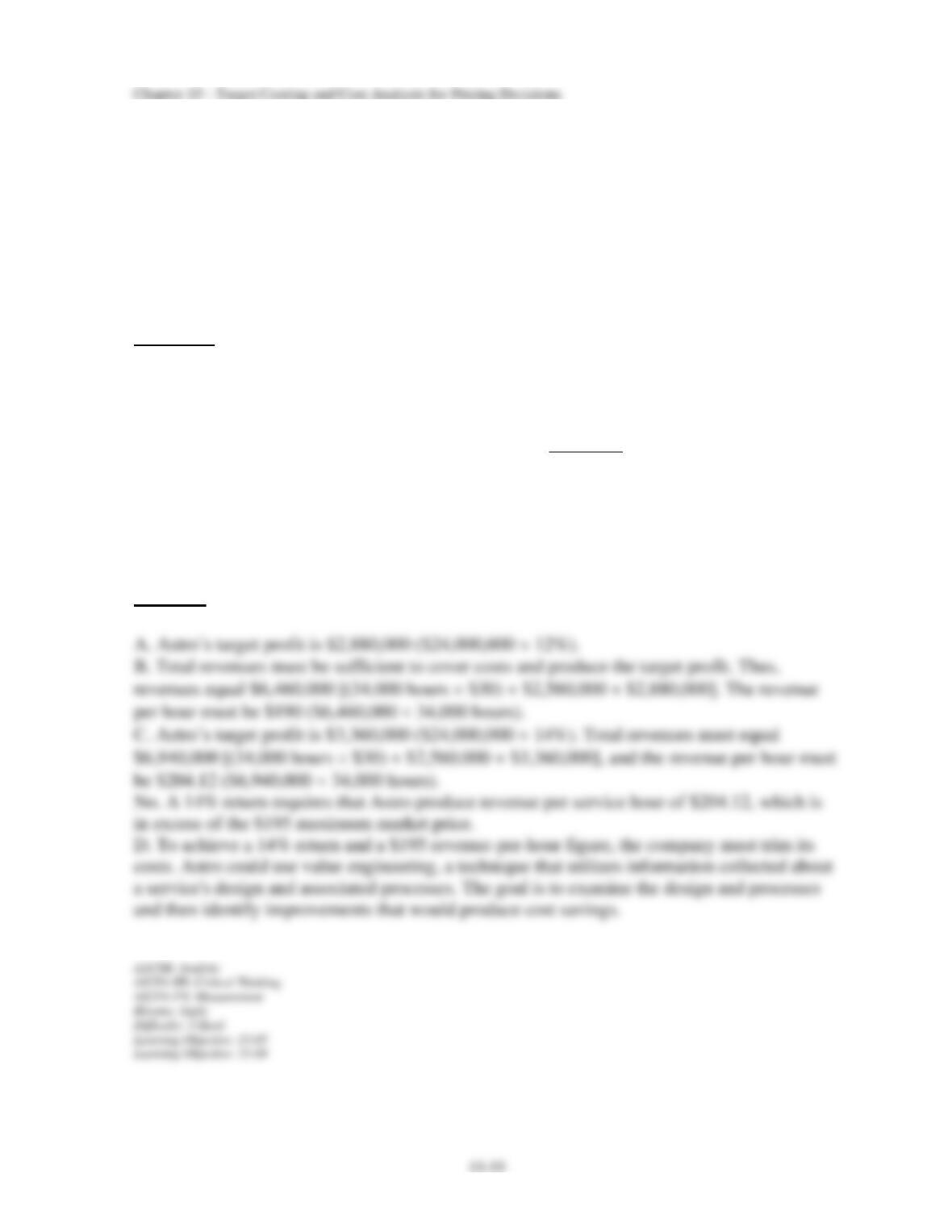
A. Compute the company’s selling price.
B. Compute the percentage markup on total cost. Round your answer to two decimal places.
C. Assume that Alpine desired to change its practice of computing a markup on total cost to a
markup on variable cost. If the company wants to hold selling price constant, would the
markup percentage increase or decrease? By how much?
100. Astro, Inc. uses target costing and will soon enter a very competitive marketplace in
which it will have limited influence over the prices that are charged. Management and
consultants are working to fine-tune the company’s sole service, which hopefully will
generate a 12% return (profit) on the firm’s $24,000,000 asset investment. The following
information is available:
Hours of service to be provided: 34,000
Anticipated variable cost per service hour: $30
Anticipated fixed cost: $2,560,000 per year
Required:
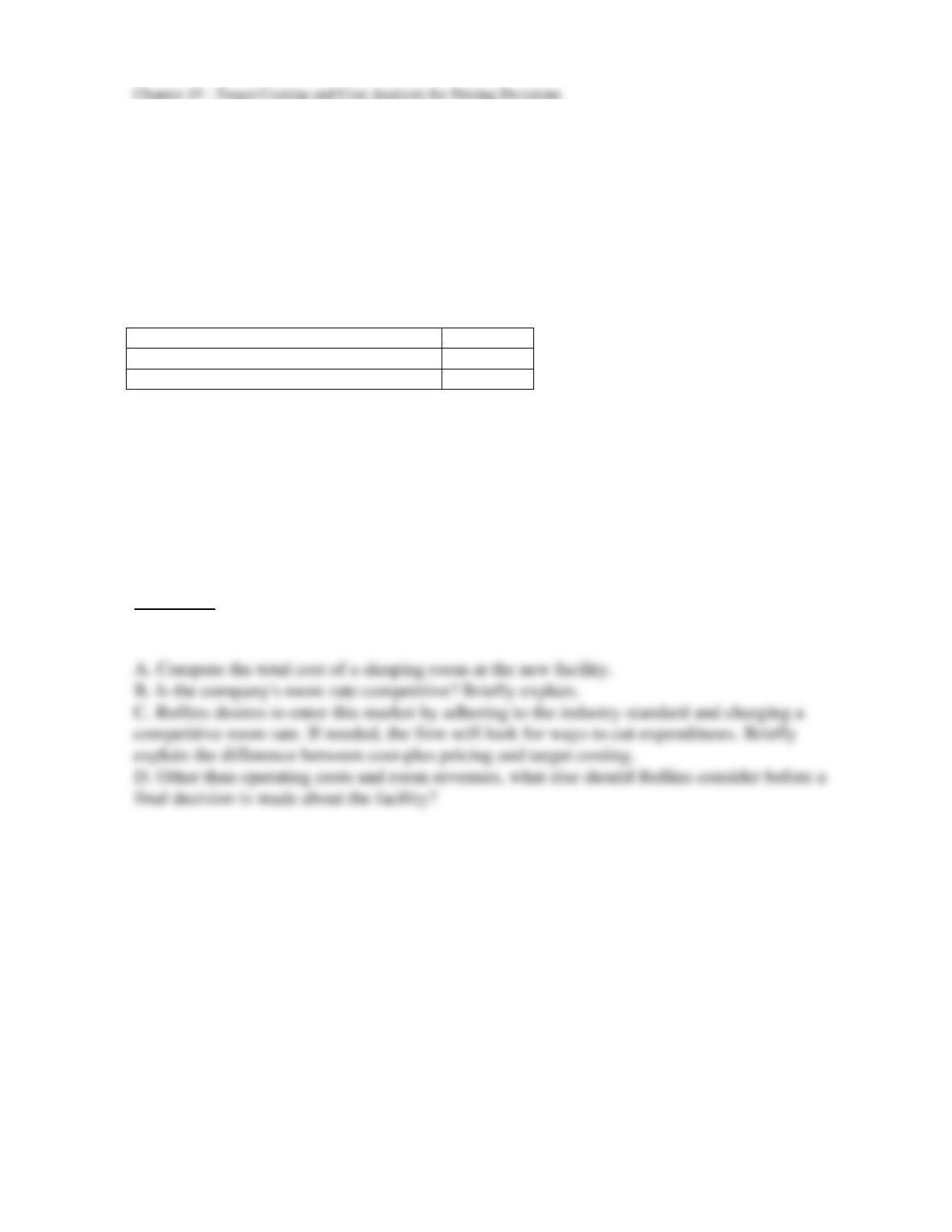
A. How much profit must Astro produce to achieve a 12% return?
B. Calculate the revenue per hour that Astro must generate to achieve a 12% return.
C. Assume that prior to entering the marketplace, management conducted a planning exercise
to determine whether a 14% return could be attained in year no. 2. Can the company achieve
this return if (a) competitive pressures dictate a maximum selling price of $195 per hour and
(b) service hours, variable cost per service hour, and fixed costs are the same as the amounts
anticipated in year no. 1? Show calculations.
D. If your answer to part “C” is “no,” suggest and briefly describe a procedure that Astro
might use to achieve desired results.
Solution:
15–56
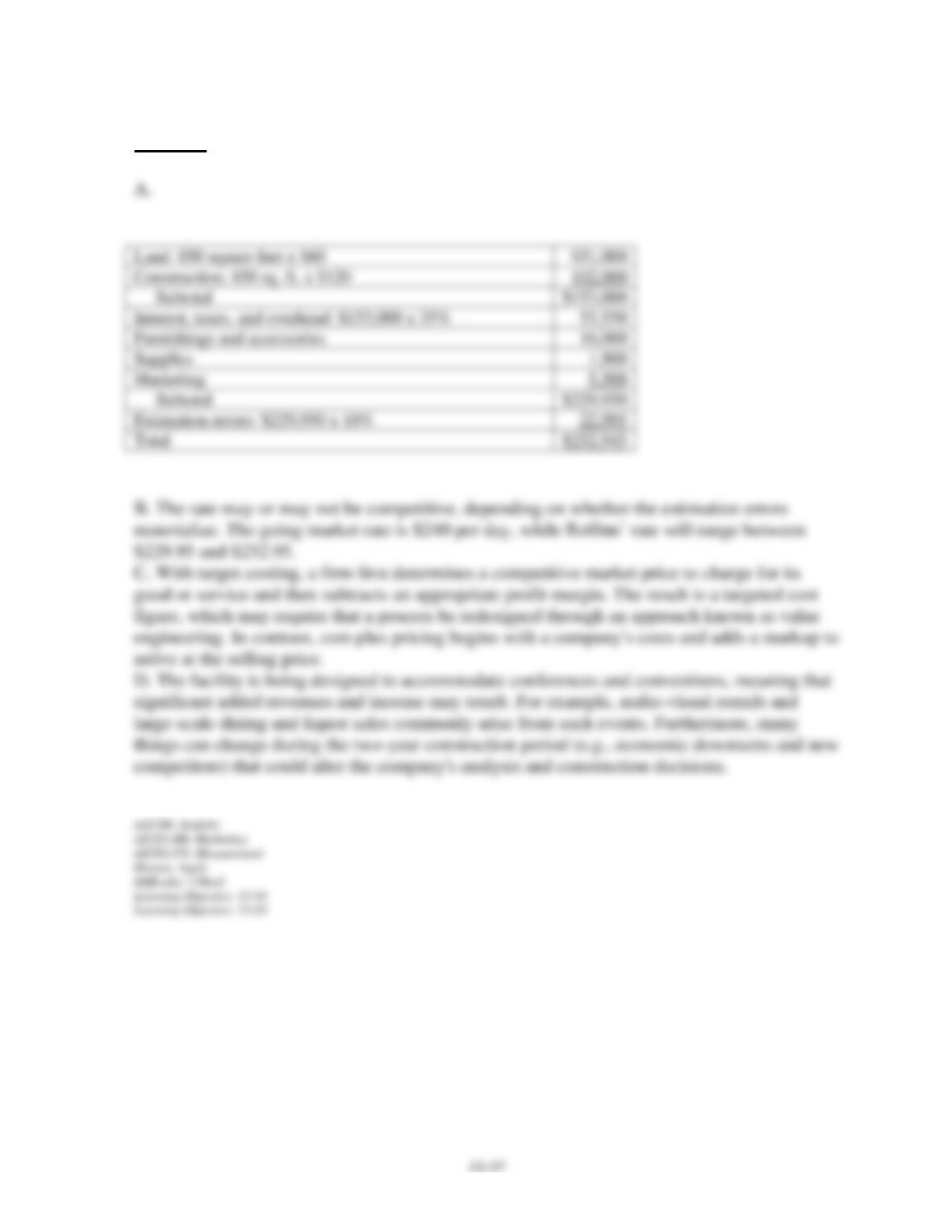
101. Rollins and Associates develops hotels in resort locations. The company is exploring the
construction of a new facility that would have significant meeting and banquet space for
conventions and conferences, and sleeping rooms that average 850 square feet. The
accounting department estimates that land and building costs will amount to $60 and $120 per
square foot of floor area, respectively. Other expenditures during construction for interest, real
estate taxes, and general overhead are expected to total 35% of land and construction cost.
Once basic construction is completed, Rollins anticipates per-room initial expenditures for:
Sleeping room furnishings and accessories
$16,000
Supplies
1,900
Marketing
5,500
The accounting department suggests that 10% be added to the total of all preceding costs to
allow for estimation errors. Construction is anticipated to take two years.
Rollins’ pricing policy is consistent with that of industry leaders, namely, to set a room rate
equal to .1% (.001) of cost. Upon completion, comparable facilities are expected to charge
$240 per day.
Required:
Chapter 15 – Target Costing and Cost Analysis for Pricing Decisions
Solution:
102. Trailrider Corporation manufactures part no. 67, which is used in the production of
mountain bikes. Per-unit information about part no. 67 follows.
Prevailing market price
$33
Direct materials
14
Direct labor
6
Manufacturing overhead
7
Selling and administrative expenses
3
Trailrider has traditionally used a 20% markup on total cost to arrive at a reasonable selling
price. The company, though, has noticed a sizable drop in sales volume during the last few
quarters, which it attributes to new entrants in the marketplace.
Required:
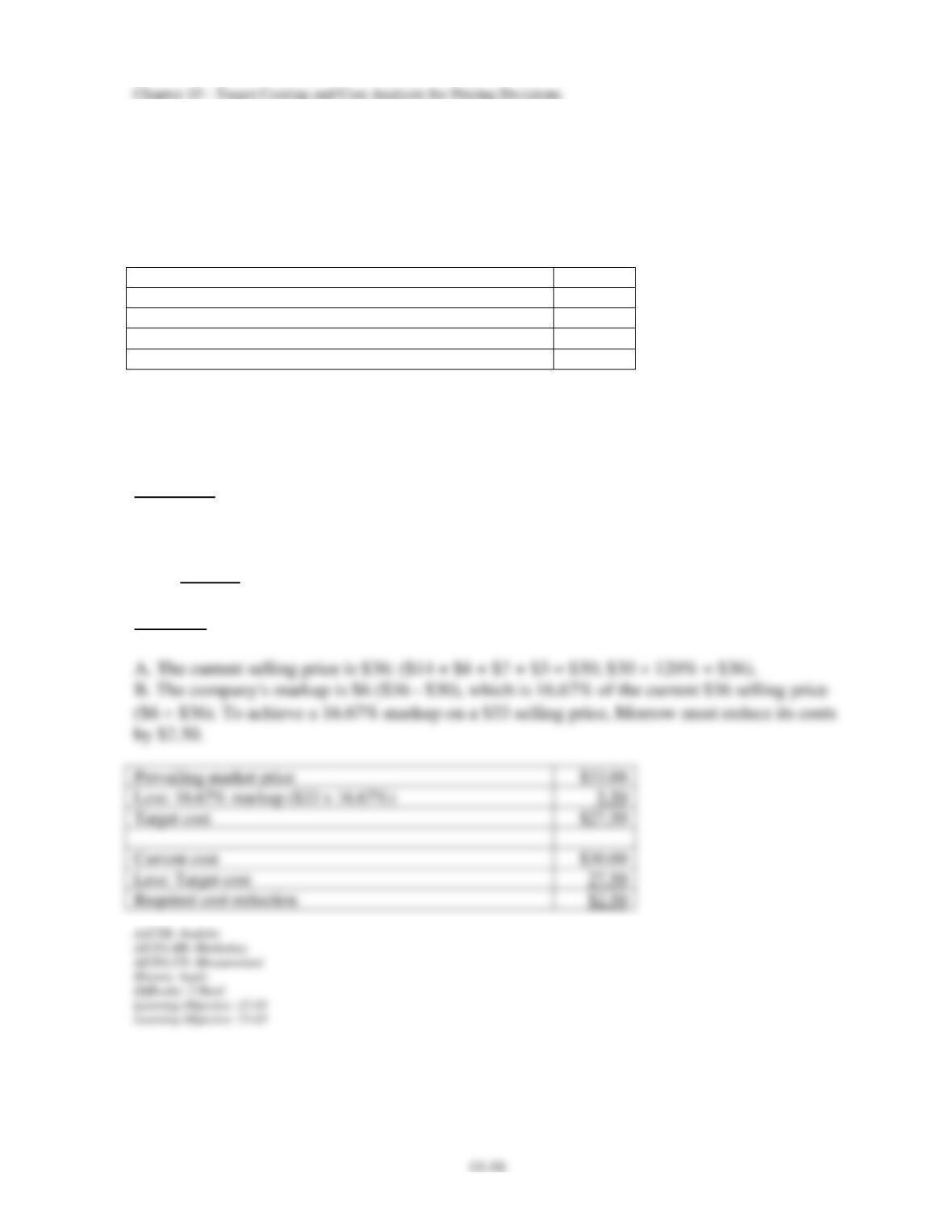
A. Compute the current selling price of part no. 67.
B. If management desired to meet the prevailing market price and maintain the current rate of
profit on sales, what must happen to the company’s total manufacturing costs? By how much?
Solution:
Prevailing market price
Less: 16.67% markup ($33 x 16.67%)
Target cost
Current cost
Less: Target cost
Required cost reduction
103. For many years, Oxmoor Corporation has used a straightforward cost-plus pricing
system, marking its goods up approximately 20% of total cost. The company has been
profitable; however, it has recently lost considerable business to foreign competitors that have
become very aggressive in the marketplace. These firms appear to be using target costing.
An example of Oxmoor’s woes is typified by item no. 710, which has the following unit-cost
characteristics: direct materials, $50; direct labor, $90; manufacturing overhead, $40; and
selling and administrative expenses, $20. The going market price for an identical product of
identical quality is $210, which is below what Oxmoor is charging.
Required:
A. Contrast cost-plus pricing and target costing.
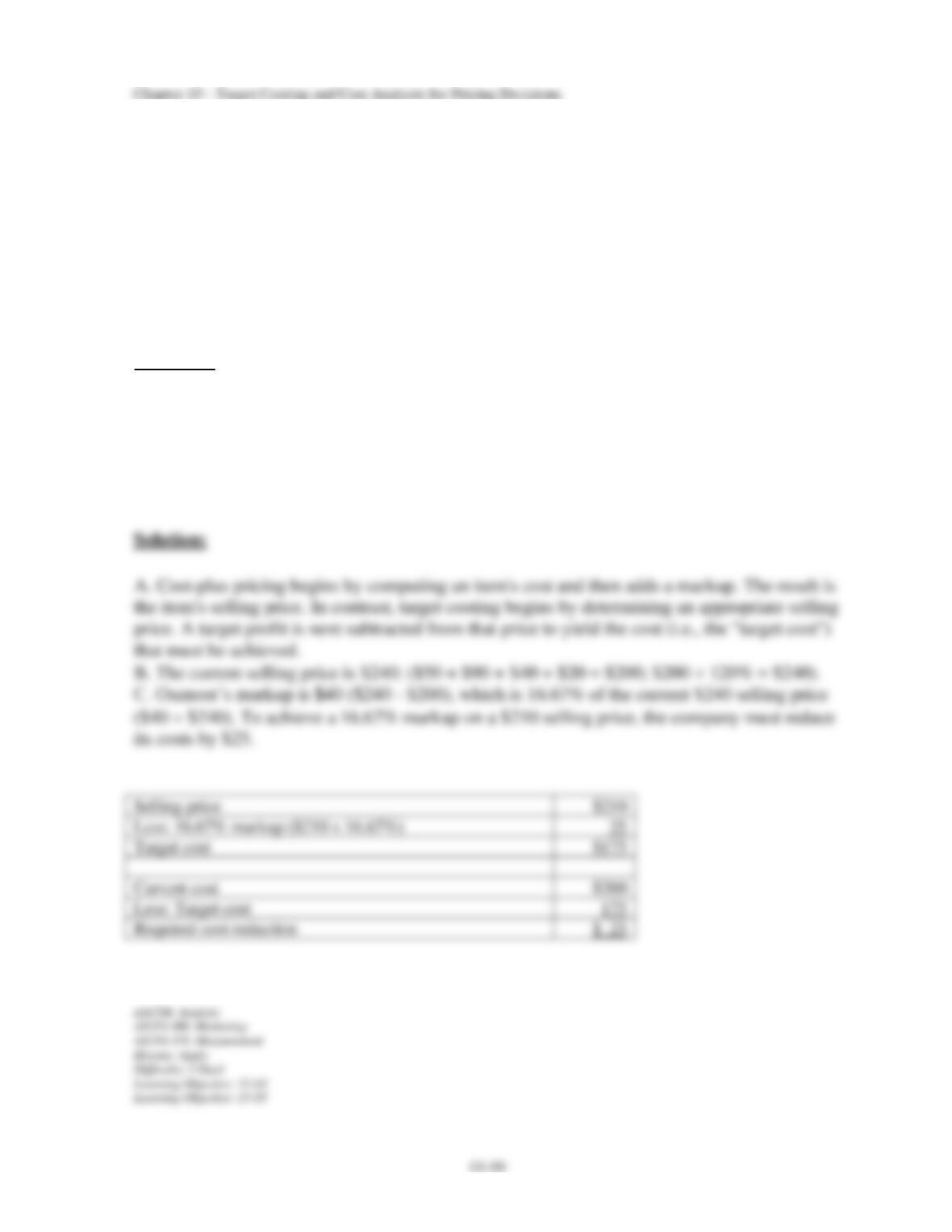
B. What is Oxmoor’s current selling price for item no. 710?
C. If Oxmoor used target costing for item no. 710, what must happen to costs if the company
desired to meet market prices and maintain its current rate of profit on sales? By how much?