61. A company has two divisions, A and B, each operated as a profit center. Division A
charges Division B $35 per unit (for each unit transferred to Division B). Other data for Division A
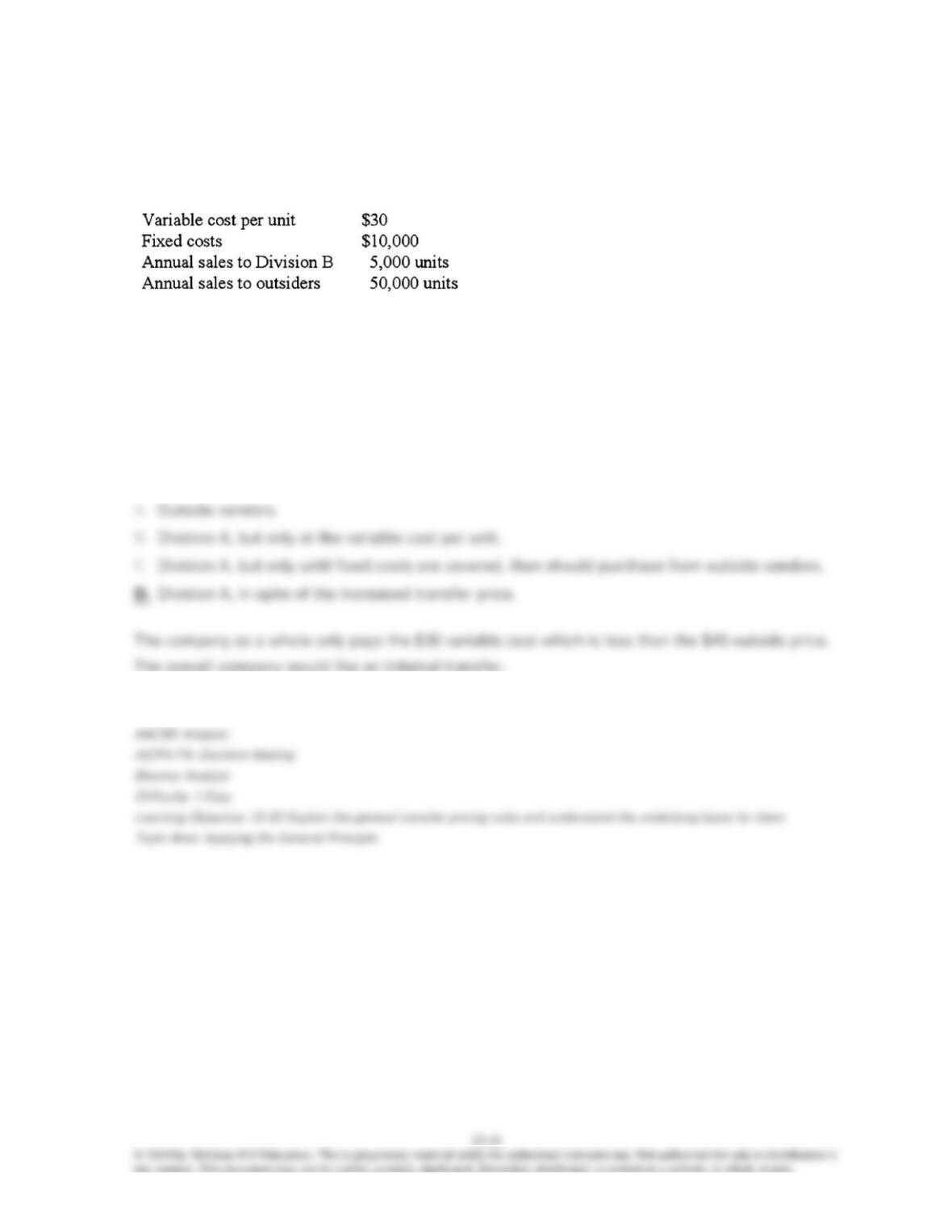
are as follows:
Division A is planning to raise its transfer price to $50 per unit. Division B can purchase units at
$40 per unit from outsiders, but doing so would idle Division A’s facilities (now committed to
producing units for Division B), Division A cannot increase its sales to outsiders. From the
perspective of the company as a whole, from who should Division B acquire the units, assuming
Division B’s market is unaffected?
62. Cohasset Company currently manufactures all component parts used in the manufacture
of various hand tools. Hurley Division produces a steel handle used in three different tools. The
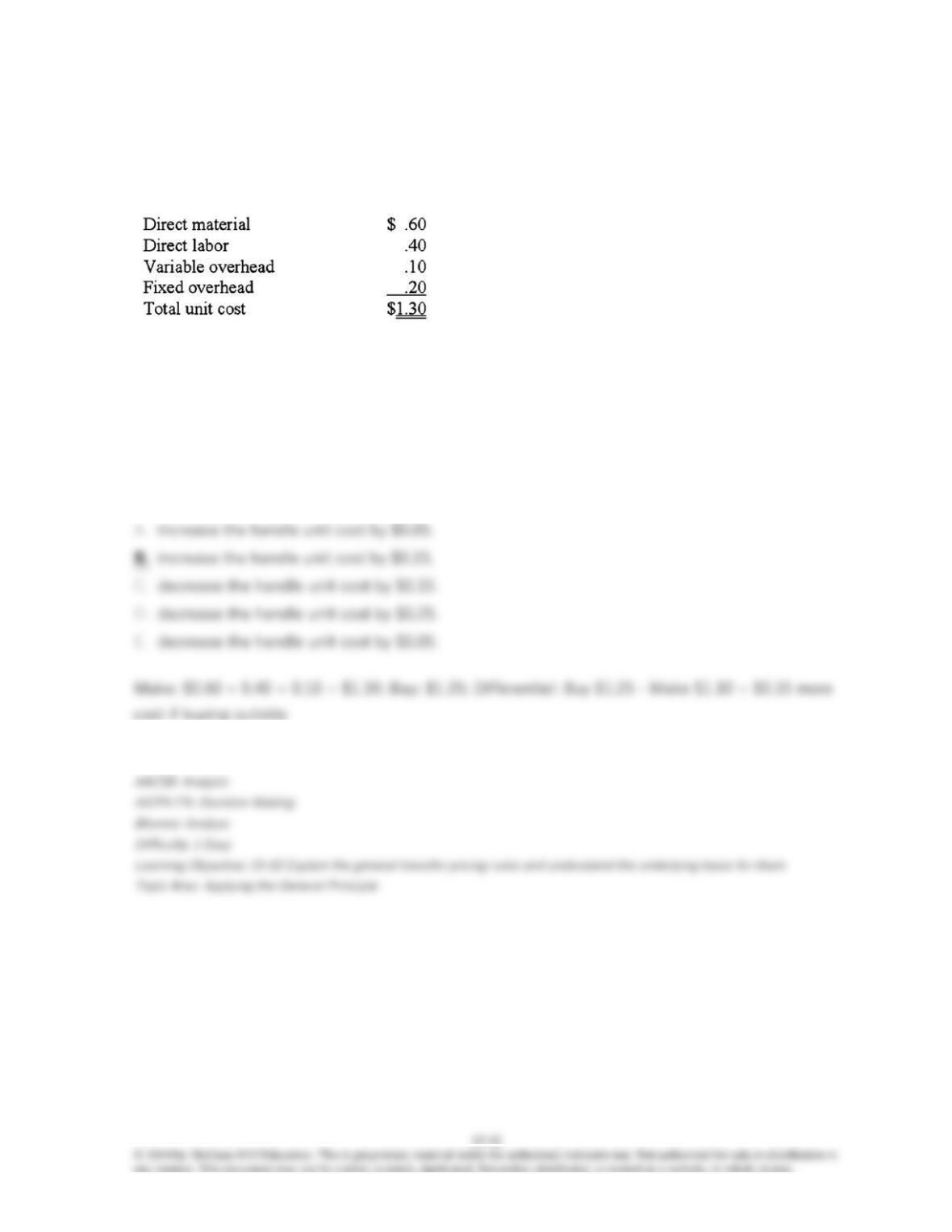
budget for these handles is 120,000 units with the following unit cost.
Ironwood Division purchases 20,000 handles from Hurley Division and completes the hand tools.
An outside supplier, R & M Steel, has offered to supply 20,000 units of the handle to Ironwood
Division for $1.25 per unit. Hurley currently has idle capacity that cannot be used.
What is the cost impact to Cohasset as a whole of purchasing from R & M Steel? (CMA adapted)
63. Cohasset Company currently manufactures all component parts used in the manufacture
of various hand tools. Hurley Division produces a steel handle used in three different tools. The
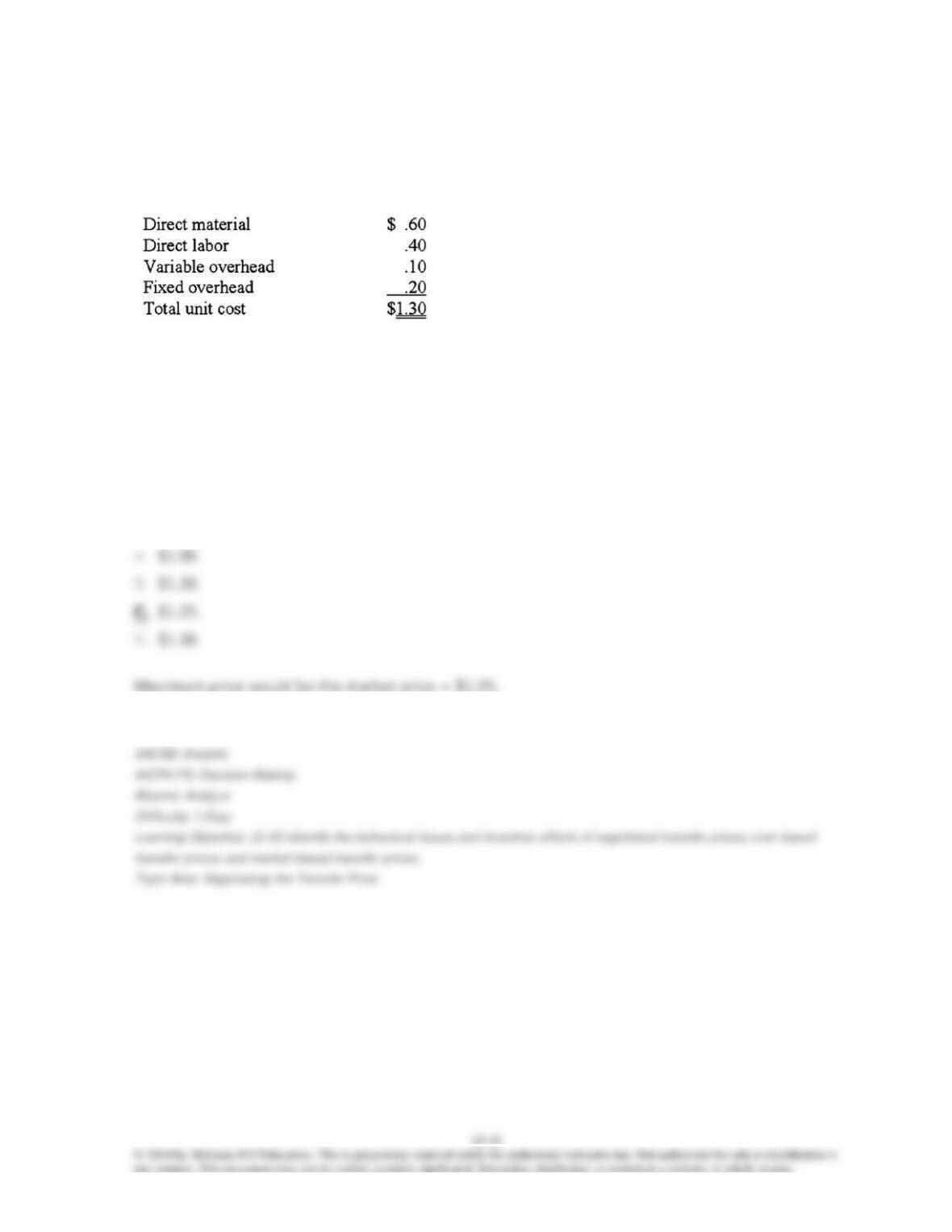
budget for these handles is 120,000 units with the following unit cost.
Ironwood Division purchases 20,000 handles from Hurley Division and completes the hand tools.
An outside supplier, R & M Steel, has offered to supply 20,000 units of the handle to Ironwood
Division for $1.25 per unit. Hurley currently has idle capacity that cannot be used.
If Cohasset would like to develop a range of transfer prices, what would be the maximum transfer
price that Ironwood would be willing to pay?
64. Cohasset Company currently manufactures all component parts used in the manufacture
of various hand tools. Hurley Division produces a steel handle used in three different tools. The
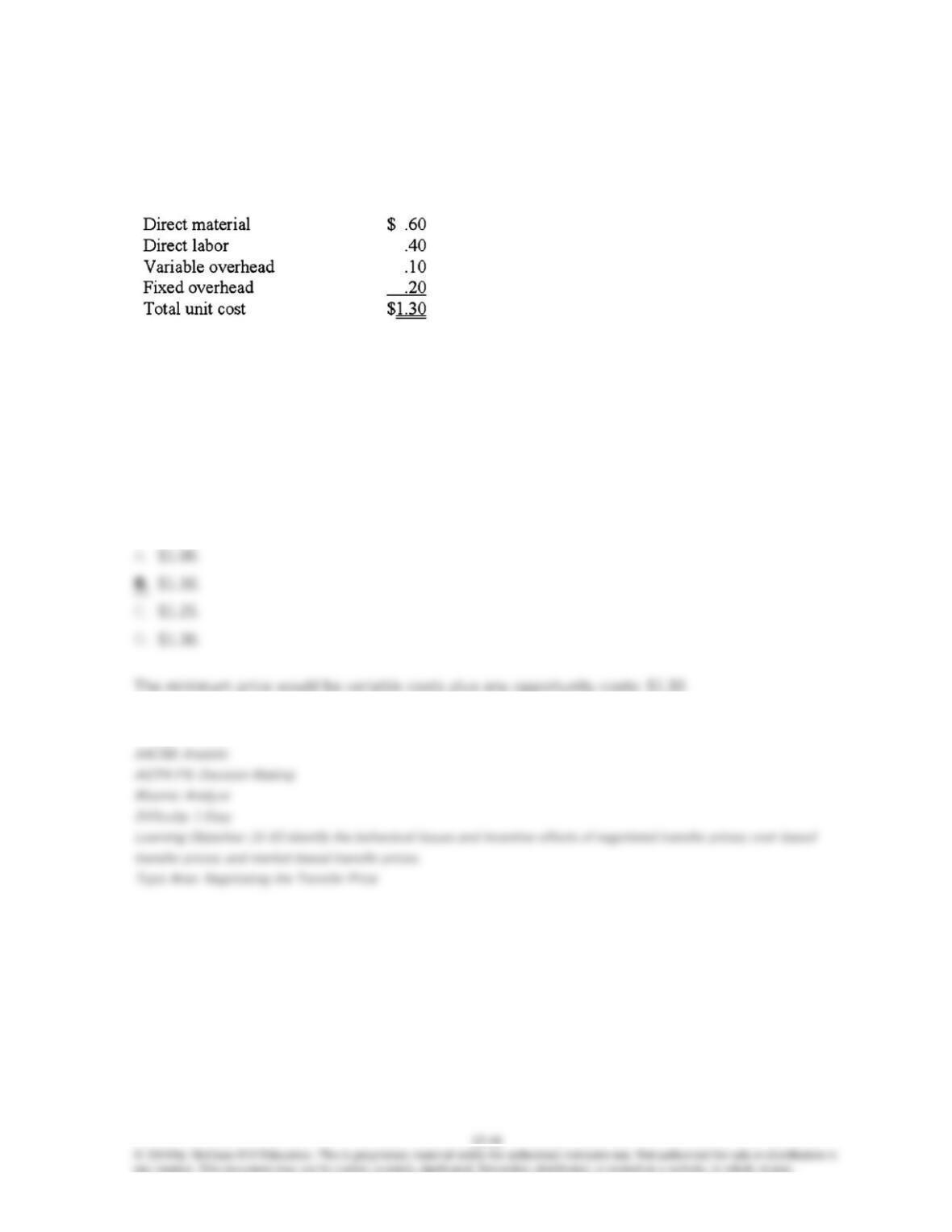
budget for these handles is 120,000 units with the following unit cost.
Ironwood Division purchases 20,000 handles from Hurley Division and completes the hand tools.
An outside supplier, R & M Steel, has offered to supply 20,000 units of the handle to Ironwood
Division for $1.25 per unit. Hurley currently has idle capacity that cannot be used.
If Cohasset would like to develop a range of transfer prices, what would be the minimum transfer
price that Hurley would be willing to accept?
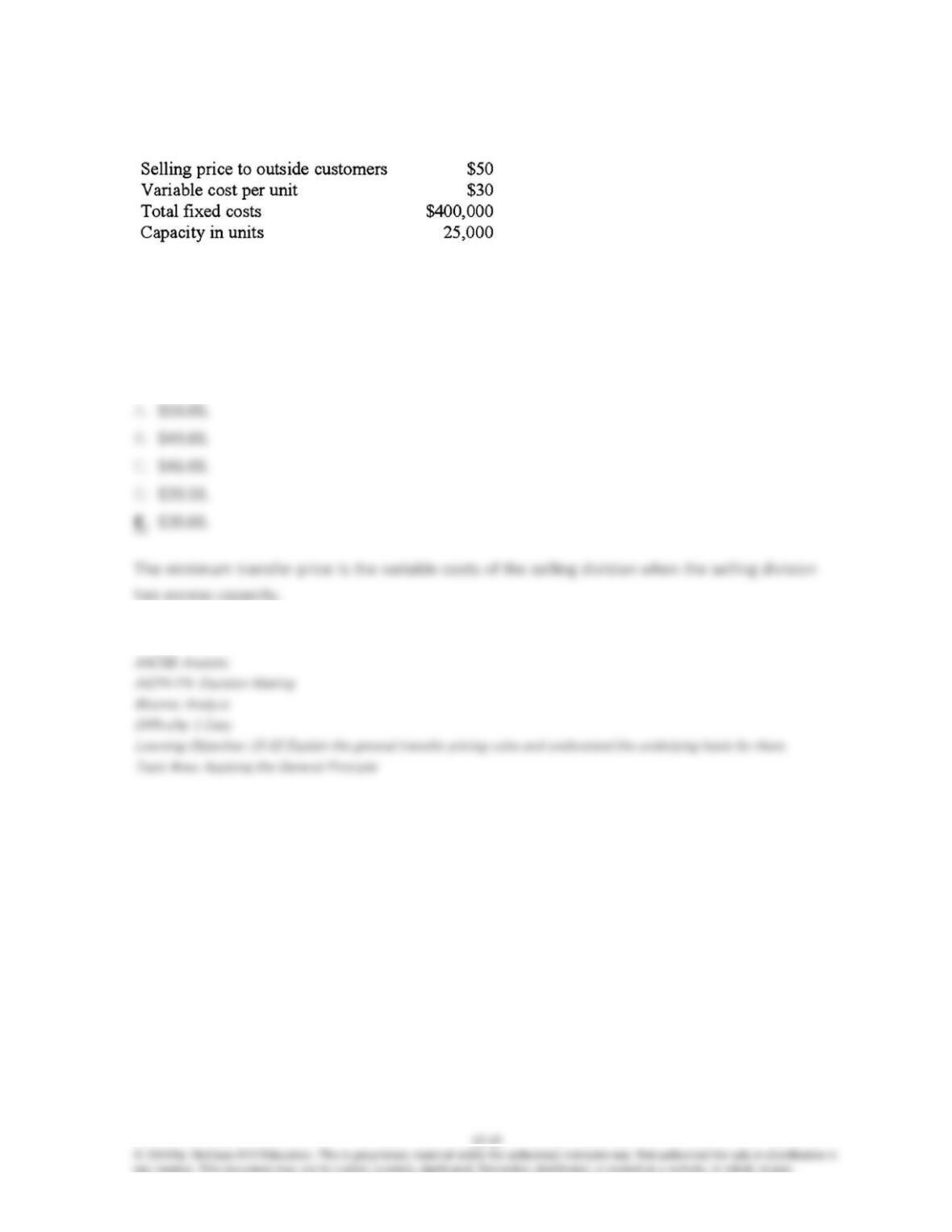
65. Given the following information for Division K:
Division L would like to purchase internally from Division K. Division L now purchases 5,000 units
each period from outside suppliers at $49 per unit. Division K has ample excess capacity to
handle all of Division L’s needs. What is the lowest price that Division K could accept?
66. A limitation of transfer prices based on actual cost is that they: (CIA adapted)
67. A large manufacturing company has several autonomous divisions that sell their products
in perfectly competitive external markets as well as internally to the other divisions of the
company. Top management expects each of its divisional managers to take actions that will
maximize the organization’s goal as well as their own goals. Top management also promotes a
sustained level of management effort of all of its divisional managers. Under these circumstances,
for products exchanged between divisions, the transfer price that will generally lead to optimal
decisions for the manufacturing company would be a transfer price equal to the: (CIA adapted)
68. The Eastern division sells goods internally to the Western division of the same company.
The quoted external price in industry publications from a supplier near Eastern is $200 per ton
plus transportation. It costs $20 per ton to transport the goods to Western. Eastern’s actual
market cost per ton to buy the direct materials to make the transferred product is $100. Actual
per-ton direct labor is $50. Other actual costs of storage and handling are $40. The company
president selects a $220 transfer price. This is an example of: (CIA adapted)
69. Which of the following is the most significant disadvantage of a cost-based transfer price?
(CIA adapted)
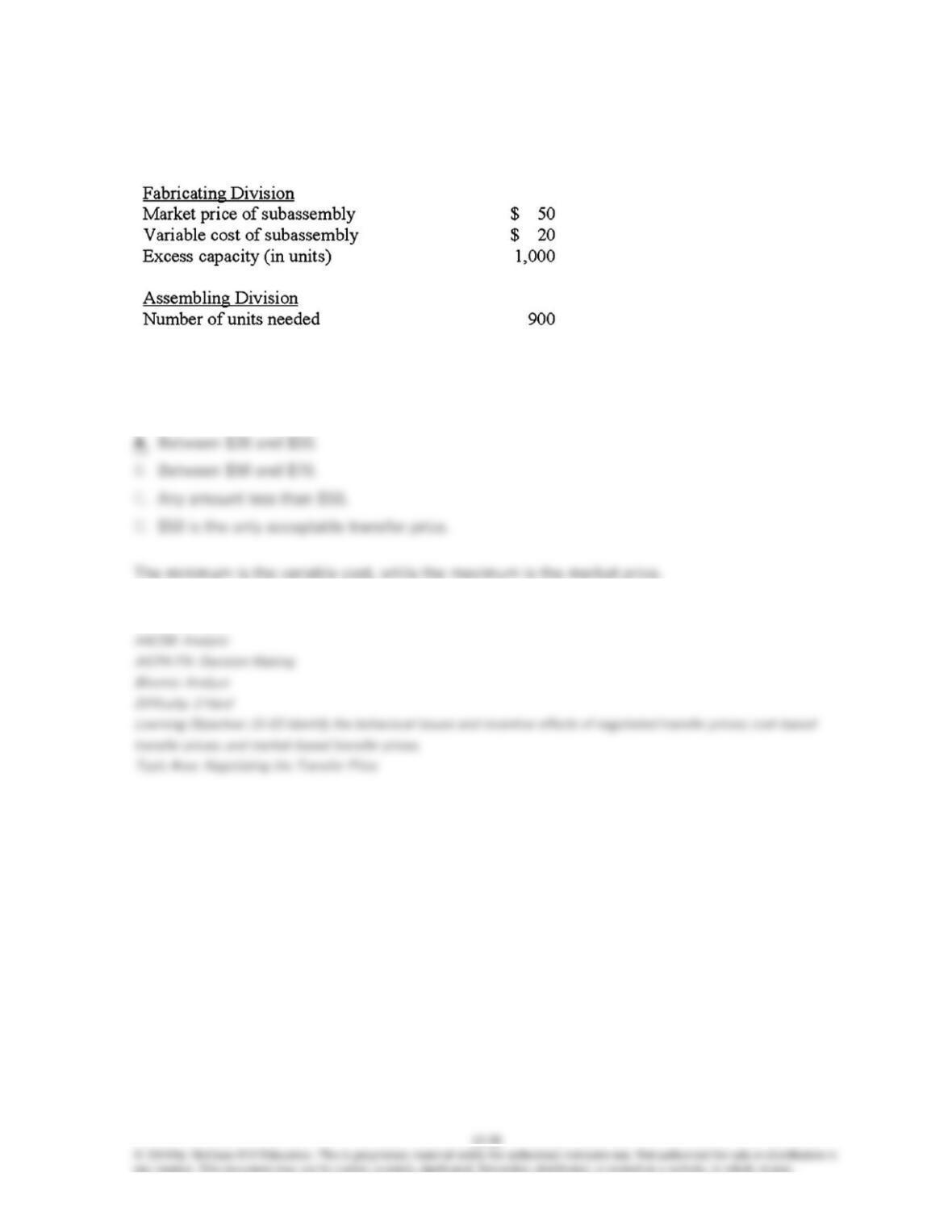
70. An appropriate transfer price between two divisions of The Stark Company can be
determined from the following data: (CIA adapted)
What is the natural bargaining range for the two divisions?
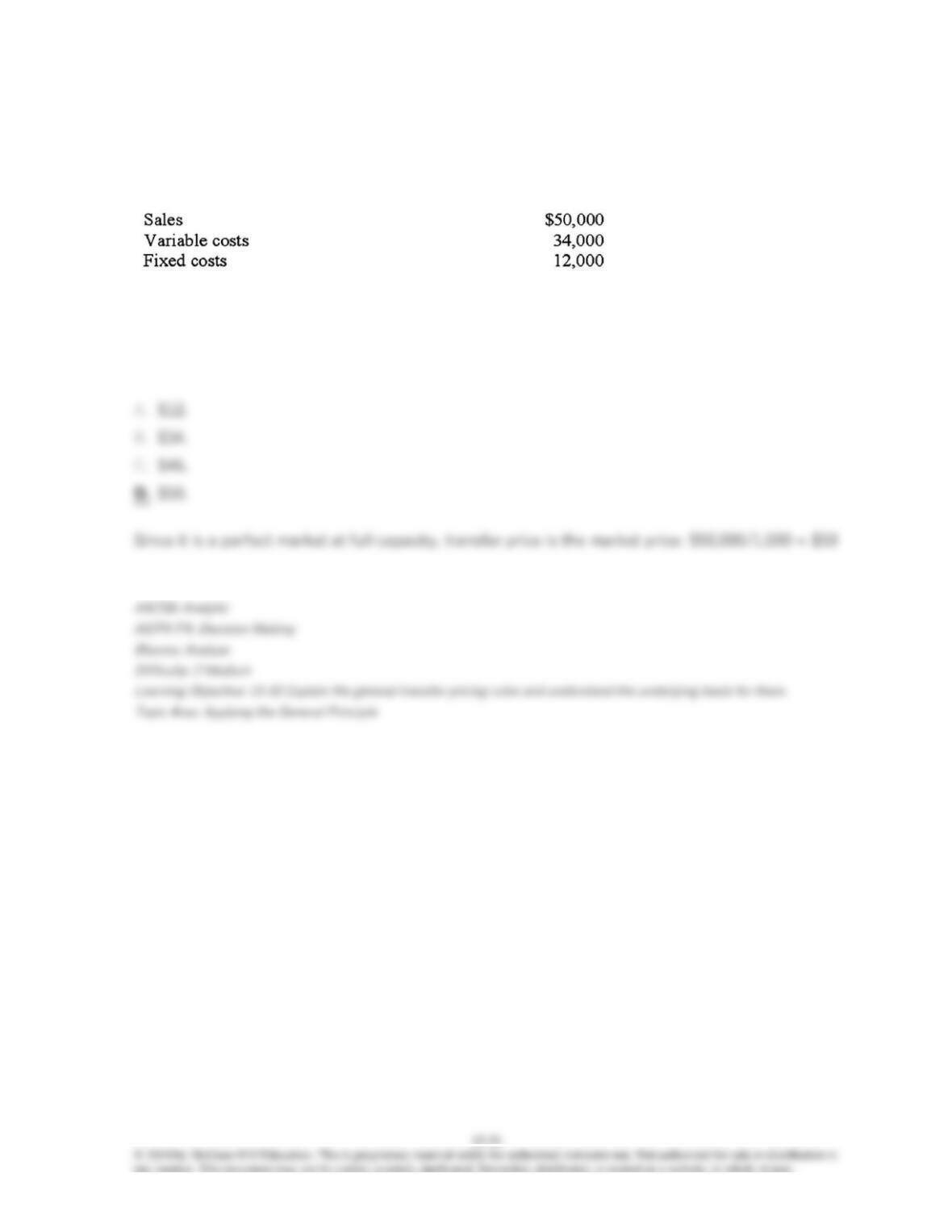
71. The Alpha Division of a company, which is operating at capacity, produces and sells 1,000
units of a certain electronic component in a perfectly competitive market. Revenue and cost data
are as follows: (CIA adapted)
The minimum transfer price that should be charged to the Beta Division of the same company for
each component is:
72. Parkside Inc. has several divisions that operate as decentralized profit centers. Parkside’s
Entertainment Division manufactures video arcade equipment using the products of two of
Parkside’s other divisions. The Plastics Division manufactures plastic components, one type that
is made exclusively for the Entertainment Division, while other less complex components are sold
to outside markets. The products of the Video Cards Division are sold in a competitive market;
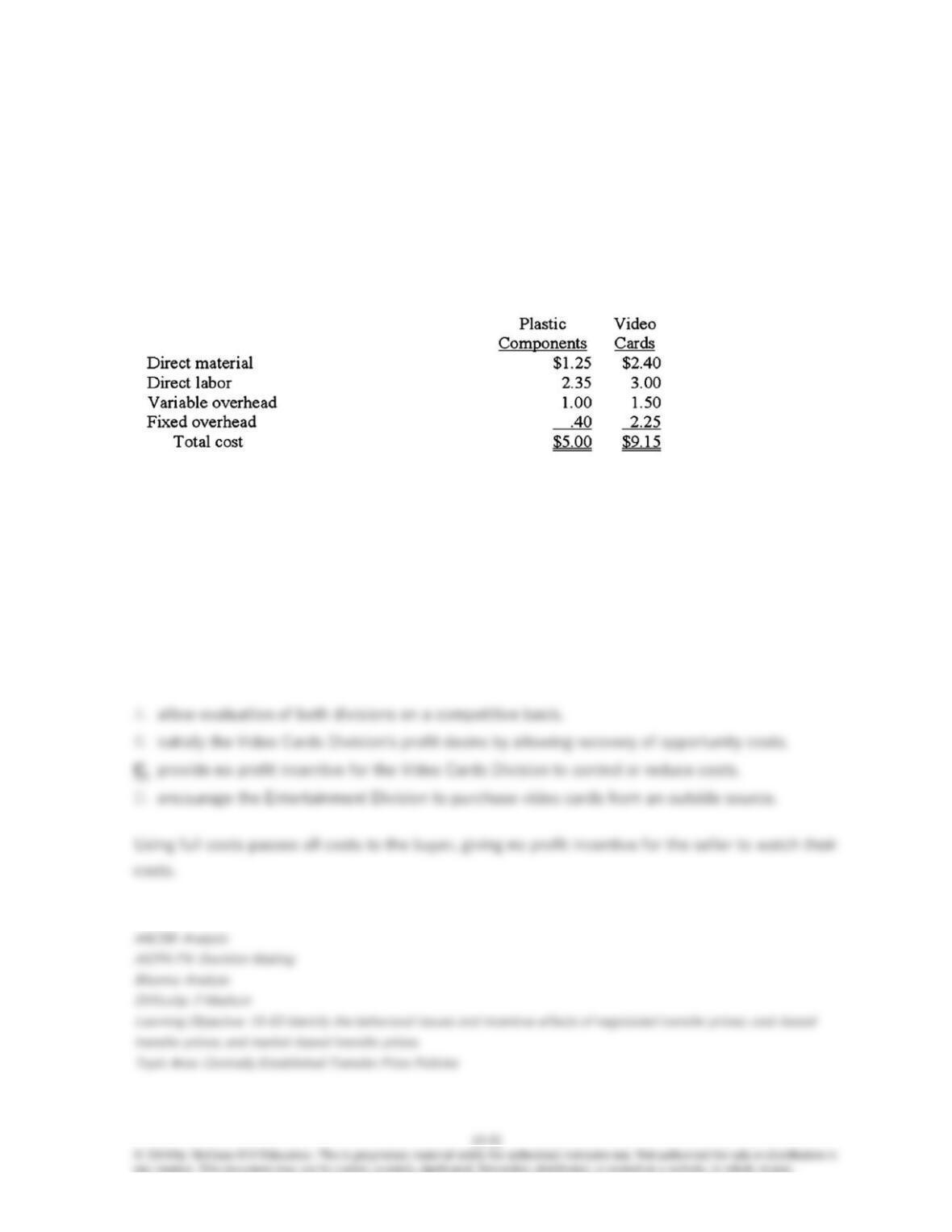
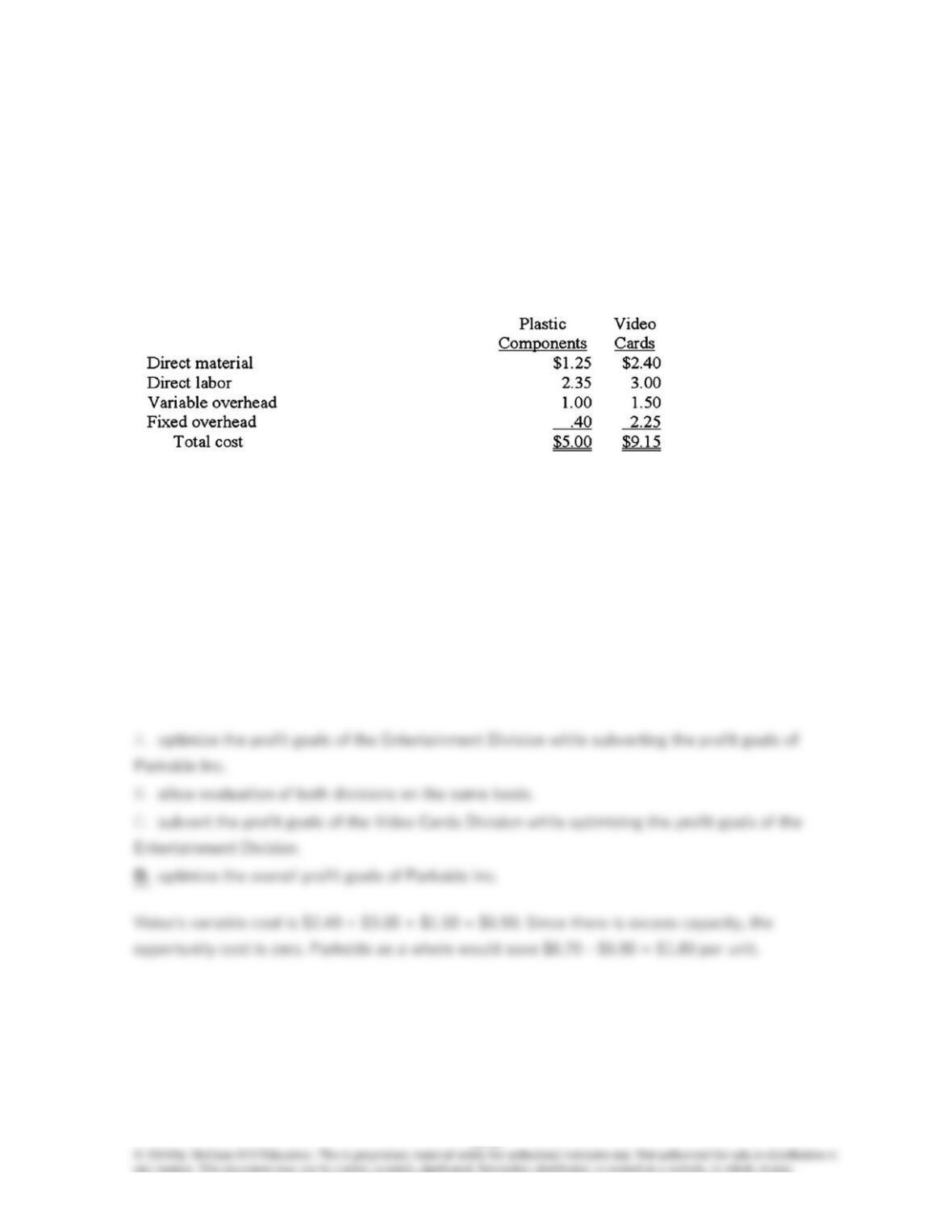
however, one video card model is also used by the Entertainment Division. The actual costs per
unit used by the Entertainment Division follow: (CMA adapted)
The Plastics Division sells its commercial products at full cost plus a 25% markup and believes
the proprietary plastic component made for the Entertainment Division would sell for $6.25 per
unit on the open market. The market price of the video card used by the Entertainment Division is
$10.98 per unit.
A per-unit transfer price from the Video Cards Division to the Entertainment Division at full cost,
$9.15, would:
15–53
73. Parkside Inc. has several divisions that operate as decentralized profit centers. Parkside’s
Entertainment Division manufactures video arcade equipment using the products of two of
Parkside’s other divisions. The Plastics Division manufactures plastic components, one type that
is made exclusively for the Entertainment Division, while other less complex components are sold
to outside markets. The products of the Video Cards Division are sold in a competitive market;
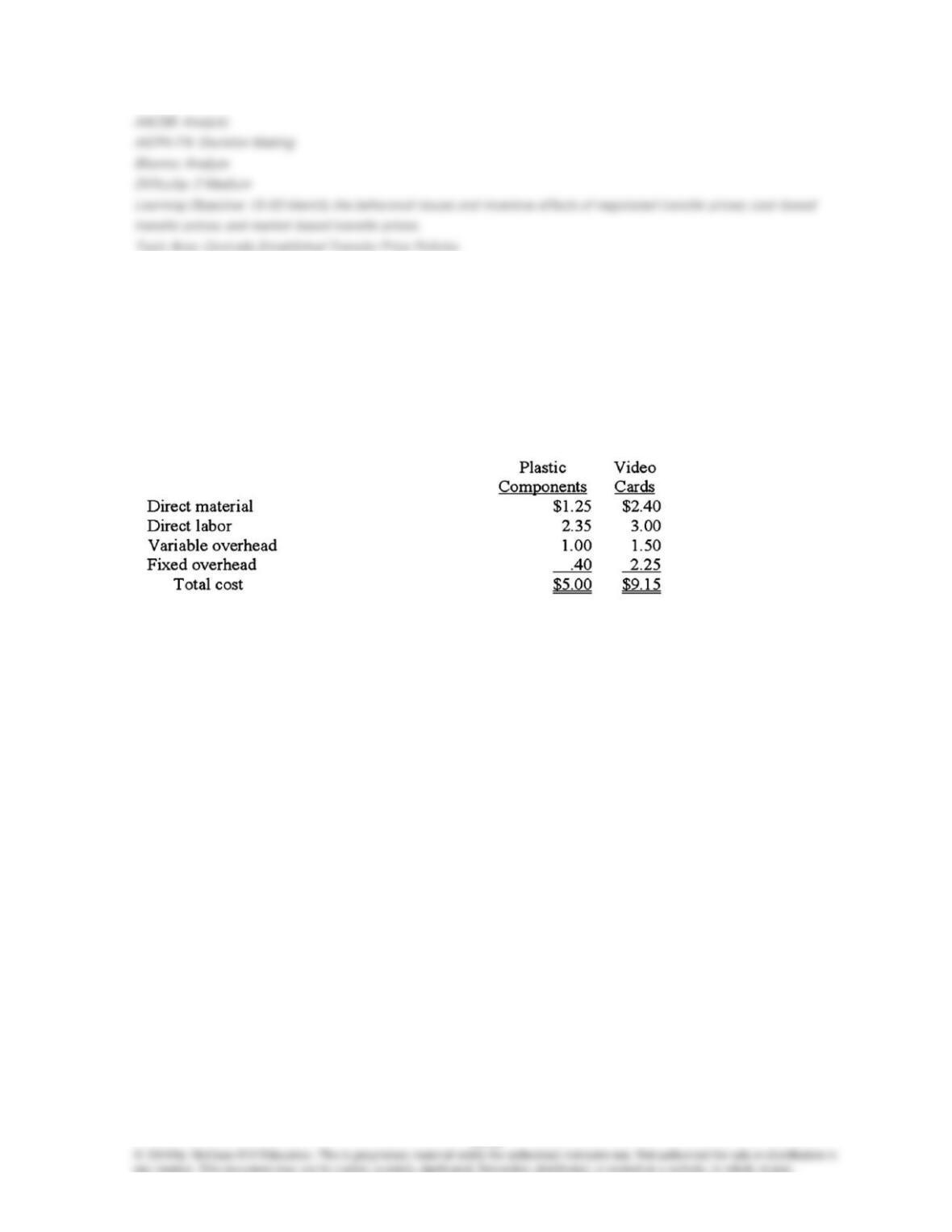
however, one video card model is also used by the Entertainment Division. The actual costs per
unit used by the Entertainment Division follow: (CMA adapted)
The Plastics Division sells its commercial products at full cost plus a 25% markup and believes
the proprietary plastic component made for the Entertainment Division would sell for $6.25 per
unit on the open market. The market price of the video card used by the Entertainment Division is
$10.98 per unit.
Assume that the Entertainment Division is able to purchase a large quantity of video cards from
an outside source at $8.70 per unit. The Video Cards Division, having excess capacity, agrees to
lower its transfer price to $8.70 per unit. This action would:
15–54
74. Parkside Inc. has several divisions that operate as decentralized profit centers. Parkside’s
Entertainment Division manufactures video arcade equipment using the products of two of
Parkside’s other divisions. The Plastics Division manufactures plastic components, one type that
is made exclusively for the Entertainment Division, while other less complex components are sold
to outside markets. The products of the Video Cards Division are sold in a competitive market;
however, one video card model is also used by the Entertainment Division. The actual costs per
unit used by the Entertainment Division follow: (CMA adapted)
The Plastics Division sells its commercial products at full cost plus a 25% markup and believes
the proprietary plastic component made for the Entertainment Division would sell for $6.25 per
unit on the open market. The market price of the video card used by the Entertainment Division is
$10.98 per unit.
Assume that the Plastics Division has excess capacity and it has negotiated a transfer price of
$5.60 per plastic component with the Entertainment Division. This price will:
75. A division can sell externally for $60 per unit. Its variable manufacturing costs are $35 per
unit, and its variable marketing costs are $12 per unit. What is the opportunity cost of transferring
internally, assuming the division is operating at capacity?
76. A division can sell externally for $60 per unit. Its variable manufacturing costs are $35 per
unit, and its variable marketing costs are $12 per unit. What is the optimal transfer price for
transferring internally, assuming the division is operating at capacity?
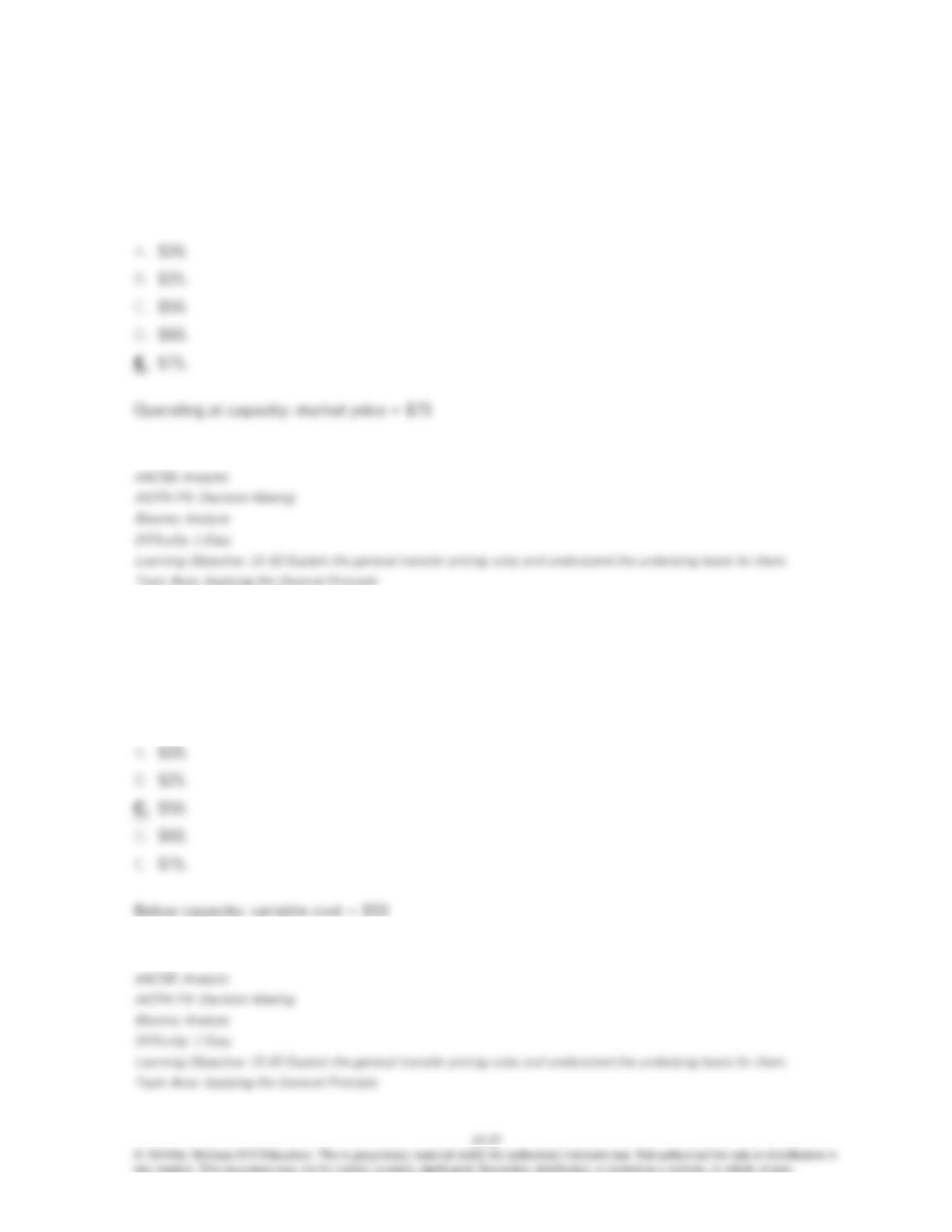
77. Division A has variable manufacturing costs of $50 per unit and fixed costs of $10 per unit.
Assuming that Division A is operating at capacity, what is the opportunity cost of an internal
transfer when the market price is $75?
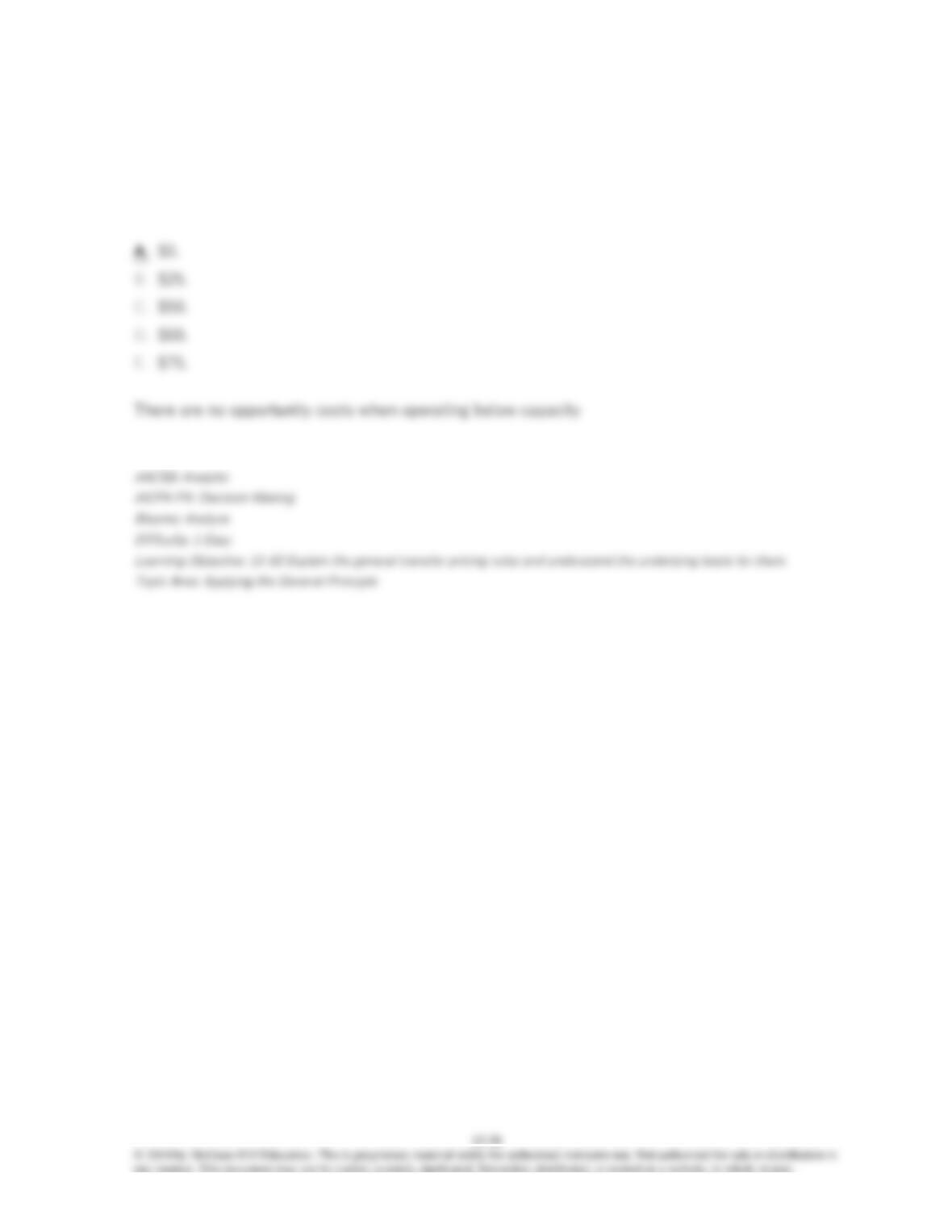
78. Division A has variable manufacturing costs of $50 per unit and fixed costs of $10 per unit.
Assuming that Division A is operating at capacity, what is the optimal transfer price of an internal
transfer when the market price is $75?
79. Division A has variable manufacturing costs of $50 per unit and fixed costs of $10 per unit.
Assuming that Division A is operating significantly below capacity, what is the optimal transfer
price of an internal transfer when the market price is $75?
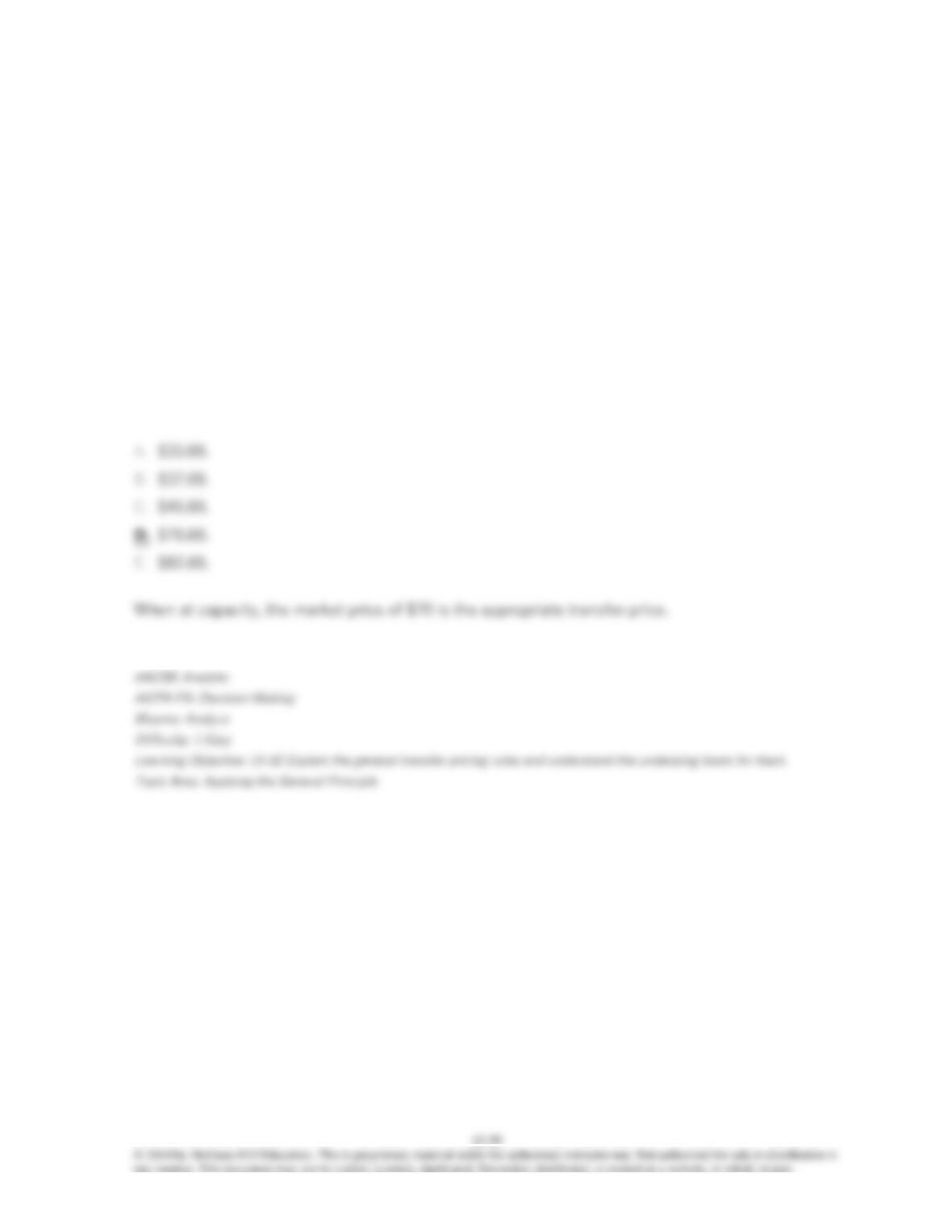
80. Division B has variable manufacturing costs of $50 per unit and fixed costs of $10 per unit.
Assuming that Division B is operating significantly below capacity, what is the opportunity cost of
an internal transfer when the market price is $75?
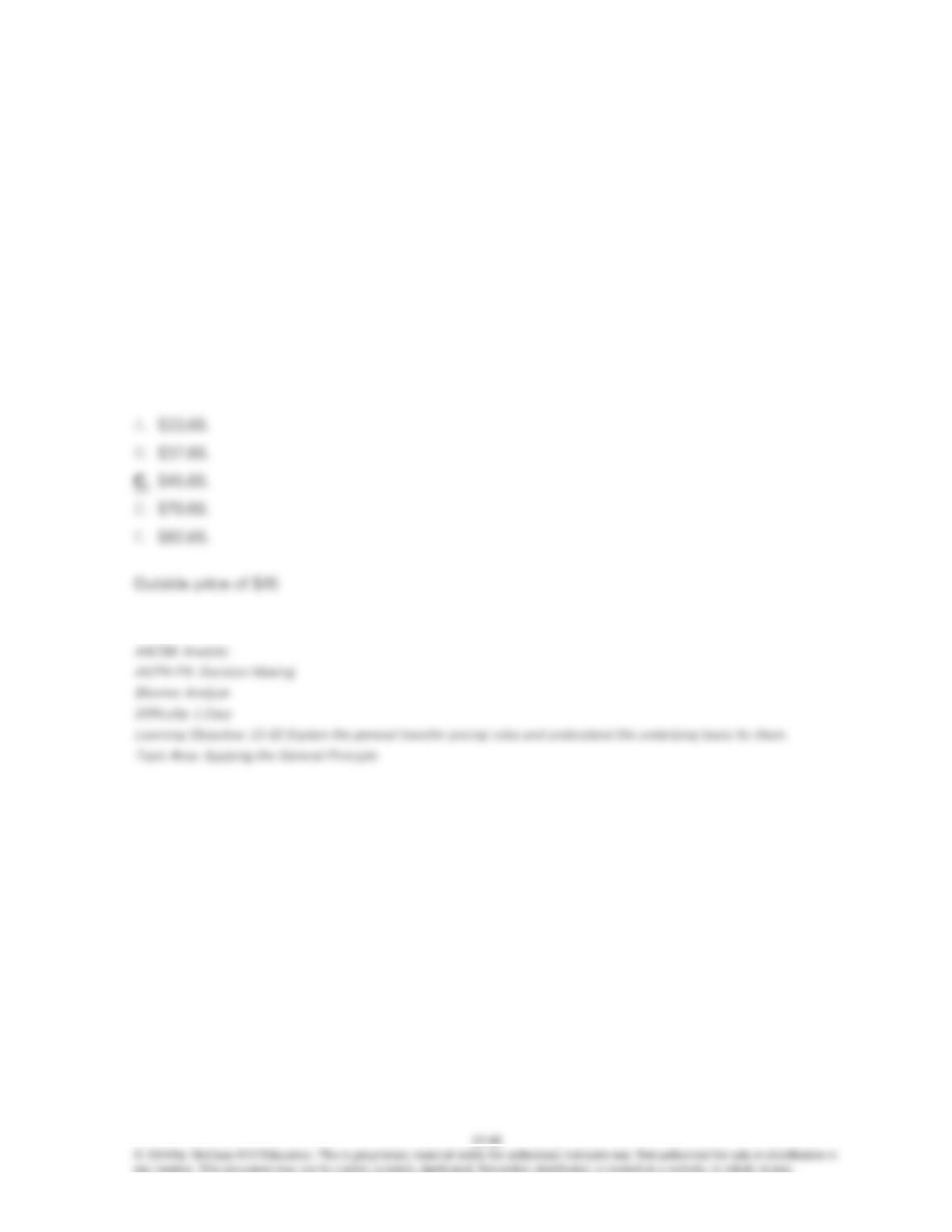
81. Cascade Cliffs, Inc., operates two divisions: (1) a management division that owns and
manages bulk carriers on the Great Lakes and (2) a repair division that operates a dry dock in
Cheboygan, Michigan. The repair division works on company ships, as well as other large-hull
ships.
The repair division has an estimated variable cost of $37 per labor-hour. The repair division has a
backlog of work for outside ships. They charge $70.00 per hour for labor, which is standard for this
type of work. The management division complained that it could hire its own repair workers for
$45.00 per hour, including leasing an adequate work area.
What is the minimum transfer price per hour that the repair division should obtain for its services,
assuming it is operating at capacity?
82. Cascade Cliffs, Inc., operates two divisions: (1) a management division that owns and
manages bulk carriers on the Great Lakes and (2) a repair division that operates a dry dock in
Cheboygan, Michigan. The repair division works on company ships, as well as other large-hull
ships.
The repair division has an estimated variable cost of $37 per labor-hour. The repair division has a
backlog of work for outside ships. They charge $70.00 per hour for labor, which is standard for this
type of work. The management division complained that it could hire its own repair workers for
$45.00 per hour, including leasing an adequate work area.
What is the maximum transfer price per hour that the management division should pay?