82. ______________________________ is a costing approach where detailed costs to perform activities
throughout the value chain are computed and can be managed or assigned to cost objects, including products.
83. ______________________________ are the sum of costs to design, produce, market, deliver, and support a
product from conception to ultimate discontinuance.
84. A(n) ______________________________ is a sequence of activities performed by an organization that add
value or utility to the product produced or service rendered.
85. The computer technology application that automates the product design process, including but not limited to
the functions of geometric modeling, materials stress and strain analysis, drafting, storing product
specifications, and mechanical simulation of a product’s performance, is called
______________________________.
86. The ______________________________ is a statement of specific production goals developed from
forecasts of demand, actual sales orders, or inventory information.
87. ______________________________ is a process that uses bills of material, raw material and WIP
inventory status data, open order data, and the master production schedule to calculate a time-phased order
requirements schedule for materials and subassemblies.
88. ______________________________ is an inventory management approach where inventory needs and
inventory production capabilities are matched across the entire global enterprise.
89. The ______________________________ process uses the information from the master production schedule
and the time-phased order requirements schedule to develop detailed machine- and labor-use schedules based
on available capacity.
90. ______________________________ convey authority for the manufacture of a specified product or
subassembly in specified quantity and describe the material, labor, and machine requirements for the job.
91. ______________________________ is an integrated decision support system for planning, executing, and
controlling manufacturing operations.
92. ______________________________ is a manufacturing philosophy or business strategy for designing
production processes that are more responsive to precisely timed customer delivery requirements.
93. A(n) ______________________________ is an automated manufacturing operations system that can react
quickly to product and design changes because a centralized computer control provides real-time routing, load
balancing, and production scheduling logic.
94. ______________________________ is the application of computer and communications technology to
improve productivity by linking computer numerical control (CNC) machines, monitoring production, and
providing automatic feedback to control operations.
95. ______________________________ is an automated decision support system that generates manufacturing
operations instructions and routings based on information about machining requirements and machine
capabilities.
96. A(n) ______________________________ is a computer-based cart capable of delivering parts and tools
among multiple work centers.
97. A(n) ______________________________ is a computer-controlled machine that stores and retrieves parts
and tools.
98. ______________________________ authorize and record movement of a job from one work center to
another.
99. A(n) ______________________________ contains the standard material quantities that are required to
produce one unit of end product.
100. The process of ______________________________ involves determining the total of each component
required to manufacture a given quantity of an upper-level assembly or subassembly.
101. The process of exploding the BOM results in a(n) ______________________________ requirements
schedule.
102. The ______________________________ process is devoted to monitoring and recording the status of
manufacturing orders as they proceed through the factory.
103. The ______________________________ specifies the operations necessary to complete a subassembly or
finished good and the sequence of these operations.
104. Used in conjunction with a perpetual inventory process, ______________________________ assists in
protecting materials, work-in-process, and finished goods inventory by providing the warehouse manager or the
inventory control supervisor with a record of the actual (on-hand) balance of each item of inventory.
105. ______________________________ is accumulation of the data on current inventories, sales
commitments, and planned production to determine whether the production of finished goods will be sufficient
to commit to additional sales orders.
106. ______________________________ is the accumulation of data on current inventories, sales
commitments, planned production and excess production capacity or other planned production capacity that
could be quickly converted to production of the desired finished goods necessary to fulfill a sales order request.

107. ______________________________ is the process of comparing actual information about input costs and
usage to standards.
108. ______________________________ data marks the end of the conversion process and the movement of
goods to the finished goods warehouse.
109. ______________________________ tags can be attached to inventory items to track their movement
throughout the warehouse and even through the entire supply chain.
110. A(n) ______________________________ is an authorization that identifies the type and quantity of
materials to be withdrawn from the storeroom and tracks the manufacturing order being produced and the work
center needing the materials.
111. The ______________________________ approach to manufacturing places responsibility for quality in
the hands of the builder rather than in those of the inspector.
112. The ______________________________ describes each work center available for producing products,
including information such as the machine available at the station, its capacity, its maintenance requirements,
labor needs to operate it, and so on.
113. A(n) ______________________________ is the assigned location where a worker performs his or her job;
it could be a machine or a workbench.

114. A(n) ______________________________ is a group of similar workstations.
115. The process within TB Figure 15.1 Bubble 1.0 might be described as follows: Consistent with the value
chain concept, the IPP begins with the design of the product and production processes. Activity-based costing
can be used to develop estimates of the future cost of producing new products as well as potential cost changes
from product or design changes. The entire design process is automated through the use of computer-aided
design (CAD) and computer-aided engineering (CAE). With the use of enterprise systems, the electronic
designs produced using CAD/CAE become the basis for developing detailed production schedules (bubble 2.0
in TB Figure 15.1) as well as the electronic control of production machines. In addition to the detailed product
design, the CAD/CAE process results in several data stores of information that are used later in the IPP:
·
Bill of materials (BOM) master: The BOM provides the basis for later orders of raw materials (bubble 3.0 in TB Figure 15.1) when a
finished good is to be produced.
·
Part master: The parts master or raw materials inventory master lists the detailed specifications of each raw materials item. An engineer
must specify the information for the new material in the parts master when a new part is used in product design. Often, existing parts will
be used in new products to reduce needed ordering and carrying costs for the inventory.
·
Routing master: The routing master specifies the operations necessary to complete a subassembly or finished good, and the sequence of
these operations. The routing master also includes the machining tolerances; the tools, jigs, and fixtures required and the time allowed for
each operation. The routing master is vital to developing detailed production instructions (bubble 4.0 in TB Figure 15.1). Computer aided
process planning (CAPP), is often used in developing the routing master for developing new products. CAPP is an automated decision
support system that generates manufacturing operations instructions and routings based on information about machinery requirements
and capabilities.
·
Work center master: The work center master describes each work center available for producing products. A work station is the assigned
location where a worker performs their job. A group of similar work stations constitutes a work center. When new products require new
machines or production activities, a new record in the work center master must be created.
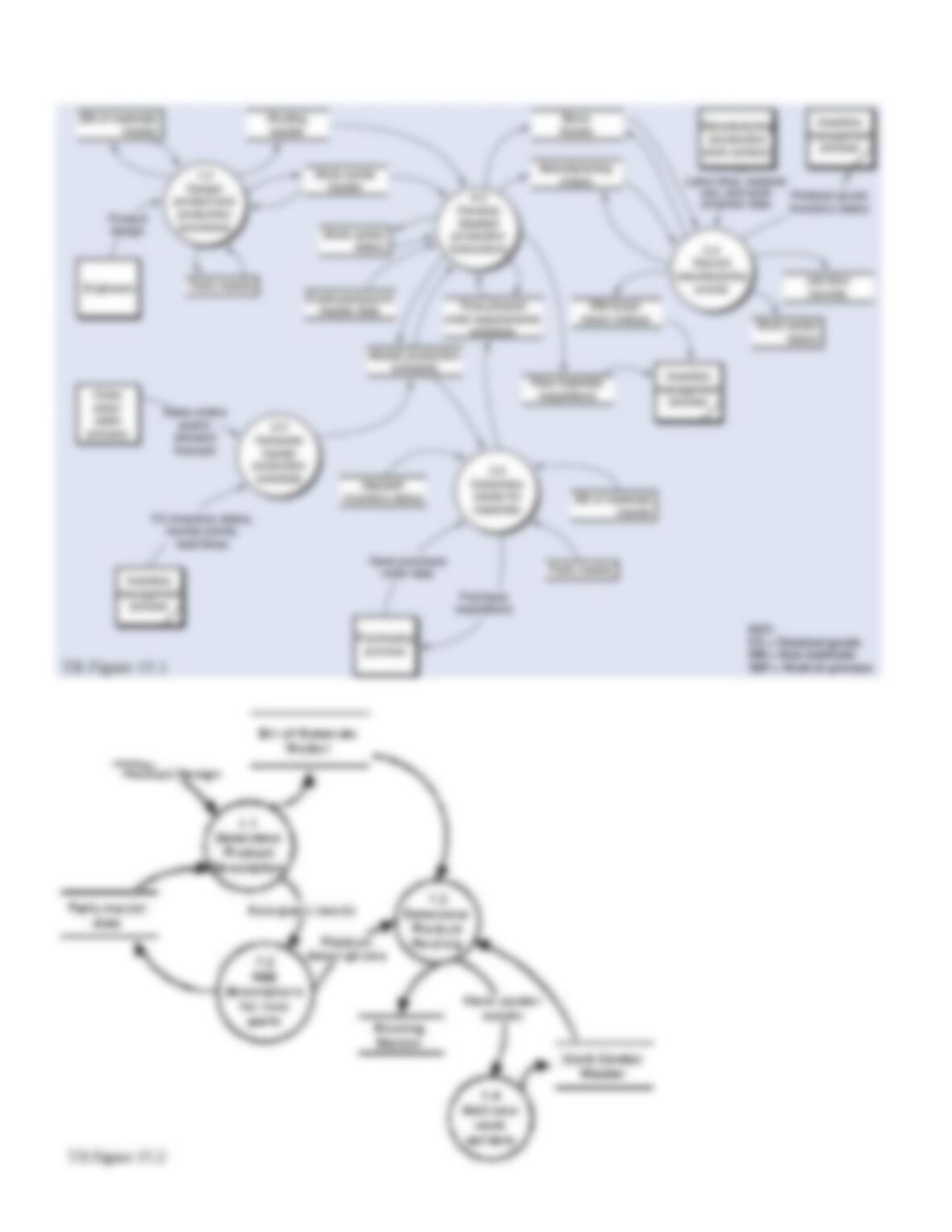
Refer to TB Figure 15.1. Prepare a Level 1 data flow diagram for the product and production process design process only.
116. The process within TB Figure 15.3, Bubble 3.0 might be described as follows: After the master production
schedule is determined, an important step in completing the production in a timely manner is identifying,
ordering, and receiving materials. Materials requirements planning is a process that uses bills of material, raw
material and WIP inventory status data, open order data, and the master production schedule to calculate a time-
phased order requirements schedule for materials and subassemblies. The schedule shows the time period when
a manufacturing order or purchase order should be released so that the subassemblies and raw materials will be
available when needed. The process involves working backward from the date production is to begin to
determine the timing for manufacturing subassemblies and then moving back further to determine the date that
orders for materials must be issued into the purchasing process. In an enterprise system, this process is
performed automatically, using a variety of data from the enterprise database including:
·
Bills of materials, showing the items and quantities required as developed by engineering.
·
Parts master data, which contains information about part number, description, unit of measure, where used, order policy, lead time, and
safety stock.
·
Raw materials and WIP inventory status data showing the current quantities on hand, and quantities already reserved for production for
the materials and subassemblies.
·
Open purchase order data showing the existing orders for materials.
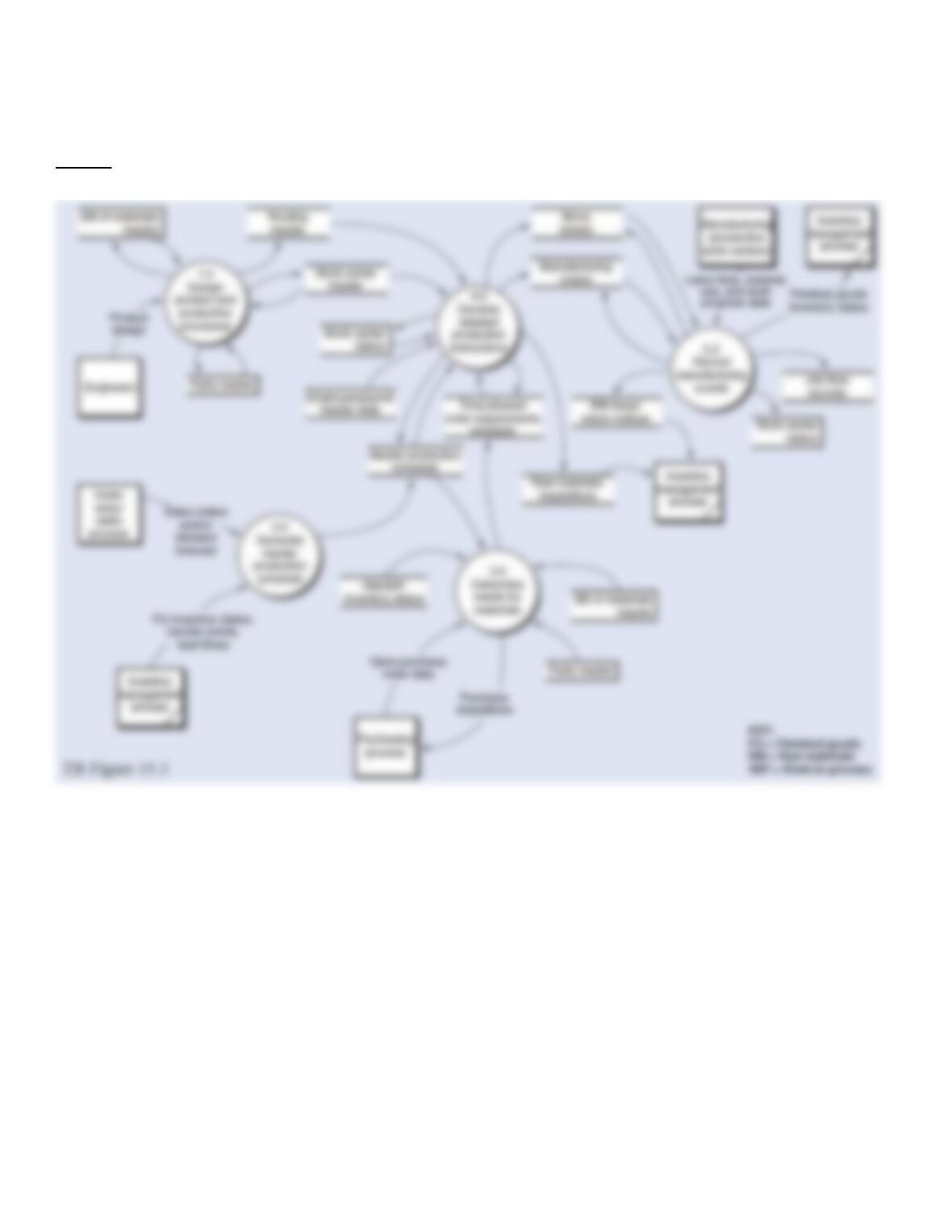
The process begins by exploding the bill of materials to determine the total of each component required to manufacture a given quantity of an upper
level assembly or a subassembly specified in the master production schedule. Based on lead time data for producing and ordering materials and
subassembly requirements are output in a time-phased order requirements schedule. Based on this schedule, and open PO data, purchase requisitions
are generated and sent to purchasing.
Required:
Refer to TB Figure 15.3. Prepare a Level 1 data flow diagram for the materials requirements planning process only.
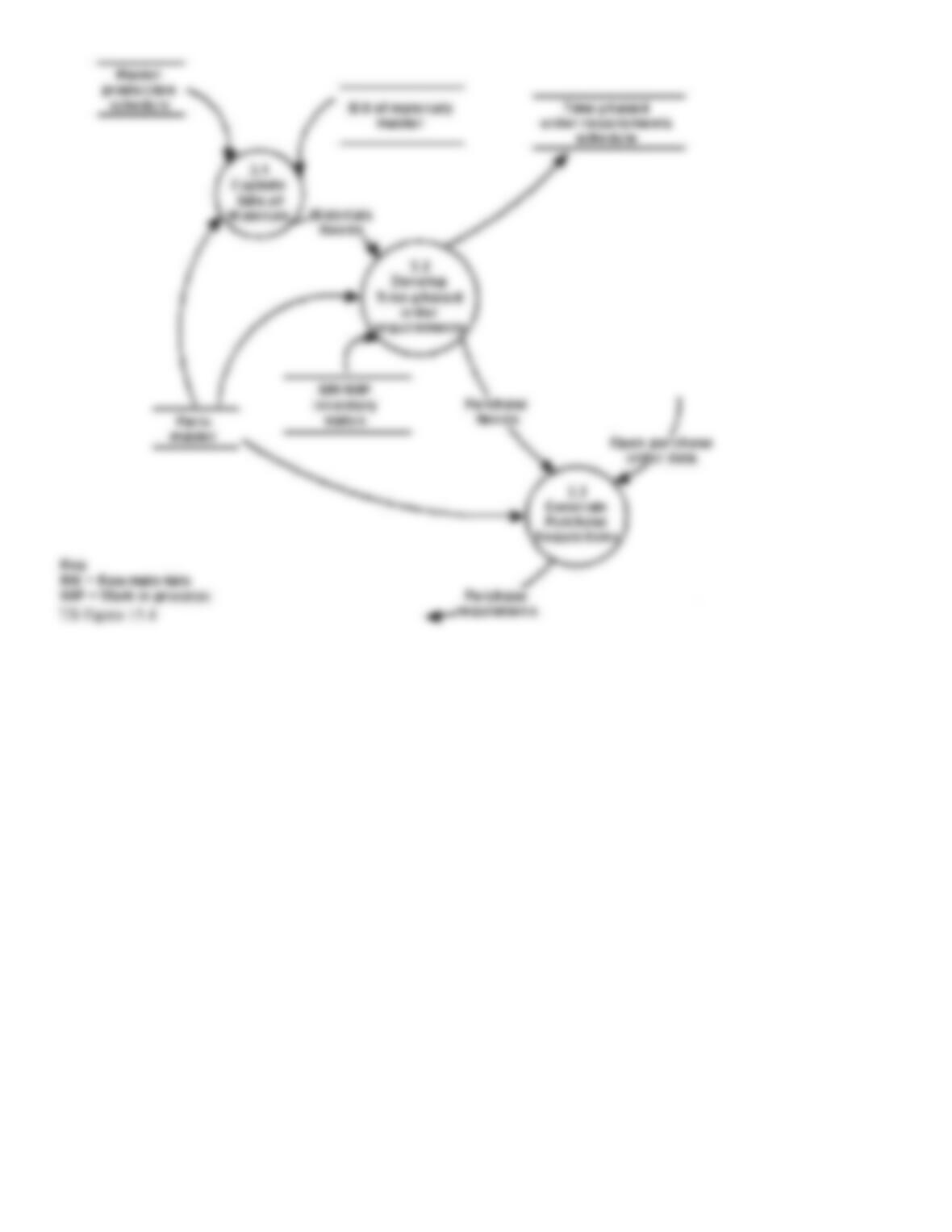
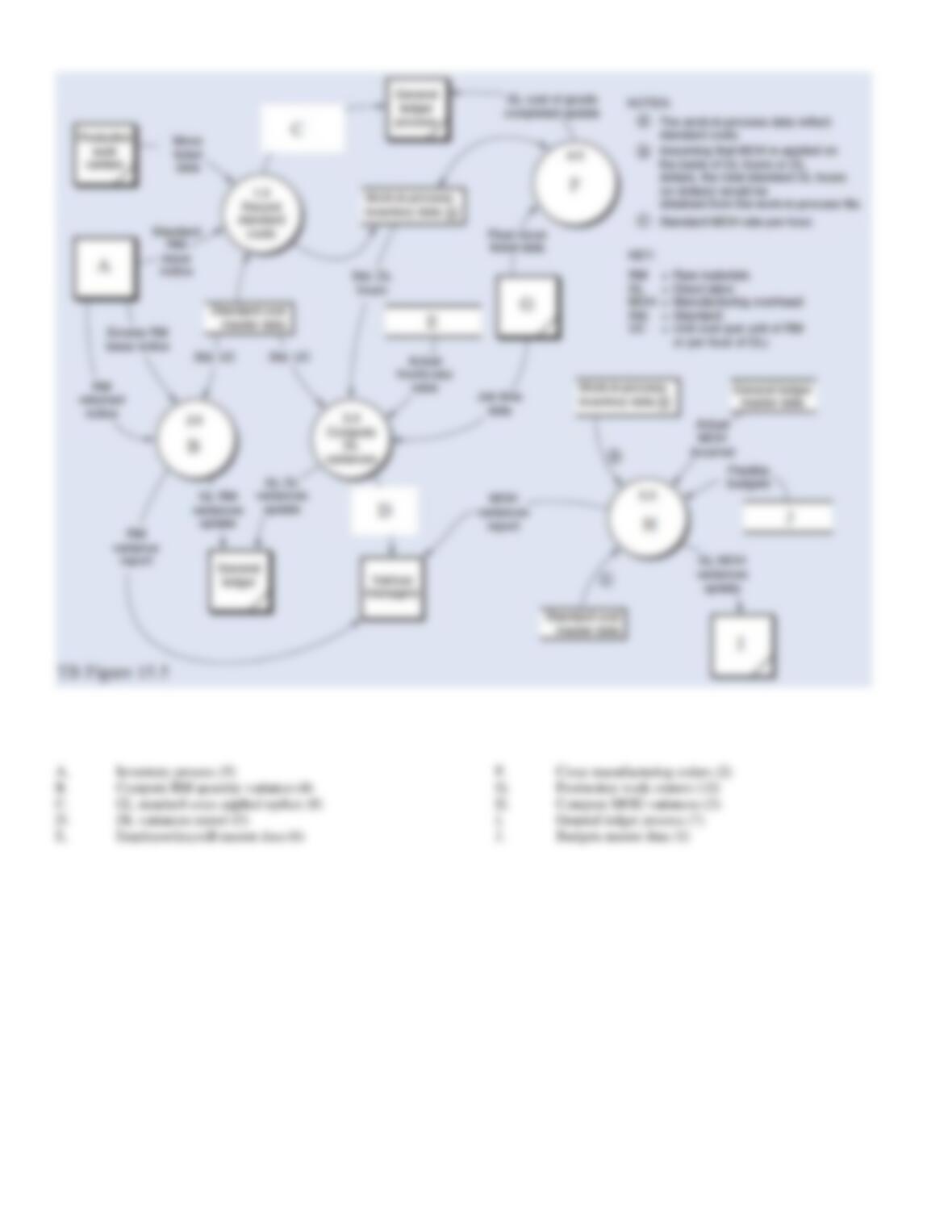
117. TB Figure 15.5 displays a Level 0 DFD – Cost Accounting: Variance Analysis. Match the items in the
following alphabetical list to the missing items (A – J) in the diagram.
1.
Budgets master data
6.
Employee/payroll master data
2.
Close manufacturing orders
7.
General ledger process
3.
Compute MOH variances
8.
GL standard costs applied update
4.
Compute RM quantity variance
9.
Inventory process
5.
DL variances report
10.
Production work centers
118. Match the terms in the left column below with the definitions in the right column by placing the letter next
to the term in the blank space next to the definition.
Term
Definition
A.
Push manufacturing
1.
The time it takes from when authorization is made for goods to be
produced to when the goods are completed.
B.
Throughput time
2.
The accumulation of the data on current inventories, sales
commitments, and planned production to determine whether the
production of finished goods will be sufficient to commit to
additional sales orders.
C.
Parts master
3.
A listing of all the subassemblies,parts, and raw materials that go into
a parent assembly showing the quantity of each that is required to
make an assembly.
D.
Master production schedule (MPS)
4.
Describes stationsavailable for producing products, including
information such as the machine available at the station, its capacity,
its maintenance requirements, labor needs to operate it, and so on.
E.
Available to promise planning
5.
The accumulation of the data on current inventories, sales
commitments, planned production and excess production capacity, or
other planned production capacity that could be quickly converted to
production of the desired finished goods necessary to fulfill a sales
order request.
F.
Pull manufacturing
6.
Process for which the sales forecast drives the production plan, and
goods are produced in large batches.
G.
Bill of materials (BOM)
7.
Specifies the operations necessary to complete a subassembly or
finished good and the sequence of these operations.
H.
Work center master
8.
A statement of specific production goals developed from forecasts of
demand, actual sales orders, or inventory information.
I.
Routing master
9.
Lists the detailed specifications for each raw materials item.
J.
Capable to promise planning
10.
This process is initiated as individual sales orders are received and
theoretically each job consists of a “batch” of one unit.
1.
B
6.
A
3.
G
8.
D
4.
H
9.
C
5.
J
10.
F