39) Division A makes a part that it sells to customers outside of the company. Data concerning
this part appear below:
Selling price to outside customers
$
40
Variable cost per unit
$
30
Total fixed costs
$
10,000
Capacity in units
20,000
Division B of the same company would like to use the part manufactured by Division A in one of
its products. Division B currently purchases a similar part made by an outside company for $38
per unit and would substitute the part made by Division A. Division B requires 5,000 units of the
part each period. Division A has ample capacity to produce the units for Division B without any
increase in fixed costs and without impacting sales to outside customers. If Division A sells to
Division B, the variable cost per unit would be $1 lower than when selling to outside customers.
What should be the lowest acceptable transfer price from the perspective of Division A?
A) $40.
B) $38.
C) $30.
D) $29.
40) The Raisin Division of Trail Mix Foods, Incorporated had the following operating results last
year:
Sales (150,000 pounds of raisins)
$
60,000
Variable expenses
37,500
Contribution margin
22,500
Fixed expenses
12,000
Profit
$
10,500
Raisin expects identical operating results this year. The Raisin Division has the ability to produce
and sell 200,000 pounds of raisins annually.
Assume that the Peanut Division of Trail Mix Foods wants to purchase an additional 20,000
pounds of raisins from the Raisin Division. Raisin will be able to increase its profit by accepting
any transfer price above:
A) $0.25 per pound.
B) $0.08 per pound.
C) $0.15 per pound.
D) $0.40 per pound.
41) The Raisin Division of Trail Mix Foods, Incorporated had the following operating results last
year:
Sales (150,000 pounds of raisins)
$
60,000
Variable expenses
37,500
Contribution margin
22,500
Fixed expenses
12,000
Profit
$
10,500
Raisin expects identical operating results this year.
Assume that the Raisin Division is currently operating at its capacity of 150,000 pounds of
raisins. Also assume that the Peanut Division wants to purchase an additional 20,000 pounds of
raisins from the Raisin Division. Under these conditions, what amount per pound of raisins
would the Raisin Division have to charge the Peanut Division in order to maintain its current
profit?
A) $0.40 per pound.
B) $0.08 per pound.
C) $0.15 per pound.
D) $0.25 per pound.
42) The Gear Division makes a part with the following characteristics:
Production capacity
25,000
units
Selling price to outside customers
$
18
Variable cost per unit
$
11
Fixed cost, total
$
100,000
The Motor Division of the same company would like to purchase 10,000 units each period from
the Gear Division. The Motor Division now purchases the part from an outside supplier at a price
of $17 each.
Suppose the Gear Division has ample excess capacity to handle all of the Motor Division’s needs
without any increase in fixed costs and without impacting sales to outside customers. If the Gear
Division refuses to accept the $17 price internally and the Motor Division continues to buy from
the outside supplier, the company as a whole will be:
A) worse off by $70,000 each period.
B) better off by $10,000 each period.
C) worse off by $60,000 each period.
D) worse off by $20,000 each period.
43) The Gear Division makes a part with the following characteristics:
Production capacity
25,000
units
Selling price to outside customers
$
18
Variable cost per unit
$
11
Fixed cost, total
$
100,000
The Motor Division of the same company would like to purchase 10,000 units each period from
the Gear Division. The Motor Division now purchases the part from an outside supplier at a price
of $17 each.
Suppose that the Gear Division is operating at capacity and can sell all of its output to outside
customers. If the Gear Division sells the parts to Motor Division at $17 per unit, the company as
a whole will be:
A) better off by $10,000 each period.
B) worse off by $20,000 each period.
C) worse off by $10,000 each period.
D) There will be no change in the status of the company as a whole.
44) Division A produces a part with the following characteristics:
Capacity in units
50,000
Selling price per unit
$
30
Variable costs per unit
$
18
Fixed costs per unit
$
3
Division B, another division in the company, would like to buy this part from Division A.
Division B is currently purchasing the part from an outside source at $28 per unit. If Division A
sells to Division B, $1 in variable costs can be avoided.
Suppose Division A is currently operating at capacity and can sell all of the units it produces on
the outside market for its usual selling price. From the point of view of Division A, any sales to
Division B should be priced no lower than:
A) $27.
B) $29.
C) $20.
D) $28.
45) Division A produces a part with the following characteristics:
Capacity in units
50,000
Selling price per unit
$
30
Variable costs per unit
$
18
Fixed costs per unit
$
3
Division B, another division in the company, would like to buy this part from Division A.
Division B is currently purchasing the part from an outside source at $28 per unit. If Division A
sells to Division B, $1 in variable costs can be avoided.
Suppose that Division A has ample idle capacity to handle all of Division B’s needs without any
increase in fixed costs and without impacting sales to outside customers. From the point of view
of Division A, any sales to Division B should be priced no lower than:
A) $29.
B) $30.
C) $18.
D) $17.
46) The Pillar Division of the Gothic Building Company produces basic pillars which can be
sold to outside customers or sold to the Lantern Division of the Gothic Company. The Lantern
Division wants to purchase 25,000 pillars from the Pillar Division. The following data are
available for last year’s activities of the Pillar Division:
Capacity in units
300,000
pillars
Selling price per pillar to outside customers
$
1.75
Variable costs per pillar
$
0.90
Fixed costs, total
$
150,000
The total fixed costs would be the same for all the alternatives considered.
Suppose there is ample capacity so that transfers of the pillars to the Lantern Division do not
impact sales to outside customers. What is the lowest transfer price that would not reduce the
profits of the Pillar Division?
A) $0.90.
B) $1.35.
C) $1.41.
D) $1.75.
47) The Pillar Division of the Gothic Building Company produces basic pillars which can be
sold to outside customers or sold to the Lantern Division of the Gothic Company. The Lantern
Division wants to purchase 25,000 pillars from the Pillar Division. The following data are
available for last year’s activities of the Pillar Division:
Capacity in units
300,000
pillars
Selling price per pillar to outside customers
$
1.75
Variable costs per pillar
$
0.90
Fixed costs, total
$
150,000
The total fixed costs would be the same for all the alternatives considered.
Suppose the transfers of pillars to the Lantern Division would reduce sales to outside customers
by 15,000 units. What is the lowest transfer price that would not reduce the profits of the Pillar
Division?
A) $0.90.
B) $1.35.
C) $1.41.
D) $1.75.
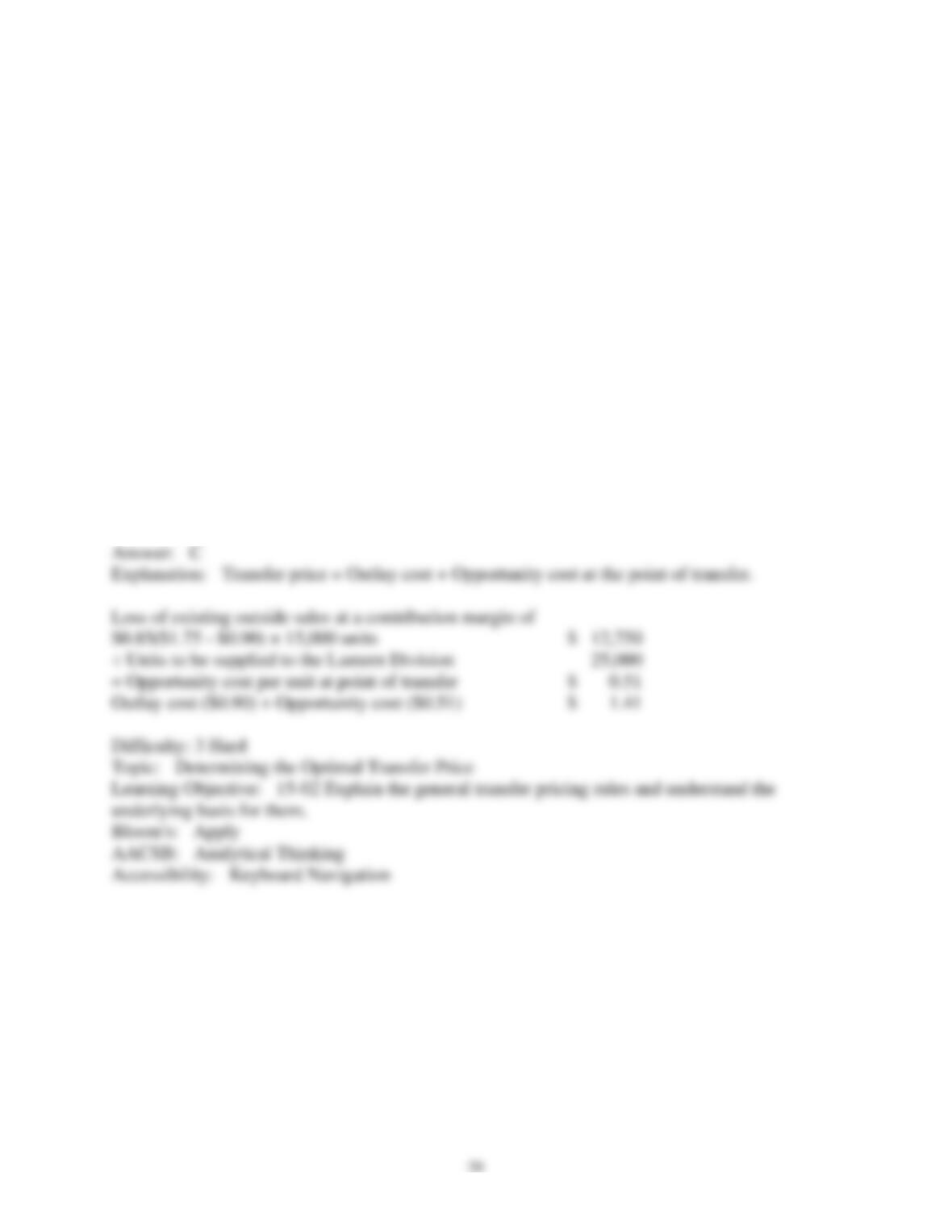
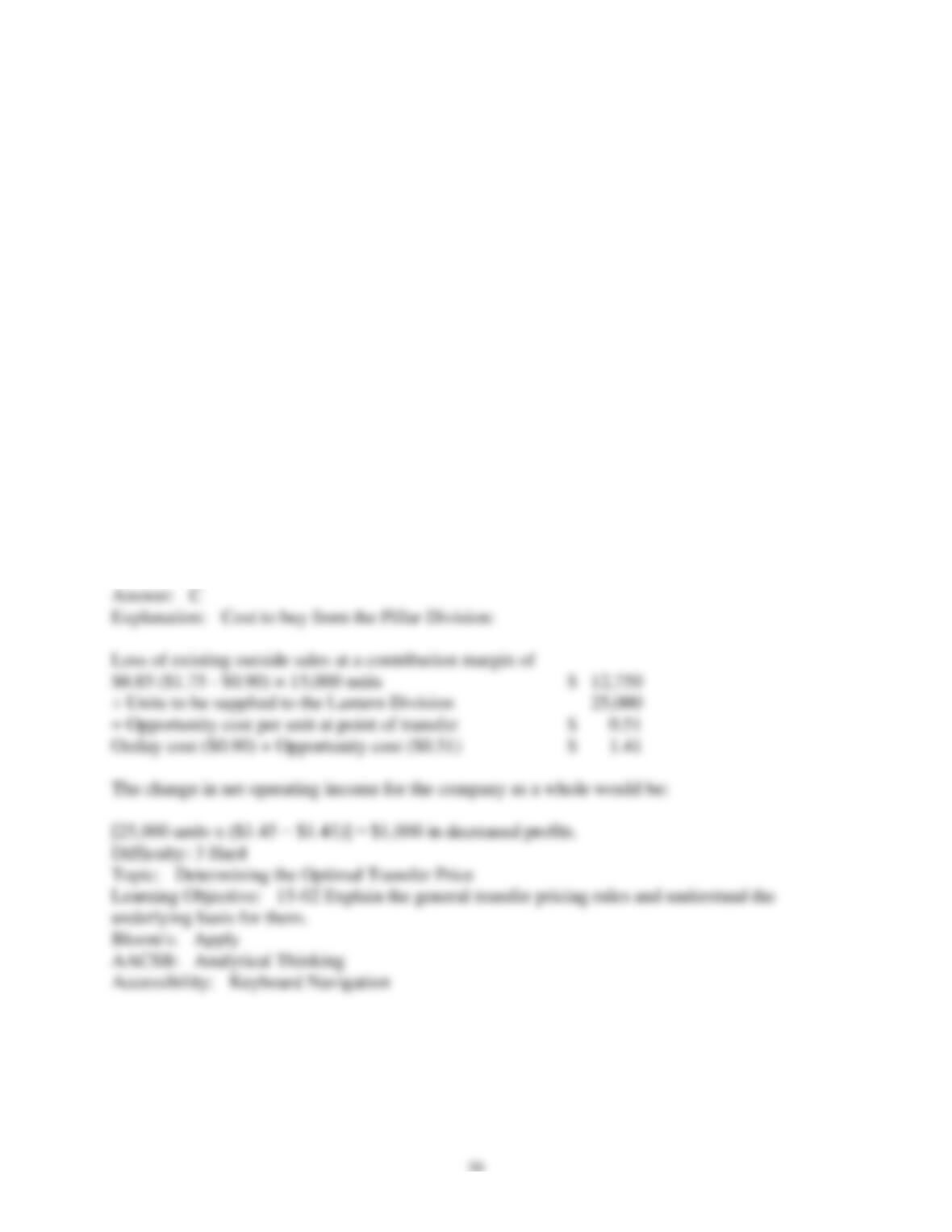
$0.85($1.75 – $0.90) × 15,000 units
$
12,750
÷ Units to be supplied to the Lantern Division
25,000
= Opportunity cost per unit at point of transfer
$
Outlay cost ($0.90) + Opportunity cost ($0.51)
$
48) The Pillar Division of the Gothic Building Company produces basic pillars which can be
sold to outside customers or sold to the Lantern Division of the Gothic Company. The Lantern
Division wants to buy 25,000 pillars from the Pillar Division. The following data are available
for last year’s activities of the Pillar Division:
Capacity in units
300,000
pillars
Selling price per pillar to outside customers
$
1.75
Variable costs per pillar
$
0.90
Fixed costs, total
$
150,000
The total fixed costs would be the same for all the alternatives considered.
Suppose the transfers of pillars to the Lantern Division would reduce sales to outside customers
by 15,000 units. Further suppose that an outside supplier is willing to provide the Lantern
Division with basic pillars at $1.45 each. If the Lantern Division had chosen to buy all of its
pillars from the outside supplier instead of the Pillar Division, the change in net operating
income for the company as a whole would have been:
A) $1,250 decrease.
B) $10,250 increase.
C) $1,000 decrease.
D) $13,750 decrease.
$0.85 ($1.75 – $0.90) × 15,000 units
$
÷ Units to be supplied to the Lantern Division
= Opportunity cost per unit at point of transfer
$
Outlay cost ($0.90) + Opportunity cost ($0.51)
$
49) The Stake Division of the Outdoor Lumination Company produces stakes which can be sold
to outside customers or transferred to the Solar Light Division of the Outdoor Lumination
Company. Last year, the Solar Light Division bought 50,000 stakes from the Stake Division. The
following data are available for last year’s activities in the Stake Division:
Capacity in units
400,000
stakes
Quantity sold to outside customers
350,000
stakes
Selling price per stake to outside customers
$
3.00
Total variable costs per stake
$
2.00
Fixed operating costs
$
200,000
In order to sell 50,000 stakes to the Solar Light Division, the Stake Division had to give up sales
of 30,000 stakes to outside customers. That is, the Stake Division could sell 380,000 stakes each
year to outside customers (rather than only 350,000 stakes as shown above) if it were not making
sales to the Solar Light Division.
What is the lowest acceptable transfer price from the viewpoint of the selling division?
A) $2.50.
B) $2.00.
C) $2.60.
D) $3.00.
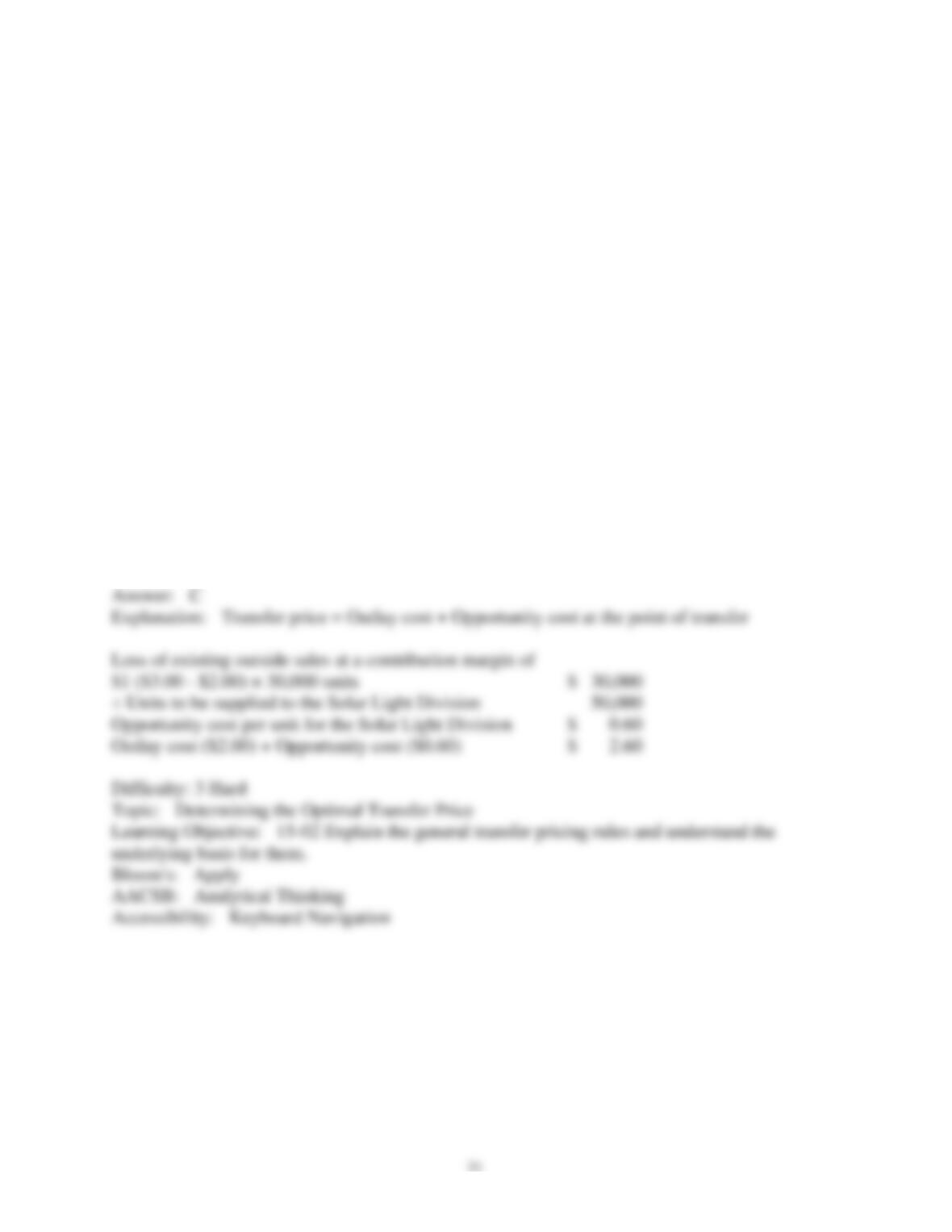
$1 ($3.00 – $2.00) × 30,000 units
30,000
÷ Units to be supplied to the Solar Light Division
50,000
Opportunity cost per unit for the Solar Light Division
Outlay cost ($2.00) + Opportunity cost ($0.60)
50) The Stake Division of the Outdoor Lumination Company produces stakes which can be sold
to outside customers or transferred to the Solar Light Division of the Outdoor Lumination
Company. Last year, the Solar Light Division bought 50,000 stakes from the Stake Division. The
following data are available for last year’s activities in the Stake Division:
Capacity in units
400,000
stakes
Quantity sold to outside customers
350,000
stakes
Selling price per stake to outside customers
$
3.00
Total variable costs per stake
$
2.00
Fixed operating costs
$
200,000
In order to sell 50,000 stakes to the Solar Light Division, the Stake Division had to give up sales
of 30,000 stakes to outside customers. That is, the Stake Division could sell 380,000 stakes each
year to outside customers (rather than only 350,000 stakes as shown above) if it were not making
sales to the Solar Light Division.
Suppose that last year an outside supplier would have been willing to provide the Solar Light
Division with the basic stakes at $2.10 each. If the Solar Light Division had chosen to buy all of
its stakes from the outside supplier instead of the Stake Division, the change in net operating
income for the company as a whole would have been:
A) $45,000 increase.
B) $20,000 decrease.
C) $20,000 increase.
D) $25,000 increase.
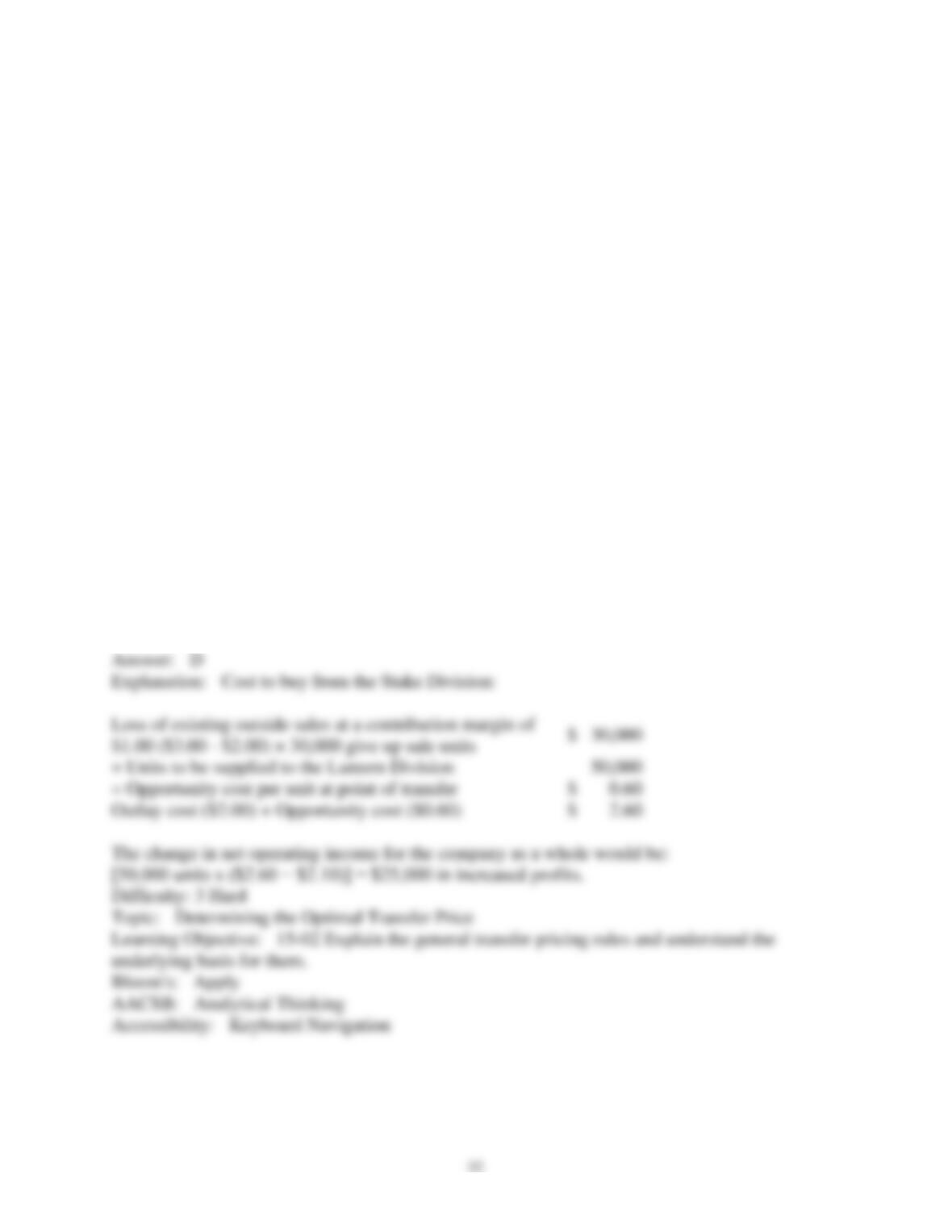
$1.00 ($3.00 – $2.00) × 30,000 give up sale units
÷ Units to be supplied to the Lantern Division
50,000
Outlay cost ($2.00) + Opportunity cost ($0.60)
51) Division X makes a part that it sells to customers outside of the company. Data concerning
this part appear below:
Selling price to outside customers
$
50
Variable cost per unit
$
30
Total fixed costs
$
400,000
Capacity in units
25,000
Division Y of the same company would like to use the part manufactured by Division X in one
of its products. Division Y currently purchases a similar part made by an outside company for
$49 per unit and would substitute the part made by Division X. Division Y requires 5,000 units
of the part each period. Division X can sell all of the units it makes to outside customers. What is
the lowest acceptable transfer price from the standpoint of the selling division?
A) $50.
B) $49.
C) $46.
D) $30.
52) Division X of Operandi Corporation makes and sells a single product which is used by
manufacturers of fork lift trucks. Currently, it sells 12,000 units per year to outside customers at
$24 per unit. The annual capacity is 20,000 units and the variable costs to make each unit is $16.
Division Y of Operandi Corporation would like to buy 10,000 units a year from Division X to
use in its products. There would be no cost savings from transferring the units within the
company rather than selling them on the outside market. What should be the lowest acceptable
transfer price from the perspective of Division X?
A) $24.00.
B) $21.40.
C) $17.60.
D) $16.00.
53) Division A of Chappelle Company has the capacity for making 3,000 motors per month and
regularly sells 1,950 motors each month to outside customers at a contribution margin of $62 per
motor. The variable cost per motor is $35.70. Division B of Chappelle Company would like to
obtain 1,400 motors each month from Division A. What should be the lowest acceptable transfer
price from the perspective of Division A?
A) $26.57.
B) $51.20.
C) $35.70.
D) $62.00.
54) Which of the following statements is(are) true?
(A) If a transfer has no effect on divisional profit, managers will be indifferent between making
the transfer or not.
(B) If an intermediate market exists but divisions are prohibited from buying or selling from the
outside, the intermediate market can be ignored in determining the optimal transfer price.
A) Only A is true.
B) Only B is true.
C) Both of these are true.
D) Neither of these is true.
55) In general, if a potential transfer has no effect on divisional profits:
A) no transfer will take place between the divisions.
B) managers will be indifferent between making the transfer or not.
C) the organization should not intervene to force a transfer.
D) the optimal transfer price is the opportunity cost for the buying division.
56) An intermediate market is perfect when:
A) there are no quality differences between inside and outside suppliers.
B) there are quality differences between inside and outside customers.
C) buyers and sellers can sell any quantity without affecting the market price.
D) buyers and sellers are motivated to make decisions that are consistent with those of the
organization.
57) When there is no intermediate market:
A) there is no optimal transfer price.
B) the selling division cannot transfer its goods internally.
C) the buying division cannot purchase its goods externally.
D) there is no reason for top management to intervene in transfer pricing disputes.
58) The general principle on setting transfer prices that are in the organization’s best interests is:
A) outlay cost plus opportunity cost of the resource at the point of transfer.
B) only variable costs plus opportunity cost of the resource at the point of transfer.
C) lost contribution margin less the allocated fixed costs for the selling division.
D) gross margin for the buying division plus the gross margin for the selling division.
59) If the selling division has excess capacity, the transfer price should be set at its:
A) outlay costs.
B) outlay costs plus the foregone contribution to the organization of making the transfer
internally.
C) selling price less the variable costs.
D) selling price less the variable costs plus the foregone contribution to the organization of
making the transfer internally.
60) Given a competitive outside market for identical intermediate goods, what is the best transfer
price, assuming all relevant information is readily available?
A) Standard production cost per unit.
B) Market price of the intermediate goods.
C) Actual full cost per unit plus a normal markup.
D) Market price of the final goods less any opportunity costs.
61) The optimal transfer price when there are intermediate markets and the seller is operating at
capacity is normally the:
A) full cost.
B) outlay cost.
C) variable cost.
D) market price.
62) A division can sell externally for $40 per unit. Its variable manufacturing costs are $15 per
unit, and its variable marketing costs are $6 per unit. What is the opportunity cost of transferring
internally, assuming the division is operating at capacity?
A) $15.
B) $19.
C) $21.
D) $25.
63) Division A has variable manufacturing costs of $25 per unit and fixed costs of $5 per unit.
Division A is operating at capacity. What is the opportunity cost of an internal transfer when the
market price is $35?
A) $5.
B) $10.
C) $25.
D) $30.