40. A division can sell externally for $40 per unit. Its variable manufacturing costs are $15 per
unit, and its variable marketing costs are $6 per unit. What is the opportunity cost of transferring
internally, assuming the division is operating at capacity?
41. Division A has variable manufacturing costs of $25 per unit and fixed costs of $5 per unit.
Division A is operating at capacity, what is the opportunity cost of an internal transfer when the
market price is $35?
42. Chipper Division of Acme Corp. sells 80,000 units of part Z-25 to the outside market. Part
Z-25 sells for $40, has a variable cost of $22, and a fixed cost per unit of $10. Chipper has a
capacity to produce 100,000 units per period. Jones Division currently purchases 10,000 units of
part Z-25 from Chipper for $40. Jones has been approached by an outside supplier willing to
supply the parts for $36. What is the effect on Acme’s overall profit if Chipper REFUSES the
outside price and Jones decides to buy outside?
43. Chipper Division of Acme Corp. sells 80,000 units of part Z-25 to the outside market. Part
Z-25 sells for $40, has a variable cost of $22, and a fixed cost per unit of $10. Chipper has a
capacity to produce 100,000 units per period. Jones Division currently purchases 10,000 units of
part Z-25 from Chipper for $40. Jones has been approached by an outside supplier willing to
supply the parts for $36. What is the effect on Acme’s overall profit if Chipper ACCEPTS the
outside price and Jones continues to buy inside?
44. Chipper Division of Acme Corp. sells 80,000 units of part Z-25 to the outside market. Part
Z-25 sells for $40, has a variable cost of $22, and a fixed cost per unit of $10. Chipper has a
capacity to produce 100,000 units per period. Jones Division currently purchases 10,000 units of
part Z-25 from Chipper for $40. Jones has been approached by an outside supplier willing to
supply the parts for $36. If Acme uses a negotiated transfer pricing system, what is the maximum
transfer price that should be charged for this transaction?
45. Chipper Division of Acme Corp. sells 80,000 units of part Z-25 to the outside market. Part
Z-25 sells for $40, has a variable cost of $22, and a fixed cost per unit of $10. Chipper has a
capacity to produce 100,000 units per period. Jones Division currently purchases 10,000 units of
part Z-25 from Chipper for $40. Jones has been approached by an outside supplier willing to
supply the parts for $36. If Acme uses a negotiated transfer pricing system, what is the minimum
transfer price that should be charged for this transaction?
15–26
46. Redimix Corporation has two producing centers, A and B. Division A has a variable cost of
$12 for its products and a total fixed cost of $120,000. Division A also has idle capacity for up to
50,000 units per month. Division B would like to purchase 20,000 units of Division A’s products per
month, but is unable to convince Division A to transfer units to Division B at $16 per unit. Division
A has consistently argued that the market price of $20 is nonnegotiable. What is A’s opportunity
cost of not transferring units to B?
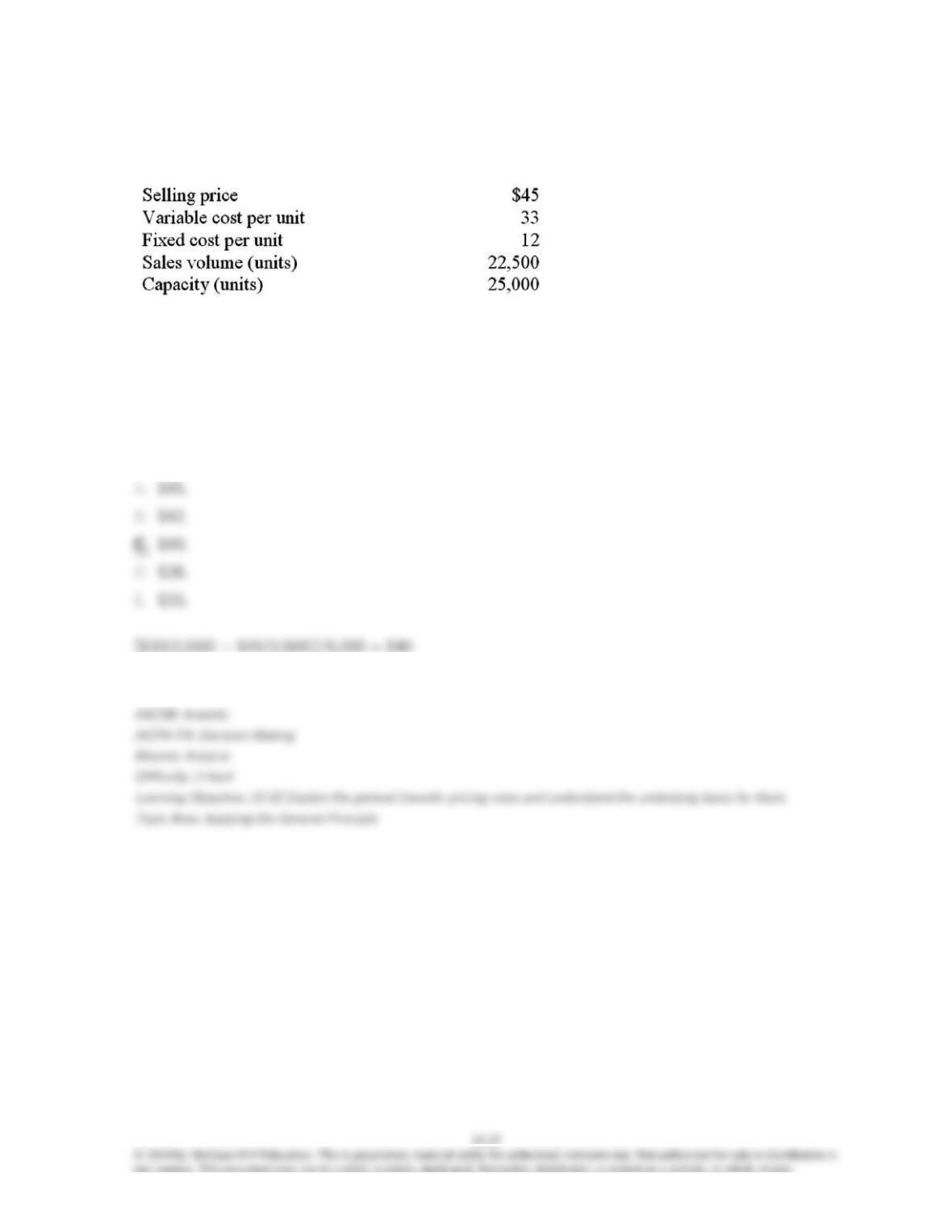
47. You have been provided with the following information for Division X of a decentralized
company:
Division W would like to purchase all of its units internally. Division W needs 6,000 units each
period and currently pays $42 per unit to an outside firm. What is the lowest price that Division X
could accept from Division W? Assume that Division W wants to use a sole supplier and will not
purchase less than 6,000 from a supplier.
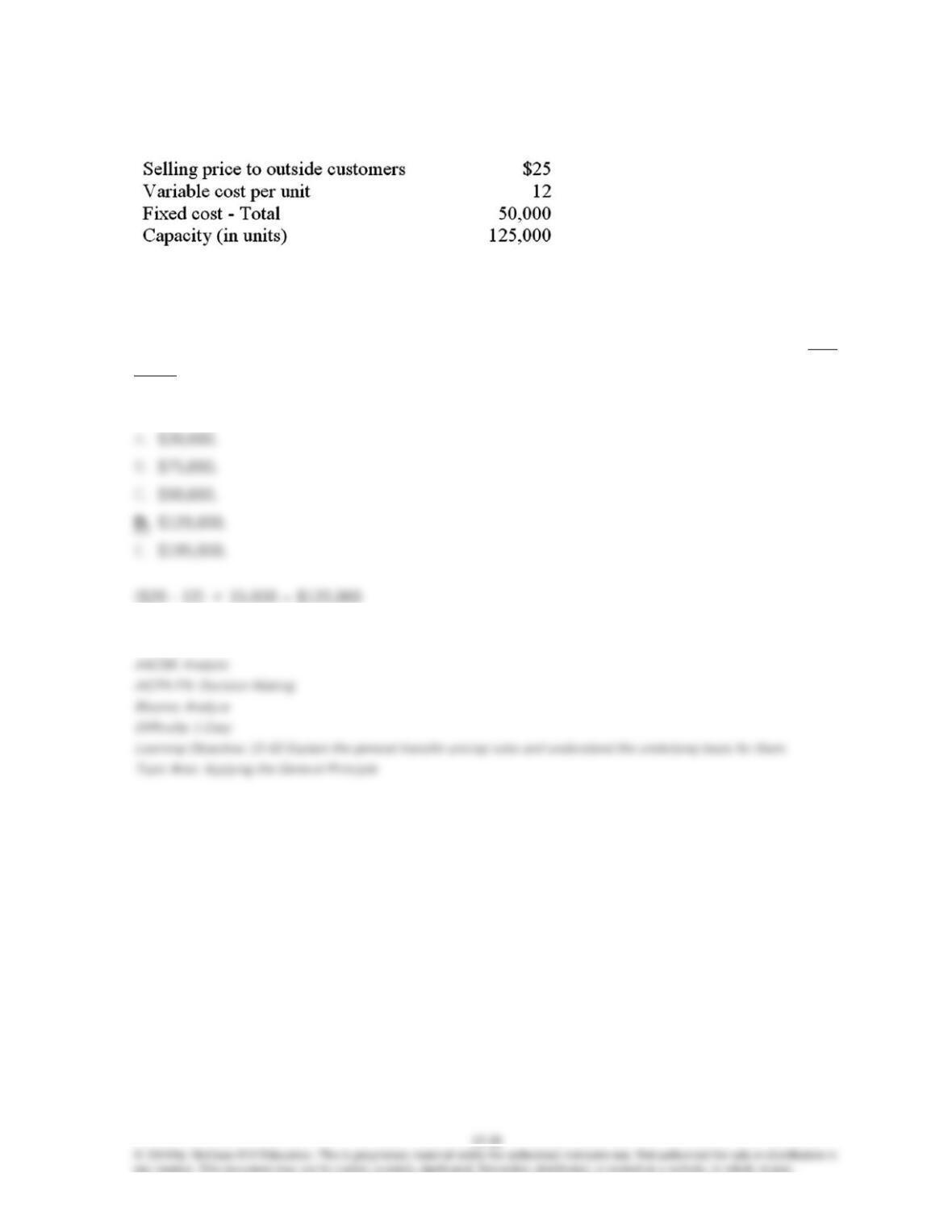
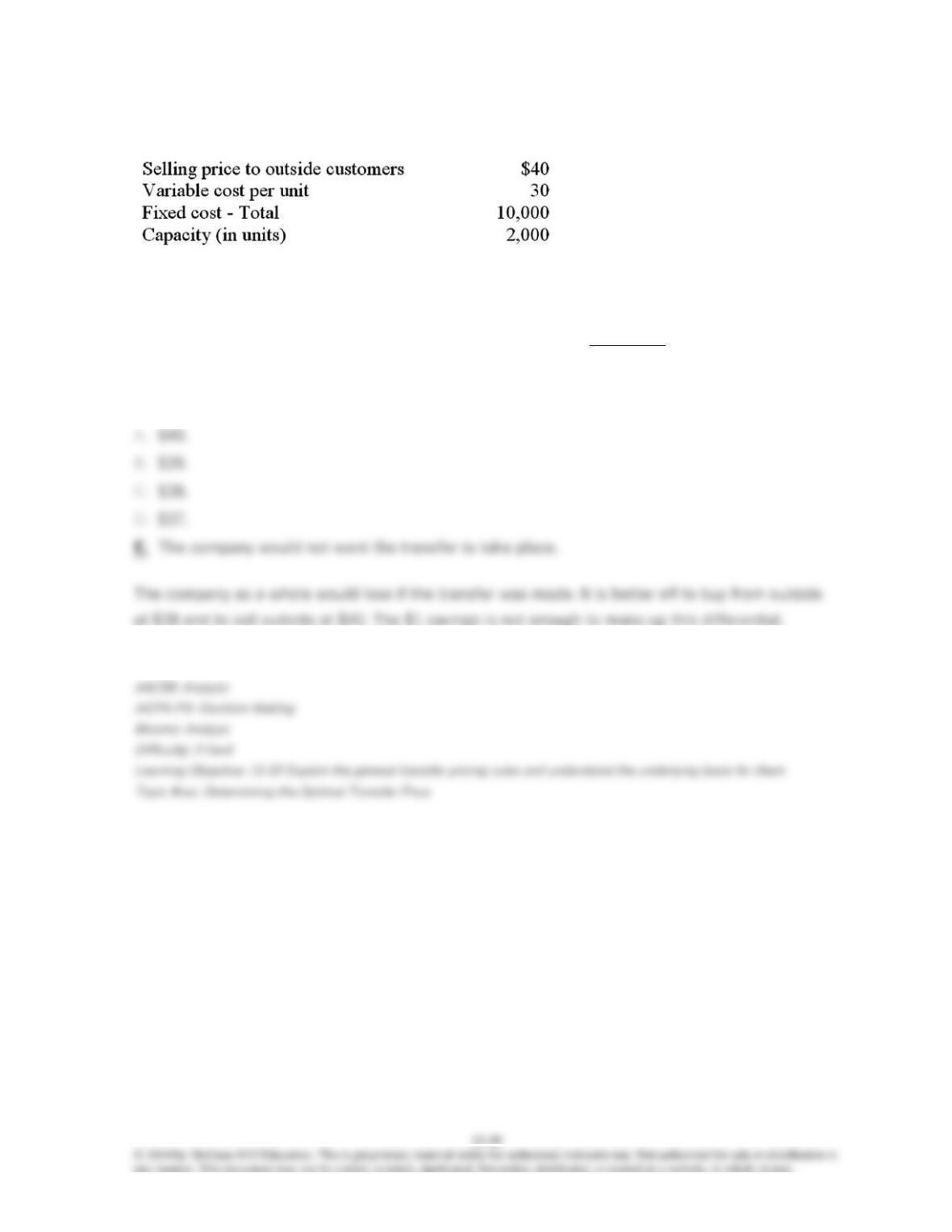
48. Given the following data for Division X:
Division Y would like to purchase 15,000 units each period from Division X. Division X has ample
excess capacity to handle all of Division Y’s needs. Division Y now purchases from an outside
supplier at a price of $20. If Division X refuses to accept an $18 price internally, the company, as a
whole, will be worse off by:
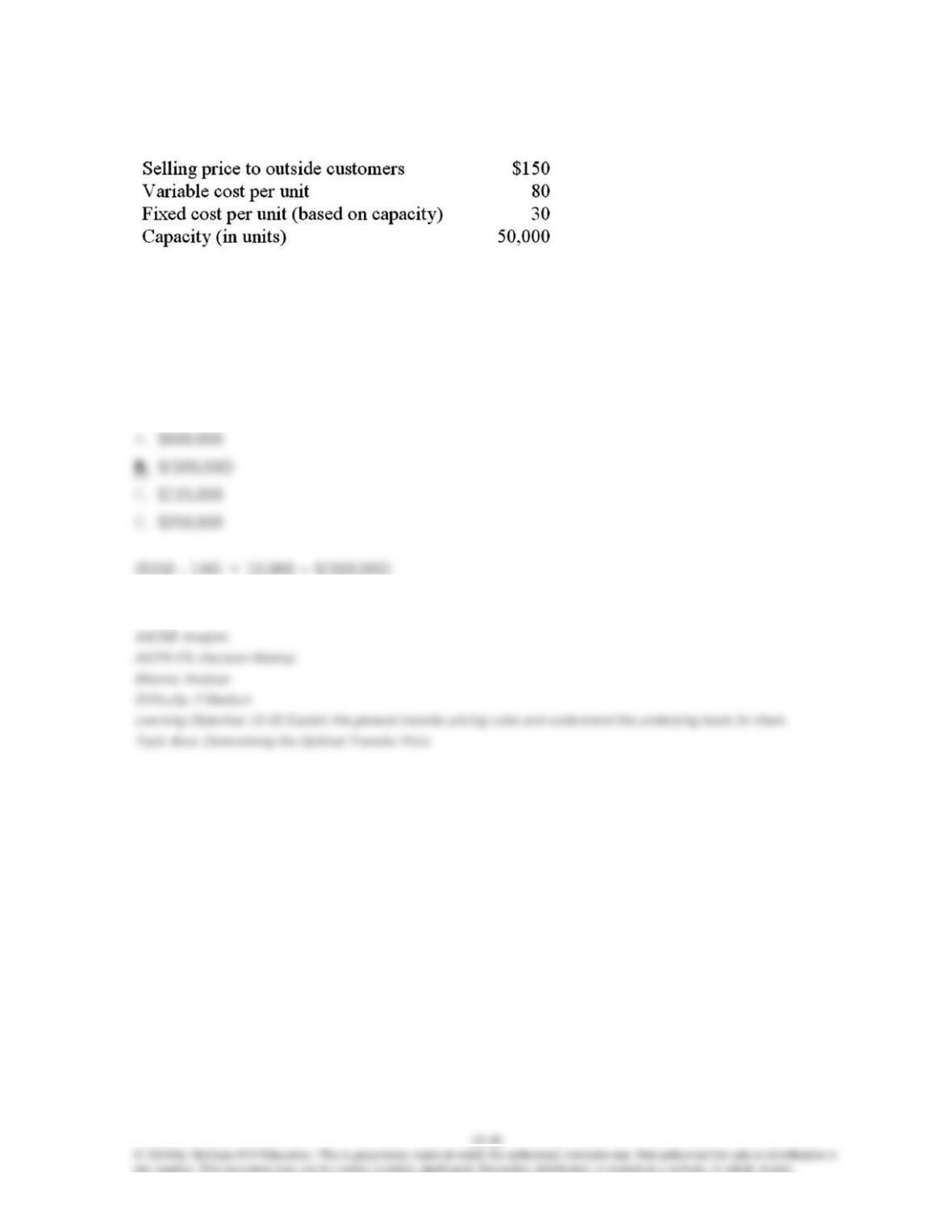
49. Given the following data for Division A:
Assume that Division A is selling all it can produce to outside customers. If it sells to Division B,
$1 can be avoided in variable cost per unit. Division B is presently purchasing from an outside
supplier at $38 per unit. From the point of view of the company as a whole, any sales to Division B
should be priced at:
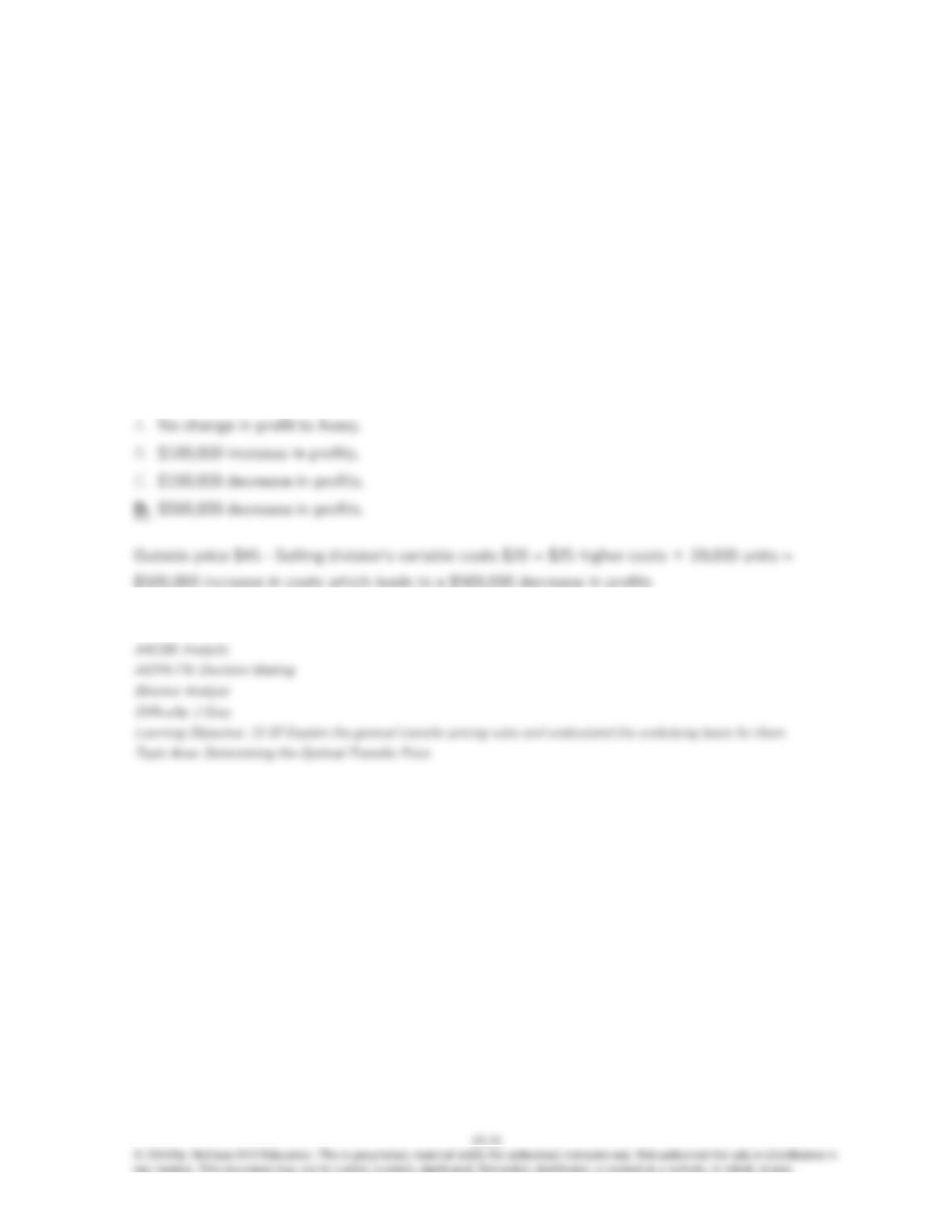
50. Given the following data for Division L:
Division N would like to purchase 10,000 units from Division L at a price of $125 per unit. Division
L has no excess capacity to handle Division N’s requirements. Division N currently purchases from
an outside supplier at a price of $140. If Division L accepts a $125 price internally, the company,
as a whole, will be better or worse off by:
51. Avery Corporation has two divisions, A and B, which are both organized as profit centers;
Division A produces and sells widgets to Division B and to outside customers. Division A has total
costs of $35, $20 of which are variable. Division A is operating significantly below capacity and
sells the widgets for $50.
Division B has received an offer from an outsider vendor to supply all the widgets it needs (20,000
widgets) at a cost of $45. The manager of Division B is considering the offer but wants to
approach Division A first.
What would be the profit impact to Avery Corporation as a whole if Division B purchased the
20,000 widgets it needs from the outside vendor for $45?
52. Avery Corporation has two divisions, A and B, which are both organized as profit centers;
Division A produces and sells widgets to Division B and to outside customers. Division A has total
costs of $35, $20 of which are variable. Division A is operating significantly below capacity and
sells the widgets for $50.
Division B has received an offer from an outsider vendor to supply all the widgets it needs (20,000
widgets) at a cost of $45. The manager of Division B is considering the offer but wants to
approach Division A first.
What is the minimum transfer price from Division A to Division B?
53. Avery Corporation has two divisions, A and B, which are both organized as profit centers;
Division A produces and sells widgets to Division B and to outside customers. Division A has total
costs of $35, $20 of which are variable. Division A is operating significantly below capacity and
sells the widgets for $50.
Division B has received an offer from an outsider vendor to supply all the widgets it needs (20,000
widgets) at a cost of $45. The manager of Division B is considering the offer but wants to
approach Division A first.
What is the maximum transfer price from Division A to Division B?
54. Cruises, Inc., operates two divisions: (1) a management division that owns and manages
cruise ships in the Florida Keys and (2) a repair division that operates a dry dock in Marble Sand
Florida. The repair division works on company ships, as well as other large-hull ships.
The repair division has an estimated variable cost of $28.50 per labor-hour. The repair division has
a backlog of work for outside ships. They charge $48.00 per hour for labor, which is standard for
this type of work. The management division complained that it could hire its own repair workers
for $30.00 per hour, including leasing an adequate work area.
What is the minimum transfer price per hour that the repair division should obtain for its services,
assuming it is operating at capacity?
55. Cruises, Inc., operates two divisions: (1) a management division that owns and manages
cruise ships in the Florida Keys and (2) a repair division that operates a dry dock in Marble Sand
Florida. The repair division works on company ships, as well as other large-hull ships.
The repair division has an estimated variable cost of $28.50 per labor-hour. The repair division has
a backlog of work for outside ships. They charge $48.00 per hour for labor, which is standard for
this type of work. The management division complained that it could hire its own repair workers
for $30.00 per hour, including leasing an adequate work area.
What is the maximum transfer price per hour that the management division should pay?
56. Cruises, Inc., operates two divisions: (1) a management division that owns and manages
cruise ships in the Florida Keys and (2) a repair division that operates a dry dock in Marble Sand
Florida. The repair division works on company ships, as well as other large-hull ships.
The repair division has an estimated variable cost of $28.50 per labor-hour. The repair division has
a backlog of work for outside ships. They charge $48.00 per hour for labor, which is standard for
this type of work. The management division complained that it could hire its own repair workers
for $30.00 per hour, including leasing an adequate work area.
If the repair division had idle capacity, what is the minimum transfer price that the repair division
should obtain?
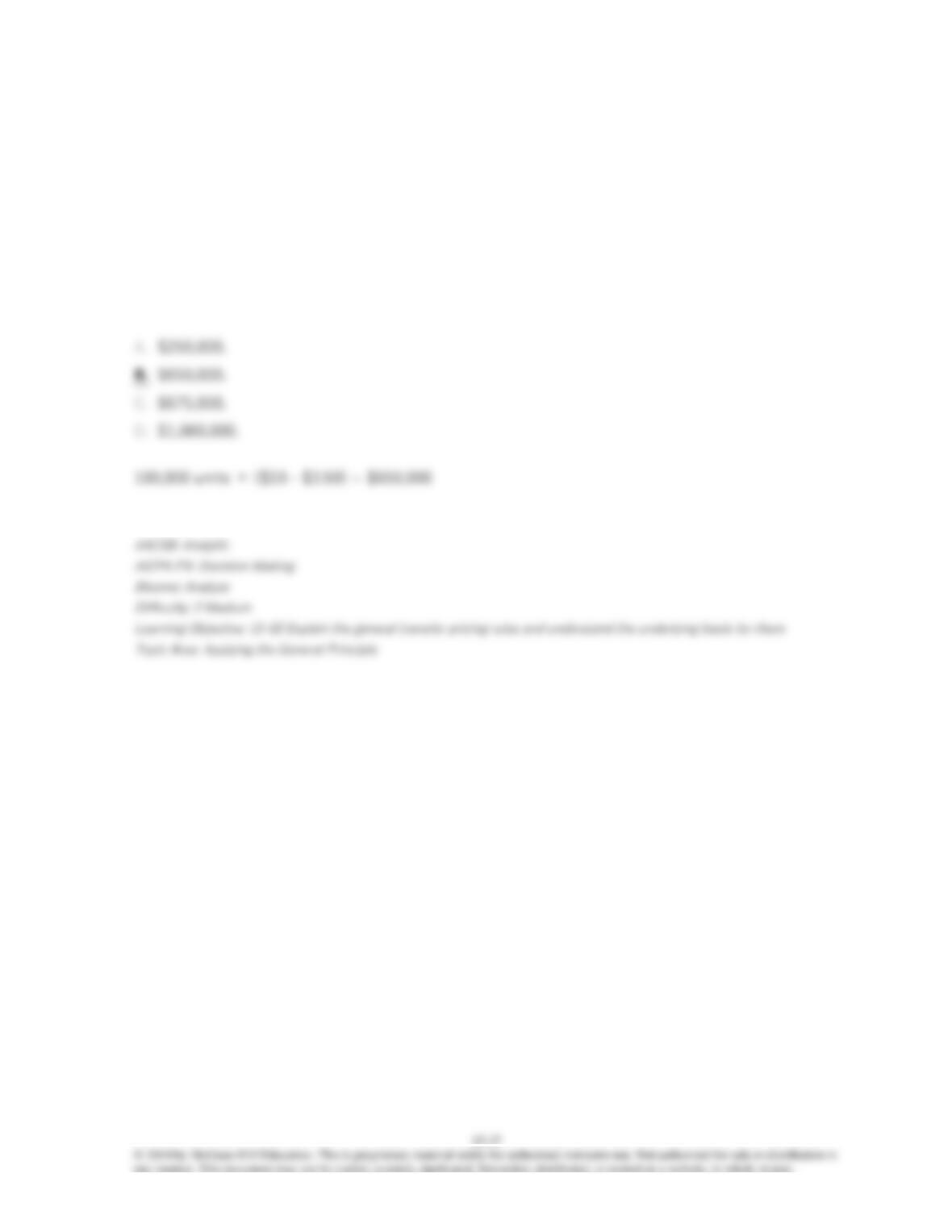
57. Flowers and Flowers, Inc., has two divisions. Division A has an investment base of
$750,000 and produces (and sells) 100,000 units of Eyne at a market price of $10.00 per unit.
Variable costs total $3.50 per unit, and fixed charges are $4.00 per unit (based on a capacity of
120,000 units). Division B wants to purchase 25,000 units of Eyne from Division A. However,
Division B is only willing to pay $6.75 per unit.
What is the contribution margin for Division A without the transfer to Division B?
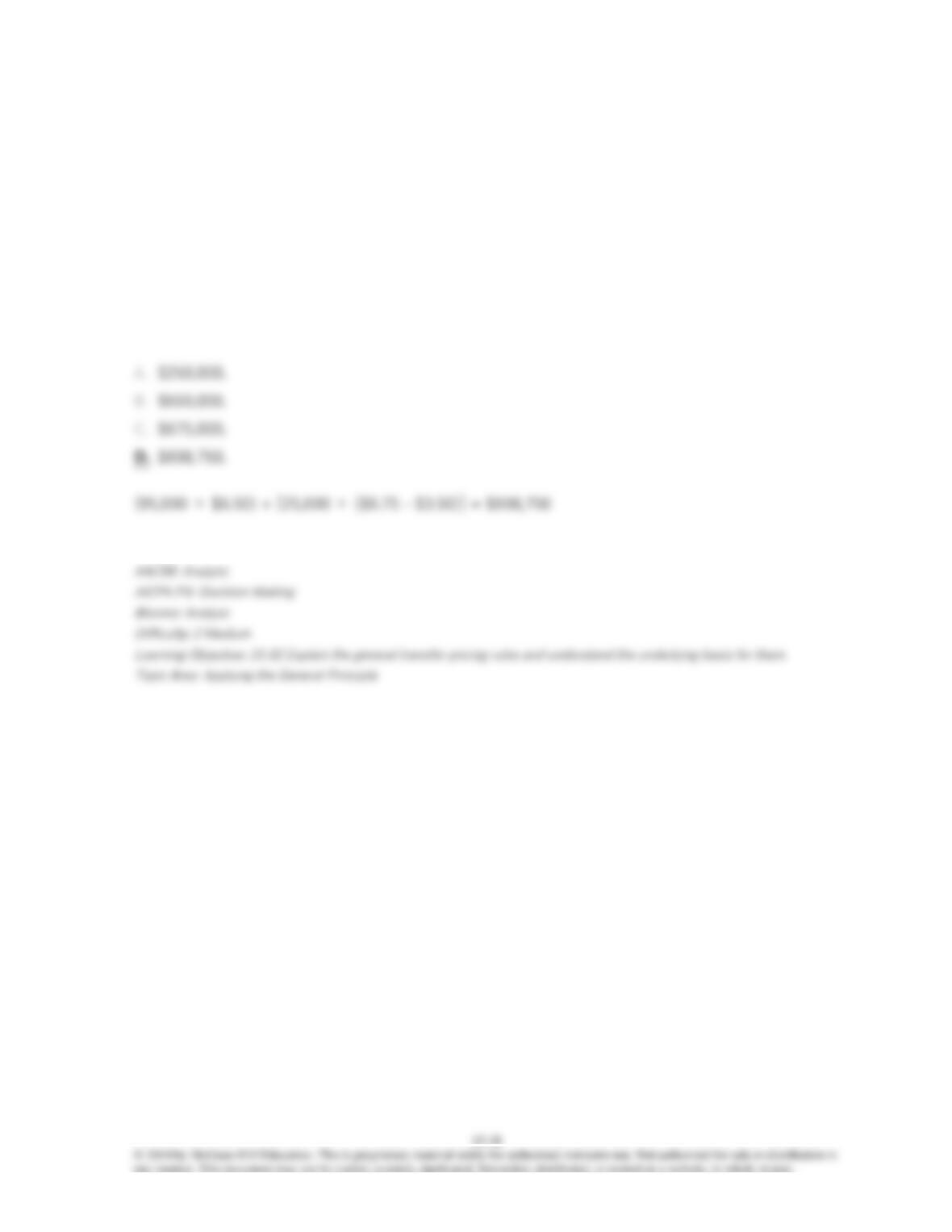
58. Flowers and Flowers, Inc., has two divisions. Division A has an investment base of
$750,000 and produces (and sells) 100,000 units of Eyne at a market price of $10.00 per unit.
Variable costs total $3.50 per unit, and fixed charges are $4.00 per unit (based on a capacity of
120,000 units). Division B wants to purchase 25,000 units of Eyne from Division A. However,
Division B is only willing to pay $6.75 per unit.
What is the contribution margin for Division A if it transfers 25,000 units to Division B at $6.75 per
unit?
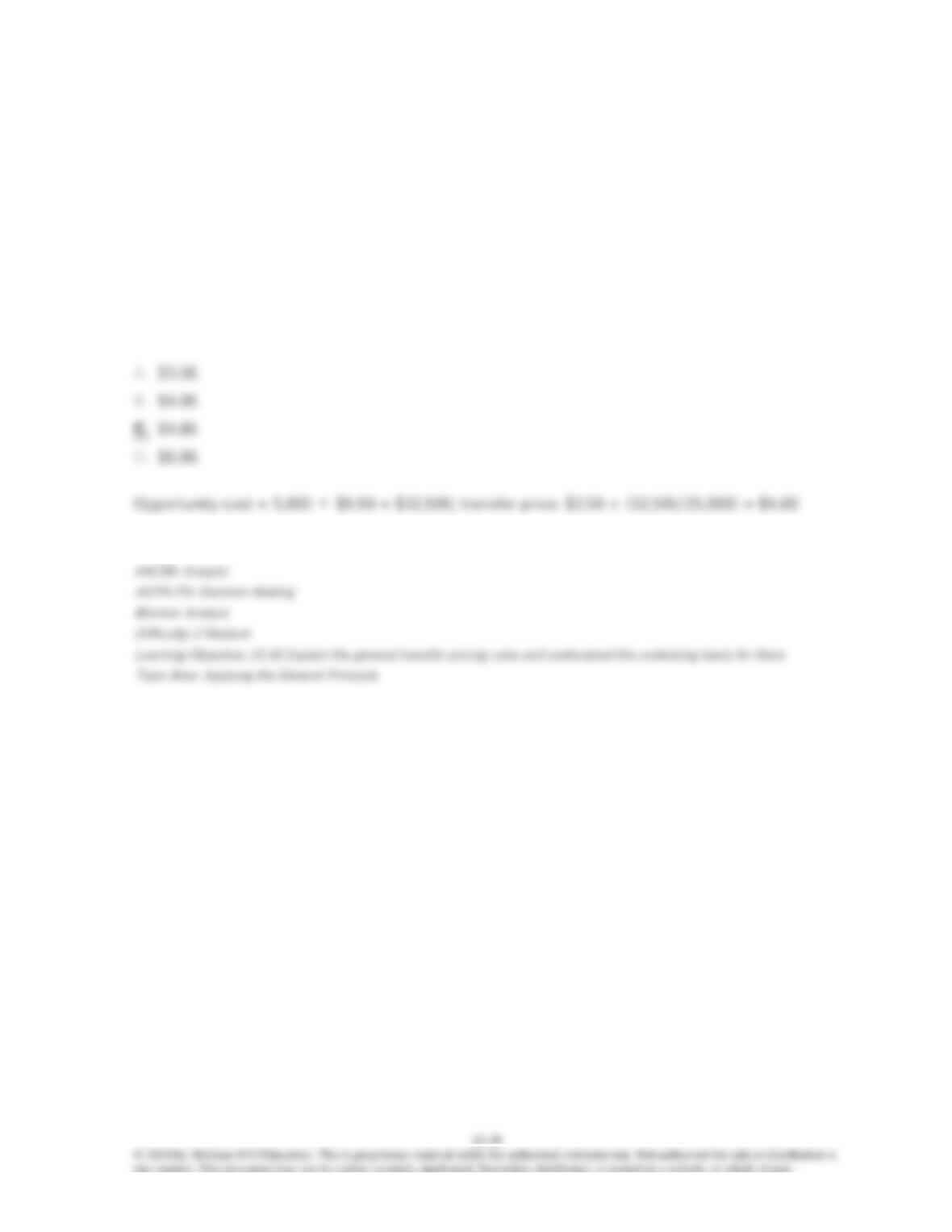
59. Flowers and Flowers, Inc., has two divisions. Division A has an investment base of
$750,000 and produces (and sells) 100,000 units of Eyne at a market price of $10.00 per unit.
Variable costs total $3.50 per unit, and fixed charges are $4.00 per unit (based on a capacity of
120,000 units). Division B wants to purchase 25,000 units of Eyne from Division A. However,
Division B is only willing to pay $6.75 per unit.
What is the minimum transfer price for the 25,000 unit order that Division A would accept if it
wishes to maintain its pre-order contribution?
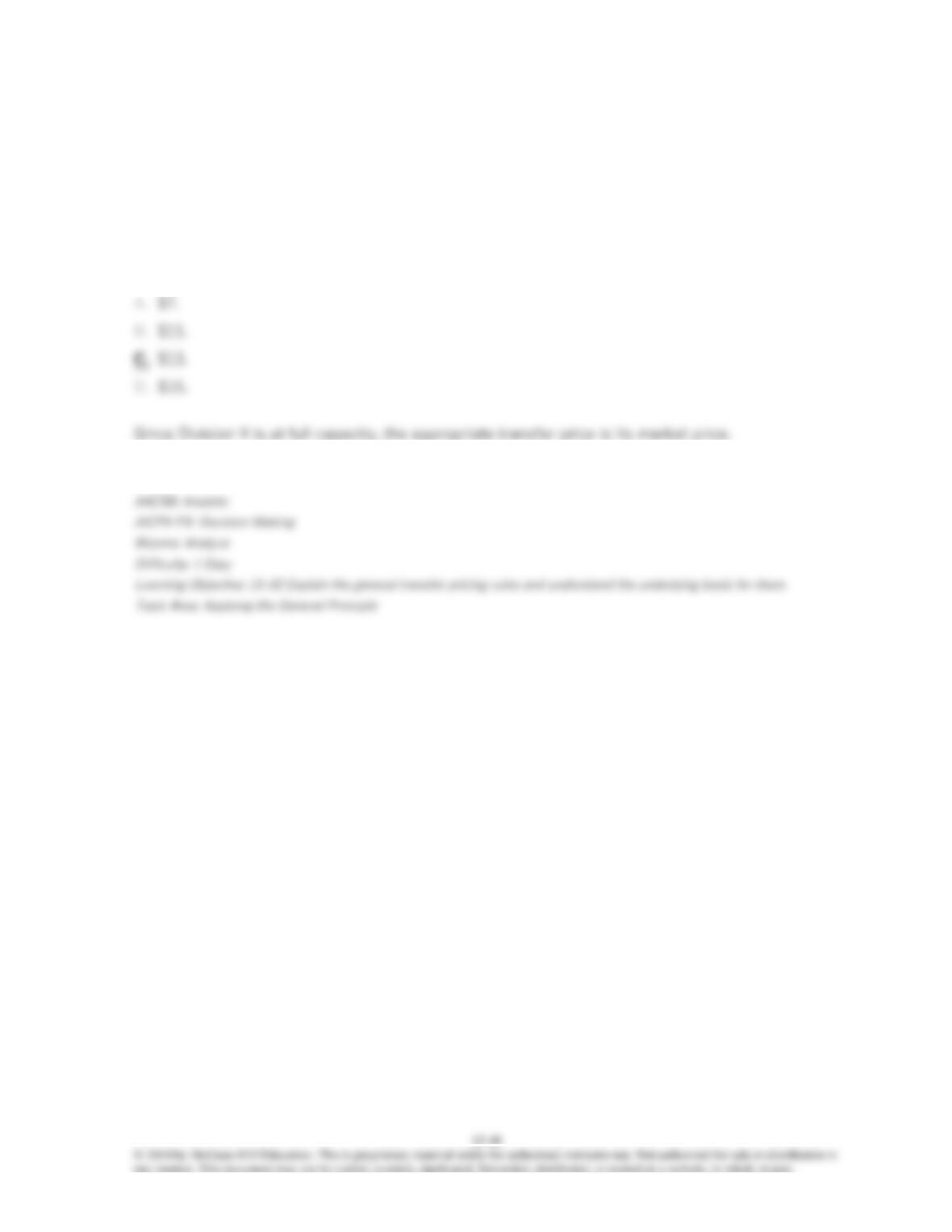
60. A company is highly centralized. Division X, which is operating at capacity, produces a
component that it currently sells in a perfectly competitive market for $13 per unit. At the current
level of production, the fixed cost of producing this component is $4 per unit and the variable cost
is $7 per unit. Division Y would like to purchase this component from Division X. The price that
Division X should charge Division Y per unit for this component is: