Chapter 15 – Target Costing and Cost Analysis for Pricing Decisions
15-1
Chapter 15
Target Costing and Cost Analysis for Pricing Decisions
Answer Key
True / False Questions
1. Setting prices requires a balance between cost considerations and market forces.
2. Due to cost-based pricing, an organization or industry can price its products below their
production costs indefinitely.
3. The revenue curve shows the relationship between the sales price and quantity sold.
Chapter 15 – Target Costing and Cost Analysis for Pricing Decisions
15-2
4. The marginal revenue curve shows the relationship between the change in total revenue that
accompanies a change in quantity sold.
5. If a company uses a cost-plus approach to pricing, it will find that there are several different
definitions of cost and the higher the cost, the higher the markup percentage.
6. A firm typically uses only one of the three cost-plus pricing formulas.
Chapter 15 – Target Costing and Cost Analysis for Pricing Decisions
15-3
7. Penetration pricing is a pricing strategy in which a new product’s initial price is set
relatively low in order to gain a large market share.
8. Skimming pricing is another name for penetration pricing.
9. Matton Corporation manufactures a single product that has a cost of $350. The company
uses a 70% markup on cost to arrive at a selling price of $595, which results in a price that
virtually always exceeds that of the market leaders. If Matton changes to the approach known
as target costing, the company will first undertake a thorough study of competitors’ prices.
Chapter 15 – Target Costing and Cost Analysis for Pricing Decisions
15-4
10. Target costing involves four key principles.
11. When a computer-integrated manufacturing (CIM) system is used, the process of target
costing sometimes is computerized.
12. When activity-based costing is integrated with target costing, a product’s projected costs
always go up.
Chapter 15 – Target Costing and Cost Analysis for Pricing Decisions
15-5
13. In many cases, traditional, volume based product costing may overcost low-volume and
complex products, while undercosting high-volume and relatively simple products.
14. Cost distortion can occur under the target-costing approach.
15. Value engineering is an outgrowth of target costing.
Chapter 15 – Target Costing and Cost Analysis for Pricing Decisions
15-6
16. Much of the historical development of the target-costing approach has taken place in
German industry.
17. Under the time and material pricing approach, the company determines one charge for the
labor used on a job, another charge for the materials, and then averages the two to apply one
charge for everything.
18. Time and material pricing is used widely by construction companies.
Chapter 15 – Target Costing and Cost Analysis for Pricing Decisions
15-7
19. In a competitive bidding situation where all of the companies submitting bids offer a
roughly equivalent product or service, the amount of variable overhead becomes the sole
criterion for selecting the contractor.
20. When a firm has excess capacity, a price that covers the incremental costs incurred
because of the job will contribute toward covering the company’s fixed cost and profit.
21. The law prohibits price discrimination of quoting different prices to different customers
for the same product or service, but it permits predatory pricing to establish initial markets.
Chapter 15 – Target Costing and Cost Analysis for Pricing Decisions
15-8
22. One of the Congressional acts that restricts certain types of pricing behavior is the
Robinson-Patman Act.
Chapter 15 – Target Costing and Cost Analysis for Pricing Decisions
15-9
Multiple Choice Questions
23. Which of the following can influence a company’s pricing decisions?
24. Which of the following choices correctly denotes factors that can influence a company’s
pricing practices for goods and services?
Market Conditions
Costs
Customer Demand
A.
No
Yes
Yes
No
Yes
Yes
Yes
D.
Yes
Yes
Chapter 15 – Target Costing and Cost Analysis for Pricing Decisions
15–10
25. Which of the following is not a major influence on pricing decisions?
26. Consider the following statements about pricing:
I. Prices are often determined by the market, subject to the constraint that costs must be
covered in the long run.
II. Prices are often based on costs, subject to the constraint that customers and competitors
will exert an influence.
III. A balance of market forces and cost is important when making pricing decisions.
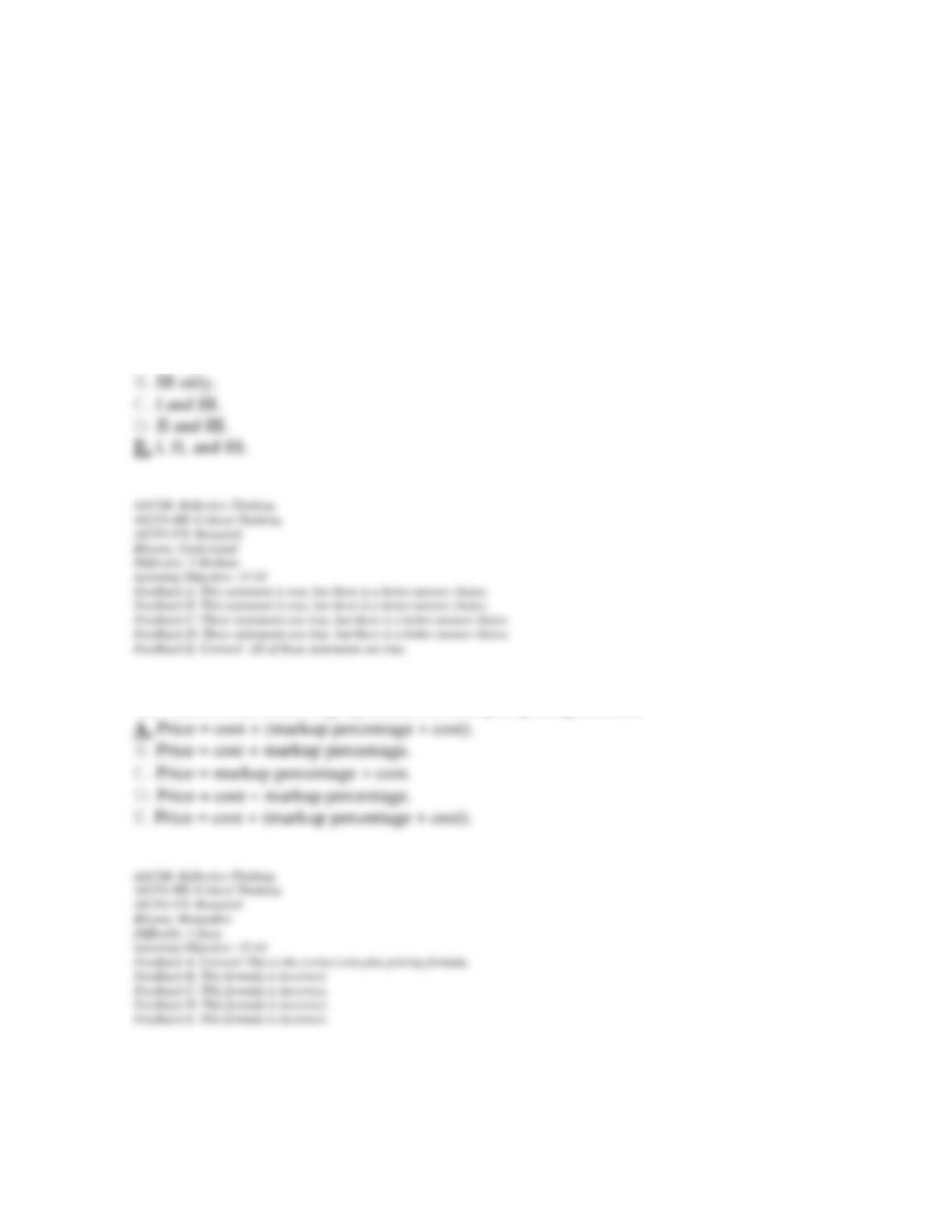
Which of the above statements is (are) true?
A. I only.
Chapter 15 – Target Costing and Cost Analysis for Pricing Decisions
15–11
27. The curve that shows the relationship between the sales price and quantity sold is called
the:
A. marginal revenue curve.
28. The curve that shows the relationship between the total sales revenue and quantity sold is
called the:
A. marginal revenue curve.
Chapter 15 – Target Costing and Cost Analysis for Pricing Decisions
15–12
29. On a graph where the horizontal axis represents quantity sold and the vertical axis
represents selling price, the basic demand curve in a competitive market can be graphed:
A. as a horizontal line.
30. The curve that shows the change in total revenue that accompanies a change in quantity
sold is called the:
Chapter 15 – Target Costing and Cost Analysis for Pricing Decisions
15–13
31. The curve that shows the change in total cost that accompanies a change in quantity
produced and sold is called the:
A. marginal revenue curve.
32. From an economic perspective, a company’s profit-maximizing quantity is found where:
A. the total cost curve intersects with the marginal cost curve.
Chapter 15 – Target Costing and Cost Analysis for Pricing Decisions
15–14
33. If the volume sold reacts strongly to changes in price, demand:
A. has no elasticity.
34. Under which of the following condition(s) are prices said to be elastic?
Price Change
Change in Sales Volume
A.
Increase
Sizable increase
Either increase or decrease
Either sizable increase or decrease
Chapter 15 – Target Costing and Cost Analysis for Pricing Decisions
15–15
35. Which of the following statements regarding price elasticity is false?
A. The concept of price elasticity is an extension of the economic pricing model.
36. Prices are said to be inelastic under which of the following conditions?
Price Change
Change in Sales Volume
Chapter 15 – Target Costing and Cost Analysis for Pricing Decisions
15–16
37. Consider the following statements regarding the economic pricing model:
I. The economic model is limited in use because a firm’s demand curve is difficult to
determine.
II. The marginal revenue and marginal cost model is valid for all forms of market
organization (perfect competition, oligopoly, and so forth).
III. Cost accounting systems are not designed to measure the marginal changes in cost
incurred as production and sales increase.
Which of the above statements is (are) true?
38. In a typical business, the firm’s overall demand would be influenced by interactions of
pricing policies and:
Chapter 15 – Target Costing and Cost Analysis for Pricing Decisions
15–17
39. Consider the following statements about why prices are often based on product costs:
I. Companies sell many products and services, and cost-based approaches provide a simple
and direct pricing method.
II. The cost of a product or service provides a lower limit or floor, below which price should
not be set in the long run.
III. Determining a company’s demand and marginal revenue curves is difficult, costly, and
time consuming.
Which of the above statements is (are) true?
A. I only.
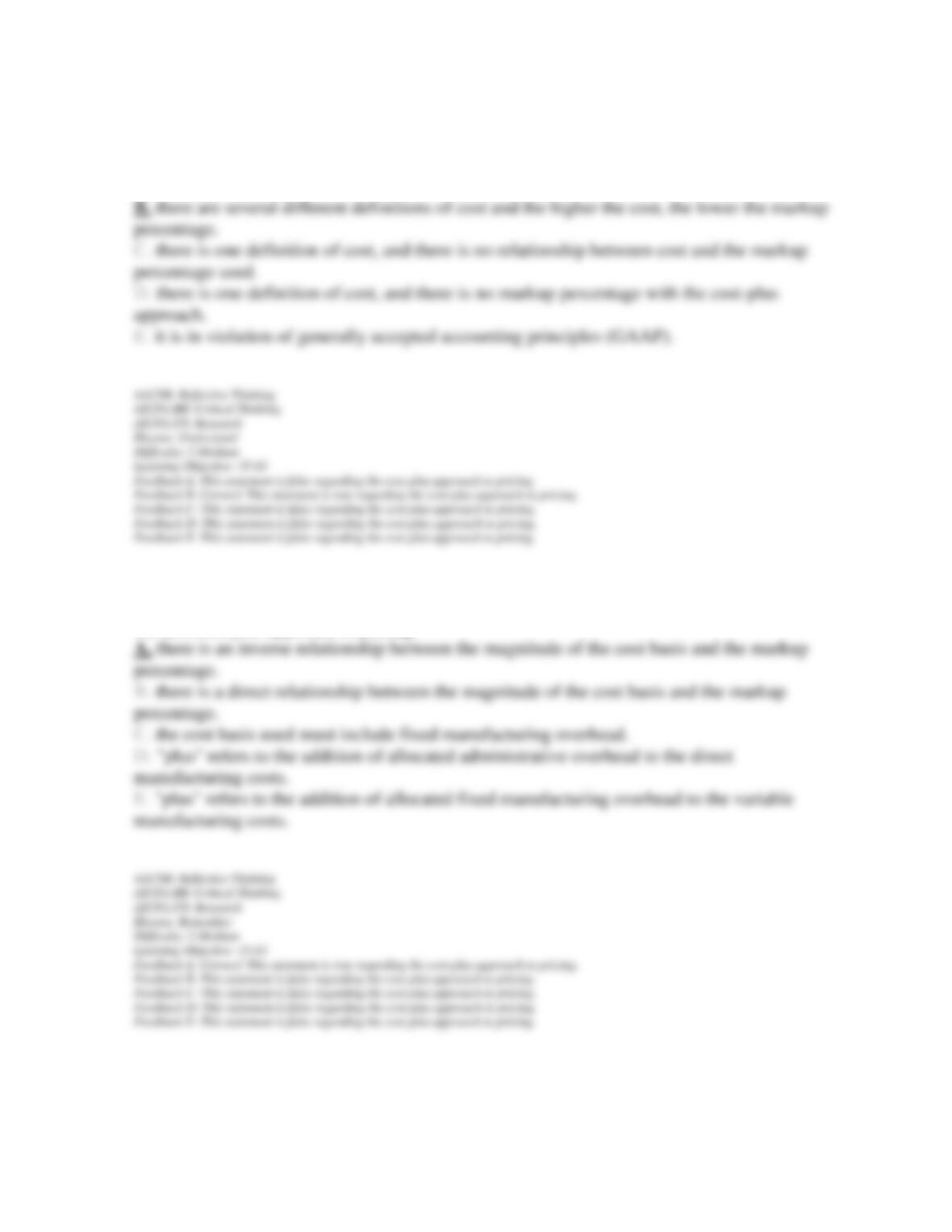
40. Which of the following represents the cost-plus pricing formula?
Chapter 15 – Target Costing and Cost Analysis for Pricing Decisions
15–18
41. If a company uses a cost-plus approach to pricing, it will find:
A. there are several different definitions of cost and the higher the cost, the higher the markup
percentage.
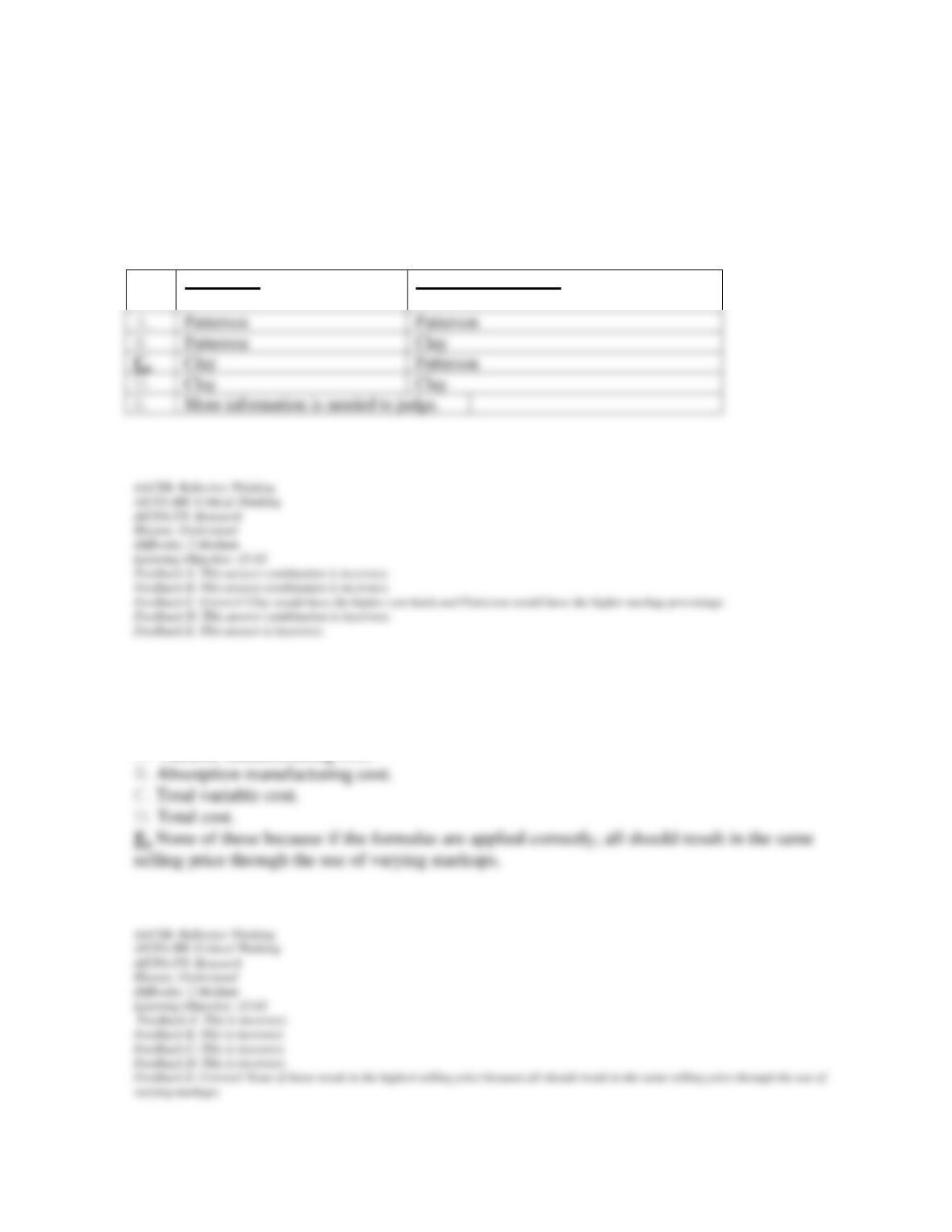
42. In a cost-plus approach to pricing:
Chapter 15 – Target Costing and Cost Analysis for Pricing Decisions
15–19
43. Patterson and Clay Companies both use cost-plus pricing formulas and arrived at a selling
price of $1,000 for the same product. Patterson uses absorption manufacturing cost as the
basis for computing its dollar markup whereas Clay uses total cost. Which of the following
choices correctly denotes the company that would have (1) the higher cost basis for deriving
its dollar markup and (2) the higher markup percentage?
Cost Basis
Markup Percentage
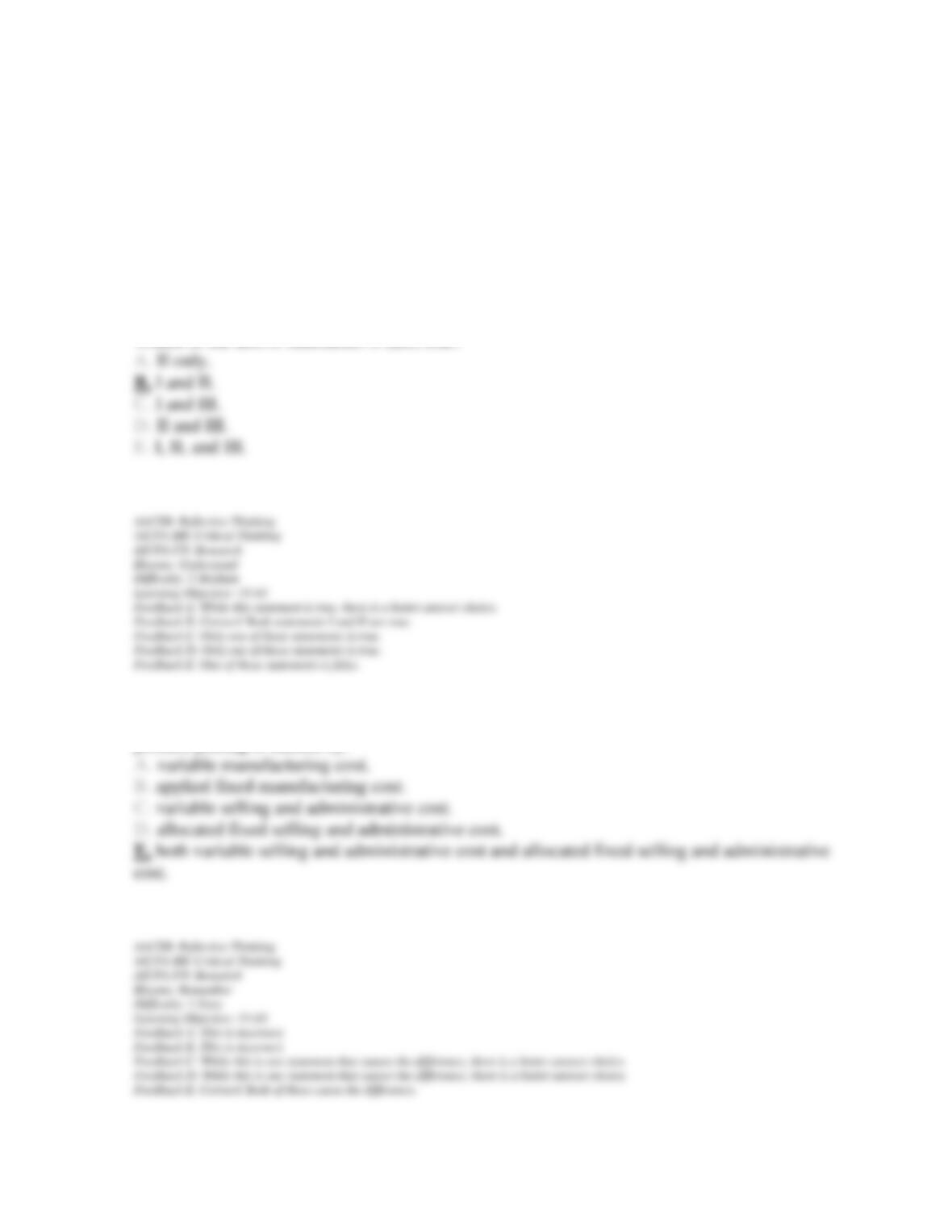
44. Durango Industries employs cost-plus pricing formulas to derive selling prices for its
various products. If the formulas are all used correctly, which of the following cost bases will
result in the highest selling price?
A. Variable manufacturing cost.
Chapter 15 – Target Costing and Cost Analysis for Pricing Decisions
15–20
45. Consider the following statements about absorption-cost pricing formulas:
I. Absorption-cost formulas consider a company’s fixed manufacturing costs when
establishing a selling price.
II. Absorption-cost formulas are often justified on the grounds that a company must cover all
of its costs in the long run.
III. Absorption-cost data are the type that managers need when facing certain pricing
decisions, such as whether or not to accept a special order.
Which of the above statements is (are) true?
46. The difference between absorption manufacturing cost and total cost with respect to
product pricing is caused by: