92. When a long-term non-interest-bearing note is exchanged solely for cash, the difference between the cash
received and the face value of the note is recorded as
93. If a company sells its 20-year bonds at a premium, the premium account should be reported on the balance
sheet as a(n)
94. Exhibit 14-10
Elaine, Inc. issued a seven-year non-interest-bearing note with a face value of $20,000 and received $11,670.
Actuarial information for seven periods is as follows:
PV of $1
PV of an Annuity
6%
7%
8%
6%
7%
8%
0.665057
0.622750
0.583490
5.5824
5.3893
5.2064
Refer to Exhibit 14-10. The implied interest rate is
95. Exhibit 14-10
Elaine, Inc. issued a seven-year non-interest-bearing note with a face value of $20,000 and received $11,670.
Actuarial information for seven periods is as follows:
PV of $1
PV of an Annuity
6%
7%
8%
6%
7%
8%
0.665057
0.622750
0.583490
5.5824
5.3893
5.2064
Refer to Exhibit 14-10. Interest expense for the first year is
96. When a company issues a long-term non-interest-bearing note payable in exchange for cash and special
rights, the difference between the cash proceeds and the present value of the note is recorded as
97. Exhibit 14-11
Hernandez, Ltd. issued a three-year, $100,000, non-interest-bearing note to a customer on January 1, 2010.
Hernandez also agrees to sell inventory to the customer at reduced rates over a five-year period. Hernandez’s
incremental interest rate is 10%, and the present value of the note is $75,132.
Refer to Exhibit 14-11. Hernandez’s total liabilities after recording the note have increased by
98. Exhibit 14-11
Hernandez, Ltd. issued a three-year, $100,000, non-interest-bearing note to a customer on January 1, 2010.
Hernandez also agrees to sell inventory to the customer at reduced rates over a five-year period. Hernandez’s
incremental interest rate is 10%, and the present value of the note is $75,132.
Refer to Exhibit 14-11. Hernandez’s interest expense for 2011 is
99. Exhibit 14-11
Hernandez, Ltd. issued a three-year, $100,000, non-interest-bearing note to a customer on January 1, 2010.
Hernandez also agrees to sell inventory to the customer at reduced rates over a five-year period. Hernandez’s
incremental interest rate is 10%, and the present value of the note is $75,132.
Refer to Exhibit 14-11. Hernandez’s sales revenue connected with the note in 2010 is
100. Exhibit 14-11
Hernandez, Ltd. issued a three-year, $100,000, non-interest-bearing note to a customer on January 1, 2010.
Hernandez also agrees to sell inventory to the customer at reduced rates over a five-year period. Hernandez’s
incremental interest rate is 10%, and the present value of the note is $75,132.
Refer to Exhibit 14-11. If the face value of a note is materially different from the cash sales price of the
property it was exchanged for, and the note is recorded at its present value, the correct interest rate to use is the
101. The proper treatment of loan origination fees is to
102. On January 1, 2010, Tran, Inc. rendered services to another company at an agreed price of $80,000. Tran
received a $20,000 cash down payment and a note for the balance. The note was non-interest-bearing and was
to be paid off in three equal installments beginning December 31, 2010. An assumed 11% interest rate is
implicit in the agreement. Actual information for 11%, three periods, follows:
Present value of 1
0.73119
Present value of annuity of 1
2.44371
What amount of interest revenue should Tran record in 2011?
103. Which statement is not true when a long-term note is issued for cash plus some right or privilege?
104. In June 2010, Gross Corporation issued a three-year non-interest-bearing note with a face value of $15,000
and received cash of $11,025.00 in exchange. The difference between the face value and the cash proceeds is
accounted for as
105. Under current GAAP, the rate of interest assigned to non-interest-bearing notes is
106. The rate of interest used to compute the present value of an impaired note is the
107. Related to long-term liabilities, reading the notes to the financial statements is important because they
contain
108. The journal entry to recognize the impairment of a note receivable includes a
109. A note receivable is considered impaired when
110. Which of the following is not an acceptable measure of the impairment of a note receivable?
111. The entry to record interest revenue on an impaired note receivable is computed each period by
multiplying the
112. Which of the following conditions might be included in a troubled debt restructuring?
113. In a troubled debt restructuring that involves only a modification of terms, if the amount to be repaid is
greater than the current carrying value of the liability
114. After a troubled debt restructuring, which does not have to be disclosed by the debtor?

115. Easy Corp. owes Hard, Inc., $30,000 on a note payable, plus $1,800 interest. Hard agrees to accept 400
shares of Easy common stock in full settlement of the debt. Easy stock has a par value of $10 and a current
market value of $70 per share. As a result of the debt restructuring, Easy Corp. should record an
116. Exhibit 14-12
Shaw owes Lawrence Co. $15,000 on a note payable, plus $3,000 of unpaid interest. Lawrence agrees to accept
equipment in full settlement of the debt. The equipment is recorded on Shaw’s books at $12,000, and it is
currently worth $14,200.
Refer to Exhibit 14-12. What total amount of ordinary gains should be recorded by Shaw on this troubled debt
restructuring?
117. Exhibit 14-12
Shaw owes Lawrence Co. $15,000 on a note payable, plus $3,000 of unpaid interest. Lawrence agrees to accept
equipment in full settlement of the debt. The equipment is recorded on Shaw’s books at $12,000, and it is
currently worth $14,200.
Refer to Exhibit 14-12. What total amounts of extraordinary gains should be recorded by Shaw on this troubled
debt restructuring?
118. On December 31, 2010, Martha Ltd. owes Stewart Corp. $50,000 on a 10% note payable. Two years of
interest is also unpaid and due. Martha cannot pay off the debt. Stewart agrees to reduce the principal amount to
$30,000, extend the due date to December 31, 2013, and reduce the interest rate to 5% per year for the extended
period. What amount of gain on restructuring should Martha record?
119. The interest rate used by the creditor to discount the future cash flows of an investment in a restructured
loan is the
120. The creditor of a restructured loan calculates interest revenues during the periods after restructuring based
on the
121. The bonds outstanding method of amortizing a discount on serial bonds
122. Exhibit 14-13
On January 1, 2010, Marty Co. issued $80,000 of serial bonds that pay 9% interest annually. Each December
31, $16,000 of the bonds comes due. The bonds were issued for $84,800.
Refer to Exhibit 14-13. If the bonds outstanding method is in use, what would be the total amount of interest
expense for 2012?
123. Exhibit 14-13
On January 1, 2010, Marty Co. issued $80,000 of serial bonds that pay 9% interest annually. Each December
31, $16,000 of the bonds comes due. The bonds were issued for $84,800.
Refer to Exhibit 14-13. On January 1, 2011, Marty Co. redeemed at 98 the issue coming due on December 31,
2011. What amount of gain or loss should be recorded on this early bond redemption?
124. On January 1, 2010, Reece Co. issued $120,000 of 14% serial bonds for $114,540. The bonds are to be
redeemed at the rate of $30,000 per year, beginning January 1, 2012. Using the bonds outstanding method, what
would be total interest expense for 2010?
125. IFRS require which of the following that is not required by GAAP?
126. Because of a difference between IFRS and GAAP with respect to the classification of an instrument as a
financial liability or as equity, certain instruments classified as liabilities under IFRS may be, under GAAP,
127. While IFRS require separate financial reporting of the separate components of all compound instruments,
GAAP requires separate financial reporting of the components of all of the following compound instruments
except
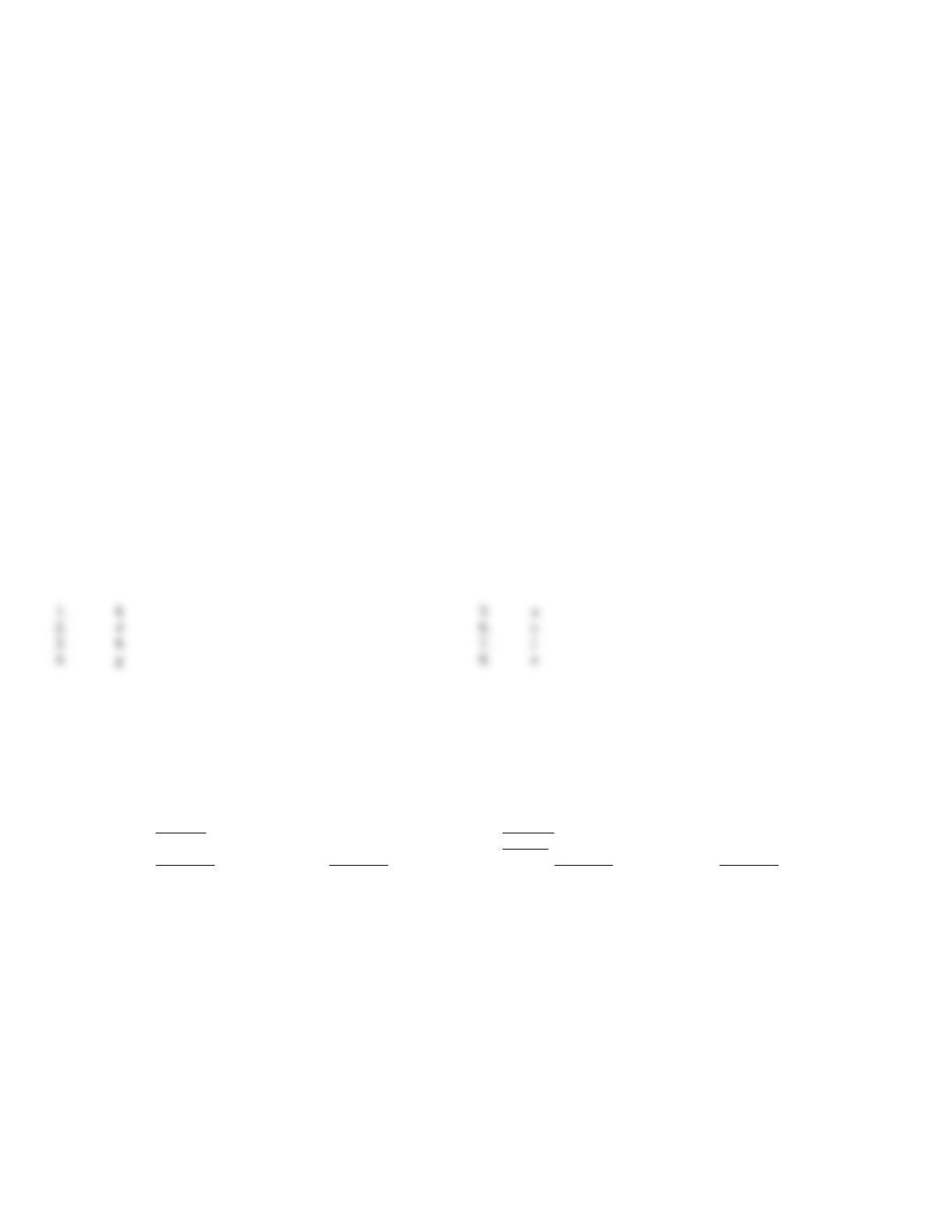
128. Match each of the following bond classifications (a-h) with the appropriate characteristic (1-8) by entering
the appropriate letter in the space provided.
a.
Debenture bonds
e.
Zero-coupon bonds
b.
Mortgage bonds
f.
Callable bonds
c.
Registered bonds
g.
Convertible bonds
d.
Coupon bonds
h.
Serial bonds
____
1.
Portions of the bond mature in periodic installments.
____
2.
Unregistered bonds.
____
3.
Bonds that are secured by a lien against specific assets.
____
4.
Bonds that can be exchanged for a predetermined number of shares of stock.
____
5.
Bonds whose marketability is based on the general credit rating of the issuing company.
____
6.
Bonds whose interest is paid to the individuals listed in the corporate records as owners of the bonds.
____
7.
Bonds that the company has the right to retire before their maturity date.
____
8.
Bonds on which no interest is paid until the maturity date.
129. On April 1, 2010, a $300,000, ten-year, 12% bond was sold to yield 14% plus accrued interest. The bond
was dated January 1, 2010, and interest is paid each January 1 and July 1. Present value data follow:
PV of $1
PV of an
Annuity
10 periods
20 periods
10 periods
20 periods
6%
0.558395
0.311805
7.360087
11.469921
7%
0.508349
0.258419
7.023582
10.594014
12%
0.321973
0.103667
5.650223
7.469444
14%
0.269744
0.072762
5.216116
6.623131
Required:
a.
Compute the amount of cash received from the sale of the bond.
b.
Prepare the journal entry to record the sale.
c.
When preparing the journal entry, you recorded a premium or discount. Why was this necessary?
1.
h
5.
a
2.
d
6.
c
4.
g
8.
e
130. A $700,000, 20-year, 14% bond issue was sold to yield 12%. Interest was payable annually. Actuarial
information for 20 periods follows:
12%
14%
Future value of 1
9.646
13.743
Present value of 1
0.104
0.073
Future value of annuity of 1
72.052
91.025
Present value of annuity of 1
7.469
6.623
Required:
Compute the amount of cash that was received when the bonds were issued.
$700,000 ´ 0.104 =
$ 72,800
$ 98,000 ´ 7.469 =
731,962
$804,762
$277,217.95, computed as follows:
$300,000 ´ 0.258419 =
$ 77,525.70
$ 18,000 ´ 10.594014 =
190,692.25
Price
$268,217.95
Interest 300,000 ´ .12 ´ 3/12 =
9,000.00
Total cash received
$277,217.95
Cash
277,217.95
Discount on Bonds Payable
31,782.05
Interest Expense
9,000
Bonds Payable
300,000
131. On January 1, 2010, the Qua Company issued $200,000 bonds with an 8% stated interest rate. Each $1,000
bonds pay interest on June 30 and December 31. The bonds are due on December 31, 2019.
Required:
a.
Assume the bonds were sold for $175,075.58 to yield 10%. Prepare a bond premium amortization schedule for the first yearof the bond
life using the effective interest method. Round all calculations to the nearest dollar.
b.
Prepare the journal entry for paying the interest on December 31, 2010.
c.
Why did these bonds originally sell at a discount?
132. On January 1, 2010, Smiley, Inc. issued $50,000 of its 12-year 10% bonds for $43,806. Interest is payable
annually and the effective yield was 12%. Issuance costs were $2,400.
Required:
a.
Prepare the entry to record the issuance of the bonds.
b.
Prepare the journal entry to record interest expense in 2011 using the effective interest method.
c.
Prepare the journal entry to record interest expense in 2012 using the straight-line method.
a.
(1)
(2)
(3)
(4)
Interest
Amortized
Cash
Expense
Discount
Book Value
Date
Credit
Debit
Credit
of Bonds
1/1/2010
$175,075.58
6/30/2010
$8,000
$8,753.78
$753.78
175,829.36
8,000
8,791.47
791.47
176,620.83
(1)
$200,000 ´ 0.08 ´ 6/12
(2)
Previous column (4) book
value ´ 0.10 ´ 6/12
b.
Bond Interest Expense
8,791.47
Discount on Bonds Payable
791.47
Cash
8,000.00
133. Raleigh, Inc. issued $400,000 of its ten-year zero-coupon bonds on January 1, 2010, to yield 12%. The
effective interest method is used.
PV of $1
PV of an Annuity
FV of $1
FV of an Annuity
12%
12%
12%
12%
10 periods
0.322
5.650
3.106
17.549
Required:
a.
Compute the cash proceeds from the sale of the bond.
b.
Prepare the journal entry to record the sale.
c.
Prepare the journal entry to record interest for 2011.
a.
Cash ($43,806 – $2,400)
41,406
Deferred Bond Issue Costs
2,400
Discount on Bonds Payable
6,194
Bonds Payable
50,000
b.
Bond Interest Expense
5,488
Deferred Bond Issue Costs
Discount on Bonds Payable
288*
Cash
5,000
*BV of Bonds
Int.
Int.
Disc.
@ Beg. of Yr.
Exp. (12%)
Pd.
Amort.
2010
43,806
5,257
5,000
257
2011
44,063
5,288
5,000
288
Deferred Bond Issue Costs
200*
Discount on Bonds Payable
516**
Cash
5,000
*
2,400/12 = $200 per year
6,194/12 = $516 per year
134. The Chicago Company issued $500,000 of 12% bonds on January 1, 2010. The bonds were sold for
$549,493, and they were expected to yield 10% interest compounded semiannually. The interest dates are June
30 and December 31. The maturity date of the bonds is December 31, 2016.
Required:
a.
Prepare the journal entry to record the issuance of the bonds.
b.
Using the effective interest method, prepare the journal entries to record the first two interest payments.
Cash
549,493.00
Bonds Payable
500,000.00
Premium on Bonds Payable
49,493.00
b.
Interest Expense ($549,493 ´ 0.10 ´ 6/12)
27,474.65
Cash
30,000.00
Interest Expense
[($549,493 – $2,525.35) ´ 0.10 ´ 6/12]
27,348.38
Premium on Bonds Payable
2,651.62
Cash
30,000.00
$400,000 ´ 0.322 = $128,800
Cash
128,800
Discount on Bonds Payable
271,200
Bond Interest Expense
17,311
of Yr.
2010
128,800
15,456
144,256
2011
144,256
17,311
161,567