196) An employee devises a payroll scheme that costs the employer $150. The employer
discovers the fraud but decides not to confront the employee since the amount of the fraud is
small. Discuss why this course of action is not advisable.
197) Define and contrast period costs and product costs. How are they reported in the financial
statements of a manufacturing company?
198) What are the three types of inventories that are carried by manufacturers? Describe each
type of inventory.
199) What is the main difference between the income statement of a manufacturer and that of a
merchandiser?
200) What does the days’ sales in raw materials inventory ratio reveal?
201) What are prime costs? What are conversion costs?
202) What are the components of the schedule of cost of goods manufactured? Describe each
component.
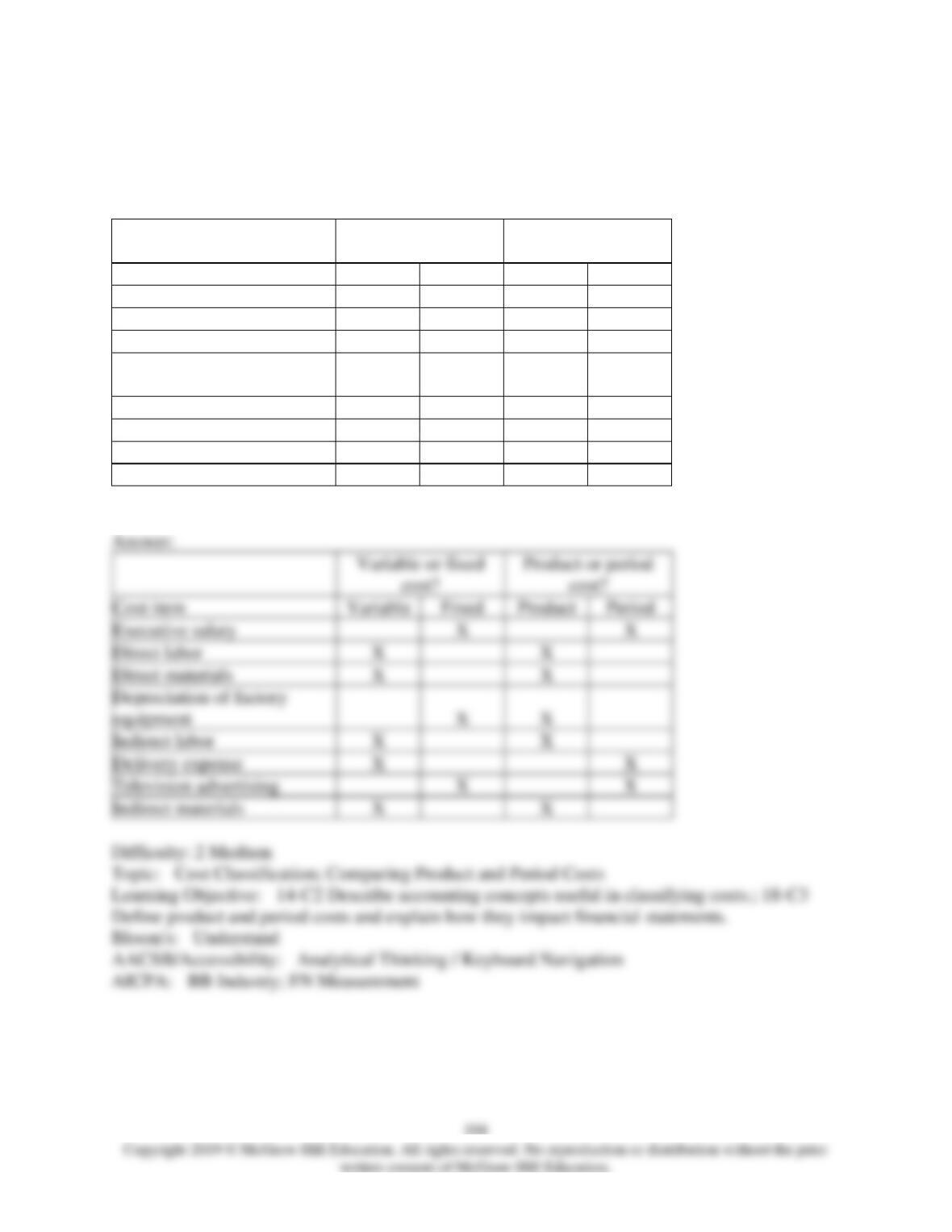
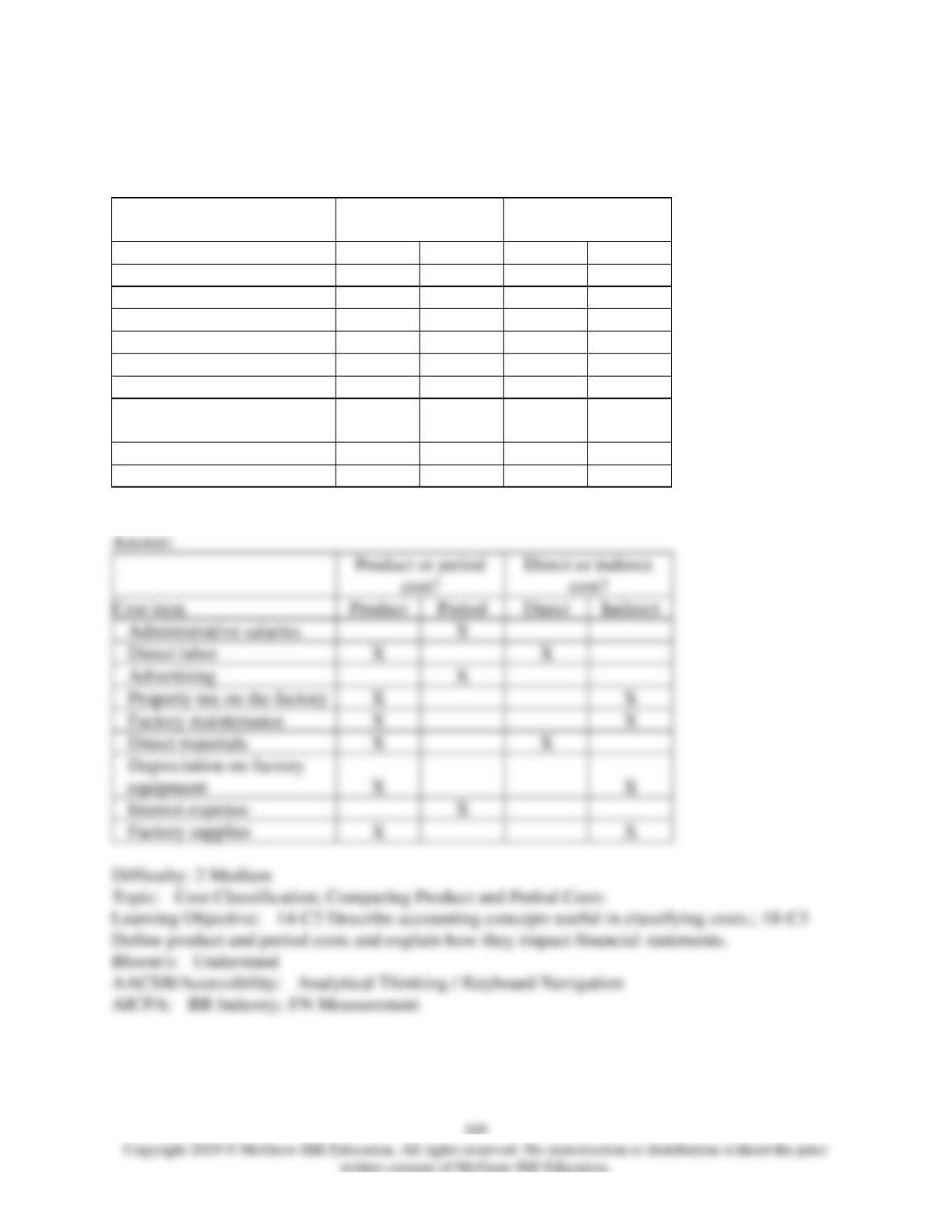
203) The following cost items relate to the Henning Company. Classify each cost as a variable
cost or a fixed cost by placing an X in the appropriate column. Each cost should be evaluated by
how it changes in total with changes in the volume of activity. Also indicate with an X for each
item if it is a product cost or a period cost.
Variable or fixed
cost?
Product or period
cost?
Cost item
Variable
Fixed
Product
Period
Executive salary
Direct labor
Direct materials
Depreciation of factory
equipment
Indirect labor
Delivery expense
Television advertising
Indirect materials
Variable or fixed
cost?
Product or period
cost?
Cost item
Variable
Fixed
Product
Period
Executive salary
Direct labor
Direct materials
Depreciation of factory
equipment
Indirect labor
Delivery expense
Television advertising
Indirect materials
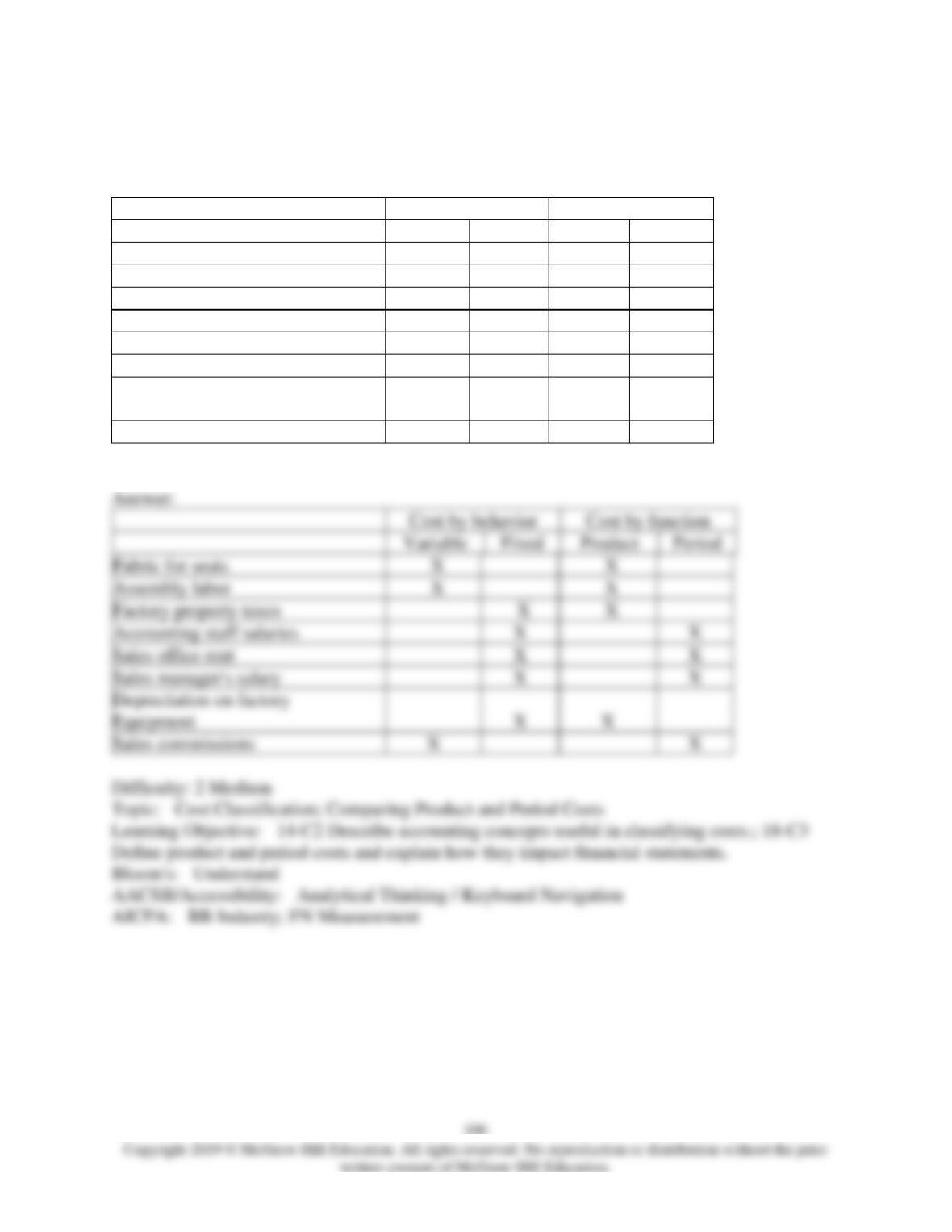
204) For each item shown below, classify it as a product cost or a period cost, by placing an X in
the appropriate column. For each item that is a product cost, also indicate whether it is a direct
cost or an indirect cost with respect to a unit of finished product.
Product or period
cost?
Direct or indirect
cost?
Cost item
Product
Period
Direct
Indirect
Administrative salaries
Direct labor
Advertising
Property tax on the factory
Factory maintenance
Direct materials
Depreciation on factory
equipment
Interest expense
Factory supplies
cost?
cost?
Cost item
Product
Period
Direct
Indirect
Administrative salaries
Direct labor
Advertising
Property tax on the factory
Factory maintenance
Direct materials
Depreciation on factory
equipment
Interest expense
Factory supplies
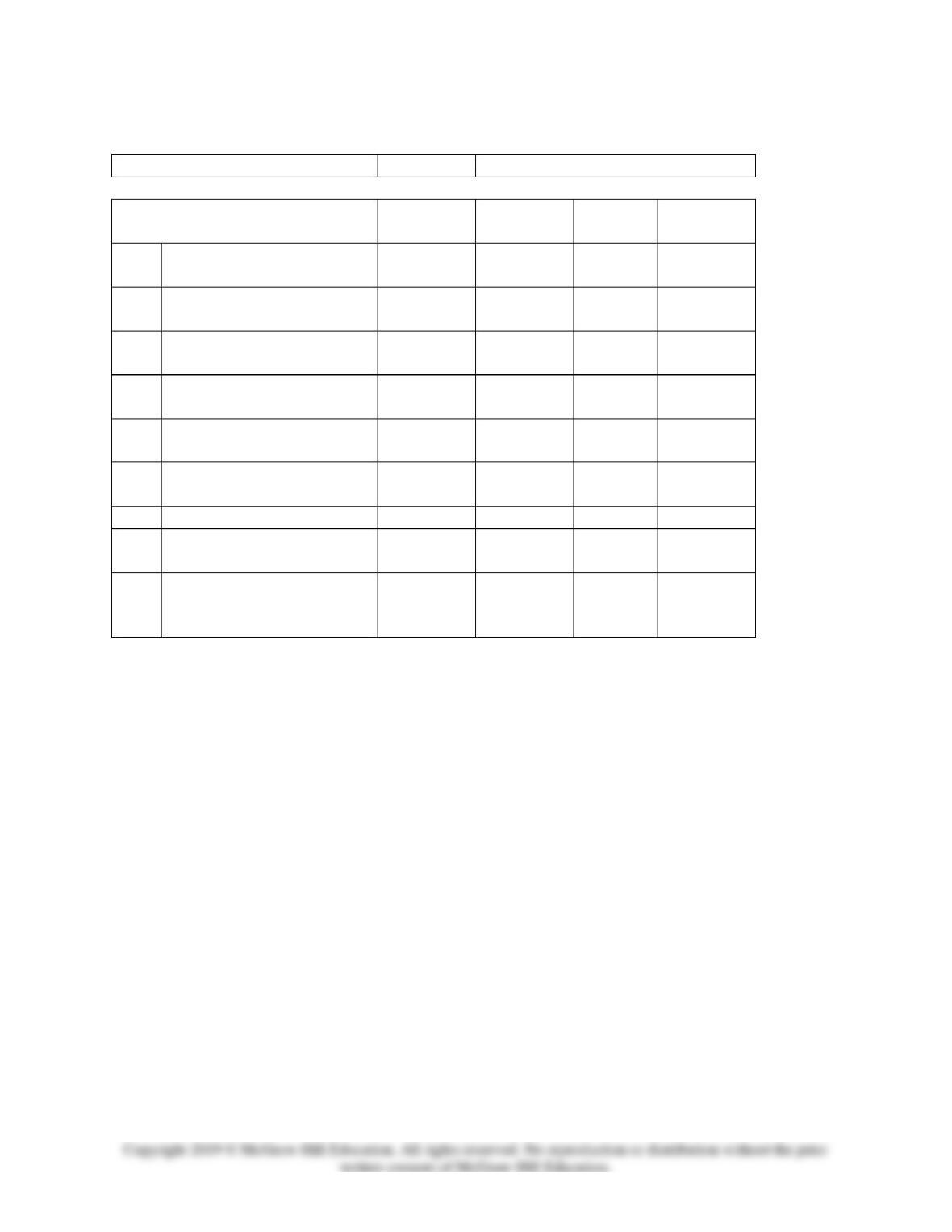
205) Shemekia Co. produces seats for movie theaters. Listed below are selected cost items for
the seat production. Classify each cost as either fixed or variable, and either a product or a period
cost by placing an x in the appropriate boxes.
Cost by behavior
Cost by function
Variable
Fixed
Product
Period
Fabric for seats
Assembly labor
Factory property taxes
Accounting staff salaries
Sales office rent
Sales manager’s salary
Depreciation on factory
equipment
Sales commissions
Variable
Fabric for seats
Assembly labor
Factory property taxes
Accounting staff salaries
Sales office rent
Sales manager’s salary
Depreciation on factory
Equipment
Sales commissions
107
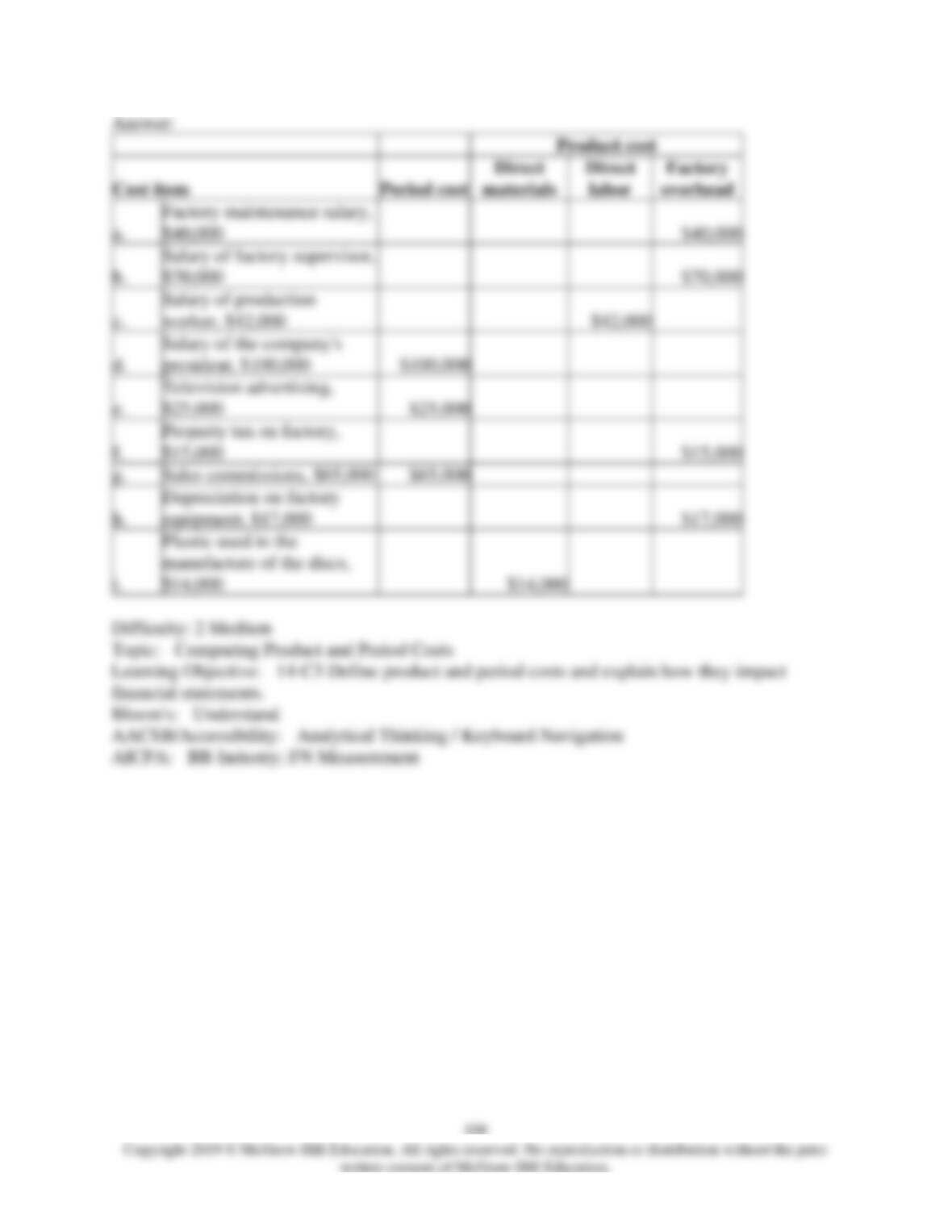
206) Place each of the following costs of a Blu-ray disc manufacturer in the appropriate column.
Product cost
Cost item
Period cost
Direct
materials
Direct
labor
Factory
overhead
a.
Factory maintenance salary,
$40,000
b.
Salary of factory supervisor,
$70,000
c.
Salary of production
worker, $42,000
d.
Salary of the company’s
president, $100,000
e.
Television advertising,
$25,000
f.
Property tax on factory,
$15,000
g.
Sales commissions, $65,000
h.
Depreciation on factory
equipment, $17,000
i.
Plastic used in the
manufacture of the discs,
$14,000
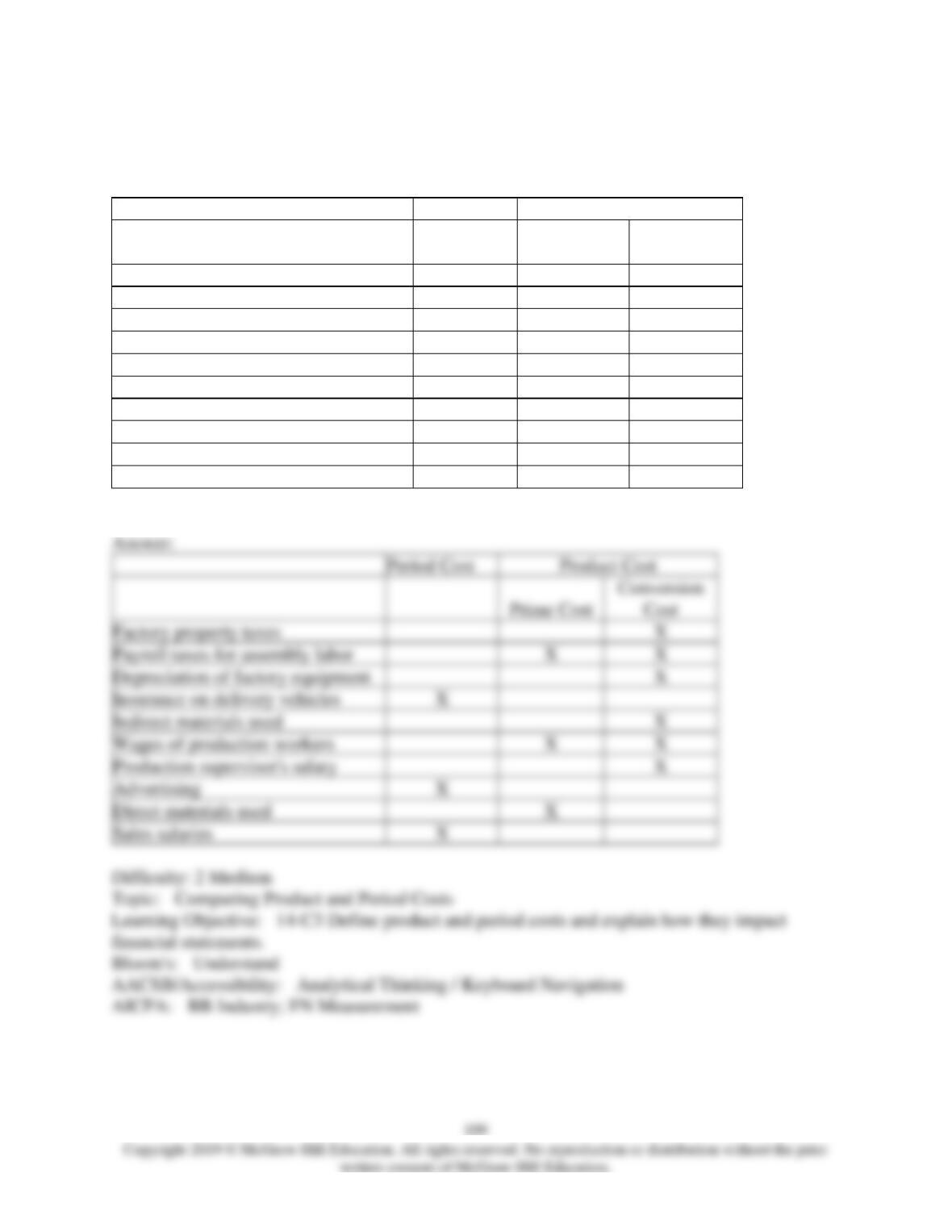
207) The following costs are incurred by Gonzalez Manufacturing Co. Classify each cost item as
either a period cost or a product cost. If the cost is a product cost, identify it as a prime and/or
conversion cost. Place an x in the appropriate column for your answers.
Period Cost
Product Cost
Prime Cost
Conversion
Cost
Factory property taxes.
Payroll taxes for assembly labor.
Depreciation of factory equipment.
Insurance on delivery vehicles
Indirect materials used
Wages of production workers.
Production supervisor’s salary
Advertising
Direct materials used.
Sales salaries.
Period Cost
Conversion
Cost
Factory property taxes
Payroll taxes for assembly labor
Depreciation of factory equipment
Insurance on delivery vehicles
Indirect materials used
Wages of production workers
Production supervisor’s salary
Advertising
Direct materials used
Sales salaries
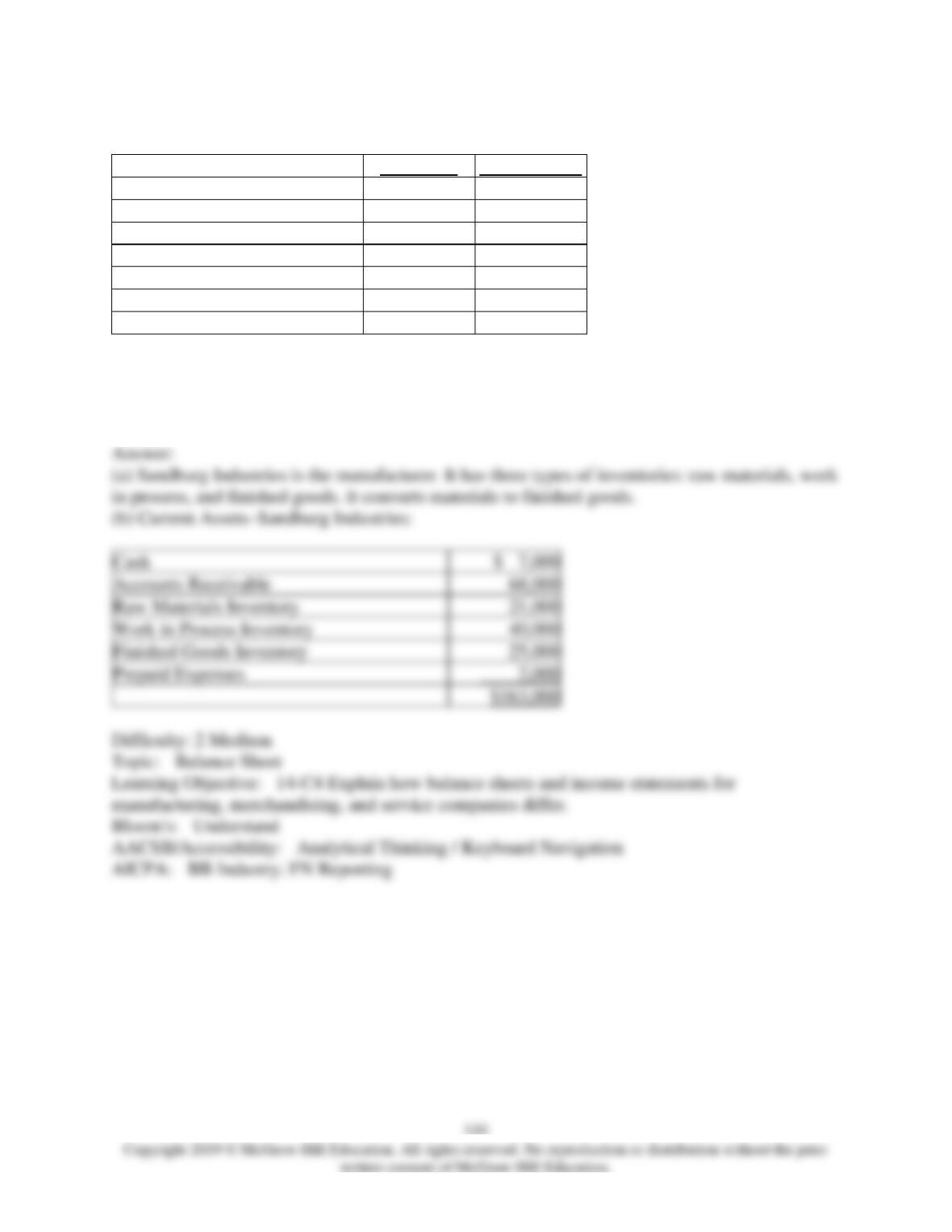
208) Walter Co. and Sandburg Industries report the following information at December 31:
WALTER
SANDBURG
Accounts Receivable
$41,000
$68,000
Cash
6,000
7,000
Finished Goods Inventory
25,000
Work in Process Inventory
40,000
Merchandise Inventory
48,000
Prepaid Expenses
1,000
2,000
Raw Materials Inventory
21,000
Required:
(a) Which company is a manufacturer? Explain.
(b) Prepare the current assets section of the balance sheet for the manufacturer.
Cash
Accounts Receivable
68,000
Raw Materials Inventory
21,000
Work in Process Inventory
40,000
Finished Goods Inventory
25,000
Prepaid Expenses
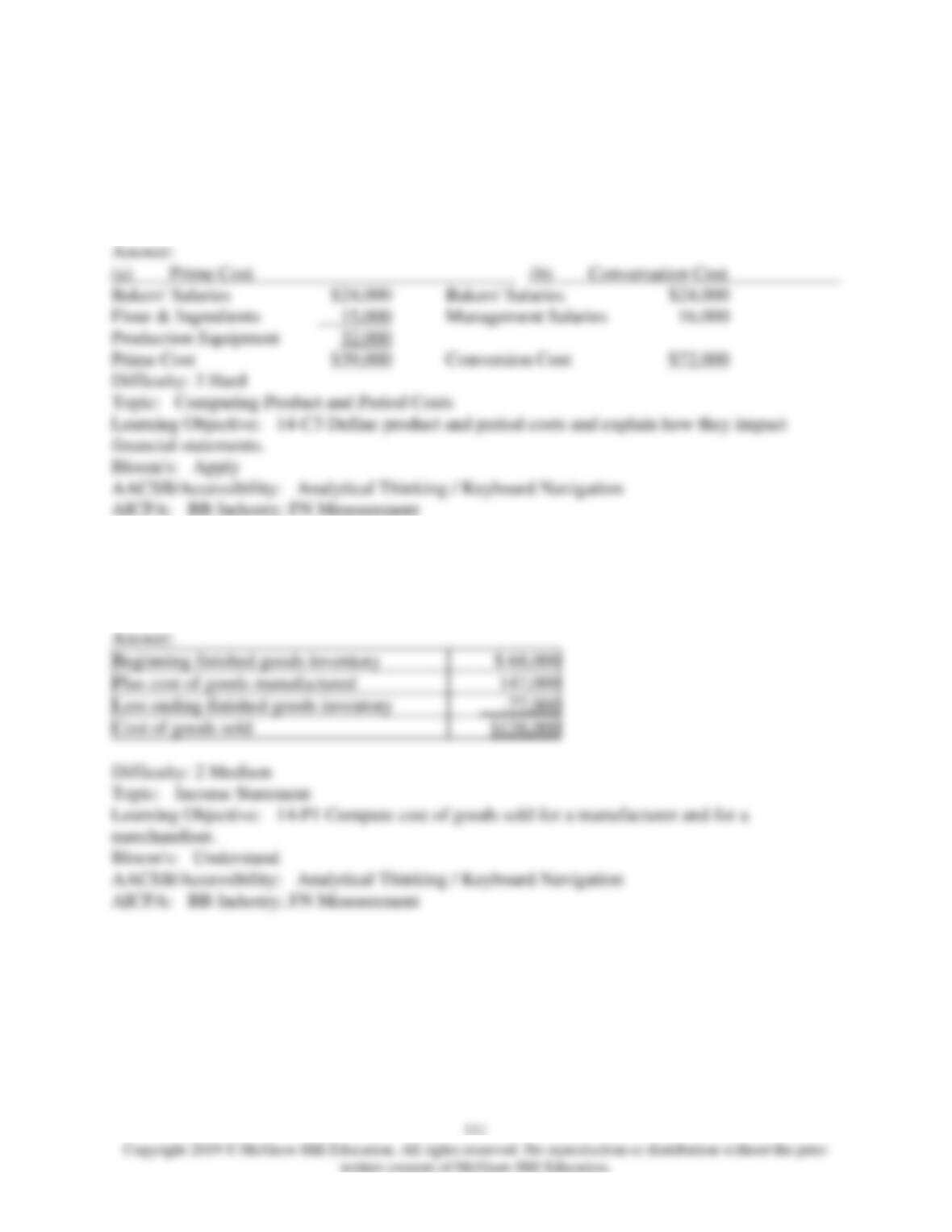
209) Tasty Foods bakes and sells 2,000 dozen muffins each week. Among the costs are bakers’
salaries, $24,000; production management salaries, $16,000; production equipment operating
costs, $32,000; and flour and ingredient costs, $15,000. Using this information, compute: (a)
prime costs and (b) conversion costs.
210) A manufacturing company’s finished goods inventory on January 1 was $68,000; cost of
goods manufactured for the year was $147,000; and the December 31 finished goods inventory
was $77,000. What is the cost of goods sold for the year?
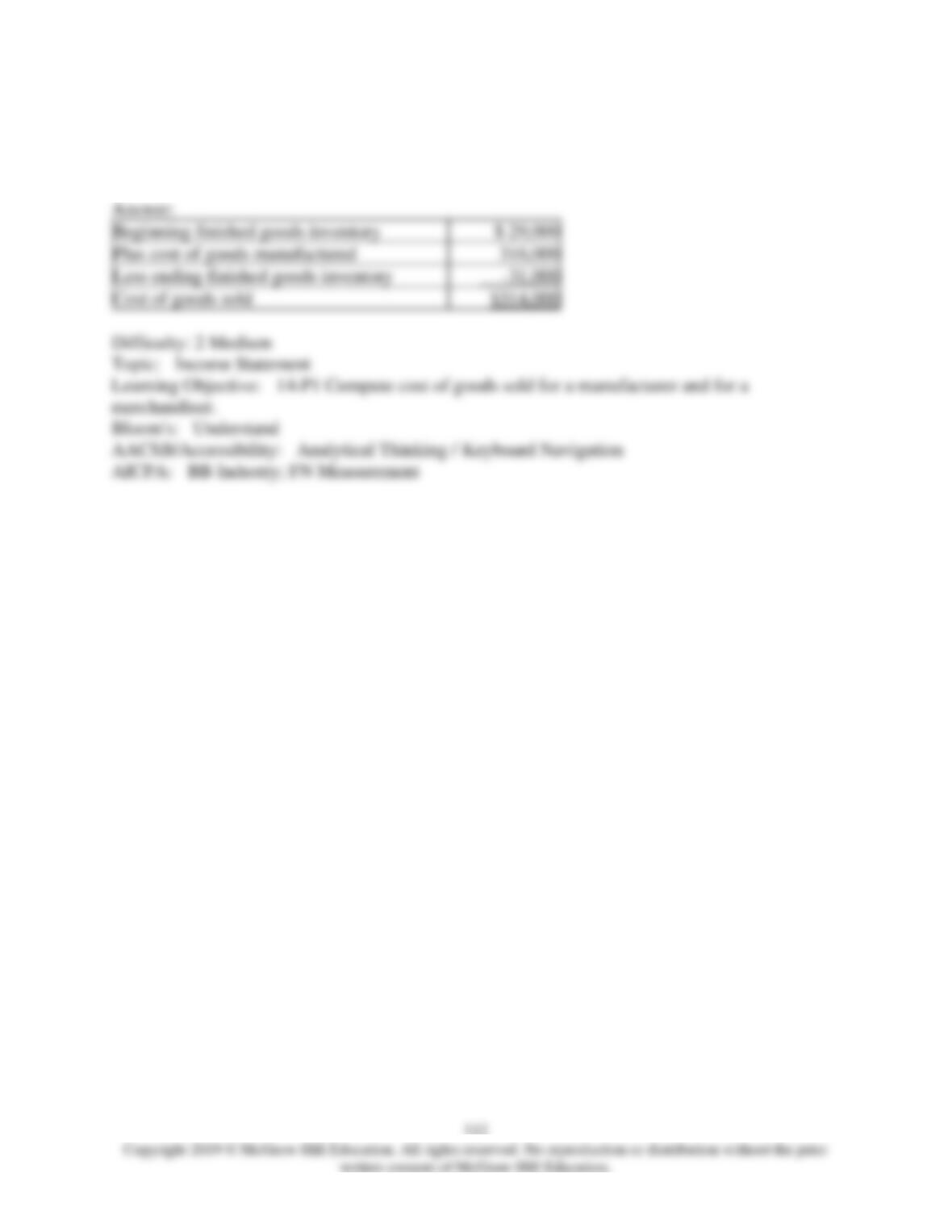
211) A manufacturing company’s beginning finished goods inventory was $29,000; cost of goods
manufactured for the year was $316,000; and the ending finished goods inventory was $31,000.
What is the cost of goods sold for the year?
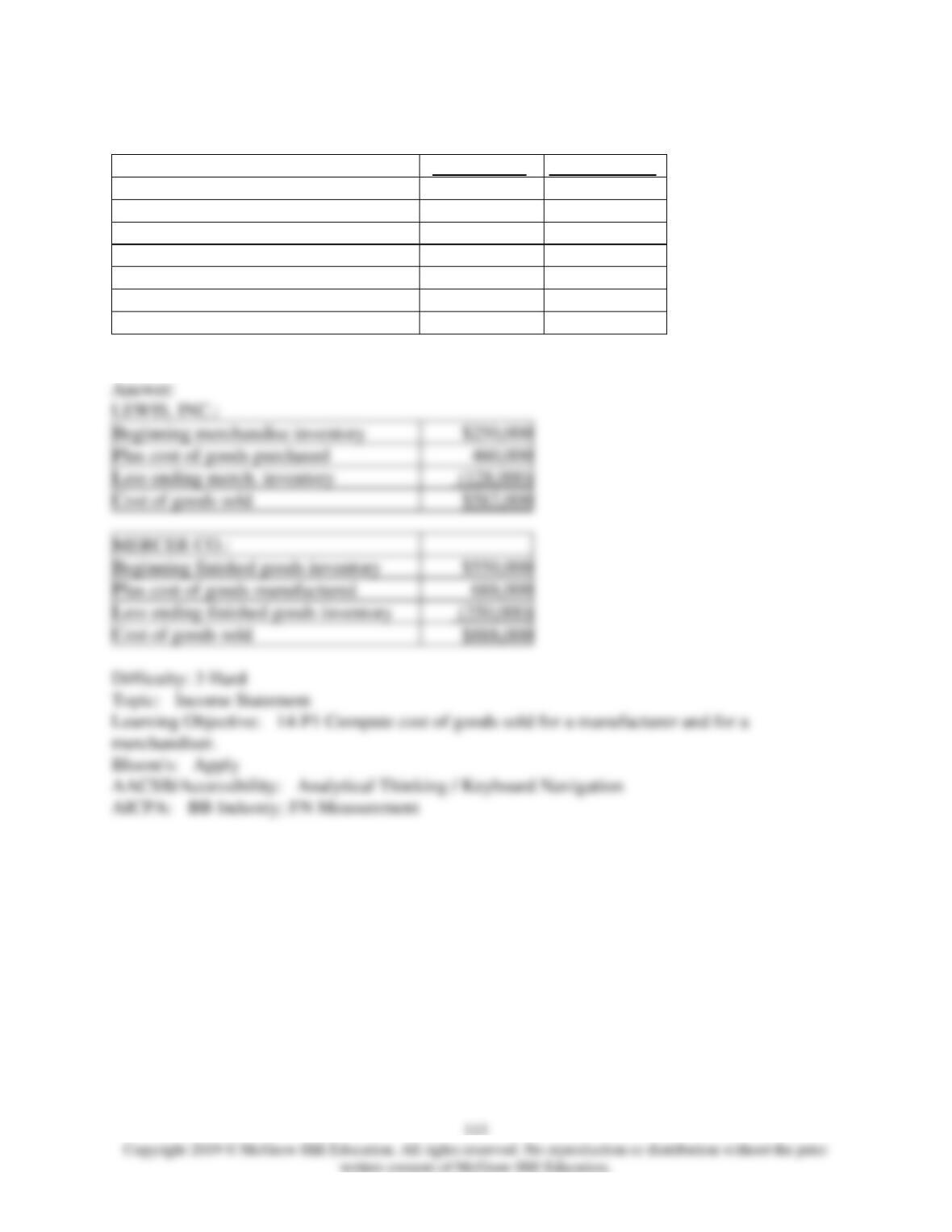
212) Calculate Cost of Goods Sold for the following two companies:
LEWIS INC.
MERCER CO.
Merchandise
$250,000
Finished Goods
$550,000
Cost of Goods Purchased
460,000
Cost of Goods Manufactured
688,000
Ending Inventory:
Merchandise
128,000
Finished Goods
350,000
Beginning merchandise inventory
Plus cost of goods purchased
Less ending merch. inventory
Cost of goods sold
MERCER CO.:
Beginning finished goods inventory
Plus cost of goods manufactured
Less ending finished goods inventory
Cost of goods sold
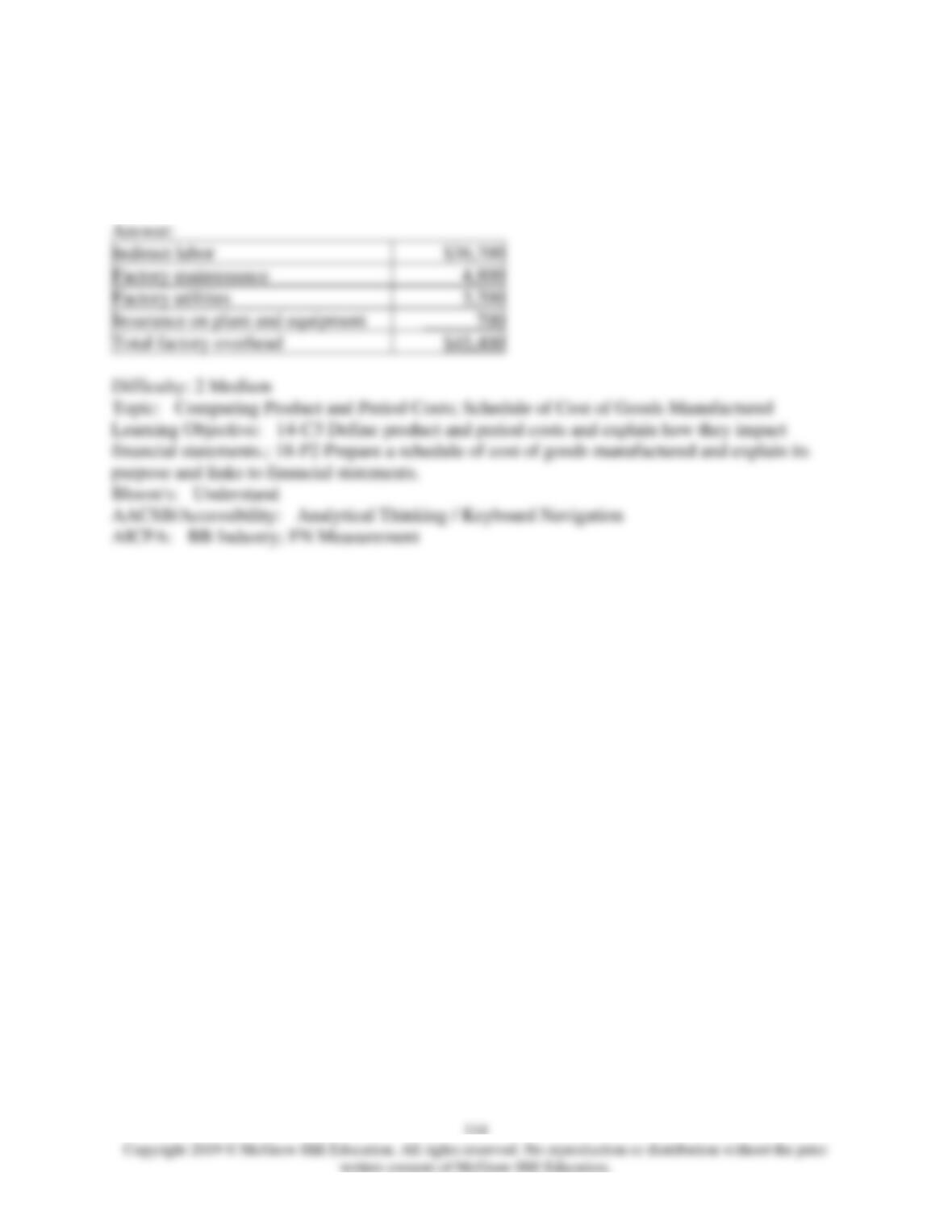
213) Castillo Co. manufactures staples. Costs for October were direct labor, $84,000; indirect
labor, $36,700; direct materials, $55,900; factory maintenance, $4,800; factory utilities, $3,200;
and insurance on plant and equipment, $700. What is the company’s total factory overhead cost
for October?
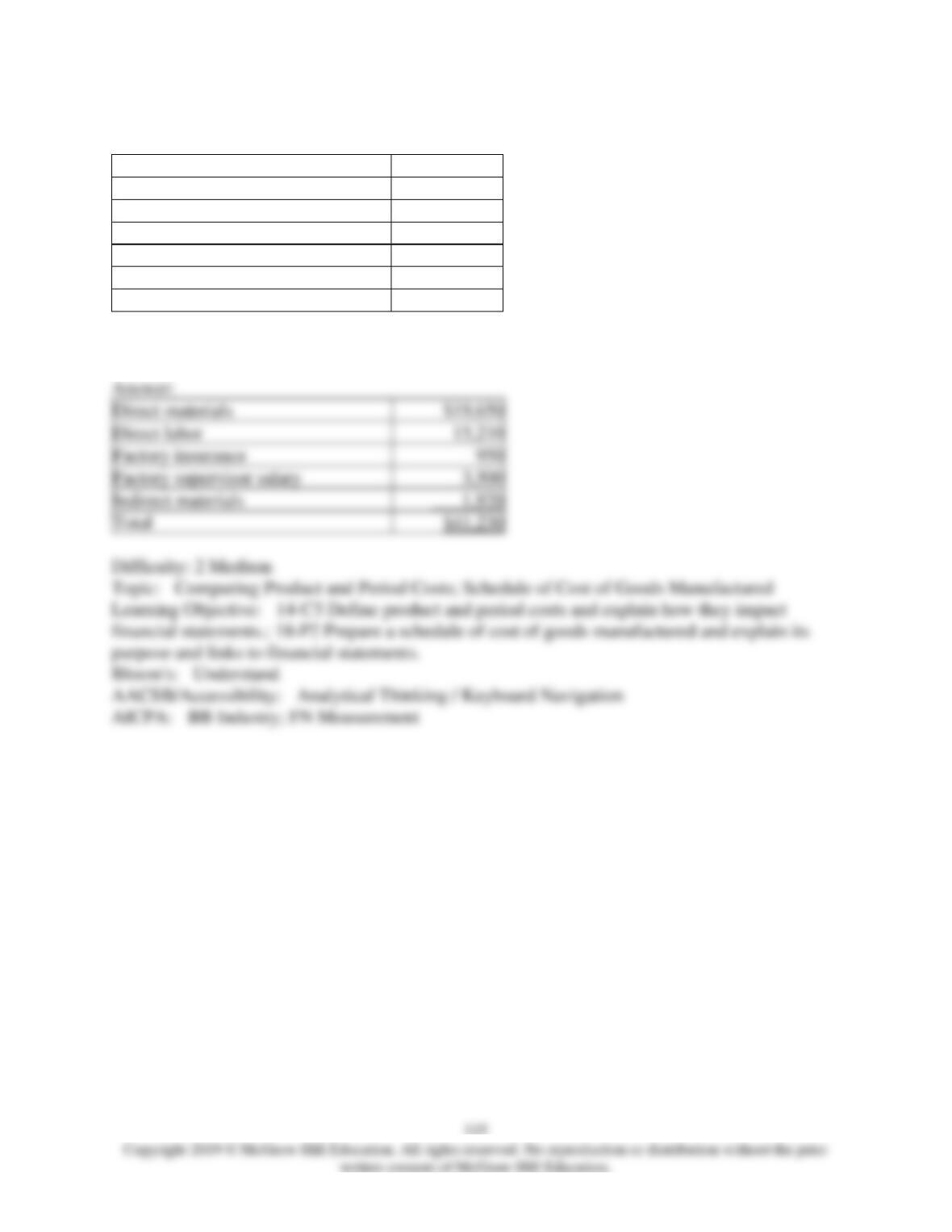
214) Langston Company manufactures coats. Costs for February were as follows:
Direct materials
$19,650
Direct labor
15,210
Factory insurance
950
Sales commissions
4,700
Corporate executive salaries
5,500
Factory supervisor salary
3,500
Indirect materials
1,920
Required: Calculate the total manufacturing cost for February.
Direct materials
$19,650
Direct labor
15,210
Factory insurance
950
Factory supervisor salary
3,500
Indirect materials
Total
$41,230
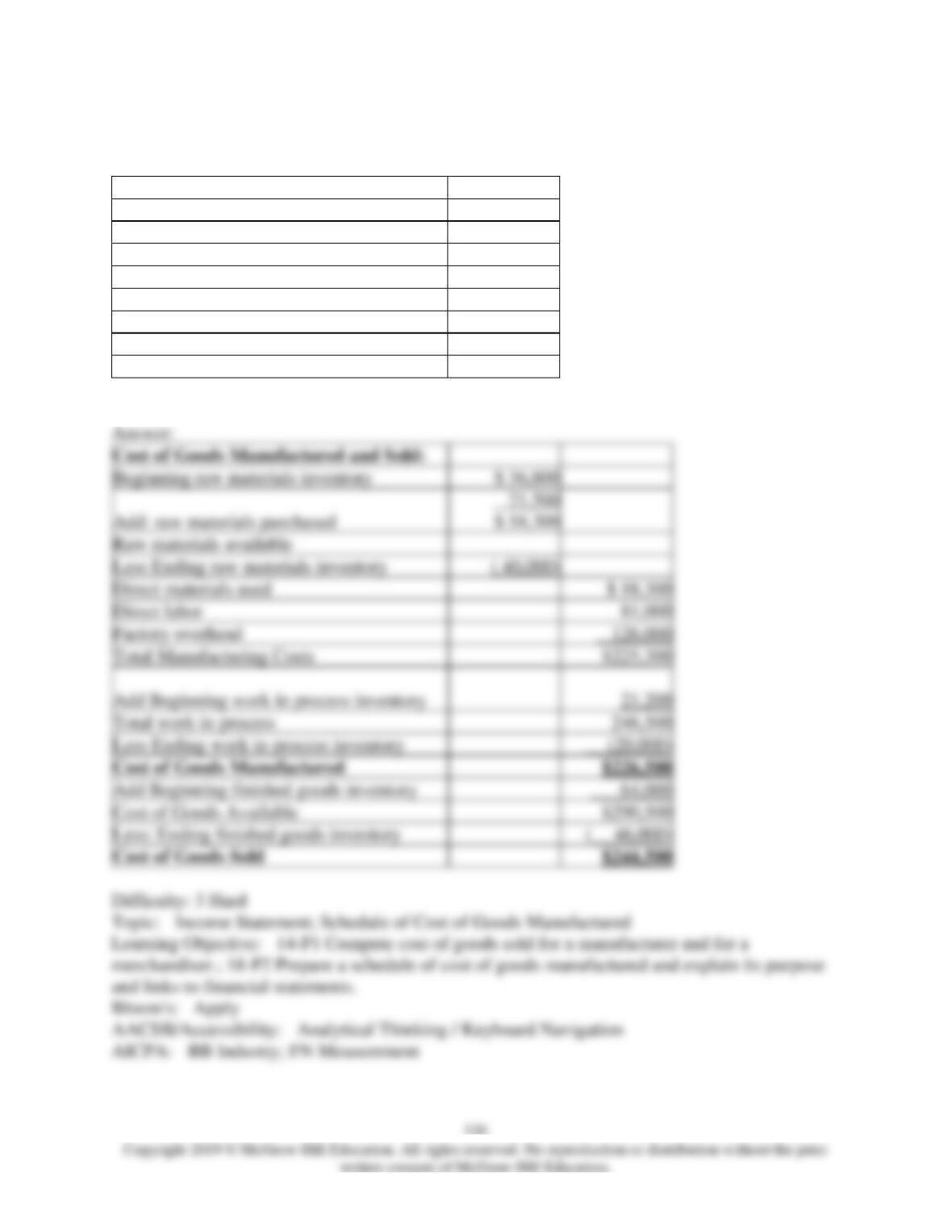
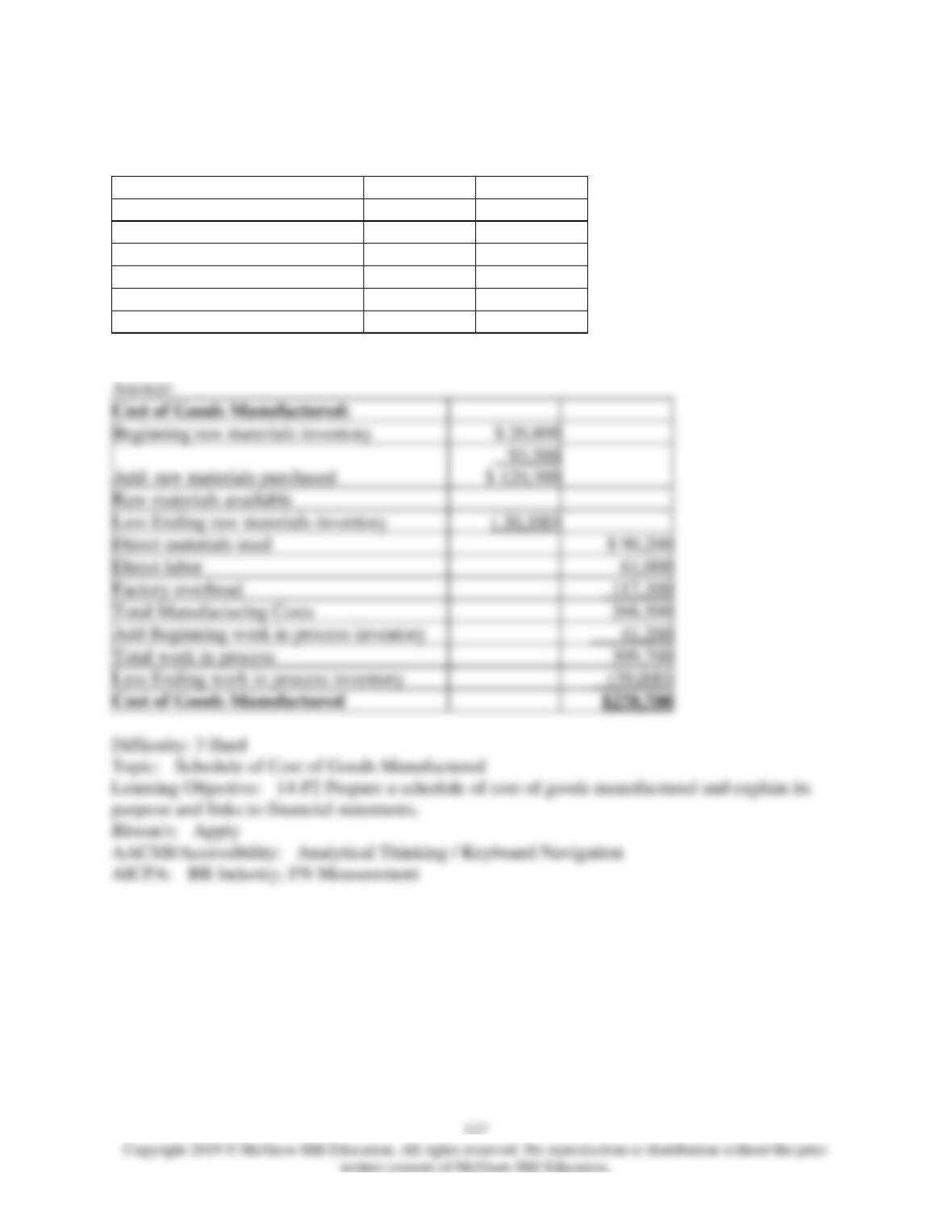
215) Information for Maxim Manufacturing is presented below. Compute both the cost of goods
manufactured and the cost of goods sold for Maxim Manufacturing.
Beginning raw materials inventor
$36,800
Beginning work in process inventory
21,200
Direct labor
81,000
Beginning finished goods inventory
64,000
Total factory overhead
126,000
Raw materials purchased
21,500
Ending raw materials inventory
40,000
Ending work in process inventory
20,000
Ending finished goods inventory
46,000
Beginning raw materials inventory
Add: raw materials purchased
Raw materials available
Less Ending raw materials inventory
Direct materials used
Direct labor
81,000
Factory overhead
Total Manufacturing Costs
Add Beginning work in process inventory
21,200
Total work in process
246,500
Less Ending work in process inventory
Add Beginning finished goods inventory
Cost of Goods Available
Less: Ending finished goods inventory
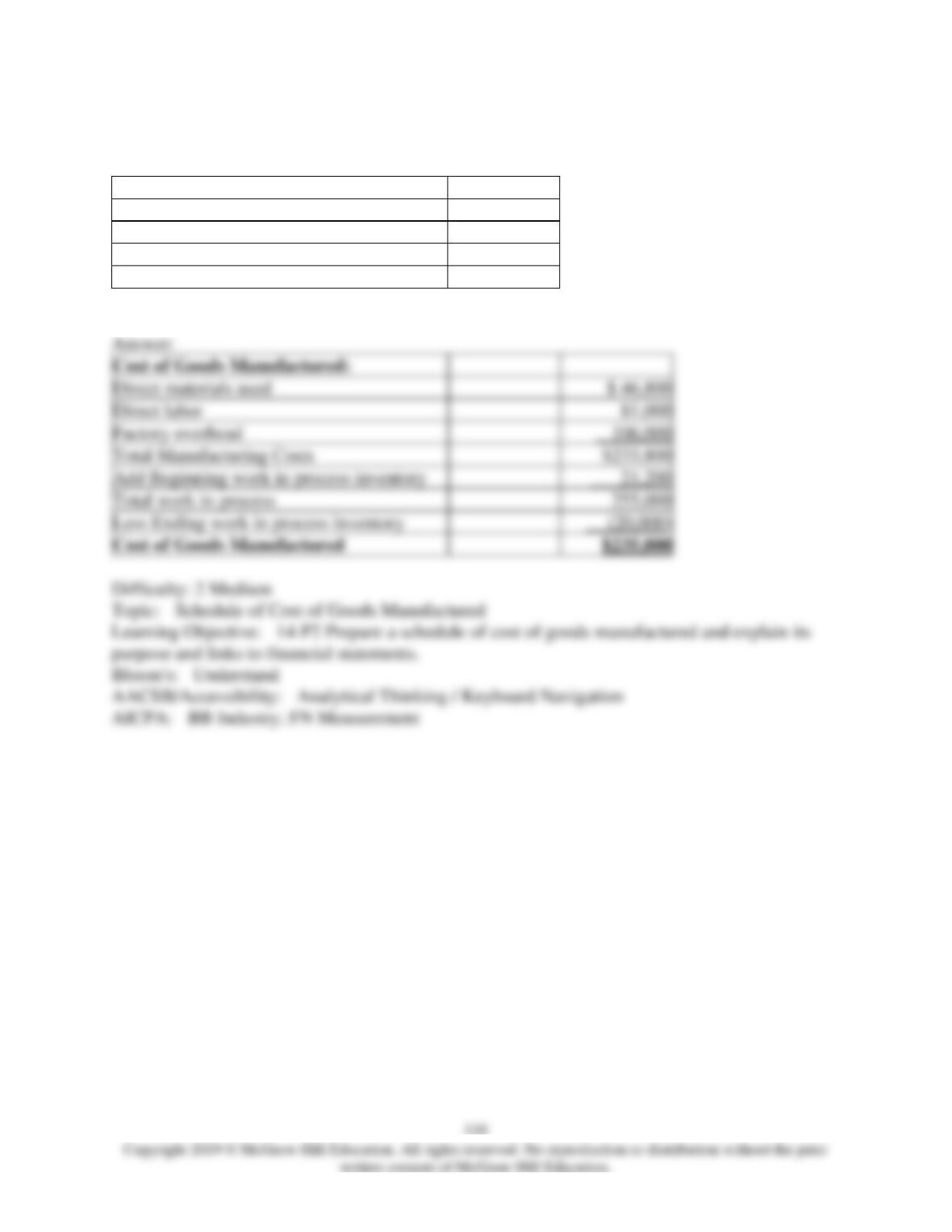
216) Information for Underwood Industries is presented below. Compute the cost of goods
manufactured.
Beginning
Ending
Raw materials inventory
$26,800
$30,100
Work in process inventory
41,200
39,000
Finished goods inventory
54,000
53,500
Raw materials purchased
93,500
Direct labor
61,000
Total factory overhead
117,300
Beginning raw materials inventory
Add: raw materials purchased
Raw materials available
Less Ending raw materials inventory
Direct materials used
Direct labor
61,000
Factory overhead
Total Manufacturing Costs
268,500
Add Beginning work in process inventory
Total work in process
309,700
Less Ending work in process inventory
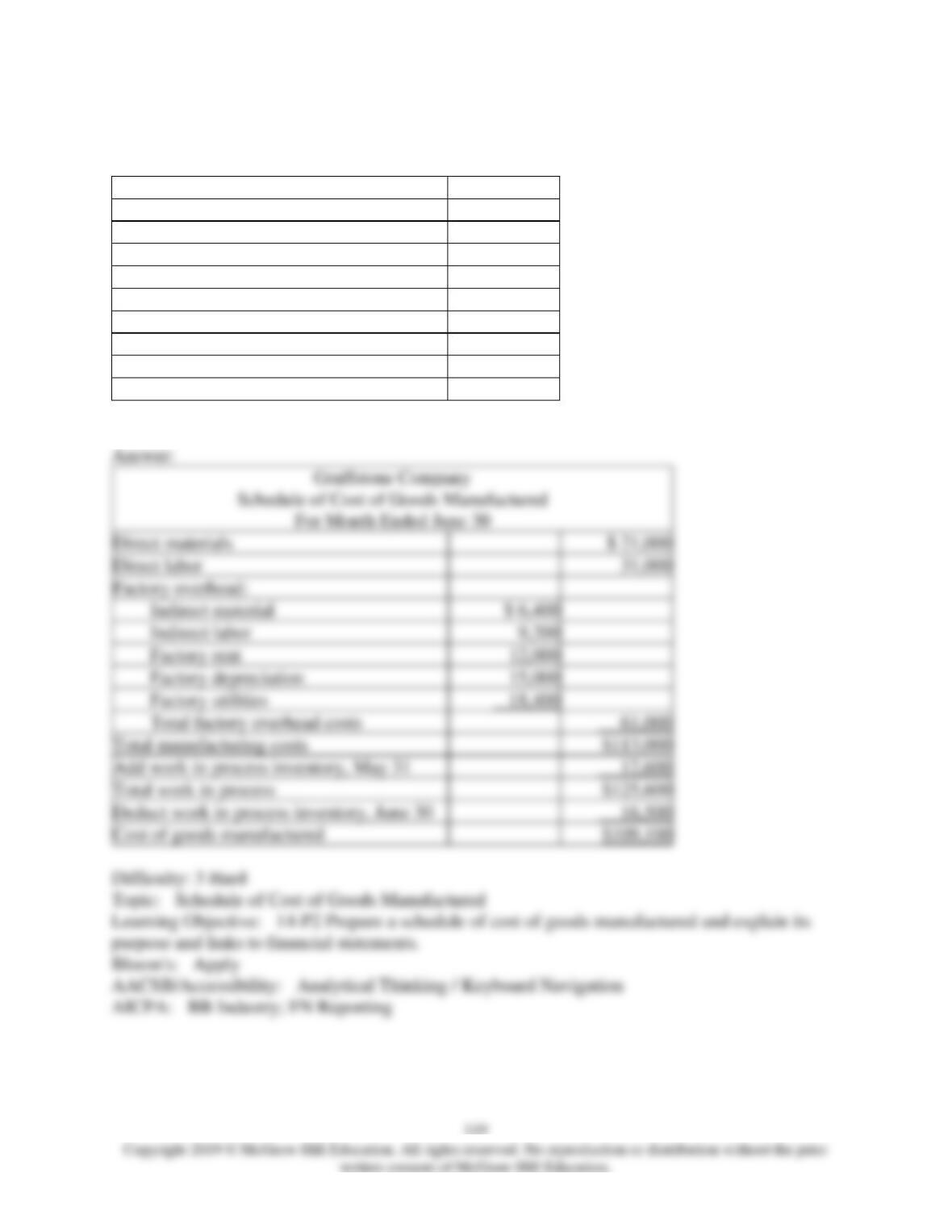
217) Information for Eastman Industries is presented below. Compute the cost of goods
manufactured.
Beginning work in process inventory
21,200
Ending work in process inventory
20,000
Direct materials used in production
$46,800
Direct labor
81,000
Total factory overhead
106,000
Direct materials used
Direct labor
81,000
Factory overhead
Total Manufacturing Costs
Add Beginning work in process inventory
Total work in process
255,000
Less Ending work in process inventory
218) Use the following information to prepare the schedule of cost of goods manufactured for
Graffstone Company for the month ended June 30.
Work in Process inventory, May 31
$12,600
Work in Process inventory, June 30
16,500
Direct materials used during June
21,000
Direct labor used during June
31,000
Factory overhead:
Indirect material
6,400
Indirect labor
9,200
Factory rent
12,000
Factory depreciation
15,000
Factory utilities
18,400
Direct materials
Direct labor
31,000
Factory overhead:
Indirect material
Indirect labor
9,200
Factory rent
12,000
Factory depreciation
15,000
Factory utilities
Total factory overhead costs
Total manufacturing costs
Add work in process inventory, May 31
Total work in process
Deduct work in process inventory, June 30
Cost of goods manufactured