135. On January 1, 2010, the Ryder Company issued $600,000 of eight-year bonds at 102. The stated annual
interest rate is 8%, and interest is paid on June 30 and December 31. The bonds are callable at 105 plus accrued
interest. The bond issue costs were $7,200. The Ryder Company uses the straight-line method to amortize bond
discounts and premiums.
Required:
a.
Prepare the journal entry(ies) to record the issuance of the bonds and the bond issue costs.
b.
At the end of the sixth year, the company retired the bonds. Prepare the journal entries to record the related interest and retirement.
136. On January 1, 2010, Lehigh issued $150,000 of 12% ten-year bonds at 104. Issuance costs amounted to
$3,000. On July 1, 2016, 40% of the bonds were called at 103.
Required:
Record the retirement of the bonds. Ignore interest and use straight-line amortization.
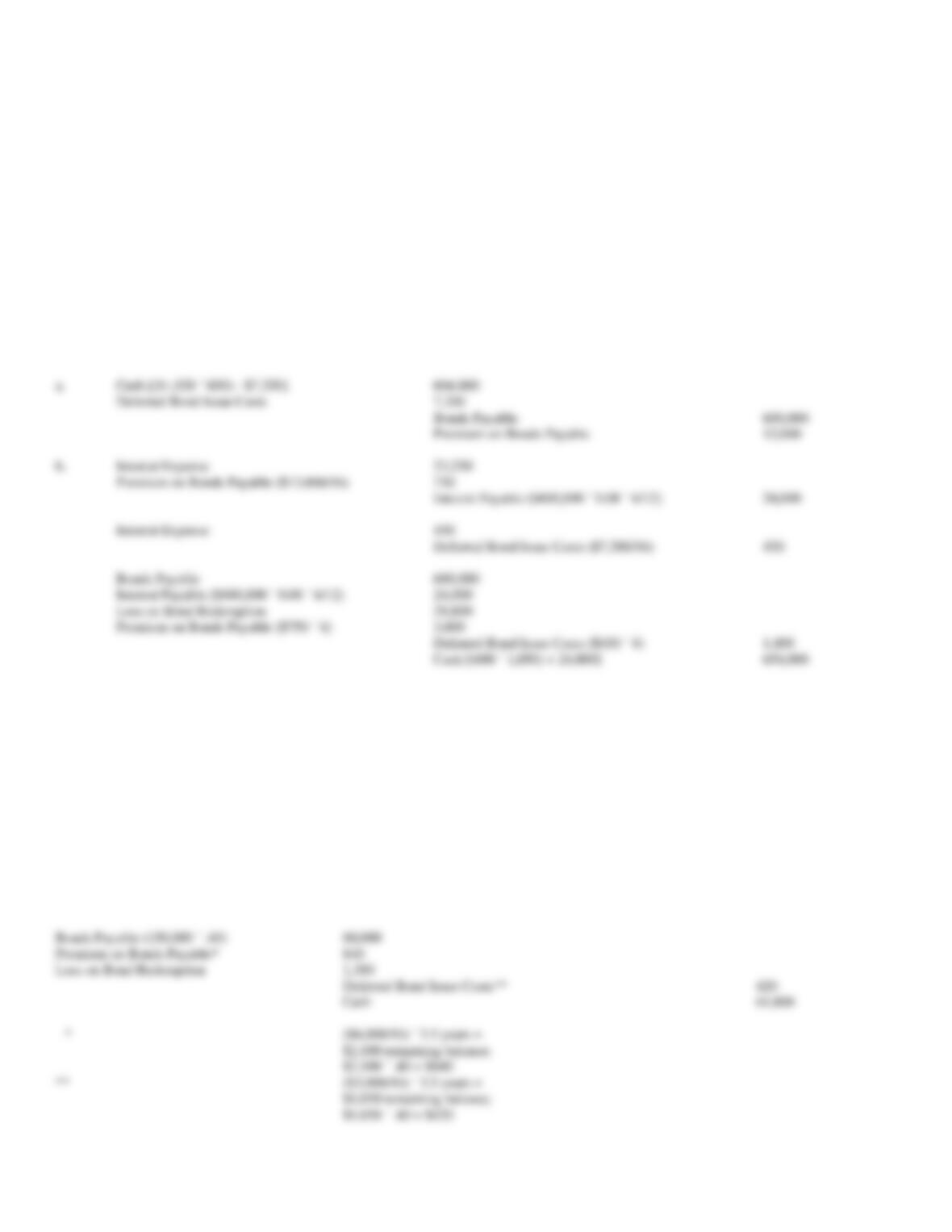
Premium on Bonds Payable*
840
Loss on Bond Redemption
1,380
Deferred Bond Issue Costs**
420
$1,050 ´ .40 = $420
Bonds Payable
600,000
Premium on Bonds Payable
12,000
Premium on Bonds Payable ($12,000/16)
750
Interest Payable ($600,000 ´ 0.08 ´ 6/12)
24,000
Deferred Bond Issue Costs ($7,200/16)
450
Bonds Payable
600,000
Loss on Bond Redemption
28,800
Premium on Bonds Payable ($750 ´ 4)
3,000
137. On January 1, 2010, Farmer issued $80,000 of serial bonds that paid 7% interest annually. Each December
31, $16,000 of the bonds comes due. The bonds were issued for $75,200.
Required:
a.
Using the bonds outstanding method, compute the total amount of interest expense for 2013.
b.
Assume that on January 1, 2012, the issue coming due on December 31, 2014, was redeemed at 101. Compute the gain or loss that
should be recognized on the bond redemption.
138. The following events relate to Mathers Corporation’s issue of convertible debentures:
·
On January 1, 2010, the Mathers Corporation issued $500,000 of 12% convertible bonds for $460,000. The bonds are due on January 1,
2020, and interest is paid on July 1 and January 1. Each $1,000 bond is convertible into 30 shares of common stock with a par value of
$1 per share. On the date of bond issuance, a share of common stock was selling at $24.
·
On January 2, 2012, 12% convertible bonds with a face value of $300,000 were converted into common stock. The market value of the
common stock on the date of conversion was $40 per share. Mathers uses the straight-line method to amortize premiums and discounts.
Required:
a.
Prepare the journal entry to record the issuance of the
convertible bonds.
b.
Record the conversion on January 2, 2012, using:
(1)
the book value method
(2)
the market value method
c.
Assuming that any gain or loss on conversion is
material, how would it be disclosed in the financial
statements?
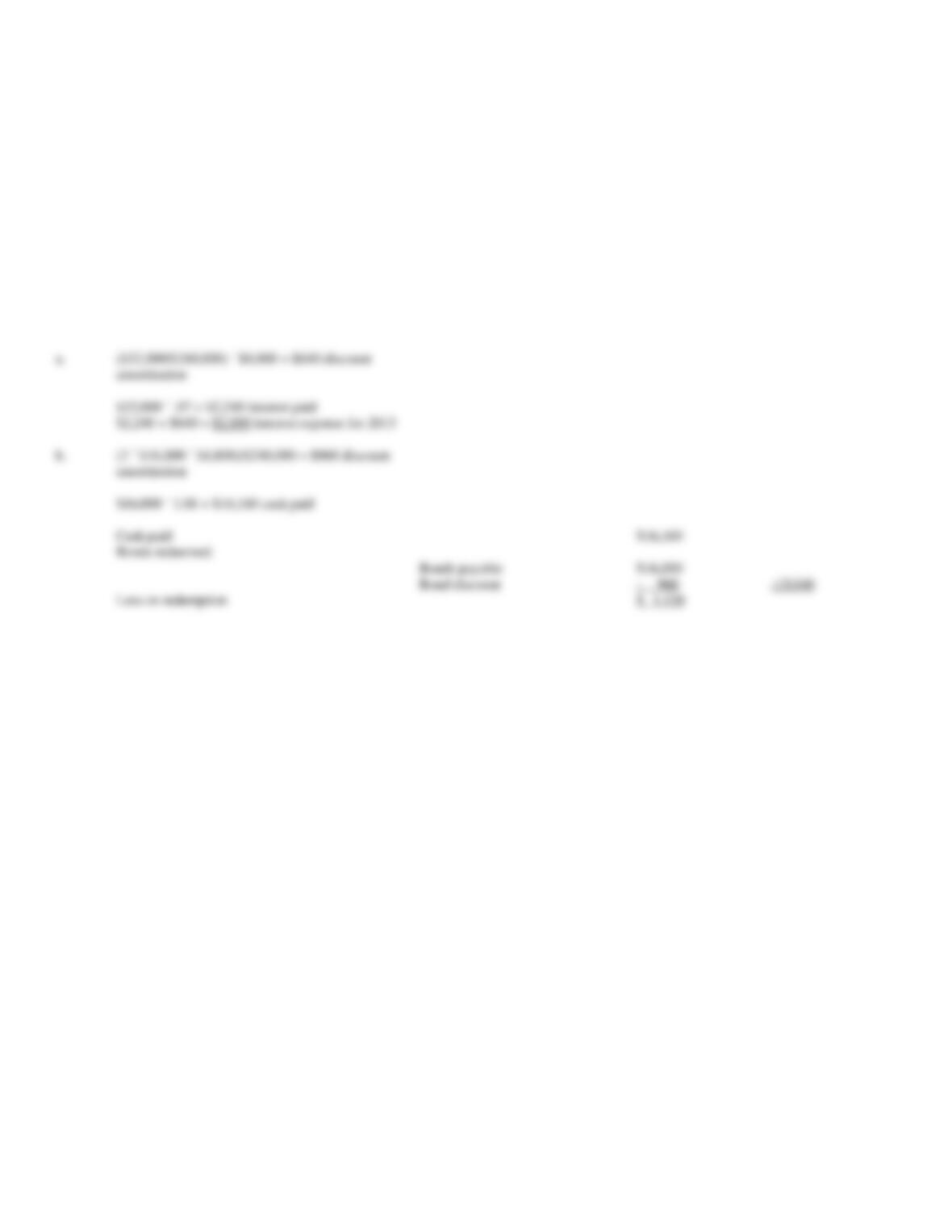
($32,000/$240,000) ´ $4,800 = $640 discount
$32,000 ´ .07 = $2,240 interest paid
amortization
$16,000 ´ 1.01 = $16,160 cash paid
Cash paid
$16,160
Bonds payable
$16,000
Bond discount
– 960
-15,040
Loss on redemption
$ 1,120
139. Hoosier Co. sold $300,000 of 10% bonds for $311,600. Each $1,000 bond carried ten warrants and each
warrant allowed the holder to acquire one share of $10 par value common stock for $25 a share. After the
issuance of the securities, the bonds were quoted at 103.5 and each warrant was quoted at $9.
Required:
Prepare the entry to record the sale of the bonds.
140. Siena sold $120,000 of 6% bonds for $127,125. Each $1,000 bond carried five warrants and each warrant
allowed the holder to acquire one share of $5 par common stock for $20 a share. After the issuance of the
securities, the bonds were quoted at 108 and the warrants were quoted at $10. Later, one-fourth of the rights
were exercised.
Required:
141. On January 1, 2010, Darvon Corp. issued 40,000 of ten-year, $1,000 bonds payable at 104. These bonds
were each convertible into 100 shares of $10 par common stock. On January 1, 2016, Darvon converted all of
these bonds when the stock was selling at $11.50 a share.
Required:
Complete the matrix below to indicate the amounts that would be recorded for the indicated accounts in the
journal entry to record the bond conversion. Then record the journal entry for the bond conversion.
Loss on
Additional
Bond Conversion
Paid-in Capital
(debit)
(credit)
Book value method
________
________
Market value method
________
________
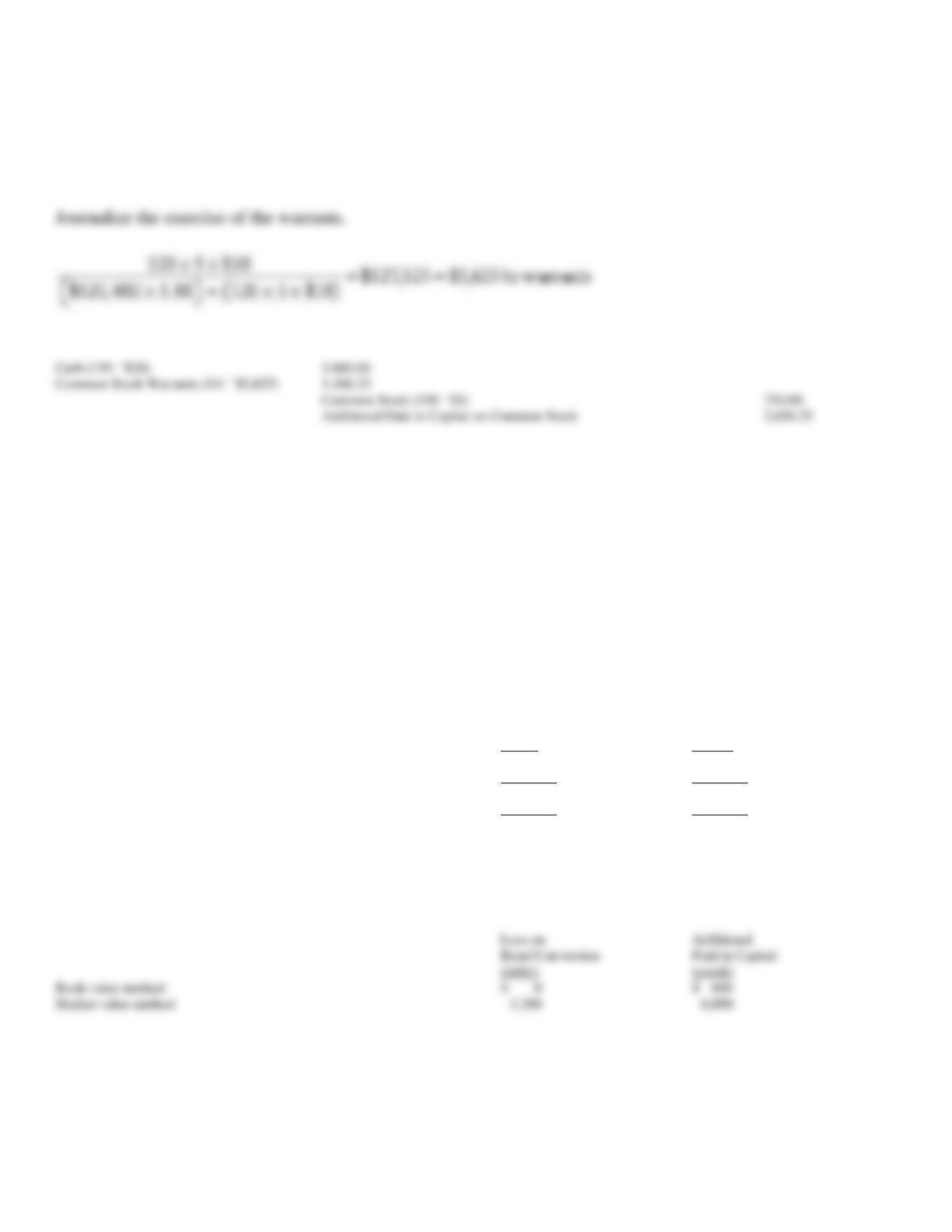
Loss on
Additional
Bond Conversion
Paid-in Capital
(debit)
(credit)
Book value method
$ 0
$ 640
Market value method
5,360
6,000
Cash (150 ´ $20)
3,000.00
Common Stock (150 ´ $5)
750.00
Additional Paid-in Capital on Common Stock
3,656.25
142. On January 1, 2010, the Barnacle Corporation issued a five-year, non-interest-bearing, $44,000 note to
Nautical Corporation in exchange for used equipment. Neither the fair market value of the equipment nor that of
the note is determinable. The incremental borrowing rate of Barnacle is 12% and the incremental borrowing rate
of Nautical is 10%. Present value factors for n = 5 years are
Interest Rate
PV of $1
10%
0.620921
12%
0.567427
Required:
a.
Prepare the journal entry to record the issuance of the note by Barnacle on January 1, 2010.
b.
Prepare the journal entry to record the interest expense on December 31, 2010.
c.
Prepare the journal entry to record the interest expense on December 31, 2011.
a.
Equipment ($44,000 ´ 0.567427)
24,966.79
Discount on Notes Payable
19,033.21
Notes Payable
44,000.00
b.
Interest Expense
[($44,000.00 – $19,033.21) ´ 0.12]
2,996.01
Discount on Notes Payable
2,996.01
c.
Interest Expense [($44,000.00 – $19,033.21)
+ $2,996.01] ´ 0.12
3,355.54
Discount on Notes Payable
3,355.54
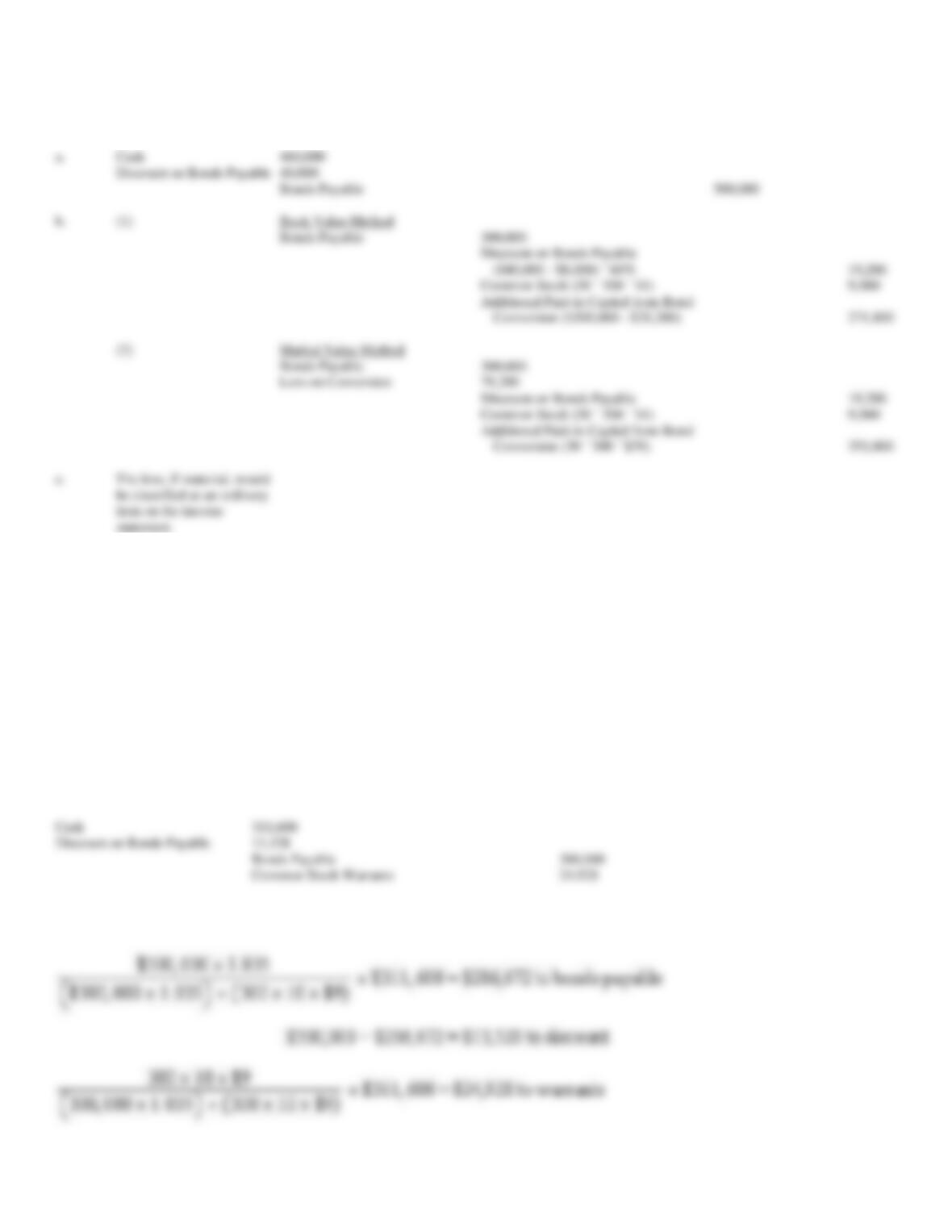
Book Value Method
Bonds Payable
40,000
640
Common Stock
40,000
Additional Paid-in Capital
Market Value Method
Bonds Payable
40,000
Premium on Bonds Payable
Loss on Conversion
376
Common Stock
40,000
6,000
$40,000(.04) ´ 4/10 = $640
40 ´ 100 ´ $1.50 = $6,000
143. Sanders Co. borrowed $40,000 by issuing a four-year non-interest-bearing note to a customer. In addition,
Sanders agreed to sell inventory to the same customer at reduced prices over the four-year period. Sanders’
incremental borrowing rate was 8%, so the present value of the note was $29,400. The customer agreed to
purchase an equal amount of inventory each year over the four-year period.
Required:
Prepare journal entries to:
a.
Issue the note
b.
Adjust at the end of the first year
c.
Adjust at the end of the second year
144. Ortiz Mfg. Co. issued a five-year non-interest-bearing note with a face value of $800,000. Ortiz received
$474,761, resulting in an effective 12% interest rate.
Required:
Prepare journal entries to:
a.
Issue the note
b.
Record interest at the end of the first year
c.
Record interest at the end of the second year
(Note: round all answers to the nearest dollar.)
a.
Cash
40,000.00
Discount on Notes Payable
10,600.00
Notes Payable
40,000.00
Unearned Revenue
10,600.00
b.
Interest Expense (0.08 ´ $29,400)
2,352.00
Unearned Revenue ($10,600/4)
2,650.00
Sales Revenue
2,650.00
c.
Interest Expense [0.08 ´ ($29,400 + $2,352)]
2,540.16
Unearned Revenue
2,650.00
Sales Revenue
2,650.00
145. Mangum Corp. carries a note receivable from Option Co. for $50,000 with a due date of December 31,
2015, and an annual interest rate of 10%, payable in two payments each year on June 30 and December 31.
After making the interest payment on December 31, 2010, Option Co. informed Mangum Corp. that it would be
unable to make the next four semiannual interest payments; however, it would then resume interest payments
and pay the principal on the due date. The market interest rate was 8% on December 31, 2010. Option Co. treats
this situation as an impairment. Present value factors for 5% are:
n
PV of $1
PV of an annuity
4 periods
0.822703
3.545951
6 periods
0.746215
5.075692
10 periods
0.613913
7.721735
Required:
a.
Compute the value of the impaired note.
b.
Prepare the journal entry to record the impairment.
as follows:
PV of principle = $50,000 ´ 0.613913 =
$30,695.65
PV of interest* = $2,500 ´ 5.075692 ´ 0.822703 =
10,439.47
$41,135.12
Bad Debt Expense
8,864.88*
Allowance for Doubtful Notes
*
$50,000.00 – $41,135.12
a.
Cash
474,761
Discount on Notes Payable
325,239
Notes Payable
800,000
Interest Expense ($474,761 ´ 0.11)
52,224
c.
Interest Expense [0.11 ($52,224 + $474,761)]
57,968
146. On January 1, 2010, a creditor has a $200,000 note receivable with an impaired value of $178,571.43. The
contract interest rate is 12%, and the current market rate is 10%. The principal is due on December 31, 2013.
Interest payments will only be made on December 31 of 2011, 2012, and 2013.
Required:
a.
Prepare the journal entry to record the 2010 interest revenue.
b.
Prepare the journal entry to record the 2011 interest revenue and cash received.
c.
Prepare the journal entry to record the 2012 interest revenue and cash received.
d.
Prepare the journal entry to record receipt of the final interest and principal.
a.
Allowance for Doubtful Notes
21,428.57
Interest Revenue ($178,571.43 ´ 12%)
21,428.57
Cash
24,000.00
Interest Revenue ($200,000 ´ 12%)
24,000.00
c.
Cash
24,000.00
Interest Revenue ($200,000 ´ 12%)
24,000.00
d.
Cash
224,000.00
Interest Revenue
24,000.00
Note Receivable
200,000.00
147. The Richards Company is delinquent on a $500,000, 12% note plus $30,000 accrued interest to the Mason
National Bank. The note was due on April 1, 2010. On April 2, 2010, the bank agrees to restructure the debt by
forgiving the accrued interest, reducing the face value of the note to $400,000, reducing the interest rate to 6%,
and extending the maturity date to April 1, 2012. The interest is due each year on April 1.
Required:
Prepare the journal entries for Richards Company to record the restructuring on April 2, 2010, and the payment
of interest on April 1, 2011.
148. San Juan Co. owes Santa Clara Ltd. $94,000 on a note payable, plus $4,000 interest. Santa Clara agrees to
accept land in full settlement. The land is recorded on the books of San Juan at $20,000 and is currently worth
$76,000.
Required:
Prepare the journal entries to record the debt settlement on the books of San Juan.
149. Cramer, Inc. owes Billings, Inc. $22,000 on a note payable, plus $2,200 interest. Billings agrees to accept
700 shares of Cramer common stock in full settlement of the debt. The stock has a par value of $10 per share
and a current market value of $32 a share.
Required:
Record this debt restructuring on the books of Cramer.
150. On December 31, 2010, Albright Bank restructures an $800,000, 12% note receivable with $192,000 of
accrued interest so that the new principal is $750,000, payable in four years at 10%. Present value factors for n
= 4 years are:
Discount rate
PV of $1
PV of an annuity
10%
0.683013
3.169865
12%
0.635518
3.037350
Required:
a.
Prepare the journal entry to record the loss on restructuring.
b.
Prepare the journal entry to record the 2010 interest revenue.
c.
Compute the carrying value of the note on December 31, 2010.
d.
Compute the carrying value of the note on December 31, 2013.
a.
Loss on Restructured Loan*
287,560.25
Interest Receivable
192,000.00
Note Receivable
95,560.25
*
PV of principle = $750,000 ´ 0.635518 =
$476,638.50
PV of interest = $75,000 ´ 3.037350 =
227,801.25
Value of restructured loan
$704,439.75
b.
Cash (750,000 ´ 10%)
75,000.00
Note Receivable
9,532.77
Interest Revenue (704,439.75 ´ 12%)
84,532.77
Note Payable
22,000
Interest Payable
2,200
Common Stock (700 ´ $10)
7,000
Additional Paid-in Capital (700 ´ $22)
15,400
Gain on Debt Restructure
1,800
151. Companies can raise additional capital either by issuing bonds or by selling common stock. And investors
can buy either bonds or common stock as a way to earn additional revenue. Both alternatives have ramifications
for both the issuing company and the investor.
Required:
Discuss the advantages and disadvantages of bonds versus common stock from both the issuing company’s and
the investor’s perspective.
152. When a company issues bonds, the selling price of the bonds is determined by a number of factors. Two
factors that affect bond prices are the bond’s contract (stated) rate and its effective yield (effective rate).
Required:
Explain the effect on a bond’s selling price caused by the stated and effective rates.
153. Two methods of amortization of a discount or premium are used by businesses. These two methods are the
effective interest method and the straight-line method.
Required:
a.
Explain how premiums and discounts are amortized using the straight-line and effective interest methods.
b.
State which of the two methods is preferred and explain why.
c.
Explain why many companies are able to use the method that is not considered GAAP.
154. There are two ways, conceptually, that can be used to account for convertible debt. However, only one of
them is acceptable under GAAP.
Required:
Identify the two methods that could be used to record convertible debt and indicate which one is acceptable
under GAAP. Also, explain why the APB selected the acceptable method.
155. How do the classification requirements of IFRS for instruments as financial liabilities versus equity differ
from those of GAAP?
Differences in two areas exist: