9) Canton Graphics issues a $13,000, 7.5%, 2-year note to Bowden Corporation. Interest on the note is
_________ and the maturity value is __________.
A) $1,950; $14,950
B) $1,950; $13,000
C) $14,950; $1,950
D) $13,000; $1,950
10) Marble Company discounts a customer‘s 8%, $4,000, 90-day note dated April 1, on May 15. The
discount period is 45 days, and the bank discount rate is 15%. The maturity value of the note is $4,080.
The bank discount is: (Use a 360-day year. Do not round any intermediate calculations. Round your final
answer to the nearest dollar.)
A) $10.
B) $153.
C) $77.
D) $80.
11) Mountain Site discounts a customer’s 10%, $2,000, 90-day note dated April 1, on May 15. The discount
period is 45 days, and the bank discount rate is 16%. The maturity value of the note is $2,050. The bank
discount is $41. The proceeds of the note are:
A) $2,050.
B) $2,009.
C) $1,959.
D) $2,000.
12) Ross, immediately after receiving a note from a customer, discounted it at the bank and received the
proceeds. Ross’s entry on his books would include a:
A) credit to Cash.
B) debit to Interest Income.
C) credit to Notes Receivable.
D) All of the above
13) Melon Industries issues a $20,000, 10%, 135–day note to Apple Communications. Interest on the note
is _________ and the maturity value is __________. (Use a 360-day year. Do not round any intermediate
calculations. Round your final answers to the nearest dollar.)
A) $2,000; $22,000
B) $7,500; $27,500
C) $750; $20,750
D) $75; $20,075
14) The maturity value of a $14,000, 6%, 9-month note is:
A) $630.
B) $14,000.
C) $14,630.
D) $13,370.
15) Bill’s Bikes discounts a customer’s 90-day, 8%, $3,000 note at a bank at 12%. The discount period is 45
days. It records the proceeds as: (Use a 360-day year. Do not round any intermediate calculations. Round
your final answers to the nearest dollar.)
A) debit Cash $3,014; credit Notes Receivable $3,000; credit Interest Income $14.
B) debit Cash $3,150; credit Notes Receivable $3,060; credit Interest Income $90.
C) debit Cash $3,046; credit Notes Receivable $3,000; credit Interest Income $46.
D) debit Cash $3,014; credit Notes Receivable $3,000; credit Interest Expense $14.
16) The maturity value for a $10,000, 72-day note at 7% interest is $10,140.
17) A $4,800, 10% note dated June 2 for 90 days was discounted on August 19 at 13%. The number of days
in the discount period is 15 days.
18) The discount period is the amount of time the bank holds a note that was discounted until the
maturity date.
19) The journal entry to record the payment of a discounted note at maturity is a debit to Notes Payable
and Interest Expense, and a credit to Cash.
20) The proceeds received from discounting a note could be more than the face value.
21) The maturity value for a $8,000, 81-day note at 10% interest is $180.
22) On June 1, Mike’s Motorcycle Shop accepted a 90–day, 10%, $8,000 note from a customer from the sale
of a motorcycle. On July 21, after 50 days, Mike discounted the note at First Bank at 8%. Record the
journal entries for Mike’s Motorcycles.
14.4 Learning Objective 14-4
1) The adjusting entry for accrued interest on a notes receivable would include:
A) a debit to Interest Income.
B) a credit to Accrued Interest Receivable.
C) a credit to Interest Income.
D) a debit to Accrued Interest Receivable.
2) What is the adjustment to Interest Income on December 31 if Pristine Company (the holder of the note)
receives a $26,000, 90-day, 7% note on December 10th from Elegant Company (debtor)? (Use a 360-day
year. Do not round any intermediate calculations. Round your final answer to the nearest dollar.)
A) $455
B) $1,820
C) $111
D) $106
3) What is the adjusting entry to record interest for Pristine Company (the holder of the note) as of
December 31 if they receive a $20,000, 90-day, 9% note on December 10th from Elegant Company
(debtor)? (Use a 360-day year. Do not round any intermediate calculations. Round your final answer to
the nearest dollar.)
A) Debit to Interest Income of $105; credit to Interest Receivable of $105.
B) Debit to Interest Expense of $450; credit to Interest Payable of $450.
C) Debit to Interest Payable of $450; credit to Interest Expense of $450.
D) Debit to Interest Receivable of $105; credit to Interest Income of $105.
4) What is the adjusting entry to record interest for Elegant Company (the debtor) as of December 31 if
Pristine Company (the holder of the note) receives a $29,000, 90–day, 12% note on December 10th from
Elegant Company (debtor)? (Use a 360-day year. Do not round any intermediate calculations. Round
your final answer to the nearest dollar.)
A) Debit to Interest Income of $870; credit to Interest Receivable of $870.
B) Debit to Interest Payable of $203; credit to Interest Expense of $203.
C) Debit to Interest Expense of $203; credit to Interest Payable of $203.
D) Debit to Interest Receivable of $870; credit to Interest Income of $870.
5) What is the adjustment to Interest Expense on December 31 if Elegant Company (debtor) owes Pristine
Company (the holder of the note) a $22,000, 60-day, 10% note on December 12th? (Use a 360-day year. Do
not round any intermediate calculations. Round your final answers to the nearest dollar.)
A) $2,200
B) $116
C) $367
D) $61
6) Aaron Company borrows $4,000 by giving the bank its own 8%, 90-day note. The bank discounts the
interest. The effective interest rate is: (Use a 360–day year. Do not round any intermediate calculations.
Round your final answer two decimal places, X.XX%.)
A) 7.84%.
B) 8.16%.
C) 8.00%.
D) 8.33%.
7) What is the holder of the note’s entry to record the proceeds of a note received, with interest accrued in
the previous year (assume there is no reversing entry)?
A) Debit Cash; credit Interest Receivable; credit Notes Receivable; credit Interest Income
B) Debit Notes Payable; debit Interest Expense; debit Interest Payable; credit Cash
C) Debit Cash; debit Interest Expense; credit Notes Payable
D) Debit Notes Receivable; debit Interest Income; credit Cash
8) What is the debtor‘s entry to record a note paid, with interest accrued in the previous year (assume
there is no reversing entry)?
A) Debit Cash; credit Interest Receivable; credit Notes Receivable; credit Interest Income
B) Debit Notes Payable; debit Interest Expense; debit Interest Payable; credit Cash
C) Debit Cash; debit Interest Expense; credit Notes Payable
D) Debit Notes Receivable; debit Interest Income; credit Cash
9) To calculate an adjustment for interest accrued during a period, a company needs to:
A) calculate interest on the note.
B) calculate the number of days the note has already run before the end of the current period.
C) calculate interest incurred for this period.
D) All of the above are correct.
10) An adjustment to interest from a note payable, incurred during the period, but not paid or recorded,
is called:
A) Notes Payable.
B) Accrued Interest Income.
C) Accrued Interest Expense.
D) Discount Payable Liability.
11) On December 8, Kerrin Company recorded $300 interest deducted from a discounted note payable.
What adjusting entry should record interest earned at the end of December?
A) Debit Interest Income; credit Discount on Notes Receivable
B) Debit Interest Expense; credit Discount on Notes Payable
C) Debit Interest Expense; credit Cash
D) Debit Interest Income; credit Discount on Notes Payable
12) Accrued interest on a note payable would:
A) increase total liabilities.
B) increase owner’s equity.
C) increase total assets.
D) None of these answers is correct.
13) What is the holder of the note’s entry to record a note received, with interest accrued in the previous
year (assume there is a reversing entry)?
A) Debit Cash; credit Interest Receivable; credit Notes Receivable; credit Interest Income
B) Debit Notes Payable; debit Interest Expense; debit Interest Payable; credit Cash
C) Debit Notes Payable; debit Interest Expense; credit Cash
D) Debit Cash; credit Interest Income; credit Notes Receivable
14) What is the debtor’s entry to record a note paid, with interest accrued in the previous year (assume
there is a reversing entry)?
A) Debit Cash; credit Interest Receivable; credit Notes Receivable; credit Interest Income
B) Debit Notes Payable; debit Interest Expense; debit Interest Payable; credit Cash
C) Debit Cash; credit Interest Income; credit Notes Receivable
D) Debit Notes Payable; debit Interest Expense; credit Cash
15) Julius Juices borrows $34,000 by giving the bank its own 8%, 120-day note. The bank discounts the
interest. The effective interest rate is: (Use a 360–day year. Do not round any intermediate calculations.
Round your final answer two decimal places, X.XX%.)
A) 8.00%.
B) 8.22%.
C) 7.79%.
D) 8.44%.
16) Paying the principal on a note plus interest would:
A) increase total liabilities.
B) decrease total assets.
C) increase owner’s equity.
D) B and C could be correct.
17) An adjustment that must be made for the accrued interest on a note receivable would include a:
A) debit to Note Receivable.
B) credit to Interest Receivable.
C) debit to Interest Receivable.
D) credit to Note Receivable.
18) An adjustment that must be made for the accrued interest on a note payable would include a:
A) credit to Interest Expense.
B) debit to Interest Expense.
C) debit to Interest Payable.
D) credit to Notes Payable.
19) On November 6, an 8%, 90-day, $3,000 note was accepted by Carmen in exchange for merchandise.
What entry does Carmen make on December 31 to recognize the interest? (Use a 360-day year. Do not
round any intermediate calculations. Round your final answer to the nearest cent.)
A) Debit Interest income; credit Interest Receivable for $36.67
B) Debit Interest Receivable; credit Interest Income for $36.67
C) Debit Interest Receivable; credit Interest Income for $240.00
D) None of these answers is correct.
20) Johnson issues a $3,000, 5%, 100-day promissory note to Adam on November 1. What is the adjusting
entry made by Johnson on December 31 to recognize the interest (using a 360-day year)? (Do not round
any intermediate calculations. Round your final answer to the nearest cent.)
A) Debit Interest Expense; credit Interest Payable for $25.00
B) Debit Interest Expense; credit Interest Payable for $12.50
C) Debit Interest Receivable; credit Interest Income for $25.00
D) Debit Interest Receivable; credit Interest Income for $12.50
21) The journal entry for accrued interest on a note receivable includes:
A) debiting Interest Income.
B) debiting Interest Expense.
C) crediting Interest Expense.
D) crediting Interest Income.
22) Delivery Plus discounts its own 120-day, 8%, $40,000 notes receivable. It records the proceeds as: (Use
a 360-day year. Do not round any intermediate calculations. Round your final answer to the nearest
dollar.)
A) debit Cash $38,933; debit Discounts on Notes Payable $1,067; credit Notes Payable $40,000.
B) debit Cash $38,933; credit Discounts on Notes Payable $1,067; credit Notes Payable $40,000.
C) debit Cash $36,800; debit Discount on Notes Payable $3,200; credit Notes Payable $40,000.
D) debit Cash $38,933; credit Notes Payable $38,933.
23) For notes payable issued in one period and due in the next period, accrued interest payable must be
recorded at the beginning of the next period.
24) When a commercial bank discounts a note on the date of issue, the interest is deducted when the note
matures.
25) Accrued Interest Expense adjusts for interest incurred during the period but has not been paid or
recorded because payment is not yet due.
26) The nominal interest rate on the note is more than the effective interest rate on a discounted note
payable.
Given the following accounts:
[1] Cash
[2] Notes receivable
[3] Accounts receivable
[4] Interest receivable
[5] Notes payable
[6] Accounts payable
[7] Interest payable
[8] Discount on notes payable
[9] Interest expense
[10] Interest income
[11] Sales
Indicate the account(s) to be debited and credited to record the following transactions.
27) Recording an adjusting entry for interest on the books of the seller (holder of the note).
Debit ________ Credit ________
28) A promissory note received in granting a time extension to a charge customer.
Debit ________ Credit ________
29) Paying the principal plus accrued interest.
Debit ________ & ________ Credit ________
30) Accrued interest on a note payable.
Debit ________ Credit ________
For each of the following, identify in Column 1 the category to which the account belongs, in Column 2
the normal balance for the account, in Column 3 the financial statement that the account in which the
account balance is reported, and in Column 4 the account’s nature (temporary/permanent).
31)
Column 1 Column 2 Column 3 Column 4
Interest payable
32)
Column 1 Column 2 Column 3 Column 4
Interest receivable
33)
Column 1 Column 2 Column 3 Column 4
Discount on notes payable
34)
Column 1 Column 2 Column 3 Column 4
Merchandise Inventory
35)
Column 1 Column 2 Column 3 Column 4
Interest expense
36)
Column 1 Column 2 Column 3 Column 4
Notes payable
37)
Column 1 Column 2 Column 3 Column 4
Allowance for Doubtful Accounts
38)
Column 1 Column 2 Column 3 Column 4
Interest income
39)
Column 1 Column 2 Column 3 Column 4
Notes receivable
40)
Column 1 Column 2 Column 3 Column 4
Cash
41)
Column 1 Column 2 Column 3 Column 4
COGS
42) Why is it necessary to adjust Interest Expense and Interest Income?
43) Why is the effective rate of interest always higher than the interest rate of the loan on a discounted
note?
44) How would you compute the accrued interest expense on December 31 for a $3,600 note payable for
80 days at 12% interest dated November 10?
45) Bert Morrison negotiated a $40,000 bank loan for 180 days at a bank rate of 14%. The bank deducted
the interest in advance.
Required (show your calculations):
a) Calculate the amount of interest charged by the bank.
b) Calculate the amount of cash Bert received from the bank.
c) Calculate the effective interest rate charged by the bank.
d) Prepare Bert’s journal entry for the transaction.
46) Prepare general journal entries for the Bell Company for the following transactions:
Mar. 31 Received a $30,000, 2-month, 11% note from Farming Consultant Service
in settlement of its account.
Apr. 30 Recorded the adjustment for interest.
May. 31 Farming paid the note and interest at maturity.
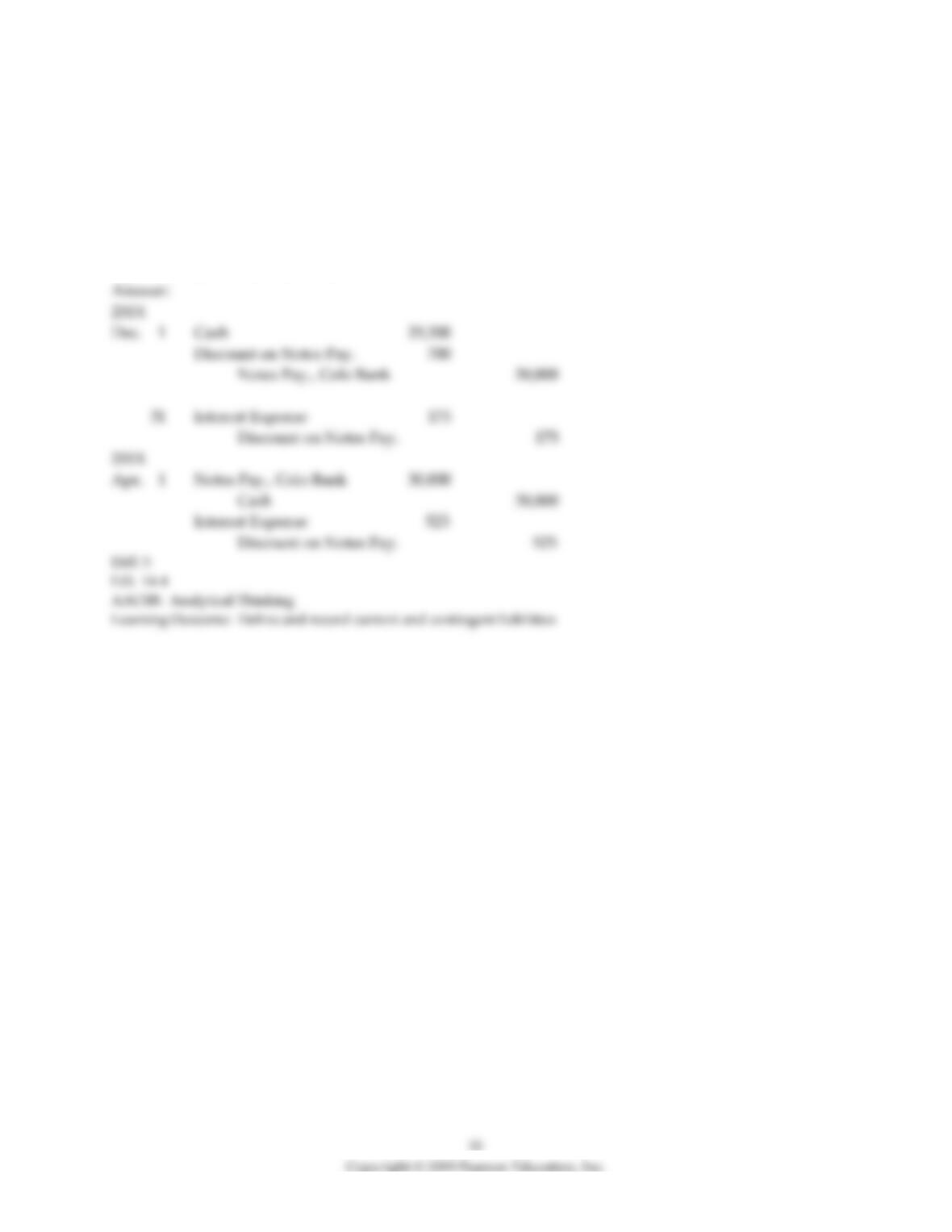
47) Prepare general journal entries for Huckabee Corporation for the following transactions:
201X
Dec. 1 Discounted its own $30,000, 4–month, 7% note at Colo Bank.
31 Accrued the interest expense on the discounted note.
201X
Apr. 1 Paid the discounted note.