72. When investing in automated systems, which of the following intangible or indirect benefits may be
important?
a.
improved customer satisfaction
b.
improved market share
c.
reduced support labor cost
d.
reduced lead time
e.
All of these.
73. Which of the following is true regarding the measurement and use of indirect and intangible benefits in
capital investment decision making?
a.
ABC has made identifying indirect benefits easier.
b.
Intangible benefits cannot be measured.
c.
Indirect and intangible benefits should not be considered, only direct costs and benefits are
considered.
d.
Actions by competitors are not considered.
e.
None of these.
74. A division manager is choosing between two mutually exclusive projects.
Project A
Project B
Net present value
$235,000
$210,000
Internal rate of return
13%
15%
The company requires any project to earn at least 12%. The manager believes that cash inflows from
the project can be reinvested at the rate of 12%. Which project will the manager likely choose?
a.
Project B
b.
Project A
c.
both Projects A and B
d.
neither Project A nor B
75. How do NPV and IRR differ?
a.
NPV measures profitability in absolute terms, whereas the IRR method measures
profitability in relative terms.
b.
IRR should be used for choosing among competing, mutually exclusive projects.
c.
NPV considers the time value of money and IRR does not.
d.
Both NPV and IRR will generate the same decisions.
76. Five mutually exclusive projects had the following information:
V
W
X
Y
Z
NPV
$(6,000)
$40,000
$30,000
$10,000
$20,000
IRR
8%
11%
13%
10%
12%
Which project is preferred?
a.
Project V
b.
Project W
c.
Project X
d.
Project Y
77. The earning of interest on interest is
a.
present value.
b.
future value.
c.
discount rate.
d.
compounding of interest.
e.
interest earned.
78. A series of equal future cash flows is a(n)
a.
future amount.
b.
future earnings.
c.
annuity.
d.
earnings to be discounted.
e.
insurance.
79. The reason that a discount factor in Year 3 is less than a discount factor in Year 2 is that
a.
cash flows are uneven.
b.
compounding does not occur.
c.
cash flows are even.
d.
present value is positive.
e.
a dollar received in 3 years is worth less than a dollar received in 2 years.
PROBLEM
1. Mistral Manufacturing is considering an investment in a new, high-efficient machine. The new
machine requires an initial investment of $1,750,000. The new system cash flows of either:
a. Even cash flows of $350,000 per year or
b. The following expected annual cash flows: $275,000, $420,000, $820,000, $470,000,
and $150,000
Required: Calculate the payback period for each case.
Even cash flows:
$1,750,000/$350,000 = 5 years
2. Brenning Company invested $3,000,000 in a new computer system. The following is the net income
stream:
Year
Net income stream
1
$475,000
2
$375,000
3
$650,000
4
$900,000
5
$920,000
6
$800,000
Required: Calculate the accounting rate of return.
3. Billings Office Services is considering the purchase of a new computer system to replace the one in
operation. Data on the new computer system are:
Cost
$12,000
Salvage value at the end of 5 years
$ 1,000
Useful life, in years
5
Annual operating cost
$ 4,000
If the existing computer system is kept and used, it would require the purchase of additional hardware
a year from now costing $2,000. After using the system for five years, the salvage value would be
$300. Additional information on the existing system is:
Additional years of use
5
Annual operating costs
$ 9,000
Remaining book value
$12,000
Current salvage value
$ 3,000
Cost of capital
12%
The company uses the straight-line method of depreciation.
Required: Should the new system be purchased? Why or why not?
4. Dale Davis Company is evaluating a proposal to purchase a new machine that would cost $100,000
and have a salvage value of $10,000 in 4 years. It would provide annual operating cash savings of
$10,000, as follows:
Old Machine
New Machine
Salaries
$40,000
$36,000
Supplies
7,000
5,000
Maintenance
9,000
5,000
Total
$56,000
$46,000
If the new machine is purchased, the old machine will be sold for its current salvage value of $20,000.
If the new machine is not purchased, the old machine will be disposed of in 4 years at a predicted
salvage value of $2,000. The old machine’s present book value is $40,000. If kept, in 1 year the old
machine will require repairs predicted to cost $35,000.
Dale Davis’s cost of capital is 14%.
Required: Should the new machine be purchased? Why or why not?
Present
Period
Value Factor
Comment
0
1.000
Outlay cost
0
1.000
Salvage of old
1
0.877
Repairs avoided
4
8,000
0.592
Difference in salvage value
Net present value of new machine
5. Fill in the lettered blanks in the following table:
Investment A
Investment B
Investment C
Amount of investment
$40,000
(A)
$20,000
Economic life in years
10
5
8
Annual cash flow
$ 5,000
(B)
$ 2,500
Payback period in years
(C)
4
(D)
Present value of cash flows
(E)
$33,000
(F)
Net present value
$ 5,500
$ 3,000
($1,000)
6. Barker Production Company is considering the purchase of a flexible manufacturing system. The
annual cash benefits/savings associated with the system are:
Decreased waste
$ 75,000
Increased quality
100,000
Decrease in operating costs
62,500
Increase in on-time deliveries
12,500
The system will cost $750,000 and will last ten years. The company’s cost of capital is 10%.
Required:
A.
What is the payback period for the flexible manufacturing system?
B.
What is the NPV for the flexible manufacturing system?
ANS:
$750,000/$250,000 = 3 years
6.145 $250,000 − $750,000 = $786,250
Figure 14-10.
Present value of $1
Periods
4%
6%
8%
10%
12%
14%
1
0.962
0.943
0.926
0.909
0.893
0.877
2
0.925
0.890
0.857
0.826
0.797
0.769
3
0.889
0.840
0.794
0.751
0.712
0.675
4
0.855
0.792
0.735
0.683
0.636
0.592
5
0.822
0.747
0.681
0.621
0.567
0.519
$33,000 − $3,000 = $30,000
B.
$30,000/4 = $7,500
C.
$40,000/$5,000 = 8
D.
$20,000/$2,500 = 8
$40,000 + $5,500 = $45,500
$20,000 − $1,000 = $19,000
6
0.790
0.705
0.630
0.564
0.507
0.456
7
0.760
0.665
0.583
0.513
0.452
0.400
8
0.731
0.627
0.540
0.467
0.404
0.351
9
0.703
0.592
0.500
0.424
0.361
0.308
10
0.676
0.558
0.463
0.386
0.322
0.270
Present value of an Annuity of $1
Periods
4%
6%
8%
10%
12%
14%
1
0.962
0.943
0.926
0.909
0.893
0.877
2
1.886
1.833
1.783
1.736
1.690
1.647
3
2.775
2.673
2.577
2.487
2.402
2.322
4
3.630
3.465
3.312
3.170
3.037
2.914
5
4.452
4.212
3.993
3.791
3.605
3.433
6
5.242
4.917
4.623
4.355
4.111
3.889
7
6.002
5.582
5.206
4.868
4.564
4.288
8
6.733
6.210
5.747
5.335
4.968
4.639
9
7.435
6.802
6.247
5.759
5.328
4.946
10
8.111
7.360
6.710
6.145
5.650
5.216
7. Refer to Figure 14-10. Jimmy Reynolds is considering investing $12,000 in a project with the
following cash revenues and expenses:
Revenues
Expenses
Year 1
$20,000
$18,000
Year 2
$22,000
$19,000
Year 3
$22,000
$20,000
Year 4
$22,000
$17,000
Year 5
$25,000
$17,000
Jimmy requires a minimum rate of return of 8%.
A.
Calculate the net cash inflows in each of the 5 years.
B.
What is the payback period?
C.
What is the net present value of the investment?
Year 1
Year 2
Year 3
Year 4
Year 5
B.
Payback period = ($2,000 + $3,000 + $2,000 + $5,000) = 4 years
Net present value = $15,134 − $12,000 = $3,134
Year 1
8. Refer to Figure 14-10. Jasmine Company is considering an investment costing $20,000. The
investment would return $8,000 per year in each of three years. Jasmine requires a minimum rate of
return of 6%.
A.
What is the payback period for the investment?
B.
What is the net present value of the investment?
C.
The internal rate of return is greater than __________________% and less than
__________________%.
A.
Payback period = $20,000/$8,000 = 2.5 years
= $8,000(0.943) + $8,000(0.890) + $8,000(0.840) − $20,000
= $1,384
OR
= $8,000(2.673) − $20,000 = $1,384
The internal rate of return for this discount factor lies between 8% and 10%
9. Refer to Figure 14-10. Geary Company is considering an investment costing $110,000. The investment
would return $40,000 per year in each of three years. Geary requires a minimum rate of return of 10%.
A.
What is the payback period for the investment?
B.
Using the Present Value of an Annuity of $1 table, calculate the net present value of
the investment.
C.
The internal rate of return is greater than __________________% and less than
__________________%.
D.
Now assume that the investment includes equipment that can be sold at the end of the
third year for $10,000. What is the present value of this investment?
A.
Payback period = $110,000/$40,000 = 2.75 years
10. Refer to Figure 14-10. Howard-Parr Company is considering an investment that will have an initial
cost of $500,000 and yield annual net cash inflows of $130,000. Yearly depreciation will be $100,000.
The equipment is expected to be useful for five years, at which point it will be scrapped with no
salvage value. Howard-Parr requires a minimum rate of return of 10%.
A.
What is the accounting rate of return?
B.
What is the net present value? Is the investment acceptable?
C.
Now suppose that Howard-Parr believes it can sell the equipment at the end of 5 years
for $50,000. What is the net present value? Is the investment acceptable?
D.
What can you say about the IRR in the first case (no salvage value) versus the IRR in
the second case ($50,000 salvage value)?
ARR = ($130,000 − $100,000)/$500,000 = 0.06 or 6%
NPV = ($130,000 3.791) − $500,000 = ($7,170)
The investment is not acceptable because the NPV is negative.
NPV = ($130,000 3.791) + ($50,000 0.621) − $500,000 = $23,880
Now the investment is acceptable because the NPV is positive.
11. Refer to Figure 14-10. A company is considering two modifications to its current manufacturing
process. The after-tax cash flows associated with the two investments are:
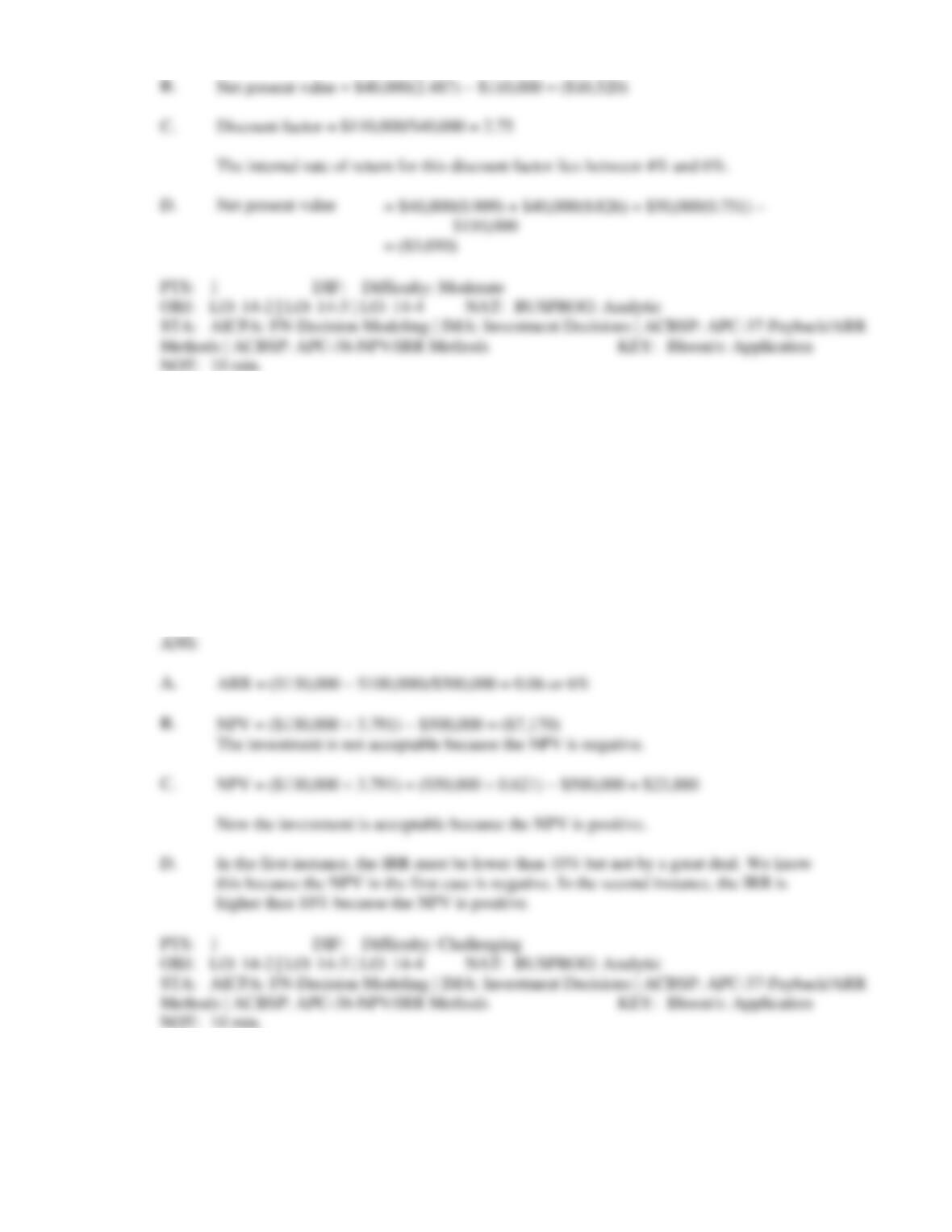
Net present value = $40,000(2.487) − $110,000 = ($10,520)
C.
Discount factor = $110,000/$40,000 = 2.75
The internal rate of return for this discount factor lies between 4% and 6%.
= $40,000(0.909) + $40,000(0.826) + $50,000(0.751) −
$110,000
= ($3,050)
Year
Project I
Project II
0
$(37,500)
$(150,000)
1
—
91,075
2
$50,460
91,075
The company’s cost of capital is 12%.
A.
Compute the net present value for each investment.
B.
Computer the internal rate of return for each investment.
C.
Which project is better? Explain your reasoning.
12. Refer to Figure 14-10. Ray Corporation is looking to invest in a new piece of equipment. Two
manufacturers of this type of equipment are being considered. After-tax inflows for the two
competing projects are:
Year
Fallon Equipment Inc.
Toller Equipment Inc.
1
$275,000
$70,000
2
225,000
70,000
3
185,000
285,000
4
140,000
330,000
5
65,000
390,000
Both projects require an initial investment of $400,000. In both cases, assume that the equipment has
a life of 5 years with no salvage value.
Required:
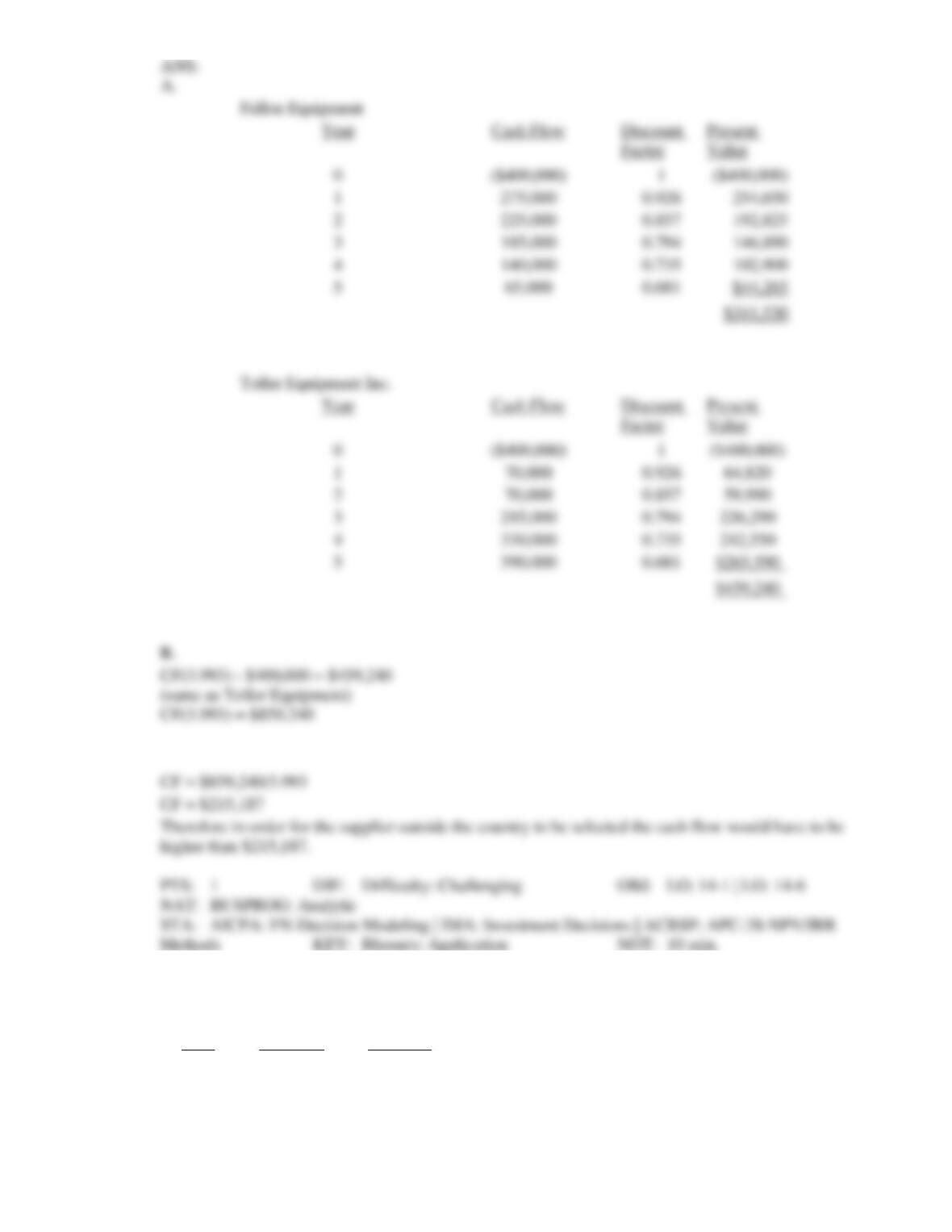
A. Assuming a discount rate of 8%, compute the net present value of each piece of equipment.
B. A third option is now available for a supplier outside of the country. The cost is also $400,000, but
it will produce even cash flows over its 5-year life. What must the annual cash flow be for this
equipment to be selected over the other two? Assume an 8% discount rate.
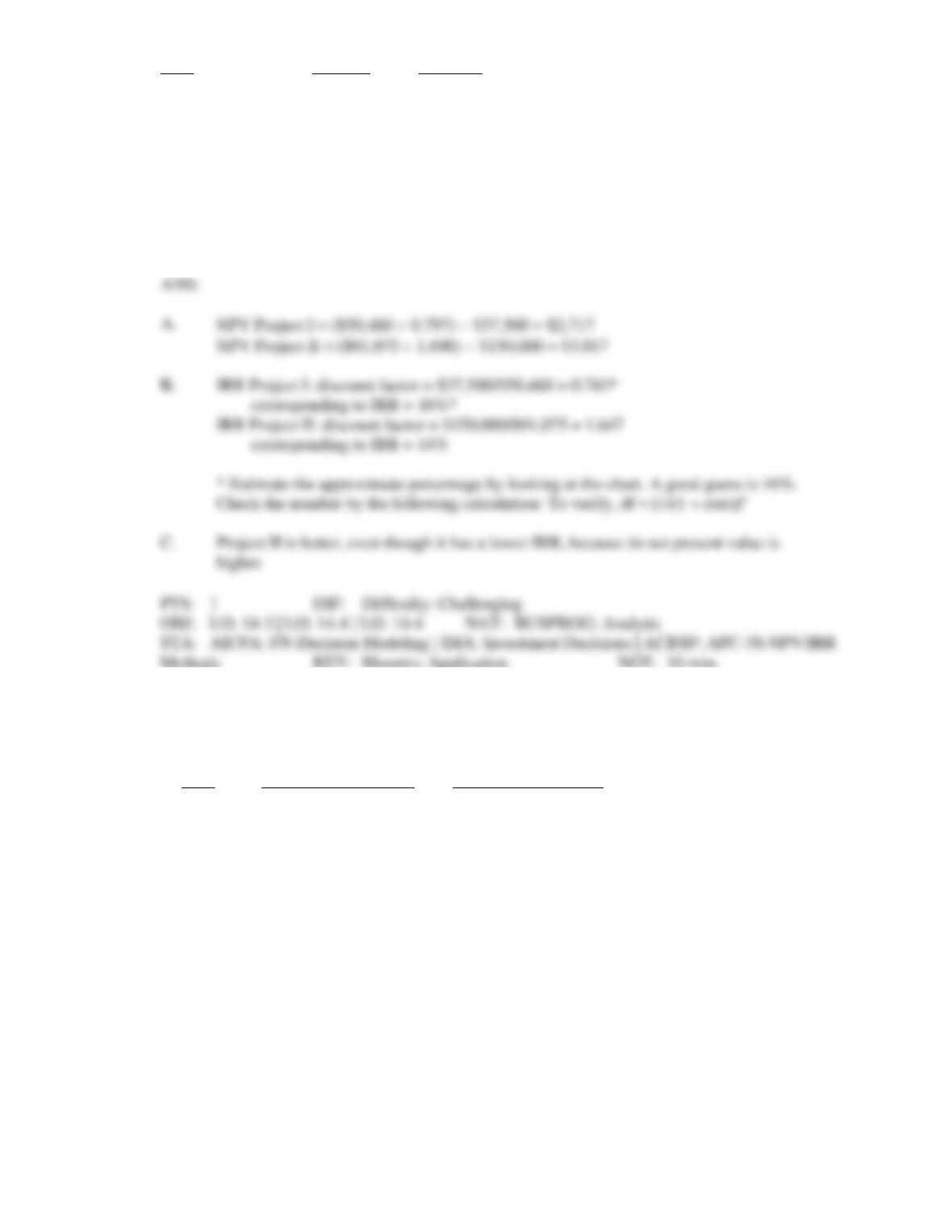
NPV Project I = ($50,460 0.797) − $37,500 = $2,717
NPV Project II = ($91,075 1.690) − $150,000 = $3,917
B.
IRR Project I: discount factor = $37,500/$50,460 = 0.743*
corresponding to IRR = 16%*
IRR Project II: discount factor = $150,000/$91,075 = 1.647
corresponding to IRR = 14%
13. Refer to Figure 14-10. Durrel Company is considering two different modifications to its current
manufacturing process. The after-tax cash flows associated with the two investments are as follows:
Year
Project A
Project B
0
($220,000)
($220,000)
1
–
88,500
2
–
88,500
3
285,000
88,500
Durrel’s cost of capital is 6%.
Required:
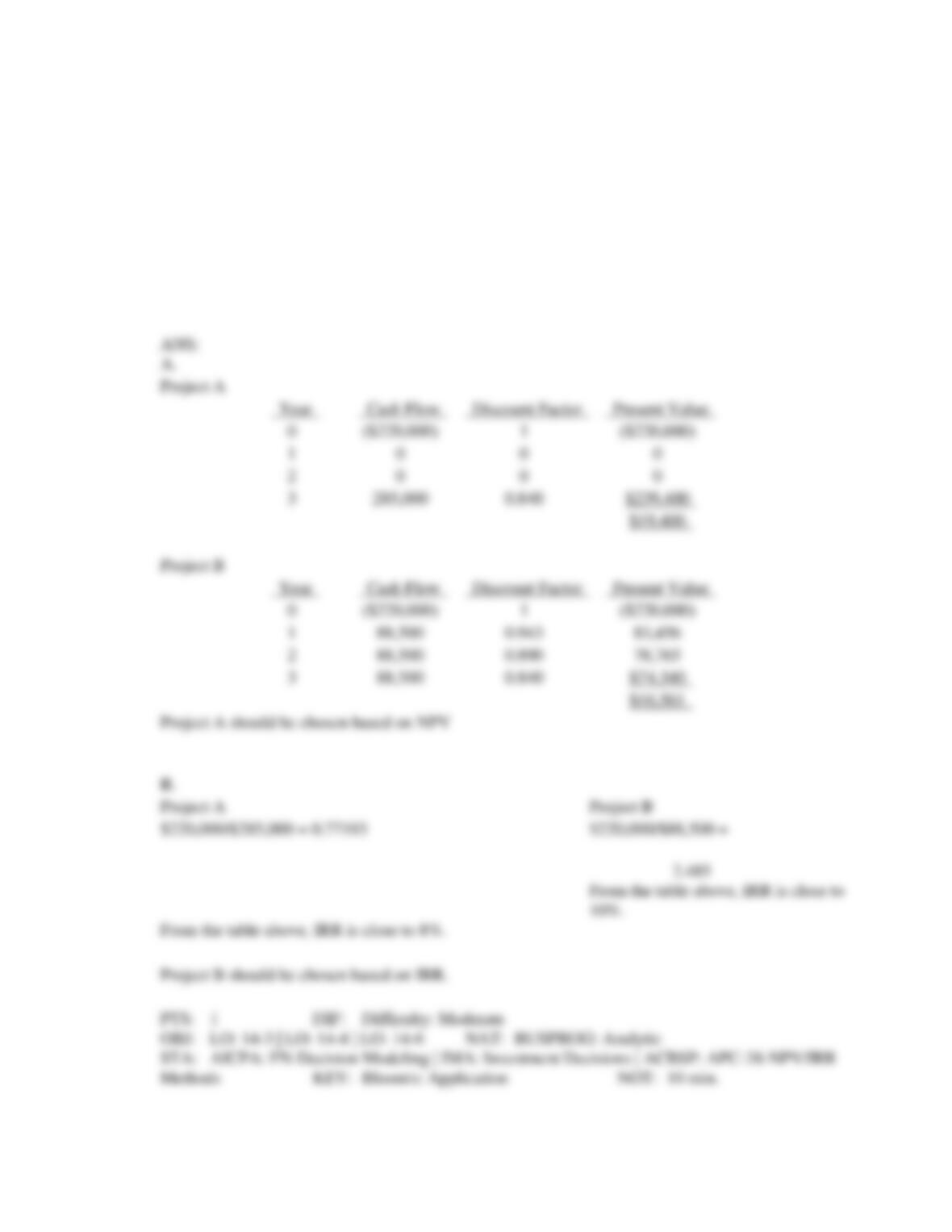
A. Compute the NPV for each investment and state which project should be chosen based on the
NPV.
B. Compute the IRR for each investment and state which project should be chosen based on the IRR.
Figure 14-11.
Present value of an Annuity of $1 in Arrears
Periods
4%
6%
8%
10%
12%
14%
1
0.962
0.943
0.926
0.909
0.893
0.877
2
1.886
1.833
1.783
1.736
1.690
1.647
3
2.775
2.673
2.577
2.487
2.402
2.322
4
3.630
3.465
3.312
3.170
3.037
2.914
5
4.452
4.212
3.993
3.791
3.605
4.433
6
5.242
4.917
4.623
4.355
4.111
3.889
7
6.002
5.582
5.206
4.868
4.564
4.288
8
6.733
6.210
5.747
5.335
4.968
4.639
9
7.435
6.802
6.247
5.759
5.328
4.946
10
8.111
7.360
6.710
6.145
5.650
5.216
14. Refer to Figure 14-11. Aragon Company is considering an investment in equipment that will have an
initial cost of $560,290 and yield annual net cash inflows of $90,000. Yearly depreciation will be
$56,000. The equipment is expected to be useful for 10 years and then it will be scrapped. Aragon
requires a minimum rate of return of 10%.
A.
What is the payback period?
B.
What is the accounting rate of return?
C.
What is the net present value?
D.
What is the approximate internal rate of return?
15. Refer to Figure 14-11. Cleves Company is considering two projects.
Project X
Project Y
Initial investment
$500,000
$100,000
Annual cash flows
$ 88,500
$ 34,320
Life of the project
10 years
4 years
Depreciation per year
$ 50,000
$ 25,000
Cleves requires a minimum rate of return of 8%.
A.
What is the accounting rate of return for each project?
B.
What is the net present value for each project?
C.
What is the internal rate of return for each project?
A.
Payback period = $560,290/$90,000 = 6.2 years
ARR = ($90,000 − $56,000)/$560,290 = 0.06068 or 6.07%
NPV = ($90,000 6.145) − $560,290 = ($7,240)
D.
Discount factor = $560,290/$90,000 = 6.225
corresponding to an IRR of slightly below 10%
D.
Given that only one project can be selected, which project should be chosen? Explain
your reasoning.
16. Refer to Figure 14-11. Lyster Company wants to buy a new machine that will be able to perform
many of the steps in the manufacturing process that they currently have to do manually. The hope is
that it will reduce the amount of time it takes to create one unit and reduce the number of defective
units. The machine requires an investment of $750,000. The machine will last six years with no
expected salvage value. The expected after-tax cash flows associated with the project are as follows:
Year
Cash revenues
Cash expenses
1
$825,000
$510,000
2
825,000
510,000
3
825,000
510,000
4
825,000
510,000
5
825,000
510,000
6
825,000
510,000
Required:
A. Compute the payback period for the new machine.
B. Compute the new machine’s ARR.
C. Compute the investment’s NPV, assuming a required rate of return of 12%.
ANS:
ESSAY
1. What is a capital investment decision? Give an example.
2. Name two nondiscounting capital investment models. What is meant by nondiscounting?
3. What are some reasons why firms use the payback period model in capital investment decision
making?
4. Which model of capital investment decision making is most widely used? Why?
5. What is a postaudit? What are the advantages and disadvantages of the postaudit?
ANS:
6. Which model is better for independent projects − net present value or internal rate of return? For
mutually exclusive projects? Explain your reasoning for each case.
7. Explain the relationship between current and future dollars.