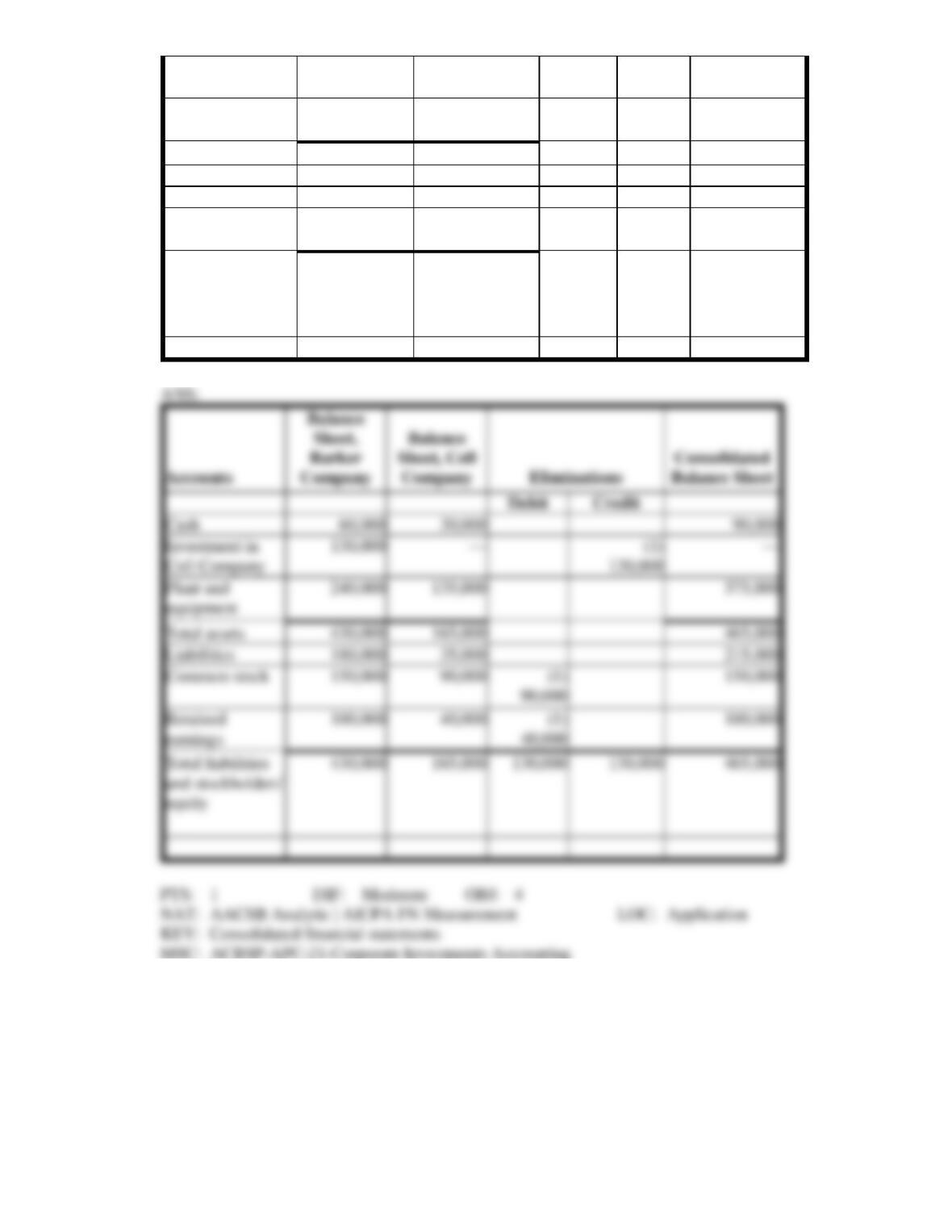
Investment in Coll
Company
130,000
—
Plant and
equipment
240,000
135,000
Total assets
430,000
165,000
Liabilities
180,000
35,000
Common stock
150,000
90,000
Retained
earnings
100,000
40,000
Total liabilities
and stockholders’
equity
430,000
165,000
16. Ming Company purchased 100 percent of Savran Company for $94,000. Of the excess of cost over
book value, $15,000 was attributed to Savran’s undervalued plant and equipment. The rest was
attributed to the general strength of the company. Complete the following work sheet by providing the
figures for the Eliminations columns and the Consolidated Balance Sheet column.
Cash
Investment in
Total assets
Liabilities
Retained
earnings
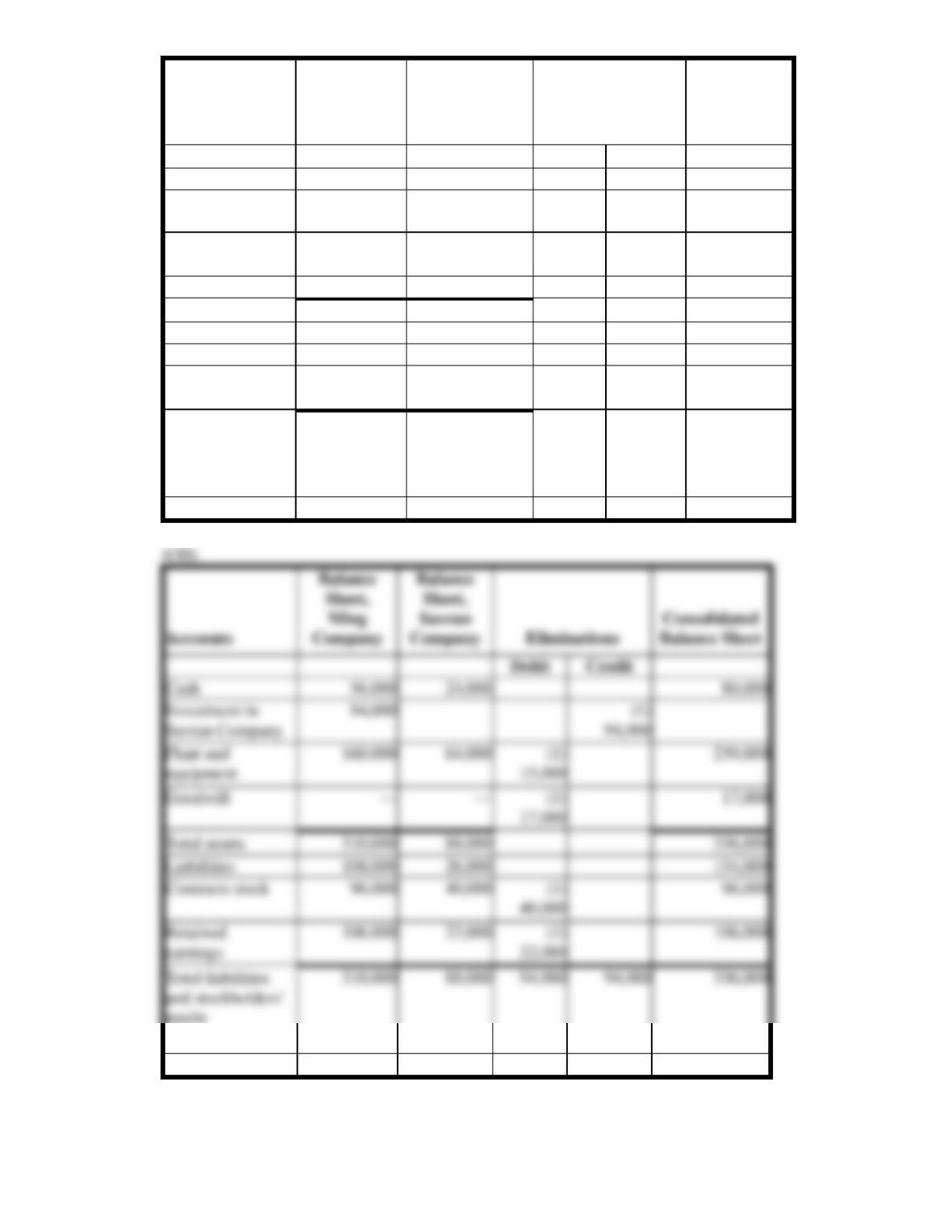
Accounts
Balance Sheet,
Ming
Company
Balance Sheet,
Savran
Company
Eliminations
Consolidated
Balance Sheet
Debit
Credit
Cash
56,000
24,000
Investment in
Savran Company
94,000
—
Plant and
equipment
160,000
64,000
Goodwill
—
—
Total assets
310,000
88,000
Liabilities
108,000
26,000
Common stock
96,000
40,000
Retained
earnings
106,000
22,000
Total liabilities
and stockholders’
equity
310,000
88,000
Cash
Liabilities
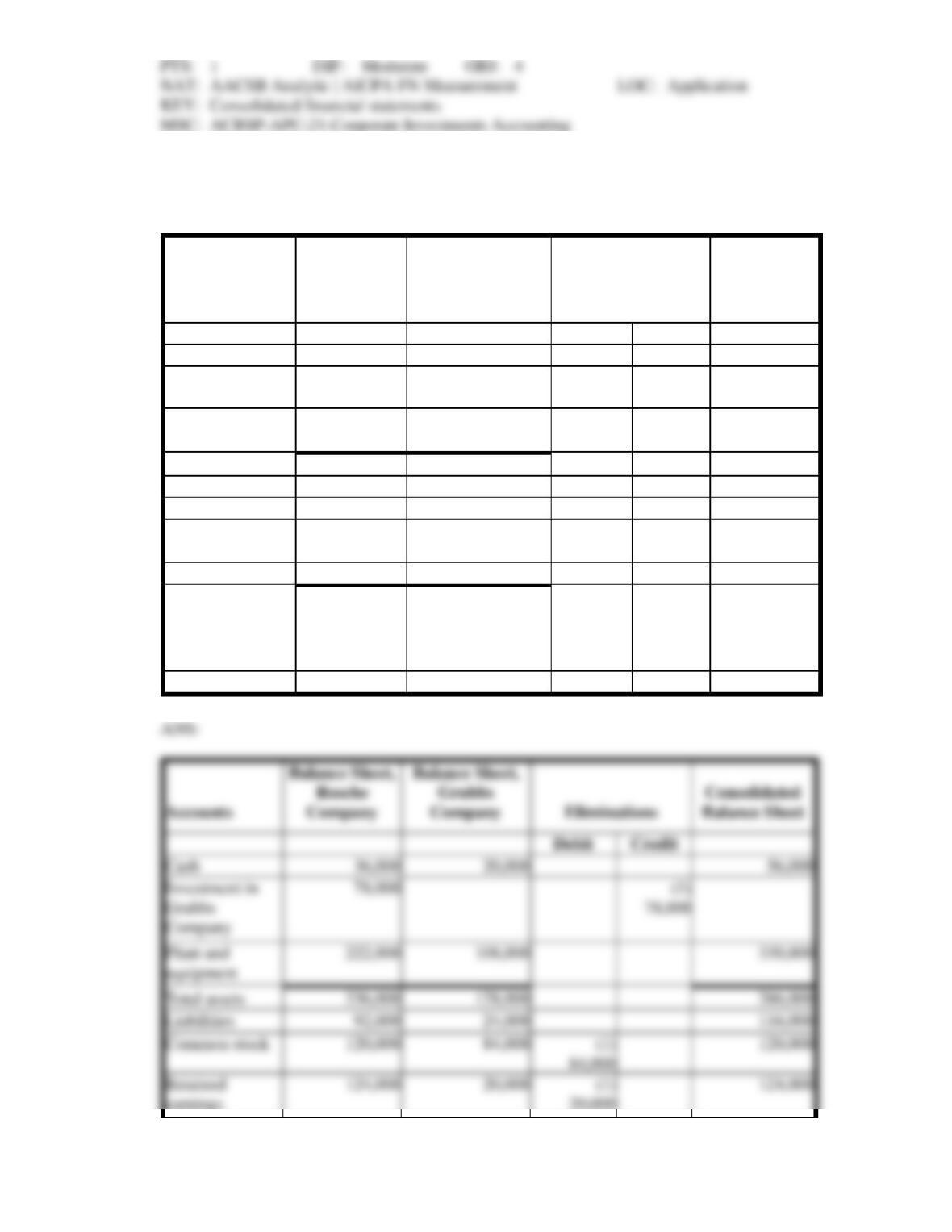
17. Rosche Company purchased 75 percent of Grubbs Company for $78,000. Complete the following
work sheet by providing the figures for the Eliminations columns and the Consolidated Balance Sheet
column.
Accounts
Balance Sheet,
Rosche
Company
Balance Sheet,
Grubbs Company
Eliminations
Consolidated
Balance Sheet
Debit
Credit
Cash
36,000
20,000
Investment in
Grubbs Company
78,000
—
Plant and
equipment
222,000
108,000
Total assets
336,000
128,000
Liabilities
92,000
24,000
Common stock
120,000
84,000
Retained
earnings
124,000
20,000
Minority interest
—
—
Total liabilities
and stockholders’
equity
336,000
128,000
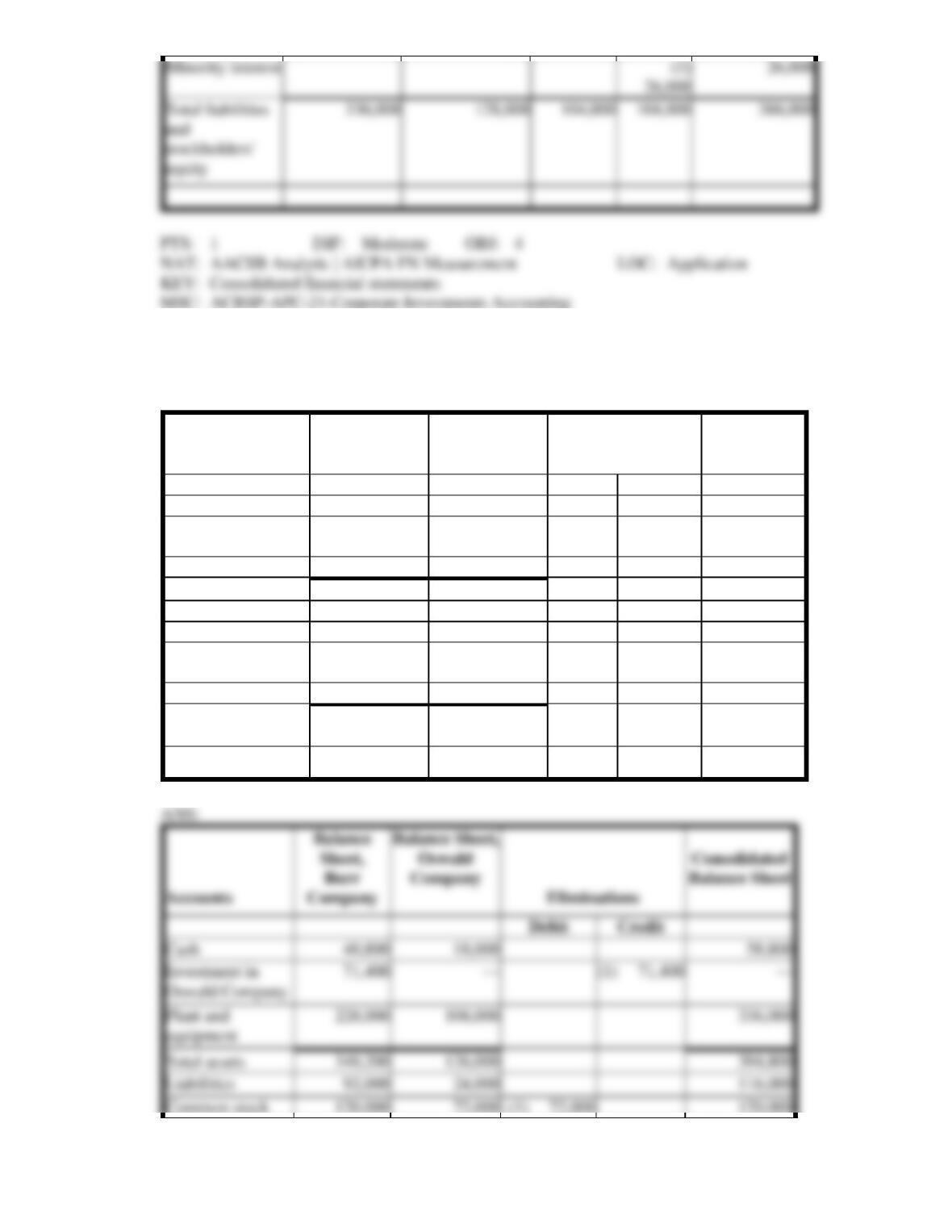
18. Burr Company purchased 70 percent of Oswald Company for $71,400. Complete the following work
sheet by providing the figures for the Eliminations columns and the Consolidated Balance Sheet
column.
Accounts
Balance Sheet,
Burr Company
Balance Sheet,
Oswald
Company
Eliminations
Consolidated
Balance
Sheet
Debit
Credit
Cash
40,800
18,000
Investment in
Oswald Company
71,400
—
Plant and equipment
228,000
108,000
Total assets
340,200
126,000
Liabilities
92,000
24,000
Common stock
120,000
72,000
Retained
earnings
128,200
30,000
Minority interest
—
—
Total liabilities and
stockholders’ equity
340,200
126,000
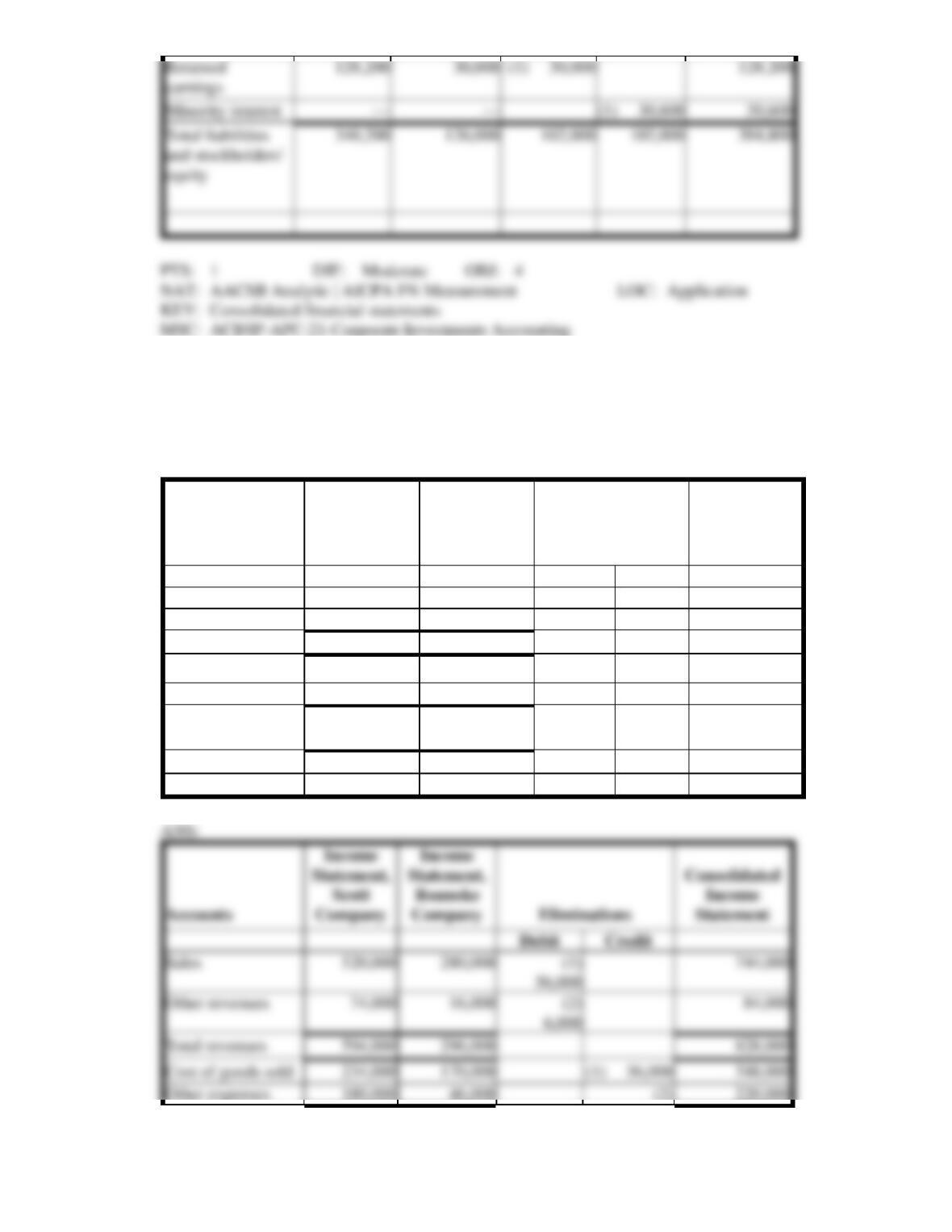
19. Scott Company owns 100 percent of the stock of Roanoke Company. The separate income statements
for the two companies for the year ended December 31, 2013, are provided below. Scott Company
sold a product to Roanoke Company for $56,000, and Roanoke Company sold it to a customer for
$80,000. Roanoke paid Scott $6,000 interest on a loan from Roanoke. Complete the work sheet by
providing the amounts for the Eliminations columns and the Consolidated Income Statement column.
Accounts
Income
Statement,
Scott
Company
Income
Statement,
Roanoke
Company
Eliminations
Consolidated
Income
Statement
Debit
Credit
Sales
520,000
280,000
Other revenues
74,000
16,000
Total revenues
594,000
296,000
Cost of goods sold
234,000
170,000
Other expenses
180,000
46,000
Total costs and
expenses
414,000
216,000
Net income
180,000
80,000
20. In the journal provided, prepare the entries for the transactions described below. (Omit explanations.)
May
5
Purchased 120-day Treasury bills for $78,000. This investment will be
held to maturity.
Sept.
2
Treasury bills matured; $80,000 received. (No prior entries were made to
recognize revenue.)
General Journal
Page 1
Date
Description
Post.
Ref.
Debit
Credit
Total costs and
21. In the journal provided, prepare the entries for the transactions described below. (Omit explanations.)
Mar.
17
Purchased 90-day Treasury bills for $23,700. This investment will be held to
maturity.
June
15
Treasury bills matured; $24,000 received. (No prior entries were made to
recognize revenue.)
General Journal
Page 1
Date
Description
Post.
Ref.
Debit
Credit
Mar.
Short-Term Investments
Cash
June
Cash
Short-Term Investments
Interest Income
MATCHING
Match each definition with the correct term below.
a.
Debt or equity securities bought and held principally for the purpose of being sold in the
near term.
b.
The method of accounting for the ownership of more than 20 percent of another
company’s voting stock.
c.
Debt or equity securities that do not meet the criteria for either trading or held–to-maturity
securities.
d.
A single set of financial statements for both the parent company and the subsidiary
company.
e.
Companies that have expanded by establishing or buying foreign subsidiaries.
f.
The method of recording available-for-sale securities that initially records securities at cost
and thereafter periodically adjusts for changes in market value by using an allowance
account.
g.
The currency in which the consolidated financial statements are presented.
h.
Debt securities that management intends to hold until their maturity date.
i.
The investing company in a parent-subsidiary relationship.
j.
Making use of inside information for personal gain.
1. Trading securities
2. Available-for-sale securities
3. Held-to-maturity securities
4. Insider trading
5. Cost-adjusted-to-market method
6. Equity method
7. Parent company
8. Multinational or transnational companies
9. Reporting currency
10. Consolidated financial statements
PROBLEM
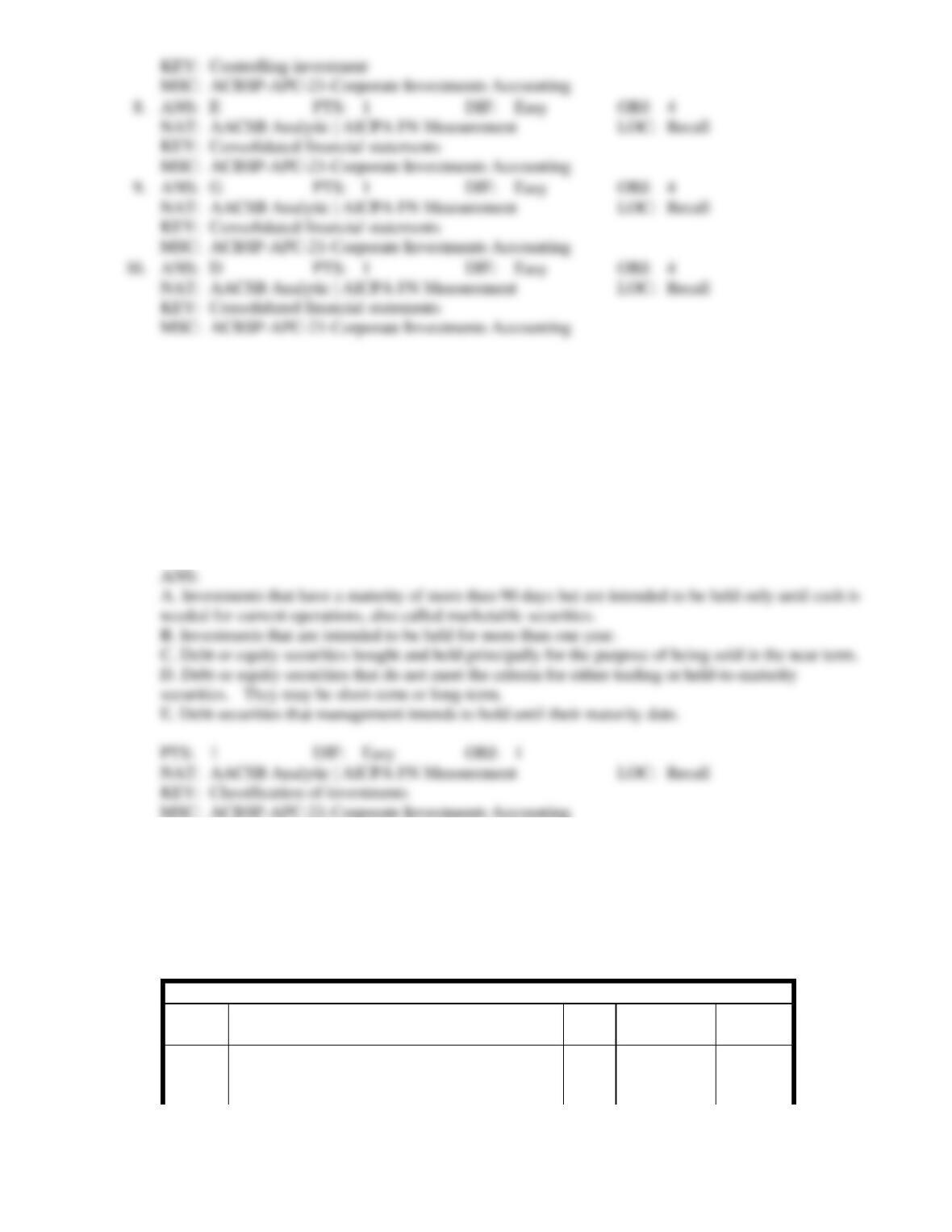
1. Define the following classifications of investments:
A. Short-term investments
B. Long-term investments
C. Trading securities
D. Available-for-sale securities
E. Held-to-maturity securities
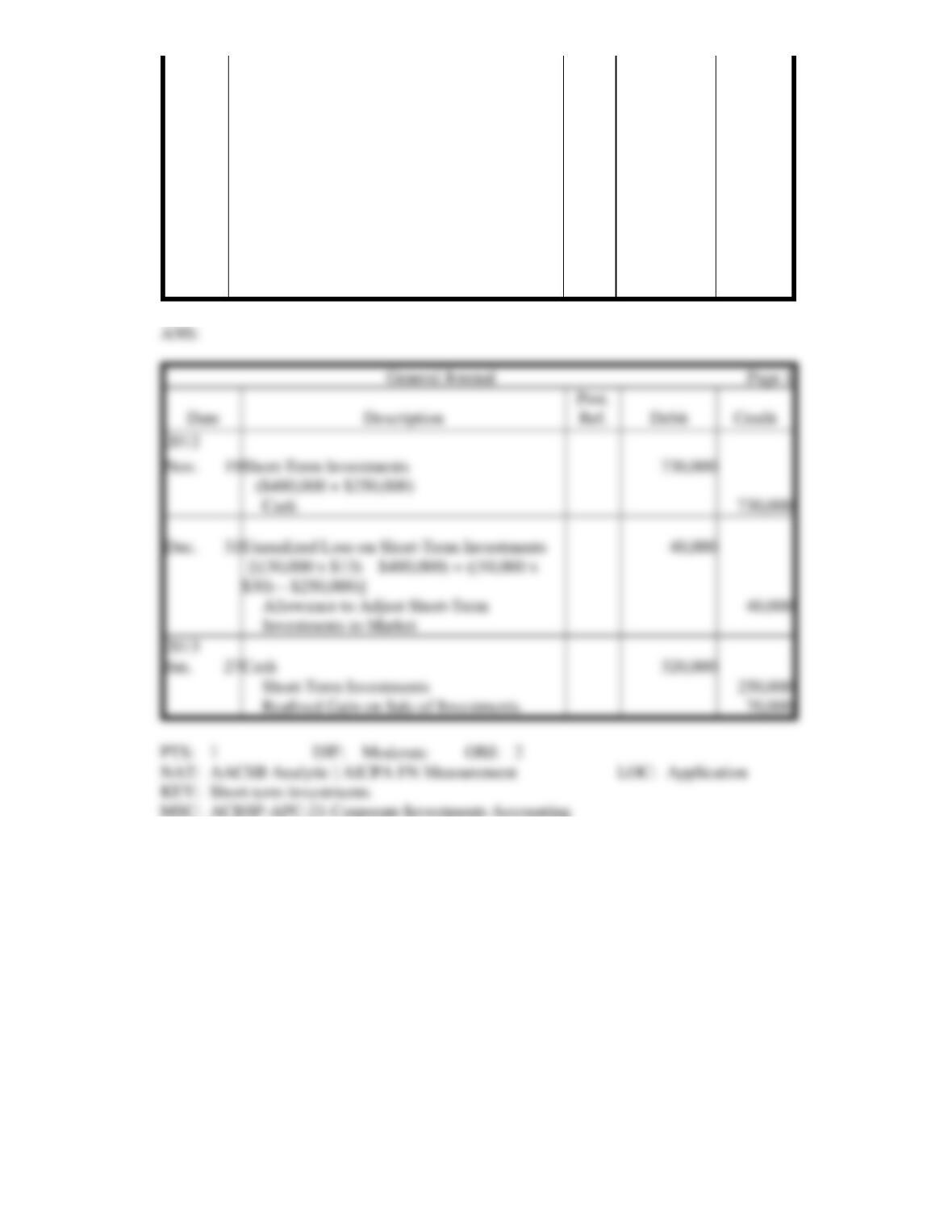
2. On November 19, 2012, Lassen Company purchased 30,000 shares of JCN Corporation stock for
$480,000, and 10,000 shares of Canoga Corporation stock for $250,000. Lassen’s management intends
to hold all 40,000 shares for a short period of time. On December 31, 2012, the price of JCN’s stock
was $13 per share, and the price of the Canoga stock was $30 per share. Finally, on January 27, 2013,
Lassen sold all 10,000 shares of Canoga stock for $320,000. In the journal provided below, prepare
Lassen’s entries for November 19, December 31, and January 27.
General Journal
Page 1
Date
Description
Post.
Ref.
Debit
Credit
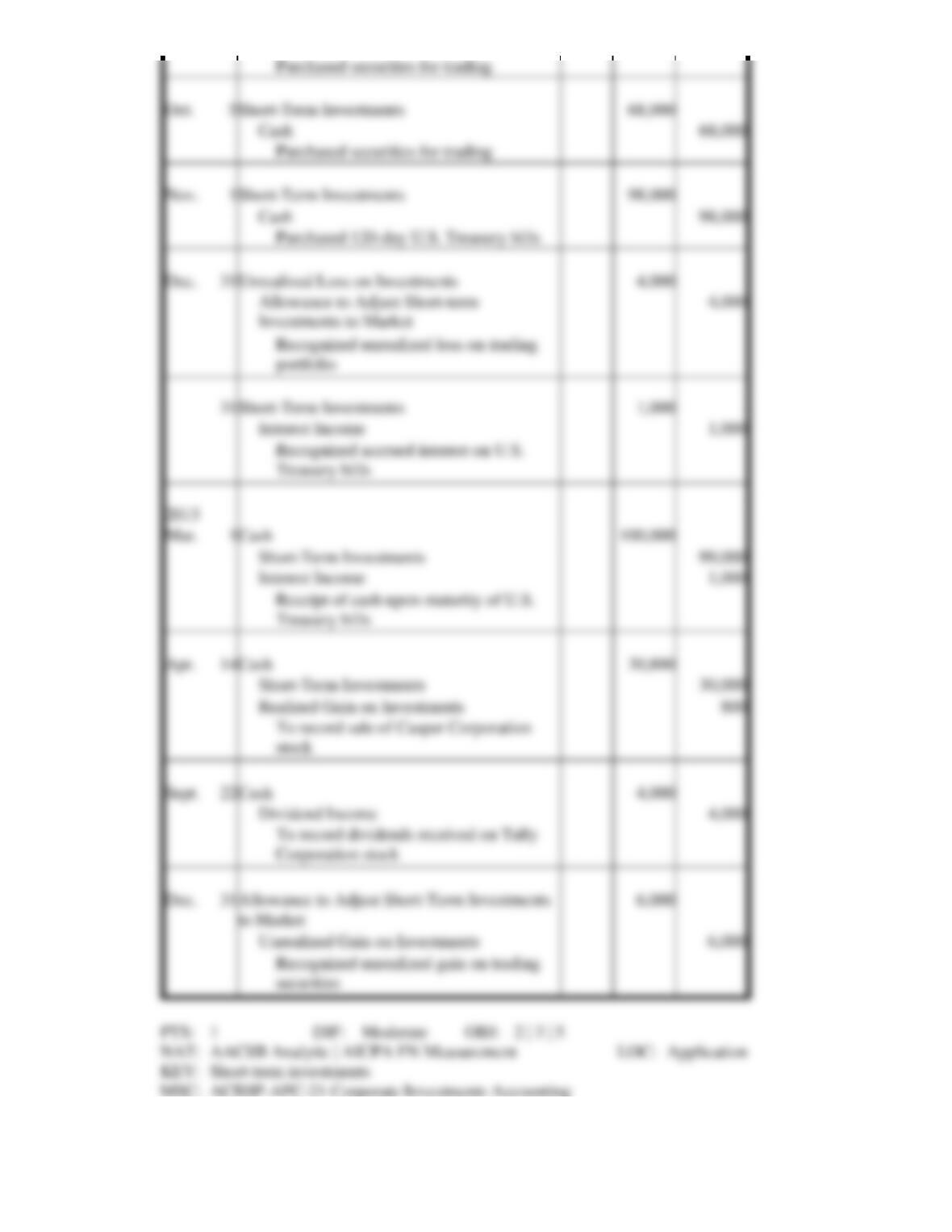
3. Using the journal provided, enter the following transactions for LaPana Corporation for 2012 and
2013. Please provide all explanations.
2012
Aug.
13
Purchased 1,000 shares of Casper Corporation stock for $30,000. These
securities were purchased primarily for trading purposes.
Oct.
5
Purchased 4,000 shares of Tally Corporation stock for $68,000. These
securities were purchased primarily for trading purposes.
Nov.
1
Invested $98,000 in 120-day U.S. Treasury bills that have a maturity value
of $100,000.
Dec.
31
The market value of the Casper Corporation shares is $31,000, and the
market value of the Tally Corporation stock is $63,000. A year-end
adjustment is made.
$30) – $250,000)]
Short-Term Investments
Realized Gain on Sale of Investments
31
A year-end adjustment is made for accrued interest on the Treasury bills.
2013
Mar.
1
Received maturity value of U.S. Treasury bills in cash.
Apr.
14
Sold all 1,000 shares of Casper Corporation stock for $30,800.
Sept.
22
Received dividends of $1 per share from Tally Corporation.
Dec.
31
The market value of the Tally Corporation shares is $70,000. A year-end
adjustment is made.
General Journal
Page 1
Date
Description
Post.
Ref.
Debit
Credit

4. The following transactions and information pertain to Lazar Corporation for 2012 and 2013.
2012
May
1
Purchased 3,000 shares of Ross Corporation common stock at $20 per share
(representing 5 percent of Ross’s total outstanding stock) as a long-term
investment.
Sept.
1
Received a cash dividend from Ross equal to $.60 per share.
Dec.
31
Market value of Ross stock at year end was $18 per share.
2013
Sept.
1
Received a cash dividend from Ross equal to $.50 per share.
Nov.
1
Sold 400 shares of Ross at $19 per share.
Dec.
31
Market value of Ross stock at year end was $17 per share.
Prepare entries in journal form, without explanations, to record the above. Lazar’s accounting year
ends December 31.
General Journal
Page 1
Date
Description
Post.
Ref.
Debit
Credit
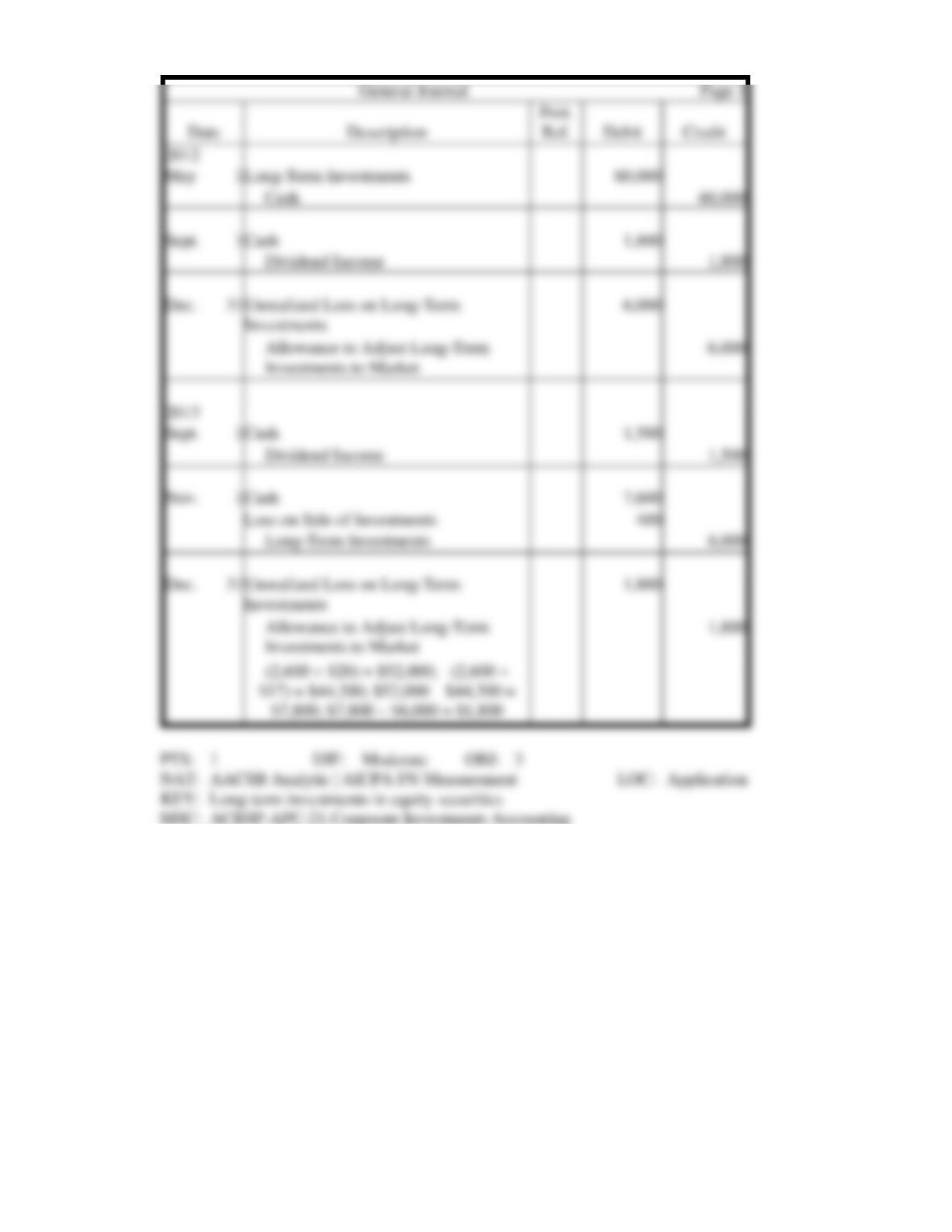
5. The following transactions and information pertain to Yates Corporation for 2012 and 2013.
2012
May
1
Purchased 3,000 shares of Templin Corporation common stock at $32 per share
representing 2 percent of Templin’s total outstanding stock) as a long-term
investment.
Sept.
1
Received a cash dividend from Templin equal to $1.40 per share.
Dec.
31
Market value of Templin stock at year end was $24 per share.
2013
Sept.
1
Received a cash dividend from Templin equal to $1.40 per share.
Nov.
1
Sold 300 shares of Templin at $26 per share.
Dec.
31
Market value of Templin stock at year end was $22 per share.
Cash
Sept.
Cash
Dividend Income
Dividend Income
Loss on Sale of Investments
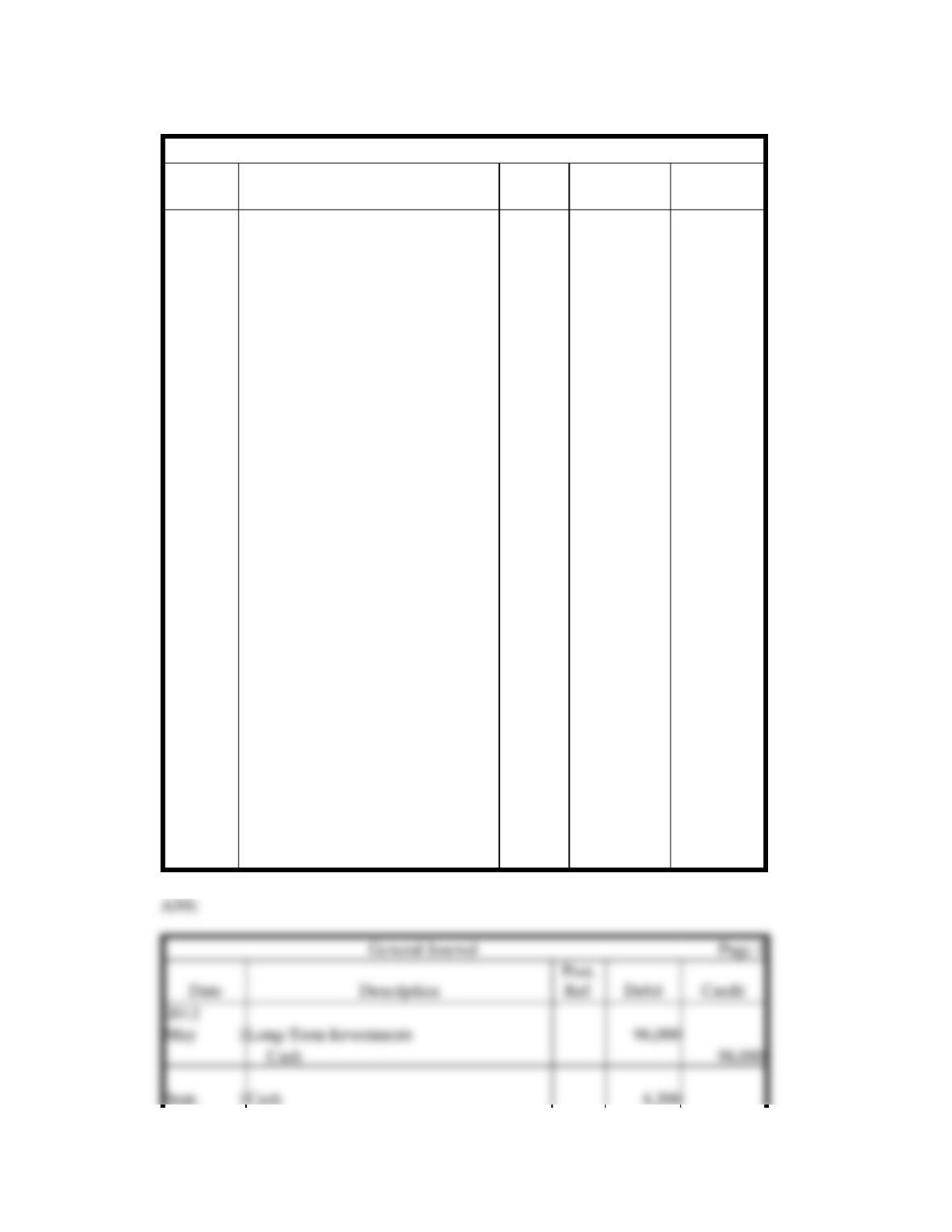
Prepare entries in journal form, without explanations, to record the above. Yates’s accounting year
ends December 31.
General Journal
Page 1
Date
Description
Post.
Ref.
Debit
Credit
Cash
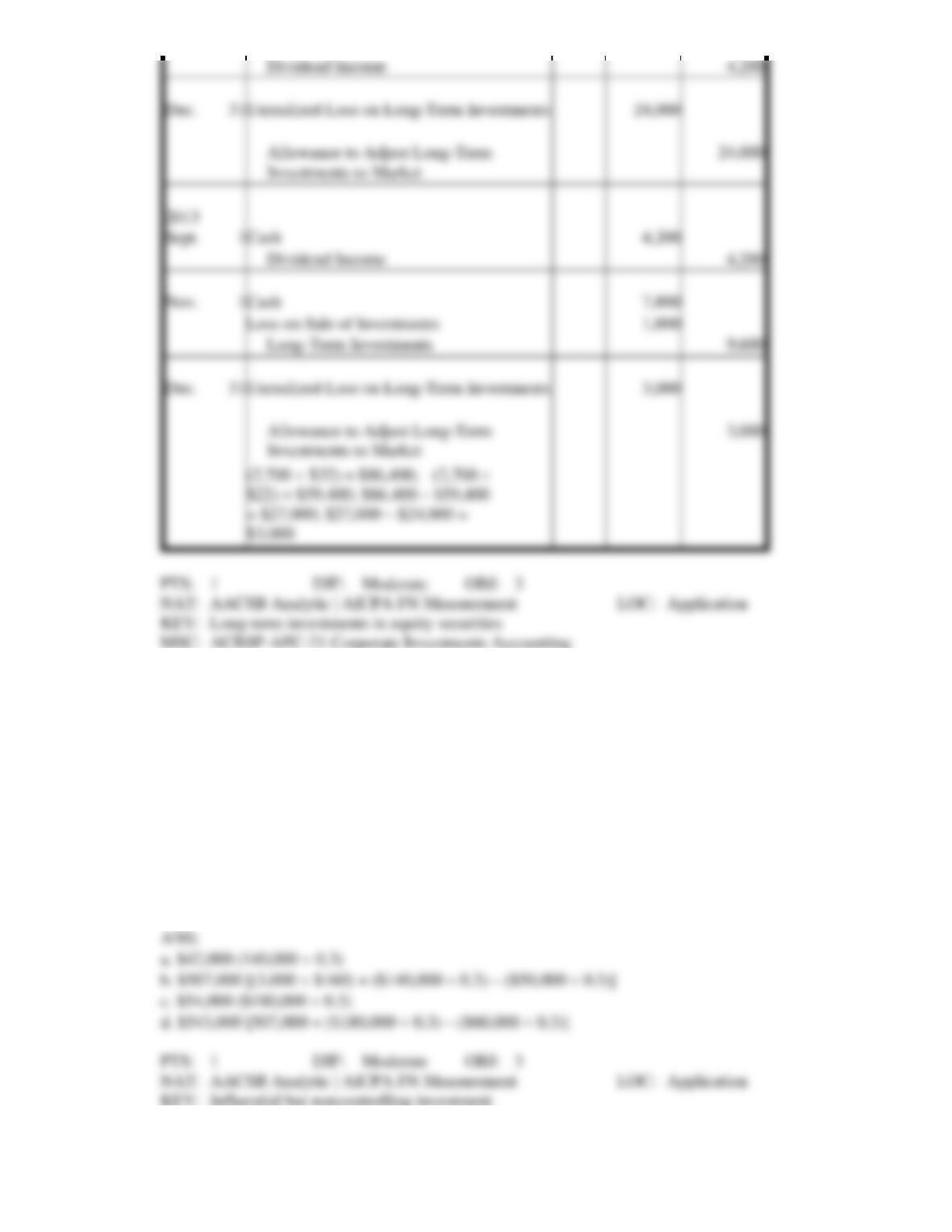
6. Raleigh Corporation purchased 3,000 shares of Mingo Corporation common stock for $160 per share
on January 1, 2012, as a long-term investment. Mingo reported net income of $140,000 and $180,000
for 2012 and 2013, respectively, and paid dividends of $50,000 and $60,000 during 2012 and 2013,
respectively. Mingo has a total of 10,000 shares outstanding. Compute the following amounts.
a. Amount of investment income recognized by Raleigh Corporation during 2012
b. Balance of Investment in Mingo Corporation account at end of 2012
c. Amount of investment income recognized by Raleigh Corporation during 2013
d. Balance of Investment in Mingo Corporation account at end of 2013
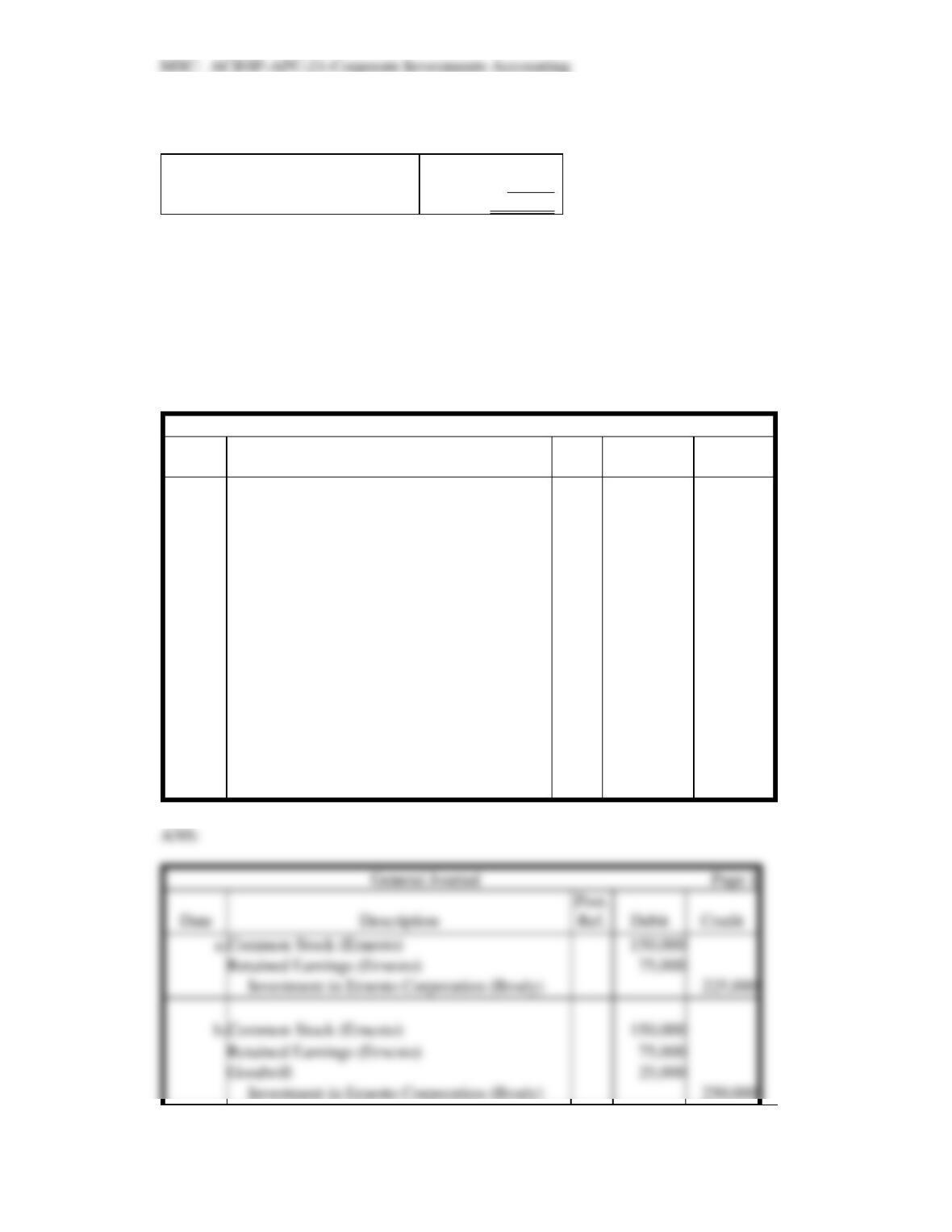
7. The stockholders’ equity section of Ernesto Corporation’s balance sheet appeared as follows on
December 31, 2013:
Common Stock
$150,000
Retained Earnings
75,000
Total Stockholders’ Equity
$225,000
Prepare entries in journal form to eliminate Brody‘s investment in Ernesto and Ernesto’s stockholders’
equity used in preparing the consolidated balance sheet under each of the following assumptions.
(Omit explanations.)
a. Brody purchased 100 percent of Ernesto for $225,000.
b. Brody purchased 100 percent of Ernesto for $250,000. The excess did not apply to any particular
asset.
c. Brody purchased 80 percent of Ernesto for $180,000.
General Journal
Page 1
Date
Description
Post.
Ref.
Debit
Credit
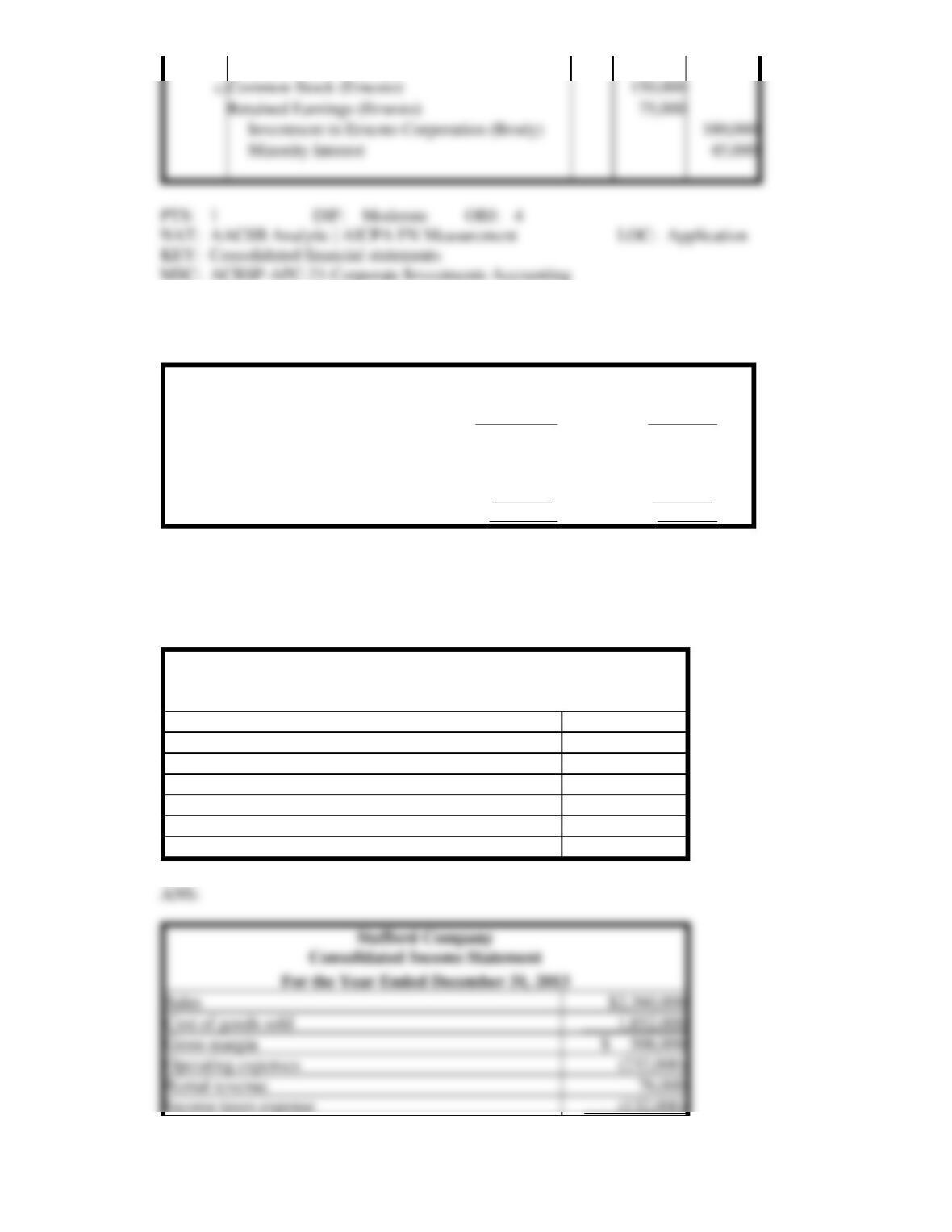
8. Stafford Company owns 100 percent of the stock of Tazewell Company. The separate income
statements for the two companies for the year ended December 31, 2013, are as follows:
Stafford Company
Tazewell Company
Sales
$1,600,000
$1,000,000
Cost of goods sold
1,300,000
792,000
Gross margin
$300,000
$208,000
Operating expenses, including rent
(172,000)
(96,000)
Rental revenue
$ 112,000
—
Income taxes expense
(88,000)
(44,000)
Net income
$ 152,000
$ 68,000
Stafford Company sold merchandise to Tazewell Company for $240,000, which in turn was sold by
Tazewell Company to its customers. Tazewell Company paid rentals of $36,000 to Stafford Company
on a long-term lease. Using the partially completed form that follows, prepare a consolidated income
statement for the year ended December 31, 2013.
Stafford Company
Consolidated Income Statement
For the Year Ended December 31, 2013
Sales
Cost of goods sold
Gross margin
Operating expenses
Rental revenue
Income taxes expense
Net income
Stafford Company
For the Year Ended December 31, 2013
Sales
Cost of goods sold
Gross margin
Operating expenses
Rental revenue
Income taxes expense
Retained Earnings (Ernesto)
Investment in Ernesto Corporation (Brody)
9. Nate Lobell is the president and sole owner of Gal’s Pal Apparel, Inc. Gal’s Pal has two wholly owned
subsidiaries with which it occasionally transacts business. Nate has been trying to get the consolidated
net income of Gal’s Pal above the $1,000,000 mark so that he can qualify for a line of credit with his
bank. This year Gal’s Pal is on track to earn approximately $700,000 after all costs and expenses.
Likewise, each subsidiary should have roughly $200,000 in net earnings by year end. Approximately
20 percent of the net earnings of Gal’s Pal will come as a result of sales to the subsidiaries, which in
turn sold the items to customers for a similar amount of profit. Nate is elated to learn that the expected
total earnings of the three companies added together will exceed his $1,000,000 goal. Assuming the
businesses finish the year as expected, discuss the result of Nate’s request for a line of credit.