c.
Dividend Income 900
Cash 900
d.
Cash 900
Investment in Upshur Corporation 900
36. Use this information to answer the following question. These facts concern the long-term stock
investments of Webster Corporation:
June 1, 2012
Paid cash for the following long-term investments: 5,000 shares Wayne
Corporation common stock (representing 5 percent of outstanding stock) at
$40 per share; 3,000 shares Upshur Corporation common stock (representing 3
percent of outstanding stock) at $24 per share.
Dec. 31, 2012
Quoted market prices at year end: Wayne common stock, $35; Upshur
common stock, $27.
April 1, 2013
A change in policy required the sale of 1,000 shares of Wayne Corporation
common stock at $38.
July 1, 2013
Received a cash dividend from Upshur Corporation equal to $.30 per share.
Dec. 31, 2013
Quoted market prices at year end: Wayne common stock, $39; Upshur
common stock, $22.
The entry to adjust the Allowance to Adjust Long-Term Investments to Market in 2013 is:
a.
Unrealized Loss on Long-Term Investments 6,000
Allowance to Adjust Long Term Investment to Market 6,000
b.
Allowance to Adjust Long Term Investment to Market 10,000
Unrealized Loss on Long-Term Investments 10,000
c.
Unrealized Loss on Long-Term Investments 10,000
Allowance to Adjust Long Term Investment to Market 10,000
d.
Allowance to Adjust Long Term Investment to Market 6,000
Unrealized Loss on Long-Term Investments 6,000
37. Tyler Corporation holds 1,900 shares of Tucker Corporation common stock as its sole long-term
investment. Tyler does not have significant influence or control over Tucker. The stock was purchased
during 2012 at a price of $120 per share. On December 31, 2012, the market price of Tucker’s stock
was $108 per share. On December 31, 2013, the market price of Tucker’s stock was $136 per share.
What should be reported as the carrying value of the investment on Tyler’s December 31, 2012, and
December 31, 2013, balance sheets, respectively?
a.
$228,000; $228,000
b.
$205,200; $228,000
c.
$205,200; $205,200
d.
$205,200; $258,400
38. Roane Company often invests in the stock of other companies for long-term purposes. None of the
stocks currently held by Roane qualify for use of the equity method. The following amounts relate to
Roane’s long-term portfolio of marketable equity securities.
Dec. 31, 2012
Dec. 31, 2013
Total cost
$560,000
$660,000
Total market
460,000
584,000
Based on the above information, the adjusting entry on December 31, 2013 is:
a.
Allowance to Adjust Long Term Investment to Market 76,000
Unrealized Loss on Long-Term Investments 76,000
b.
Allowance to Adjust Long Term Investment to Market 24,000
Unrealized Loss on Long-Term Investments 24,000
c.
Unrealized Loss on Long-Term Investments 76,000
Allowance to Adjust Long Term Investment to Market 76,000
d.
Unrealized Loss on Long-Term Investments 24,000
Allowance to Adjust Long Term Investment to Market 24,000
39. Orlov Corporation purchased 8,000 shares of Matsey Corporation common stock for $40 per share on
January 1, 2012. Matsey reported net income of $120,000 for 2012 and paid dividends of $42,000
during 2012. As of December 31, 2012, the market value of Matsey Corporation common stock was
$40 per share. Assuming the shares owned by Orlov represent 10 percent of the total outstanding stock
of Matsey, the entry to record the receipt of dividend income in Orlov Corporation’s books is:
a.
Cash 8,000
Dividend Income 8,000
b.
Cash 4,000
Dividend Income 4,000
c.
Cash 4,200
Dividend Income 4,200
d.
Cash 12,000
Dividend Income 12,000
40. Orlov Corporation purchased 22,000 shares of Matsey Corporation common stock for $40 per share on
January 1, 2012. Matsey reported net income of $120,000 for 2012 and paid dividends of $45,000
during 2012. As of December 31, 2012, the market value of Matsey Corporation common stock was
$39 per share. Assuming the shares owned by Orlov represent 10 percent of the total outstanding stock
of Matsey, the year end adjustment entry in Orlov Corporation’s books is:
a.
Cash 22,000
Dividend Income 22,000
b.
Cash 22,000
Long-Term Investments 22,000
c.
Unrealized Loss on Long-term Investments 22,000
Allowance to Adjust Long-Term Investments to Market 22,000
d.
Loss on Long-Term Investments 22,000
Allowance to Adjust Long-Term Investments to Market 22,000
41. Orlov Corporation purchased 8,000 shares of Matsey Corporation common stock for $40 per share on
January 1, 2012. Matsey reported net income of $110,000 for 2012 and paid dividends of $45,000
during 2012. As of December 31, 2012, the market value of Matsey Corporation common stock was
$40 per share. Assuming the shares owned by Orlov represent 30 percent of the total outstanding stock
of Matsey, the entry to record the recognition of income by Orlov Corporation is:
a.
Cash 33,000
Dividend Income 33,000
b.
Investment in Matsey Corporation 110,000
Income, Matsey Corporation Investment 110,000
c.
Investment in Matsey Corporation 33,000
Income, Matsey Corporation Investment 33,000
d.
Investment in Orloy Corporation 33,000
Cash 33,000
42. Orlov Corporation purchased 8,500 shares of Matsey Corporation common stock for $40 per share on
January 1, 2012. Matsey reported net income of $120,000 for 2012 and paid dividends of $45,000
during 2012. As of December 31, 2012, the market value of Matsey Corporation common stock was
$40 per share. Assuming the shares owned by Orlov represent 30 percent of the total outstanding stock
of Matsey, Orlov Corporation should report the long-term investment on December 31, 2012, at a
carrying value of
a.
$362,500.
b.
$376,000.
c.
$353,500.
d.
$340,000.
43. Summers Corporation purchased 15,000 shares of Ritchie Corporation common stock for $60 per
share on January 2, 2012. Ritchie Corporation reported net income of $1,500,000 for 2012 and paid
dividends of $300,000 during 2012. Ritchie has a total of 50,000 shares of common stock outstanding.
The entry that would be recorded to recognize the income is:
a.
Cash 90,000
Dividend Income 90,000
b.
Investment in Ritchie Corporation 450,000
Income, Ritchie Corporation Investment 450,000
c.
Dividend Income 450,000
Cash 450,000
d.
Investment in Ritchie Corporation 450,000
Cash 450,000
44. Summers Corporation purchased 15,000 shares of Ritchie Corporation common stock for $60 per
share on January 2, 2012. Ritchie Corporation reported net income of $1,500,000 for 2012 and paid
dividends of $300,000 during 2012. Ritchie has a total of 50,000 shares of common stock outstanding.
The entry that would be recorded to recognize the receipt of cash dividend is:
a.
Cash 90,000
Dividend Income 90,000
b.
Income, Ritchie Corporation Investment 90,000
Cash 90,000
c.
Cash 90,000
Income, Ritchie Corporation Investment 90,000
d.
Cash 90,000
Investment in Ritchie Corporation 90,000
45. When a corporation owns more than 50 percent of the voting stock in another corporation, it usually
should report its investment by using (the)
a.
equity method.
b.
cost adjusted to market method.
c.
book value method.
d.
consolidated financial statements.
46. Consolidated financial statements are useful because
a.
they treat parent and subsidiary firms as one combined company that gives investors a
clear financial picture of the entire entity.
b.
minority shareholders need the consolidated information to make good investment
decisions.
c.
they are much less detailed than the statements for the individual companies.
d.
the parent and subsidiaries constitute a single legal entity, and the financial statements
should reflect that fact.
47. Which of the following entries would not require an eliminating entry when one is preparing
consolidated financial statements?
a.
Amount owed by subsidiary to parent
b.
Investment in subsidiary
c.
Amount owed by parent to subsidiary
d.
Sale to customer
48. Which of the following is a true statement regarding elimination entries necessary for the preparation
of consolidated financial statements?
a.
The entries appear only on the consolidated work sheet.
b.
The entries contain either debits or credits, but not both.
c.
The entries are made only for intercompany receivables, payables, and expenses.
d.
The entries are recorded in the consolidated general journal but not posted to the
consolidated general ledger.
49. Minority interest is reported as a(n)
a.
current liability on the consolidated balance sheet.
b.
asset on the consolidated balance sheet.
c.
revenue item on the consolidated income statement.
d.
separate item between liabilities and stockholders’ equity on the consolidated balance
sheet.
50. In preparing consolidated financial statements, all of the following commonly require elimination
entries except a(n)
a.
intercompany payable.
b.
receivable from a nonaffiliated company.
c.
intercompany sale.
d.
intercompany investment.
51. Eliminations appear on the books of
a.
the subsidiary company only.
b.
neither the parent company nor the subsidiary company.
c.
both the parent company and the subsidiary company.
d.
the parent company only.
52. When a parent has borrowed cash from the subsidiary company, the related receivable and payable are
eliminated in preparing a consolidated balance sheet so that
a.
stockholders’ equity will not be understated.
b.
stockholders’ equity will not be overstated.
c.
assets and liabilities will not be understated.
d.
assets and liabilities will not be overstated.
53. When a parent company owns 100 percent of the outstanding stock of a subsidiary, Goodwill from
Consolidation will appear on the consolidated balance sheet when the
a.
cost of the parent’s investment exceeds the book value and the fair value of the investee’s
net identifiable assets.
b.
cost of the parent’s investment exceeds the book value of the parent’s net assets.
c.
book value of the parent’s net assets exceeds the fair value of the parent’s net assets.
d.
fair value of the investee’s net identifiable assets exceeds the cost of the parent’s
investment.
54. Amelia Corporation purchases 60 percent of the voting stock of Bath Corporation for $96,000. Bath
has common stock of $50,000 and retained earnings of $70,000. Based solely on the above facts, the
consolidated balance sheet would include
a.
goodwill of $8,400.
b.
investment in Bath of $96,000.
c.
minority interest of $72,000.
d.
minority interest of $48,000.
55. Isber Corporation purchases 80 percent of the voting stock of Bossart Corporation for $175,000. At the
date of acquisition, the fair market value of Bossart’s identifiable net assets was equal to their book
value. Bossart has common stock of $80,000 and retained earnings of $120,000. The elimination entry
necessary to prepare a consolidated balance sheet for this date is:
a.
Common Stock(Bossart) 80,000
Retained Earnings(Bossart) 120,000
Investment in Bossart Corporation(Isber) 200,000
b.
Common Stock(Bossart) 80,000
Retained Earnings(Bossart) 120,000
Goodwill 15,000
Investment in Bossart Corporation(Isber) 175,000
Minority Interest 40,000
c.
Common Stock(Bossart) 80,000
Retained Earnings(Bossart) 120,000
Investment in Bossart Corporation(Isber) 160,000
Minority Interest 40,000
d.
Common Stock(Bossart) 80,000
Retained Earnings(Bossart) 120,000
Investment in Bossart Corporation(Isber) 160,000
Gain on consolidation 40,000
56. Bland Corporation purchases 75 percent of the stock of Carroll Corporation for $726,000. Sikora has
contributed capital of $400,000 and retained earnings of $568,000. The consolidated financial
statements will contain
a.
minority interest and negative goodwill.
b.
neither minority interest nor goodwill.
c.
goodwill but not minority interest.
d.
minority interest but not goodwill.
57. Platek Company buys 100 percent of the stock of Brendel Company for $180,000. Brendel Company
has contributed capital of $105,000 and retained earnings of $75,000. The consolidated financial
statements would contain
a.
minority interest and goodwill.
b.
minority interest but not goodwill.
c.
goodwill but not minority interest.
d.
neither minority interest nor goodwill.
58. Craig Company buys 70 percent of the stock of Essex Company for $182,000. Essex Company has
contributed capital of $140,000 and retained earnings of $120,000. The consolidated financial
statements would contain
a.
goodwill but not minority interest.
b.
neither minority interest nor goodwill.
c.
minority interest and goodwill.
d.
minority interest but not goodwill.
59. On January 1, 2013, Walker Corporation has the following stockholders’ equity accounts:
Common Stock, $10 par $300,000
Retained Earnings 900,000
The fair market value of Walker’s net identifiable assets on this date was equal to their book value. On
January 1, 2013, Rau Corporation acquired 100 percent of the common stock of Walker Corporation
for $1,320,000 cash. The elimination entry necessary to prepare a consolidated balance sheet for this
date is:
a.
Common Stock(Walker) 300,000
Retained Earnings(Walker) 900,000
Goodwill 120,000
Investment in Walker Corporation(Rau) 1,320,000
b.
Common Stock(Walker) 300,000
Retained Earnings(Walker) 900,000
Loss from Consolidation 120,000
Investment in Walker Corporation (Rau) 1,320,000
c.
Common Stock(Walker) 300,000
Retained Earnings(Walker) 900,000
Investment in Walker Corporation (Rau) 1,200,000
d.
Common Stock(Walker) 300,000
Retained Earnings(Walker) 900,000
Gain from Consolidation 120,000
Investment in Walker Corporation (Rau) 1,320,000
60. Giles Company buys 100 percent of the outstanding stock of Henrico Company for $1,300,000.
Henrico Company has contributed capital of $840,000 and retained earnings of $360,000. The fair
market value of Henrico’s identifiable net assets was equal to their book value on the date of
acquisition. The consolidated financial statements would contain
a.
neither minority interest nor goodwill.
b.
goodwill but not minority interest.
c.
minority interest but not goodwill.
d.
minority interest and goodwill.
61. Perri Company buys 80 percent of the stock of McGrath Company for $150,000. McGrath Company
has contributed capital of $100,000 and retained earnings of $60,000. The eliminating entry that would
appear on the work sheet for consolidating the balance sheets of two companies is:
a.
Common Stock(McGrath) 100,000
Retained Earnings(McGrath) 60,000
Goodwill 22,000
Investment in McGrath Company(Perri) 150,000
Minority Interest 32,000
b.
Common Stock(McGrath) 100,000
Retained Earnings(McGrath) 60,000
Investment in McGrath Company(Perri) 160,000
c.
Common Stock(McGrath) 100,000
Retained Earnings(McGrath) 60,000
Investment in McGrath Company(Perri) 150,000
Minority Interest 10,000
d.
Common Stock(McGrath) 100,000
Retained Earnings(McGrath) 60,000
Goodwill 22,000
Investment in McGrath Company(Perri) 182,000
62. Loudoun Company and Nelson Company have separate incomes of $77,000 and $85,000, respectively.
They had intercompany purchases and sales of $30,000 and intercompany interest of $3,000.
Consolidated net income would be
a.
$129,000.
b.
$162,000.
c.
$74,000.
d.
$47,000.
63. Coll Company (the parent company) manufactured a product at a cost of $150 and sold it to Obman
Company, a subsidiary of Coll, for $200. Obman Company sold the product to its customer for $284.
As a result of these transactions, how much gross profit will appear on a consolidated income
statement?
a.
$134
b.
$84
c.
$234
d.
$0
64. Page Company and Orange Company have separate incomes of $280,000 and $480,000, respectively.
They had intercompany purchases and sales of $80,000 and intercompany interest of $4,000.
Consolidated net income is
a.
$844,000.
b.
$760,000.
c.
$676,000.
d.
$284,000.
65. Blau Corporation invests $302,500 in Hills Corporation, buying 80 percent of the voting stock. Hills
pays Blau $20,000 in cash dividends and earns a net income of $130,000 during 2013. On the
consolidated balance sheet, the balance in the investments account representing Blau’s interest in Hills
will be
a.
$432,500.
b.
$412,500.
c.
$0 .
d.
$302,500.
66. Held-to-maturity securities are valued on the balance sheet at
a.
original cost.
b.
fair value.
c.
maturity value.
d.
cost, adjusted for the effects of interest.
67. Available-for-sale debt securities are valued on the balance sheet at
a.
cost, adjusted for the effects of interest.
b.
maturity value.
c.
fair value.
d.
original cost.
68. When the accounting period ends before U.S. Treasury bills are scheduled to mature, the investor’s
adjusting entry would include a
a.
debit to Short-Term Investments.
b.
credit to Cash.
c.
debit to Interest Income.
d.
credit to Short-Term Investments.
69. A short-term investment in a U.S. Treasury bill costs $48,800 and will mature six months later at
$50,000. Management intends to hold the investment until it matures. The entry to record the initial
investment is:
a.
Short – Term Investments 50,000
Cash 50,000
b.
Cash 48,800
Short – Term Investments 48,800
c.
Short – Term Investments 48,800
Cash 48,800
d.
Cash 50,000
Short – Term Investments 48,800
Interest Income 1,200
70. A short-term investment in a U.S. Treasury bill costs $48,400 and will mature in six months at
$50,000. Management intends to hold the investment until it matures. The entry to record receipt of
cash at maturity is: (No prior entries were made to recognize revenue.)
a.
Cash 50,000
Short – Term Investments 48,400
Interest Income 1,600
b.
Cash 50,000
Short – Term Investments 50,000
c.
Cash 48,400
Short – Term Investments 48,400
d.
Cash 50,000
Short – Term Investments 48,400
Gain on Sale of Investments 1,600
SHORT ANSWER
1. Write the term that matches each description below.
A. Ownership of more than 50 percent of another company’s voting stock
B. Debt and equity investments that may or may not be held short– or long-term
C. Debt investments that will be kept for the long run
D. Ownership of less than 20 percent of another company’s voting stock
E. Illegally using unreleased company knowledge for personal gain
F. Ownership of 20 to 50 percent of another company’s voting stock
G. Debt and equity investments that will be sold shortly after purchase
H. Another term for short-term investments
2. Investments are initially recorded in accounting records using the cost principle. However, after the
purchase, the value on the balance sheet may be adjusted due to subsequent conditions. List three
such subsequent conditions.
3. Distinguish between the financial statement presentation of unrealized gains and losses related to
trading securities and the financial statement presentation of unrealized gains and losses related to
available-for-sale securities.
4. Discuss the financial statement presentation of the account Allowance to Adjust Short-Term
Investments to Market, distinguishing between the effect of a debit balance and the effect of a credit
balance in the account.
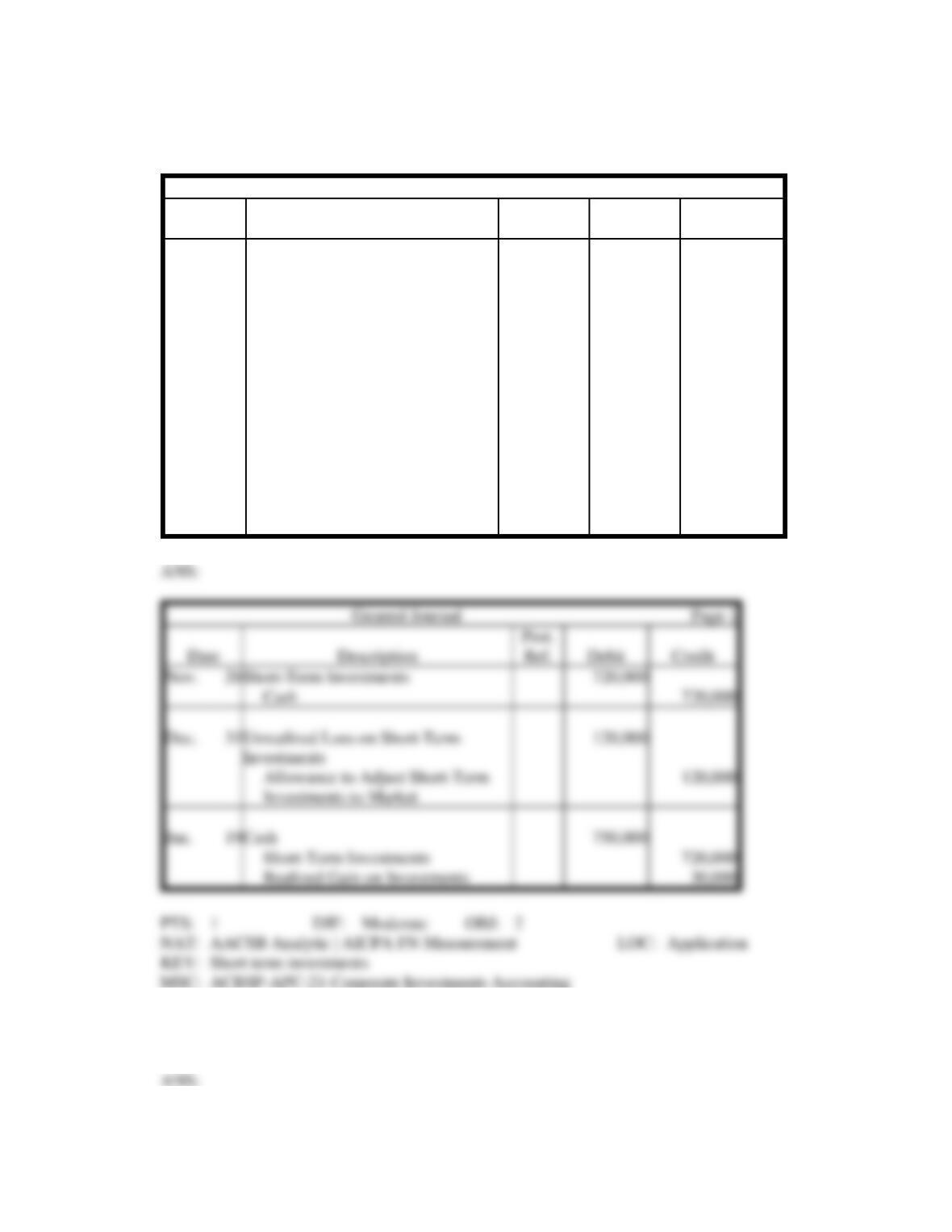
5. On November 28, 2012, Barbour Company purchased 20,000 shares of Cabell Corporation stock for
$720,000. Barbour’s management intends to hold the shares for a short period of time. On December
31, 2012, the price of Cabell stock was $30 per share. Finally, on January 19, 2013, Barbour sells all
20,000 shares for $750,000. In the journal provided below, prepare Barbour’s entries for November
28, December 31, and January 19. (Omit explanations).
General Journal
Page 1
Date
Description
Post.
Ref.
Debit
Credit
6. When a company receives a dividend from its investee, what will be the effect on the financial
statements of the investing company if it uses the equity method?
Nov.
Short-Term Investments
Short-Term Investments
Realized Gain on Investments
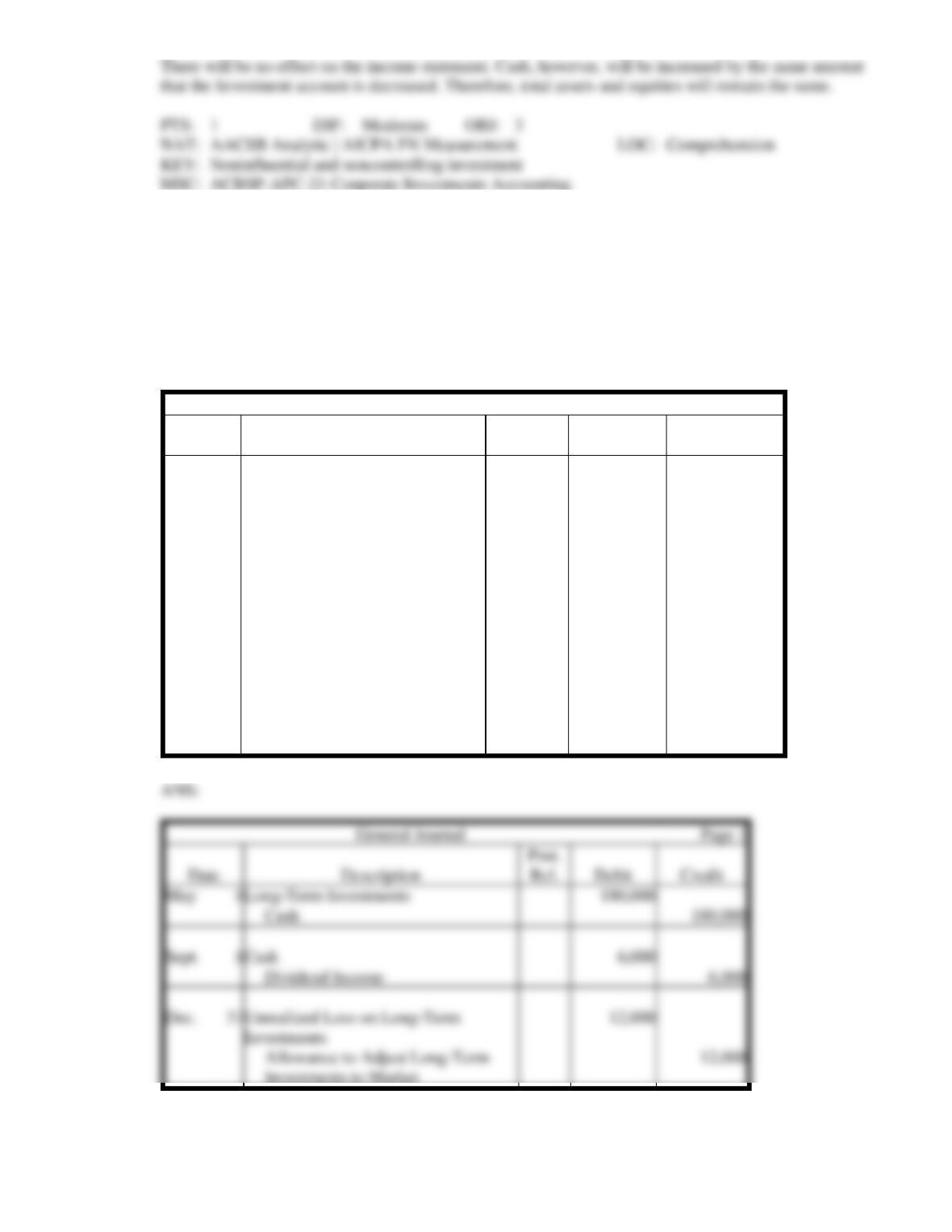
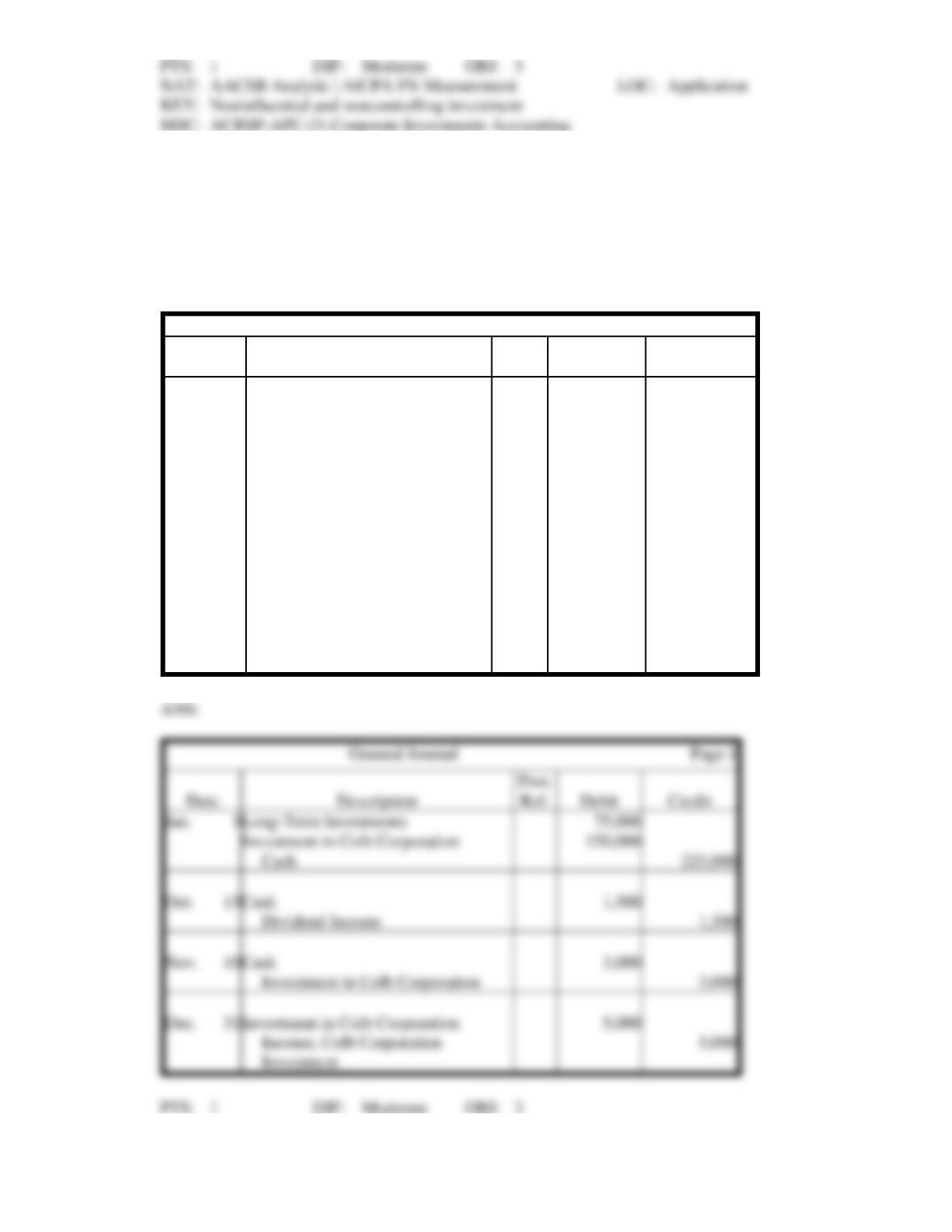
7. The following transactions and information pertain to Langston Corporation for 2013. Prepare entries
in journal form, without explanations, to record these transactions.
May
1
Purchased 1,000 shares of Granger Corporation’s common stock at $180 per
share (representing 5 percent of Granger’s total outstanding stock) as a
long-term investment.
Sept.
1
Received a cash dividend of $6.00 per share from Granger.
Dec.
31
End of Langston’s accounting year. Granger’s market price per share is $168.
General Journal
Page 1
Date
Description
Post.
Ref.
Debit
Credit
May
Long-Term Investments
Dividend Income
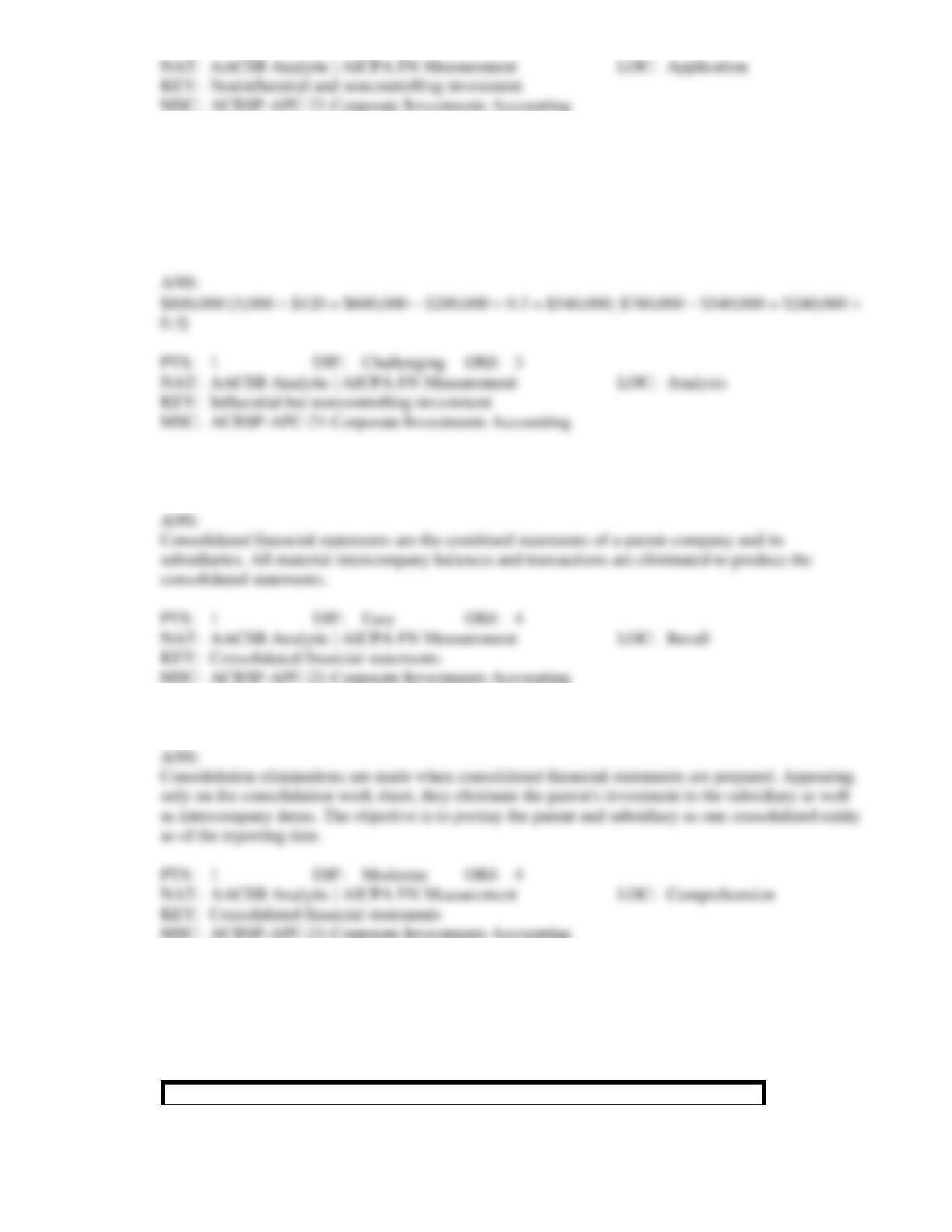
8. On January 1, Chapin Corporation purchased, as long-term investments, 10 percent of the voting stock
of Paxton Corporation for $75,000 and 25 percent of the voting stock of Colb Corporation for
$150,000. During the year, Paxton Corporation had earnings of $40,000 and paid dividends of $15,000
on October 15, and Colb Corporation had earnings of $20,000 and paid dividends of $12,000 on
November 10. The market value of neither investment declined nor rose during the year. Prepare
journal entries without explanations to record this information as appropriate in Chapin Corporation’s
general journal.
General Journal
Page 1
Date
Description
Post.
Ref.
Debit
Credit
Jan.
Long-Term Investments
Cash
225,000
Oct.
Cash
Dividend Income
Nov.
Cash
Investment in Colb Corporation
9. On January 1, 2013, Preston Corporation purchased 5,000 shares of Nicholas Corporation common
stock for $120 per share. Preston’s investment represents 30 percent of the total outstanding shares of
Nicholas. During 2010, Nicholas paid total dividends of $200,000. Preston appropriately used the
equity method to account for this investment and accordingly reported the investment at a carrying
value of $780,000 on December 31, 2013. Compute the amount of earnings reported by Nicholas
Corporation for 2013.
10. Briefly explain, what are the consolidated financial statements, and how is the consolidation
accomplished?
11. When are eliminating entries made, where are they entered, and why are they needed?
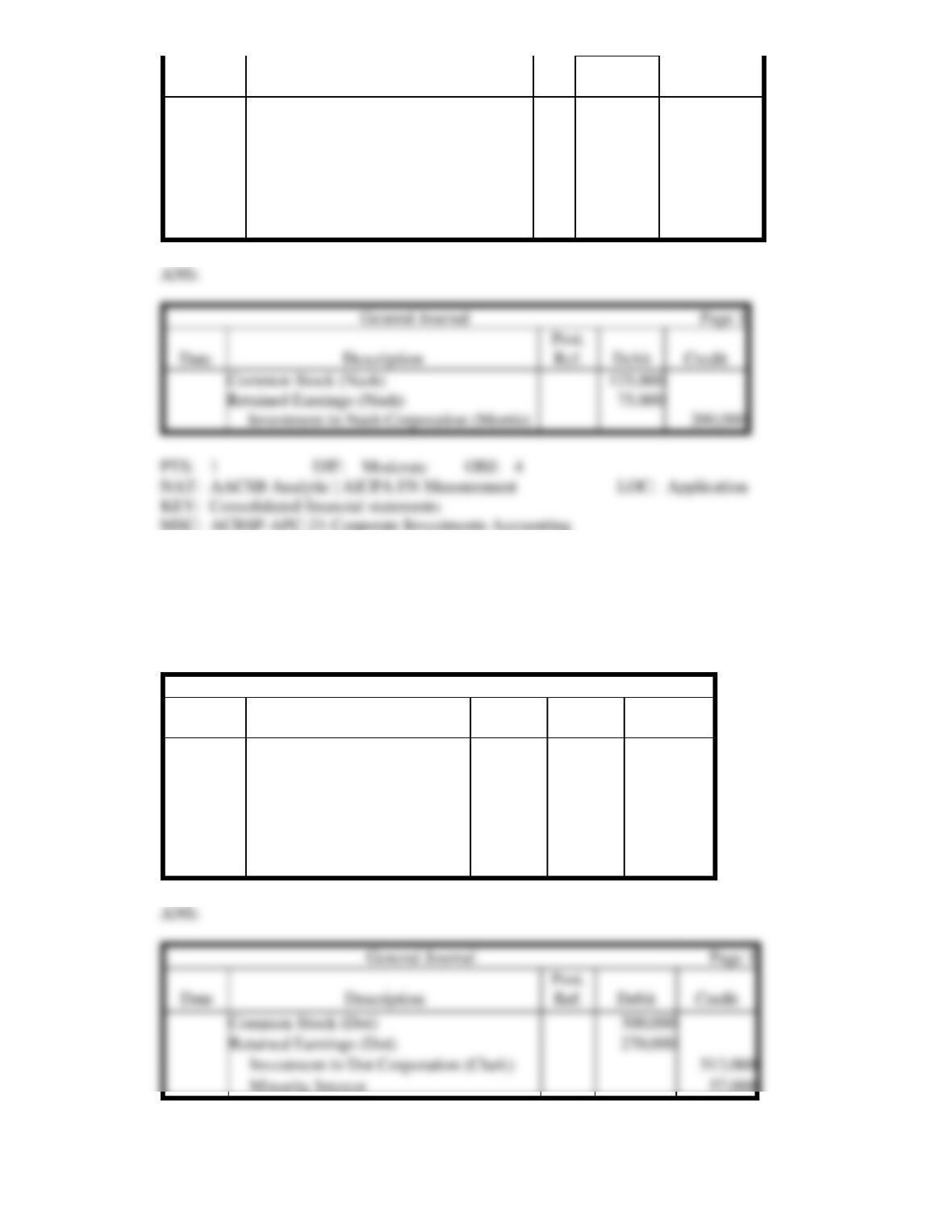
12. At the beginning of the current year, Morris Corporation acquired 100 percent of the common stock of
Nash Corporation for $200,000. Nash’s stockholders’ equity included common stock for $125,000 and
retained earnings of $75,000. Prepare the eliminating entry in journal form that would appear on the
work sheet for consolidating the balance sheets of the two entities as of the acquisition date. (Omit
explanations.)
General Journal
Page 1
Date
Description
Post.
Ref.
Debit
Credit
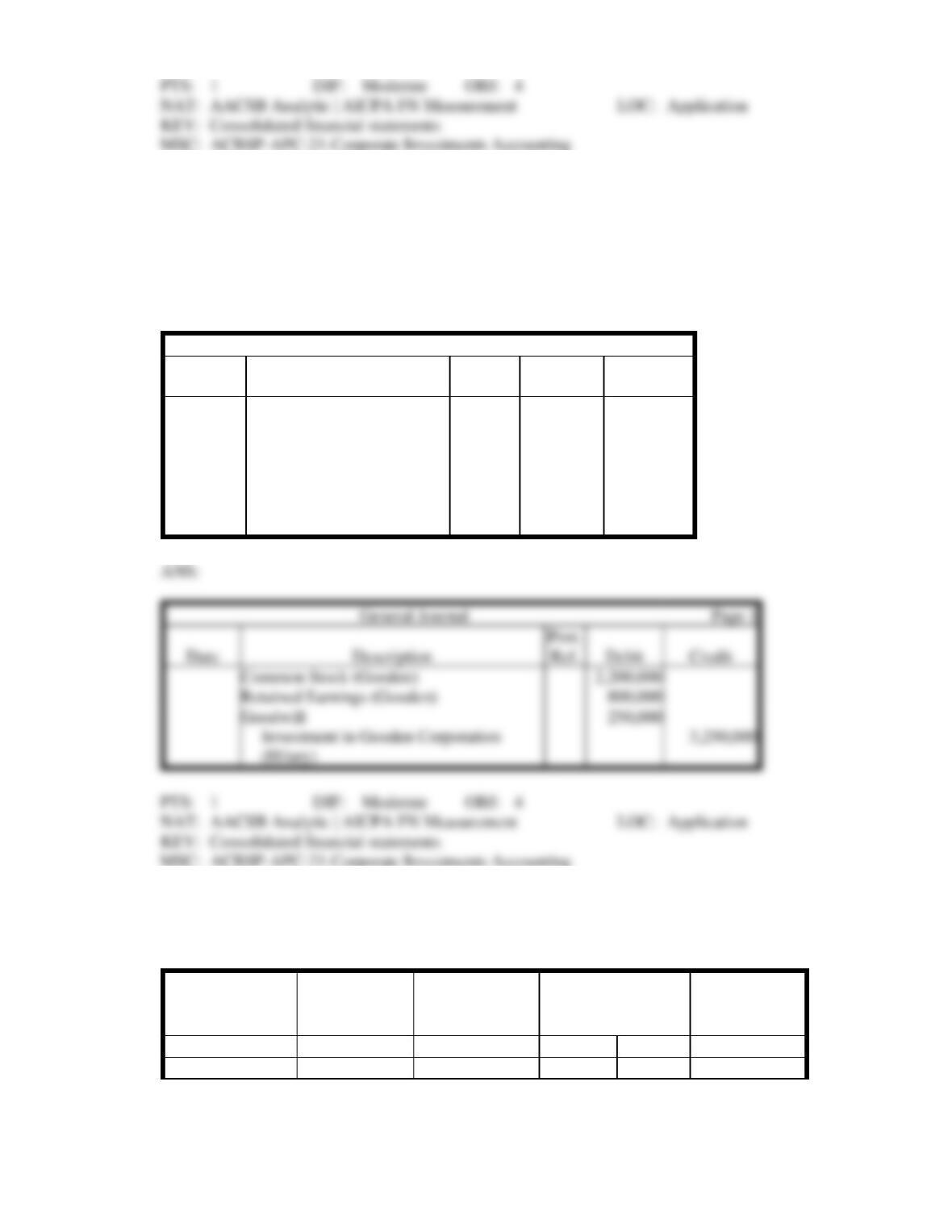
13. On January 1, 2012, Clark Corporation acquired 90 percent of the common stock of Dot Corporation
for $513,000. Dot’s stockholders’ equity on this date consisted of common stock of $300,000 and
retained earnings of $270,000. Prepare the eliminating entry in journal form that would appear on the
work sheet for consolidating the balance sheets of the two entities as of the acquisition date. (Omit
explanations.)
General Journal
Page 1
Date
Description
Post.
Ref.
Debit
Credit
Common Stock (Nash)
Retained Earnings (Nash)
14. On January 1, 2013, Hilary Corporation acquired 100 percent of the common stock of Gooden
Corporation for $3,250,000. At the date of acquisition, Gooden Corporation reported total assets of
$4,200,000, liabilities of $1,200,000, common stock of $2,200,000, and retained earnings of $800,000
on its balance sheet. An appraisal on the acquisition date showed that the fair value of Gooden’s net
identifiable assets was equal to their book value. Prepare the eliminating entry in journal form that
would appear on the work sheet for consolidating the balance sheets of the two companies as of the
acquisition date. (Omit explanations.)
General Journal
Page 1
Date
Description
Post.
Ref.
Debit
Credit
Common Stock (Gooden)
Goodwill
15. Barker Company purchased 100 percent of Coll Company for $130,000. The balance sheets for the
two companies are provided below. Complete the work sheet by providing the figures for the
Eliminations columns and the Consolidated Balance Sheet column.
Accounts
Balance Sheet,
Barker
Company
Balance Sheet,
Coll Company
Eliminations
Consolidated
Balance Sheet
Debit
Credit
Cash
60,000
30,000