
Chapter 14: Performance Evaluation for Decentralized Operations
The following financial information was summarized from the accounting records of Globe
Corporation for the current year ended December 31:
Northern
Southern
Corporate
Division
Division
Total
Cost of goods sold
$310,000
$175,000
Direct operating expenses
250,000
115,000
Net sales
600,000
410,000
Interest expense
$ 12,000
General overhead
101,000
Income tax
26,700
90. The gross profit for the Southern Division is:
a. $150,000.
b. $295,000.
c. $235,000.
d. $120,000.
91. The income from operations for the Southern Division is:
a. $150,000.
b. $120,000.
c. $295,000.
d. $154,400.
92. The net income for Globe Corporation is:
a. $59,000.
b. $160,000.
c. $19,400.
d. $47,000.
93. How do the responsibilities of a manager in an investment center compare to the
responsibilities of managers in a cost or profit center?
a. Investment center managers have more authority and responsibility than managers of a cost
or profit center.
b. Investment center managers have more authority and responsibility than managers of a cost
center but less than managers of a profit center.
c. Investment center managers have about the same authority and responsibility as managers
of a cost or profit center.
d. Investment center managers have more authority and responsibility than managers of a
profit center but less than managers of a cost center.

Chapter 14: Performance Evaluation for Decentralized Operations
94. Plamba Corporation had $250,000 invested in assets, sales of $490,000, income from
operations amounting to $70,000, and a desired minimum rate of return of 15%. The rate of
return on investment for Plamba is:
a. 14%.
b. 28%.
c. 20%.
d. 15%.
95. Blancher Corporation had $495,000 in invested assets, sales of $660,000, income from
operations amounting to $99,000, and a desired minimum rate of return of 15%. The profit
margin for Blancher is:
a. 16%.
b. 20%.
c. 18%.
d. 15%.
96. Blancher Corporation had $495,000 in invested assets, sales of $660,000, income from
operations amounting to $99,000, and a desired minimum rate of return of 15%. The
investment turnover for Blancher is:
a. 1.20.
b. 1.00.
c. 1.10.
d. 1.33.
97. Plamba Corporation had $250,000 in invested assets, sales of $490,000, income from
operations amounting to $70,000, and a desired minimum rate of return of 15%. The residual
income for Plamba is:
a. $32,500.
b. $10,500.
c. $59,500.
d. $37,500.
98. In an investment center, the manager has the responsibility for and the authority to make
decisions that affect:
a. the assets invested in the center but not costs and revenues.
b. costs and assets invested in the center but not revenues.
c. both costs and revenues for the department or division.
d. not only costs and revenues but also assets invested in the center.

Chapter 14: Performance Evaluation for Decentralized Operations
99. Espinosa Corporation had $220,000 invested in assets, sales of $242,000, income from
operations amounting to $48,400, and a desired minimum rate of return of 3%. The rate of
return on investment for Espinosa is:
a. 20%.
b. 22%.
c. 3%.
d. 6.4%.
100. The profit margin for Division E is 28% and the investment turnover is 3.0. What is the rate of
return on investment for Division E?
a. 84%
b. 28%
c. 14%
d. 9%
101. Division M for Movism Company has a rate of return on investment of 20% and an investment
turnover of 1.5. What is the profit margin?
a. 20%
b. 13%
c. 15%
d. 30%
102. Division A of Purvis Company has a rate of return on investment of 15% and an investment
turnover of 1.6. What is the profit margin?
a. 10%
b. 12.5%
c. 9.4%
d. 24%
103. In an investment center, the manager has responsibility and authority for making decisions that
affect:
a. only costs.
b. both costs and revenues.
c. only assets.
d. costs, revenues, and assets.

Chapter 14: Performance Evaluation for Decentralized Operations
104. The profit margin for Division J is 12% and the investment turnover is 1.40. What is the rate
of return on investment for Division J?
a. 16.8%
b. 8.6%
c. 12.0%
d. 9.6%
105. The balanced scorecard measures:
a. only financial information.
b. only nonfinancial information.
c. both financial and nonfinancial information.
d. both external and internal information.
106. The profit margin is the ratio of:
a. income from operations to sales.
b. income from operations to invested assets.
c. assets to liabilities.
d. sales to invested assets.
107. The investment turnover is the ratio of:
a. income from operations to sales.
b. income from operations to invested assets.
c. assets to liabilities.
d. sales to invested assets.
108. Identify the formula for the rate of return on investment.
a. Invested Assets/Income From Operations
b. Sales/Invested Assets
c. Income From Operations/Sales
d. Income From Operations/Invested Assets

Chapter 14: Performance Evaluation for Decentralized Operations
109. Which of the following expressions is termed the profit margin factor as used in determining
the rate of return on investment?
a. Sales/Income From Operations
b. Income From Operations/Sales
c. Invested Assets/Sales
d. Sales/Invested Assets
110. Which of the following expressions is termed the investment turnover factor as used in
determining the rate of return on investment?
a. Invested Assets/Sales
b. Income From Operations/Invested Assets
c. Income From Operations/Sales
d. Sales/Invested Assets
111. Division M of Tenist Company has a rate of return on investment of 20% and a profit margin
of 13%. What is the investment turnover?
a. 3.6
b. 1.5
c. 5.0
d. .7
112. What additional information is needed to find the rate of return on investment if income from
operations is known?
a. Invested assets
b. Residual income
c. Direct expenses
d. Sales
113. The best measure of managerial efficiency in the use of investments in assets is:
a. rate of return on stockholders’ equity.
b. rate of return on investment.
c. income from operations.
d. inventory turnover.

Chapter 14: Performance Evaluation for Decentralized Operations
114. Two divisions of Crowson Company (Divisions X and Y) have the same profit margins.
Division X’s investment turnover is larger than that of Division Y (1.2 to 1.0). Which of the
following statements is true?
a. Division Y will have a higher return on investment as it is using its assets more efficiently
in generating sales.
b. Division X will have a higher return on investment as it is generating more income from its
operations.
c. Division X will have a higher return on investment as it is using its assets more efficiently
in generating sales.
d. Division Y will have a higher return on investment as it is generating more income from its
operations.
115. The excess of divisional income from operations over a minimum acceptable divisional
income from operations is termed:
a. profit margin.
b. residual income.
c. rate of return on investment.
d. gross profit.
116. Assume that divisional income from operations amounts to $325,000 and top management has
established 10% as the minimum rate of return on divisional assets totaling $1,250,000. The
residual income for the division is:
a. $200,000.
b. $292,500.
c. $125,000.
d. $0.
117. Which one of the following is not a measure that management can use in evaluating and
controlling investment center performance?
a. Rate of return on investment
b. Negotiated price
c. Residual income
d. Income from operations

Chapter 14: Performance Evaluation for Decentralized Operations
118. Assume that Division A has generated sales revenue of $4,550,000 and achieved income from
operations of $530,000 using $2,800,000 of invested assets. If management desires a minimum
rate of return of 15%, the residual income would be:
a. $110,000.
b. $152,500.
c. $79,500.
d. $530,000.
119. Assume that Division X has generated sales revenue of $3,025,000 and achieved income from
operations of $242,000 using $1,800,000 of invested assets. If management desires a minimum
rate of return of 12%, the profit margin would be:
a. 59.5%.
b. 13.4%.
c. 12%.
d. 8%.
120. A common balanced scorecard measures performance in all of the following areas except:
a. education.
b. internal process.
c. financial.
d. innovation and learning.
121. Which component of the balanced scorecard evaluates the economic performance of the
responsibility centers?
a. Internal process
b. Financial
c. Innovation and learning
d. Customer
122. Which of the following is true of the balanced scorecard?
a. It ignores the financial performance of the company.
b. It has the ability to reveal the underlying nonfinancial drivers of financial performance.
c. It aims to improve the nonfinancial performance of the business.
d. It focuses primarily on the short term performance of the business.
Chapter 14: Performance Evaluation for Decentralized Operations
123. Which of the following is not a approach used for setting transfer prices?
a. Market price approach
b. Revenue price approach
c. Negotiated price approach
d. Cost price approach
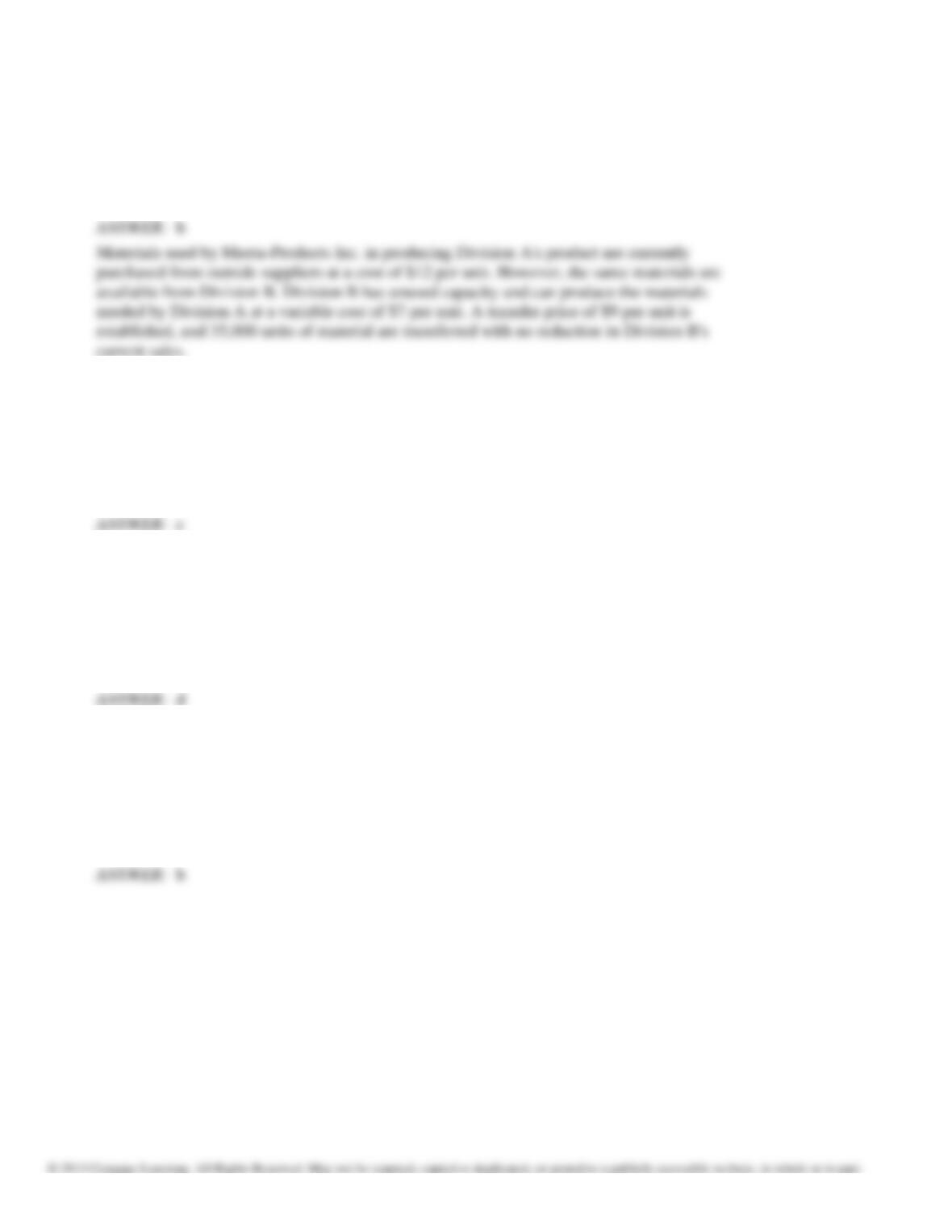
124. How much would Division A’s income from operations increase?
a. $175,000
b. $70,000
c. $105,000
d. $75,000
125. How much would Division B’s income from operations increase?
a. $75,000
b. $175,000
c. $105,000
d. $70,000
126. How much would Meeta-Products total income from operations increase?
a. $70,000
b. $175,000
c. $105,000
d. $100,000

Chapter 14: Performance Evaluation for Decentralized Operations
Materials used by Boone Company in producing Division C’s product are currently purchased
from outside suppliers at a cost of $20 per unit. However, the same materials are available
from Division A. Division A has unused capacity and can produce the materials needed by
Division C at a variable cost of $17 per unit. A transfer price of $19 per unit is negotiated and
60,000 units of material are transferred, with no reduction in Division A’s current sales.
127. How much would Division C’s income from operations increase?
a. $0
b. $180,000
c. $60,000
d. $120,000
128. How much would Division A’s income from operations increase?
a. $0
b. $180,000
c. $60,000
d. $120,000
129. How much would Boone’s total income from operations increase?
a. $180,000
b. $240,000
c. $120,000
d. $300,000
130. Which transfer price approach is used when the transfer price is set at the amount sold to
outside buyers?
a. Market price
b. Cost price
c. Negotiated price
d. Variable price
Chapter 14: Performance Evaluation for Decentralized Operations
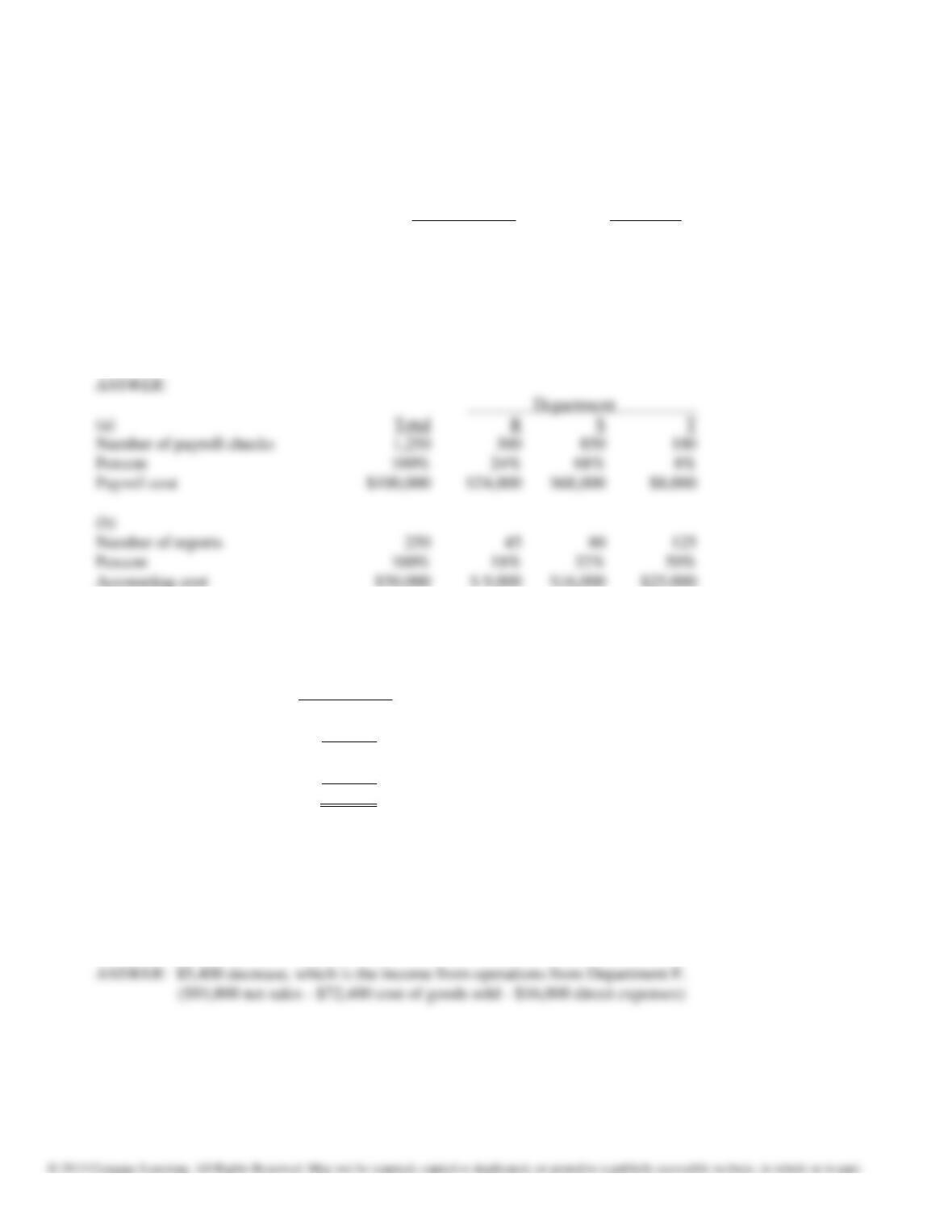
131. The budget for Department 5 of Plant M for the current month ending March 31 is as follows:
Materials
$206,000
Factory wages
265,000
Supervisory salaries
67,800
Depreciation of plant and equipment
35,000
Power and light
22,500
Insurance and property taxes
15,500
Maintenance
9,700
During March, the costs incurred in Department 5 of Plant M were materials, $204,000;
factory wages, $285,000; supervisory salaries, $63,600; depreciation of plant and equipment,
$35,000; power and light, $21,360; insurance and property taxes, $14,400; maintenance,
$9,456.
(a)
Prepare a budget performance report for the supervisor of Department 5 of Plant M for the
month of March.
(b)
Are there any significant variances (greater than 5%) of the budgeted amounts that should
be examined by the supervisor?
Factory wages
Depreciation of plant
and equipment
Insurance and property taxes
$621,500
$632,816
(b)
The factory wages and supervisory salaries expenses should be examined by the supervisor.
Chapter 14: Performance Evaluation for Decentralized Operations
132. A department store apportions payroll costs on the basis of the number of payroll checks
issued. Accounting costs are apportioned on the basis of the number of reports. The payroll
costs for the year were $100,000, and the accounting costs for the year totaled $50,000. The
number of payroll checks issued and the number of reports for each department are as follows:
Number of
Number
Payroll Checks
of Reports
Department R
300
45
Department S
850
80
Department T
100
125
Determine the amount of (a) payroll cost and (b) accounting cost to be apportioned to each
department.
133. A portion of the divisional income statement for the year just ended is presented below in a
condensed form.
Department F
Net sales
$93,800
Cost of goods sold
72,400
Gross profit
$21,400
Operating expenses
28,900
Loss from operations
$ (7,500)
The operating expenses of Department F include $16,000 for direct expenses.
It is estimated that the discontinuance of Department F would not have affected the sales of the
other departments nor have reduced the indirect expenses of the business. Assuming the
accuracy of these estimates, determine the effect (increase or decrease and the amount) on the
income from operations of the business if Department F had been discontinued.
Chapter 14: Performance Evaluation for Decentralized Operations
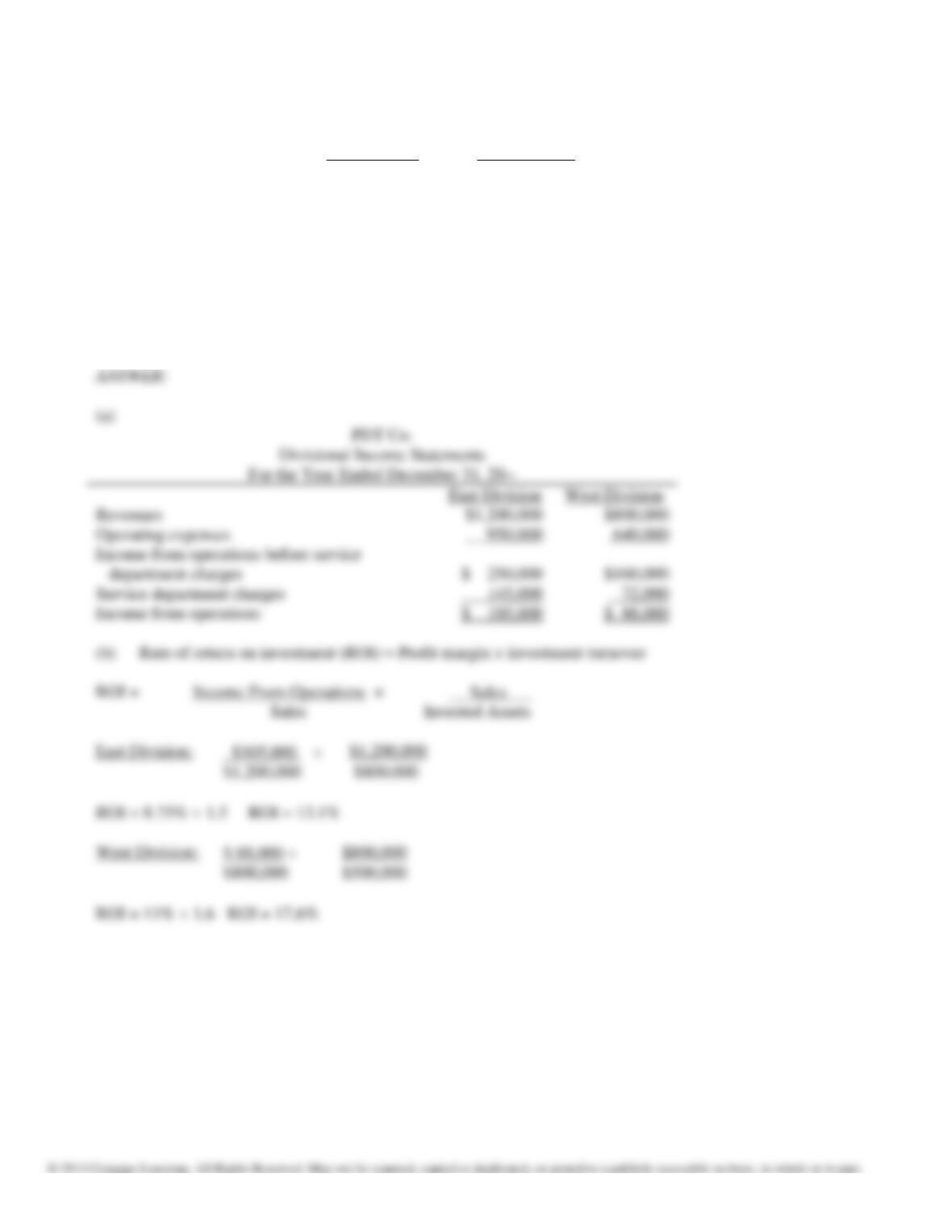
134. PDT Co. has two divisions, East and West. Invested assets and condensed income statement
data for each division for the past year ended December 31 are as follows:
East Division
West Division
Revenues
$1,200,000
$800,000
Operating expenses
950,000
640,000
Service department charges
145,000
72,000
Invested assets
800,000
500,000
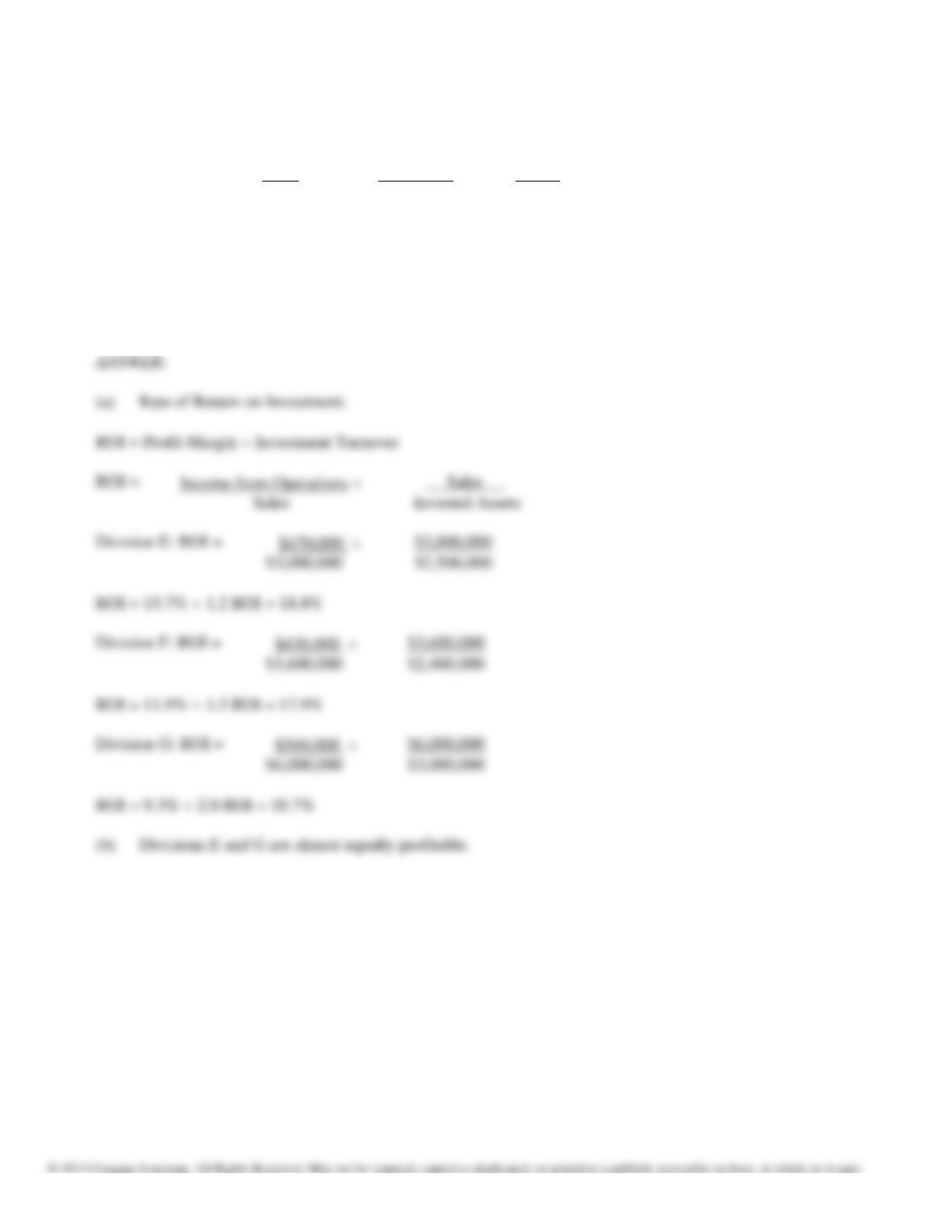
(a) Prepare condensed income statements for the past year for each division.
(b) Using the expanded expression, determine the profit margin, investment turnover, and
rate of return on investment for each division. Round to one decimal place.
Chapter 14: Performance Evaluation for Decentralized Operations
135. The sales, income from operations, and invested assets for each division of Garner Company
are as follows:
Income from
Invested
Sales
Operations
Assets
Division E
$3,000,000
$470,000
$2,500,000
Division F
3,600,000
430,000
2,400,000
Division G
6,000,000
560,000
3,000,000
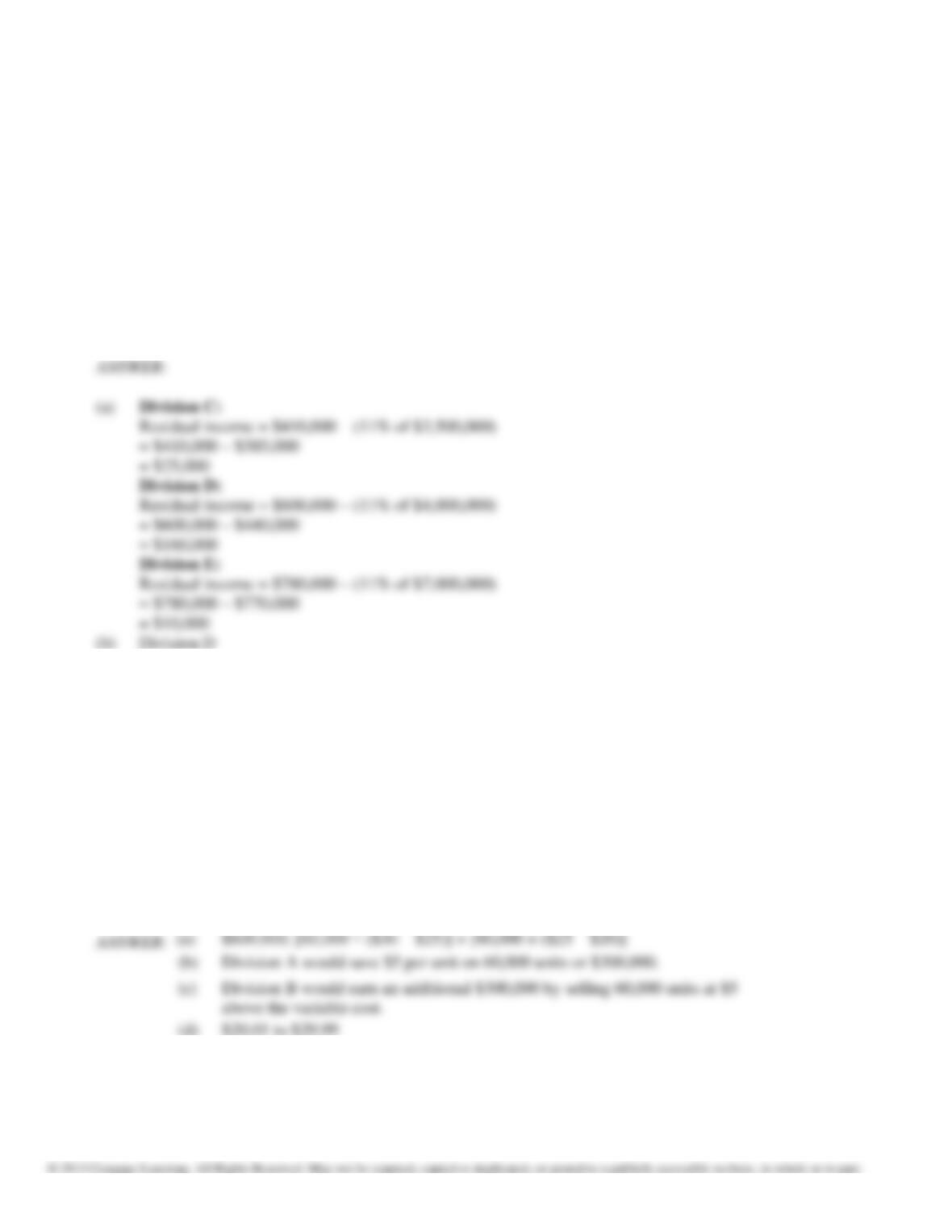
(a)
Using the expanded expression, determine the profit margin, investment turnover, and
rate of return on investment for each division. Round to one decimal place.
(b)
Which division is (are) the most profitable as per dollar invested?
(a)
Rate of Return on Investment:
$3,000,000
$3,000,000
$3,600,000
$6,000,000
(b)
Divisions E and G are almost equally profitable.
Chapter 14: Performance Evaluation for Decentralized Operations
136. The sales, income from operations, and invested assets for each division of Salem Company
are as follows:
Income from
Invested
Sales
Operations
Assets
Division C
$4,000,000
$410,000
$3,500,000
Division D
3,500,000
600,000
4,000,000
Division E
2,250,000
780,000
7,000,000
Management has established a minimum rate of return for invested assets of 11%.
(a) Determine the residual income for each division.
(b) Based on residual income, which division is the most profitable?
Residual income = $780,000 – (11% of $7,000,000)
= $780,000 – $770,000
= $10,000
137. Materials used by Ford Company in producing Division A’s product are currently purchased
from outside suppliers at a cost of $30 per unit. However, the same materials are available
from Division B. Division B has unused capacity and can produce the materials needed by
Division A at a variable cost of $20 per unit.
(a)
If a transfer price of $25 per unit is established and 60,000 units of material are
transferred with no reductions in Division B’s current sales, how much would Ford
Company’s total income from operations increase?
(b)
How much would the income from operations of Division A increase?
(c)
How much would the income from operations of Division B increase?
(d)
If the negotiated price approach is used, what would be the range of acceptable
transfer prices?