Megan Corporation’s net income last year was $98,000. Changes in the company’s balance sheet
accounts for the year appear below:
Increases
(Decreases)
Asset and Contra-Asset Accounts:
Cash and cash equivalents
$
(3,000
)
Accounts receivable
$
(14,000
)
Inventory
$
3,000
Prepaid expenses
$
(7,000
)
Long-term investments
$
80,000
Property, plant, and equipment
$
55,000
Accumulated depreciation
$
58,000
Liability and Equity Accounts:
Accounts payable
$
0
Accrued liabilities
$
15,000
Income taxes payable
$
(11,000
)
Bonds payable
$
(30,000
)
Common stock
$
20,000
Retained earnings
$
62,000
The company paid a cash dividend of $36,000 and it did not dispose of any long-term investments
or property, plant, and equipment. The company did not issue any bonds payable or repurchase any
of its own common stock. The following questions pertain to the company’s statement of cash
flows.
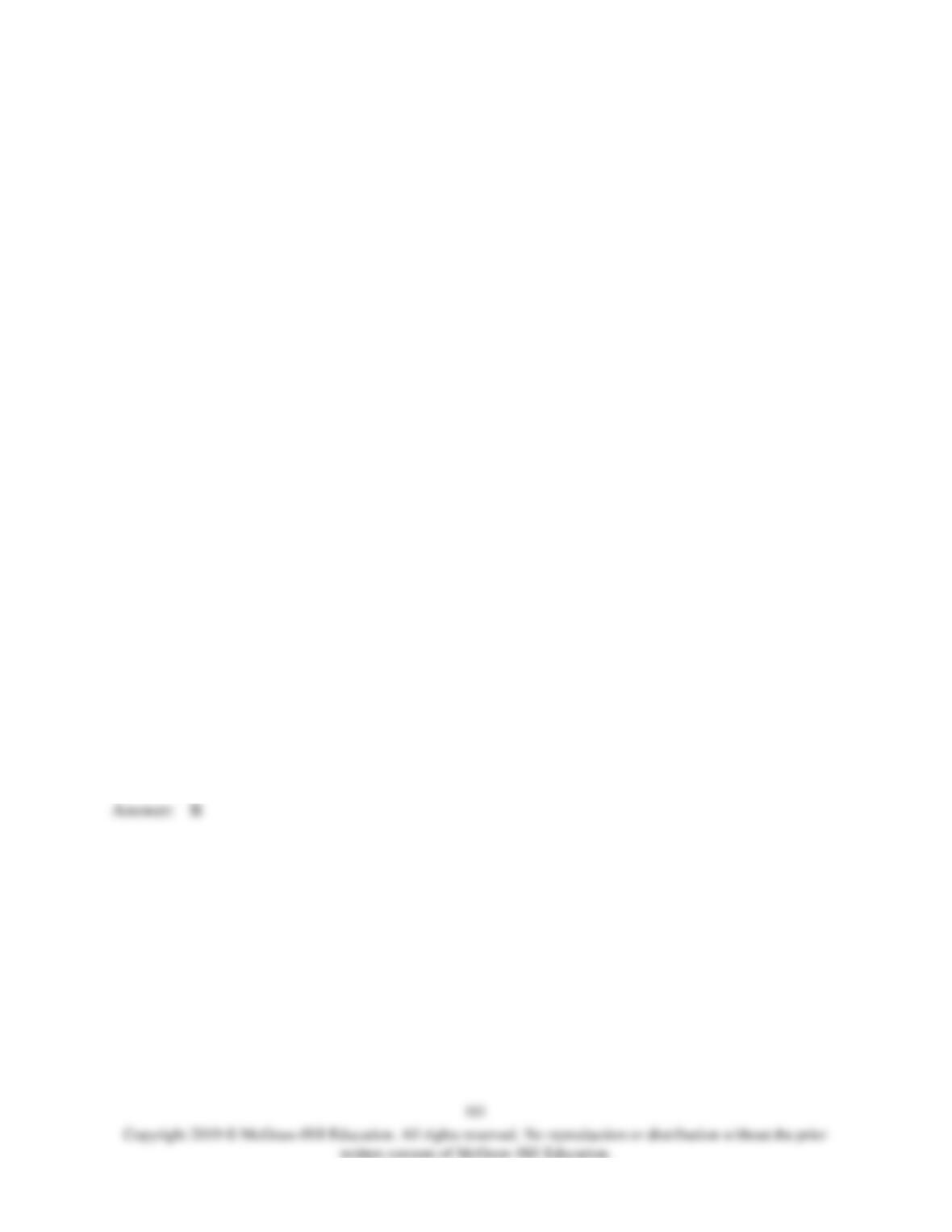
113) The net cash provided by (used in) operating activities last year was:
A) $98,000
B) $178,000
C) $156,000
D) $120,000
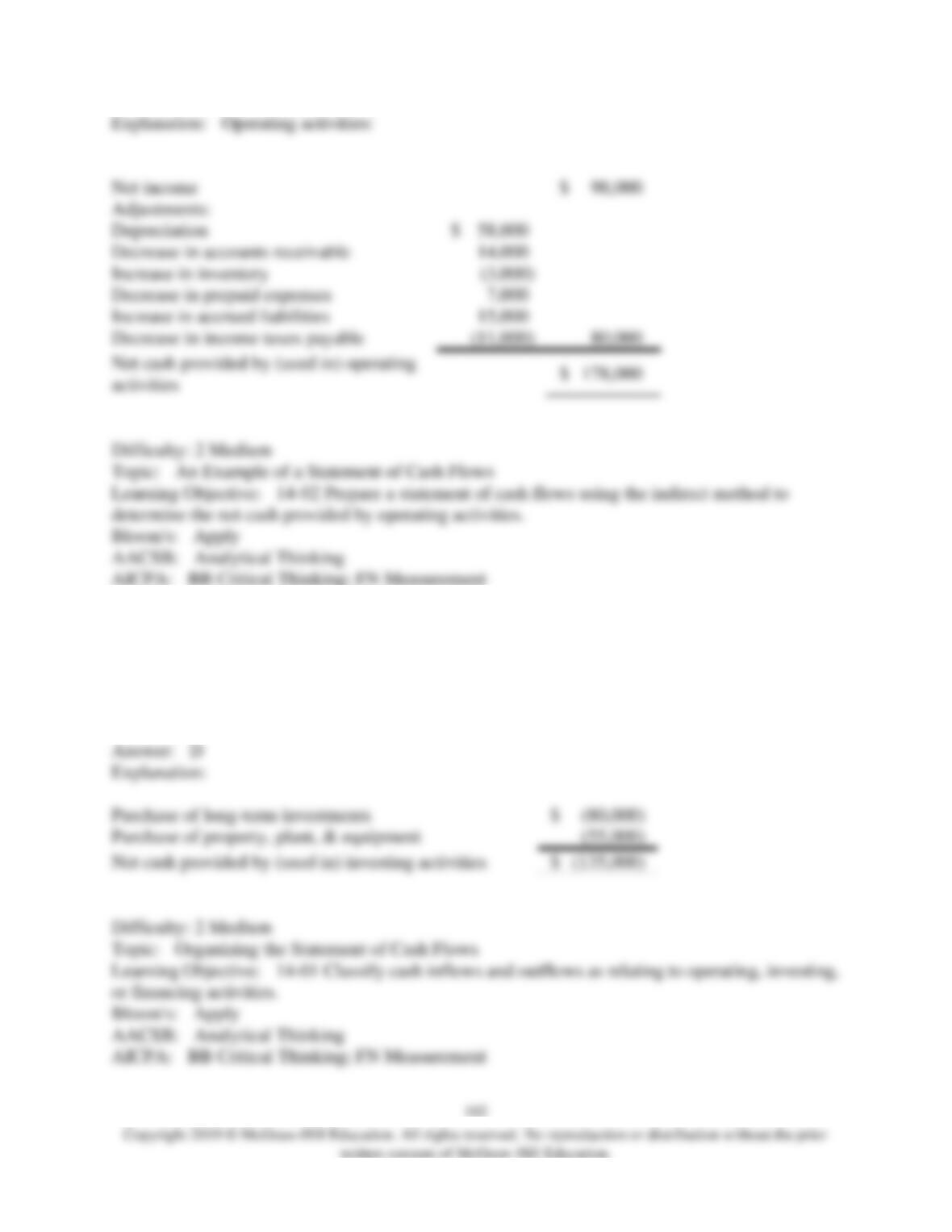
114) The net cash provided by (used in) investing activities last year was:
A) $115,000
B) $(115,000)
C) $135,000
D) $(135,000)
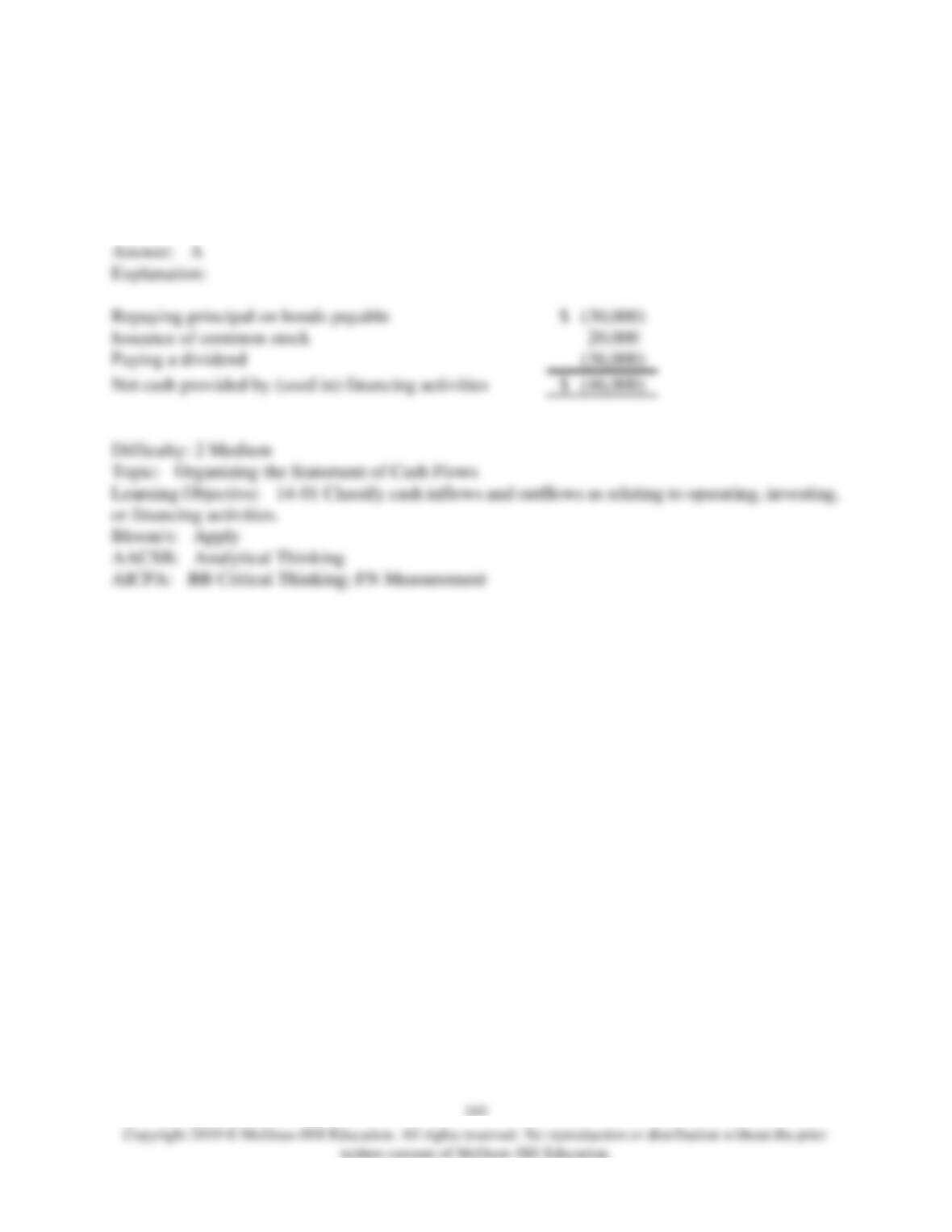
115) The net cash provided by (used in) financing activities last year was:
A) $(46,000)
B) $46,000
C) $(10,000)
D) $10,000
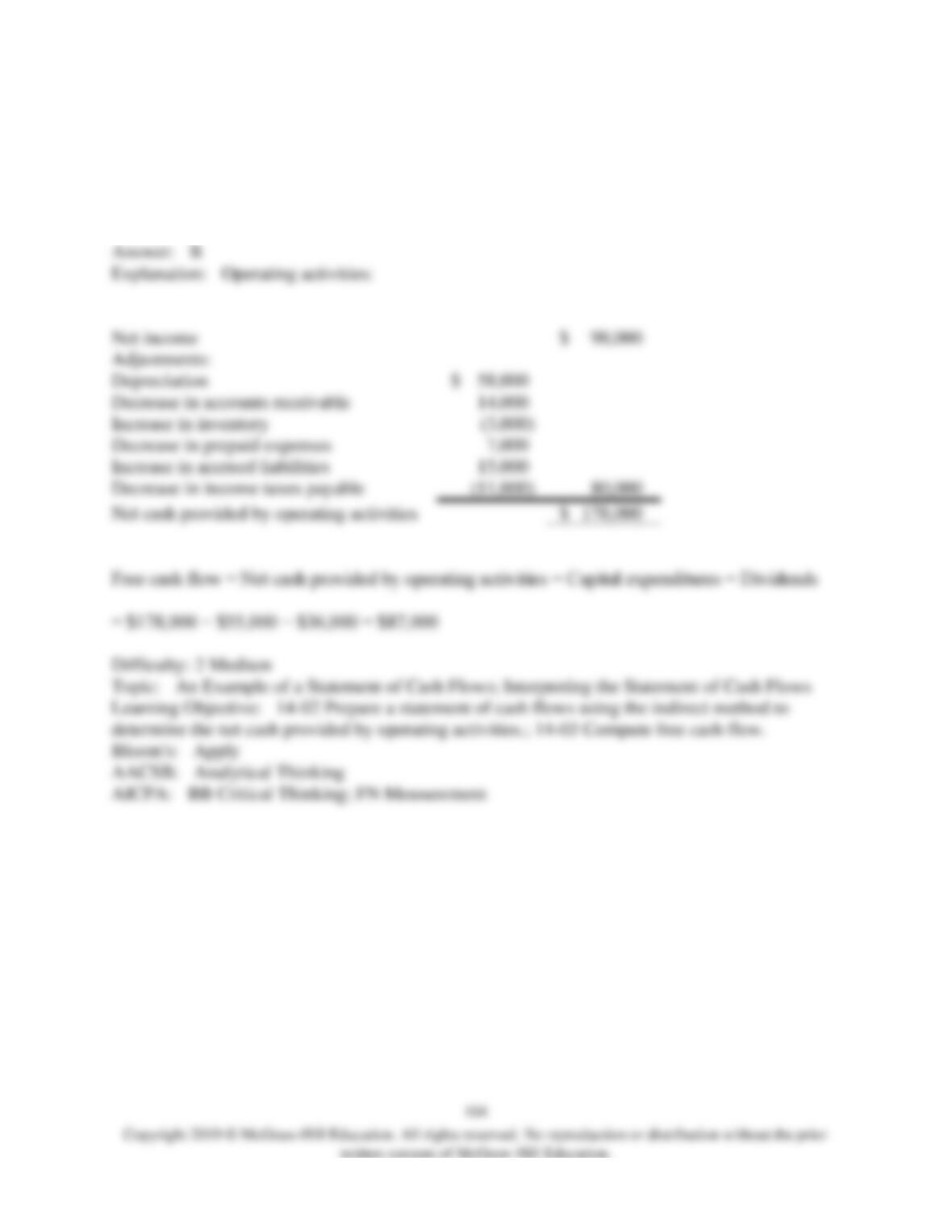
116) The free cash flow for the year was:
A) $123,000
B) $87,000
C) $142,000
D) $269,000

105
The most recent comparative balance sheet of Giacomelli Corporation appears below:
Comparative Balance Sheet
Ending
Balance
Beginning
Balance
Assets:
Current assets:
Cash and cash equivalents
$
37,000
$
29,000
Accounts receivable
20,000
24,000
Inventory
65,000
61,000
Prepaid expenses
5,000
7,000
Total current assets
127,000
121,000
Property, plant, and equipment
424,000
399,000
Less accumulated depreciation
231,000
200,000
Net property, plant, and equipment
193,000
199,000
Total assets
$
320,000
$
320,000
Liabilities and stockholders’ equity:
Current liabilities:
Accounts payable
$
19,000
$
17,000
Accrued liabilities
58,000
51,000
Income taxes payable
47,000
42,000
Total current liabilities
124,000
110,000
Bonds payable
77,000
80,000
Total liabilities
201,000
190,000
Stockholders’ equity:
Common stock
31,000
30,000
Retained earnings
88,000
100,000
Total stockholders’ equity
119,000
130,000
Total liabilities and stockholders’ equity
$
320,000
$
320,000
The company uses the indirect method to construct the operating activities section of its statement
of cash flows.
117) Which of the following is correct regarding the operating activities section of the statement of
cash flows?
A) The change in Accounts Receivable will be subtracted from net income; The change in
Inventory will be added to net income
B) The change in Accounts Receivable will be added to net income; The change in Inventory will
be subtracted from net income
C) The change in Accounts Receivable will be added to net income; The change in Inventory will
be added to net income
D) The change in Accounts Receivable will be subtracted from net income; The change in
Inventory will be subtracted from net income
118) Which of the following is correct regarding the operating activities section of the statement of
cash flows?
A) The change in Accounts Payable will be added to net income; The change in Accrued
Liabilities will be subtracted from net income
B) The change in Accounts Payable will be subtracted from net income; The change in Accrued
Liabilities will be added to net income
C) The change in Accounts Payable will be subtracted from net income; The change in Accrued
Liabilities will be subtracted from net income
D) The change in Accounts Payable will be added to net income; The change in Accrued
Liabilities will be added to net income
119) Which of the following is correct regarding the operating activities section of the statement of
cash flows?
A) The change in Prepaid Expenses will be added to net income; The change in Income Taxes
Payable will be subtracted from net income
B) The change in Prepaid Expenses will be subtracted from net income; The change in Income
Taxes Payable will be subtracted from net income
C) The change in Prepaid Expenses will be subtracted from net income; The change in Income
Taxes Payable will be added to net income
D) The change in Prepaid Expenses will be added to net income; The change in Income Taxes
Payable will be added to net income

109
120) Manila Corporation’s comparative balance sheet appears below:
Comparative Balance Sheet
Ending
Balance
Beginning
Balance
Assets:
Current assets:
Cash and cash equivalents
$
42,000
$
26,000
Accounts receivable*
22,000
26,000
Inventory*
77,000
75,000
Total current assets
141,000
127,000
Property, plant, and equipment*
340,000
315,000
Less accumulated depreciation*
218,000
187,000
Net property, plant, and equipment
122,000
128,000
Total assets
$
263,000
$
255,000
Liabilities and stockholders’ equity:
Current liabilities:
Accounts payable*
$
13,000
$
14,000
Accrued liabilities*
32,000
33,000
Income taxes payable*
63,000
54,000
Total current liabilities
108,000
101,000
Bonds payable*
93,000
94,000
Total liabilities
201,000
195,000
Stockholders’ equity:
Common stock*
28,000
24,000
Retained earnings
34,000
36,000
Total stockholders’ equity
62,000
60,000
Total liabilities and stockholders’ equity
$
263,000
$
255,000
The company’s net income (loss) for the year was $0 and its cash dividends were $2,000. It did not
dispose of any property, plant, and equipment, issue any bonds payable, or repurchase any of its
own common stock during the year.
Required:
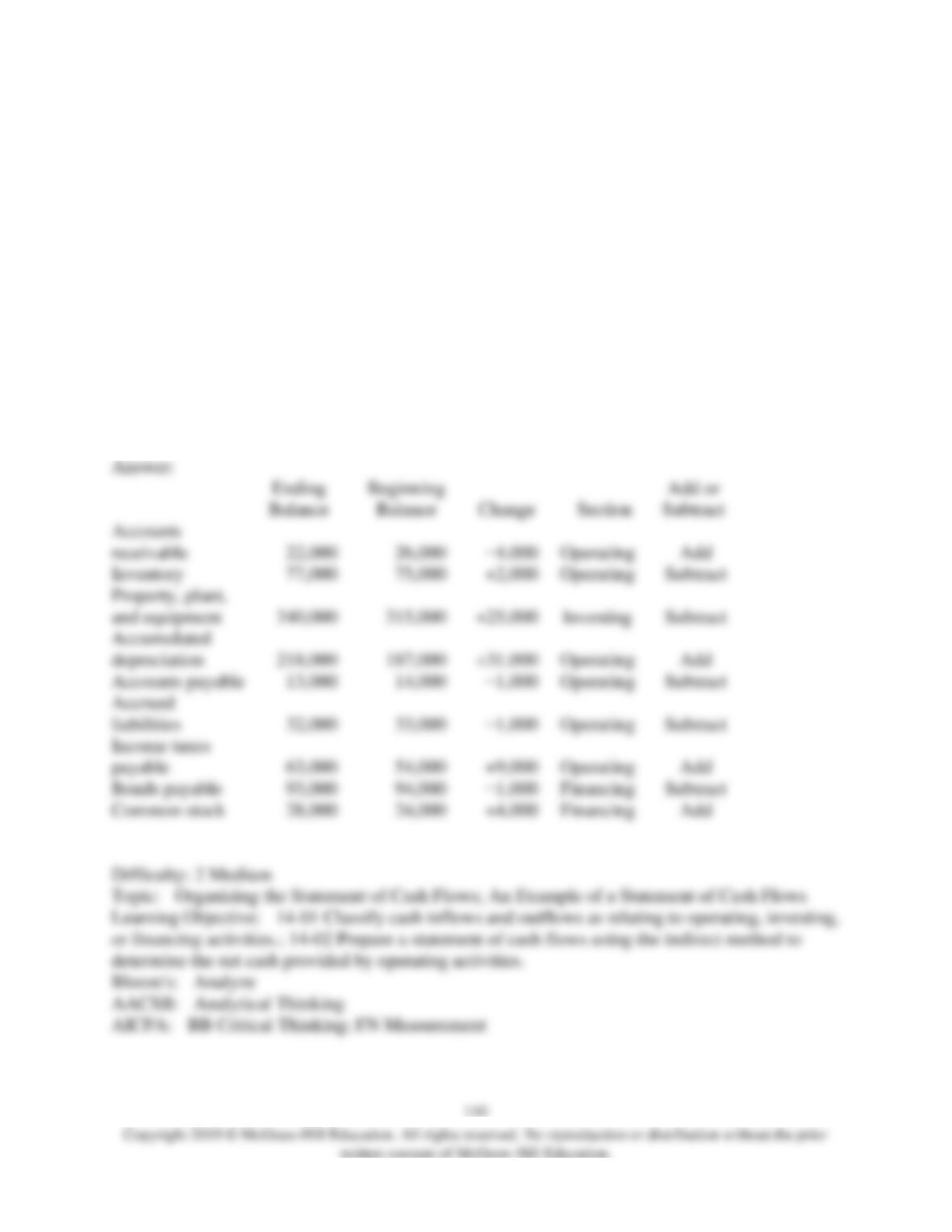
Compute the change in each balance sheet account denoted with an asterisk (*). Indicate whether
the change in each balance will be recorded in the operating, investing, or financing activities
section of the statement of cash flows. For items recorded in the operating activities section, also
indicate whether the change will be added to or subtracted from net income. For all other items,
indicate whether the change will be added as a cash inflow or subtracted as a cash outflow. The
first entry has been filled in as an example.
Ending
Balance
Beginning
Balance
Change
Section
Add or
Subtract
Accounts receivable
22,000
26,000
−4,000
Operating
Add
Inventory
77,000
75,000
Property, plant, and
equipment
340,000
315,000
Accumulated
depreciation
218,000
187,000
Accounts payable
13,000
14,000
Accrued liabilities
32,000
33,000
Income taxes payable
63,000
54,000
Bonds payable
93,000
94,000
Common stock
28,000
24,000
Ending
Beginning
Section
Add or
Accounts
receivable
22,000
26,000
Operating
Add
Inventory
77,000
75,000
+2,000
Operating
Property, plant,
and equipment
340,000
315,000
+25,000
218,000
187,000
+31,000
Operating
Add
Accounts payable
13,000
14,000
Operating
Accrued
liabilities
32,000
33,000
Operating
Income taxes
payable
63,000
54,000
+9,000
Operating
Add
Bonds payable
93,000
94,000
Financing
Common stock
28,000
24,000
+4,000
Financing
Add

111
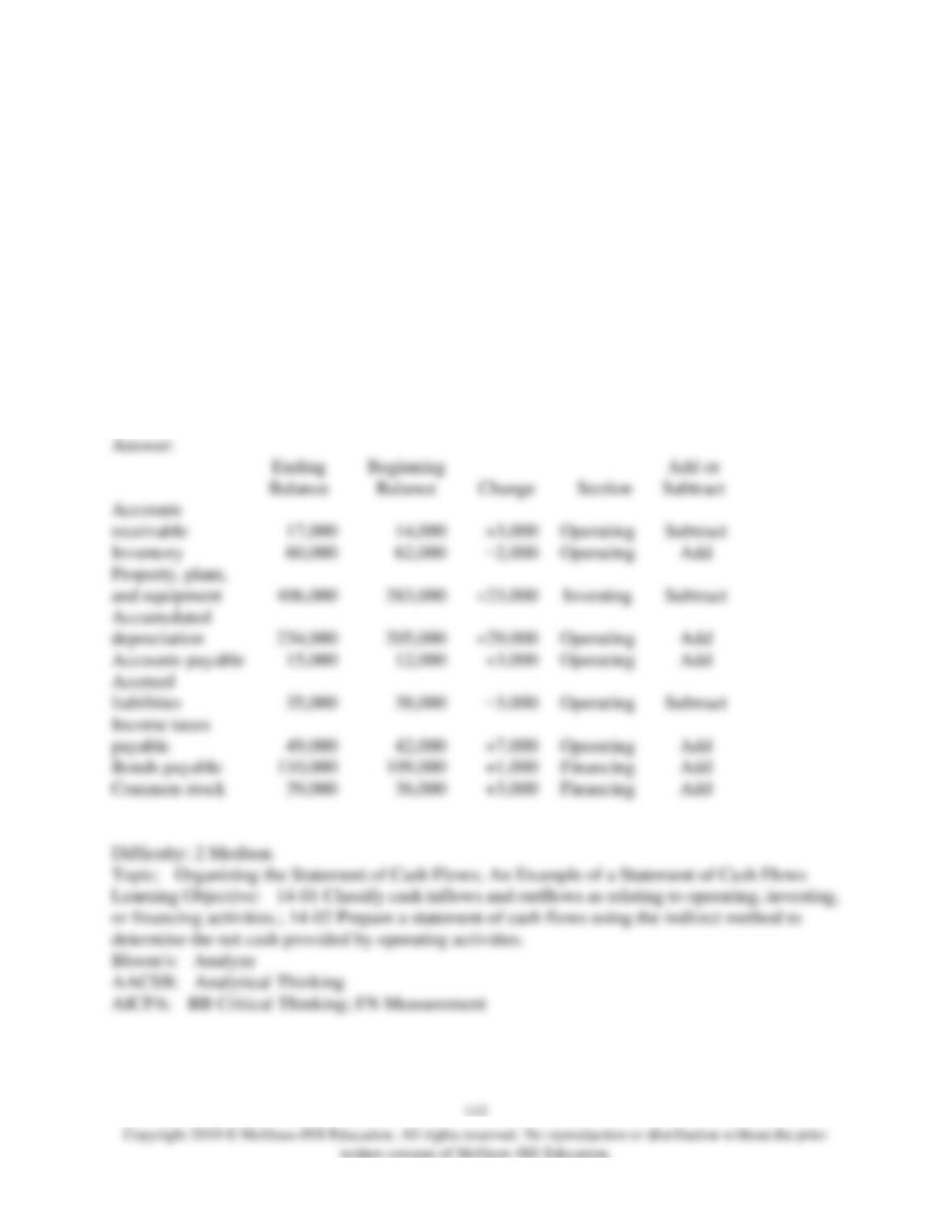
121) The ending and beginning balances of Farmer Corporation’s balance sheet accounts for the
most recent year are listed below:
Ending
Balance
Beginning
Balance
Assets & Contra-Assets:
Cash and cash equivalents
$
40,000
$
28,000
Accounts receivable
$
17,000
$
14,000
Inventory
$
60,000
$
62,000
Property, plant, and equipment
$
406,000
$
383,000
Accumulated depreciation
$
234,000
$
205,000
Liabilities and stockholders’ equity:
Accounts payable
$
15,000
$
12,000
Accrued liabilities
$
35,000
$
38,000
Income taxes payable
$
49,000
$
42,000
Bonds payable
$
110,000
$
109,000
Common stock
$
39,000
$
36,000
Retained earnings
$
41,000
$
45,000
The company’s net income (loss) for the year was $0 and its cash dividends were $4,000. It did not
dispose of any property, plant, and equipment, retire any bonds payable, or repurchase any of its
own common stock during the year.
Required:
Compute the change in each balance sheet account in the below table. Indicate whether the change
in each balance will be recorded in the operating, investing, or financing activities section of the
statement of cash flows. For items recorded in the operating activities section, also indicate
whether the change will be added to or subtracted from net income. For all other items, indicate
whether the change will be added as a cash inflow or subtracted as a cash outflow. The first entry
has been filled in as an example.
Ending
Balance
Beginning
Balance
Change
Section
Add or
Subtract
Accounts receivable
17,000
14,000
+3,000
Operating
Add
Inventory
60,000
62,000
Property, plant, and
equipment
406,000
383,000
Accumulated
depreciation
234,000
205,000
Accounts payable
15,000
12,000
Accrued liabilities
35,000
38,000
Income taxes payable
49,000
42,000
Bonds payable
110,000
109,000
Common stock
39,000
36,000
Balance
Balance
Section
Accounts
17,000
14,000
+3,000
Operating
Inventory
60,000
62,000
Operating
Add
Property, plant,
and equipment
406,000
383,000
+23,000
Accumulated
depreciation
234,000
205,000
+29,000
Operating
Add
Accounts payable
15,000
12,000
+3,000
Operating
Add
Accrued
liabilities
35,000
38,000
Operating
Income taxes
payable
49,000
42,000
+7,000
Operating
Add
Bonds payable
110,000
109,000
+1,000
Financing
Add
Common stock
39,000
36,000
+3,000
Financing
Add

113
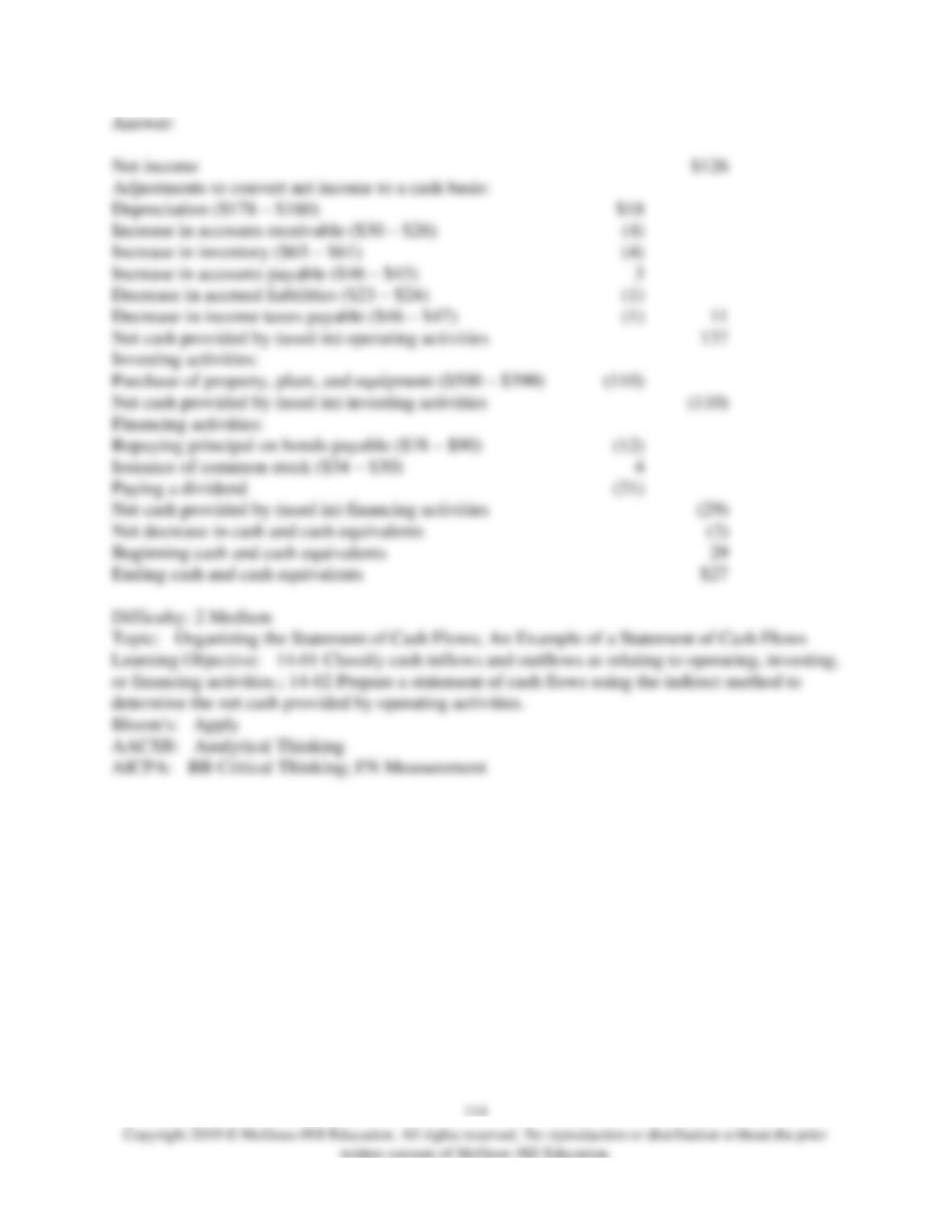
122) Belk Corporation’s balance sheet appears below:
Comparative Balance Sheet
Ending
Balance
Beginning
Balance
Assets:
Cash and cash equivalents
$
27
$
29
Accounts receivable
30
26
Inventory
65
61
Property, plant, and equipment
500
390
Less accumulated depreciation
178
160
Total assets
$
444
$
346
Liabilities and stockholders’ equity:
Accounts payable
$
46
$
43
Accrued liabilities
23
24
Income taxes payable
46
47
Bonds payable
78
90
Common stock
34
30
Retained earnings
217
112
Total liabilities and equity
$
444
$
346
The net income for the year was $126. Cash dividends were $21. The company did not dispose of
any property, plant, and equipment, issue any bonds payable, or repurchase any of its own
common stock during the year.
Required:
Prepare a statement of cash flows in good form using the indirect method.

115
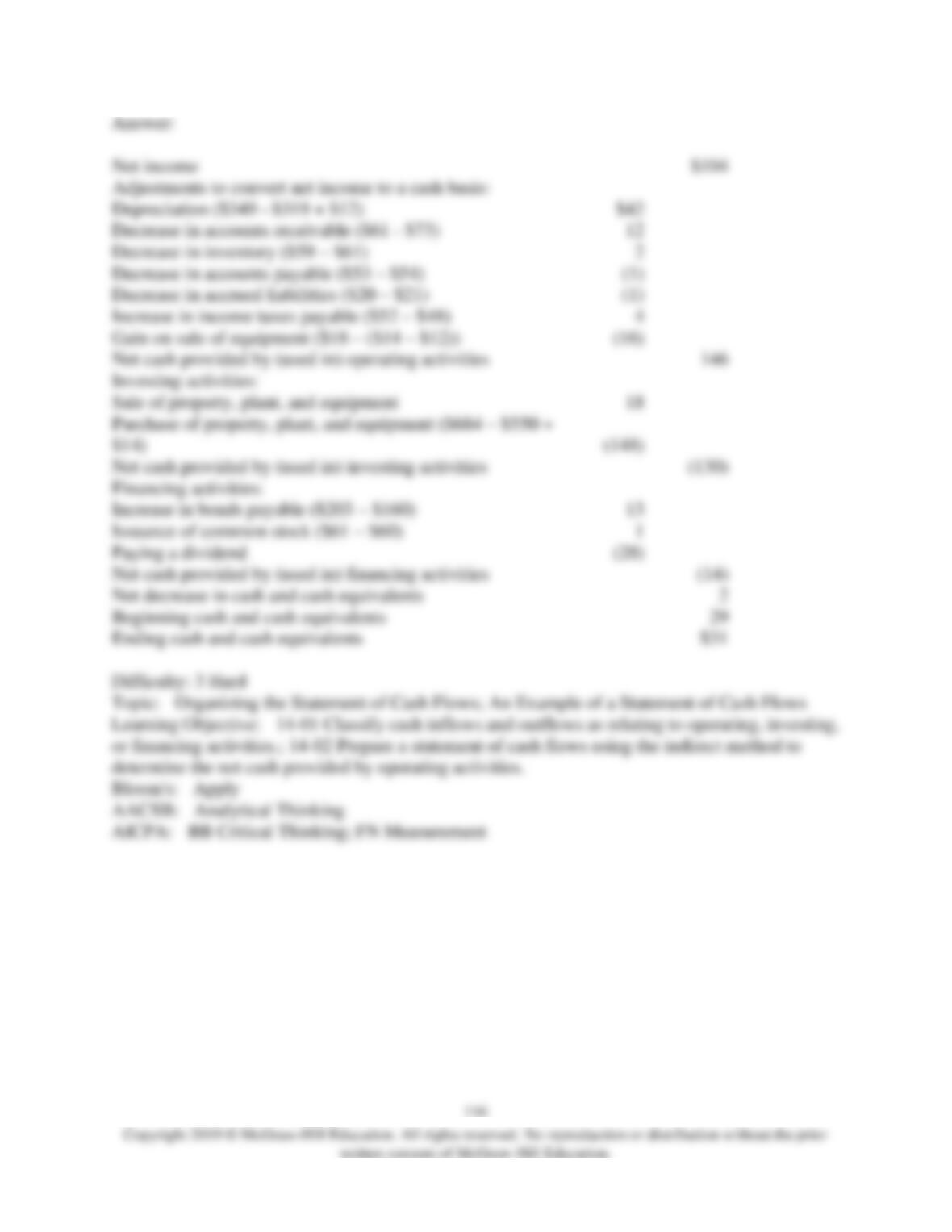
123) Vandy Corporation’s balance sheet and income statement appear below:
Comparative Balance Sheet
Ending
Balance
Beginning
Balance
Assets:
Cash and cash equivalents
$
31
$
29
Accounts receivable
61
73
Inventory
59
61
Property, plant, and equipment
684
550
Less accumulated depreciation
349
319
Total assets
$
486
$
394
Liabilities and stockholders’ equity:
Accounts payable
$
53
$
54
Accrued liabilities
20
21
Income taxes payable
52
48
Bonds payable
203
190
Common stock
61
60
Retained earnings
97
21
Total liabilities and stockholders’ equity
$
486
$
394
Income Statement
Sales
$807
Cost of goods sold
492
Gross margin
315
Selling and administrative expense
182
Net operating income
133
Gain on sale of equipment
16
Income before taxes
149
Income taxes
45
Net income
$104
The company sold equipment for $18 that was originally purchased for $14 and that had
accumulated depreciation of $12. It paid a cash dividend of $28 during the year and did not retire
any bonds payable or repurchase any of its own common stock.
Required:
Prepare a statement of cash flows for the year using the indirect method.
117
124) Alden Corporation’s most recent comparative Balance Sheet is as follows:
Comparative Balance Sheet
Ending Balance
Beginning
Balance
Assets:
Cash and cash equivalents
$
7,000
$
12,000
Accounts receivable
11,000
2,000
Inventory
39,000
24,000
Long-term investments
23,000
9,000
Property, plant, and equipment
83,000
100,000
Less accumulated depreciation
66,000
62,000
Total assets
$
97,000
$
85,000
Liabilities and Stockholders’ Equity:
Accounts payable
$
9,000
$
28,000
Income taxes payable
1,000
2,000
Bonds Payable
16,000
10,000
Common Stock
42,000
30,000
Retained Earnings
29,000
15,000
Total liabilities and stockholders’ equity
$
97,000
$
85,000
Alden’s net income was $34,000. No equipment was purchased and no long-term investments were
sold. There was a gain of $3,000 when equipment was sold. The accumulated depreciation on the
equipment that was sold was $12,000. Cash dividends of $20,000 were declared and paid during
the year.
Required:
Prepare Alden’s statement of cash flows using the indirect method.