CHAPTER 14
LONG-TERM LIABILITIES
IFRS questions are available at the end of this chapter.
TRUE-FALSE—Conceptual
Answer No. Description
MULTIPLE CHOICE—Conceptual
Answer No. Description
Test Bank for Intermediate Accounting, Fifteenth Edition
14 – 2
MULTIPLE CHOICE—Conceptual (cont.)
Answer No. Description
MULTIPLE CHOICE—Computational
Answer No. Description
Long-Term Liabilities
14 – 3
MULTIPLE CHOICE—Computational (cont.)
Answer No. Description
MULTIPLE CHOICE—CPA Adapted

Test Bank for Intermediate Accounting, Fifteenth Edition
14 – 4
BRIEF EXERCISES
Item Description
BE14-117 Terms related to long-term debt.
BE14-118 Bond issue price and premium amortization.
BE14-119 Amortization of discount or premium.
EXERCISES
E14-120 Entries for bonds payable.
E14-121 Retirement of bonds.
E14-122 Early extinguishment of debt.
*E14-123 Accounting for a troubled debt settlement.
*E14-124 Accounting for troubled debt restructuring.
*E14-125 Accounting for troubled debt.
PROBLEMS
Item Description
P14-126 Bond discount amortization.
P14-127 Bond interest and discount amortization.
P14-128 Entries for bonds payable.
P14-129 Entries for bonds payable.
P14-130 Fair value option
*P14-131 Accounting for a troubled debt settlement.
CHAPTER LEARNING OBJECTIVES
1. Describe the formal procedures associated with issuing long-term debt.
2. Identify various types of bond issues.
3. Describe the accounting valuation for bonds at date of issuance.
4. Apply the methods of bond discount and premium amortization.
5. Describe the accounting for the extinguishment of debt.
6. Explain the accounting for long-term notes payable.
7. Describe the accounting for the fair value option.
8. Explain the reporting of off-balance-sheet financing arrangements.
9. Indicate how to present and analyze long-term debt.
*10. Describe the accounting for a debt restructuring.

Long-Term Liabilities
14 – 5
11. Compare the accounting procedures for long-term liabilities under GAAP and IFRS.

Test Bank for Intermediate Accounting, Fifteenth Edition
14 – 6
SUMMARY OF LEARNING OBJECTIVES BY QUESTIONS
Item
Type
Item
Type
Item
Type
Item
Type
Item
Type
Item
Type
Item
Type
Learning Objective 1
1.
TF
21.
MC
22.
MC
Learning Objective 2
2.
TF
3.
TF
23.
MC
P24.
MC
S25.
MC
Learning Objective 3
4.
TF
27.
MC
30.
MC
61.
MC
65.
MC
126.
P
5.
TF
28.
MC
31.
MC
62.
MC
117.
BE
6.
TF
29.
MC
60.
MC
63.
MC
118.
BE
Learning Objective 4
7.
TF
35.
MC
68.
MC
76.
MC
84.
MC
120.
E
8.
TF
36.
MC
69.
MC
77.
MC
106.
MC
126.
P
9.
TF
37.
MC
70.
MC
78.
MC
107.
MC
127.
P
10.
TF
38.
MC
71.
MC
79.
MC
108.
MC
128.
P
26.
MC
39.
MC
72.
MC
80.
MC
109.
MC
129.
P
32.
MC
64.
MC
73.
MC
81.
MC
117.
BE
33.
MC
66.
MC
74.
MC
82.
MC
118.
BE
34.
MC
67.
MC
75.
MC
83.
MC
119.
BE
Learning Objective 5
11.
TF
85.
MC
89.
MC
93.
MC
111.
MC
115.
MC
122.
E
40.
MC
86.
MC
90.
MC
94.
MC
112.
MC
117.
BE
128.
P
41.
MC
87.
MC
91.
MC
95.
MC
113.
MC
120.
E
P42.
MC
88.
MC
92.
MC
110.
MC
114.
MC
121.
E
Learning Objective 6
12.
TF
P43.
MC
45.
MC
97.
MC
13.
TF
S44.
MC
96.
MC
98.
MC
Learning Objective 7
14.
TF
46.
MC
47
MC
130.
P-
CT
Learning Objective 8
15.
TF
48.
MC
S49.
MC
Long-Term Liabilities
14 – 7
SUMMARY OF LEARNING OBJECTIVES BY QUESTIONS (cont.)
Learning Objective 9
16.
TF
18.
TF
51.
MC
53.
MC
99.
MC
101.
MC
17.
TF
S50.
MC
52.
MC
54.
MC
100.
MC
102.
MC
Learning Objective *10
19.
TF
56.
MC
59.
MC
105.
MC
124.
E
20.
TF
57.
MC
103.
MC
106.
MC
125.
E-
CT
55.
MC
58.
MC
104.
MC
123.
E
131.
P
Learning Objective 11– IFRS
1.
TF
3.
TF
5.
TF
7.
MC
9.
MC
11.
MC
2.
SA
2.
TF
4.
TF
6.
MC
8.
MC
10.
MC
1.
SA
Note: TF = True-False E = Exercise CT= Critical Thinking
MC = Multiple Choice P = Problem BE =Brief Exercise
TRUE FALSE—Conceptual
1. Companies usually make bond interest payments semiannually, although the interest rate
is generally expressed as an annual rate.
2. A mortgage bond is referred to as a debenture bond.
3. Bond issues that mature in installments are called serial bonds.
4. If the market rate is greater than the coupon rate, bonds will be sold at a premium.
5. The interest rate written in the terms of the bond indenture is called the effective yield or
market rate.
6. The stated rate is the same as the coupon rate.
7. Amortization of a premium increases bond interest expense, while amortization of a
discount decreases bond interest expense.
8. A bond may only be issued on an interest payment date.
9. The cash paid for interest will always be greater than interest expense when using
effective-interest amortization for a bond.

Test Bank for Intermediate Accounting, Fifteenth Edition
14 – 8
10. Bond issue costs are capitalized as a deferred charge and amortized to expense over the
life of the bond issue.
11. The replacement of an existing bond issue with a new one is called refunding.
12. If a long-term note payable has a stated interest rate, that rate should be considered to be
the effective rate.
13. The interest rate of variable-rate mortgages is tied to changes in the fluctuating market
rate.
14. An unrealized holding gain or loss is the net change in the fair value of the liability from
one period to another, exclusive of interest expense recognized but not recorded.
15. Off-balance-sheet financing is an attempt to borrow monies in such a way to minimize the
reporting of debt on the balance sheet.
16. The debt to assets ratio will go up if an equal amount of assets and liabilities are added to
the balance sheet.
17. If a company plans to retire long-term debt from a bond retirement fund, it should report
the debt as current.
18. The times interest earned ratio is computed by dividing income before interest expense by
interest expense.
*19. The loss to be recognized by a creditor on an impaired loan is the difference between the
investment in the loan and the expected undiscounted future cash flows from the loan.
*20. In a troubled debt restructuring, the loss recognized by the creditor will equal the gain
recognized by the debtor.
True False Answers—Conceptual
Item
Ans.
Item
Ans.
Item
Ans.
Item
Ans.
MULTIPLE CHOICE—Conceptual
21. An example of an item which is not a liability is
a. dividends payable in stock.
b. advances from customers on contracts.
c. accrued estimated warranty costs.
d. the portion of long-term debt due within one year.

Long-Term Liabilities
14 – 9
22. The covenants and other terms of the agreement between the issuer of bonds and the
lender are set forth in the
a. bond indenture.
b. bond debenture.
c. registered bond.
d. bond coupon.

Test Bank for Intermediate Accounting, Fifteenth Edition
14 – 10
23. The term used for bonds that are unsecured as to principal is
a. mortgage bonds.
b. debenture bonds.
c. indebenture bonds.
d. callable bonds.
P24. Bonds for which the owners’ names are not registered with the issuing corporation are
called
a. bearer bonds.
b. term bonds.
c. debenture bonds.
d. secured bonds.
S25. Bonds that pay no interest unless the issuing company is profitable are called
a. collateral trust bonds.
b. debenture bonds.
c. revenue bonds.
d. income bonds.
S26. If bonds are issued initially at a premium and the effective-interest method of amortization
is used, interest expense in the earlier years will be
a. greater than if the straight-line method were used.
b. greater than the amount of the interest payments.
c the same as if the straight-line method were used.
d. less than if the straight-line method were used.
27. The interest rate written in the terms of the bond indenture is known as the
a. coupon rate.
b. nominal rate.
c. stated rate.
d. coupon rate, nominal rate, or stated rate.
28. The rate of interest actually earned by bondholders is called the
a. stated rate.
b. coupon rate.
c. nominal rate.
d. effective rate.
Use the following information for questions 29 and 30:
Fox Co. issued $100,000 of ten-year, 10% bonds that pay interest semiannually. The bonds are
sold to yield 8%.
29. One step in calculating the issue price of the bonds is to multiply the principal by the table
value for
a. 10 periods and 10% from the present value of 1 table.
b. 20 periods and 5% from the present value of 1 table.
c. 10 periods and 8% from the present value of 1 table.
d. 20 periods and 4% from the present value of 1 table.

Long-Term Liabilities
14 – 11
30. Another step in calculating the issue price of the bonds is to
a. multiply $10,000 by the table value for 10 periods and 10% from the present value of
an annuity table.
b. multiply $10,000 by the table value for 20 periods and 5% from the present value of an
annuity table.
c. multiply $10,000 by the table value for 20 periods and 4% from the present value of an
annuity table.
d. None of these answers is correct.
31. Reich, Inc. issued bonds with a maturity amount of $200,000 and a maturity ten years
from date of issue. If the bonds were issued at a premium, this indicates that
a. the effective yield or market rate of interest exceeded the stated (nominal) rate.
b. the nominal rate of interest exceeded the market rate.
c. the market and nominal rates coincided.
d. no necessary relationship exists between the two rates.
32. If bonds are initially sold at a discount and the straight-line method of amortization is used,
interest expense in the earlier years will
a. exceed what it would have been had the effective-interest method of amortization
been used.
b. be less than what it would have been had the effective-interest method of amortization
been used.
c. be the same as what it would have been had the effective-interest method of amortiza-
tion been used.
d. be less than the stated (nominal) rate of interest.
33. Under the effective-interest method of bond discount or premium amortization, the
periodic interest expense is equal to
a. the stated (nominal) rate of interest multiplied by the face value of the bonds.
b. the market rate of interest multiplied by the face value of the bonds.
c. the stated rate multiplied by the beginning–of-period carrying amount of the bonds.
d. the market rate multiplied by the beginning–of-period carrying amount of the bonds.
34. When the effective-interest method is used to amortize bond premium or discount, the
periodic amortization will
a. increase only if the bonds were issued at a discount.
b. decrease only if the bonds were issued at a premium.
c. increase only if the bonds were issued at a premium.
d. increase if the bonds were issued at either a discount or a premium.
35. If bonds are issued between interest dates, the entry on the books of the issuing
corporation could include a
a. debit to Interest Payable.
b. credit to Interest Receivable.
c. credit to Interest Expense.
d. credit to Unearned Interest.

Test Bank for Intermediate Accounting, Fifteenth Edition
14 – 12
36. When the interest payment dates of a bond are May 1 and November 1, and a bond issue
is sold on June 1, the amount of cash received by the issuer will be
a. decreased by accrued interest from June 1 to November 1.
b. decreased by accrued interest from May 1 to June 1.
c. increased by accrued interest from June 1 to November 1.
d. increased by accrued interest from May 1 to June 1.
37. Theoretically, the costs of issuing bonds could be
a. expensed when incurred.
b. reported as a reduction of the bond liability.
c. debited to a deferred charge account and amortized over the life of the bonds.
d. any of these answers are correct.
38. The printing costs and legal fees associated with the issuance of bonds should
a. be expensed when incurred.
b. be reported as a deduction from the face amount of bonds payable.
c. be accumulated in a deferred charge account and amortized over the life of the bonds.
d. not be reported as an expense until the period the bonds mature or are retired.
39. Treasury bonds should be shown on the balance sheet as
a. an asset.
b. a deduction from bonds payable issued to arrive at net bonds payable and outstanding.
c. a reduction of stockholders’ equity.
d. both an asset and a liability.
40. An early extinguishment of bonds payable, which were originally issued at a premium, is
made by purchase of the bonds between interest dates. At the time of reacquisition
a. any costs of issuing the bonds must be amortized up to the purchase date.
b. the premium must be amortized up to the purchase date.
c. interest must be accrued from the last interest date to the purchase date.
d. All of these answers are correct.
41. The generally accepted method of accounting for gains or losses from the early
extinguishment of debt treats any gain or loss as
a. an adjustment to the cost basis of the asset obtained by the debt issue.
b. an amount that should be considered a cash adjustment to the cost of any other debt
issued over the remaining life of the old debt instrument.
c. an amount received or paid to obtain a new debt instrument and, as such, should be
amortized over the life of the new debt.
d. a difference between the reacquisition price and the net carrying amount of the debt
which should be recognized in the period of redemption.
P42. “In-substance defeasance” is a term used to refer to an arrangement whereby
a. a company gets another company to cover its payments due on long-term debt.
b. a governmental unit issues debt instruments to corporations.
c. a company provides for the future repayment of a long-term debt by placing
purchased securities in an irrevocable trust.
d. a company legally extinguishes debt before its due date.

Long-Term Liabilities
14 – 13
P43. A corporation borrowed money from a bank to build a building. The long-term note signed
by the corporation is secured by a mortgage that pledges title to the building as security
for the loan. The corporation is to pay the bank $80,000 each year for 10 years to repay
the loan. Which of the following relationships can you expect to apply to the situation?
a. The balance of mortgage payable at a given balance sheet date will be reported as a
long-term liability.
b. The balance of mortgage payable will remain a constant amount over the 10-year
period.
c. The amount of interest expense will decrease each period the loan is outstanding, while
the portion of the annual payment applied to the loan principal will increase each period.
d. The amount of interest expense will remain constant over the 10-year period.
S44. A debt instrument with no ready market is exchanged for property whose fair value is
currently indeterminable. When such a transaction takes place
a. the present value of the debt instrument must be approximated using an imputed
interest rate.
b. it should not be recorded on the books of either party until the fair value of the property
becomes evident.
c. the board of directors of the entity receiving the property should estimate a value for
the property that will serve as a basis for the transaction.
d. the directors of both entities involved in the transaction should negotiate a value to be
assigned to the property.
45. When a note payable is exchanged for property, goods, or services, the stated interest
rate is presumed to be fair unless
a. no interest rate is stated.
b. the stated interest rate is unreasonable.
c. the stated face amount of the note is materially different from the current cash sales
price for similar items or from current fair value of the note.
d. any of these answers are correct.
46. Which of the following arguments is presented by FASB to explain why a gain is recorded
by a company when its creditworthiness is becoming worse?
a. The shareholders’ loss is the debtholders’ gain.
b. The income of the company will increase as the amount of interest payment will
reduce.
c. The decrease in market rate will increase the value of equity shares.
d. The debtholders’ loss is the shareholders’ gain.
47. If a company chooses the fair value option, a decrease in the fair value of the liability is
recorded by crediting
a. Bonds Payable.
b. Gain on Restructuring of Debt.
c. Unrealized Holding Gain/Loss-Income.
d. None of these answers are correct.

Test Bank for Intermediate Accounting, Fifteenth Edition
14 – 14
48. A project financing arrangement refers to:
a. an arrangement where a company creates a special-purpose entity to perform a
special project.
b. an arrangement where a company borrows from its subsidiary to finance a project.
c. an arrangement where a company promises future repayment by placing purchased
assets in an irrevocable trust.
d. an arrangement where a company finances a project from a sinking fund established
for bond repayments.
S49. When a business enterprise enters into what is referred to as off-balance-sheet financing,
the company
a. is attempting to conceal the debt from shareholders by having no information about
the debt included in the balance sheet.
b. wishes to confine all information related to the debt to the income statement and the
statement of cash flow.
c. can enhance the quality of its financial position and perhaps permit credit to be
obtained more readily and at less cost.
d. is in violation of generally accepted accounting principles.
S50. Long-term debt that matures within one year and is to be converted into stock should be
reported
a. as a current liability.
b. in a special section between liabilities and stockholders’ equity.
c. as noncurrent.
d. as noncurrent and accompanied with a note explaining the method to be used in its
liquidation.
51. Which of the following must be disclosed relative to long-term debt maturities and sinking
fund requirements?
a. The present value of future payments for sinking fund requirements and long-term
debt maturities during each of the next five years.
b. The present value of scheduled interest payments on long-term debt during each of
the next five years.
c. The amount of scheduled interest payments on long-term debt during each of the next
five years.
d. The amount of future payments for sinking fund requirements and long-term debt
maturities during each of the next five years.
52. Note disclosures for long-term debt generally include all of the following except
a. assets pledged as security.
b. call provisions and conversion privileges.
c. restrictions imposed by the creditor.
d. names of specific creditors.
53. The times interest earned ratio is computed by dividing
a. net income by interest expense.
b. income before taxes by interest expense.
c. income before income taxes and interest expense by interest expense.
d. net income and interest expense by interest expense.

Long-Term Liabilities
14 – 15
54. The debt to assets ratio is computed by dividing
a. current liabilities by total assets.
b. long-term liabilities by total assets.
c. total liabilities by total assets.
d. total assets by total liabilities.
*55. In a troubled debt restructuring in which the debt is continued with modified terms and the
carrying amount of the debt is less than the total future cash flows,
a. a loss should be recognized by the debtor.
b. a gain should be recognized by the debtor.
c. a new effective-interest rate must be computed.
d. no interest expense or revenue should be recognized in the future.
*56. A troubled debt restructuring will generally result in a
a. loss by the debtor and a gain by the creditor.
b. loss by both the debtor and the creditor.
c. gain by both the debtor and the creditor.
d. gain by the debtor and a loss by the creditor.
*57. In a troubled debt restructuring in which the debt is restructured by a transfer of assets
with a fair value less than the carrying amount of the debt, the debtor would recognize
a. no gain or loss on the restructuring.
b. a gain on the restructuring.
c. a loss on the restructuring.
d. None of these answers are correct.
*58. In a troubled debt restructuring in which the debt is continued with modified terms, a gain
should be recognized at the date of restructure, but no interest expense should be
recognized over the remaining life of the debt, whenever the
a. carrying amount of the pre-restructure debt is less than the total future cash flows.
b. carrying amount of the pre-restructure debt is greater than the total future cash flows.
c. present value of the pre-restructure debt is less than the present value of the future
cash flows.
d. present value of the pre-restructure debt is greater than the present value of the future
cash flows.
*59. In a troubled debt restructuring in which the debt is continued with modified terms and the
carrying amount of the debt is less than the total future cash flows, the creditor should
a. compute a new effective-interest rate.
b. not recognize a loss.
c. calculate its loss using the historical effective rate of the loan.
d. calculate its loss using the current effective rate of the loan.
Test Bank for Intermediate Accounting, Fifteenth Edition
14 – 16
Multiple Choice Answers—Conceptual
Item
Ans.
Item
Ans.
Item
Ans.
Item
Ans.
Item
Ans.
Item
Ans.
Item
Ans.
MULTIPLE CHOICE—Computational
Use the following information for questions 60 through 62:
On January 1, 2014, Ellison Co. issued eight-year bonds with a face value of $4,000,000 and a
stated interest rate of 6%, payable semiannually on June 30 and December 31. The bonds were
sold to yield 8%. Table values are:
Present value of 1 for 8 periods at 6% ………………………………….. .627
Present value of 1 for 8 periods at 8% ………………………………….. .540
Present value of 1 for 16 periods at 3% ………………………………… .623
Present value of 1 for 16 periods at 4% ………………………………… .534
Present value of annuity for 8 periods at 6% ………………………….. 6.210
Present value of annuity for 8 periods at 8% ………………………….. 5.747
Present value of annuity for 16 periods at 3% ………………………… 12.561
Present value of annuity for 16 periods at 4% ………………………… 11.652
60. The present value of the principal is
a. $2,136,000.
b. $2,160,000.
c. $2,492,000.
d. $2,508,000.
61. The present value of the interest is
a. $1,379,280.
b. $1,398,240.
c. $1,490,400.
d. $1,507,320.
62. The issue price of the bonds is
a. $3,534,240.
b. $3,539,280.
c. $3,558,240.
d. $3,998,400.

Long-Term Liabilities
14 – 17
63. Downing Company issues $4,000,000, 6%, 5-year bonds dated January 1, 2014 on
January 1, 2014. The bonds pay interest semiannually on June 30 and December 31. The
bonds are issued to yield 5%. What are the proceeds from the bond issue?
2.5%
3.0%
5.0%
6.0%
Present value of a single sum for 5 periods
.88385
.86261
.78353
.74726
Present value of a single sum for 10 periods
.78120
.74409
.61391
.55839
Present value of an annuity for 5 periods
4.64583
4.57971
4.32948
4.21236
Present value of an annuity for 10 periods
8.75206
8.53020
7.72173
7.36009
a. $4,000,000
b. $4,173,195
c. $4,175,047
d. $4,173,847
64. Feller Company issues $15,000,000 of 10-year, 9% bonds on March 1, 2014 at 97 plus
accrued interest. The bonds are dated January 1, 2014, and pay interest on June 30 and
December 31. What is the total cash received on the issue date?
a. $14,550,000
b. $15,337,500
c. $14,775,000
d. $14,325,000
65. Everhart Company issues $20,000,000, 6%, 5-year bonds dated January 1, 2014 on
January 1, 2014. The bonds pay interest semiannually on June 30 and December 31. The
bonds are issued to yield 5%. What are the proceeds from the bond issue?
2.5%
3.0%
5.0%
6.0%
Present value of a single sum for 5 periods
.88385
.86261
.78353
.74726
Present value of a single sum for 10 periods
.78120
.74409
.61391
.55839
Present value of an annuity for 5 periods
4.64583
4.57971
4.32948
4.21236
Present value of an annuity for 10 periods
8.75206
8.53020
7.72173
7.36009
a. $20,000,000
b. $20,865,976
c. $20,875,236
d. $20,869,232
66. Farmer Company issues $25,000,000 of 10-year, 9% bonds on March 1, 2014 at 97 plus
accrued interest. The bonds are dated January 1, 2014, and pay interest on June 30 and
December 31. What is the total cash received on the issue date?
a. $24,250,000
b. $25,562,500
c. $24,625,000
d. $23,875,000

Test Bank for Intermediate Accounting, Fifteenth Edition
14 – 18
67. A company issues $10,000,000, 7.8%, 20-year bonds to yield 8% on January 1, 2014.
Interest is paid on June 30 and December 31. The proceeds from the bonds are
$9,802,072. Using effective-interest amortization, how much interest expense will be
recognized in 2014?
a. $390,000
b. $780,000
c. $784,249
d. $784,166
68. A company issues $10,000,000, 7.8%, 20-year bonds to yield 8% on January 1, 2014.
Interest is paid on June 30 and December 31. The proceeds from the bonds are
$9,802,072. Using effective-interest amortization, what will the carrying value of the bonds
be on the December 31, 2014 balance sheet?
a. $9,806,321
b. $10,000,000
c. $9,812,563
d. $9,804,155
69. A company issues $10,000,000, 7.8%, 20-year bonds to yield 8% on January 1, 2013.
Interest is paid on June 30 and December 31. The proceeds from the bonds are
$9,802,072. Using straight-line amortization, what is the carrying value of the bonds on
December 31, 2015?
a. $9,835,115
b. $9,970,311
c. $9,816,916
d. $9,831,761
70. A company issues $10,000,000, 7.8%, 20-year bonds to yield 8% on January 1, 2014.
Interest is paid on June 30 and December 31. The proceeds from the bonds are
$9,802,072. What is interest expense for 2015, using straight-line amortization?
a. $1,026,805
b. $780,000
c. $784,596
d. $789,896
71. A company issues $20,000,000, 7.8%, 20-year bonds to yield 8% on January 1, 2014.
Interest is paid on June 30 and December 31. The proceeds from the bonds are
$19,604,144. Using effective-interest amortization, how much interest expense will be
recognized in 2014?
a. $780,000
b. $1,560,000
c. $1,568,498
d. $1,568,332
72. A company issues $20,000,000, 7.8%, 20-year bonds to yield 8% on January 1, 2014.
Interest is paid on June 30 and December 31. The proceeds from the bonds are
$19,604,144. Using effective-interest amortization, what will the carrying value of the
bonds be on the December 31, 2014 balance sheet?
a. $19,612,642
b. $20,000,000
c. $19,625,124
d. $19,608,308

Long-Term Liabilities
14 – 19
73. A company issues $20,000,000, 7.8%, 20-year bonds to yield 8% on January 1, 2013.
Interest is paid on June 30 and December 31. The proceeds from the bonds are
$19,604,144. Using straight-line amortization, what is the carrying value of the bonds on
December 31, 2015?
a. $19,670,232
b. $19,940,624
c. $19,633,832
d. $19,663,522
74. A company issues $20,000,000, 7.8%, 20-year bonds to yield 8% on January 1, 2014.
Interest is paid on June 30 and December 31. The proceeds from the bonds are
$19,604,144. What is interest expense for 2015, using straight-line amortization?
a. $1,540,208
b. $1,560,000
c. $1,569,192
d. $1,579,793
75. On January 1, 2014, Huber Co. sold 12% bonds with a face value of $1,000,000. The
bonds mature in five years, and interest is paid semiannually on June 30 and December
31. The bonds were sold for $1,077,250 to yield 10%. Using the effective-interest method
of amortization, interest expense for 2014 is
a. $100,000.
b. $107,419.
c. $107,700.
d. $120,000.
76. On January 2, 2014, a calendar-year corporation sold 8% bonds with a face value of
$1,500,000. These bonds mature in five years, and interest is paid semiannually on June
30 and December 31. The bonds were sold for $1,384,000 to yield 10%. Using the
effective-interest method of computing interest, how much should be charged to interest
expense in 2014?
a. $120,000.
b. $138,400.
c. $138,860.
d. $150,000.
The following information applies to both questions 77 and 78.
On October 1, 2014 Macklin Corporation issued 5%, 10-year bonds with a face value of
$4,000,000 at 104. Interest is paid on October 1 and April 1, with any premiums or discounts
amortized on a straight-line basis.
77. The entry to record the issuance of the bonds would include a credit of
a. $100,000 to Interest Payable.
b. $160,000 to Discount on Bonds Payable.
c. $3,840,000 to Bonds Payable.
d. $160,000 to Premium on Bonds Payable.

Test Bank for Intermediate Accounting, Fifteenth Edition
14 – 20
78. Bond interest expense reported on the December 31, 2014 income statement of Macklin
Corporation would be
a. $46,000
b. $50,000
c. $54,000
d. $92,000
The following information applies to both questions 79 and 80.
On October 1, 2014 Bartley Corporation issued 5%, 10-year bonds with a face value of
$5,000,000 at 104. Interest is paid on October 1 and April 1, with any premiums or discounts
amortized on a straight-line basis.
79. The entry to record the issuance of the bonds would include a
a. credit of $125,000 to Interest Payable.
b. credit of $200,000 to Premium on Bonds Payable.
c. credit of $4,800,000 to Bonds Payable.
d. debit of $200,000 to Discount on Bonds Payable.
80. Bond interest expense reported on the December 31, 2014 income statement of Bartley
Corporation would be
a. $67,500
b. $115,000
c. $57,500
d. $62,500
81. At the beginning of 2014, Wallace Corporation issued 10% bonds with a face value of
$3,000,000. These bonds mature in the five years, and interest is paid semiannually on
June 30 and December 31. The bonds were sold for $2,779,200 to yield 12%. Wallace
uses a calendar-year reporting period. Using the effective-interest method of amortization,
what amount of interest expense should be reported for 2014? (Round your answer to the
nearest dollar.)
a. $344,160
b. $334,510
c. $333,500
d. $332,500
82. On January 1, Patterson Inc. issued $4,000,000, 9% bonds for $3,756,000. The market
rate of interest for these bonds is 10%. Interest is payable annually on December 31.
Patterson uses the effective-interest method of amortizing bond discount. At the end of
the first year, Patterson should report unamortized bond discount of
a. $219,600.
b. $228,400.
c. $206,440.
d. $204,000.

Long-Term Liabilities
14 – 21
83. On January 1, Martinez Inc. issued $5,000,000, 11% bonds for $5,325,000. The market
rate of interest for these bonds is 10%. Interest is payable annually on December 31.
Martinez uses the effective-interest method of amortizing bond premium. At the end of the
first year, Martinez should report unamortized bond premium of:
a. $308,550
b. $307,500
c. $289,250
d. $275,000
84. At the beginning of 2014, Winston Corporation issued 10% bonds with a face value of
$2,000,000. These bonds mature in five years, and interest is paid semiannually on June
30 and December 31. The bonds were sold for $1,852,800 to yield 12%. Winston uses a
calendar-year reporting period. Using the effective-interest method of amortization, what
amount of interest expense should be reported for 2014? (Round your answer to the
nearest dollar.)
a. $221,667
b. $222,333
c. $223,006
d. $229,440
85. Kant Corporation retires its $300,000 face value bonds at 102 on January 1, following the
payment of interest. The carrying value of the bonds at the redemption date is $288,750.
The entry to record the redemption will include a
a. credit of $11,250 to Loss on Bond Redemption.
b. credit of $11,250 to Discount on Bonds Payable.
c. debit of $17,250 to Gain on Bond Redemption.
d. debit of $16,000 to Premium on Bonds Payable.
86. Carr Corporation retires its $300,000 face value bonds at 105 on January 1, following the
payment of interest. The carrying value of the bonds at the redemption date is $311,235.
The entry to record the redemption will include a
a. credit of $11,235 to Loss on Bond Redemption.
b. debit of $11,235 to Premium on Bonds Payable.
c. credit of $3,765 to Gain on Bond Redemption.
d. debit of $15,000 to Premium on Bonds Payable.
87. At December 31, 2014 the following balances existed on the books of Foxworth
Corporation:
Bonds Payable $4,000,000
Discount on Bonds Payable 320,000
Interest Payable 100,000
Unamortized Bond Issue Costs 240,000
If the bonds are retired on January 1, 2015, at 102, what will Foxworth report as a loss on
redemption?
a. $740,000
b. $640,000
c. $540,000
d. $400,000

Test Bank for Intermediate Accounting, Fifteenth Edition
14 – 22
88. At December 31, 2014 the following balances existed on the books of Rentro Corporation:
Bonds Payable $3,500,000
Discount on Bonds Payable 280,000
Interest Payable 84,000
Unamortized Bond Issue Costs 210,000
If the bonds are retired on January 1, 2015, at 102, what will Rentro report as a loss on
redemption?
a. $350,000
b. $472,500
c. $560,000
d. $644,000
89. The December 31, 2014, balance sheet of Hess Corporation includes the following items:
9% bonds payable due December 31, 2023 $3,000,000
Unamortized premium on bonds payable 81,000
The bonds were issued on December 31, 2013, at 103, with interest payable on July 1
and December 31 of each year. Hess uses straight-line amortization. On March 1, 2015,
Hess retired $1,200,000 of these bonds at 98 plus accrued interest. What should Hess
record as a gain on retirement of these bonds? Ignore taxes.
a. $56,400.
b. $32,400.
c. $55,800.
d. $60,000.
90. On January 1, 2008, Hernandez Corporation issued $9,000,000 of 10% ten-year bonds at
103. The bonds are callable at the option of Hernandez at 105. Hernandez has recorded
amortization of the bond premium on the straight-line method (which was not materially
different from the effective-interest method).
On December 31, 2014, when the fair value of the bonds was 96, Hernandez repurchased
$2,000,000 of the bonds in the open market at 96. Hernandez has recorded interest and
amortization for 2014. Ignoring income taxes and assuming that the gain is material,
Hernandez should report this reacquisition as
a. a loss of $98,000.
b. a gain of $98,000.
c. a loss of $122,000.
d. a gain of $122,000.
91. The 10% bonds payable of Nixon Company had a net carrying amount of $950,000 on
December 31, 2014. The bonds, which had a face value of $1,000,000, were issued at a
discount to yield 12%. The amortization of the bond discount was recorded under the
effective-interest method. Interest was paid on January 1 and July 1 of each year. On
July 2, 2015, several years before their maturity, Nixon retired the bonds at 102. The
interest payment on July 1, 2015 was made as scheduled. What is the loss that Nixon
should record on the early retirement of the bonds on July 2, 2015? Ignore taxes.
a. $20,000.
b. $63,000.
c. $56,000.
d. $70,000.

Long-Term Liabilities
14 – 23
92. A corporation called an outstanding bond obligation four years before maturity. At that
time there was an unamortized discount of $750,000. To extinguish this debt, the
company had to pay a call premium of $250,000. Ignoring income tax considerations, how
should these amounts be treated for accounting purposes?
a. Amortize $1,000,000 over four years.
b. Charge $1,000,000 to a loss in the year of extinguishment.
c. Charge $250,000 to a loss in the year of extinguishment and amortize $750,000 over
four years.
d. Either amortize $1,000,000 over four years or charge $1,000,000 to a loss
immediately, whichever management selects.
93. The 12% bonds payable of Nyman Co. had a carrying amount of $3,120,000 on
December 31, 2014. The bonds, which had a face value of $3,000,000, were issued at a
premium to yield 10%. Nyman uses the effective-interest method of amortization. Interest is
paid on June 30 and December 31. On June 30, 2015, several years before their maturity,
Nyman retired the bonds at 104 plus accrued interest. The loss on retirement, ignoring
taxes, is
a. $0.
b. $24,000.
c. $37,200.
d. $120,000.
94. Didde Company issues $20,000,000 face value of bonds at 96 on January 1, 2013. The
bonds are dated January 1, 2013, pay interest semiannually at 8% on June 30 and
December 31, and mature in 10 years. Straight-line amortization is used for discounts and
premiums. On September 1, 2016, $12,000,000 of the bonds are called at 102 plus
accrued interest. What gain or loss would be recognized on the called bonds on
September 1, 2016?
a. $1,200,000 loss
b. $544,000 loss
c. $720,000 loss
d. $907,000 loss
95. Cortez Company issues $4,000,000 face value of bonds at 96 on January 1, 2013. The
bonds are dated January 1, 2013, pay interest semiannually at 8% on June 30 and
December 31, and mature in 10 years. Straight-line amortization is used for discounts and
premiums. On September 1, 2016, $2,400,000 of the bonds are called at 102 plus
accrued interest. What gain or loss would be recognized on the called bonds on
September 1, 2016?
a. $240,000 loss
b. $108,800 loss
c. $144,000 loss
d. $181,000 loss

Test Bank for Intermediate Accounting, Fifteenth Edition
14 – 24
96. On January 1, 2014, Ann Price loaned $112,695 to Joe Kiger. A zero-interest-bearing
note (face amount, $150,000) was exchanged solely for cash; no other rights or privileges
were exchanged. The note is to be repaid on December 31, 2016. The prevailing rate of
interest for a loan of this type is 10%. The present value of $150,000 at 10% for three
years is $112,695. What amount of interest income should Ms. Price recognize in 2014?
a. $11,270.
b. $15,000.
c. $45,000.
d. $33,810.
97. On January 1, 2014, Jacobs Company sold property to Dains Company which originally
cost Jacobs $1,330,000. There was no established exchange price for this property. Danis
gave Jacobs a $2,100,000 zero-interest-bearing note payable in three equal annual
installments of $700,000 with the first payment due December 31, 2014. The note has no
ready market. The prevailing rate of interest for a note of this type is 10%. The present
value of a $2,100,000 note payable in three equal annual installments of $700,000 at a
10% rate of interest is $1,740,900. What is the amount of interest income that should be
recognized by Jacobs in 2014, using the effective-interest method?
a. $0.
b. $70,000.
c. $174,090.
d. $210,000.
98. On January 1, 2014, Crown Company sold property to Leary Company. There was no
established exchange price for the property, and Leary gave Crown a $4,000,000 zero–
interest-bearing note payable in 5 equal annual installments of $800,000, with the first
payment due December 31, 2014. The prevailing rate of interest for a note of this type is
9%. The present value of the note at 9% was $2,884,000 at January 1, 2014. What should
be the balance of the Discount on Notes Payable account on the books of Leary at
December 31, 2014 after adjusting entries are made, assuming that the effective-interest
method is used?
a. $0
b. $856,440
c. $892,800
d. $1,116,000
99. Putnam Company’s 2014 financial statements contain the following selected data:
Income taxes $40,000
Interest expense 15,000
Net income 60,000
Putnam’s times interest earned for 2014 is
a. 4.0 times
b. 5.0 times.
c. 6.7 times.
d. 7.7 times.

Long-Term Liabilities
14 – 25
100. In the recent year Hill Corporation had net income of $210,000, interest expense of
$60,000, and tax expense of $90,000. What was Hill Corporation’s times interest earned
ratio for the year?
a. 6.0
b. 5.0
c. 4.5
d. 3.5
101. In recent year Cey Corporation had net income of $500,000, interest expense of
$100,000, and a times interest earned ratio of 9. What was Cey Corporation’s income
before taxes for the year?
a. $1,000,000
b. $900,000
c. $800,000
d. None of these answers are correct.
102. The adjusted trial balance for Lifesaver Corp. at the end of the current year, 2014,
contained the following accounts.
5-year Bonds Payable 8% $2,500,000
Interest Payable 50,000
Premium on Bonds Payable 100,000
Notes Payable (3 months.) 40,000
Notes Payable (5 yr.) 165,000
Mortgage Payable ($15,000 due currently) 200,000
Salaries and wages Payable 18,000
Income Taxes Payable (due 3/15 of 2015) 25,000
The total long-term liabilities reported on the balance sheet are
a. $2,865,000.
b. $2,850,000.
c. $2,965,000.
d. $2,950,000.
Use the following information for questions *103 through *105:
On December 31, 2012, Nolte Co. is in financial difficulty and cannot pay a note due that day. It is
a $1,800,000 note with $180,000 accrued interest payable to Piper, Inc. Piper agrees to accept
from Nolte equipment that has a fair value of $870,000, an original cost of $1,440,000, and
accumulated depreciation of $690,000. Piper also forgives the accrued interest, extends the
maturity date to December 31, 2015, reduces the face amount of the note to $750,000, and
reduces the interest rate to 6%, with interest payable at the end of each year.
*103. Nolte should recognize a gain or loss on the transfer of the equipment of
a. $0.
b. $120,000 gain.
c. $180,000 gain.
d. $570,000 loss.
Test Bank for Intermediate Accounting, Fifteenth Edition
14 – 26
*104. Nolte should recognize a gain on the partial settlement and restructure of the debt of
a. $0.
b. $45,000.
c. $165,000.
d. $225,000.
*105. Nolte should record interest expense for 2015 of
a. $0.
b. $45,000.
c. $90,000.
d. $135,000.
Multiple Choice Answers—Computational
Item
Ans.
Item
Ans.
Item
Ans.
Item
Ans.
Item
Ans.
Item
Ans.
Item
Ans.
MULTIPLE CHOICE—CPA Adapted
106. On July 1, 2014, Spear Co. issued 2,000 of its 10%, $1,000 bonds at 99 plus accrued
interest. The bonds are dated April 1, 2014 and mature on April 1, 2024. Interest is
payable semiannually on April 1 and October 1. What amount did Spear receive from the
bond issuance?
a. $2,030,000
b. $2,000,000
c. $1,980,000
d. $1,930,000
107. On January 1, 2014, Solis Co. issued its 10% bonds in the face amount of $6,000,000,
which mature on January 1, 2024. The bonds were issued for $6,810,000 to yield 8%,
resulting in bond premium of $810,000. Solis uses the effective-interest method of
amortizing bond premium. Interest is payable annually on December 31. At December 31,
2014, Solis’s adjusted unamortized bond premium should be
a. $810,000.
b. $754,800.
c. $729,000.
d. $609,000.

Long-Term Liabilities
14 – 27
108. On July 1, 2013, Noble, Inc. issued 9% bonds in the face amount of $8,000,000, which
mature on July 1, 2019. The bonds were issued for $7,648,000 to yield 10%, resulting in a
bond discount of $352,000. Noble uses the effective-interest method of amortizing bond
discount. Interest is payable annually on June 30. At June 30, 2015, Noble’s unamortized
bond discount should be
a. $257,920.
b. $272,000.
c. $281,600.
d. $248,000.
109. On January 1, 2014, Huff Co. sold $4,000,000 of its 10% bonds for $3,541,184 to yield
12%. Interest is payable semiannually on January 1 and July 1. What amount should Huff
report as interest expense for the six months ended June 30, 2014?
a. $177,064
b. $200,000
c. $212,471
d. $240,000
110. On January 1, 2015, Doty Co. redeemed its 15-year bonds of $5,000,000 par value for
102. They were originally issued on January 1, 2003 at 98 with a maturity date of
January 1, 2018. The bond issue costs relating to this transaction were $300,000. Doty
amortizes discounts, premiums, and bond issue costs using the straight-line method.
What amount of loss should Doty recognize on the redemption of these bonds (ignore
taxes)?
a. $180,000
b. $120,000
c. $100,000
d. $0
111. On its December 31, 2014 balance sheet, Emig Corp. reported bonds payable of
$3,000,000 and related unamortized bond issue costs of $160,000. The bonds had been
issued at par. On January 2, 2015, Emig retired $1,500,000 of the outstanding bonds at
par plus a call premium of $35,000. What amount should Emig report in its 2015 income
statement as loss on extinguishment of debt (ignore taxes)?
a. $0
b. $35,000
c. $80,000
d. $115,000
112. On January 1, 2010, Goll Corp. issued 2,000 of its 10%, $1,000 bonds for $2,080,000.
These bonds were to mature on January 1, 2020 but were callable at 101 any time after
December 31, 2013. Interest was payable semiannually on July 1 and January 1. On
July 1, 2015, Goll called all of the bonds and retired them. Bond premium was amortized
on a straight-line basis. Before income taxes, Goll’s gain or loss in 2015 on this early
extinguishment of debt was
a. $60,000 gain.
b. $24,000 gain.
c. $20,000 loss.
d. $16,000 gain.

Test Bank for Intermediate Accounting, Fifteenth Edition
14 – 28
113. On June 30, 2015, Omara Co. had outstanding 8%, $6,000,000 face amount, 15-year
bonds maturing on June 30, 2025. Interest is payable on June 30 and December 31. The
unamortized balances in the bond discount and deferred bond issue costs accounts on
June 30, 2015 were $210,000 and $60,000, respectively. On June 30, 2015, Omara
acquired all of these bonds at 94 and retired them. What net carrying amount should be
used in computing gain or loss on this early extinguishment of debt?
a. $5,940,000.
b. $5,790,000.
c. $5,730,000.
d. $5,640,000.
114. A ten-year bond was issued in 2013 at a discount with a call provision to retire the bonds.
When the bond issuer exercised the call provision on an interest date in 2015, the carrying
amount of the bond was less than the call price. The amount of bond liability removed
from the accounts in 2015 should have equaled the
a. call price.
b. call price less unamortized discount.
c. face amount less unamortized discount.
d. face amount plus unamortized discount.
115. Paige Co. took advantage of market conditions to refund debt. This was the fourth
refunding operation carried out by Paige within the last three years. The excess of the
carrying amount of the old debt over the amount paid to extinguish it should be reported
as a
a. gain, net of income taxes.
b. loss, net of income taxes.
c. part of continuing operations.
d. deferred credit to be amortized over the life of the new debt.
*116. Eddy Co. is indebted to Cole under a $800,000, 12%, three-year note dated
December 31, 2013. Because of Eddy’s financial difficulties developing in 2015, Eddy
owed accrued interest of $96,000 on the note at December 31, 2015. Under a troubled
debt restructuring, on December 31, 2015, Cole agreed to settle the note and accrued
interest for a tract of land having a fair value of $720,000. Eddy‘s acquisition cost of the
land is $580,000. Ignoring income taxes, on its 2015 income statement Eddy should
report as a result of the troubled debt restructuring
Gain on Disposal Restructuring Gain
a. $316,000 $0
b. $220,000 $0
c. $140,000 $80,000
d. $140,000 $176,000
Multiple Choice Answers—CPA Adapted
Item
Ans.
Item
Ans.
Item
Ans.
Item
Ans.
Item
Ans.
Item
Ans.
Long-Term Liabilities
14 – 29
DERIVATIONS — Computational
Test Bank for Intermediate Accounting, Fifteenth Edition
14 – 30
DERIVATIONS — Computational (cont.)
Long-Term Liabilities
14 – 31
DERIVATIONS — Computational (cont.)
DERIVATIONS — CPA Adapted
No. Answer Derivation

Test Bank for Intermediate Accounting, Fifteenth Edition
14 – 32
DERIVATIONS — CPA Adapted (cont.)
No. Answer Derivation
BRIEF EXERCISES
BE. 14-117—Terms related to long-term debt.
Place the letter of the best matching phrase before each word.
____ 1. Indenture ____ 6. Times Interest Earned Ratio
____ 2. Refunding ____ 7. Mortgage
____ 3. Bonds Issued at Par ____ 8. Premium on Bonds
____ 4. Carrying Value ____ 9. Reacquisition Price
____ 5. Nominal Rate ____ 10. Market Rate
a. Requires that bond discount be reported in the balance sheet as a direct deduction from the
face of the bond.
b. Rate set by party issuing the bonds which appears on the bond instrument.
c. The interest paid each period is the effective interest at date of issuance.
d. Rate of interest actually earned by the bondholders.
e. Results when bonds are sold below par.
f. Results when bonds are sold above par.
g. The replacement of an existing bond issuance with a new one.
h. Price paid by issuing corporation for its own bonds.
i. Book value of bonds at any given date.
j. Ratio of current assets to current liabilities.
k. The bond contract or agreement.
l. Indicates the company’s ability to meet interest payments as they come due.
m. Ratio of debt to equity.
n. Exclusive right to manufacture a product.
o. A document that pledges title to property as security for a loan.

Long-Term Liabilities
14 – 33
Solution 14-117
BE. 14-118—Bond issue price and premium amortization.
On January 1, 2015, Piper Co. issued ten-year bonds with a face value of $3,000,000 and a
stated interest rate of 10%, payable semiannually on June 30 and December 31. The bonds were
sold to yield 12%. Table values are:
Present value of 1 for 10 periods at 10% ……………………………. .386
Present value of 1 for 10 periods at 12% ……………………………. .322
Present value of 1 for 20 periods at 5% ……………………………… .377
Present value of 1 for 20 periods at 6% ……………………………… .312
Present value of annuity for 10 periods at 10% …………………… 6.145
Present value of annuity for 10 periods at 12% …………………… 5.650
Present value of annuity for 20 periods at 5% …………………….. 12.462
Present value of annuity for 20 periods at 6% …………………….. 11.470
Instructions
(a) Calculate the issue price of the bonds.
(b) Without prejudice to your solution in part (a), assume that the issue price was $2,652,000.
Prepare the amortization table for 2015, assuming that amortization is recorded on interest
payment dates using the effective-interest method.
Solution 14-118
BE. 14-119—Amortization of discount or premium.
Grider Industries, Inc. issued $10,000,000 of 8% debentures on May 1, 2014 and received cash
totaling $8,872,628. The bonds pay interest semiannually on May 1 and November 1. The maturity
date on these bonds is November 1, 2022. The firm uses the effective-interest method of amortizing
discounts and premiums. The bonds were sold to yield an effective-interest rate of 10%.
Instructions
Calculate the total dollar amount of discount or premium amortization during the first year (5/1/14
through 4/30/15) these bonds were outstanding. (Show computations and round to the nearest
dollar.)
Test Bank for Intermediate Accounting, Fifteenth Edition
14 – 34
Solution 14-119
EXERCISES
Ex. 14-120—Entries for Bonds Payable.
Prepare journal entries to record the following transactions related to long-term bonds of Quirk Co.
(a) On April 1, 2013, Quirk issued $800,000, 9% bonds for $860,589 including accrued interest.
Interest is payable annually on January 1, and the bonds mature on January 1, 2023.
(b) On July 1, 2015 Quirk retired $240,000 of the bonds at 102 plus accrued interest. Quirk uses
straight-line amortization.
Solution 14-120
Ex. 14-121—Retirement of bonds.
Prepare journal entries to record the following retirement. (Show computations and round to the
nearest dollar.)
The December 31, 2014 balance sheet of Wolfe Co. included the following items:
7.5% bonds payable due December 31, 2022 $2,000,000
Unamortized discount on bonds payable 80,000
The bonds were issued on December 31, 2012 at 95, with interest payable on June 30 and
December 31. (Use straight-line amortization.)
On April 1, 2015, Wolfe retired $400,000 of these bonds at 101 plus accrued interest.
Long-Term Liabilities
14 – 35
Solution 14-121
Ex. 14-122—Early extinguishment of debt.
Hurst, Incorporated sold its 8% bonds with a maturity value of $6,000,000 on August 1, 2013 for
$5,892,000. At the time of the sale the bonds had 5 years until they reached maturity. Interest on
the bonds is payable semiannually on August 1 and February 1. The bonds are callable at 104 at
any time after August 1, 2015. By October 1, 2015, the market rate of interest has declined and
the market price of Hurst’s bonds has risen to a price of 101. The firm decides to refund the
bonds by selling a new 6% bond issue to mature in 5 years. Hurst begins to reacquire its 8%
bonds in the market and is able to purchase $1,000,000 worth at 101. The remainder of the
outstanding bonds is reacquired by exercising the bonds’ call feature. In the final analysis, how
much was the gain or loss experienced by Hurst in reacquiring its 8% bonds? (Assume the firm
used straight-line amortization.) Show calculations.
Solution 14-122
*Ex. 14-123—Accounting for a troubled debt settlement.
Mann, Inc., which owes Doran Co. $800,000 in notes payable with accrued interest of $72,000, is
in financial difficulty. To settle the debt, Doran agrees to accept from Mann equipment with a fair
value of $760,000, an original cost of $1,120,000, and accumulated depreciation of $260,000.
Instructions
(a) Compute the gain or loss to Mann on the settlement of the debt.
(b) Compute the gain or loss to Mann on the transfer of the equipment.
(c) Prepare the journal entry on Mann ‘s books to record the settlement of this debt.
(d) Prepare the journal entry on Doran’s books to record the settlement of the receivable.
Test Bank for Intermediate Accounting, Fifteenth Edition
14 – 36
*Solution 14-123
*Ex. 14-124—Accounting for a troubled debt restructuring.
On December 31, 2013, Short Co. is in financial difficulty and cannot pay a note due that day. It is
a $1,000,000 note with $100,000 accrued interest payable to Bryan, Inc. Bryan agrees to forgive
the accrued interest, extend the maturity date to December 31, 2015, and reduce the interest rate
to 4%. The present value of the restructured cash flows is $856,000.
Instructions
Prepare entries for the following:
(a) The restructure on Short’s books.
(b) The payment of interest on December 31, 2014.
(c) The restructure on Bryan’s books.
*Solution 14-124
Long-Term Liabilities
14 – 37
*Ex. 14-125—Accounting for troubled debt.
(a) What are the general rules for measuring and recognizing a gain or loss by the debtor on a
settlement of troubled debt which includes the transfer of noncash assets?
(b) What are the general rules for measuring and recognizing a gain and for recording future
payments by the debtor in a troubled debt restructuring?
*Solution 14-125
PROBLEMS
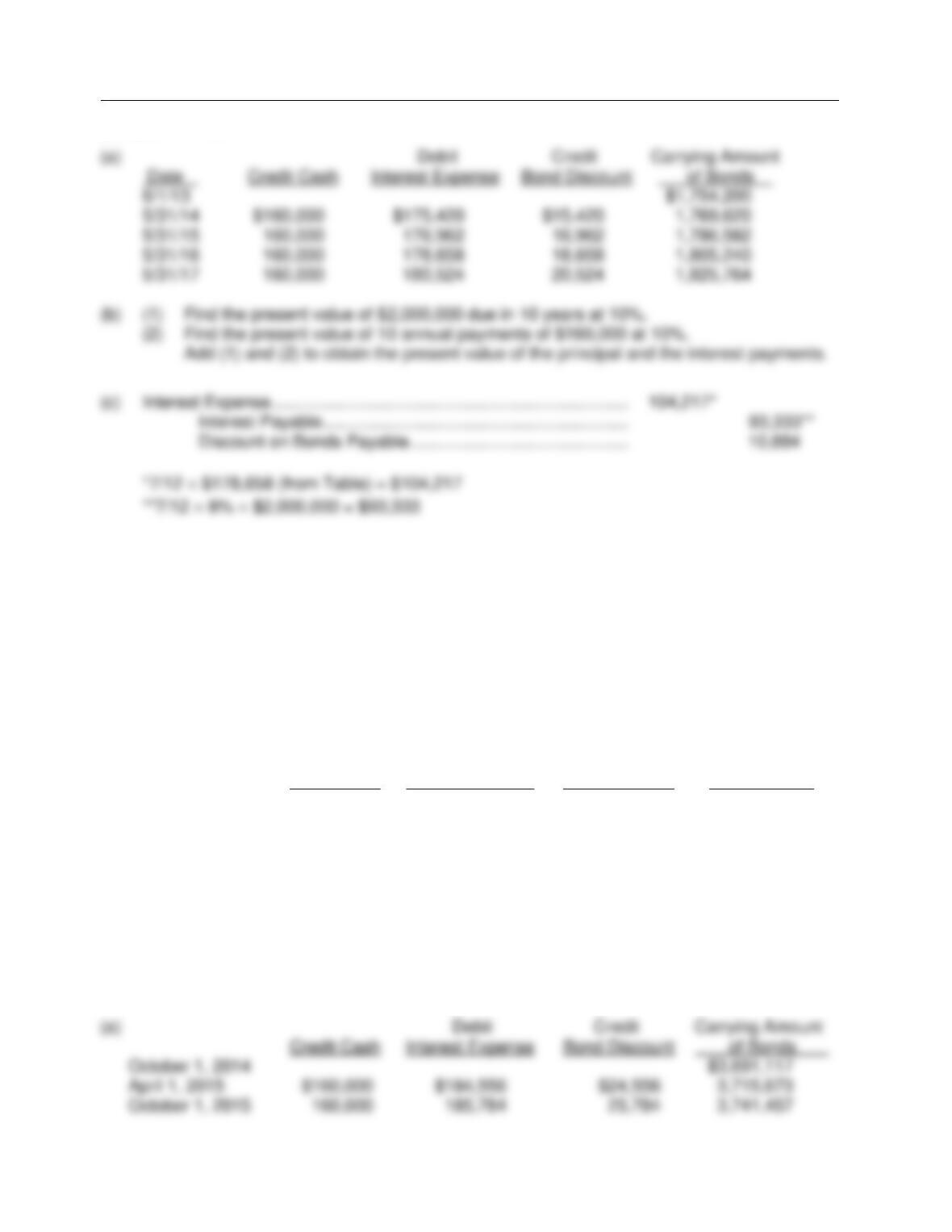
Pr. 14-126—Bond discount amortization.
On June 1, 2013, Everly Bottle Company sold $2,000,000 in long-term bonds for $1,754,200. The
bonds will mature in 10 years and have a stated interest rate of 8% and a yield rate of 10%. The
bonds pay interest annually on May 31 of each year. The bonds are to be accounted for under
the effective-interest method.
Instructions
(a) Construct a bond amortization table for this problem to indicate the amount of interest
expense and discount amortization at each May 31. Include only the first four years. Make
sure all columns and rows are properly labeled. (Round to the nearest dollar.)
(b) The sales price of $1,754,200 was determined from present value tables. Specifically explain
how one would determine the price using present value tables.
(c) Assuming that interest and discount amortization are recorded each May 31, prepare the
adjusting entry to be made on December 31, 2015. (Round to the nearest dollar.)
Test Bank for Intermediate Accounting, Fifteenth Edition
14 – 38
Solution 14-126
Pr. 14-127—Bond interest and discount amortization.
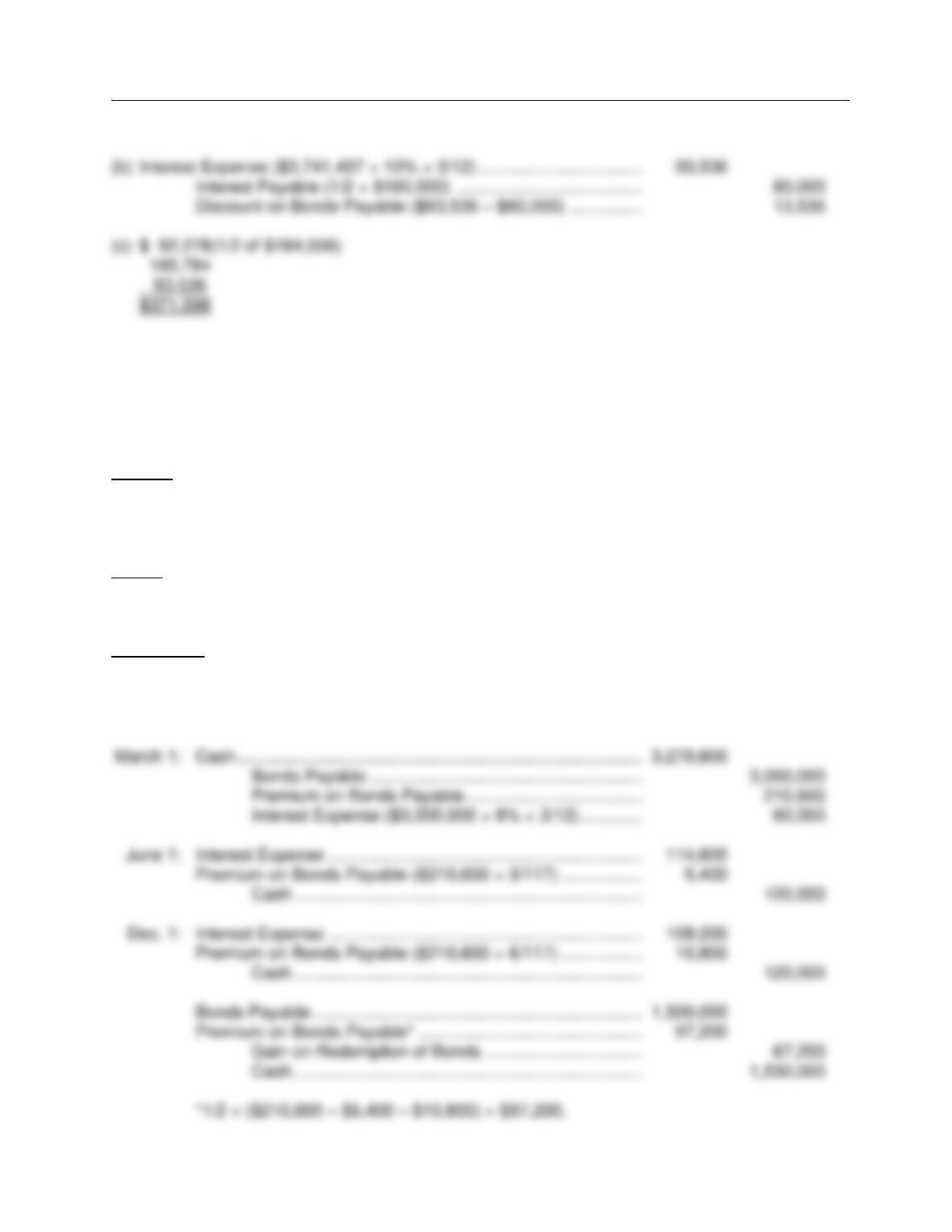
Grove Corporation issued $4,000,000 of 8% bonds on October 1, 2014, due on October 1, 2019.
The interest is to be paid twice a year on April 1 and October 1. The bonds were sold to yield
10% effective annual interest. Grove Corporation closes its books annually on December 31.
Instructions
(a) Complete the following amortization schedule for the dates indicated. (Round all answers to
the nearest dollar.) Use the effective-interest method.
Debit Credit Carrying Amount
Credit Cash Interest Expense Bond Discount of Bonds
October 1, 2014 $3,691,117
April 1, 2015
October 1, 2015
(b) Prepare the adjusting entry for December 31, 2015. Use the effective-interest method.
(c) Compute the interest expense to be reported in the income statement for the year ended
December 31, 2015.
Solution 14-127
Long-Term Liabilities
14 – 39
Solution 14-127 (Cont.)
Pr. 14-128—Entries for bonds payable.
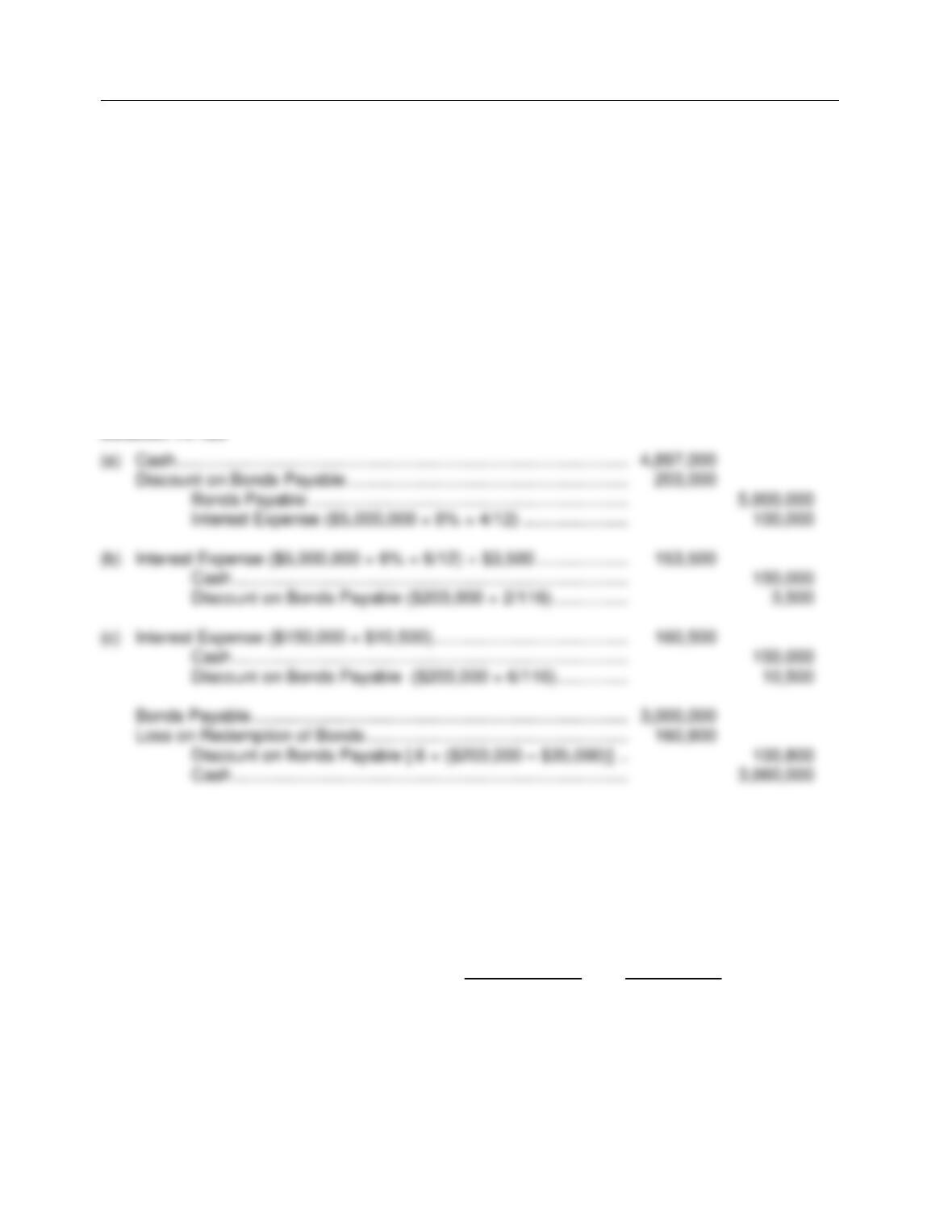
Prepare the necessary journal entries to record the following transactions relating to the long-term
issuance of bonds of Pitts Co.:
March 1
Issued $3,000,000 face value Pitts Co. second mortgage, 8% bonds for $3,270,600, including
accrued interest. Interest is payable semiannually on December 1 and June 1 with the bonds
maturing 10 years from this past December 1. The bonds are callable at 102.
June 1
Paid semiannual interest on Pitts Co. bonds. (Use straight-line amortization of any premium or
discount.)
December 1
Paid semiannual interest on Pitts Co. bonds and purchased $1,500,000 face value bonds at the
call price in accordance with the provisions of the bond indenture.
Solution 14-128
Test Bank for Intermediate Accounting, Fifteenth Edition
14 – 40
Pr. 14-129—Entries for bonds payable.
Prepare journal entries to record the following transactions relating to long-term bonds of Kirby,
Inc. (Show computations.)
(a) On June 1, 2013, Kirby, Inc. issued $5,000,000, 6% bonds for $4,897,000, which includes
accrued interest. Interest is payable semiannually on February 1 and August 1 with the
bonds maturing on February 1, 2023. The bonds are callable at 102.
(b) On August 1, 2013, Kirby paid interest on the bonds and recorded amortization. Kirby uses
straight-line amortization.
(c) On February 1, 2015, Kirby paid interest and recorded amortization on all of the bonds, and
purchased $3,000,000 of the bonds at the call price. Assume that a reversing entry was
made on January 1, 2015.
Solution 14-129
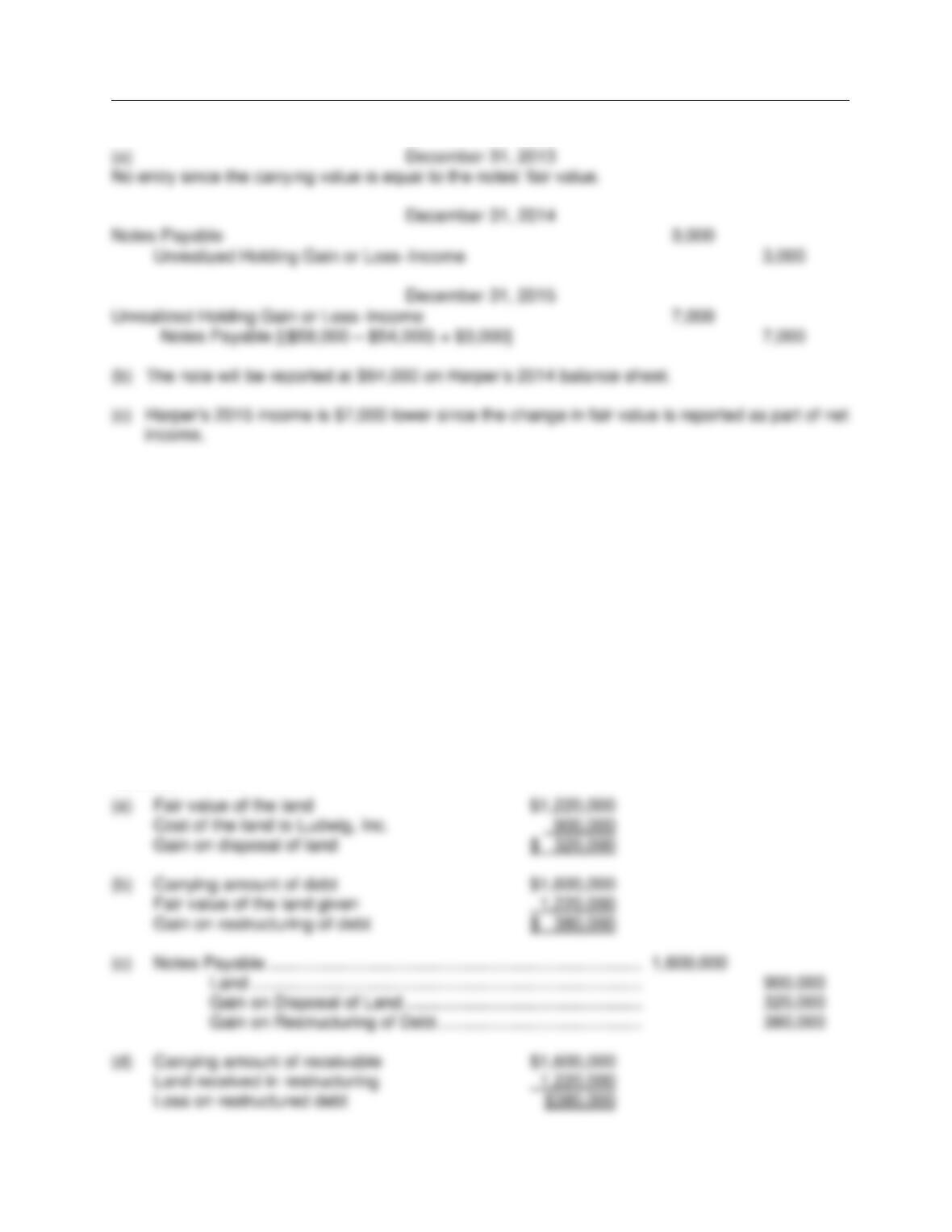
Pr. 14-130—Fair value option
Harper Company commonly issues long-term notes payable to its various lenders. Harper has
had a pretty good credit rating such that its effective borrowing rate is quite low (less than 8% on
an annual basis). Harper has elected to use the fair value option for the long-term notes issued to
Barclay’s Bank and has the following data related to the carrying and fair value for these notes.
Carrying Value Fair Value
December 31, 2013 $81,000 $81,000
December 31, 2014 67,000 64,000
December 31, 2015 54,000 58,000
Instructions
(a) Prepare the journal entry at December 31 (Harper’s year-end) for 2013, 2014, and 2015 to
record the fair value option for these notes.
(b) At what amount will the note be reported on Harper’s 2014 balance sheet?
(c) What is the effect of recording the fair value option on these notes on Harper’s 2015 income?
Long-Term Liabilities
14 – 41
Solution 14-130
*Pr. 14-131—Accounting for a troubled debt restructuring.
Ludwig, Inc., which owes Giffin Co. $1,600,000 in notes payable, is in financial difficulty. To
eliminate the debt, Giffin agrees to accept from Ludwig land having a fair value of $1,220,000 and
a recorded cost of $900,000.
Instructions
(a) Compute the amount of gain or loss to Ludwig, Inc. on the transfer (disposition) of the land.
(b) Compute the amount of gain or loss to Ludwig, Inc. on the restructuring of the debt.
(c) Prepare the journal entry on Ludwig ‘s books to record the restructuring of this debt.
(d) Compute the gain or loss to Giffin Co. from restructuring of its receivable from Ludwig.
(e) Prepare the journal entry on Giffin’s books to record the restructuring of this receivable.
*Solution 14-131

Test Bank for Intermediate Accounting, Fifteenth Edition
14 – 42
Solution 14-131 (Cont.)
IFRS QUESTIONS
True/False
1. IFRS requires the use of straight-line method for amortization of a discount or premium.
2. U.S. GAAP and IFRS have the same accounting guideline for bond issue cost.
3. Under IFRS, bond issue costs are recorded as an asset.
4. Under IFRS, all troubled-debt restructurings are accounted for as extinguishments.
5. Under IFRS the required procedure for amortization of a discount or premium is the effective–
interest method.
Multiple Choice Questions
6. IFRS generally assumes that all restructurings be accounted for as:
a. extinguishments of debt.
b. loss on debt.
c. amortization expense.
d. bad-debt expense.
7. Which of the following is not a difference between IFRS and U.S. GAAP in accounting for
non-current liabilities?
a. Non-current liabilities follow current liabilities on the statement of financial position under
U.S. GAAP, but precede current liabilities under IFRS.
b. The criteria for recognizing environmental liabilities is more stringent under U.S. GAAP
compared to IFRS.
c. Bond issuance cost are recorded as a reduction of the carrying value of the debt under
U.S. GAAP but are recorded as an asset and amortized to expense over the term of the
debt under IFRS.
d. Under U.S. GAAP, bonds payable is recorded at the face amount and any premium or
discount is recorded in a separate account. Under IFRS, bonds payable is recorded at the
carrying value so no separate premium or discount accounts are used.
Long-Term Liabilities
14 – 43
8. All of the following are differences between IFRS and U.S. GAAP in accounting for liabilities
except:
a. When a bond is issued at a discount U.S. GAAP records the discount in a separate
contra-liability account. IFRS records the bond net of the discount.
b. Under IFRS, bond issuance costs reduces the carrying value of the debt. Under U.S.
GAAP, these costs are recorded as an asset and amortized to expense over the term of
the bond.
c. U.S. GAAP, but not IFRS uses the term “troubled debt restructurings.”
d. U.S. GAAP, but not IFRS uses the term “provisions” for contingent liabilities which are
accrued.
9. IFRS requires bond issue costs:
a. to be recorded as an asset.
b. to be excluded while computing the interest expense.
c. to be netted against the carrying amount of the bonds.
d. to be considered when computing income tax payable.
10. Both IFRS and U.S. GAAP permit valuation of long-term debt and other liabilities at
a. present value discounted at the firm’s cost of capital.
b. current market values of the obligations, based on changes in the discount rate with
unrealized gains and losses reflected in a separate account in stockholders’ equity.
c. fair value with gains and losses on changes in fair value recorded in income in certain
situations.
d. historic costs without reflecting changes in valuation as obligations will be retired at their
maturity date.
Answers to multiple choice:
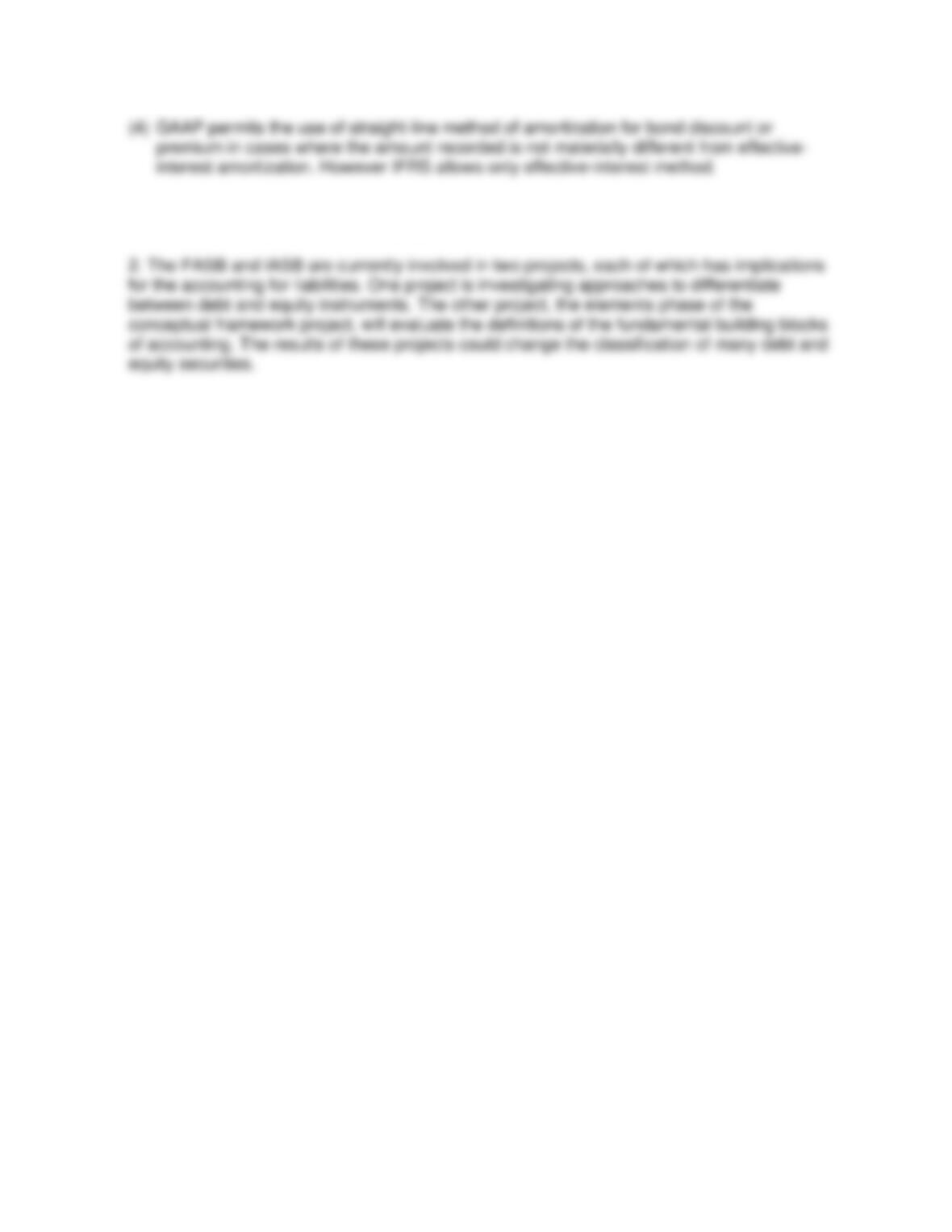
IFRS Short Answer:
1. Briefly describe some of the differences between U.S. GAAP and IFRS with respect to the
accounting for long-term liabilities.
Test Bank for Intermediate Accounting, Fifteenth Edition
14 – 44
2. Briefly discuss how accounting convergence efforts addressing liabilities is related to the
IASB/FASB conceptual framework project.