
Name:
Class:
Date:
chapter 14
Indicate whether the statement is true or false.
1. Discount on Bonds Payable is a contra liability account.
a.
True
b.
False
2. If the amount of a bond premium on an issued 11%, 4-year, $100,000 bond is $12,928, the semiannual straight-line
amortization of the premium is $1,416.
a.
True
b.
False
3. If $500,000 of 10-year bonds with interest payable semiannually are sold for $494,040 based on (1) the present value of
$500,000 due in 20 periods at 5% plus (2) the present value of twenty $25,000 payments at 5%, the nominal or contract
rate and the market rate of interest for the bonds are both 10%.
a.
True
b.
False
4. The present value of an annuity is the sum of the present values of each cash flow.
a.
True
b.
False
5. The concept of present value is that an amount of cash to be received at some date in the future is the equivalent of the
same amount of cash held at an earlier date.
a.
True
b.
False
6. Callable bonds are redeemable by the issuing corporation within the period of time and at the price stated in the bond
indenture.
a.
True
b.
False
7. One reason a dollar today is worth more than a dollar one year from today is the time value of money.
a.
True
b.
False
8. A bond is usually divided into a number of individual bonds of $500 each.
a.
True
b.
False
9. There is a loss on redemption of bonds when bonds are redeemed above carrying value.
a.
True
b.
False
10. If the bondholder has the right to exchange a bond for shares of common stock, the bond is called a convertible bond.
a.
True
b.
False

Name:
Class:
Date:
chapter 14
11. Interest payments on 12% bonds with a face value of $20,000 and interest paid semiannually would be $2,400 every 6
months.
a.
True
b.
False
12. A corporation often issues callable bonds to protect itself against significant declines in future interest rates.
a.
True
b.
False
13. Only callable bonds can be purchased by the issuing corporation before maturity.
a.
True
b.
False
14. If the market rate of interest is 8% and a corporation’s bonds bear interest at 7%, the bonds will sell at a premium.
a.
True
b.
False
15. An installment note is a debt that requires the borrower to make equal periodic payments to the lender for the term of
the note.
a.
True
b.
False
16. Callable bonds can be redeemed by the issuing corporation at the fair market price of the bonds.
a.
True
b.
False
17. Gains on the redemption of bonds are reported in the Other Revenue section of the income statement.
a.
True
b.
False
18. The market rate of interest is affected by a variety of factors, including investors’ assessment of current economic
conditions.
a.
True
b.
False
19. The higher the times interest earned ratio, the better the creditors’ protection.
a.
True
b.
False
20. When the effective interest rate method of amortization is used, the amount of interest expense for a given period is
computed by multiplying the contract rate of interest by the bond’s carrying value at the beginning of the given period.
a.
True
b.
False
21. The times interest earned ratio is computed by dividing bonds payable by interest expense.
a.
True

Name:
Class:
Date:
chapter 14
a.
True
b.
False
22. The balance in Premium on Bonds Payable should be reported as a deduction from Bonds Payable on the balance
sheet.
a.
True
b.
False
23. Premium on bonds payable may be amortized by the straight-line method if the results obtained by its use do not
materially differ from the results obtained by use of the interest method.
a.
True
b.
False
24. Amortization is the allocation process of writing off bond premiums and discounts to interest expense over the life of
the bond issue.
a.
True
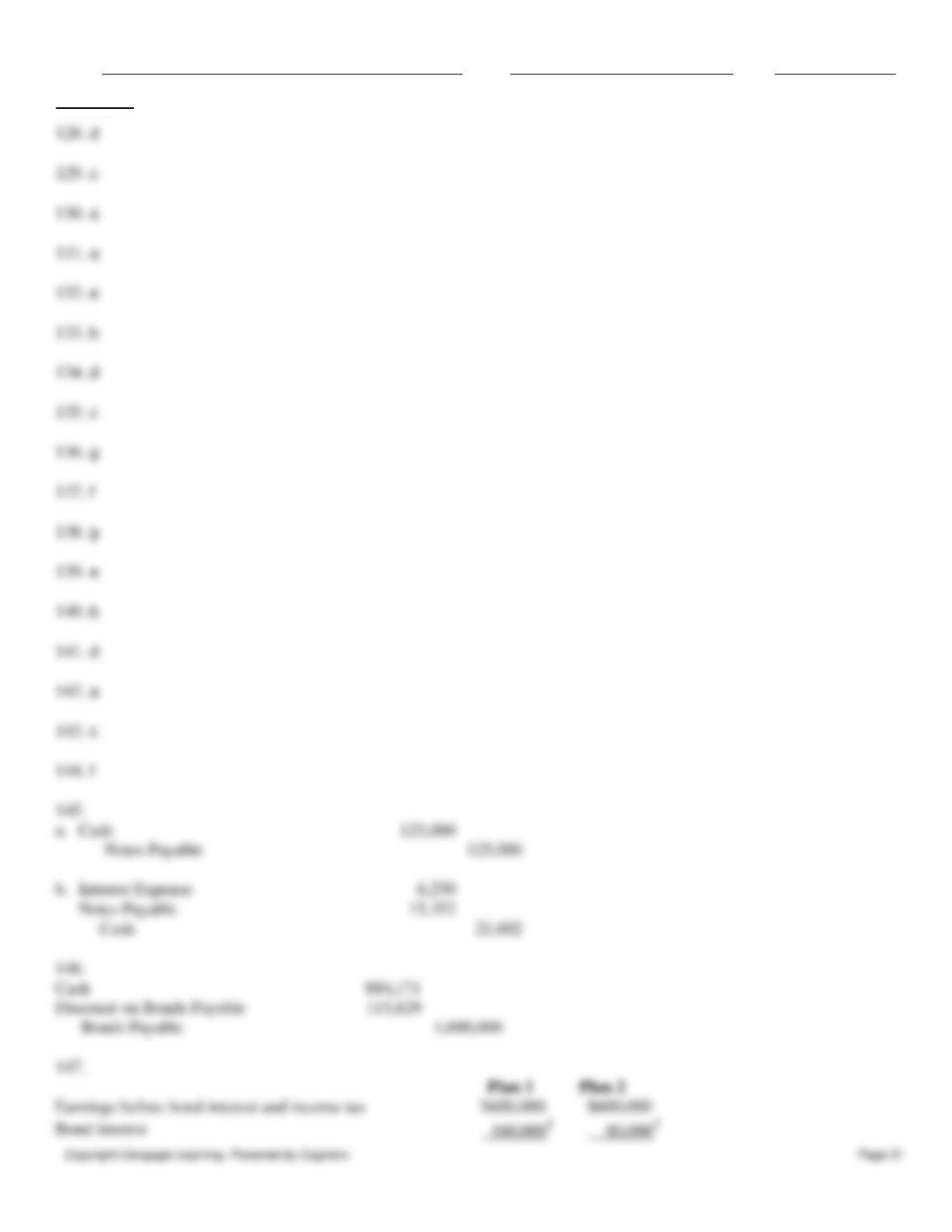
b.
False
25. The present value of $5,000 to be received in 4 years at a market rate of interest of 6% compounded annually is
$3,636.30.
a.
True
b.
False
26. The effective interest rate method of amortizing a bond discount or premium is the preferred method.
a.
True
b.
False
27. There are two methods of amortizing a bond discount or premium: the straight-line method and the double-declining-
balance method.
a.
True
b.
False
28. The amortization of a premium on bonds payable decreases bond interest expense.
a.
True
b.
False
29. The interest portion of an installment note payment is computed by multiplying the interest rate by the carrying
amount of the note at the end of the period.
a.
True
b.
False
30. If bonds of $1,000,000 with unamortized discount of $10,000 are redeemed at 98, the gain on redemption of bonds is
$10,000.
a.
True
b.
False
31. Bondholders are creditors of the issuing corporation.

Name:
Class:
Date:
chapter 14
b.
False
32. The face value of a term bond is payable at a single specific date in the future.
a.
True
b.
False
33. Bondholders’ claims on the assets of the corporation rank ahead of stockholders’ claims.
a.
True
b.
False
34. An equal stream of periodic payments is called an annuity.
a.
True
b.
False
35. Bonds are sold at face value when the contract rate is equal to the market rate of interest.
a.
True
b.
False
36. The carrying amount of the bonds is defined as the face value of the bonds plus any unamortized discount or less any
unamortized premium.
a.
True
b.
False
37. If bonds are sold for a discount, the carrying value of the bonds is equal to the face value less the unamortized
discount.
a.
True
b.
False
38. When a portion of a bond issue is redeemed, a related proportion of the unamortized premium or discount must be
written off.
a.
True
b.
False
39. When the market rate of interest is less than the contract rate for a bond, the bond will sell for a premium.
a.
True
b.
False
40. When a corporation issues bonds, it executes a contract with the bondholders, known as a bond debenture.
a.
True
b.
False
41. If the amount of a bond premium on an issued 11%, 4-year, $100,000 bond is $12,928 and straight-line amortization is
used, the annual interest expense is $5,500.
a.
True
b.
False

Name:
Class:
Date:
chapter 14
52. If the straight-line method of amortization is used, the amount of unamortized premium on bonds payable will
42. The prices of bonds are quoted as a percentage of the bonds’ market value.
a.
True
b.
False
43. Both callable and noncallable bonds can be purchased by the issuing corporation on the open market.
a.
True
b.
False
44. The total interest expense over the entire life of a bond is equal to the sum of the interest payments plus the total
discount or minus the total premium related to the bond.
a.
True
b.
False
45. The effective interest rate method produces a constant dollar amount of interest expense to be reported each interest
period.
a.
True
b.
False
46. A bond is simply a form of an interest-bearing note.
a.
True
b.
False
47. The balance in a bond discount account should be reported on the balance sheet as a deduction from the related bonds
payable.
a.
True
b.
False
48. Bonds payable should be reported on the balance sheet at face value plus or minus any unamortized premium or
discount.
a.
True
b.
False
49. The price of a bond is equal to the sum of the interest payments and the face amount of the bonds.
a.
True
b.
False
50. The amount of interest expense reported on the income statement will be more than the interest paid to bondholders if
the bonds were originally sold at a discount.
a.
True
b.
False
51. If the straight-line method of amortization of discount on bonds payable is used, the amount of yearly interest expense
will increase as the bonds approach maturity.
a.
True
b.
False

Name:
Class:
Date:
chapter 14
decrease as the bonds approach maturity.
a.
True
b.
False
53. To determine the 6-month interest payment amount on a bond, you would take one-half of the market rate times the
face value of the bond.
a.
True
b.
False
54. When there are material differences between the results of using the straight-line method and using the effective
interest rate method of amortization, the effective interest rate method should be used.
a.
True
b.
False
55. The present value of the periodic bond interest payments is the value today of the amount of interest to be received at
the end of future interest periods.
a.
True
b.
False
56. The buyer determines how much to pay for bonds by computing the present value of future cash receipts using the
contract rate of interest.
a.
True
b.
False
Indicate the answer choice that best completes the statement or answers the question.
57. The balance in Discount on Bonds Payable that is applicable to bonds due in 3 years would be reported on the balance
sheet under
a.
Investments
b.
Long-term liabilities
c.
Current assets
d.
Intangible assets
58. If the straight-line method of amortization of bond premium or discount is used, which of the following statements is
true?
a.
Annual interest expense will increase over the life of the bonds with the amortization of bond premium.
b.
Annual interest expense will remain the same over the life of the bonds with the amortization of bond
discount.
c.
Annual interest expense will decrease over the life of the bonds with the amortization of bond discount.
d.
Annual interest expense will increase over the life of the bonds with the amortization of bond discount.
59. Franklin Corporation issues a $50,000, 10%, 5-year bond on January 1 for $52,100. Interest is paid semiannually on
January 1 and July 1. If Franklin uses the straight-line method of amortization of bond premium, the amount of bond
interest expense to be recognized on July 1 is
a.
$10,290
b.
$2,710

Name:
Class:
Date:
chapter 14
b.
$1,080,000
c.
$2,500
d.
$2,290
60. Bonds with a face amount of $1,000,000 are sold at 98. The journal entry for the issuance is
a.
Cash 1,000,000
Premium on Bonds Payable 20,000
Bonds Payable 980,000
b.
Cash 980,000
Premium on Bonds Payable 20,000
Bonds Payable 1,000,000
c.
Cash 980,000
Discount on Bonds Payable 20,000
Bonds Payable 1,000,000
d.
Cash 980,000
Bonds Payable 980,000
61. When the bonds are sold for more than their face value, the carrying value of the bonds is equal to
a.
face value
b.
face value plus the unamortized discount
c.
face value minus the unamortized premium
d.
face value plus the unamortized premium
62. Merchant Company issued 10-year bonds on January 1. The 15% bonds have a face value of $100,000 and pay
interest every January 1 and July 1. The bonds were sold for $117,205 based on the market interest rate of 12%. Merchant
uses the effective interest rate method to amortize bond discounts and premiums. On July 1 of the first year, Merchant
should record interest expense (rounded to the nearest dollar) of
a.
$7,032
b.
$7,500
c.
$8,790
d.
$14,065
63. The present value of $40,000 to be received in 2 years, at 12% compounded annually, is (rounded to nearest dollar)
a.
$31,888
b.
$48,112
c.
$8,112
d.
$40,000
64. When the corporation issuing the bonds has the right to redeem the bonds prior to maturity, the bonds are
a.
convertible bonds
b.
unsecured bonds
c.
debenture bonds
d.
callable bonds
65. If Eddie Industries issues $1,500,000 of 8% bonds at 105, the amount of cash received from the sale is
a.
$1,425,000

Name:
Class:
Date:
chapter 14
c.
$1,000,000
d.
$1,575,000
66. If the market rate of interest is 7%, the price of 6% bonds paying interest semiannually with a face value of $500,000
will be
a.
equal to $500,000
b.
greater than $500,000
c.
less than $500,000
d.
greater than or less than $500,000, depending on the maturity date of the bonds
67. The balance in Discount on Bonds Payable
a.
should be reported on the balance sheet as an asset because it has a debit balance
b.
should be allocated to the remaining periods for the life of the bonds by the straight-line method, if the results
obtained by that method materially differ from the results that would be obtained by the effective interest rate
method
c.
would be added to the related bonds payable to determine the carrying amount of the bonds
d.
would be subtracted from the related bonds payable on the balance sheet
68. The journal entry a company makes for the issuance of bonds when the contract rate is greater than the market rate
would be
a.
debit Bonds Payable, credit Cash
b.
debit Cash and Discount on Bonds Payable, credit Bonds Payable
c.
debit Cash, credit Premium on Bonds Payable and Bonds Payable
d.
debit Cash, credit Bonds Payable
69. Balance sheet and income statement data indicate the following:
Bonds payable, 6% (due in 15 years)
$1,200,000
Preferred 8% stock, $100 par
(no change during the year)
200,000
Common stock, $50 par
(no change during the year)
1,000,000
Income before income tax for year
320,000
Income tax for year
80,000
Common dividends paid
60,000
Preferred dividends paid
16,000
Based on the data presented, what is the times interest earned ratio (round to two decimal places)?
a.
5.00
b.
5.44
c.
4.00
d.
4.33
70. Levi Company issued $200,000 of 12% bonds on January 1 at face value. The bonds pay interest semiannually on
January 1 and July 1. The bonds are dated January 1 and mature in 5 years on January 1. The total interest expense related
to these bonds for the current year ending on December 31 is
a.
$2,000

Name:
Class:
Date:
chapter 14
b.
$6,000
c.
$18,000
d.
$24,000
71. A legal document that indicates the name of the issuer, the face value of the bond and such other data is called
a.
trading on the equity
b.
a convertible bond
c.
a bond debenture
d.
a bond indenture
72. When callable bonds are redeemed below carrying value,
a.
Gain on Redemption of Bonds is credited
b.
Loss on Redemption of Bonds is debited
c.
Retained Earnings is credited
d.
Retained Earnings is debited
73. On January 1, Elias Corporation issued 10% bonds with a face value of $50,000. The bonds are sold for $46,000. The
bonds pay interest semiannually on June 30 and December 31 and the maturity date is December 31, 10 years from
now. Elias records straight-line amortization of the bond discount. The bond interest expense for the year ended December
31 of the first year is
a.
$5,000
b.
$5,200
c.
$5,800
d.
$5,400
74. Basil Corporation issues for cash $1,000,000 of 8%, 10-year bonds, interest payable annually, at a time when the
market rate of interest is 7%. The straight-line method is adopted for the amortization of bond discount or premium.
Which of the following statements is true?
a.
The carrying amount increases from its amount at issuance date to $1,000,000 at maturity.
b.
The carrying amount decreases from its amount at issuance date to $1,000,000 at maturity.
c.
The amount of annual interest paid to bondholders increases over the 10-year life of the bonds.
d.
The amount of annual interest expense decreases as the bonds approach maturity.
75. Balance sheet and income statement data indicate the following:
Bonds payable, 6% (this is Year 4 of 20 years)
$1,000,000
Preferred 8% stock, $100 par
(no change during the year)
200,000
Common stock, $50 par
(no change during the year)
1,000,000
Income before income tax for year
340,000
Income tax for year
80,000
Common dividends paid
60,000
Preferred dividends paid
16,000
Based on the data presented above, what is the times interest earned ratio (round to two decimal places)?
a.
5.25

Name:
Class:
Date:
chapter 14
b.
6.67
c.
4.66
d.
4.83
76. If bonds payable are not callable, the issuing corporation
a.
can exchange them for common stock
b.
can repurchase them on the open market
c.
must get special permission from the SEC to repurchase them
d.
is more likely to repurchase them if the interest rates increase
77. On January 1, a $2,000,000, 10%, 5-year bond was issued for $1,960,000. Interest is paid semiannually on January 1
and July 1. If the issuing corporation uses the straight-line method to amortize the discount on bonds payable, the
semiannual amortization amount is
a.
$8,000
b.
$2,000
c.
$4,000
d.
$10,000
78. On January 1, Year 1, Zero Company obtained a $52,000, 6.5%, 4-year installment note from Regional Bank. The
note requires annual payments of $15,179, beginning on December 31, Year 1. The December 31, Year 2 carrying amount
in the amortization table for this installment note will be equal to
a.
$26,000
b.
$27,635
c.
$21,642
d.
$28,402
79. If a company borrows money from a bank as an installment note, the interest portion of each annual payment will
a.
equal the interest rate on the note times the carrying amount of the note at the beginning of the period
b.
remain constant over the term of the note
c.
equal the interest rate on the note times the face amount
d.
increase over the term of the note
80. Bonds Payable has a balance of $1,000,000 and Discount on Bonds Payable has a balance of $10,000. If the issuing
corporation redeems the bonds at 97.5, what is the amount of gain or loss on redemption?
a.
$10,000 loss
b.
$25,000 loss
c.
$25,000 gain
d.
$15,000 gain
81. On January 1, Gemstone Company obtained a $165,000, 7%, 10-year installment note from Guarantee Bank. The note
requires annual payments of $23,492, with the first payment occurring on December 31. The first payment consists of
interest of $11,550 and principal repayment of $11,942. The journal entry for the issuance of the installment note for cash
on January 1 would include a
a.
debit to Interest Expense for $11,550
b.
credit to Interest Payable for $11,550

Name:
Class:
Date:
chapter 14
c.
credit to Notes Payable for $165,000
d.
debit to Notes Payable for $165,000
82. The interest rate specified in the bond indenture is called the
a.
discount rate
b.
contract rate
c.
market rate
d.
effective rate
83. Any unamortized premium should be reported on the balance sheet of the issuing corporation as
a.
a direct deduction from the face amount of the bonds in the Liabilities section
b.
paid-in capital
c.
a direct deduction from retained earnings
d.
an addition to the face amount of the bonds in the Liabilities section
84. The balance in Premium on Bonds Payable
a.
should be reported on the balance sheet as a deduction from the related bonds payable
b.
should be allocated to the remaining periods for the life of the bonds by the straight-line method, if the results
obtained by that method materially differ from the results that would be obtained by the effective interest rate
method
c.
would be added to the related bonds payable on the balance sheet
d.
should be reported in the Paid-In Capital section of the balance sheet
85. On January 1 of the current year, Barton Corporation issued 10%, 5-year bonds with a face value of $200,000. The
bonds are sold for $191,000. The bonds pay interest semiannually on June 30 and December 31, and the maturity date is
December 31, 5 years from now. Barton records straight-line amortization of the bond discount. The bond interest
expense for the current year ended December 31 is
a.
$10,900
b.
$18,200
c.
$21,800
d.
$29,000
86. Bonds with a face amount of $1,000,000 are sold at 106. The journal entry for the issuance is
a.
Cash 1,000,000
Premium on Bonds Payable 60,000
Bonds Payable 1,060,000
b.
Cash 1,060,000
Premium on Bonds Payable 60,000
Bonds Payable 1,000,000
c.
Cash 1,060,000
Discount on Bonds Payable 60,000
Bonds Payable 1,000,000
d.
Cash 1,060,000
Bonds Payable 1,060,000
87. If the market rate of interest is greater than the contractual rate of interest, bonds will sell

Name:
Class:
Date:
chapter 14
a.
at a premium
b.
at face value
c.
at a discount
d.
only after the stated rate of interest is increased
88. A corporation issues for cash $9,000,000 of 8%, 30-year bonds, with interest payable semiannually. The amount
received for the bonds will be the
a.
present value of 60 semiannual interest payments of $360,000, plus the present value of $9,000,000 to be
repaid in 30 years, computed at the market rate of interest
b.
present value of 30 annual interest payments of $720,000, computed at the contract rate of interest
c.
present value of 30 annual interest payments of $360,000, plus the present value of $9,000,000 to be repaid in
30 years, computed at the market rate of interest
d.
present value of $9,000,000 to be repaid in 30 years, less the present value of 60 semiannual interest payments
of $360,000, computed at the contract rate of interest
89. Bonds that may be redeemed prior to maturity at the option of the issuer are called
a.
debentures
b.
callable bonds
c.
early retirement bonds
d.
options
90. Debtors are interested in the times interest earned ratio because they want to
a.
know what rate of interest the corporation is paying
b.
have adequate protection against a potential drop in earnings jeopardizing their interest payments
c.
be sure their debt is backed by collateral
d.
know the tax effect of lending to a corporation
91. On January 1, Year 1, Zero Company obtained a $52,000, 6.5%, 4-year installment note from Regional Bank. The
note requires annual payments of $15,179, beginning on December 31, Year 1. The December 31, Year 3 carrying amount
in the amortization table for this installment note will be equal to
a.
$0
b.
$13,000
c.
$14,252
d.
$16,603
92. The journal entry a company makes for the issuance of bonds when the contract rate is less than the market rate would
be
a.
debit Bonds Payable, credit Cash
b.
debit Cash and Discount on Bonds Payable, credit Bonds Payable
c.
debit Cash, credit Premium on Bonds Payable and Bonds Payable
d.
debit Cash, credit Bonds Payable
93. The journal entry a company makes for the issuance of bonds when the contract rate and the market rate are the same
is to
a.
debit Bonds Payable, credit Cash

Name:
Class:
Date:
chapter 14
b.
debit Cash and Discount on Bonds Payable, credit Bonds Payable
c.
debit Cash, credit Premium on Bonds Payable and Bonds Payable
d.
debit Cash, credit Bonds Payable
94. The times interest earned ratio is computed as
a.
(Income Before Income Tax + Interest Expense) ÷ Interest Expense
b.
(Income Before Income Tax – Interest Expense) ÷ Interest Expense
c.
Income Before Income Tax ÷ Interest Expense
d.
(Income Before Income Tax + Interest Expense) ÷ Interest Revenue
95. A corporation issues for cash $1,000,000 of 10%, 20-year bonds, interest payable annually, at a time when the market
rate of interest is 12%. The straight-line method is adopted for the amortization of bond discount or premium. Which of
the following statements is true?
a.
The amount of annual interest expense is computed at 10% of the bond carrying amount at the beginning of
the year.
b.
The amount of annual interest expense gradually decreases over the life of the bonds.
c.
The amount of unamortized discount decreases from its balance at issuance date to a zero balance at maturity.
d.
The bonds will be issued at a premium.
96. When the maturities of a bond issue are spread over several dates, the bonds are called
a.
serial bonds
b.
bearer bonds
c.
debenture bonds
d.
term bonds
97. Which of the following is not an advantage of issuing bonds instead of additional common stock?
a.
Tax savings result.
b.
Income to common shareholders may increase.
c.
Earnings per share on common stock may be lower.
d.
Stockholder control is not affected.
98. Freeman Corporation issues a $2,000,000, 8%, 10-year bond dated January 1 at 96. The journal entry for the issuance
will show a
a.
debit to Cash for $2,000,000
b.
credit to Discount on Bonds Payable for $80,000
c.
credit to Bonds Payable for $1,920,000
d.
debit to Cash for $1,920,000
99. A $300,000 bond was redeemed at 98 when the carrying value of the bond was $292,000. The journal entry for the
redemption would include a
a.
loss on bond redemption of $4,000
b.
gain on bond redemption of $4,000
c.
gain on bond redemption of $2,000
d.
loss on bond redemption of $2,000

Name:
Class:
Date:
chapter 14
100. If $1,000,000 of 8% bonds are issued at 102 3/4, the amount of cash received from the sale is
a.
$1,080,000
b.
$972,500
c.
$1,000,000
d.
$1,027,500
101. Glenn Corporation issues a $2,000,000, 8%, 10-year bond dated January 1 at 96. The journal entry for the issuance
will show a
a.
debit to Discount on Bonds Payable for $80,000
b.
debit to Cash for $2,000,000
c.
credit to Bonds Payable for $1,920,000
d.
credit to Cash for $1,920,000
102. If bonds are issued at a premium, the stated interest rate is
a.
higher than the market rate of interest
b.
lower than the market rate of interest
c.
too low to attract investors
d.
adjusted to a higher rate of interest
103. The present value of $60,000 to be received in 1 year, at 6% compounded annually, is (rounded to nearest dollar)
a.
$56,604
b.
$63,396
c.
$60,000
d.
$3,396
104. If $2,000,000 of 10% bonds are issued at 97, the amount of cash received from the sale is
a.
$2,060,000
b.
$2,000,000
c.
$2,100,000
d.
$1,940,000
105. When the market rate of interest on bonds is higher than the contract rate, the bonds will sell at
a.
a premium
b.
their face value
c.
their maturity value
d.
a discount
106. An installment note payable for a principal amount of $94,000 at 6% interest requires Lawson Company to repay the
principal and interest in equal annual payments of $22,315 beginning December 31, of the first year, for each of the next 5
years. After the final payment, the carrying amount on the note will be
a.
$1,263
b.
$21,053
c.
$22,315
d.
$0

Name:
Class:
Date:
chapter 14
107. If bonds are issued at a discount, it means that the
a.
bondholder will receive effectively less interest than the contractual rate of interest
b.
market interest rate is lower than the contractual interest rate
c.
market interest rate is higher than the contractual interest rate
d.
financial strength of the issuer is suspect
108. When the market rate of interest was 12%, Halprin Corporation issued $1,000,000, 11%, 10-year bonds that pay
interest annually. The selling price of this bond issue was
a.
$321,970
b.
$1,000,000
c.
$943,494
d.
$621,524
109. A bond indenture is
a.
a contract between the corporation issuing the bonds and the underwriters selling the bonds
b.
the amount due at the maturity date of the bonds
c.
a contract between the corporation issuing the bonds and the bondholders
d.
the amount for which the corporation can buy back the bonds prior to the maturity date
110. Bonds Payable has a balance of $900,000, and Premium on Bonds Payable has a balance of $10,000. If the issuing
corporation redeems the bonds at 103, what is the amount of gain or loss on redemption?
a.
$1,200 loss
b.
$1,200 gain
c.
$17,000 loss
d.
$17,000 gain
111. The journal entry a company makes for the payment of interest, interest expense, and amortization of bond premium
is
a.
debit Interest Expense, credit Cash and Premium on Bonds Payable
b.
debit Interest Expense, credit Cash
c.
debit Interest Expense and Premium on Bonds Payable, credit Cash
d.
debit Interest Expense, credit Interest Payable and Premium on Bonds Payable
112. On the first day of the fiscal year, Lisbon Co. issued $1,000,000 of 7%, 10-year bonds for $1,050,000, with interest
payable semiannually. If Lisbon uses the straight-line method for amortizing the premium and combines interest and
amortization in the same entry, the journal entry for the first semiannual interest payment would include a debit to
a.
Interest Payable for $30,000
b.
Interest Expense for $32,500
c.
Cash for $70,000
d.
Premium on Bonds Payable for $5,500
113. The journal entry a company makes for the payment of interest, interest expense, and amortization of bond discount
is
a.
debit Interest Expense, credit Cash and Discount on Bonds Payable
b.
debit Interest Expense, credit Cash

Name:
Class:
Date:
chapter 14
c.
debit Interest Expense and Discount on Bonds Payable, credit Cash
d.
debit Interest Expense, credit Interest Payable and Discount on Bonds Payable
114. A $300,000 bond was redeemed at 104 when the carrying value of the bond was $316,000. The journal entry for the
redemption would include a
a.
loss on bond redemption of $3,000
b.
gain on bond redemption of $3,000
c.
gain on bond redemption of $4,000
d.
loss on bond redemption of $4,000
115. Designer Company issued 10-year bonds on January 1. The 6% bonds have a face value of $800,000 and pay interest
every January 1 and July 1. The bonds were sold for $690,960 based on the market interest rate of 8%. Designer uses the
effective interest rate method to amortize bond discounts and premiums. On July 1 of the first year, Designer should
record an interest expense (rounded to the nearest dollar) of
a.
$27,638
b.
$24,000
c.
$48,000
d.
$55,277
116. If the market rate of interest is 10%, a $10,000, 12%, 10-year bond that pays interest semiannually would sell at an
amount
a.
less than face value
b.
equal to the face value
c.
greater than face value
d.
The answer cannot be determined from the information given.
117. The market interest rate related to a bond is also called the
a.
stated interest rate
b.
effective interest rate
c.
contract interest rate
d.
straight-line rate
118. On January 1, Zero Company obtained a $52,000, 6.5%, 4-year installment note from Regional Bank. The note
requires annual payments consisting of principal and interest of $15,179, beginning on December 31 of the current year.
The December 31, Year 1, carrying amount in the amortization table for this installment note will be equal to
a.
$27,635
b.
$40,201
c.
$36,821
d.
$48,620
119. On the first day of the fiscal year, Lisbon Co. issued $1,000,000 of 7%, 10-year bonds for $1,050,000, with interest
payable semiannually. The journal entry for the amortization of the premium (by the straight-line method) for the year by
Lisbon Co. includes a debit to
a.
Interest Expense for $2,500
b.
Premium on Bonds Payable for $2,500

Name:
Class:
Date:
chapter 14
c.
Interest Expense for $5,000
d.
Premium on Bonds Payable for $5,000
120. On January 1, Gemstone Company obtained a $165,000, 7%, 10-year installment note from Guarantee Bank. The
note requires annual payments of $23,492, with the first payment occurring on December 31. The first payment consists
of interest of $11,550 and principal repayment of $11,942. The journal entry for the payment would include a
a.
debit to Cash for $11,942
b.
credit to Interest Payable for $11,550
c.
debit to Notes Payable for $11,942
d.
debit to Interest Expense for $23,492
121. Dylan Corporation issues for cash $2,000,000 of 8%, 15-year bonds, interest payable annually, at a time when the
market rate of interest is 9%. The straight-line method is adopted for the amortization of bond discount or premium.
Which of the following statements is true?
a.
The amount of annual interest paid to bondholders remains the same over the life of the bonds.
b.
The amount of annual interest expense decreases as the bonds approach maturity.
c.
The amount of annual interest paid to bondholders increases over the 15-year life of the bonds.
d.
The carrying amount decreases from its amount at issuance date to $2,000,000 at maturity.
122. Hayden Corporation issues a $2,000,000, 8%, 10-year bond dated January 1 at 92. The journal entry for the issuance
will show a
a.
credit to Discount on Bonds Payable for $160,000
b.
debit to Cash for $2,000,000
c.
credit to Bonds Payable for $2,000,000
d.
credit to Cash for $1,840,000
123. Bonds Payable has a balance of $1,000,000 and Premium on Bonds Payable has a balance of $7,000. If the issuing
corporation redeems the bonds at 101, what is the amount of gain or loss on redemption?
a.
$3,000 loss
b.
$3,000 gain
c.
$7,000 loss
d.
$7,000 gain
124. The adjusting entry for the amortization of a discount on bonds payable is
a.
debit Discount on Bonds Payable, credit Interest Expense
b.
debit Interest Expense, credit Discount on Bonds Payable
c.
debit Interest Expense, credit Cash
d.
debit Bonds Payable, credit Interest Expense
125. One potential advantage of a corporation issuing bonds rather than additional common stock is
a.
the interest on bonds must be paid when due
b.
the corporation must pay the bonds at maturity
c.
the interest expense reduces taxable income and, thus, income tax expense
d.
a higher earnings per share is guaranteed for existing common shareholders

Name:
Class:
Date:
chapter 14
126. When the effective interest rate method is used, the amortization of the bond premium
a.
increases interest expense each period
b.
decreases interest expense each period
c.
increases interest expense in some periods and decreases interest expense in other periods
d.
has no effect on the interest expense in any period
127. On the first day of the fiscal year, Hawthorne Company obtained an $88,000, 5%, 7-year installment note from
Seaside Bank. The note requires annual payments of $15,208, with the first payment occurring on the last day of the fiscal
year. The first payment consists of interest of $4,400 and principal repayment of $10,808. The journal entry Hawthorne
would make for the first annual payment due on the note would include a
a.
debit to Cash for $15,208
b.
credit to Notes Payable for $10,808
c.
debit to Interest Expense for $4,400
d.
debit to Notes Payable for $15,208
128. Selling the bonds at a premium has the effect of
a.
raising the effective interest rate above the stated interest rate
b.
attracting investors that are willing to pay a lower rate of interest than on similar bonds
c.
causing the interest expense to be higher than the bond interest paid
d.
causing the interest expense to be lower than the bond interest paid
129. The interest expense recorded on an interest payment date is increased
a.
only if the market rate of interest is less than the stated rate of interest on that date
b.
by the amortization of premium on bonds payable
c.
by the amortization of discount on bonds payable
d.
only if the bonds were sold at face value
130. Bonds Payable has a balance of $1,000,000, and Discount on Bonds Payable has a balance of $15,500. If the issuing
corporation redeems the bonds at 98.5, what is the amount of gain or loss on redemption?
a.
$500 loss
b.
$15,500 loss
c.
$15,500 gain
d.
$500 gain
Match each of the following descriptions to the term (a–g) it describes.
a.
EPS
b.
Face value
c.
Callable bond
d.
Indenture
e.
Term bond
f.
Convertible bond
g.
Serial bond

Name:
Class:
Date:
chapter 14
131. A measure of income earned by each share of common stock
132. The entire principal of the bond is paid back on maturity date
133. The value of a bond stated on the bond certificate
134. The legal contract between issuer and bondholder
135. Allows the issuer to redeem bonds before maturity date
136. The principal of the bond issue is paid back in installments
137. Allows the bondholder to exchange bond for shares of stock
Match each of the following descriptions to the term (a–g) it describes.
a.
Contract rate
b.
Effective or market rate
c.
Bond discount
d.
Bond premium
e.
Bond
f.
Bond indenture
g.
Principal
138. The face amount of each bond
139. A form of an interest-bearing note
140. The return required by the market on the day of issuance
141. If the contract rate exceeds the market rate
142. The rate printed on the bond certificate
143. If the contract rate is less than the market rate
144. The contract between bond issuer and bond purchaser
145. On January 1, Yeargan Company obtained a $125,000, 5%, 7-year installment note from Farmers Bank. The note
requires annual payments of $21,602, with the first payment occurring on the last day of the fiscal year. The first payment
consists of $6,250 interest and principal repayment of $15,352.
Journalize the following transactions:
a.
Issued the installment note for cash on January 1.
b.
Paid the first annual payment on the note.
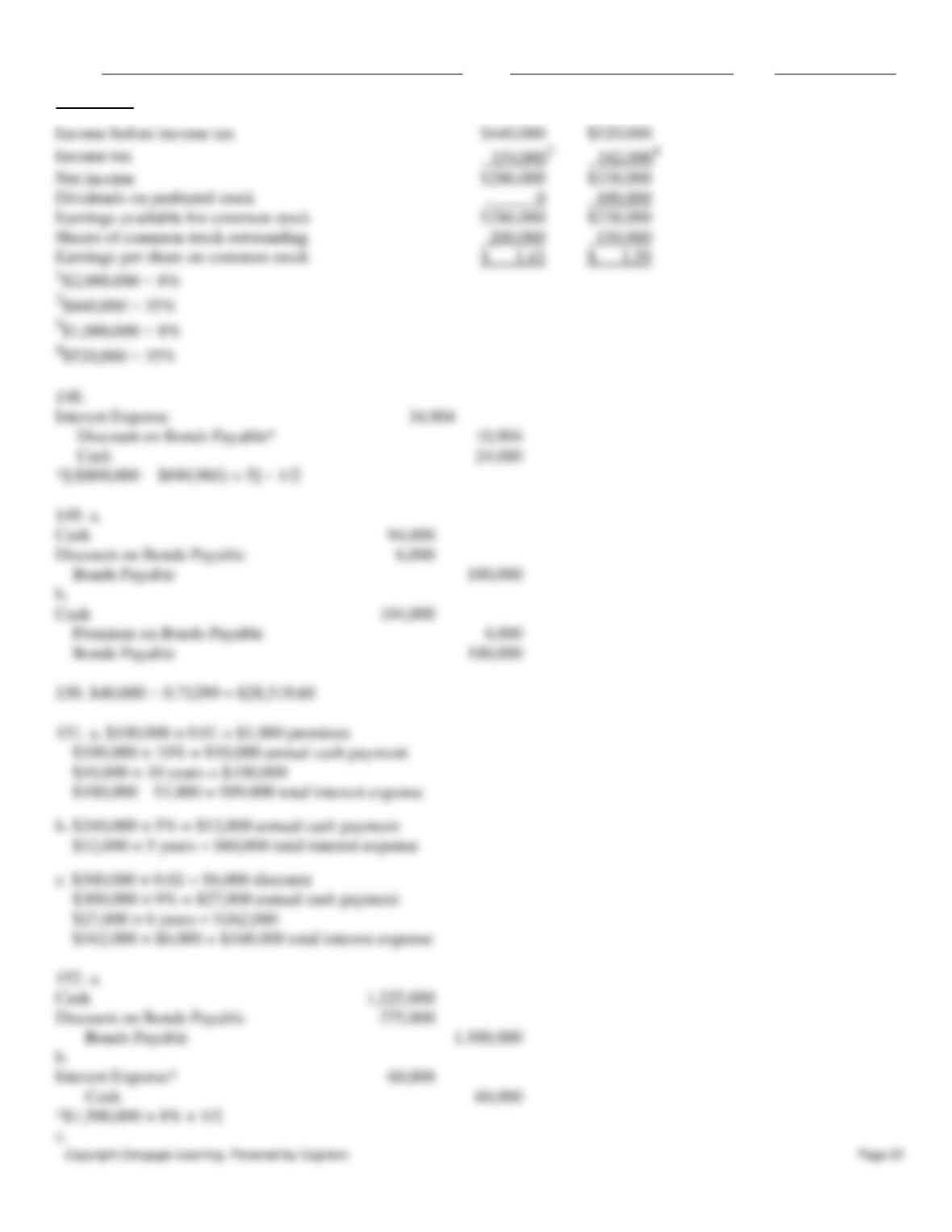
146. On the first day of the fiscal year, a company issues a $1,000,000, 7%, 5-year bond that pays semiannual interest of
$35,000 ($1,000,000 × 7% × 1/2), receiving cash of $884,171. Journalize the entry for the issuance of the bonds.
Name:
Class:
Date:
chapter 14
147. Ulmer Company is considering the following alternative financing plans:
Plan 1
Plan 2
Issue 8% bonds at face value
$2,000,000
$1,000,000
Issue preferred stock, $15 par
—
1,500,000
Issue common stock, $10 par
2,000,000
1,500,000
Income tax is estimated at 35% of income. Dividends of $1 per share were declared and paid on the preferred stock.
Determine the earnings per share of common stock, assuming income before bond interest and income tax is $600,000.
148. On the first day of the fiscal year, a company issues an $800,000, 6%, 5-year bond that pays semiannual interest of
$24,000 ($800,000 × 6% × 1/2), receiving cash of $690,960. Journalize the entry for the first interest payment and the
amortization of the related bond discount using the straight-line method.
149. Journalize the following selected bond transactions:
a. Issued $100,000 of 7%, 10-year bonds, receiving $94,000 in cash.
b. Issued $100,000 of 7%, 10-year bonds, receiving $104,000 in cash.
150. Using the following table, determine the present value of $40,000 to be received in 5 years, if the market rate is 7%
compounded annually?
Periods
5%
6%
7%
10%
1
0.95238
0.94340
0.93458
0.90909
2
0.90703
0.89000
0.87344
0.82645
3
0.86384
0.83962
0.81630
0.75131
4
0.82270
0.79209
0.76290
0.68301
5
0.78353
0.74726
0.71299
0.62092
6
0.74622
0.70496
0.66634
0.56447
7
0.71068
0.66506
0.62275
0.51316
8
0.67684
0.62741
0.58201
0.46651
9
0.64461
0.59190
0.54393
0.42410
10
0.61391
0.55839
0.50835
0.38554
151. Compute the total amount of interest expense over the life of the bonds for the following independent situations:
a. $100,000 face value, 10%, 10-year bonds issued at 101
b. $240,000 face value, 5%, 5-year bonds issued at 100
c. $300,000 face value, 9%, 6-year bonds issued at 98
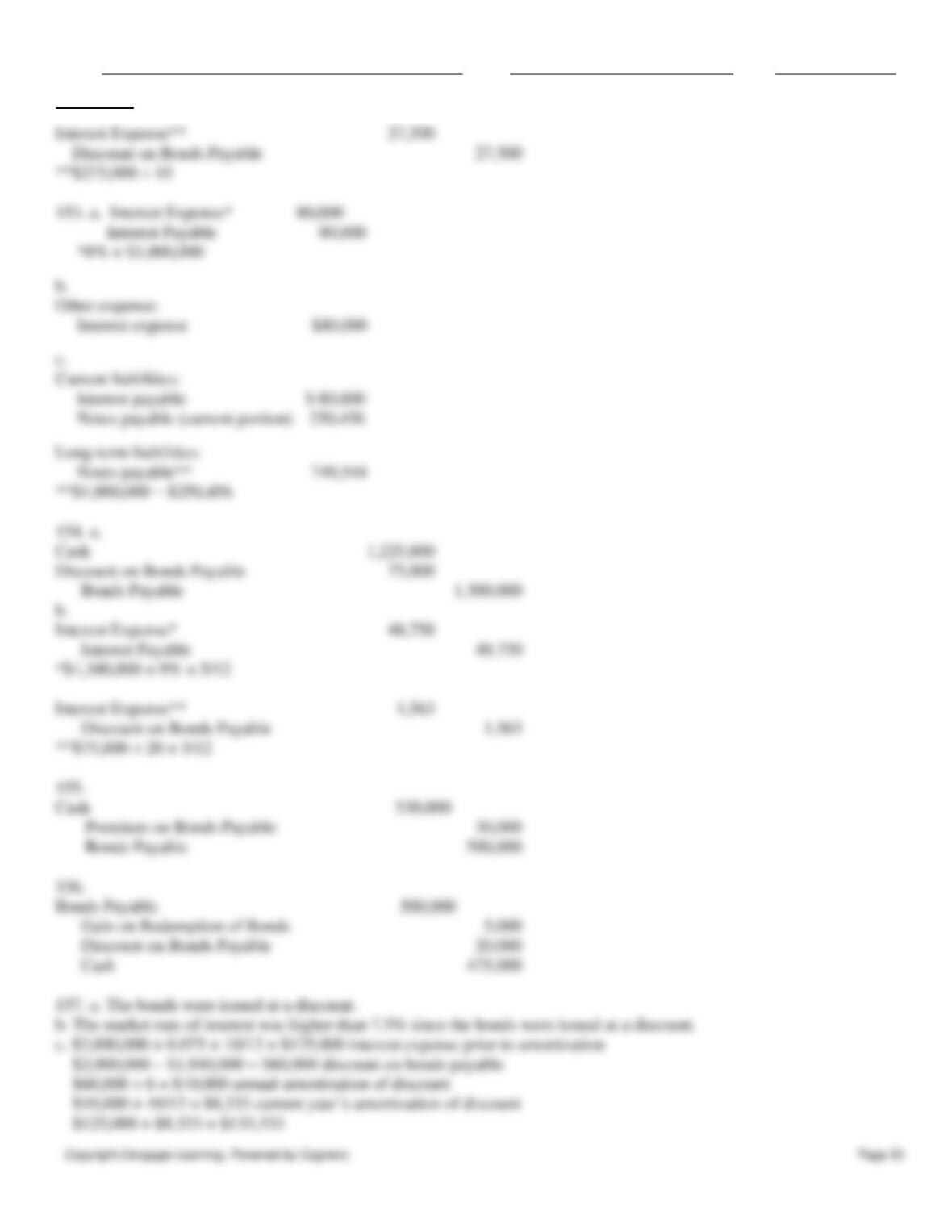
152. On the first day of the current fiscal year, $1,500,000 of 8%, 10-year bonds, with interest payable semiannually, were
issued for $1,225,000. Journalize the following transactions for the current fiscal year:
a.
Issuance of the bonds.
b.
First semiannual interest payment (record as a separate entry from discount amortization).
c.
Amortization of bond discount for the year, using the straight-line method of amortization.
153. On January 1, Luther Co. issued a $1,000,000, 8%, 5-year installment note payable. The first note payment consists
of $250,456 principal plus interest due on January 1 of the next year.
a. Journalize the adjusting entry at December 31 to accrue interest for the year.
b. Show the account(s) and amount(s) and where it(they) will appear on a multiple-step income statement prepared on

Name:
Class:
Date:
chapter 14
December 31.
c. Show the account(s) and amount(s) and where it(they) will appear on a classified balance sheet prepared on December
31.
154. On August 1, Clayton Co. issued $1,300,000 of 9%, 20-year bonds, dated August 1, for $1,225,000. Interest is
payable semiannually on February 1 and August 1. The fiscal year of the company is the calendar year. Journalize the
following transactions for the current year:
a.
Issuance of the bonds.
b.
Accrual of interest on December 31 and amortization of the bond discount for the first year using
the straight-line method (as separate entries). Round to the nearest dollar when necessary.
155. On the first day of the fiscal year, a company issues a $500,000, 8%, 10-year bond that pays semiannual interest of
$20,000 ($500,000 × 8% × 1/2), receiving cash of $530,000. Journalize the entry for the issuance of the bonds.
156. A $500,000 bond issue on which there is an unamortized discount of $20,000 is redeemed for $475,000. Journalize
the redemption of the bonds.
157. Glover Corporation issued $2,000,000 of 7.5%, 6-year bonds dated March 1, with semiannual interest payments on
September 1 and March 1. The bonds were issued on March 1 at 97. Glover’s year-end is December 31. If required, round
answers to the nearest whole amount.
a. Were the bonds issued at a premium, at a discount, or at face value?
b. Was the market rate of interest higher, lower, or the same as the contract rate of interest?
c. If the company uses the straight-line method of amortization, what is the amount of interest expense Glover
Corporation will show for the first year ended December 31?
d. What is the carrying value of the bonds on December 31?
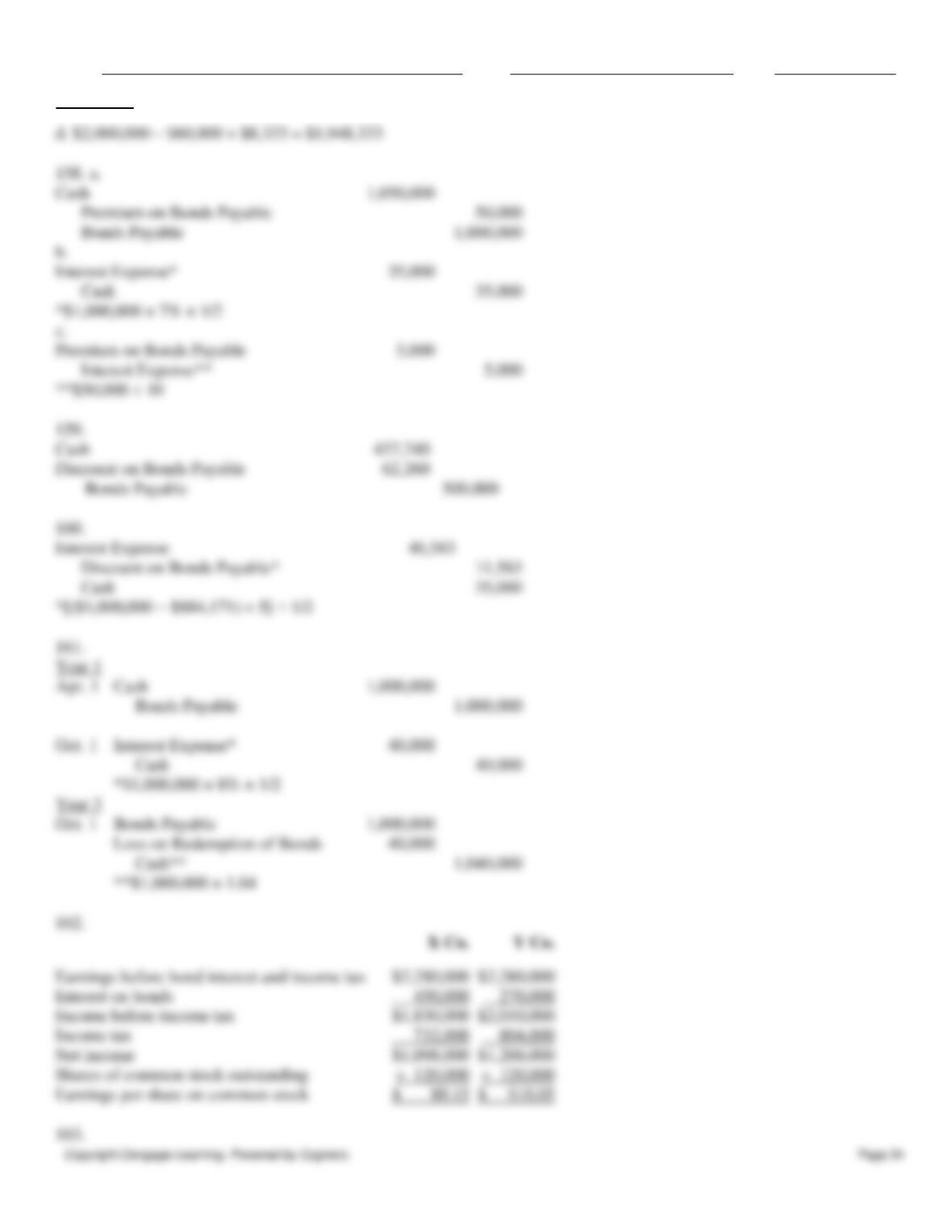
158. On the first day of the fiscal year, Lisbon Co. issued $1,000,000 of 7%, 10-year bonds for $1,050,000, with interest
payable semiannually. Journalize the following transactions for the current fiscal year:
a.
Issuance of the bonds.
b.
Second semiannual interest payment (record as a separate entry from the premium amortization).
c.
Amortization of bond premium for the first year, using the straight-line method.
159. On the first day of the fiscal year, a company issues a $500,000, 8%, 10-year bond that pays semiannual interest of
$20,000 ($500,000 × 8% × 1/2), receiving cash of $437,740. Journalize the entry for the issuance of the bonds.
160. On the first day of the fiscal year, a company issues a $1,000,000, 7%, 5-year bond that pays semiannual interest of
$35,000 ($1,000,000 × 7% × 1/2), receiving cash of $884,171. Journalize the first interest payment and the amortization
of the related bond discount using the straight-line method. Round answers to the nearest dollar.
161. A company issued $1,000,000 of 8%, 30-year callable bonds on April 1, with interest payable on April 1 and October
1. The fiscal year of the company is the calendar year. Journalize the entries for the following selected transactions:
Year 1
Apr. 1
Issued the bonds for cash at their face amount.
Oct. 1
Paid the interest on the bonds.
Year 3
Oct. 1
Called the bond issue at 104, the rate provided in the bond indenture. (Omit entry for
payment of interest.)

Name:
Class:
Date:
chapter 14
162. Two companies are financed as follows:
X Co.
Y Co.
Bonds payable, 9% issued at face
$5,000,000
$3,000,000
Common stock, $25 par
3,000,000
3,000,000
Income tax is estimated at 40% of income for both companies.
Determine for each company the earnings per share of common stock, assuming that the income before bond interest and
income taxes is $2,280,000 each.
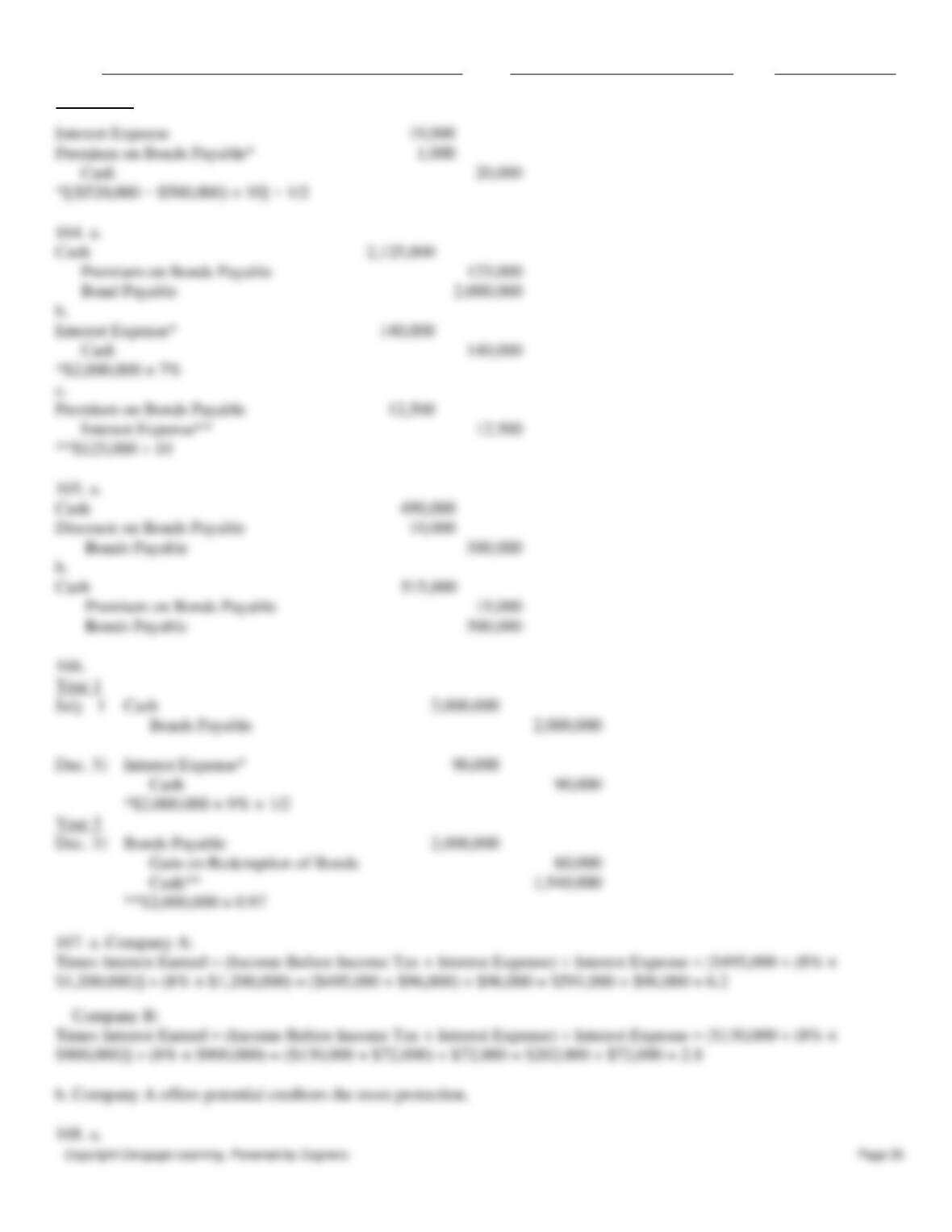
163. On the first day of the fiscal year, a company issues a $500,000, 8%, 10-year bond that pays semiannual interest of
$20,000 ($500,000 × 8% × 1/2), receiving cash of $520,000. Journalize the entry for the first interest payment and
amortization of premium using the straight-line method.
164. On the first day of the current fiscal year, $2,000,000 of 7%, 10-year bonds, with interest payable annually, were sold
for $2,125,000. Journalize the following transactions for the current fiscal year:
a.
Issuance of the bonds.
b.
First annual interest payment (record as a separate entry from premium amortization).
c.
Amortization of bond premium for the year, using the straight-line method of amortization.
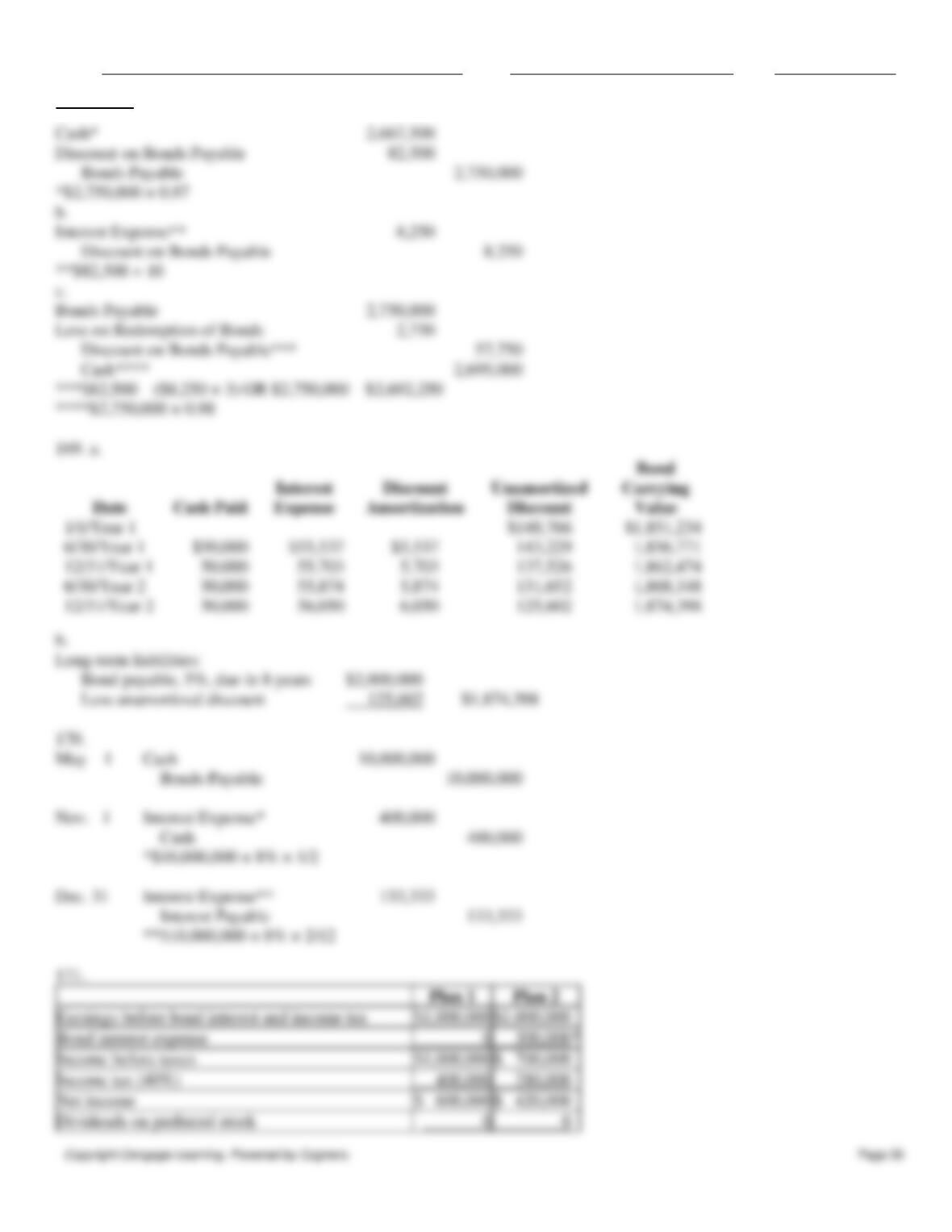
165. Journalize the entries for the following:
a. Issued a $500,000, 6%, 5-year bond, receiving cash of $490,000.
b. Issued a $500,000, 6%, 5-year bond, receiving cash of $515,000.
166. Luke Corp. issued $2,000,000 of 9%, 20-year callable bonds on July 1, Year 1, with interest payable on June 30 and
December 31. The fiscal year of the company is the calendar year. Journalize the entries for the following selected
transactions:
Year 1
July 1
Issued the bonds for cash at their face amount.
Dec. 31
Paid the interest on the bonds.
Year 5
Dec. 31
Called the bond issue at 97, the rate provided in the bond indenture. (Omit entry for
payment of interest.)
167. Balance sheet and income statement data indicate the following:
Company A
Company B
Bonds payable, 8% (issued 2000, due 2024)
$1,200,000
$900,000
Preferred 5% stock, $100 par (no change during year)
300,000
400,000
Common stock, $50 par (no change during year)
1,000,000
1,000,000
Income before income tax for year
495,000
130,000
Income tax for year
75,000
12,000
Common dividends paid
50,000
0
Preferred dividends paid
15,000
20,000
a.
For each company, what is the times interest earned ratio (round to one decimal place)?
b.
Which company gives potential creditors the most protection?

Name:
Class:
Date:
chapter 14
168. Journalize the following selected bond transactions:
a.
Issued $2,750,000 of 8%, 10–year bonds at 97.
b.
Amortized bond discount for a full year, using the straight-line method (as a separate entry
from the interest payment).
c.
At the end of the third year, called bonds at 98. The bonds were carried at $2,692,250 at the
time of the redemption.
169. On January 1, Year 1, Kennard Co. issued $2,000,000, 5%, 10-year bonds, with interest payable on June 30 and
December 31 to yield 6%. Use the following format and round figures to nearest dollar. The bonds were issued for
$1,851,234.
a. Prepare an amortization schedule for Year 1 and Year 2 using the effective interest rate method.
Interest
Discount
Unamortized
Bond
Date
Cash Paid
Expense
Amortization
Discount
Carrying Value
b. Show how this bond would be reported on the balance sheet at December 31, Year 2.
170. Brubeck Co. issued $10,000,000 of 8% 30-year bonds on May 1 of the current year, with interest payable on May 1
and November 1. The fiscal year of the company is the calendar year. Journalize the entries for the following selected
transactions for the current year:
May 1
Issued the bonds for cash at their face amount.
Nov. 1
Paid the interest on the bonds.
Dec. 31
Accrued interest for 2 months.
171. Sorenson Co. is considering the following alternative plans for financing the company:
Plan 1
Plan 2
Issue 10% bonds (at face)
—
$3,000,000
Issue $10 par common stock
$4,000,000
1,000,000
Income tax is estimated at 40% of income.
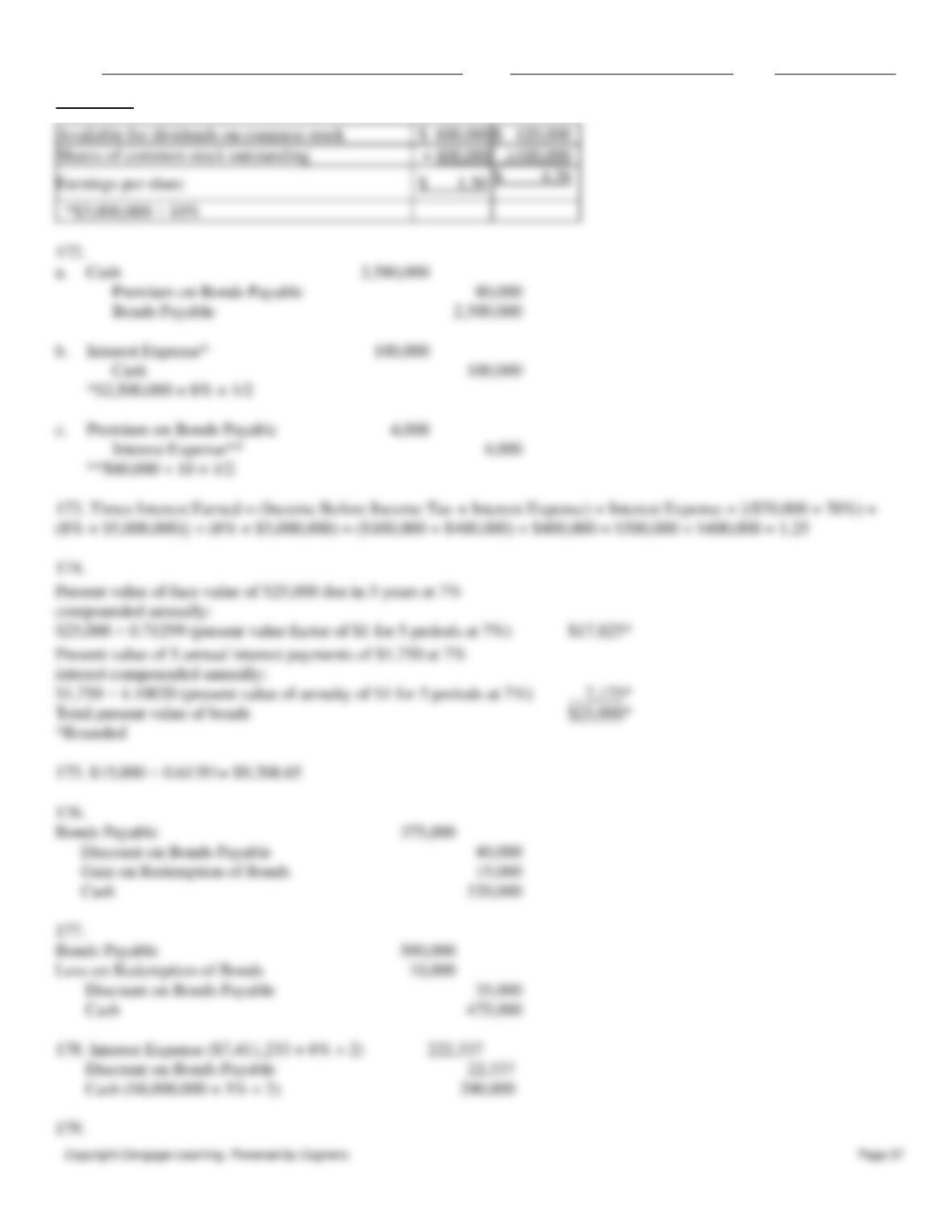
Determine the earnings per share of common stock under the two alternative financing plans, assuming income before
bond interest and income tax is $1,000,000.
172. On June 30, Jamison Company issued $2,500,000 of 8%, 10-year bonds, dated June 30, for $2,580,000. Journalize
the entries for the following transactions:
a.
Issuance of bonds.
b.
Payment of first semiannual interest on December 31 (record as a separate entry from the
premium amortization).
c.
Amortization by straight-line method of bond premium on December 31.
173. Given the following data, determine the times interest earned ratio.
Net income, $70,000
Bonds payable, issued at face value, 8%, $5,000,000
Preferred stock, $50 par value, 6%, 10,000 shares issued and outstanding
Tax rate is 30%.
Name:
Class:
Date:
chapter 14
174. Use the following tables to compute the present value of a $25,000, 7%, 5-year bond that pays $1,750 ($25,000 ×
7%) interest annually, if the market rate of interest is 7%.
Present Value of $1 at Compound Interest
Periods
5%
6%
7%
10%
1
0.95238
0.94340
0.93458
0.90909
2
0.90703
0.89000
0.87344
0.82645
3
0.86384
0.83962
0.81630
0.75131
4
0.82270
0.79209
0.76290
0.68301
5
0.78353
0.74726
0.71299
0.62092
6
0.74622
0.70496
0.66634
0.56447
7
0.71068
0.66506
0.62275
0.51316
8
0.67684
0.62741
0.58201
0.46651
9
0.64461
0.59190
0.54393
0.42410
10
0.61391
0.55839
0.50835
0.38554
Present Value of Annuity of $1 at Compound Interest
Periods
5%
6%
7%
10%
1
0.95238
0.94340
0.93458
0.90909
2
1.85941
1.83339
1.80802
1.73554
3
2.72325
2.67301
2.62432
2.48685
4
3.54595
3.46511
3.38721
3.16987
5
4.32948
4.21236
4.10020
3.79079
6
5.07569
4.91732
4.76654
4.35526
7
5.78637
5.58238
5.38929
4.86842
8
6.46321
6.20979
5.97130
5.33493
9
7.10782
6.80169
6.51523
5.75902
10
7.72173
7.36009
7.02358
6.14457
175. Using the following table, determine the present value of $15,000 to be received in 10 years, if the market rate is 5%
compounded annually.
Periods
5%
6%
7%
10%
1
0.95238
0.94340
0.93458
0.90909
2
0.90703
0.89000
0.87344
0.82645
3
0.86384
0.83962
0.81630
0.75131
4
0.82270
0.79209
0.76290
0.68301
5
0.78353
0.74726
0.71299
0.62092
6
0.74622
0.70496
0.66634
0.56447
7
0.71068
0.66506
0.62275
0.51316
8
0.67684
0.62741
0.58201
0.46651
9
0.64461
0.59190
0.54393
0.42410
10
0.61391
0.55839
0.50835
0.38554
176. A $375,000 bond issue on which there is an unamortized discount of $40,000 is redeemed for $320,000. Journalize
the redemption of the bonds.
177. A $500,000 bond issue on which there is an unamortized discount of $35,000 is redeemed for $475,000. Journalize
the redemption of the bonds.

Name:
Class:
Date:
chapter 14
178. Given the following data, journalize the entry for interest expense and any related amortization on July 1 of the first
year using the effective interest rate method. The bonds were issued on January 1 for $7,411,233.
Bonds payable, maturing in 10 years = $8,000,000
Contract interest rate = 5%
Market (effective) interest rate = 6%
Round answers to nearest dollar.
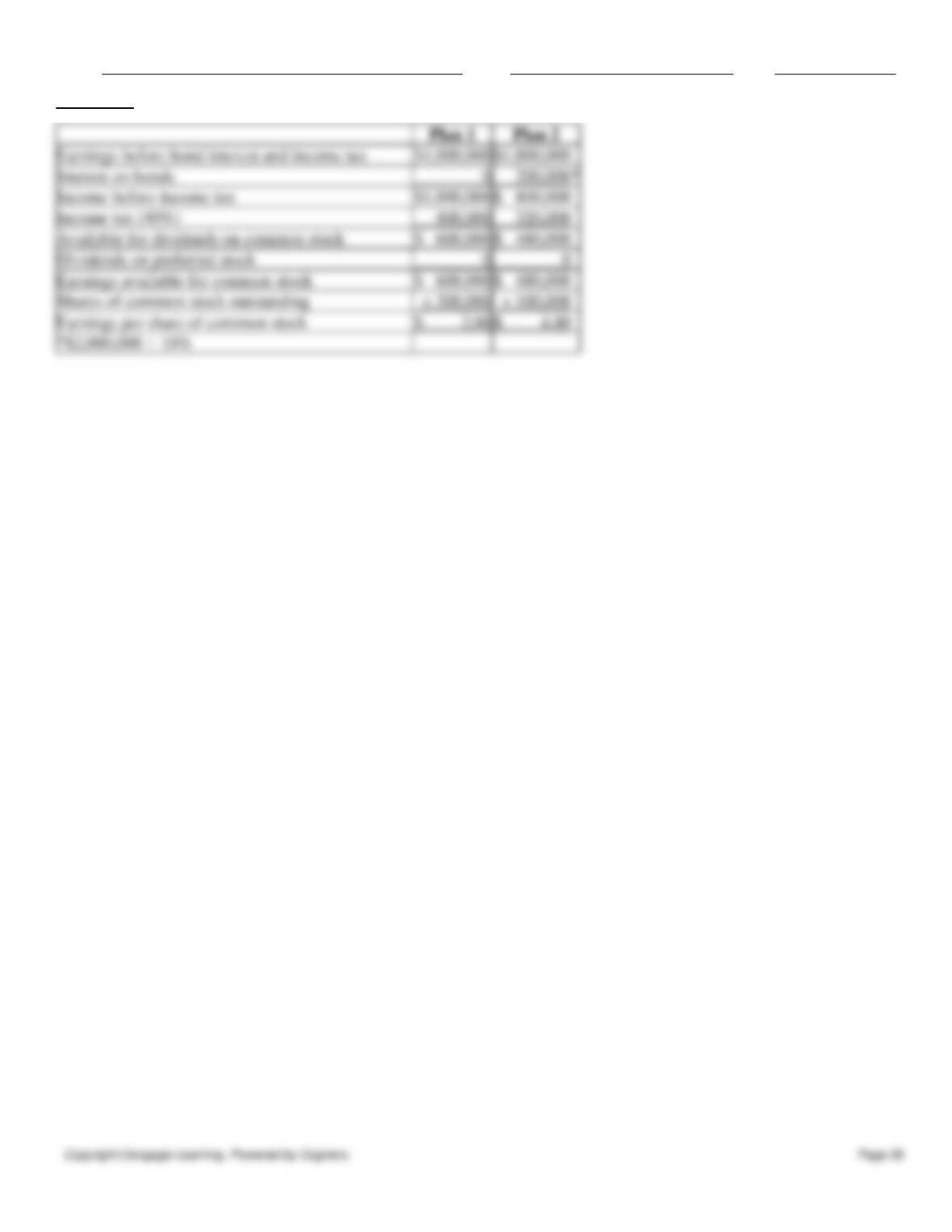
179. Jenson Co. is considering the following alternative plans for financing the company:
Plan 1
Plan 2
Issue 10% bonds (at face)
—
$2,000,000
Issue $10 common stock
$3,000,000
1,000,000
Income tax is estimated at 40% of income.
Determine the earnings per share of common stock under the two alternative financing plans, assuming income before
bond interest and income tax is $1,000,000.
Name:
Class:
Date:
chapter 14
Answer Key
Name:
Class:
Date:
chapter 14
Name:
Class:
Date:
chapter 14
Name:
Class:
Date:
chapter 14
Name:
Class:
Date:
chapter 14
Name:
Class:
Date:
chapter 14
Name:
Class:
Date:
chapter 14
Name:
Class:
Date:
chapter 14
Name:
Class:
Date:
chapter 14
Name:
Class:
Date:
chapter 14
Name:
Class:
Date:
chapter 14
Name:
Class:
Date:
chapter 14
Name:
Class:
Date:
chapter 14