Chapter 14 – Decision Making: Relevant Costs and Benefits
Solution:
14–58
94. St. Luke’s Hospital has been hit with a number of complaints about its food service from
patients, employees, and cafeteria customers. These complaints, coupled with a very tight
local labor market, have prompted the organization to contact Nationwide Institutional Food
Service (NIFS) about the possibility of an outsourcing arrangement.
The hospital’s business office has provided the following information for food service for the
year just ended: food costs, $890,000; labor, $85,000; variable overhead, $35,000; allocated
fixed overhead, $60,000; and cafeteria net income, $80,000.
Conversations with NIFS personnel revealed the following information:
· NIFS will charge St. Luke’s Hospital $14 per day for each patient served. Note: This figure
has been “marked up” by NIFS to reflect the firm’s cost of operating the hospital cafeteria.
· St. Luke’s 250-bed facility operates throughout the year and typically has an average
occupancy rate of 70%.
· Labor is the primary driver for variable overhead. If an outsourcing agreement is reached,
hospital labor costs will drop by 90%. NIFS plans to use St. Luke’s facilities for meal
preparation.
· Cafeteria net income is expected to increase by 15% because NIFS will offer an improved
menu selection.
Required:
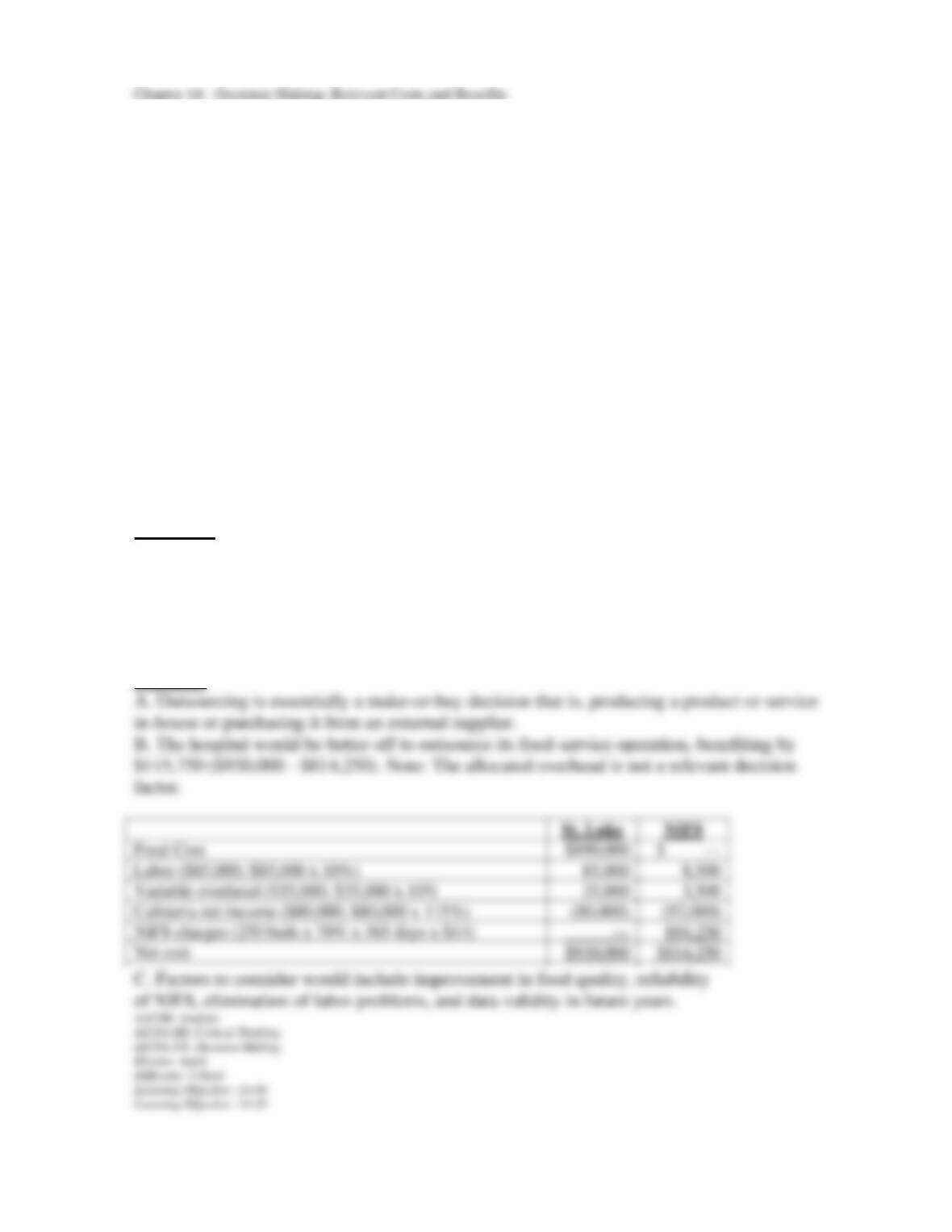
A. What is meant by the term “outsourcing”?
B. Should St. Luke’s outsource its food-service operation to NIFS?
C. What factors, other than dollars, should St. Luke’s consider before making the final
decision?
Solution:
14–59
95. Mama Louise’s Pizza store no. 16 has fallen on hard times and is about to be closed. The
following figures are available for the period just ended:
Sales
$205,000
Cost of sales
67,900
Building occupancy costs:
Rent
36,500
Utilities
15,000
Supplies used
5,600
Wages
77,700
Miscellaneous
2,400
Allocated corporate overhead
16,800
All employees except the store manager would be discharged. The manager, who earns
$27,000 annually, would be transferred to store no. 19 in a neighboring suburb. Additionally,
no. 16’s furnishings and equipment are fully depreciated and would be removed and
transported to Mama Louise’s warehouse at a cost of $2,800.
Required:
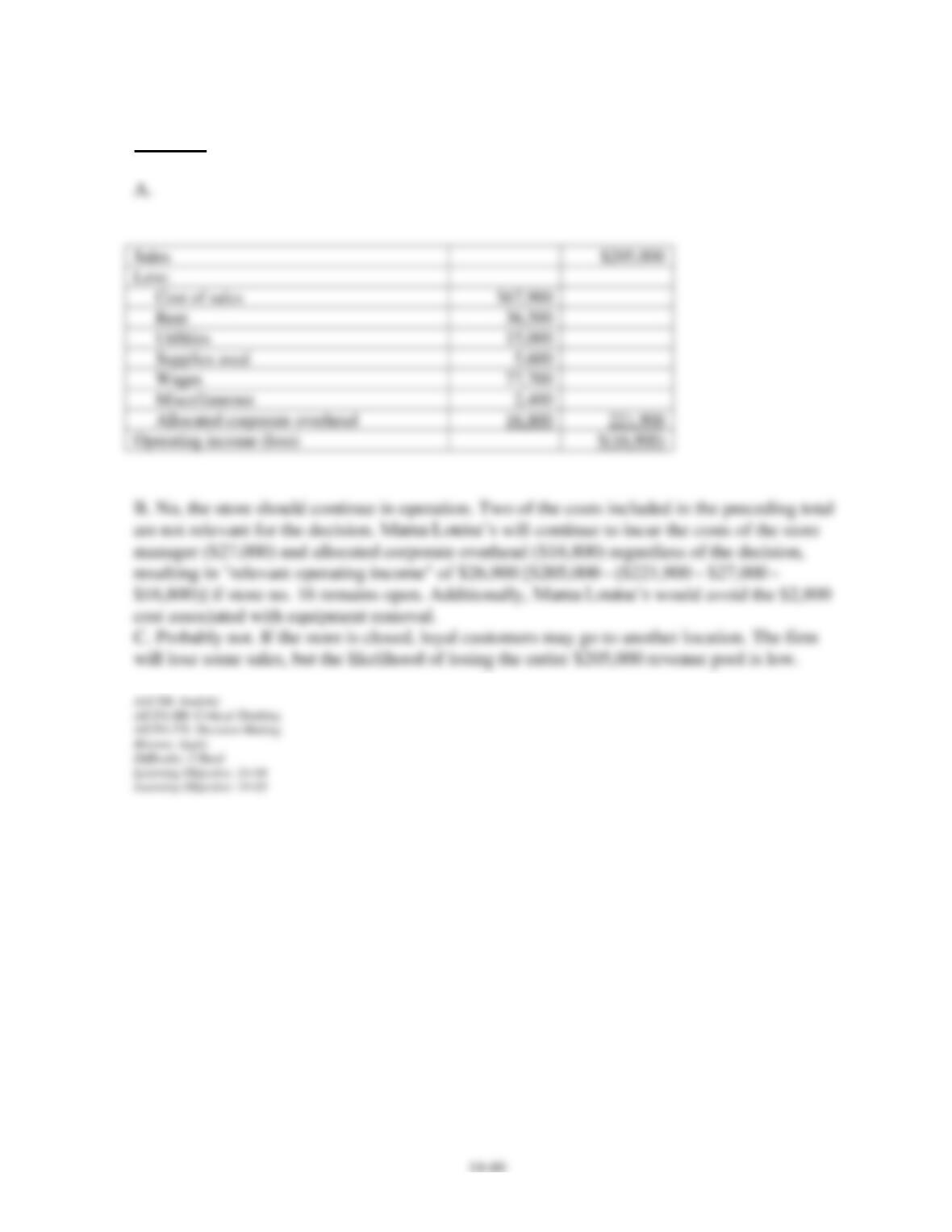
A. What is store no. 16’s reported loss for the period just ended?
B. Should the store be closed? Why?
C. Would Mama Louise’s likely lose all $205,000 of sales revenue if store no. 16 were
closed? Explain.
Chapter 14 – Decision Making: Relevant Costs and Benefits
Solution:
14–61
96. “It’s close to a $40,000 loser and we ought to devote our efforts elsewhere,” noted Cindy
Mires, after reviewing financial reports of her company’s attempt to offer a reduced-price
daycare service to employees. The daycare’s financial figures for the year just ended follow.
Revenues
$120,000
Variable costs
45,000
Traceable fixed costs
89,000
Allocated corporate overhead
24,000
If the daycare service/center is closed, 70% of the traceable fixed cost will be avoided. In
addition, the company will incur one-time closure costs of $6,800.
Required:
A. Show calculations that support Mires’ belief that the daycare center lost almost $40,000.
B. Should the center be closed? Show calculations to support your answer.
C. What problem might the company experience if the center is closed?
97. Second Time Around sells clothing, shoes, and accessories at a suburban location near
Dallas. Information for the just concluded calendar year follows.
Clothing
Shoes
Accessories
Sales
$850,000
$320,000
$150,000
Less: Variable costs
$510,000
$270,000
$82,500
Fixed costs
290,000
70,000
42,000
Total costs
$800,000
$340,000
$124,500
Operating income (loss)
$50,000
$(20,000)
$25,500
Management is considering closing the shoe operation because of the loss and
expanding the space that is currently devoted to accessories sales. A salaried salesperson
in the shoe department who earns $45,000 will be terminated; however, all other
departmental fixed costs will continue to be incurred. Second Time Around will spend
$16,000 on remodeling costs and anticipates that accessories sales will increase by
$70,000. This additional sales revenue is expected to generate a 35% contribution
margin for the firm. Finally, because clothing customers often purchased shoes and feel
strongly about “one-stop shopping,” clothing sales are expected to fall by 15% if the
shoe department is closed.
Required:
Determine whether the shoe department should be closed.
14–64
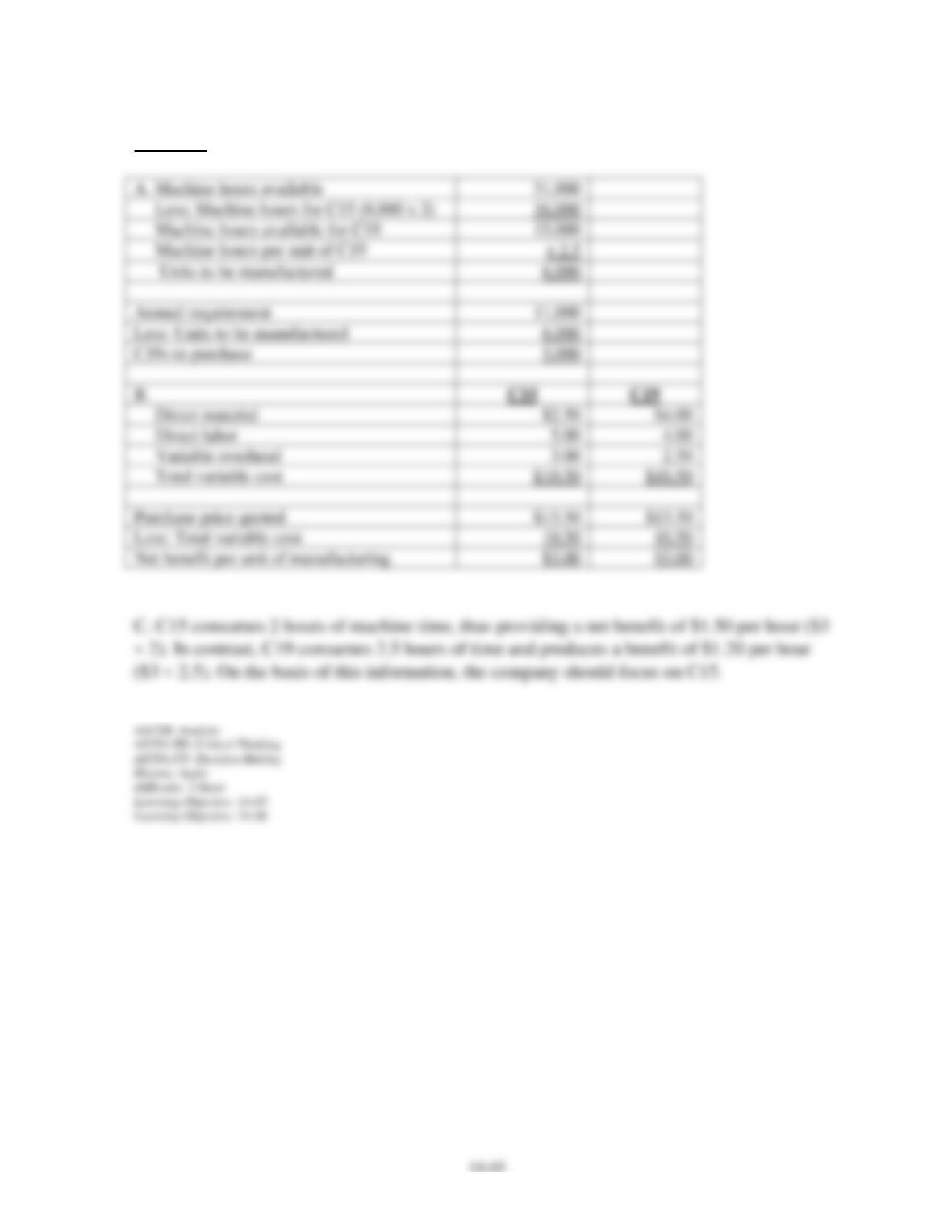
98. Tyson Corner Manufacturing produces two bearings: C15 and C19. Data regarding these
two bearings follow.
C15
C19
Machine hours required per unit
2.00
2.50
Standard cost per unit
Direct material
$2.50
$4.00
Direct labor
5.00
4.00
Manufacturing overhead:
Variable*
3.00
2.50
Fixed**
4.00
5.00
Total
$14.50
$15.50
* Applied on the basis of direct labor hours
** Applied on the basis of machine hours
The company requires 8,000 units of C15 and 11,000 units of C19. Recently, management
decided to devote additional machine time to other product lines, resulting in only 31,000
machine hours per year that can be dedicated to production of the bearings. An outside
company has offered to sell Tyson Corner the bearings at prices of $13.50 for C15 and $13.50
for C19.
Required:
A. Assume that Tyson Corner decided to produce all C15s and purchase C19s only as needed.
Determine the number of C19s to be purchased.
B. Compute the net benefit to the company of manufacturing (rather than purchasing) a unit
of C15. Repeat the calculation for a unit of C19. (Note: in answering this question, do not take
into consideration any machine hours constraint).
C. Tyson Corner lacks sufficient machine time to produce all of the C15s and C19s needed.
Which component (C15 or C19) should Tyson Corner manufacture first with the limited
machine hours available? Why? Be sure to show all supporting computations.
Chapter 14 – Decision Making: Relevant Costs and Benefits
Solution:
14–66
99. Ooo-La–La Company has met all production requirements for the current month and has
an opportunity to manufacture additional units with its excess capacity. Unit selling prices and
unit costs for three product lines follow.
Plain
Regular
Super
Selling price
$40
$55
$65
Direct material
12
16
22
Direct labor (at $20 per hour)
10
15
20
Variable overhead
8
12
16
Fixed overhead
6
7
8
Variable overhead is applied on the basis of direct labor dollars, whereas fixed overhead is
applied on the basis of machine hours. There is sufficient demand for the additional
manufacture of all products.
Required:
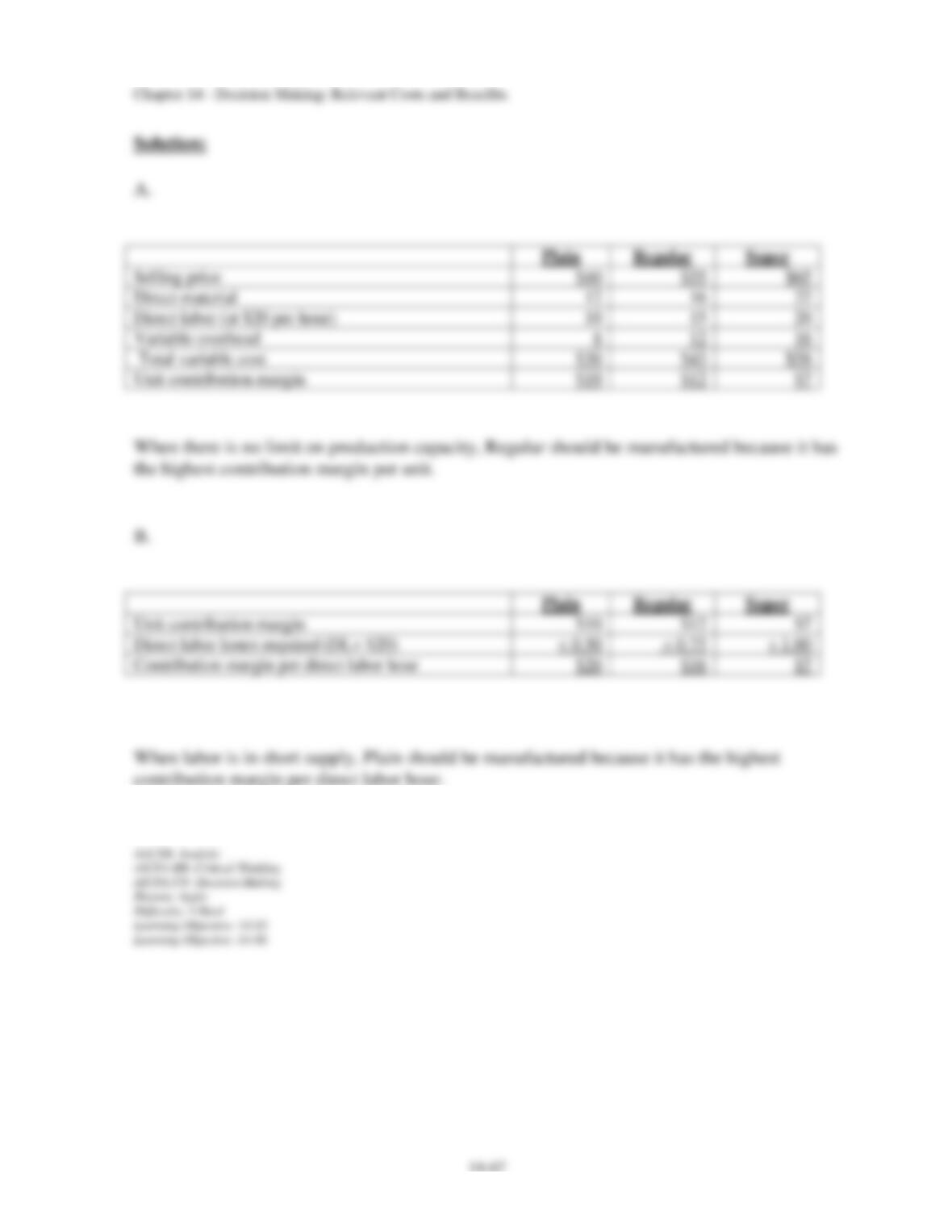
A. If Ooo-La–La has excess machine capacity and can add more labor as needed (i.e., neither
machine capacity nor labor is a constraint), which product is the most attractive to produce?
B. If Ooo-La–La has excess machine capacity but a limited amount of labor time available,
which product or products should be manufactured in the excess capacity?
100. Townson Company manufactures G and H in a joint process. The joint costs amount to
$80,000 per batch of finished goods. Each batch yields 20,000 liters, of which 40% are G and
60% are H. The selling price of G is $8.75 per liter, and the selling price of H is $15.00 per
liter.
Required:
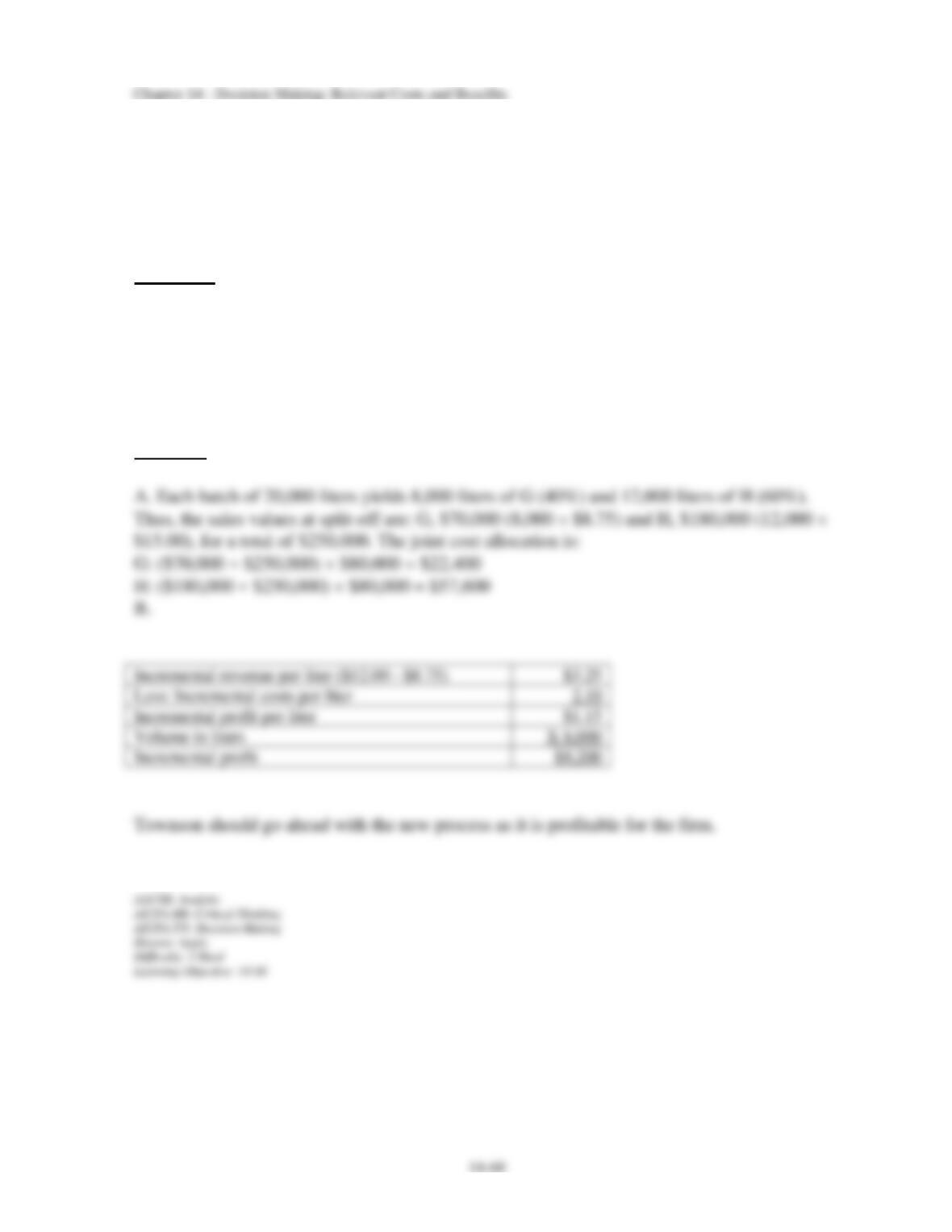
A. If the joint costs are allocated on the basis of the products’ sales value at the split-off point,
what amount of joint cost will be charged to each product?
B. Townson has discovered a new process by which G can be refined into Product GG, which
has a sales price of $12 per liter. This additional processing would increase costs by $2.10 per
liter. Assuming there are no other changes in costs, should the company use the new process?
Show calculations.
Solution:
101. Dixie Highway Corporation manufactures products J, K, and L in a joint process. The
company incurred $480,000 of joint processing costs during the period just ended and had the
following data that related to production:
Sales values and Additional cost if
Processed Beyond Split-off
Product
Sales Value at Split-off
Sales Value
Additional cost
J
$400,000
$550,000
$130,000
K
350,000
540,000
240,000
L
850,000
975,000
118,000
An analysis revealed that all costs incurred after the split-off point are variable and
directly traceable to the individual product line.
Required:
A. If Dixie Highway allocates joint costs on the basis of the products’ sales values at the
split-off point, what amount of joint cost would be allocated to product J?
B. If production of J totaled 50,000 gallons for the period, determine the relevant cost per
gallon that should be used in decisions that explore whether to sell at the split-off point or
process further? Briefly explain your answer.
C. At the beginning of the current year, Dixie Highway decided to process all three
products beyond the split-off point. If the company desired to maximize income, did it err
in regards to its decision with product J? Product K? Product L? By how much?
Solution:
14–70
102. Information is said to be useful in decision making if it possesses three characteristics.
Required:
A. List the three characteristics of useful information.
B. Frequently, there is a conflict between two of the characteristics requested in part “A.”
Briefly explain what this conflict is.
C. What distinguishes relevant from irrelevant information?
Solution:
103. Sunk costs and opportunity costs are inherent in decision making.
Required:
A. Define the terms “sunk cost” and “opportunity cost.”
B. How are sunk costs treated when making decisions?
C. “Information about sunk costs can be found in the financial statements and accounting
records; however, information about opportunity costs is omitted.” Do you agree with this
statement? Explain.
104. Capacity restrictions often change the way that managers make decisions. For example,
consider a retailer that has limited square footage in its store. What guideline should be used
in deciding which new products to carry? How would this differ, say, from a concert promoter
that desires to bring a rock group to an arena-type facility?
Solution: