Chapter 14 – Decision Making: Relevant Costs and Benefits
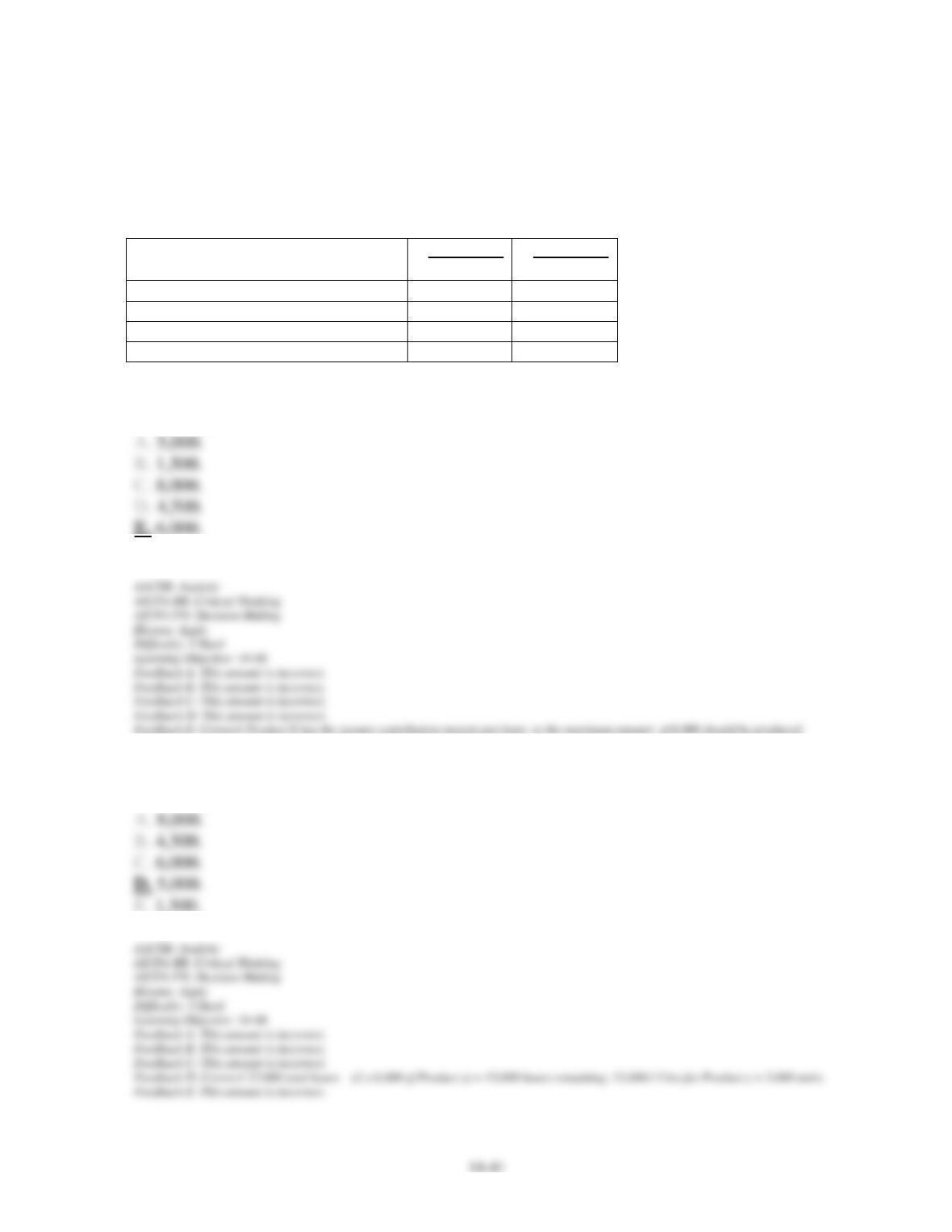
Use this information to answer Questions 74-76.
Kingston Manufacturing has 27,000 labor hours available for producing X and Y. Consider
the following information:
Product X
Product Y
Required labor time per unit (hours)
2
3
Maximum demand (units)
6,000
8,000
Contribution margin per unit
$5
$6
Contribution margin per labor hour
$2.50
$2
74. If Kingston follows proper managerial accounting practices, how many units of Product X
should it produce?
75. If Kingston follows proper managerial accounting practices, how many units of Product Y
should it produce?
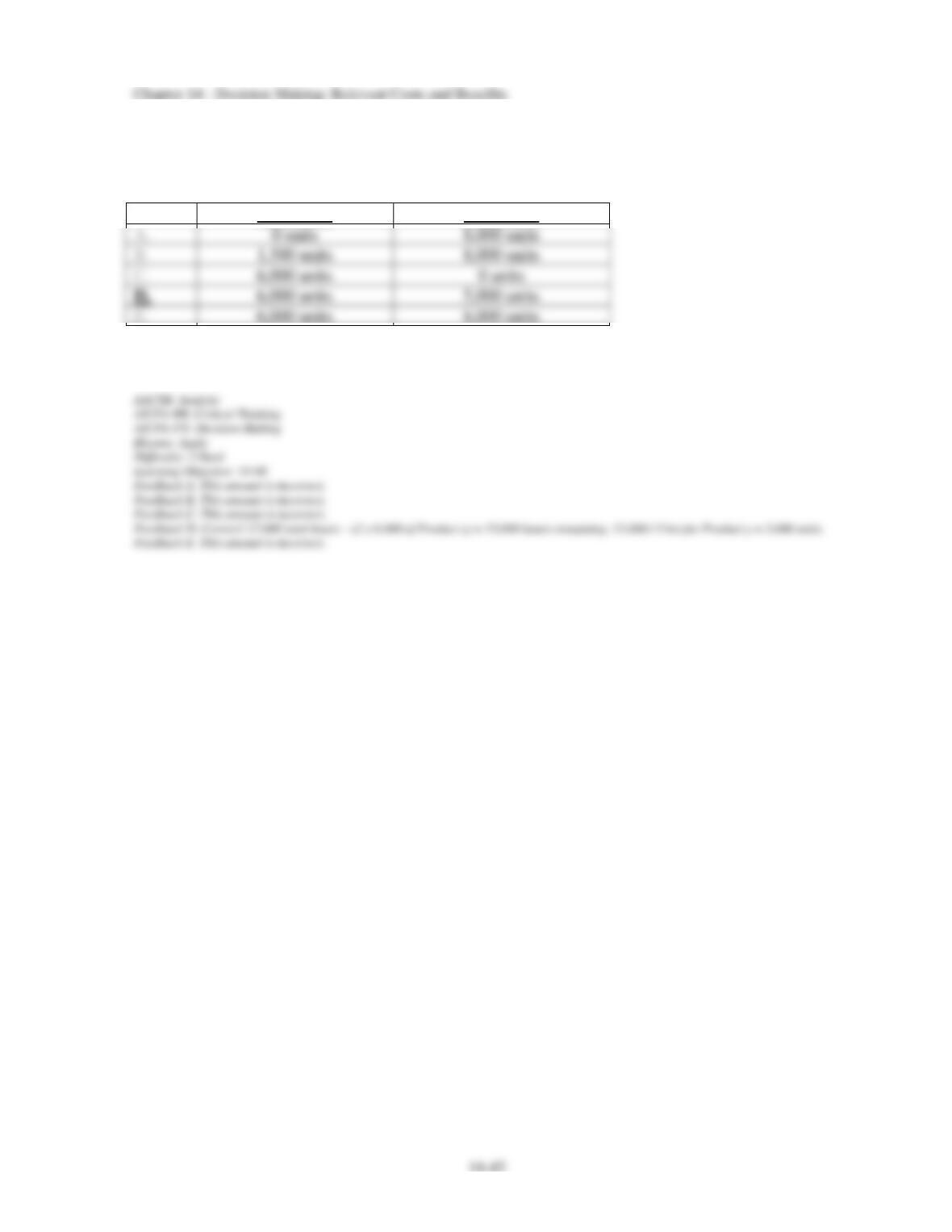
76. If Kingston follows proper managerial accounting practices, which of the following
production schedules should the company set?
Product X
Product Y
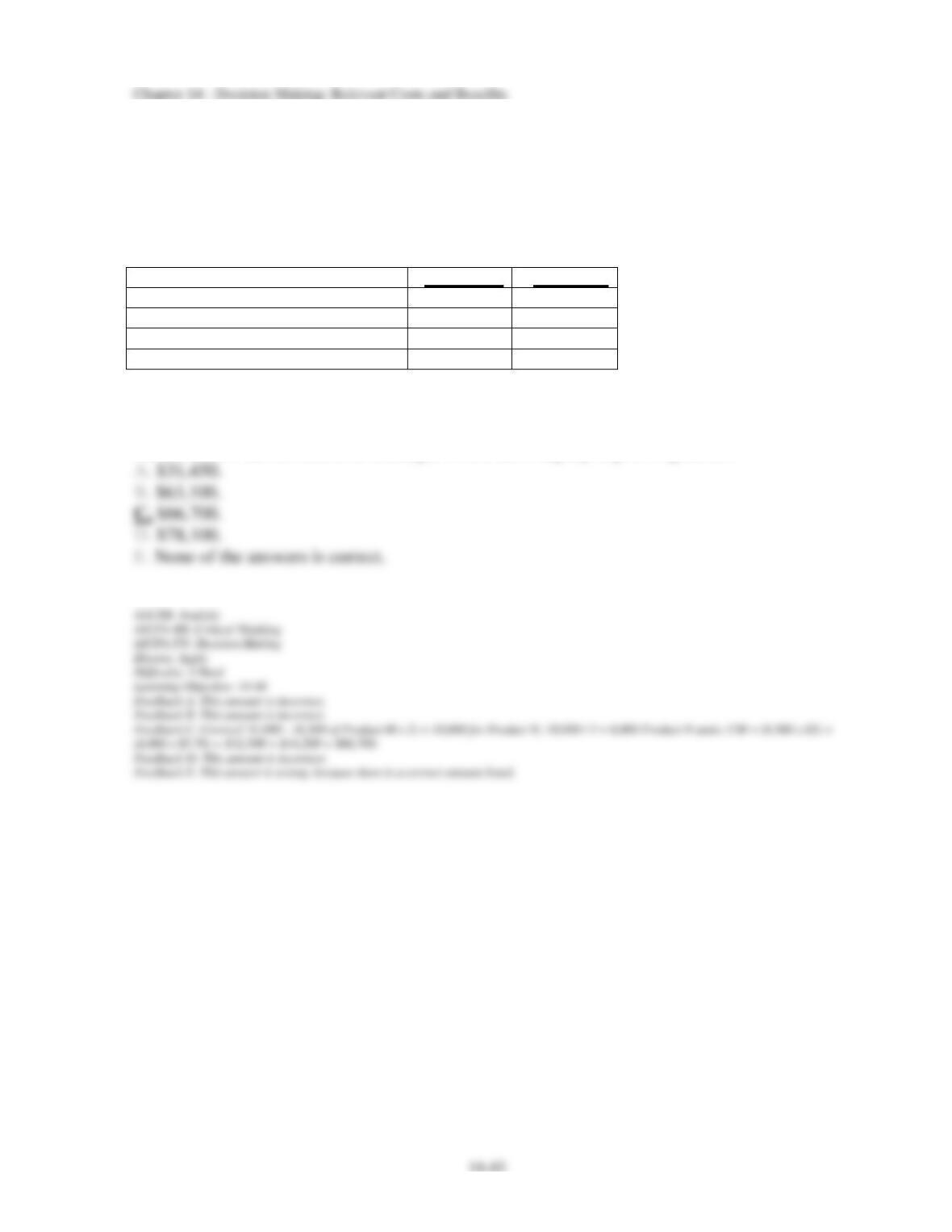
77. Newton Manufacturing has 31,000 labor hours available for producing M and N. Consider
the following information:
Product M
Product N
Required labor time per unit (hours)
2
3
Maximum demand (units)
6,500
8,000
Contribution margin per unit
$5
$5.70
Contribution margin per labor hour
$2.50
$1.90
If Newton follows proper managerial accounting practices in terms of setting a production
schedule, how much contribution margin would the company expect to generate?
Chapter 14 – Decision Making: Relevant Costs and Benefits
Use the following information to answer Questions 78-79.
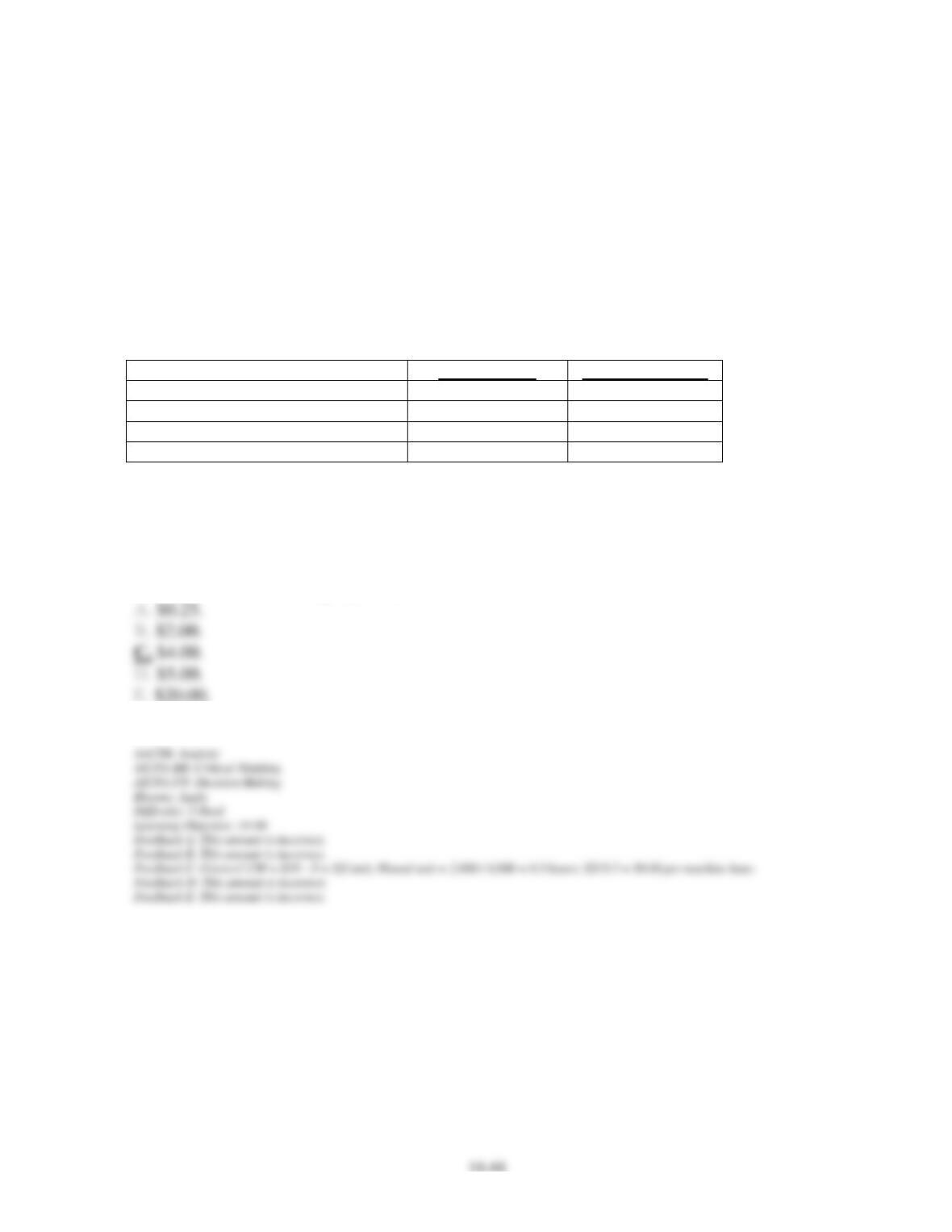
Jayleen Company makes two products: Carpet Kleen and Floor Deodorizer. Operating
information from the previous year follows.
Carpet Kleen
Floor Deodorizer
Units produced and sold
5,000
4,000
Machine hours used
5,000
2,000
Sales price per unit
$7
$10
Variable cost per unit
$4
$8
Fixed costs of $20,000 per year are presently allocated equally between both products. If the
product mix were to change, total fixed costs would remain the same.
78. The contribution margin per machine hour for Floor Deodorizer is:
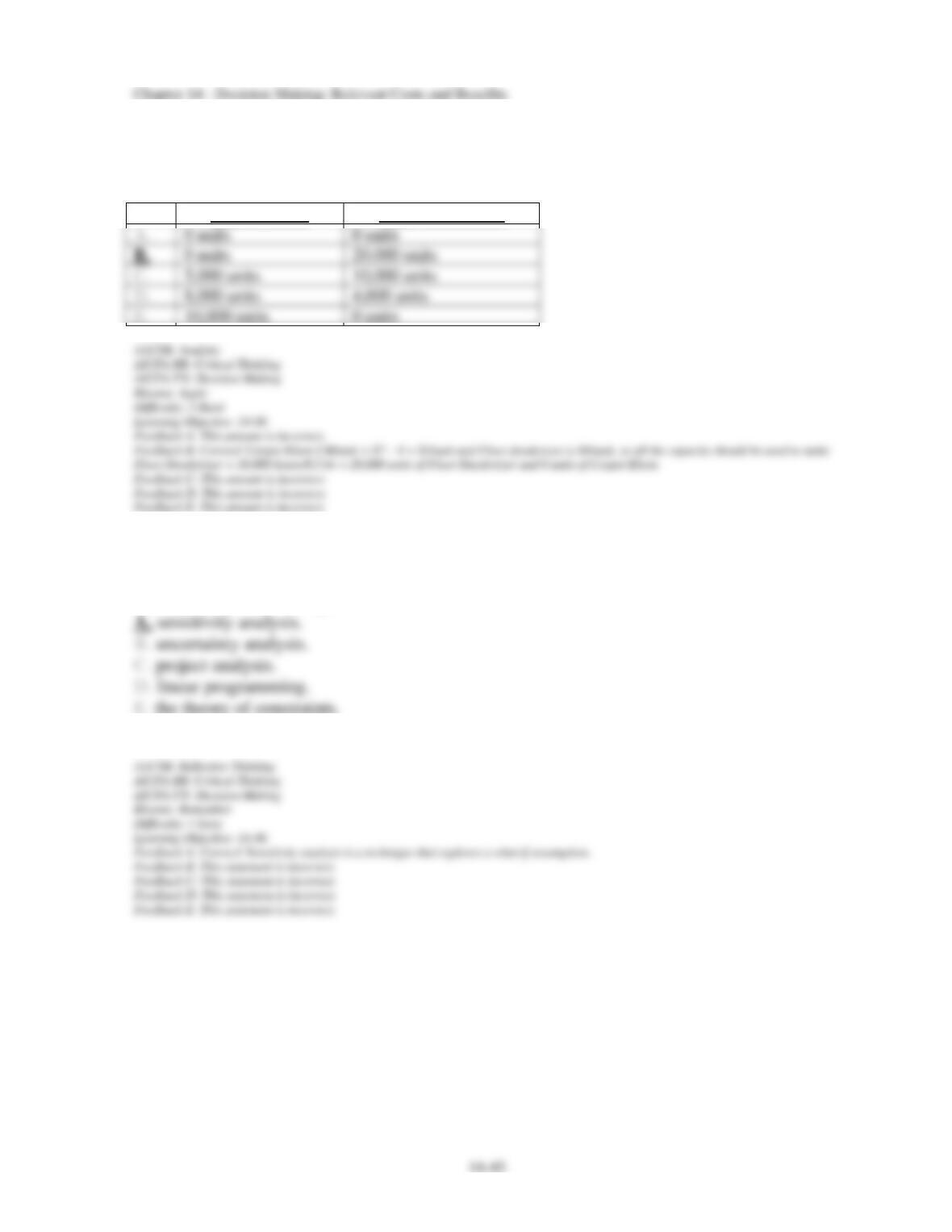
79. Assuming there is unlimited demand for both products and Jayleen has 10,000 machine
hours available, how many units of each product should be produced and sold?
Carpet Kleen
Floor Deodorizer
0 units
20,000 units
8,000 units
4,000 units
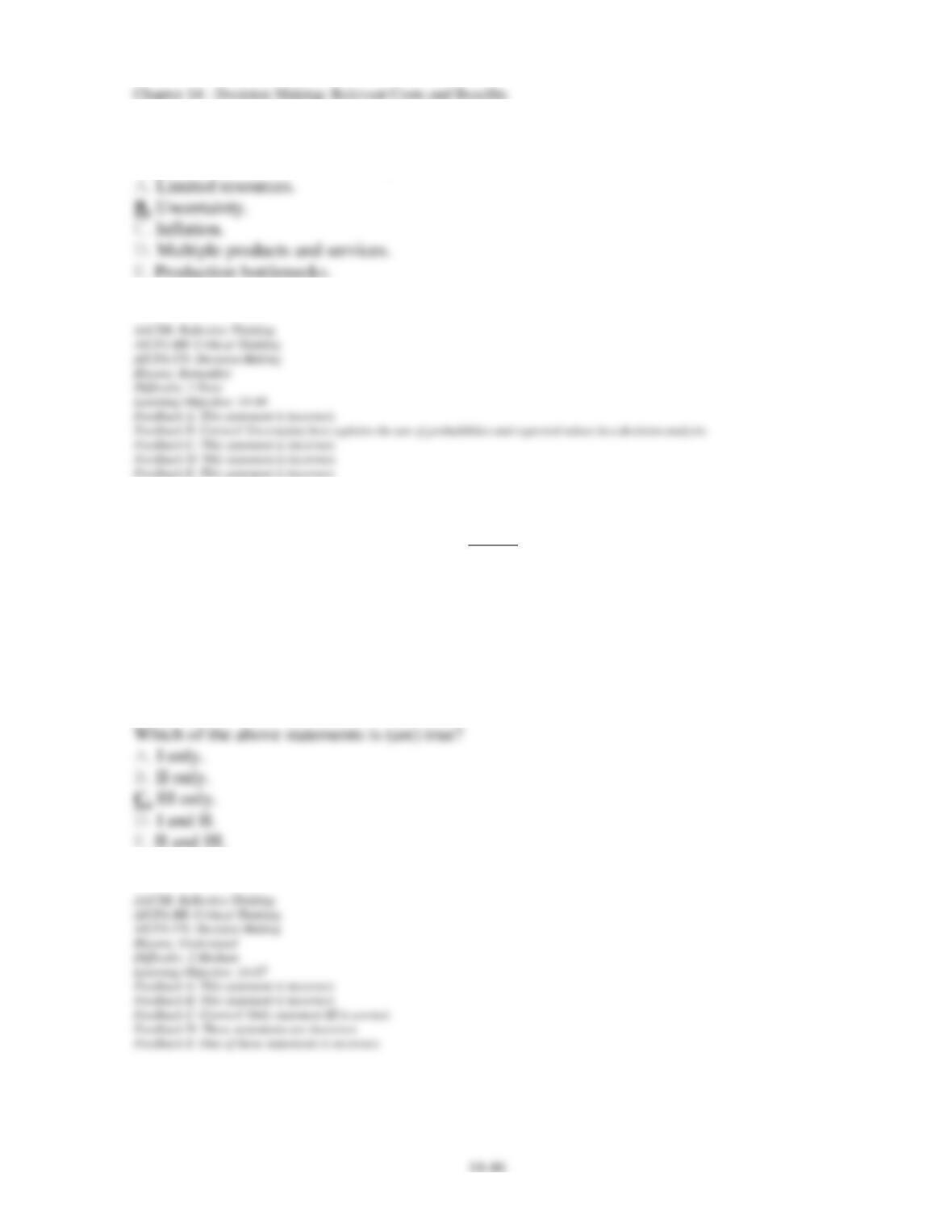
80. A technique that is useful in exploring what would happen if a key decision prediction or
assumption proved wrong is termed:
81. Which of the following characteristics would best explain the use of probabilities and
expected values in a decision analysis?
82. Consider the following statements about relevant costing and activity-based costing:
I. The concept of relevant costs and benefits cannot be used in conjunction with an activity-
based costing system.
II. The concept of relevant costs and benefits must be modified for use with an activity-based
costing system.
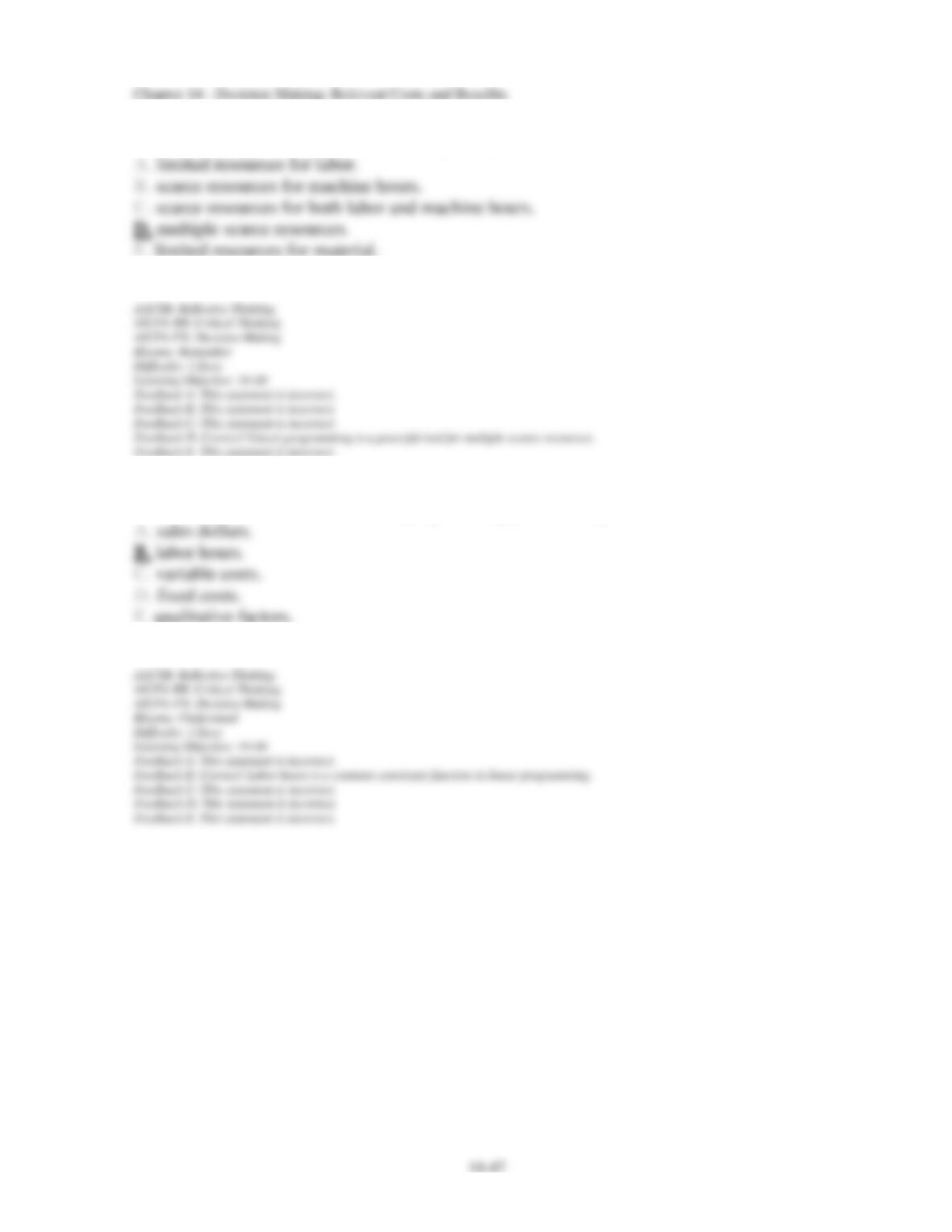
III. Generally speaking, the decision maker can better associate relevant costs with the
activities that drive them under an activity-based costing system than under a conventional
product-costing system.
83. Linear programming would be used by decision makers when there are:
84. A constraint function in a linear-programming problem might focus on:
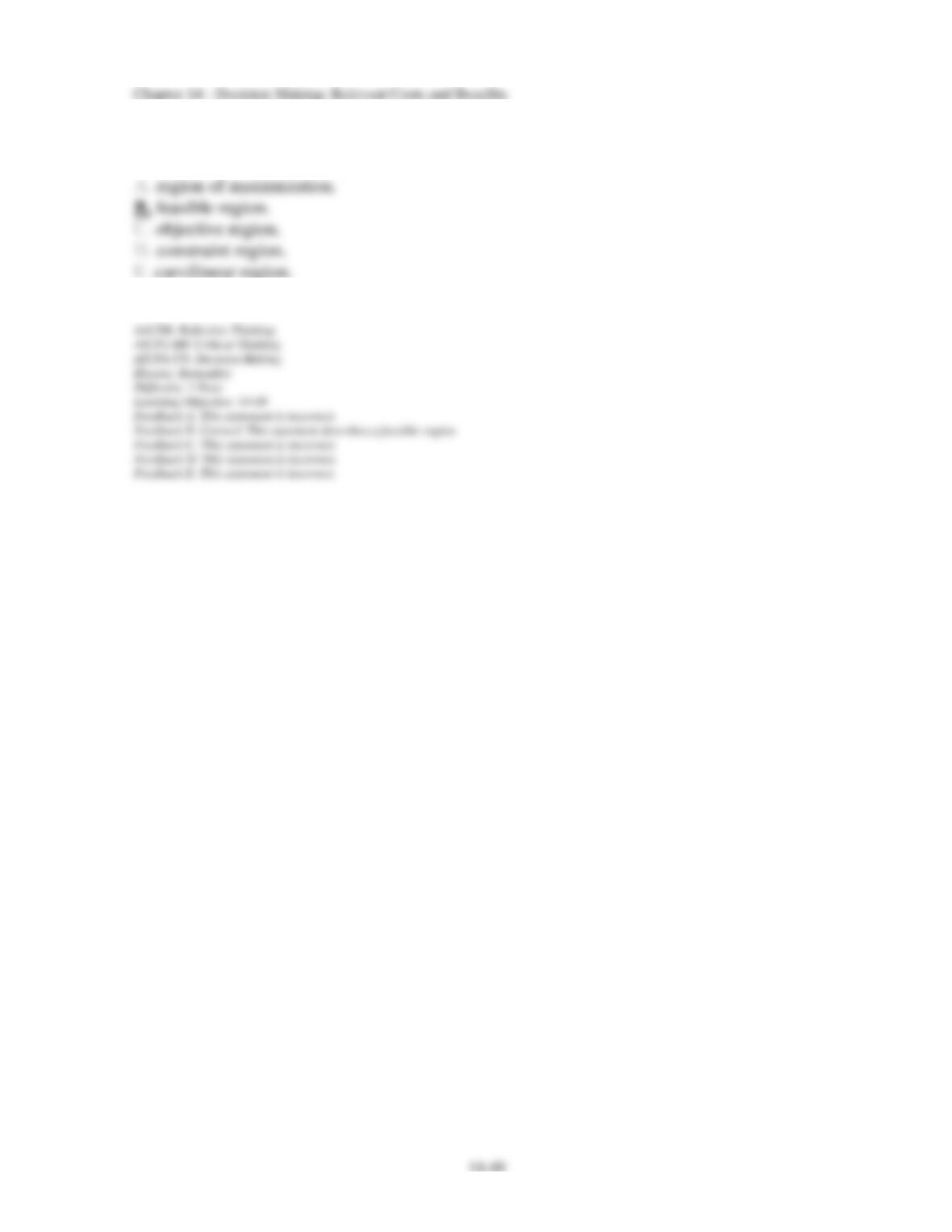
85. When using a graphical solution to a linear programming problem, the optimal solution
will lie in an area commonly known as the:
Chapter 14 – Decision Making: Relevant Costs and Benefits
Use the following information to answer Questions 86-87.
Technostrain Corporation manufactures two products: X and Y. The company has 4,000
hours of machine time available and can sell no more than 800 units of product X. Other
pertinent data follow.
Product X
Product Y
Selling price
$8.00
$19.00
Variable cost
3.00
5.00
Fixed cost
3.50
6.25
Machine time per unit
2 hours
3 hours
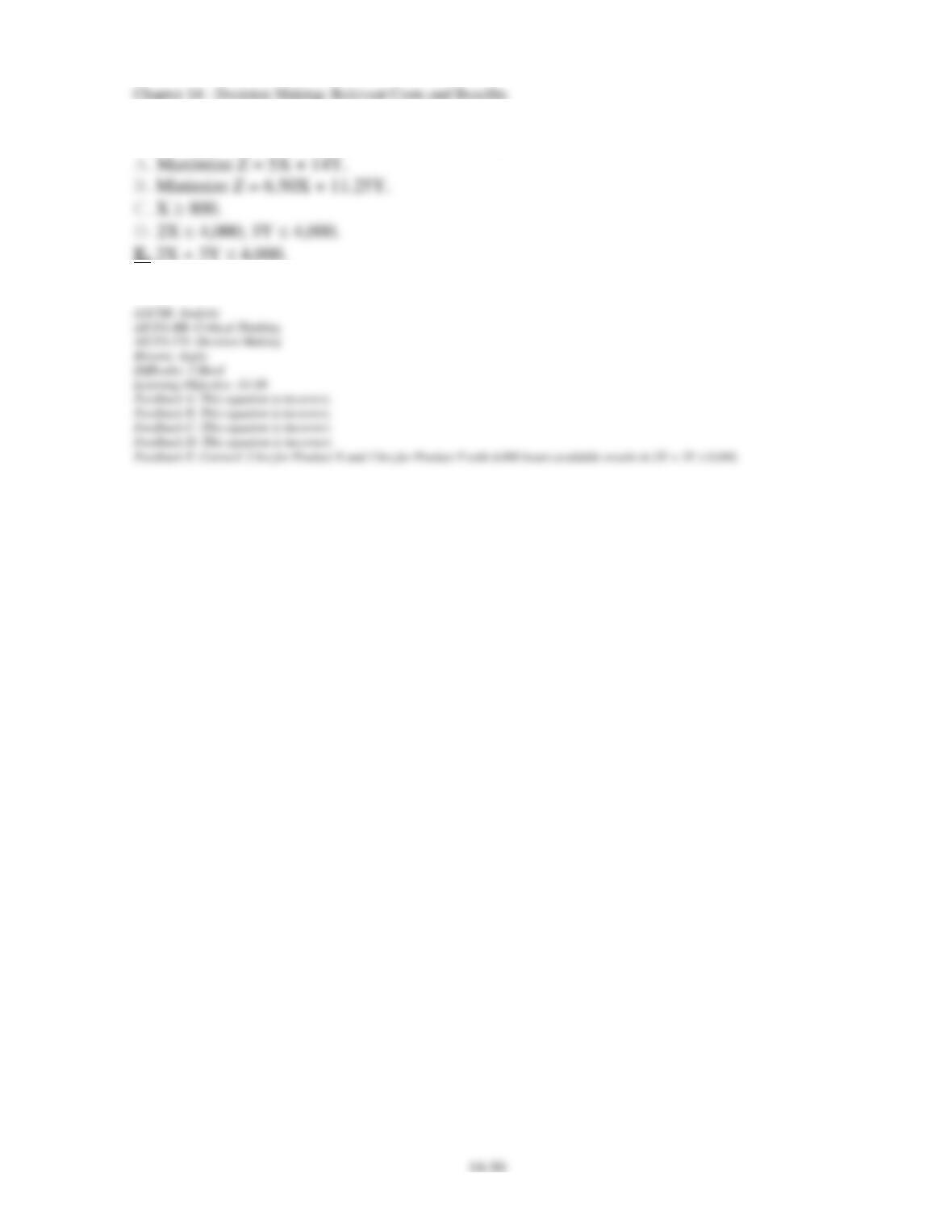
86. Which of the following is Technostrain’s objective function?
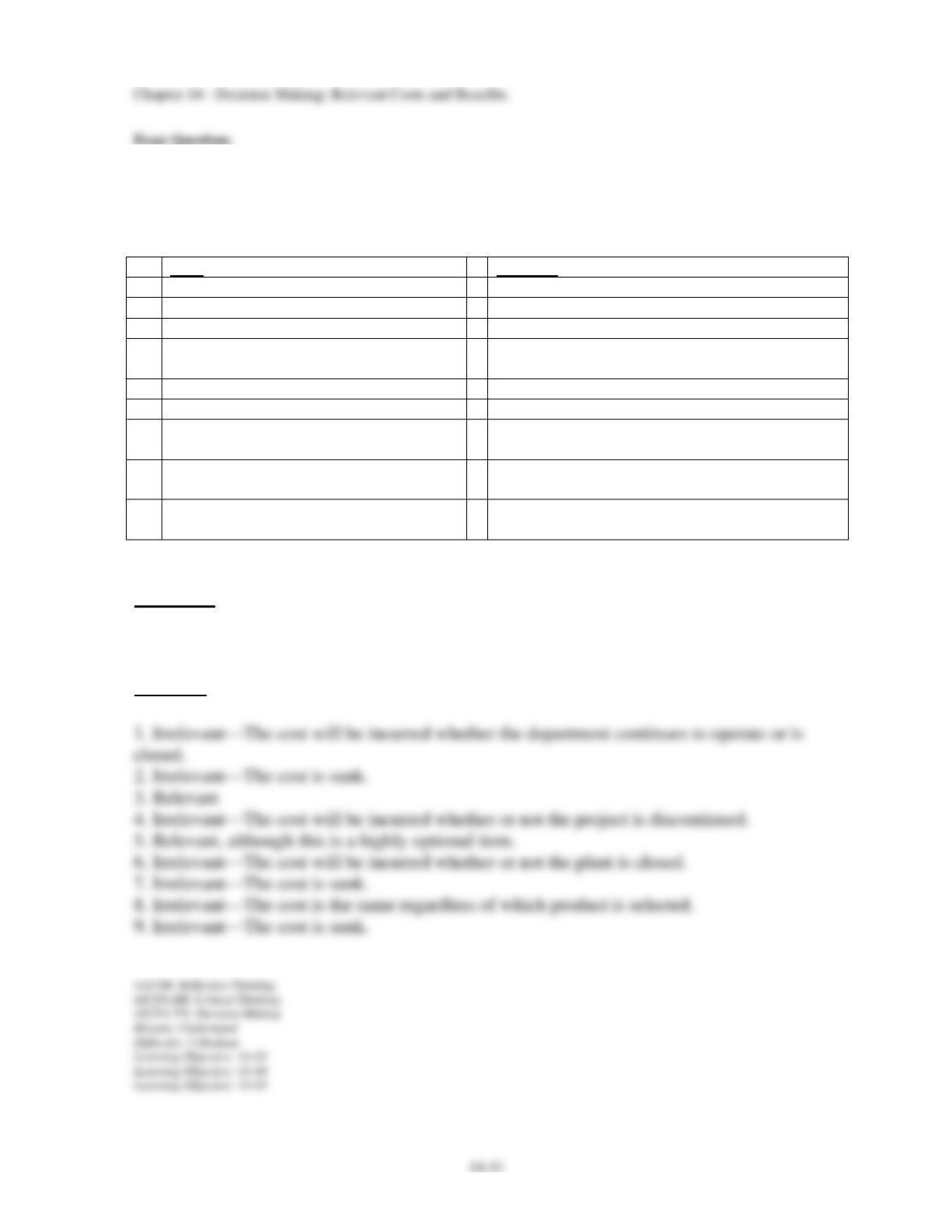
87. Which of the following is a constraint function of Technostrain ?
88. The following costs relate to a variety of decision settings:
Cost
Decision
1.
Allocated corporate overhead
Closing a money-losing department
2.
Cost of an old car
Vehicle replacement
3.
Direct materials
Make or buy a product
4.
Salary of marketing manager
Project discontinuance; manager to be transferred
elsewhere in the firm
5.
Home theater installation
Purchase of a new home
6.
Unavoidable fixed overhead
Plant closure
7.
Research expenditures incurred last year,
related to new product
Product introduction to marketplace
8.
$4 million advertising program
Whether to promote product A or B with the $4
million program
9.
Manufactured cost of existing inventory
Whether to discard the goods or sell them to a
third-world country
Required:
Consider each of the nine costs listed and determine whether it is relevant or irrelevant to the
decision cited. If the cost is irrelevant, briefly explain why.
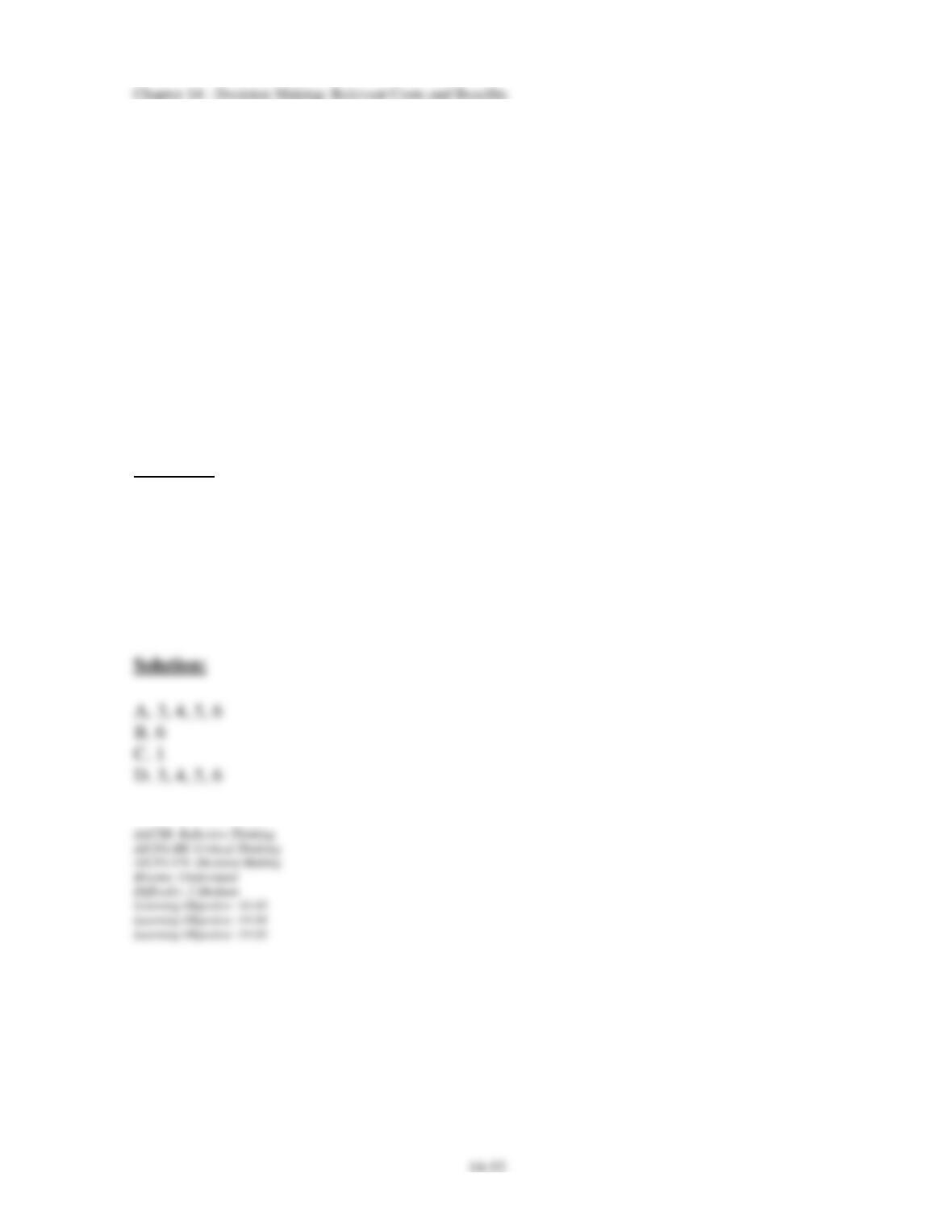
Solution:
89. Alton Van Lines is considering the acquisition of two new trucks. Because of improved
mileage, these vehicles are expected to have a lower operating cost per mile than the trucks
the company plans to replace. Management is studying whether the firm would be better-off
keeping the older vehicles or going ahead with the replacement, and has identified the
following decision factors to evaluate:
1. Cost and book value of the old trucks
2. Moving revenues, which are not expected to change with the acquisition
3. Operating costs of the new and old vehicles
4. New truck purchase price and related depreciation charges
5. Proceeds from sale of the old vehicles
6. The 8% return on alternative investments that Alton will forego by tying up cash in the new
trucks
7. Drivers’ wages and fringe benefits
Required:
Classify the seven decision factors listed into the following categories (note: A factor may be
included in more than one category, or the factor may not necessarily be included in any of
the categories):
A. Relevant information.
B. Opportunity costs.
C. Sunk costs.
D. Factors to be considered in the decision.
90. Maine Company recently discontinued the manufacture of product J15. The standard costs
for this product were:
Direct materials
$50
Direct labor
20
Variable overhead
14
Fixed overhead
35
Total
$119
There are 800 units of this product in finished-goods inventory. The units are technologically
obsolete, and the following alternatives are being considered:
1. Dispose of as scrap. The proceeds from the sale will equal the cost of transportation to the
disposal site.
2. Sell to an exporter for sale in a developing country. The sales price to the exporter would
be $12 per unit.
3. Remanufacture the products to convert them into model J16, a model that normally sells for
$200. The additional cost to convert the J15 units would be $45; the standard cost to
manufacture J16 is $125. Presently, there is sufficient capacity to manufacture product J16
directly or to do the necessary conversion work on J15.
Required:
A. Determine the current carrying value of the J15 inventory.
B. Evaluate each alternative and determine the financial benefit to Maine if the alternative is
pursued.
Solution:
Incremental revenue
Less: Incremental cost
Net benefit
91. Icon, Inc. produces a variety of products that carry the logos of teams in the Fortified
Football League (FFL). The company recently paid the league $85,000 for the rights to
market a popular player jersey and immediately began production. The following information
is available:
Number of jerseys manufactured: 25,000
Cost of jerseys manufactured: $625,000
Amount of manufacturing costs paid to-date: $410,000
Number of jerseys sold to-date: 0
Estimated future marketing costs: $330,000
Anticipated selling price per jersey: $42
The FFL is about to file a lawsuit to stop jersey sales and is demanding another $50,000 from
Icon for the manufacturing rights. Conversations with Icon’s attorneys indicate that the league
has a strong case and is likely to win the suit. If this situation arises, Icon will be unable to
recover any amounts paid to the FFL.
Required:
Icon’s sales department anticipates very strong demand and a sellout of all jerseys
manufactured.
A. Determine the overall profitability of the jersey product line if Icon settles the
disagreement with the FFL and the anticipated sellout occurs.
B. Should the company pay the additional $50,000 demanded by the league or should the
jersey program be dropped? Show computations to support your answer.
Solution:
92. Drew Mellow builds custom homes in Miami. Mellow was approached not too long ago
by a client about a potential project, and he submitted a bid of $590,000, derived as follows:
Land
$90,000
Construction materials
120,000
Subcontractor labor costs
150,000
$360,000
Construction overhead: 20% of direct costs
72,000
Allocated corporate overhead
40,000
Total cost
$472,000
Mellow adds a 25% profit margin to all jobs, computed on the basis of total cost. In this
client’s case the profit margin amounted to $118,000 ($472,000 25%), producing a bid price
of $590,000. Assume that 60% of construction overhead is fixed.
Required:
A. Suppose that business is presently very slow, and the client countered with an offer on this
home of $455,000. Should Mellow accept the client’s offer? Why?
B. If Mellow has more business than he can handle, how much should he be willing to accept
for the home? Why?
Solution:
Land
Construction materials
120,000
Subcontractor labor costs
150,000
Variable Construction overhead: $72,000 x 40%
28,800
$388,800

14–56
93. Pea Ridge Corporation manufactures faucets. Several weeks ago, the company received a
special-order inquiry from Galena, Inc. Galena desires to market a faucet similar to Pea
Ridge’s model no. 55 and has offered to purchase 3,000 units. The following data are
available:
· Cost data for Pea Ridge’s model no. 55 faucet: direct materials, $45; direct labor, $30 (2
hours at $15 per hour); and manufacturing overhead, $70 (2 hours at $35 per hour).
· The normal selling price of model no. 55 is $180; however, Galena has offered Pea Ridge
only $115 because of the large quantity it is willing to purchase.
· Galena requires a design modification that will allow a $4 reduction in direct-material cost.
· Pea Ridge’s production supervisor notes that the company will incur $8,700 in additional
set-up costs and will have to purchase a $3,300 special device to manufacture these units. The
device will be discarded once the special order is completed.
· Total manufacturing overhead costs are applied to production at the rate of $35 per labor
hour. This figure is based, in part, on budgeted yearly fixed overhead of $624,000 and
planned production activity of 24,000 labor hours.
· Pea Ridge will allocate $5,000 of existing fixed administrative costs to the order as “part of
the cost of doing business.”
Required:
A. One of Pea Ridge’s staff accountants wants to reject the special order because “financially,
it’s a loser.” Do you agree with this conclusion if Pea Ridge currently has excess capacity?
Show calculations to support your answer.
B. If Pea Ridge currently has no excess capacity, should the order be rejected from a financial
perspective? Briefly explain.
C. Assume that Pea Ridge currently has no excess capacity. Would outsourcing be an option
that Pea Ridge could consider if management truly wanted to do business with Galena?
Briefly discuss, citing several key considerations for Pea Ridge in your answer.