81) The Labrador Falls Company has three divisions: A Division, B Division, and C Division.
A B C
Sales $ 320,000 $ 540,000 ?
Net operating income 60,000 ? $ 24,000
Residual income ? 36,000 14,400
Average Division Assets ? ? 80,000
Cost of Capital 12 % 16 % ?
Profit Margin 20 % 5 % ?
Asset Turnover ? 4.0 ?
Return on investment 15 % ? ?
What was A Division’s residual income last year?
A) $12,000.
B) $22,500.
C) $30,000.
D) $48,000.
82) The Labrador Falls Company has three divisions: A Division, B Division, and C Division.
A B C
Sales $ 320,000 $ 540,000 ?
Net operating income 60,000 ? $ 24,000
Residual income ? 36,000 14,400
Average Division Assets ? ? 80,000
Cost of Capital 12 % 16 % ?
Profit Margin 20 % 5 % ?
Asset Turnover ? 4.0 ?
Return on investment 15 % ? ?
What was B Division’s return on investment (ROI) last year?
A) 16.00%.
B) 20.00%.
C) 24.00%.
D) 33.75%.
43
83) The Labrador Falls Company has three divisions: A Division, B Division, and C Division.
A B C
Sales $ 320,000 $ 540,000 ?
Net operating income 60,000 ? $ 24,000
Residual income ? 36,000 14,400
Average Division Assets ? ? 80,000
Cost of Capital 12 % 16 % ?
Profit Margin 20 % 5 % ?
Asset Turnover ? 4.0 ?
Return on investment 15 % ? ?
What was A Division’s residual income last year?
A) 8%.
B) 12%.
C) 18%.
D) 20%.
84) Which of the following items would not be an example of an economic value added (EVA)
adjustment to eliminate accounting distortions?
A) Research & development costs.
B) Advertising expenditures.
C) Patent amortization.
D) Common stock.
85) Which of the following items would not require an adjustment to capital employed when
using economic value added (EVA)?
A) Research & development costs.
B) Advertising expenditures.
C) Preferred stock.
D) Accounts Payable.
86) Economic value added (EVA) is a concept that is closely related to residual income. EVA is
computed by:
A) subtracting the adjusted total cost of capital from the adjusted after-tax income.
B) subtracting adjusted after-tax income from total divisional investment.
C) dividing adjusted after-tax income by adjusted divisional investment.
D) dividing adjusted after-tax income by adjusted total cost of capital.
87) Economic value added (EVA) assumes that which of the following GAAP expenses would
not result in an adjustment to either the income or the capital employed?
A) Research & development costs.
B) Use of process costing rather than job costing.
C) Advertising expenses.
D) Write-off of goodwill.
88) Which of the following statements regarding the use of historical costs and current costs to
compute return on investment (ROI) is(are) true?
(A) Historical costs are based on the original costs to acquire a long-term asset, while current
costs represent the costs to replace the long-term asset.
(B) For a specific multiple-period project, the return on investment (ROI) computed using
current costs will generally be less than the ROI computed using historical costs.
A) Only (A) is true.
B) Only (B) is true.
C) Both of these are true.
D) Neither of these is true.
89) Level return on investments (ROI) over the life of a long-term project is more likely when
ROI is computed using:
A) historical costs and net book values.
B) historical costs and gross book values.
C) current costs and net book values.
D) current costs and gross book values.
90) Using ending balances for the investment base in computing return on investment (ROI)
might encourage managers to acquire assets:
A) early in the year and dispose of assets late in the year.
B) early in the year and dispose of assets early in the year.
C) late in the year and dispose of assets late in the year.
D) late in the year and dispose of assets early in the year.
91) Using beginning balances for the investment base in computing return on investment (ROI)
might encourage managers to acquire assets:
A) early in the year and dispose of assets late in the year.
B) early in the year and dispose of assets early in the year.
C) late in the year and dispose of assets late in the year.
D) late in the year and dispose of assets early in the year.
92) One division of the Marvin Educational Enterprises has depreciable assets costing
$4,000,000. The cash flows from these assets for the past three years have been:
Year Cash flows
1 $ 1,200,000
2 $ 1,400,000
3 $ 1,620,000
The current (i.e., replacement) costs of these assets were expected to increase 25% each year.
Marvin used the straight-line depreciation method and the assets had an estimated useful life of
10 years with no salvage value. For return on investment (ROI) calculations, Marvin uses end-
of-year balances.
What is the ROI using historical cost and gross book value?
Year 1 Year 2 Year 3
A. 20.0 % 25.0 % 30.5 %
B. 25.0 % 28.0 % 32.0 %
C. 18.0 % 26.5 % 28.0 %
D. 30.0 % 35.0 % 40.5 %
A) Option A
B) Option B
C) Option C
D) Option D
93) One division of the Marvin Educational Enterprises has depreciable assets costing
$4,000,000. The cash flows from these assets for the past three years have been:
Year Cash flows
1 $ 1,200,000
2 $ 1,400,000
3 $ 1,620,000
The current (i.e., replacement) costs of these assets were expected to increase 25% each year.
Marvin used the straight-line depreciation method and the estimated useful life is 10-years with
no salvage value. For return on investment (ROI) calculations, Marvin uses end-of-year
balances.
What is the ROI using historical cost and net book value?
Year 1 Year 2 Year 3
A. 21.5 % 34.0 % 42.0 %
B. 22.2 % 31.3 % 43.6 %
C. 23.0 % 32.0 % 47.0 %
D. 24.8 % 35.0 % 49.5 %
A) Option A
B) Option B
C) Option C
D) Option D
94) One division of the Marvin Educational Enterprises has depreciable assets costing
$4,000,000. The cash flows from these assets for the past three years have been:
Year Cash flows
1 $ 1,200,000
2 $ 1,400,000
3 $ 1,620,000
The current (i.e., replacement) costs of these assets were expected to increase 25% each year.
Marvin used the straight-line depreciation method and the estimated useful life is 10-years with
no salvage value. For return on investment (ROI) calculations, Marvin uses end-of-year
balances.
What is the ROI using current costs and gross book value?
Year 1 Year 2 Year 3
A. 14.0 % 18.0 % 22.4 %
B. 13.0 % 14.0 % 14.0 %
C. 12.0 % 10.1 % 9.5 %
D. 14.0 % 12.4 % 10.7 %
A) Option A
B) Option B
C) Option C
D) Option D
95) One division of the Marvin Educational Enterprises has depreciable assets costing
$4,000,000. The cash flows from these assets for the past three years have been:
Year Cash flows
1 $ 1,200,000
2 $ 1,400,000
3 $ 1,620,000
The current (i.e., replacement) costs of these assets were expected to increase 25% each year.
Marvin used the straight-line depreciation method and the estimated useful life is 10-years with
no salvage value. For return on investment (ROI) calculations, Marvin uses end-of-year
balances.
What is the ROI using current costs and net book value?
Year 1 Year 2 Year 3
A. 14.6 % 15.9 % 16.0 %
B. 15.8 % 15.9 % 14.9 %
C. 15.6 % 15.5 % 15.3 %
D. 15.6 % 15.8 % 11.9 %
A) Option A
B) Option B
C) Option C
D) Option D
96) One division of the Marvin Educational Enterprises has depreciable assets costing
$4,000,000. The cash flows from these assets for the past three years have been:
Year Cash flows
1 $ 1,200,000
2 $ 1,400,000
3 $ 1,620,000
The current (i.e., replacement) costs of these assets were expected to increase 25% each year.
Marvin used the straight-line depreciation method and the estimated useful life is 10-years with
no salvage value. For return on investment (ROI) calculations, Marvin uses end-of-year
balances.
What is the residual income for each year, assuming the cost of capital is 15% and Marvin uses
historical costs and gross book values to compute residual income?
Year 1 Year 2 Year 3
A. $ 200,000 $ 400,000 $ 620,000
B. $ 200,000 $ 200,000 $ 200,000
C. $ 250,000 $ 200,000 $ 450,000
D. $ 250,000 $ 400,000 $ 375,000
A) Option A
B) Option B
C) Option C
D) Option D
97) One division of the Marvin Educational Enterprises has depreciable assets costing
$4,000,000. The cash flows from these assets for the past three years have been:
Year Cash flows
1 $ 1,200,000
2 $ 1,400,000
3 $ 1,620,000
The current (i.e., replacement) costs of these assets were expected to increase 25% each year.
Marvin used the straight-line depreciation method and the estimated useful life is 10-years with
no salvage value. For return on investment (ROI) calculations, Marvin uses end-of-year
balances.
What is the residual income for each year, assuming the cost of capital is 15% and Marvin uses
historical costs and net book values to compute residual income?
Year 1 Year 2 Year 3
A. $ 200,000 $ 435,000 $ 690,000
B. $ 260,000 $ 520,000 $ 800,000
C. $ 260,000 $ 420,000 $ 540,000
D. $ 280,000 $ 400,000 $ 750,000
A) Option A
B) Option B
C) Option C
D) Option D
98) The Jones Company purchased assets costing $200,000 which will be depreciated over 5
years using straight-line depreciation and no salvage value. Jones also purchased land and other
assets, which are not depreciable, at a cost of $200,000. It is estimated that in 5 years, the value
of these assets will be unchanged. Assume that annual cash profits are $80,000 and, for return on
investment (ROI) calculations, the company uses end-of-year asset values.
What is the ROI for each year using net book value?
Year 1 Year 2 Year 3 Year 4
A. 11.1 % 12.5 % 14.3 % 16.7 %
B. 10.0 % 10.0 % 10.0 % 10.0 %
C. 10.0 % 8.9 % 7.3 % 6.5 %
D. 11.1 % 11.5 % 12.5 % 12.3 %
A) Option A
B) Option B
C) Option C
D) Option D
99) The Jones Company purchased assets costing $200,000 which will be depreciated over 5
years using straight-line depreciation and no salvage value. Jones also purchased land and other
assets, which are not depreciable, at a cost of $200,000. It is estimated that in 5 years, the value
of these assets will be unchanged. Assume that annual cash profits are $80,000 and, for return on
investment (ROI) calculations, the company uses end-of-year asset values.
What is the ROI for each year using gross book value?
Year 1 Year 2 Year 3 Year 4
A. 10.0 % 9.5 % 8.0 % 7.9 %
B. 10.0 % 10.0 % 10.0 % 10.0 %
C. 12.5 % 11.0 % 12.0 % 15.0 %
D. 10.0 % 12.5 % 14.0 % 17.0 %
A) Option A
B) Option B
C) Option C
D) Option D
100) The Jones Company purchased assets costing $200,000 which will be depreciated over 5
years using straight-line depreciation and no salvage value. Jones also purchased land and other
assets, which are not depreciable, at a cost of $200,000. It is estimated that in 5 years, the value
of these assets will be unchanged. Assume that annual cash profits are $80,000 and, for return on
investment (ROI) calculations, the company uses end-of-year asset values.
If sales each year average $840,000, what will be the asset turnover using gross book value?
A) 3.0.
B) 2.6.
C) 2.1.
D) 1.9.
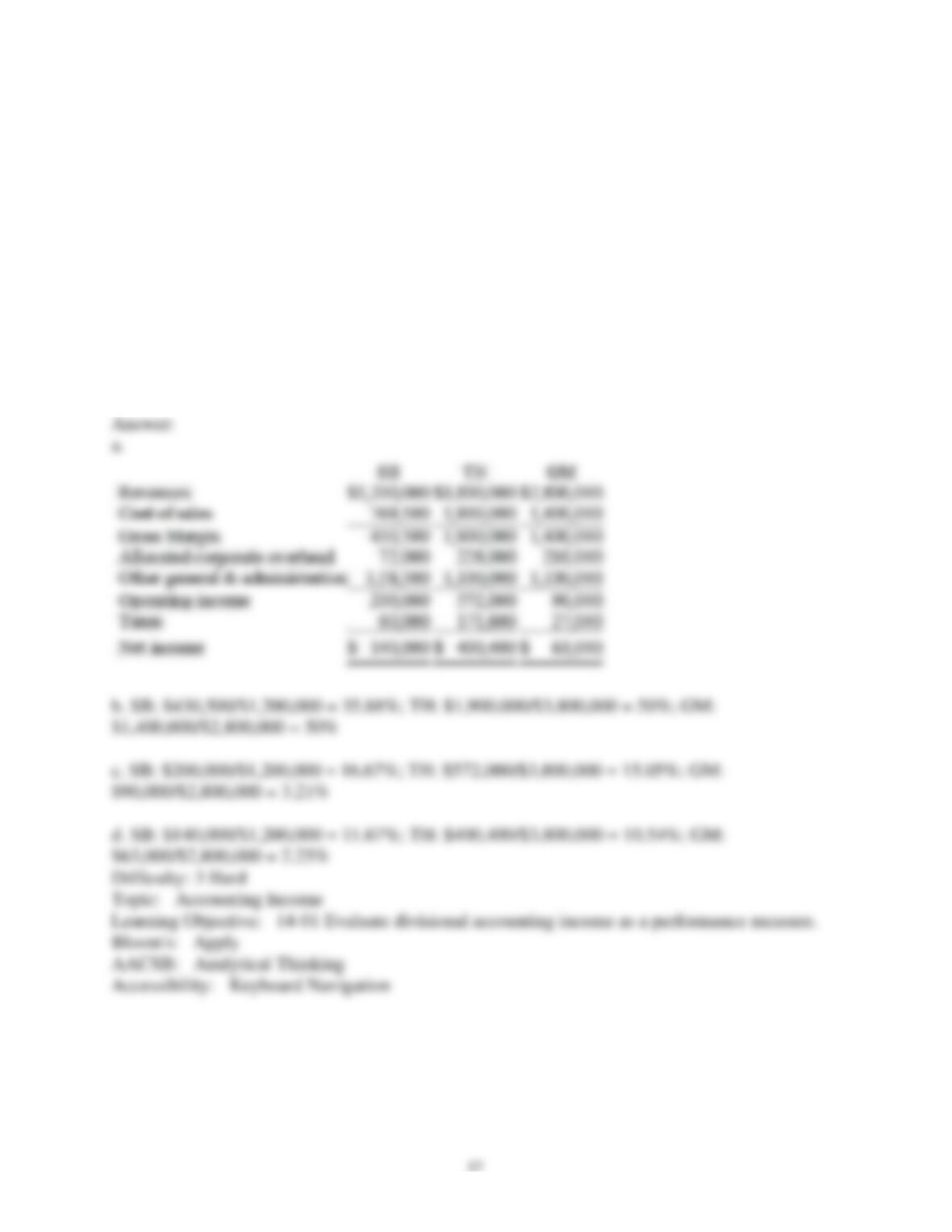
101) Seaside Enterprises has the following data for its three divisions for the year:
SB TH GM
Revenues $ 1,200,000 $ 3,800,000 $ 2,800,000
Cost of sales 769,500 1,900,000 1,400,000
Allocated corporate overhead 72,000 228,000 210,000
Other general & administration 158,500 1,100,000 1,100,000
Required:
a. Compute divisional operating income for each of the divisions. Assume taxes are 30%.
b. Calculate the gross margin ratio for each division.
c. Calculate the operating margin ratio for each division.
d. Calculate the profit margin ratio for each division.
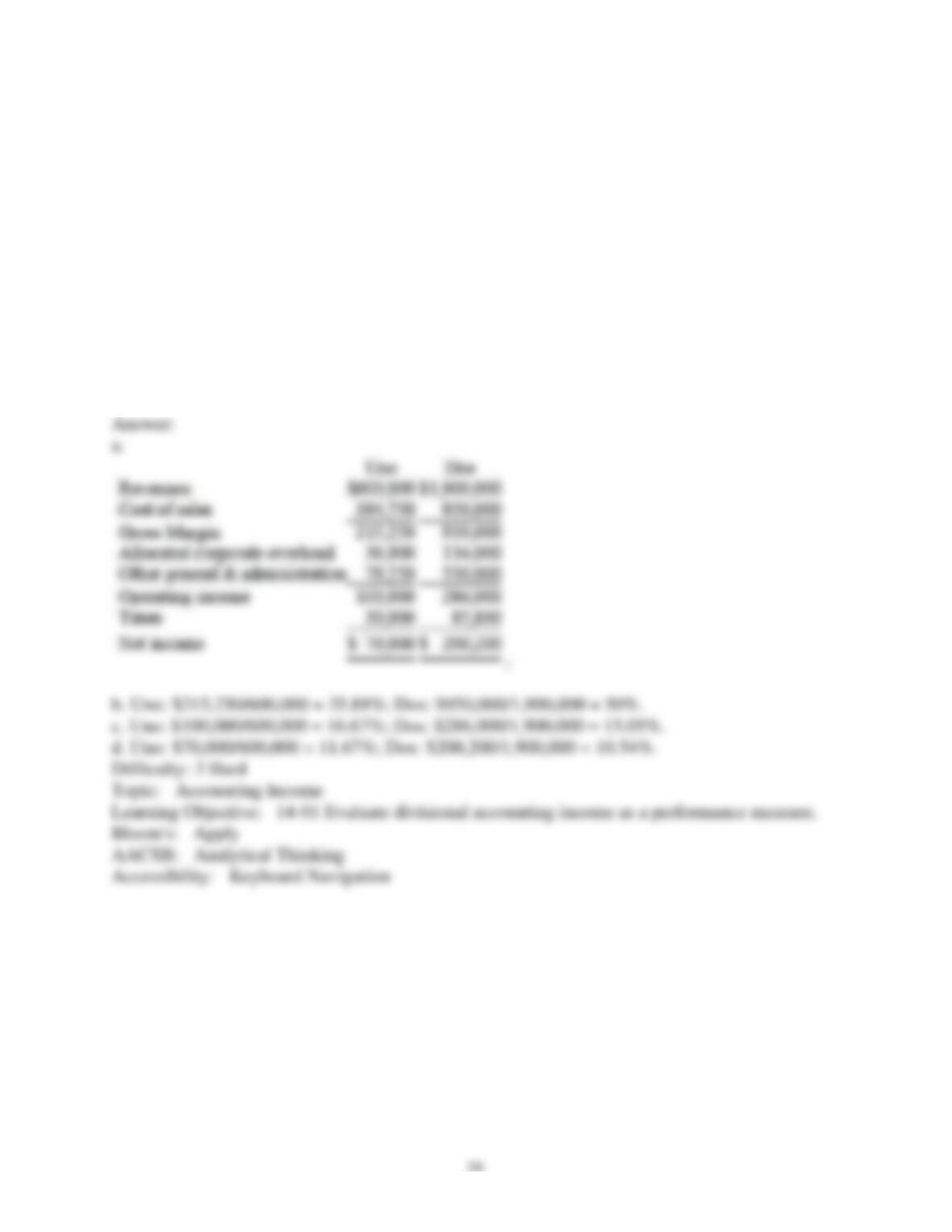
102) La Mesa Foods has the following data for its two divisions for the year:
Uno Dos
Revenues $ 600,000 $ 1,900,000
Cost of sales 384,750 950,000
Allocated corporate overhead 36,000 114,000
Other general & administration 79,250 550,000
Required:
a. Compute divisional operating income for each of the divisions. Assume taxes are 30%.
b. Calculate the gross margin ratio for each division.
c. Calculate the operating margin ratio for each division.
d. Calculate the profit margin ratio for each division.
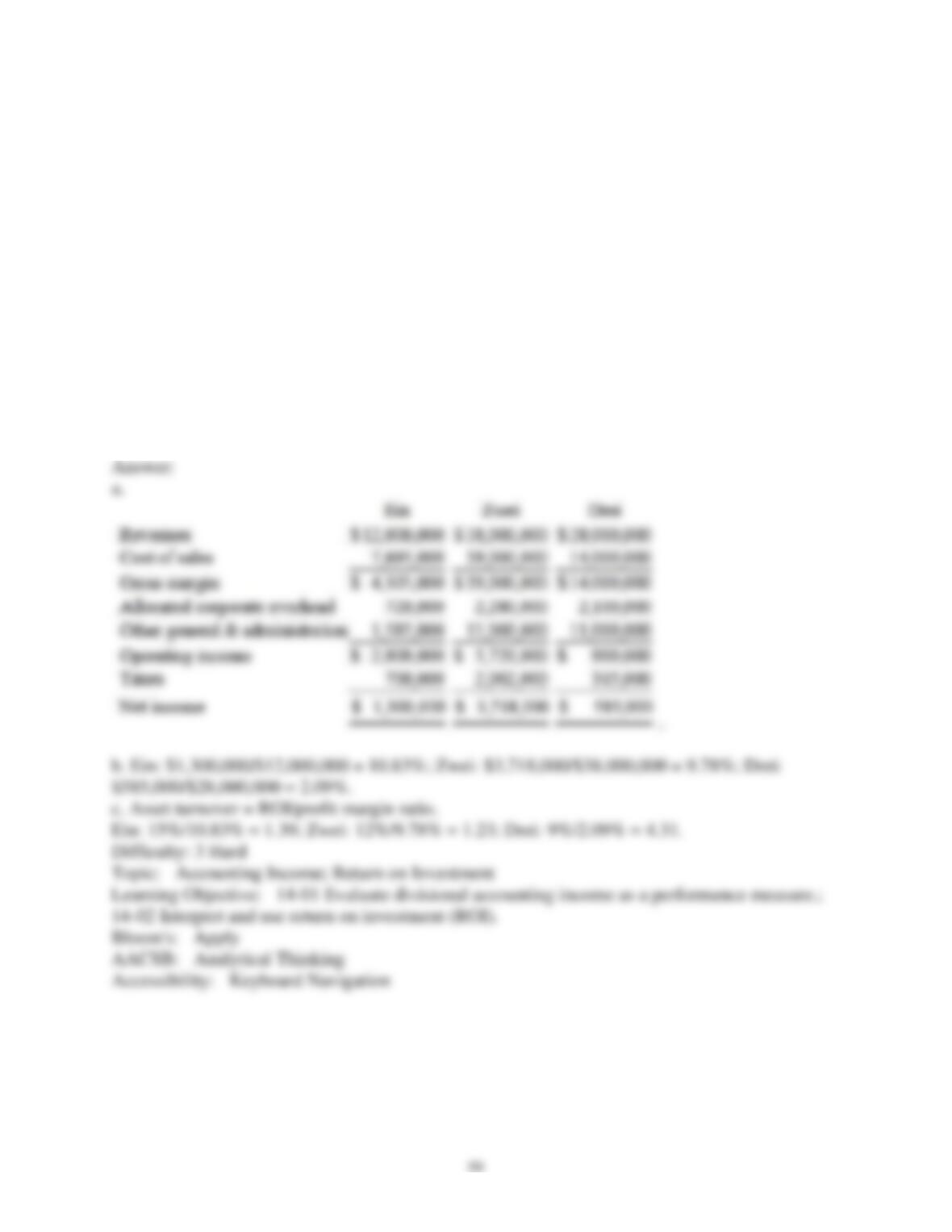
103) Nue Wines has the following data for its three divisions for the year:
Ein Zwei Drei
Revenues $ 12,000,000 $ 38,000,000 $ 28,000,000
Cost of sales 7,695,000 19,000,000 14,000,000
Allocated corporate overhead 720,000 2,280,000
2,100,000
Other general & administration 1,585,000 11,000,000
11,000,000
Return on Investment 15 % 12 % 9 %
Required:
a. Compute divisional operating income for each of the divisions. Assume taxes are 35%.
b. Calculate the profit margin ratio for each division.
c. Calculate the asset turnover for each division.
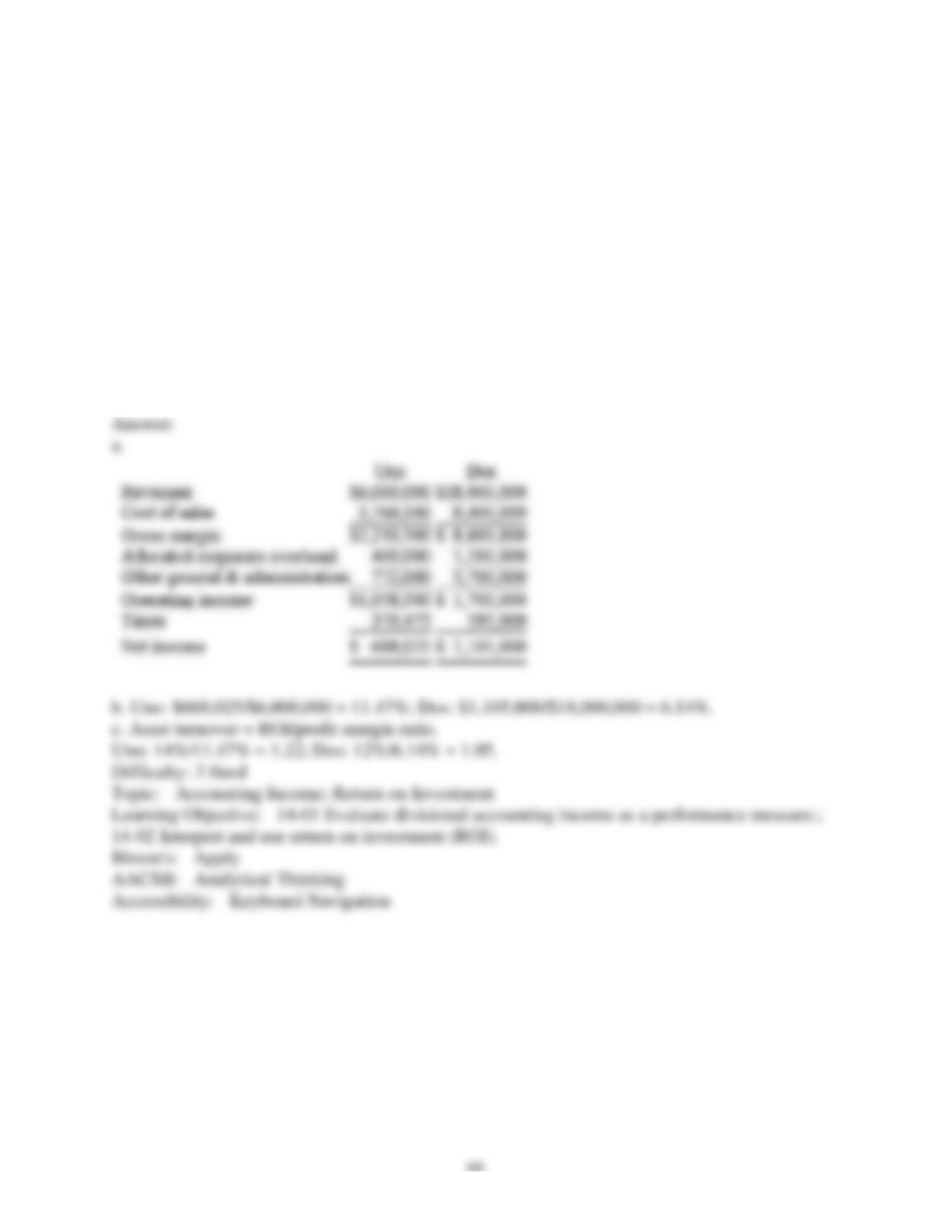
104) La Mesa Stores has the following data for its two divisions for the year:
Uno Dos
Revenues $ 6,000,000 $ 18,000,000
Cost of sales 3,769,500 9,400,000
Allocated corporate overhead 400,000 1,200,000
Other general & administration 772,000 5,700,000
Return on Investment 14 % 12 %
Required:
a. Compute divisional operating income for each of the divisions. Assume taxes are 35%.
b. Calculate the profit margin ratio for each division.
c. Calculate the asset turnover for each division.