36) How are business entities and their relationships identified?
A) Determining the business rules for business transactions
B) Determining the entity identifiers
C) Normalizing the database
D) Analyzing business transactions
37) Which of the following is a way to collect information about business transactions?
A) Interviewing users
B) Reviewing source documents
C) Observing procedures
D) All the above
38) When using normalization for database development, all the attributes are placed in
A) Three large tables
B) Two huge tables
C) One large table
D) B and C
39) What is the purpose of an entity relationship diagram?
40) Why does a database designer need to understand a business’s rules?
41) What are the steps for designing an ERD?
42) List the ERD design steps that are independent of the database structure.
43) List the ERD design steps that are dependent on the database structure.
44) List and define the first three normalization rules.
Objective 3
1) In an REA model, entities are business objects or events.
2) In a REA model, an agent is related to a resource through an event.
3) In a REA model, a resource has an intangible value.
4) An REA diagram does not depict agent dependents.
5) In a REA model, a(n) ________ is a person or organization involved in events and can include
a vendor, employee, or customer.
6) In an REA, a(n) ________ has an economic value to the enterprise, such as inventory.
7) In an REA model, a(n) ________ included activities and transactions.
8) In an REA, an entity can be a
A) Business object or event
B) Resource or business object
C) Resource, event, or agent
D) Business object or agent
9) In REA modeling, a resource
A) Is a person or organization involved in events
B) Has economic value to the enterprise
C) Is a transaction
D) A business rule
10) In REA modeling, an agent is related to a resource through a(n)
A) Event
B) Attribute
C) Occurrence
D) Relationship
11) In the REA model, the ________ event consumes business resources.
A) Purchasing
B) Buying
C) Giving
D) Taking
12) In the REA model, the ________ event compensates the consumed resource with a different
or same type of resource.
A) Purchasing
B) Buying
C) Giving
D) Taking
13) Which REA diagraming rule states every event entity must relate to a resource entity?
A) Rule 1. Resource-event relationship
B) Rule 2. Event-event relationship
C) Rule 3. Agent-event relationship
D) Rule 4. Agent-agent relationship
14) Which REA diagraming rule states at least two agent entities are required for an event entity.
A) Rule 1. Resource-event relationship
B) Rule 2. Event-event relationship
C) Rule 3. Agent-event relationship
D) Rule 4. Agent-agent relationship
15) What are the four rules for designing an REA diagram? Include a definition for each.
16) You are a staff accountant at a large firm and are assigned to work with the IT department to
update the current systems throughout the organization. An accounting intern is assigned to help
with the project. The intern wants to document the current processes using a REA diagram. How
do you explain to the intern why REA diagram is not appropriate?
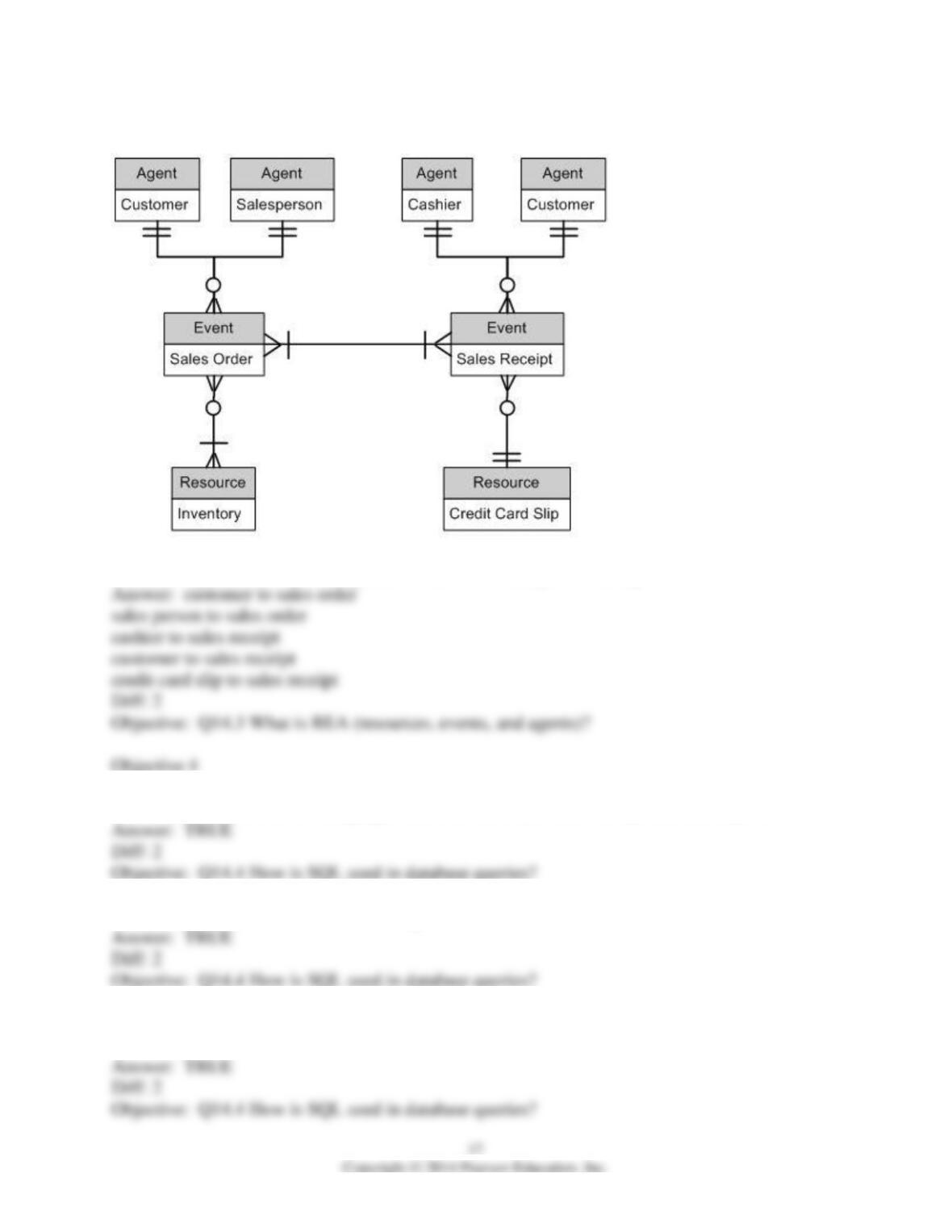
Spice House REA Diagram
17) In the Spice House REA diagram, list the one-to-many relationships.
1) In SQL, Data Definition Language statements create, alter, and drop database objects.
2) SQL DML statements select, insert, update, and delete database records.
3) The SQL command ALTER changes the relational database, such as adding a new field to a
specific table.
4) The SQL command DROP deletes a database object, such as removing an existing field from
a specific table.
5) SQL is a language for ________ databases.
6) In SQL, ________ statements create, alter, and drop database objects.
7) In SQL, ________ statements select, insert, update, and delete database records.
8) Which of the following statements about SQL is false?
A) SQL is a nonprocedural language.
B) SQL is a procedural language.
C) SQL can query many records from one or more tables with a single statement.
D) SQL can manipulate relational database object.
9) Which of the following SQL commands retrieves data from the database?
A) Create
B) Select
C) Alter
D) Drop
10) Which of the following SQL commands specifies the database table?
A) Insert
B) Update
C) From
D) Delete
11) Which of the following SQL commands specifies the filter condition of an SQL statement?
A) Where
B) From
C) And
D) Select
12) What is the difference between a procedural programming language and a non-procedural
programming language?
13) Besides retrieving data from a relational database, what else can you do with SQL
statements?
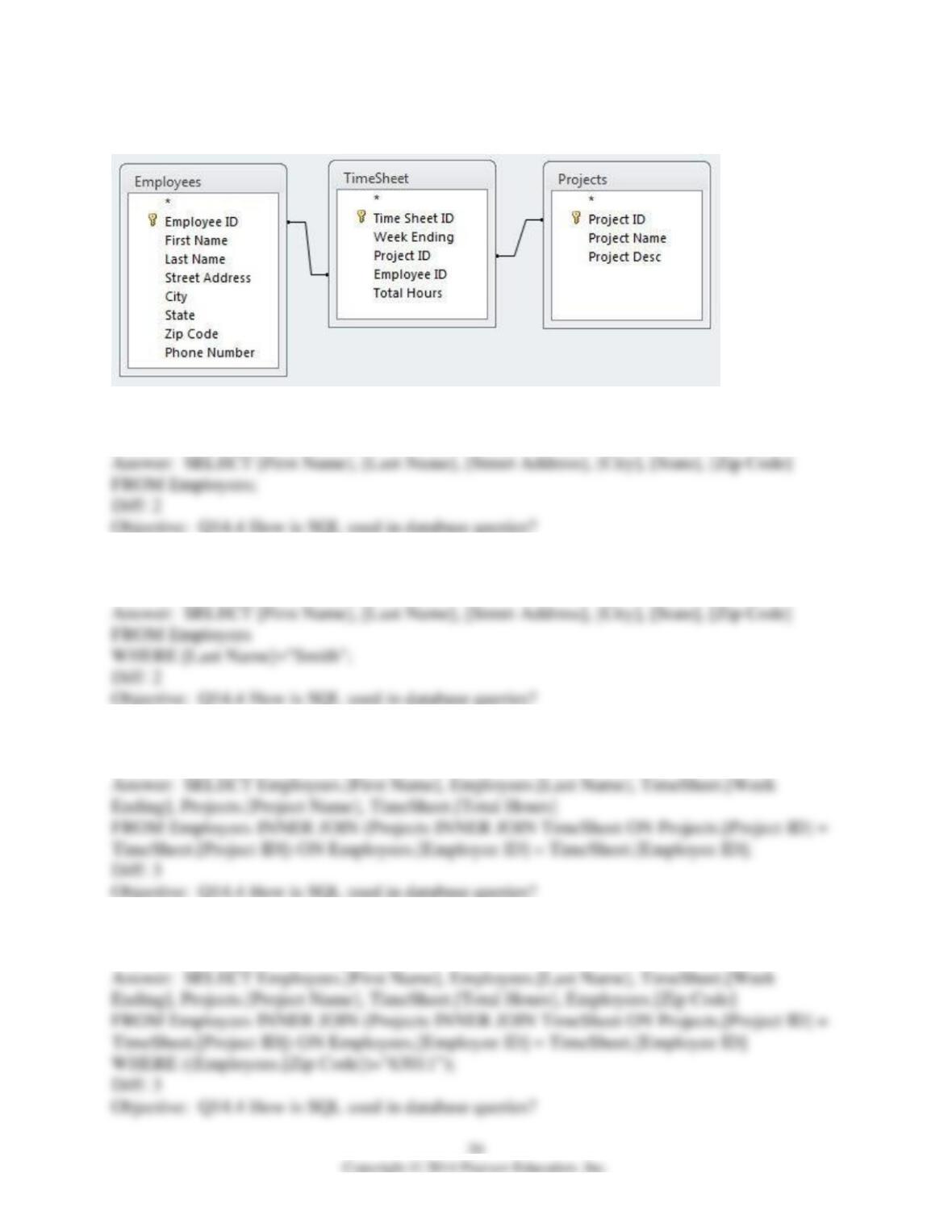
Nice Lawn Database Tables
14) Using the Nice Lawn database tables, write an SQL statement to retrieve employee
addresses.
15) Using the Nice Lawn database tables, write an SQL statement to retrieve the address for all
the employees with the last name of ‘Smith.’
16) Using the Nice Lawn database tables, write an SQL statement to retrieve all the time sheets
for the employees listing the projects each employee worked.
17) Using the Nice Lawn database tables, write an SQL statement to retrieve all time sheets of
employees living in a 63011 zip code.

18) Using the Nice Lawn database tables, write an SQL statement to retrieve all time sheets of
employees living in the 63011 zip code and a project name of Park.
19) Using the Nice Lawn database tables, write an SQL statement to retrieve time sheets for
employees living in the 63011 or 63012 zip code.