82. Which of the following control plans will detect discrepancies between the attendance time and job time?
A. approve attendance time data and job time data
83. Which of the following control plans is an account used solely for payroll purposes and funds are
transferred into the account to cover payroll checks to be issued?
84. In some organizations, employees “punch” in and out of work by swiping an employee identification card
through or by a(n) ______________________________.
85. ______________________________ reflect(s) the start and stop times on specific jobs to allow the
distribution of payroll costs to jobs in process (or to other accounts).
86. ______________________________ show the time periods that employees are in attendance at the job site
and available for work.
87. The ______________________________ is an account used solely for payroll purposes. Funds are
transferred into the account to cover payroll checks to be issued.
88. ______________________________ is the process of managing how people are hired, trained, assigned,
motivated and retained.
89. The ______________________________ process is an interacting structure of people, equipment,
activities, and controls that supports the repetitive work routines and decision needs of the HR department
90. The ______________________________ process maintains data for payroll taxes, fringe benefits,
attendance reporting, timekeeping, and paying employees for work performed.
91. The manager of safety, health, and human services usually reports to the
______________________________.
92. The manager of ______________________________ handles employee complaints.
93. The ______________________________ plans and forecasts an organization’s short-term and long-term
HR needs.
94. Systems that allow employees to access their personnel information and business-related information and
functions are known as human resources ______________________________.

96. The ______________________________ data maintains data concerning an organization’s short-term and
long-term staffing requirements.
97. The ______________________________ data catalogs each employee’s set of relative skills.
98. A payroll ______________________________ often makes tax and insurance payments for the client.
99. The chief financial officer usually has direct supervision of the treasurer and
______________________________.
100. The GL supervisor usually reports to the ______________________________.
101. Payroll is typically processed in the ______________________________ mode.
102. The trigger for the payroll process “pay employees” is (are) validated
______________________________.
103. The data flow between “prepare paychecks” and “prepare disbursement voucher” is the
______________________________.
104. The ______________________________ master data is the central repository of data about people who
work for the organization.

105. The employee wage and tax statement is known as a(n) ______________________________.
106. Annuities, pensions, and retirement pay are reported on Form ______________________________.
107. Wages taxable under FICA are reported on Form ______________________________.
108. A(n) ______________________________ system is a computer based system that captures, stores, and
reports time.
109. A company that specializes in rendering payroll services to client companies for a fee is a(n)
______________________________.
110. ______________________________ employees are employees who do not currently work for the
company but who receive paychecks.
111. For good internal control, there should be a(n) ______________________________ between personnel
data creation/modification, payroll preparation, and disbursement of the checks.
112. The control plan ______________________________, entails having paychecks distributed to employees
by an entity not otherwise involved in payroll processing.
113. A(n) ______________________________ account is used solely for payroll purposes. Funds are
transferred into the account to cover payroll checks to be issued.

114. To transfer funds from the company’s general account to its payroll bank account, the payroll register is
sent to the ______________________________ department.
115. ______________________________ of the payroll bank account helps ensure the safety of resources
(cash) by identifying missing or unusual items entered into the account.
116. In a(n) ______________________________ bank account funds are transferred into the account for the
exact amount of the paychecks cashed.
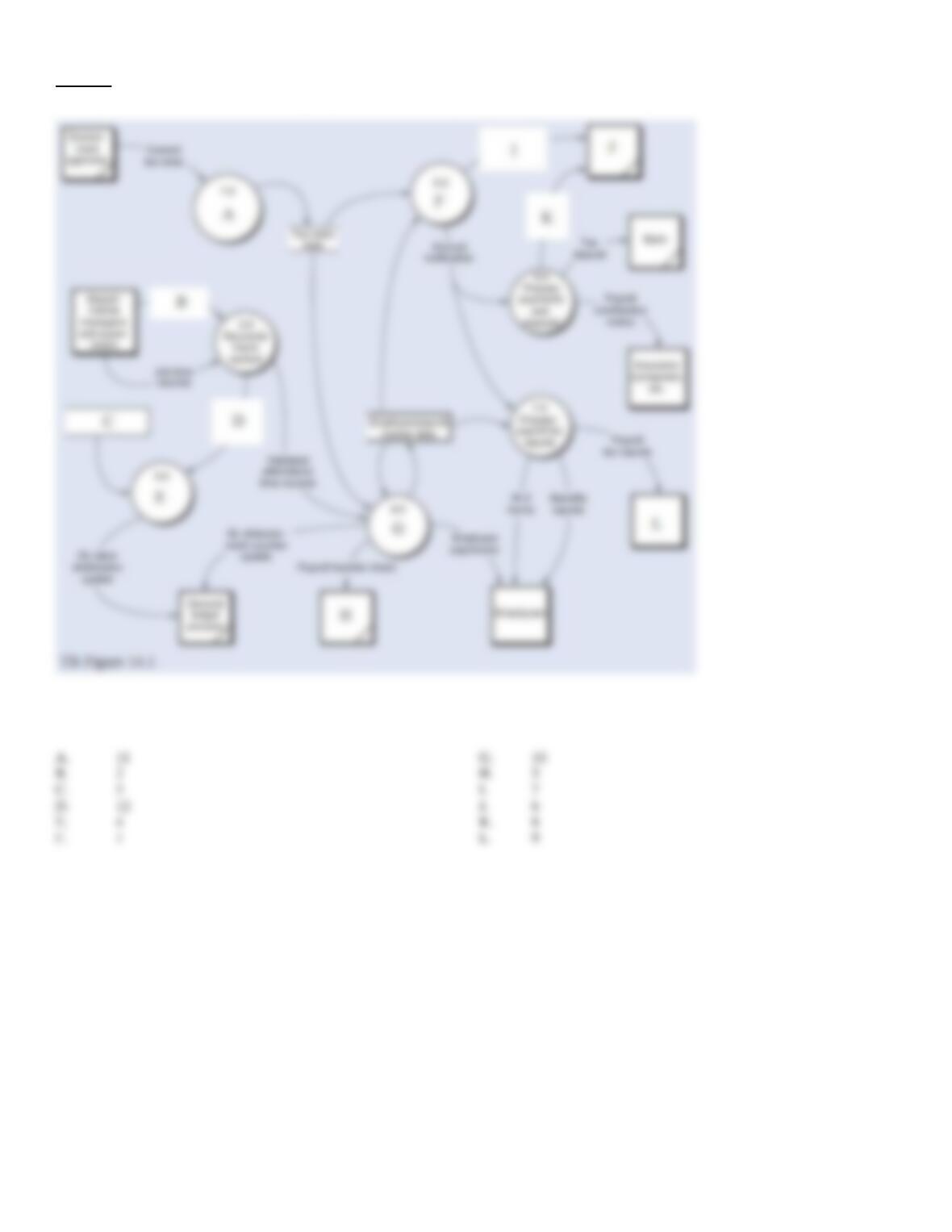
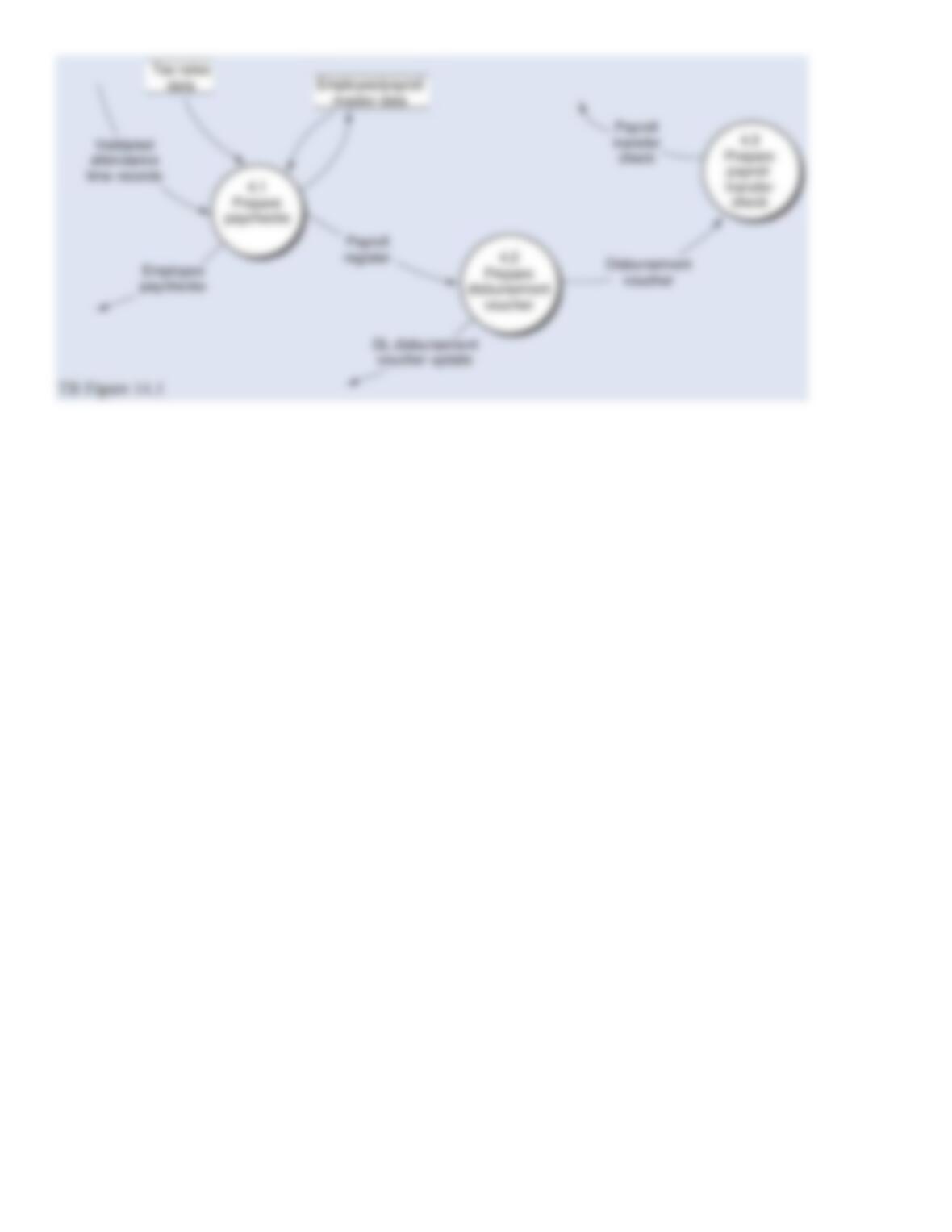
117. TB Figure 14.1 is a Level 0 DFD of a payroll process with several labels omitted. Listed below is a
numbered, alphabetical list of the omitted items.
Omitted
Labels
1.
Accrue liabilities
7.
GL employer tax accrual update
2.
Attendance time records
8.
GL tax deposit update
3.
Bank
9.
Government agencies
4.
Distribute labor costs
10.
Pay employees
5.
Employee/payroll master data
11.
Perform data maintenance
6.
General ledger process
12.
Validated job time records
Required:
Match each letter in the Level DFD to the appropriate number from the list of omitted labels.
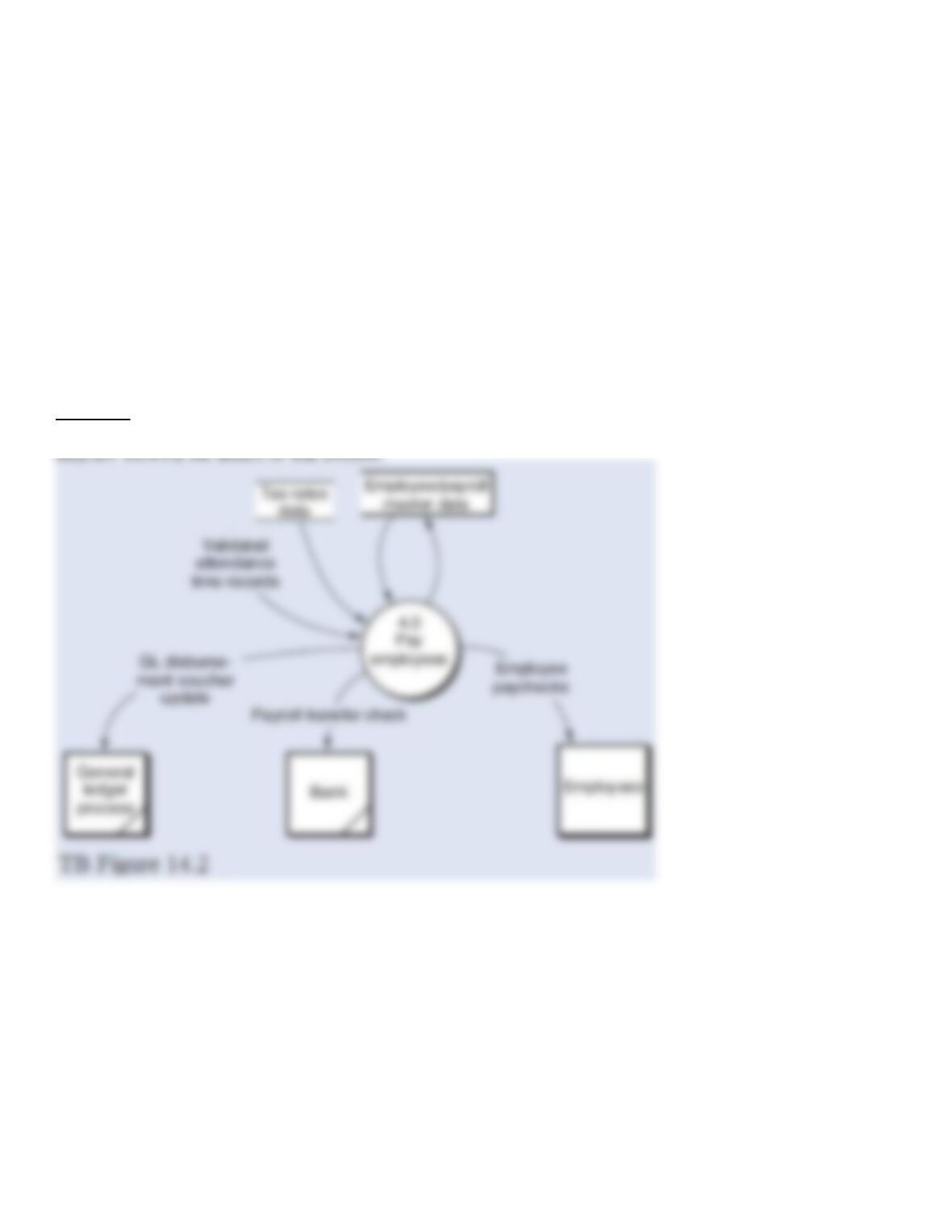
118. Below is a narrative for the “Pay employees” portion (bubble 4.0) of the payroll process described in
Chapter 14.
Narrative Description
Validated attendance time records initiate the payment to workers in process 4.0 (Pay employees). In
calculating employees’ gross and net pay, Process 4.1 (Prepare paychecks) retrieves data from both the
employee/payroll master data and the tax rates data. Process 4.1 accumulates current, quarter-to-date, and year-
to-date totals for each employee and reports this information via the data flow “Payroll register.” This
information also is used to update the employee/payroll master data. Finally, process 4.1 prints and distributes
paychecks to employees as reflected in the “Employee paychecks” data flow.
The data flow “Payroll register” triggers process 4.2 (Prepare disbursement voucher). This will result in a data
flow for the GL disbursement voucher update and a data flow for the disbursement voucher. Process 4.3
(Prepare payroll transfer check) and sends the check to the bank to cover the organization’s periodic net payroll.
Required:
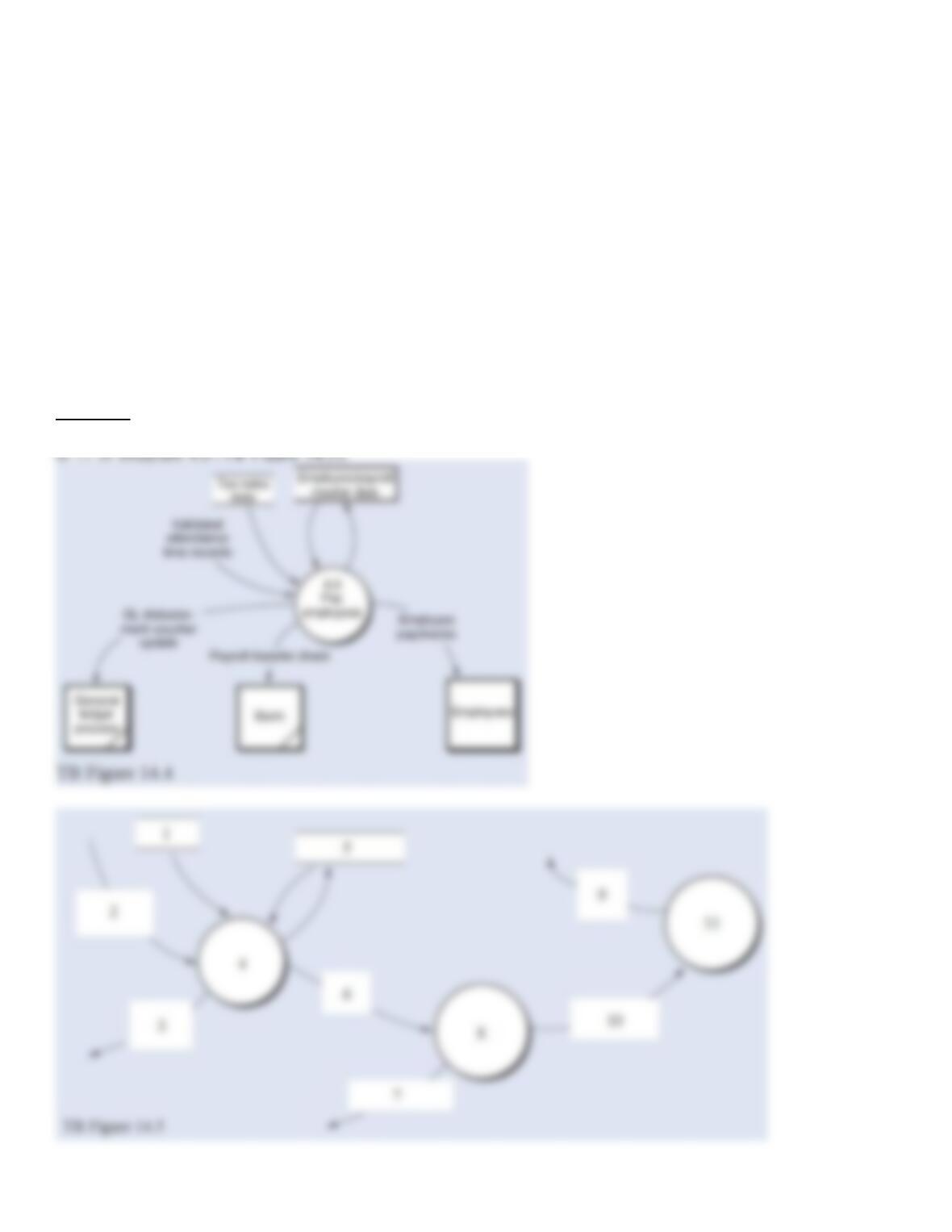
From the DFD in TB Figure 14.2 and the narrative description above, explode bubble 4.0 into a lower level
119. Below is a narrative for the “Pay employees” portion (bubble 4.0) of the payroll process described in
Chapter 14.
Narrative Description
Validated attendance time records initiate the payment to workers in process 4.0 (Pay employees). In
calculating employees’ gross and net pay, Process 4.1 (Prepare paychecks) retrieves data from both the
employee/payroll master data and the tax rates data. Process 4.1 accumulates current, quarter-to-date, and year-
to-date totals for each employee and reports this information via the data flow “Payroll register.” This
information also is used to update the employee/payroll master data. Finally, process 4.1 prints and distributes
paychecks to employees as reflected in the “Employee paychecks” data flow.
The data flow “Payroll register” triggers process 4.2 (Prepare disbursement voucher). This will result in a data
flow for the GL disbursement voucher update and a data flow for the disbursement voucher. Process 4.3
(Prepare payroll transfer check) and sends the check to the bank to cover the organization’s periodic net payroll.
Required:
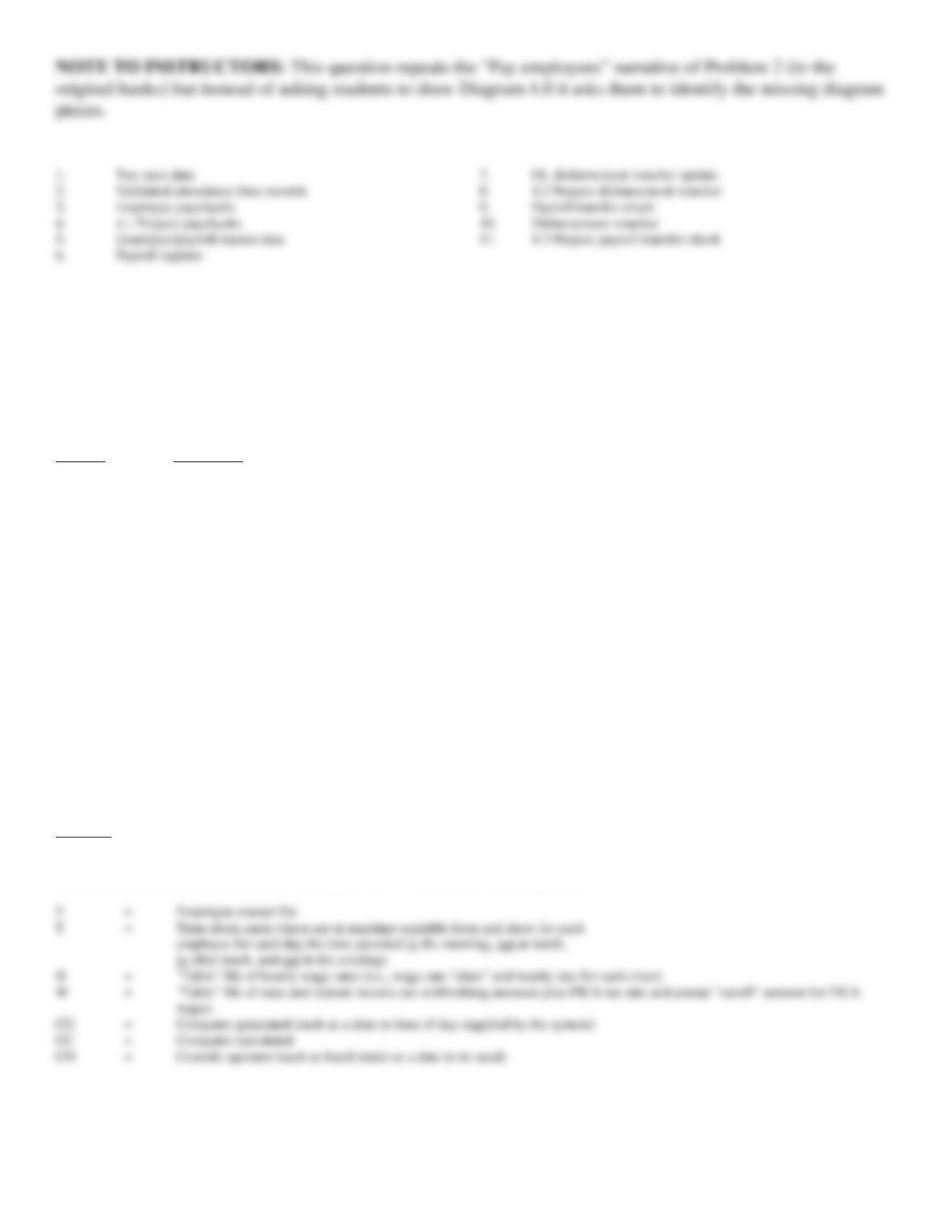
Using the DFD in TB Figure 14.4 and the narrative description above, identify the words that belong in items 1
120. Assume you are working with a payroll application that produces weekly paychecks, including paystubs.
Listed below are 20 data elements that appear on the paycheck/paystub.
Data Elements
Number
Description
1.
Employee identification number
2.
Social security number
3.
Employee name
4.
Employee address
5.
Regular hours worked
6.
Overtime hours worked
7.
Pay rate classification
8.
Hourly pay rate
9.
Regular earnings
10.
Overtime earnings
11.
Total earnings
12.
Deduction for federal income tax
13.
Deduction for state income tax
14.
Deduction for FICA tax
15.
Union dues withheld (flat amount based on length of service)
16.
Net pay
17.
Check number (same number is also preprinted on each check form)
18.
Year-to-date amounts for items 11 through 14 preceding
19.
Pay-period end date
20.
Date of check (employees are paid on Wednesday for the week ended the previous Friday)
Required:
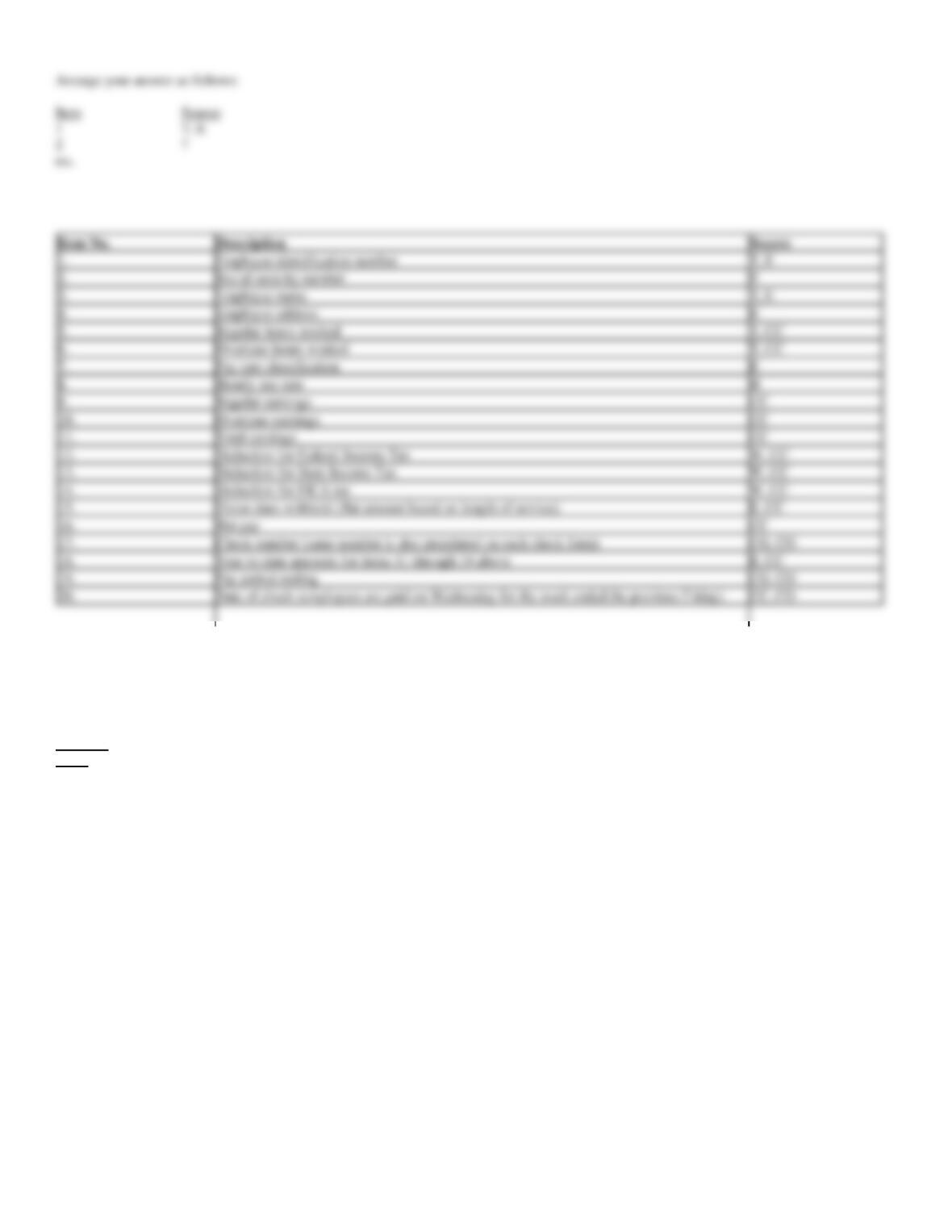
For each numbered item, indicate the immediate (versus ultimate) source of the item. For instance, the immediate source of the number of
exemptions for an employee would be the employee master file as opposed to the ultimate source which is the W-4 form filed by the employee. Some
items may have more than one source, as in the case of item 1. You have the following choices:
E
=
Employee master file
T
=
Time clock cards (these are in machine-readable form and show for each
employee for each day the time punched in the morning, out at lunch,
H
=
“Table” file of hourly wage rates (i.e., wage rate “class” and hourly rate for each class)
=
Computer generated (such as a date or time of day supplied by the system)
=
Computer calculated
=
Console operator (such as batch totals or a date to be used)
1.
Tax rates data
7.
GL disbursement voucher update
2.
Validated attendance time records
8.
4.2 Prepare disbursement voucher
3.
Employee paychecks
9.
Payroll transfer check
4.
4.1 Prepare paychecks
10.
Disbursement voucher
5.
Employee/payroll master data
11.
4.3 Prepare payroll transfer check
6.
Payroll register
121. The following is a list of 10 control plans.
Control
Plans
A.
Independent paycheck distribution
F.
Payroll service bureau
B.
Reconcile bank account
G.
Payroll clearing account
C.
Tickler file of employees due for periodic performance reviews.
H.
Reconcile run-to-run totals
D.
Reconcile attendance time data and attendance time data
I.
Approve job time data
E.
Electronic time management system
J.
HR self-service system
Item
Source
1
2
?
etc.
Employee identification number
Social security number
E
Employee name
Employee address
E
Regular hours worked
T, CC
Overtime hours worked
T, CC
Pay rate classification
E
Regular earnings
CC
Overtime earnings
CC
Total earnings
Deduction for Federal Income Tax
W, CC
Deduction for State Income Tax
W, CC
Deduction for FICA tax
W, CC
Union dues withheld (flat amount based on length of service)
E, CC
Net pay
CC
Check number (same number is also preprinted on each check form)
CG, CO
E, CC
Pay period ending
CG, CO
Date of check (employees are paid on Wednesday for the week ended the previous Friday)
CC, CO

Required:
Listed below are ten system failures that indicate weaknesses in control. On the answer line to the left of each description, insert the capital letter
(from the list above) of the best control plan to address the system deficiency described. A letter should be used only once.
1.
Grover Company was experiencing cost overruns on several construction projects. An investigation seemed to indicate
that workers were recording more hours to some jobs than they actually worked on those jobs.
2.
Some project managers at Gecko Consultants are having trouble understanding why there are cost overruns on their
projects. They suspect that some staff are mistakenly recording hours worked to their projects and not to other
managers’ projects.
3.
Management at Duclos Company suspects that some supervisors are submitting attendance time records, and collecting
the paychecks, for employees that don’t exist.
4.
Payroll checks being cashed at Bemidji Company are greater than the amount of the checks issued.
5.
Randy, the owner of Winsted Company, suspects that his accountant is making unauthorized disbursements.
6.
Employees at Farmington, Inc. are complaining that they cannot easily view and make changes to their retirement plans.
7.
Employees at Kindle, Inc are unclear as to how well they are doing in their jobs.
8.
Beverly, the new CFO at Florida Company, believes that the process of collecting attendance and job time data is
inefficient.
9.
The initial calculations for employee payments at Garfield Inc. do not agree with the payments recorded and made.
10.
The controller at Blanford Company believes that the present payroll process is inefficient and error-prone. For
example, they have trouble keeping up with changing tax and benefits regulations.
1.
D
2.
I
3.
A
4.
G
5.
B
7.
C
8.
E
9.
H
10.
F