Accounting Information Systems, 2e (Kay/Ovlia)
Chapter 14 Database Design: ERD, REA, and SQL
Objective 1
1) The largest provider of relational database tools is Sun Microsystems Inc.
2) Information assets are the new currency of business.
3) The database integrity rule Referential Integrity states that field values must be from a
predefined domain.
4) The database integrity rule Primary Key Integrity states each record in the database must have
a unique identifier called a primary key.
5) Database anomalies are problems within a database table that result in inaccurate or
incomplete data.
6) Database modeling may require additional investment of time as the database is being
developed.
7) ________ are a crucial component of the enterprise system, containing intellectual property.
8) ________ databases contain data collected by other organizations and agencies, such as the
Securities and Exchange Commission (SEC).
9) ________ databases can be classified as (1) operational databases, (2) data warehouses, or (3)
XBRL databases.
10) Operational databases almost exclusively use the ________ structure.
11) The ________ database structure is used by data warehouses.
12) ________ is a technique used to develop an anomaly-free database with database integrity.
13) Database anomalies are removed through ________ and/or database modeling.
14) The database ________ creates the database model.
15) The database ________ creates the database.

Match the database integrity rule to the appropriate definition.
A) Each record in the database must have a unique identifier called a primary key.
B) Data referenced and stored in related tables must be consistent across the database.
C) The field values must be from a predefined domain.
D) The primary key value cannot be null (empty).
16) Rule 1: Entity Integrity
Diff: 2
Objective: Q14.1 What do I need to know about databases?
17) Rule 2: Primary Key Integrity
Diff: 2
Objective: Q14.1 What do I need to know about databases?
18) Rule 3: Domain Integrity
Diff: 1
Objective: Q14.1 What do I need to know about databases?
19) Rule 4: Referential Integrity
Diff: 1
Objective: Q14.1 What do I need to know about databases?
Match the database realm to the appropriate activity.
A) Create database tables
B) Update data
C) Create database model
20) Database designer realm
Diff: 1
Objective: Q14.1 What do I need to know about databases?
21) Database builder realm
Diff: 1
Objective: Q14.1 What do I need to know about databases?
22) Database user realm
Diff: 1
Objective: Q14.1 What do I need to know about databases?
23) Which database architecture is a relatively new type of database?
A) Dimensional
B) XBRL
C) Relational
D) Network
24) Which database architecture is typically used for data warehouses?
A) Dimensional
B) XBRL
C) Relational
D) Network
25) Data, such as accounting data, can be facts related to
A) Records
B) Tables
C) Objects
D) RDBMS software
26) Data integrity refers to data being
A) Current and active
B) Current and complete
C) Accurate and current
D) Accurate and complete
27) This database essential retrieves data from a database.
A) Report
B) Form
C) Query
D) Field
28) Which of the following is NOT a database anomaly?
A) Update
B) Commit
C) Deletion
D) Insertion
29) You are an intern at a company. Some managers want to copy some of the data in the
accounting database into a data warehouse. Your boss is questioning why this is necessary.
Create an email explaining why this is a good idea.
30) List and define the four database essentials.
31) Provide an example of a deletion anomaly, update anomaly, and an insertion anomaly.
32) What is data modeling?
33) What are the three realms of a database and what happens in each realm?
1) Sometimes, in an entity relationship diagram, the entity relationship is written on the
connection line.
2) Entity identifiers are attributes that uniquely identify an entity occurrence.
3) For a single occurrence of one entity (one customer), cardinality defines the maximum and
minimum number of occurrences that might relate to the other entity (sales orders).
4) A candidate key is an entity identifier that uniquely identifies an entity.
5) One-to-one relationships are problematic when building a database.
6) In an ERD diagram, an entity is represented by a rounded box or rectangle.
7) The third step in creating a ERD diagram is to determine the relevant business transactions
that the enterprise must support.
8) The name given to a relationship, for example one-to-one, defines the maximum cardinalities.
9) When using normalization for database development, all the attributes are placed in one huge
table.
10) After ensuring compliance with the BCNF normalization rule, rarely does a database table
need further normalization.
11) ________ depicts the relationship among entities in the database.
12) A specific customer, such as Vincent, is an entity ________.
13) A ________ relationship are problematic when designing databases
14) In a one-to-many relationship in an ERD, the entity on the one side (customer) is called a
________ entity and the entity on the many side (sales order) is called a ________ entity.

15) Database ________ removes anomalies from a database.
16) Detail of the ERD and information about the tables fields, such as their size and type, are
stored in a document called the ________.
Match the ERD symbols to the definition.
A) Entity Attributes
B) Entity
C) Entity identifier
D) Relationship cardinality
E) Entity relationship
17)
Diff: 2
Objective: Q14.2 What is ERD (entity relationship diagram)?
18)
Diff: 2
Objective: Q14.2 What is ERD (entity relationship diagram)?
19)
Diff: 2
Objective: Q14.2 What is ERD (entity relationship diagram)?
20)
Diff: 2
Objective: Q14.2 What is ERD (entity relationship diagram)?
21)
Diff: 2
Objective: Q14.2 What is ERD (entity relationship diagram)?
Match the normalization rule to the appropriate definition.
A) No field can have multiple values.
B) Every identifier should be a candidate key
C) The table identifier (primary key) should not be a composite key.
22) Rule 1: First Normal Form (1NF)
Diff: 2
Objective: Q14.2 What is ERD (entity relationship diagram)?
23) Rule 2. Second Normal Form (2NF)
Diff: 2
Objective: Q14.2 What is ERD (entity relationship diagram)?
24) Rule 3. Boyce-Codd Normal Form (BCNF)
Diff: 2
Objective: Q14.2 What is ERD (entity relationship diagram)?
25) In database design terminology, a customer is an
A) Occurrence
B) Object
C) Attribute
D) Entity
26) Which of the following uniquely identifies the occurrence of an object or event?
A) Entity occurrence
B) Entity attribute
C) Entity identifier
D) Entity name
27) Which of the following describes a property of an object or event?
A) Entity attribute
B) Entity occurrence
C) Entity identifier
D) Composite keys
28) In an ERD diagram, an entity identifier is represented as
A) PK symbol listed by attribute
B) Connector lines
C) Square box
D) Crow’s feet symbols
29) In an ERD diagram, relationship cardinality is represented as
A) PK symbol listed by attribute
B) Connector lines
C) Square box
D) Crow’s feet symbols
30) In an ERD diagram, a relationship between entities is represented as
A) PK symbol listed by attribute
B) Connector lines
C) Square box
D) Crow’s feet symbols
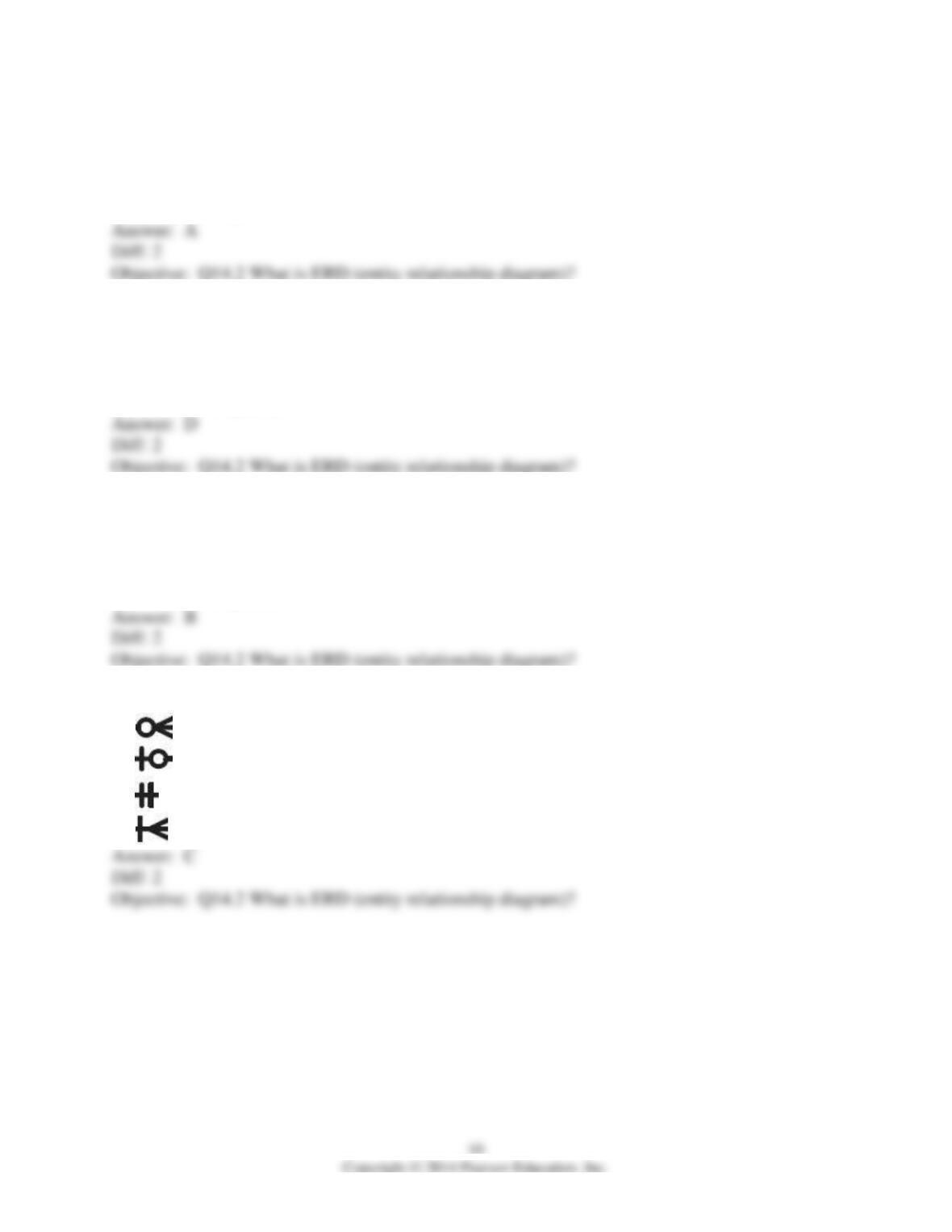
31) Which symbol represents a cardinality of a maximum: 1 and minimum: 1?
A)
B)
C)
D)
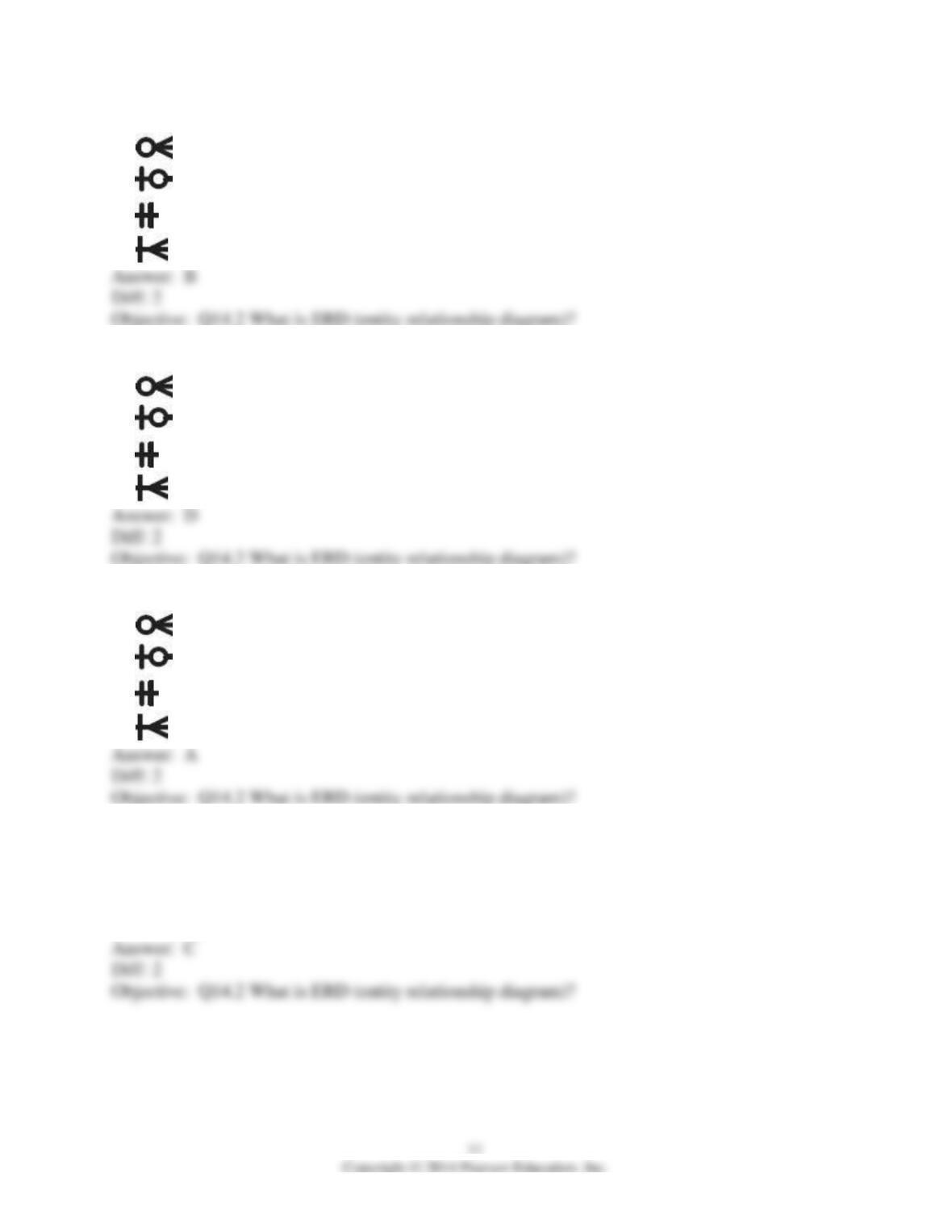
32) Which symbol represents a cardinality of a maximum: 1 and minimum: 0?
A)
B)
C)
D)
33) Which symbol represents a cardinality of a maximum: many and minimum: 1?
A)
B)
C)
D)
34) Which symbol represents a cardinality of a maximum: many and minimum: 0?
A)
B)
C)
D)
35) For an ERD, what do the business rules define?
A) Entities
B) Business transactions
C) Attribute limitations
D) Entity attributes