1. Divisional income statements do not have to follow generally accepted accounting
principles (GAAP) because they are internal reports.
2. One advantage of using after-tax income as a performance measure of divisional results is
it’s a financial accounting measure that is also used to compute the organizational income.
3. One disadvantage of using after-tax income as a performance measure of divisional
results is it’s an absolute measure which makes it difficult to compare divisions of significantly
different sizes.
4. The profit margin ratio is computed by dividing after-tax operating income by sales.
5. In general, it is better to have a higher return on investment (ROI) than a lower one.
6. One problem associated with using accounting measures to evaluate divisional
performance is the measures are based on historical information.
7. A problem with ratio-based measures is that managers can make decisions that improve
divisional income but lower total organizational income.
8. It is not possible for a manager to accept an unacceptable project when his/her
performance is evaluated using ROI.
9. Residual income is the difference between the divisional income and the cost of invested
capital required to operate the division.
10. The use of residual income reduces, but does not eliminate, the suboptimization problem.
11. Managerial myopia is the distortion in incentives that result from using accounting
measures to evaluate performance.
12. Most organizations use residual income instead of return on investment (ROI) as a
performance measure.
13. Economic value added (EVA) adjustments are made to
both
the after-tax income and the
capital employed.
14. Treating research and development costs as an expense rather than a long-term asset
may reduce a manager’s inclination to participate in research and development activities.
15. One problem with economic value added (EVA) adjustments is determining the
appropriate life for expenditures that benefit multiple periods.
16. Like return on investment (ROI), economic value added (EVA) adjustments fail to
sufficiently address the sub-optimization problem.
17. In general, a division’s investment base includes an allocated share of the corporate
headquarters’ assets.
18. Using net book values instead of gross book values to compute return on investment (ROI)
might encourage an investment center manager to delay replacing inefficient assets until they are
fully depreciated.
19. Current costs should not be used to compute either return on investment (ROI) or residual
income because current costs are not generally accepted accounting principles (GAAP).
20. Historical costs are based on the original costs to acquire a long-term asset, while current
costs represent the costs to replace the long-term asset.
21. Which of the following statements is (are) true?
(A) Divisional income statements do not include allocated common costs.
(B) The gross margin ratio is computed by dividing operating income by sales.
22. After-tax income divided by sales is called the:
23. The measure (ratio) that reflects the performance of a manager regarding sales and cost
of goods sold, but not other operating costs and income taxes, is called the:
24. If a division is evaluated using return on investment (ROI) without regard to how assets
are financed, the denominator in the ROI calculation will be:
25. Return on investment (ROI) can be decomposed into the asset turnover and the:
26. The asset turnover is a measure (ratio) of an investment center’s ability to:
27. Which of the following statements does
not
represent a limitation of using return on
investment (ROI) for measuring and evaluating performance?
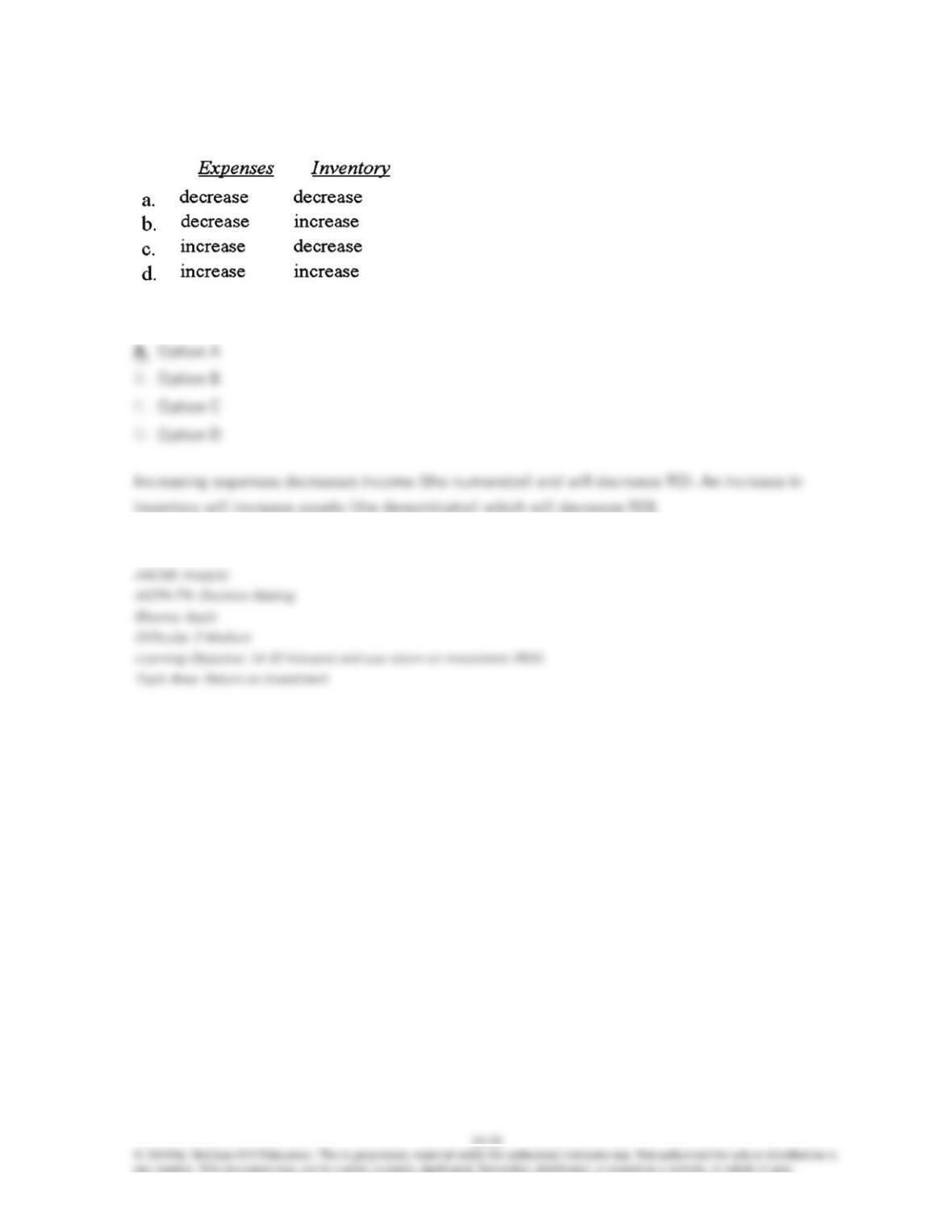
28. How will
increases
in the following items affect return on investment (ROI)?
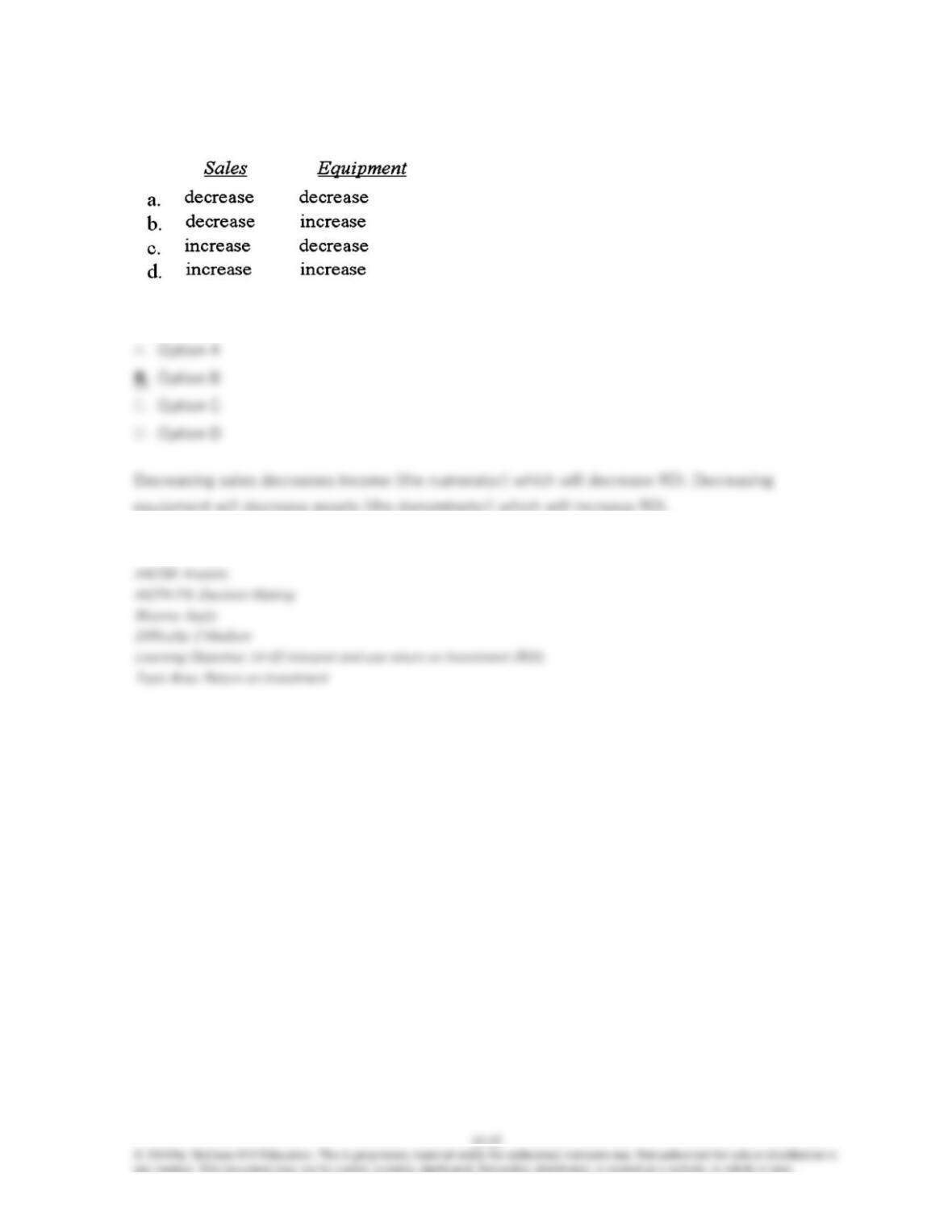
29. How will
decreases
in the following items affect return on investment (ROI)?
30. A division earning a profit will increase its return on investment (ROI) if it increases
operating expenses and:
31. Which of the following statement(s) is/are true?
(A) If a division’s return on investment (ROI) exceeds its cost of capital, then its residual income is
positive.
(B) If a division’s cost of capital equals its return on investment (ROI), then its residual income is
zero.
32. Residual income is similar to the _________ notion of profit as being the amount left over
after all costs, including the cost of the capital employed in the division, are subtracted.
33. Which of the following statement(s) is/are false?
(A) Residual income can be used to compare divisions of different sizes.
(B) Residual income can be used to compare divisions that are profit centers.
34. Managerial performance can be measured in many different ways including return on
investment (ROI) and residual income. A good reason for using residual income instead of ROI is
that:
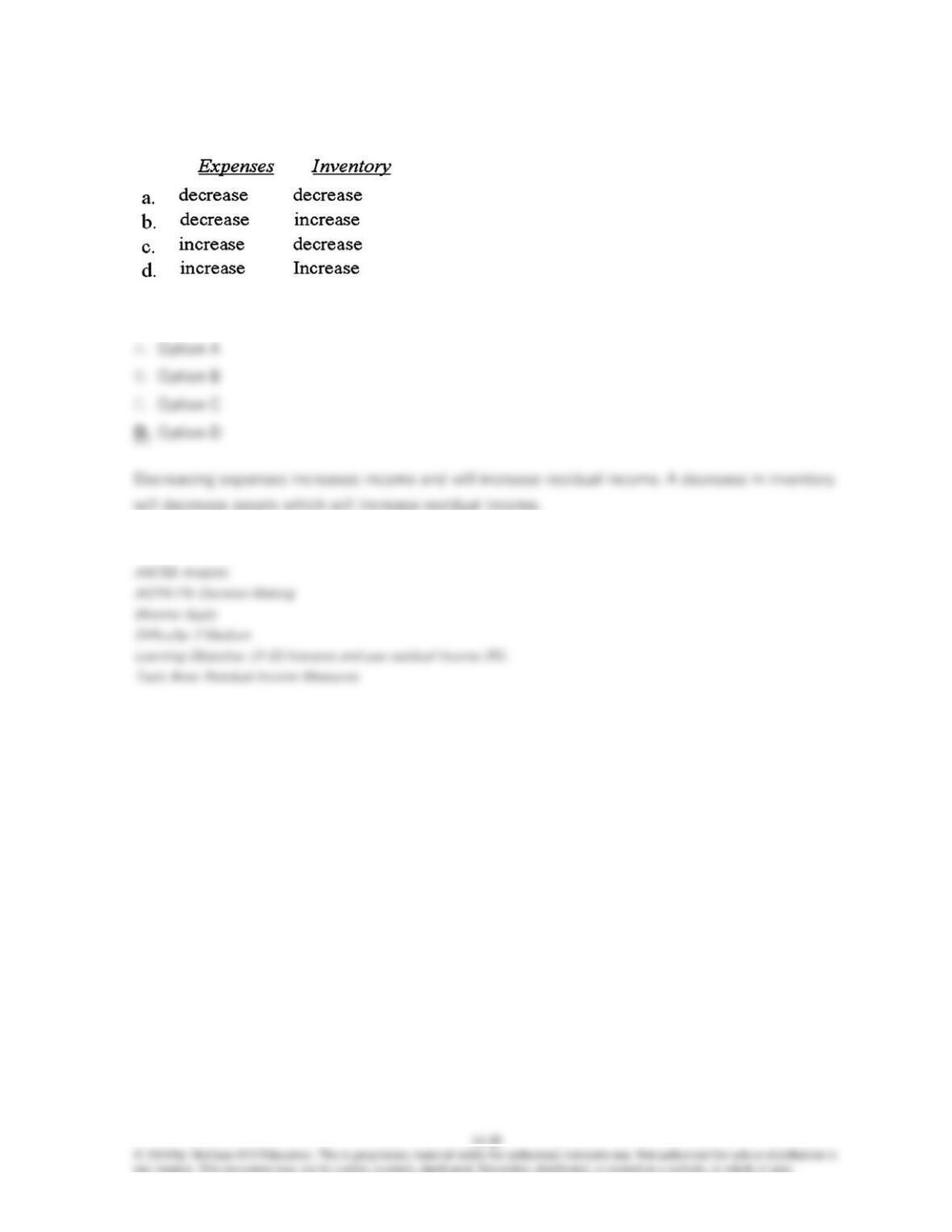
35. How will
decreases
in the following items affect residual income?