Chapter 14 – Decision Making: Relevant Costs and Benefits
14-1
Chapter 14
Decision Making: Relevant Costs and Benefits
Answer Key
True / False Questions
1. The first step in the decision-making process is to identify the alternatives.
2. The last step in the decision-making process is to collect the data.
3. The managerial accountant’s primary role in the decision-making process is to decide what
information is relevant to the problem and provide timely and accurate data.
Chapter 14 – Decision Making: Relevant Costs and Benefits
14-2
4. In the final analysis of a decision, quantitative measures are more important than qualitative
measures.
5. The concept of a relevant cost can be defined as a past cost that differs among alternatives.
6. Cost predictions relevant to repetitive decisions typically can draw on a large amount of
historical data.
Chapter 14 – Decision Making: Relevant Costs and Benefits
14-3
7. The City of Columbus should not consider the purchase price of its old vehicle when
making the decision to replace it with a more cost effective new vehicle.
8. The term “opportunity cost” is best defined as the benefit associated with a rejected
alternative when making a choice.
9. Dubin Company is operating at capacity and wants to add a new service to its expanding
business. The new service should be added as long as service revenues exceed the sum of
variable costs and fixed costs.
Chapter 14 – Decision Making: Relevant Costs and Benefits
14-4
10. Opportunity cost is not important in special order decisions.
11. In most all decisions, joint costs are relevant costs.
12. A firm that decides to emphasize those goods with the highest contribution margin per
unit may have made an incorrect decision when the company has capacity constraints in the
form of limited resources.
Chapter 14 – Decision Making: Relevant Costs and Benefits
14-5
13. Under activity-based costing, the concepts underlying relevant-costing analysis are not
valid because they may derive conclusions that are different than those obtained with
conventional cost analyses.
14. The process of identifying relevant costs and benefits is largely the same whether the
decision is viewed from a short-run or long-run perspective.
15. The axes and constraints form an area for the solution to a linear program called the
relevant region.
Chapter 14 – Decision Making: Relevant Costs and Benefits
14-6
16. Linear programming is used for writing code, but not for product mix problems.
Chapter 14 – Decision Making: Relevant Costs and Benefits
14-7
Multiple Choice Questions
17. Managerial accountants:
Chapter 14 – Decision Making: Relevant Costs and Benefits
14-8
19. At which step or steps in the decision-making process do qualitative considerations
generally have the greatest impact?
20. An accounting information system should be designed to provide information that is
useful. To be useful the information must be:
Chapter 14 – Decision Making: Relevant Costs and Benefits
14-9
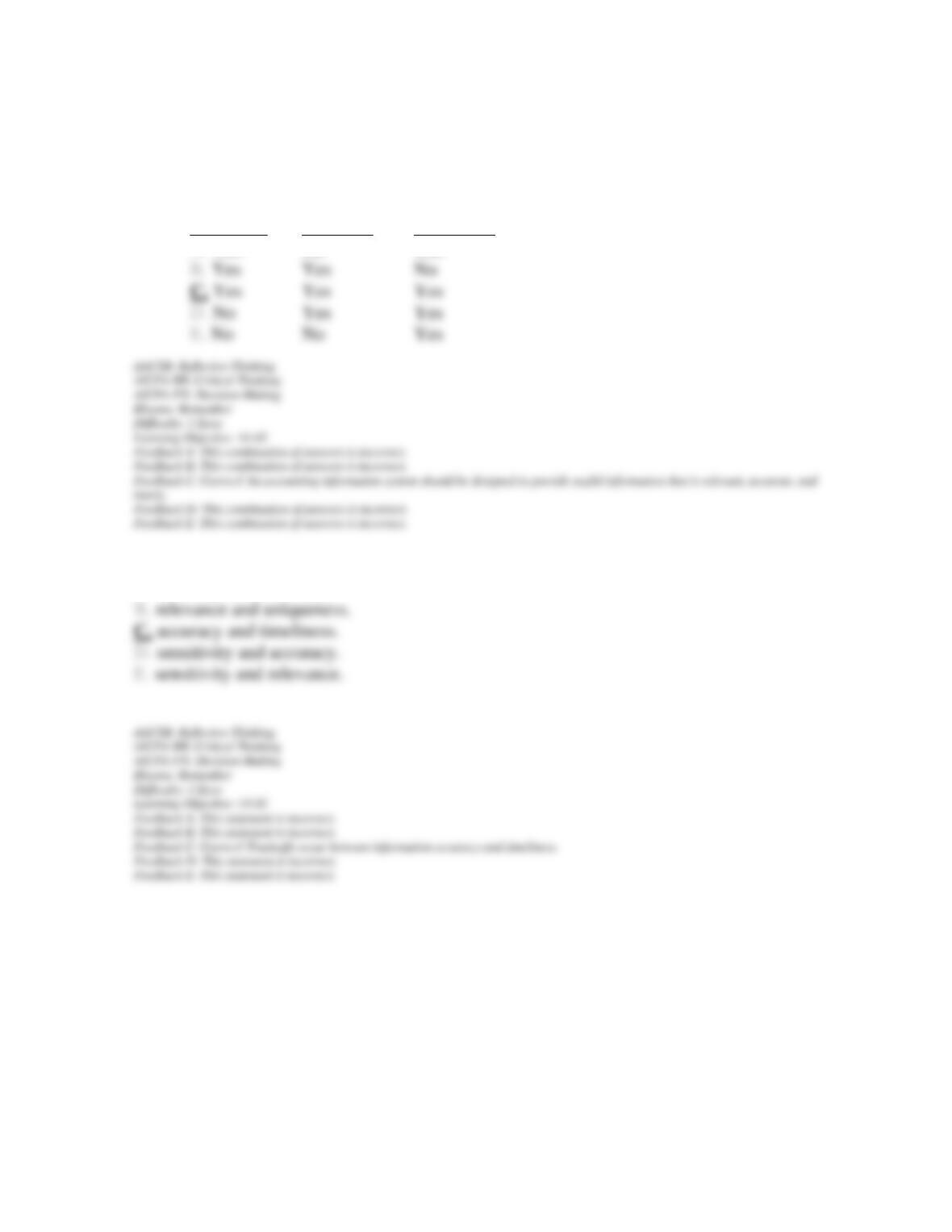
21. To be useful in decision making, information should possess which of the following
characteristics?
Relevance Accuracy Timeliness
A. Yes No Yes
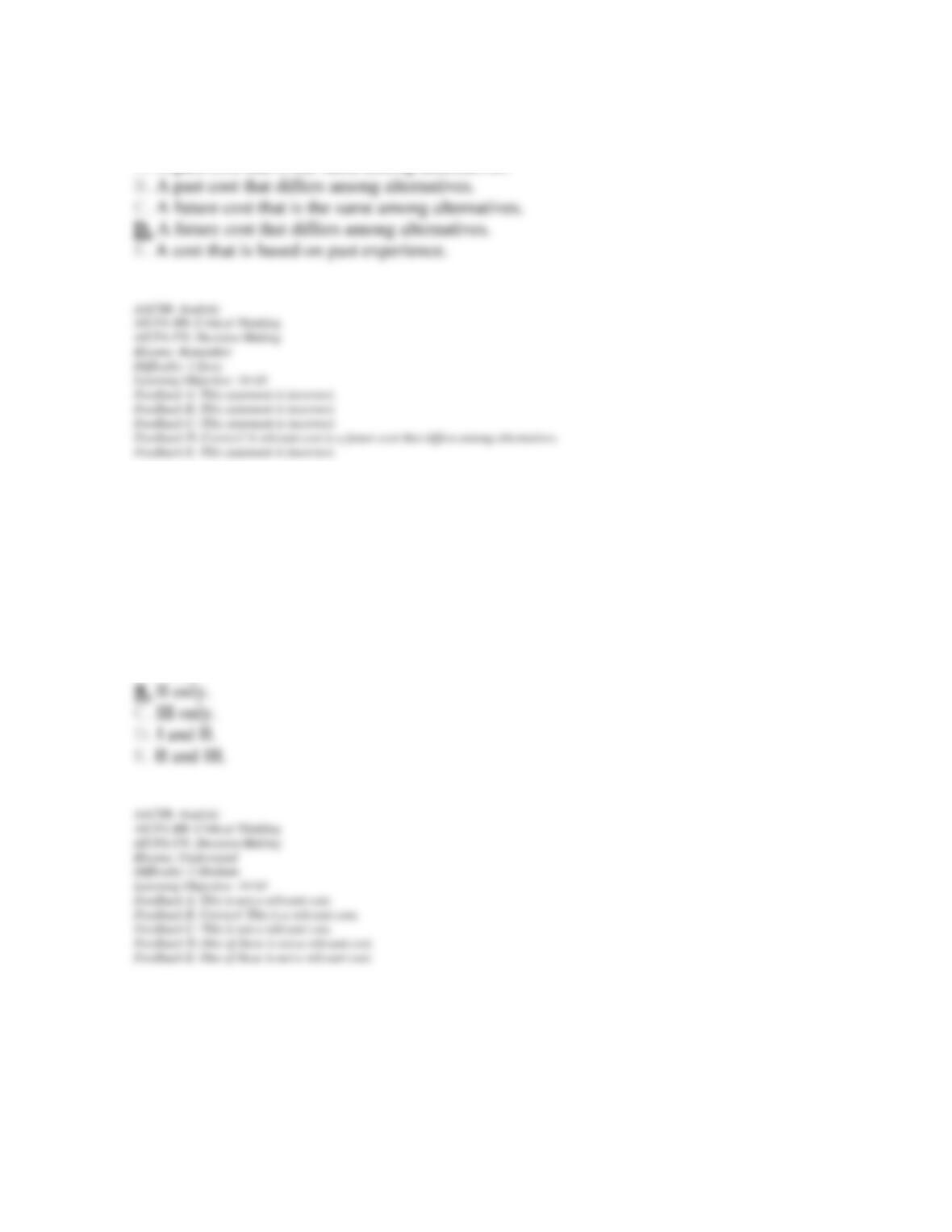
22. A trade-off in a decision situation sometimes occurs between information:
A. accuracy and relevance.
Chapter 14 – Decision Making: Relevant Costs and Benefits
14–10
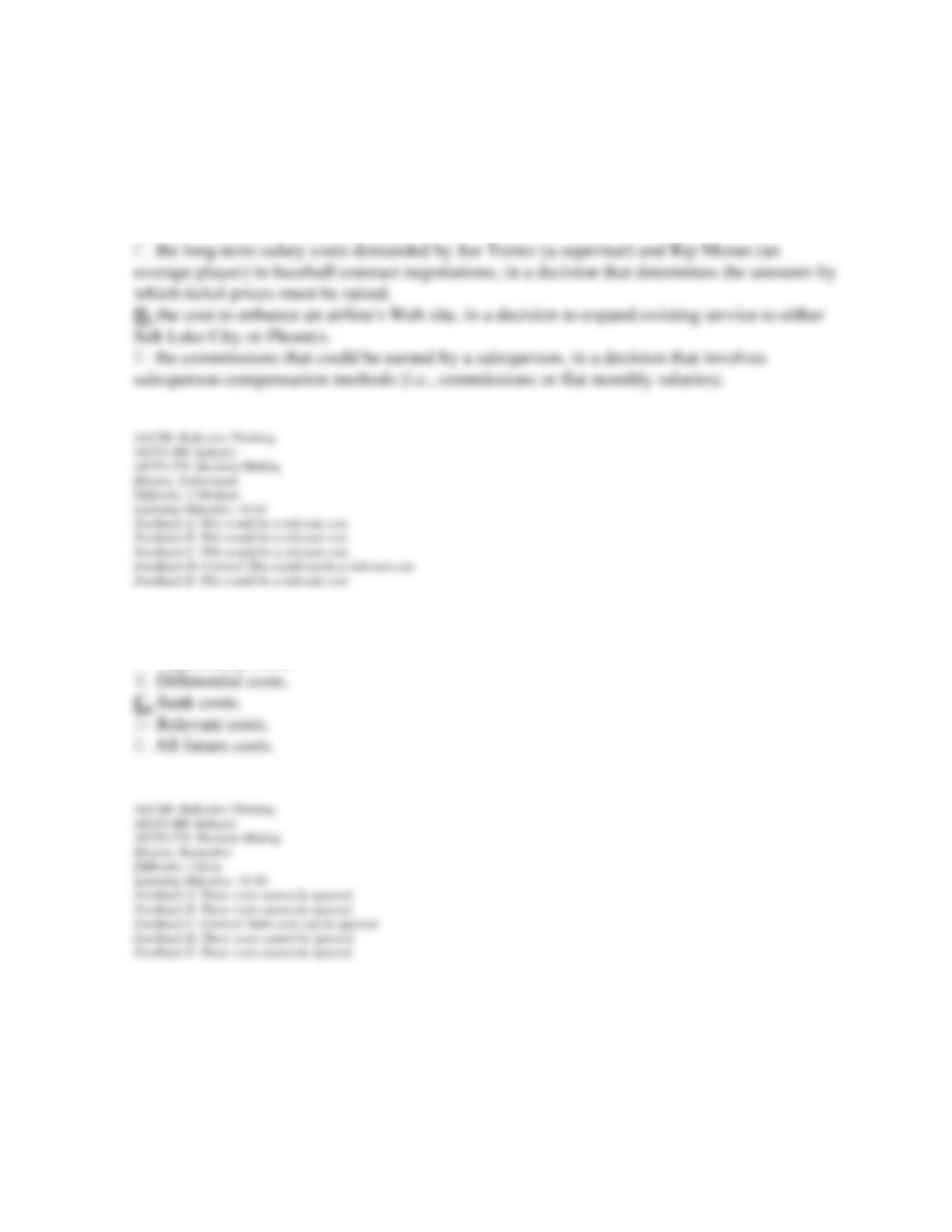
23. Which of the following best defines the concept of a relevant cost?
A. A past cost that is the same among alternatives.
24. Consider the following costs and decision-making situations:
I. The cost of existing inventory, in a keep vs. disposal decision.
II. The cost of special electrical wiring, in an equipment acquisition decision.
III. The salary of a supervisor who will be transferred elsewhere in the organization, in a
department-closure decision.
Which of the above costs is (are) relevant to the decision situation noted?
A. I only.
Chapter 14 – Decision Making: Relevant Costs and Benefits
14–11
25. The following costs are relevant to the decision situation cited except:
A. the cost of hiring a full-time staff attorney, in a decision to establish an in-house legal
department or retain the services of a prominent law firm.
B. the remodeling cost of existing office space, in a firm’s decision to stay at its current
location or move to a new building.
26. Which of the following costs can be ignored when making a decision?
A. Opportunity costs.

Chapter 14 – Decision Making: Relevant Costs and Benefits
14–12
27. The book value of equipment currently owned by a company is an example of a (n):
A. future cost.
28. The cost of inventory currently owned by a company is an example of a (n):
A. opportunity cost.
Chapter 14 – Decision Making: Relevant Costs and Benefits
14–13
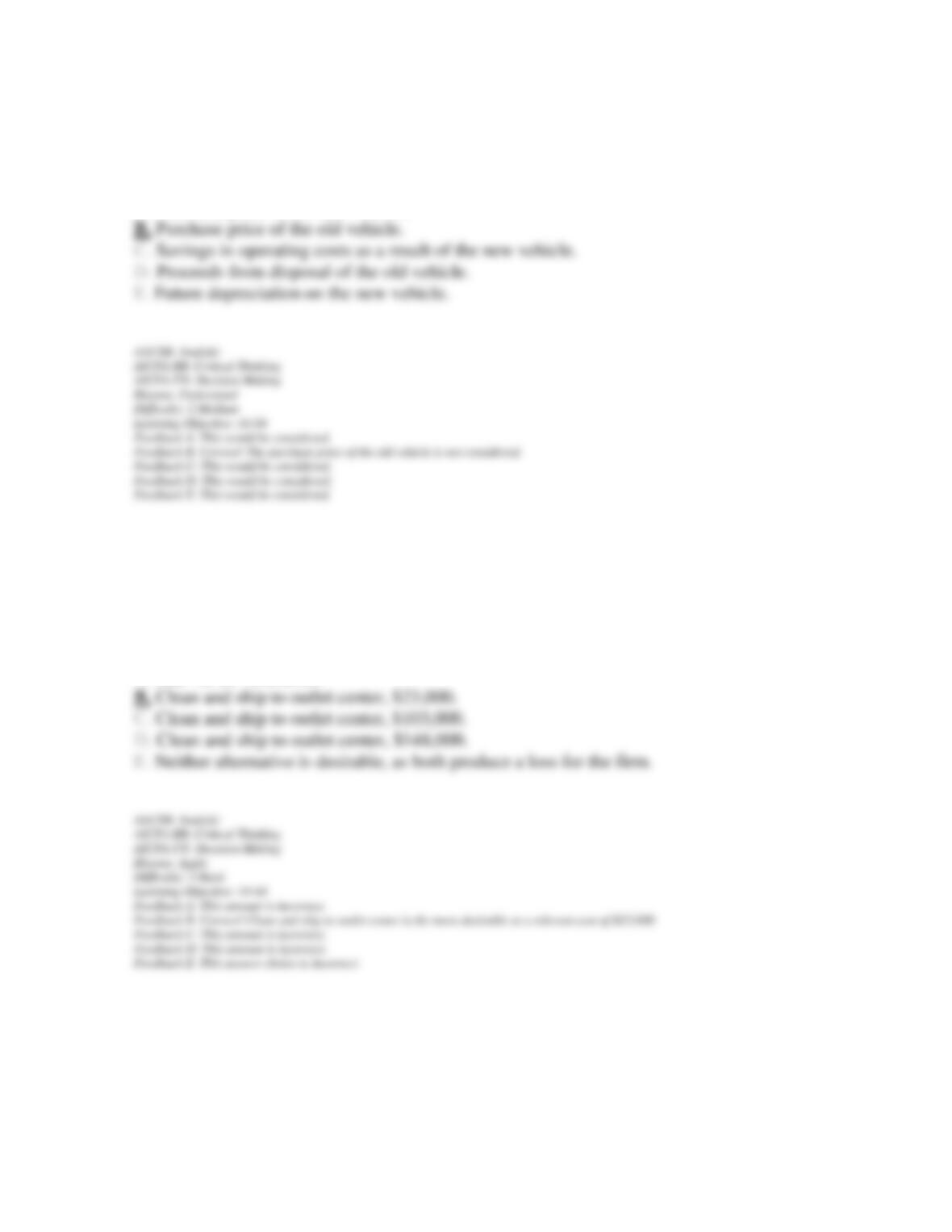
29. The City of San Diego is about to replace an old fire truck with a new vehicle in an effort
to save maintenance and other operating costs. Which of the following items, all related to the
transaction, would not be considered in the decision?
A. Purchase price of the new vehicle.
30. Cornerstone, Inc. has $125,000 of inventory that suffered minor smoke damage from a
fire in the warehouse. The company can sell the goods “as is” for $45,000; alternatively, the
goods can be cleaned and shipped to the firm’s outlet center at a cost of $23,000. There the
goods could be sold for $80,000. What alternative is more desirable and what is the relevant
cost for that alternative?
A. Sell “as is,” $125,000.
Chapter 14 – Decision Making: Relevant Costs and Benefits
14–14
31. In early July, Colin Marks purchased a $70 ticket to the December 15 game of the
Sarasota Shippers. Parking for the game was expected to cost approximately $22, and Marks
would probably spend another $15 for a souvenir program and food. It is now December 14.
The Shippers were having a miserable season and the temperature was expected to peak at 5
degrees on game day. Marks therefore decided to skip the game and took his wife to the
movies, with tickets and dinner costing $50. The sunk cost associated with this decision
situation is:
A. $20.
32. In early July, Damon Rutton purchased a $70 ticket to the December 15 game of the
Sarasota Shippers. Parking for the game was expected to cost approximately $22, and Rutton
would probably spend another $15 for a souvenir program and food. It is now December 14.
The Shippers were having a miserable season and the temperature was expected to peak at 5
degrees on game day. Damon is thinking about skipping the game and taking his wife to the
movies and dinner, at a cost of $50. The amount of sunk cost that should influence Damon’s
decision to spend some time with his wife is:
Chapter 14 – Decision Making: Relevant Costs and Benefits
14–15
33. An opportunity cost may be described as:
34. The term “opportunity cost” is best defined as:
A. the amount of money paid for an item.
Chapter 14 – Decision Making: Relevant Costs and Benefits
14–16
35. A factory that makes a part has significant idle capacity. The factory’s opportunity cost of
36. Allison is contemplating a job offer with an advertising agency where she will make
$54,000 in her first year of employment. Alternatively, Allison can begin to work in her
father’s business where she will earn an annual salary of $38,000. If Allison decides to work
with her father, the opportunity cost would be:
Chapter 14 – Decision Making: Relevant Costs and Benefits
14–17
37. Which of the following costs should be used when choosing between two decision
alternatives?
38. Forte, Inc. is studying whether to expand operations by adding a new product line. Which
of the following choices correctly denotes the costs that should be considered in this decision?
Chapter 14 – Decision Making: Relevant Costs and Benefits
14–18
39. A special order generally should be accepted if:
A. its revenue exceeds allocated fixed costs, regardless of the variable costs associated with
the order.
40. Two months ago, Air-tite Corporation purchased 4,500 pounds of Hydrol, paying
$15,300. The demand for this product has been very strong since the acquisition, with the
market price jumping to $4.05 per pound. (Air-tite can buy or sell Hydrol at this price.) The
company recently received a special-order inquiry, one that would require the use of 4,200
pounds of Hydrol. Which of the following is (are) relevant in deciding whether to accept the
special order?
A. The 300-pound remaining inventory of Hydrol.
Chapter 14 – Decision Making: Relevant Costs and Benefits
14–19
41. McAlister Company is operating at capacity and desires to add a new service to its rapidly
expanding business. The service should be added as long as service revenues exceed:
A. variable costs.
42. Flavor Enterprises has been approached about providing a new service to its clients. The
company will bill clients $140 per hour; the related hourly variable and fixed operating costs
will be $75 and $18, respectively. If all employees are currently working at full capacity on
other client matters, the per-hour opportunity cost of being unable to provide this new service
is:
A. $0.
Chapter 14 – Decision Making: Relevant Costs and Benefits
14–20
43. Elkhorn, Inc., which has excess capacity, received a special order for 4,000 units at a price
of $15 per unit. Currently, production and sales are anticipated to be 10,000 units without
considering the special order. Budget information for the current year follows.
Sales $190,000
Less: Cost of Goods Sold 145,000
Gross Margin $ 45,000
Cost of goods sold includes $30,000 of fixed manufacturing cost. If the special order is
accepted, the company’s income will:
A. increase by $2,000.