Chapter 14 – Analyzing Financial Statements
1. A primary objective of financial statements is to provide information to current and
potential investors and creditors.
2. Return on equity (ROE) is a function of three ratios: net profit margin, return on assets, and
financial leverage.
3. Return on equity (ROE) provides insight with respect to a company’s use of its assets.
Chapter 14 – Analyzing Financial Statements
4. Time series analysis is where we compare information for a specific company over a period
of time to determine changes in operations.
5. Finding comparable companies in order to compare performance is often difficult since no
two companies have identical products, markets and operating strategies.
6. Finding comparable companies in order to compare performance is important because
ratios in isolation are difficult to evaluate.
Chapter 14 – Analyzing Financial Statements
7. Component percentages are used to express items on financial statements as a percentage of
a single base amount.
8. Financial statement analysis is very precise and doesn’t involve judgment.
9. Purchasing treasury stock increases the return on equity ratio.
Chapter 14 – Analyzing Financial Statements
10. The return on assets ratio is influenced significantly by a company’s relative debt and
equity financing of its assets.
11. Negative financial leverage occurs when a company has more debt than stockholders’
equity.
12. The financial leverage percentage is positive when return on assets is greater than return
on equity.
Chapter 14 – Analyzing Financial Statements
13. Earnings per share (EPS) is affected by treasury stock transactions.
14. The quality of income ratio increases when net income increases.
15. The profit margin ratio considers the asset base utilized to earn income.
Chapter 14 – Analyzing Financial Statements
16. The fixed asset turnover ratio increases when net income increases.
Chapter 14 – Analyzing Financial Statements
17. The cash ratio is less sensitive to small transactions involving cash than is either the
current or quick ratios.
18. A company that has a high level of inventory and other assets above their investment in
property, plant and equipment should calculate the total asset turnover ratio in addition to the
fixed asset turnover ratio.
19. A company with a high amount of inventory will have a much lower fixed asset turnover
ratio when compared to its total asset turnover ratio.
Chapter 14 – Analyzing Financial Statements
20. A higher current ratio is preferable for companies with variable cash flows.
21. The quick ratio decreases when the adjusting entry to record bad debt expense is
recorded.
22. A very high current ratio and low quick ratio may indicate the company is not collecting
its accounts receivables in a timely manner.
Chapter 14 – Analyzing Financial Statements
23. The inventory turnover ratio is significantly affected by the choice of inventory
accounting method.
24. The cash coverage ratio measures a firm’s ability to pay its current liabilities with its cash
flows from operating activities.
25. The price earnings ratio is affected by the amount of risk that investors are willing to
take.
Chapter 14 – Analyzing Financial Statements
26. The debt to equity ratio is a risk measure used by both investors and lenders.
27. The dividend yield ratio decreases when earnings per share increases.
28. Many companies use high levels of debt to finance their assets because of financial
leverage benefits provided to investors when return on assets exceeds the after tax cost of
interest.
Chapter 14 – Analyzing Financial Statements
29. Dividend yield is calculated by dividing dividends per share by earnings per share and
measures the current dividend return to investors.
30. A high price earnings ratio usually indicates the market is optimistic about the company’s
future earnings potential.
31. There are several fundamental purposes decision makers consider when they use financial
data. Which of the following statements is not one of those fundamental purposes?
Chapter 14 – Analyzing Financial Statements
32. When considering an investment, which of the following is not one of the three critical
factors used to evaluate future earning potential of that investment?
33. Which of the following statements is incorrect?
Chapter 14 – Analyzing Financial Statements
34. Which of the following statements is correct?
35. Which of the following statements is incorrect?
36. Which of the following statements is correct?
Chapter 14 – Analyzing Financial Statements
37. Home Depot’s operating strategy is to offer a broad assortment of high-quality
merchandise and services at competitive prices using highly knowledgeable service-oriented
personnel and aggressive advertising. Which of the following is not as critical to achieving its
strategy?
38. Which of the following statements is false?
Chapter 14 – Analyzing Financial Statements
39. Which of the following statements is correct?
40. The base amount in preparing a common-size income statement is usually which of the
following?
Chapter 14 – Analyzing Financial Statements
41. Which of the following statements is correct?
42. Which of the following statements is incorrect?
Chapter 14 – Analyzing Financial Statements
43. During 2010, Home Style’s cost of goods sold percentage was 68.2% and selling and store
operating costs was 19.3% of sales. During 2009, their cost of goods sold percentage was
68.9% while selling and store operating costs was 19.2% of sales. What effect would the
change in these percentages have on 2010’s gross margin percentage and profit margin
percentage?
44. Which of the following ratios is not considered to be a test of profitability?
Chapter 14 – Analyzing Financial Statements
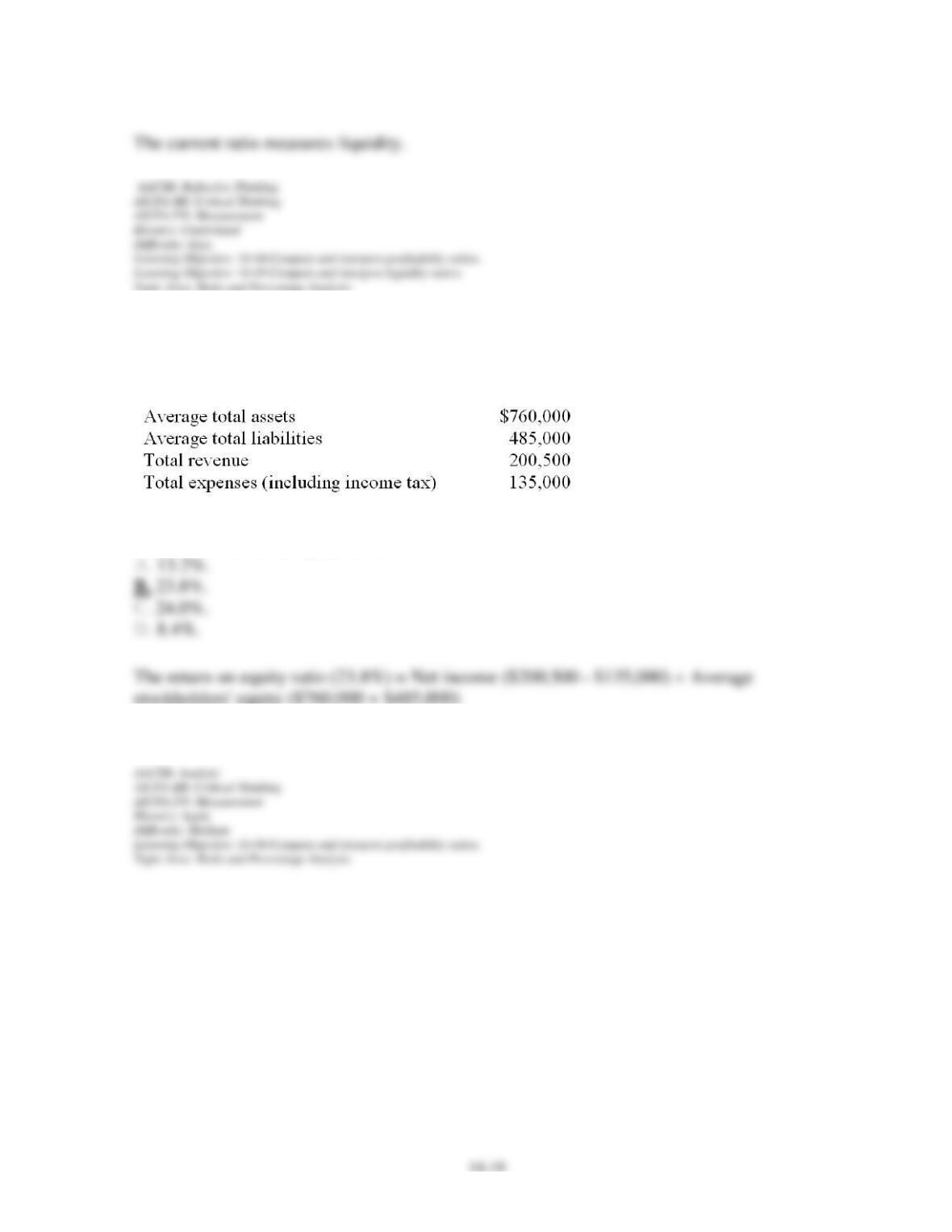
45. The records of Everyday Electronics Corporation for a particular period include the
following:
What is the return on equity ratio?
Chapter 14 – Analyzing Financial Statements
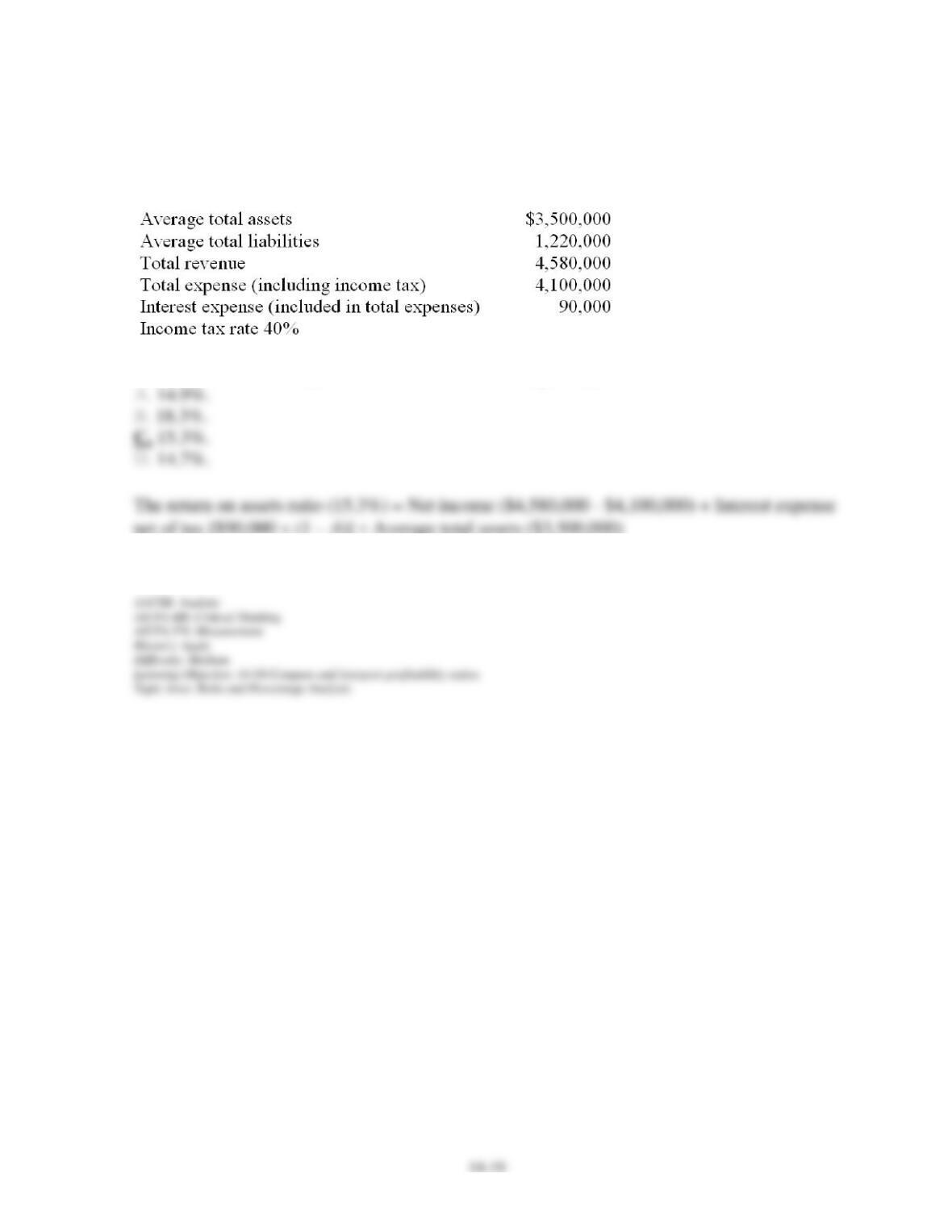
46. The records of Marshall Company include the following:
The return on assets is (round to the nearest tenth of a percent)
Chapter 14 – Analyzing Financial Statements
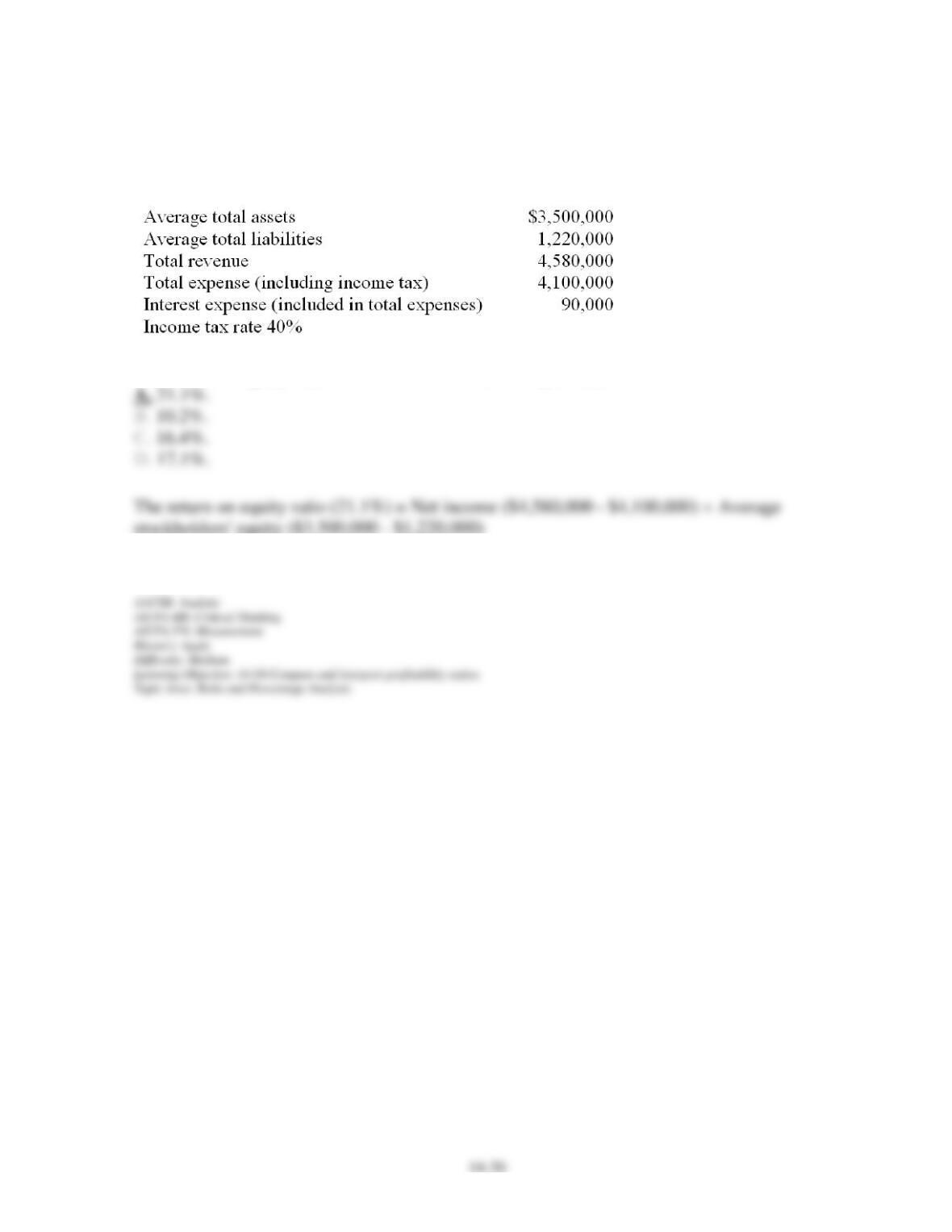
47. The records of Marshall Company include the following:
The return on equity is (round to the nearest tenth of a percent)