Managerial Accounting, 16e (Garrison)
Chapter 13A: The Concept of Present Value
1) The present value of a cash flow will never be greater than the future dollar amount of the cash
flow.
2) The higher the discount rate, the higher the present value of a given future cash flow.
3) The present value of a cash flow increases as it moves further into the future.
4) The present value of an amount to be received in five years is exactly twice as large as the
present value of an equal amount to be received in ten years.
5) The present value of a given future cash flow will decrease as the discount rate decreases.
6) An increase in the discount rate:
A) will increase the present value of future cash flows.
B) will have no effect on net present value.
C) will reduce the present value of future cash flows.
D) is one method of compensating for reduced risk.
7) Suppose an investment has cash inflows of R dollars at the end of each year for two years. The
present value of these cash inflows using a 12% discount rate will be:
A) greater than under a 10% discount rate.
B) less than under a 10% discount rate.
C) equal to that under a 10% discount rate.
D) sometimes greater than under a 10% discount rate and sometimes less; it depends on R.
8) Suddeth Corporation has entered into a 6 year lease for a building it will use as a warehouse. The
annual payment under the lease will be $2,468. The first payment will be at the end of the current
year and all subsequent payments will be made at year-ends. If the discount rate is 5%, the present
value of the lease payments is closest to (Ignore income taxes.):
See separate Exhibit 13B-1 and Exhibit 13B-2 to determine the appropriate discount factor(s)
using table.
A) $12,528
B) $14,103
C) $14,808
D) $11,050
9) How much would you have to invest today in the bank at an interest rate of 8% to have an
annuity of $4,800 per year for 7 years, with nothing left in the bank at the end of the 7 years? Select
the amount below that is closest to your answer. (Ignore income taxes.)
See separate Exhibit 13B-1 and Exhibit 13B-2 to determine the appropriate discount factor(s)
using table.
A) $33,600
B) $2,798
C) $24,989
D) $31,111
10) At an interest rate of 14%, approximately how much would you need to invest today if you
wanted to have $2,000,000 in 10 years? (Ignore income taxes.)
See separate Exhibit 13B-1 and Exhibit 13B-2 to determine the appropriate discount factor(s)
using table.
A) $383,436
B) $540,000
C) $740,741
D) $1,043,200
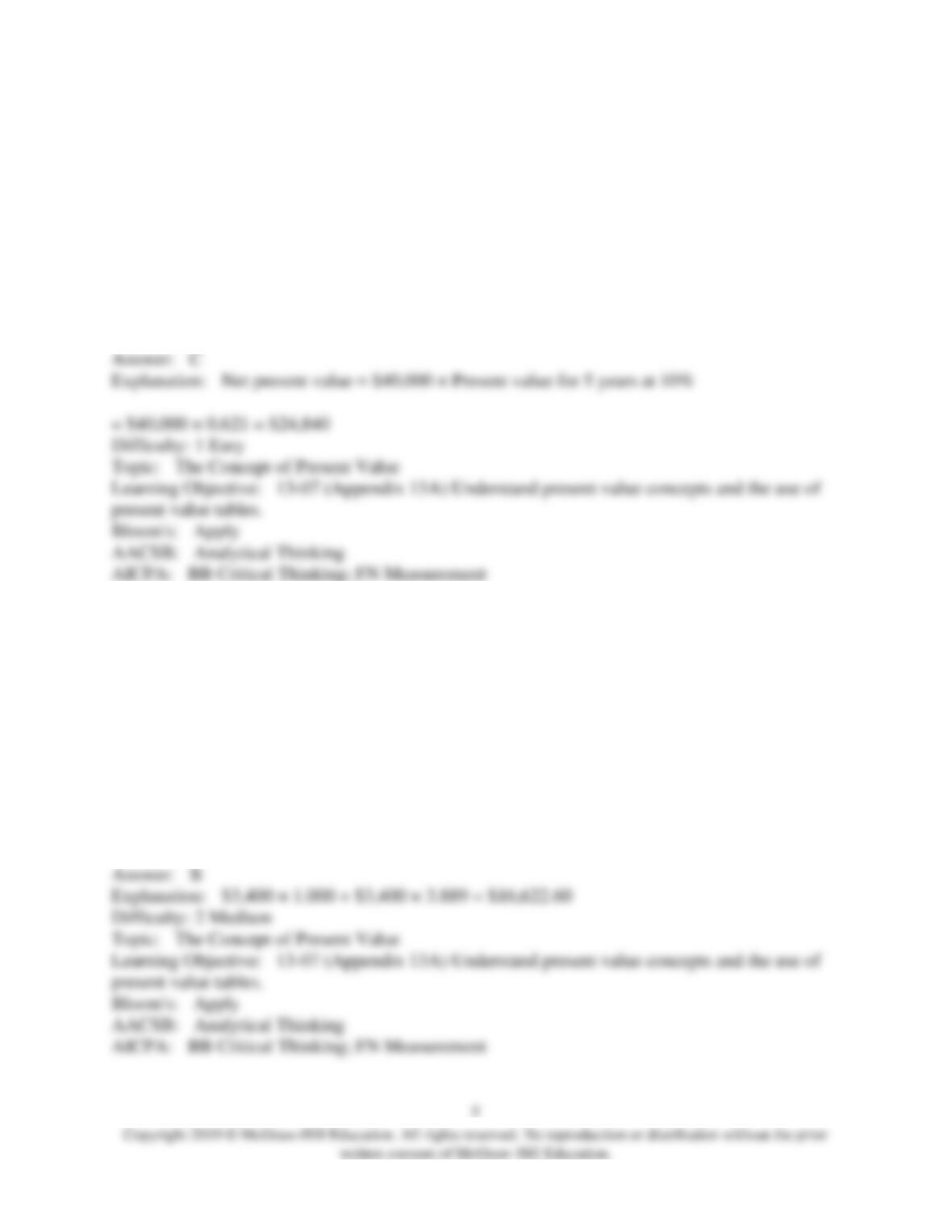
11) A company wants to have $40,000 at the end of a five-year period through investment of a
single sum now. How much needs to be invested in order to have the desired sum in five years, if
the money can be invested at 10% (Ignore income taxes.)?
See separate Exhibit 13B-1 and Exhibit 13B-2 to determine the appropriate discount factor(s)
using table.
A) $10,551
B) $8,000
C) $24,840
D) $12,882
12) Domebo Corporation has entered into a 7 year lease for a piece of equipment. The annual
payment under the lease will be $3,400, with payments being made at the beginning of each year.
If the discount rate is 14%, the present value of the lease payments is closest to (Ignore income
taxes.):
See separate Exhibit 13B-1 and Exhibit 13B-2 to determine the appropriate discount factor(s)
using table.
A) $9,511
B) $16,623
C) $20,877
D) $23,800
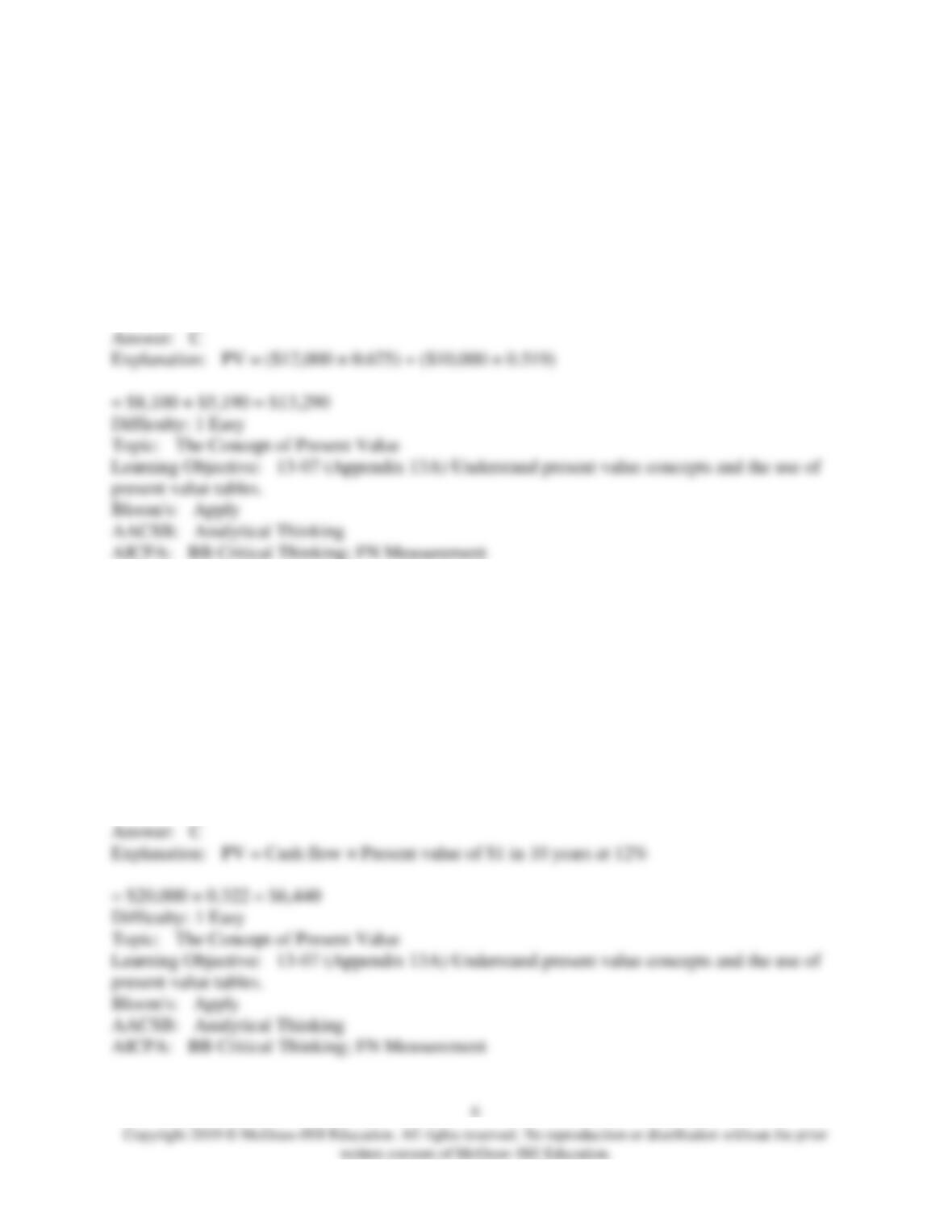
13) In order to receive $12,000 at the end of three years and $10,000 at the end of five years, how
much must be invested now if you can earn 14% rate of return? (Ignore income taxes.)
See separate Exhibit 13B-1 and Exhibit 13B-2 to determine the appropriate discount factor(s)
using table.
A) $12,978
B) $8,100
C) $13,290
D) $32,054
14) A company wants to have $20,000 at the end of a ten-year period by investing a single sum
now. How much needs to be invested in order to have the desired sum in ten years, if the money
can be invested at 12%? (Ignore income taxes.)
See separate Exhibit 13B-1 and Exhibit 13B-2 to determine the appropriate discount factor(s)
using table.5
A) $3,254.68
B) $3,539.82
C) $6,440
D) $7,720
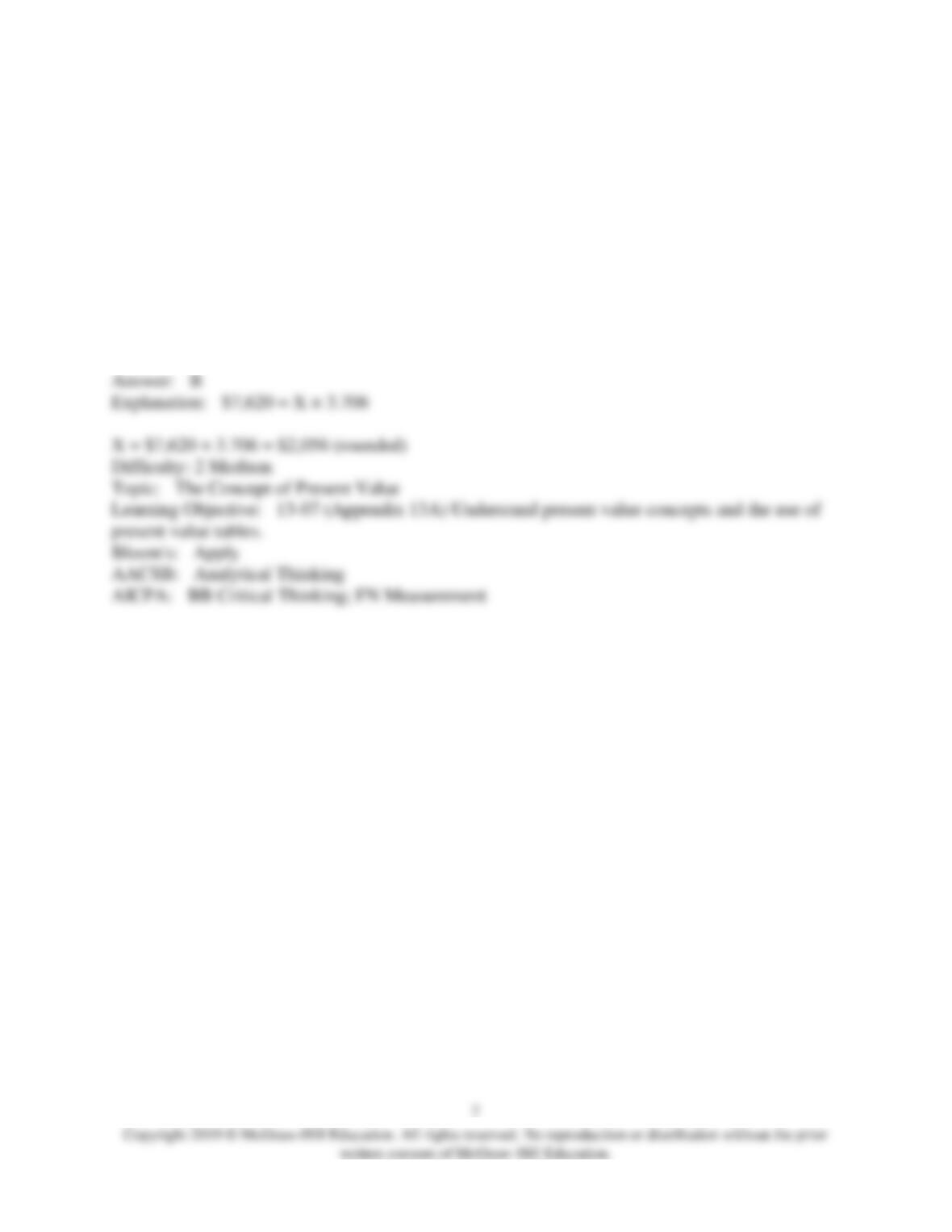
15) You have deposited $7,620 in a special account that has a guaranteed rate of return of 19% per
year. If you are willing to completely exhaust the account, what is the maximum amount that you
could withdraw at the end of each of the next 7 years? Select the amount below that is closest to
your answer. (Ignore income taxes.)
See separate Exhibit 13B-1 and Exhibit 13B-2 to determine the appropriate discount factor(s)
using table.
A) $1,295
B) $2,056
C) $2,219
D) $1,089
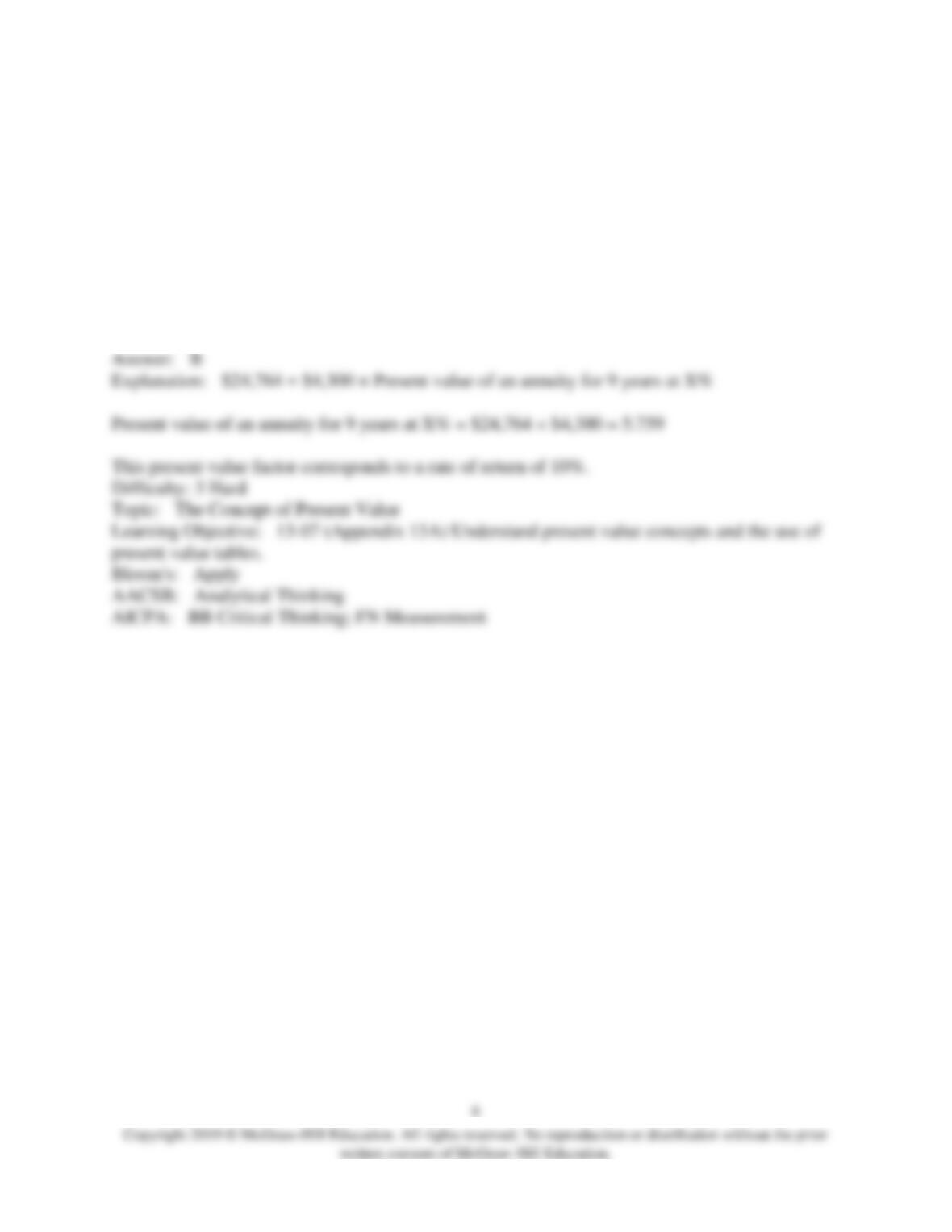
16) You have deposited $24,764 in a special account that has a guaranteed rate of return. If you
withdraw $4,300 at the end of each year for 9 years, you will completely exhaust the balance in the
account. The guaranteed rate of return is closest to: (Ignore income taxes.)
See separate Exhibit 13B-1 and Exhibit 13B-2 to determine the appropriate discount factor(s)
using table.
A) 6%
B) 10%
C) 17%
D) 56%