
81
179) In its 2018 annual report to shareholders, Ank-Morpork Times Inc. included the following
disclosure:
Revenue Recognition
• Advertising revenue is recognized when advertisements are published, are broadcast, or
when placed on the Company’s websites, net of provisions for estimated rebates, credit and rate
adjustments and discounts.
• Circulation revenue includes single copy and home-delivery subscription revenue. Single
copy revenue is recognized based on date of publication, net of provisions for related returns.
Proceeds from home-delivery subscriptions and related costs, principally agency commissions,
are deferred at the time of sale and are recognized in earnings on a pro rata basis over the terms
of the subscriptions.
• Other revenue is recognized when the related service or product has been delivered.
Also, the following information on its current liabilities was included in its comparative balance
sheets:
2018
2017
CURRENT LIABILITIES
Commercial paper outstanding
$158,300,000
$291,251,000
Accounts payable
$170,950,000
$174,552,000
Accrued payroll and other related liabilities
$81,299,000
$126,983,000
Accrued expenses
$160,867,000
$190,748,000
Accrued income taxes
$225,220,000
$9,852,000
Deferred subscriptions revenue
$61,706,000
$81,385,000
Current portion of long-term debt and capital
lease obligations
$2,534,000
$2,599,000
Total current liabilities
$860,876,000
$877,370,000
Required:
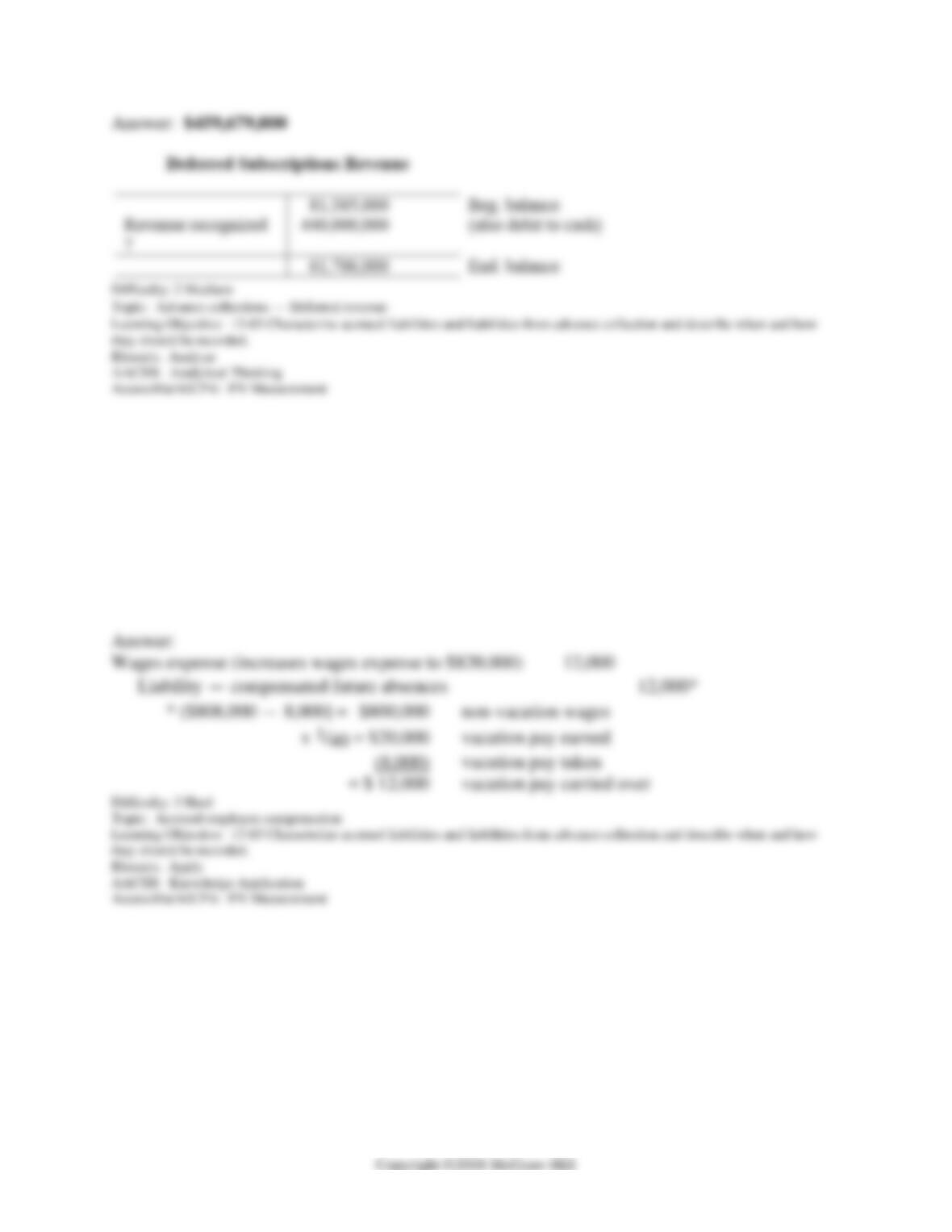
Assuming that Ank-Morpork Times Inc. collected $440,000,000 in cash for home-delivery
subscriptions during fiscal year 2018, what amount of revenue did it recognize during 2018 from
this source? Show the relevant T-account information to support your answer.
82
180) MullerB Company’s employees earn vacation time at the rate of 1 hour per 40-hour work
period. The vacation pay vests immediately, meaning an employee is entitled to the pay even if
employment terminates. During 2018, total wages paid to employees equaled $808,000,
including $8,000 for vacations actually taken in 2018, but not including vacations related to 2018
that will be taken in 2019. All vacations earned before 2018 were taken before January 1, 2018.
No accrual entries have been made for the vacations.
Required:
Prepare the appropriate adjusting entry for vacations earned but not taken in 2018.

83
181) The following facts relate to gift cards sold by Sunbru Coffee Company during 2018.
Sunbru’s fiscal year ends on December 31.
(a.) In October 2018, sold $3,000 of gift cards, and redeemed $500 of those gift cards.
(b.) In November 2018, sold $4,000 of gift cards, and redeemed $1,400 of October gift cards and
$700 of November gift cards.
(c.) In December 2018, sold $3,000 of gift cards, and redeemed $200 of October gift cards,
$2,000 of November gift cards, and $400 of December gift cards.
(d.) Sunbru views a gift card to be “broken” (with a remote probability of redemption) two
months after the end of the month in which it is sold. Thus, an unredeemed gift card sold at any
time during July would be viewed as broken as of September 30.
Required:
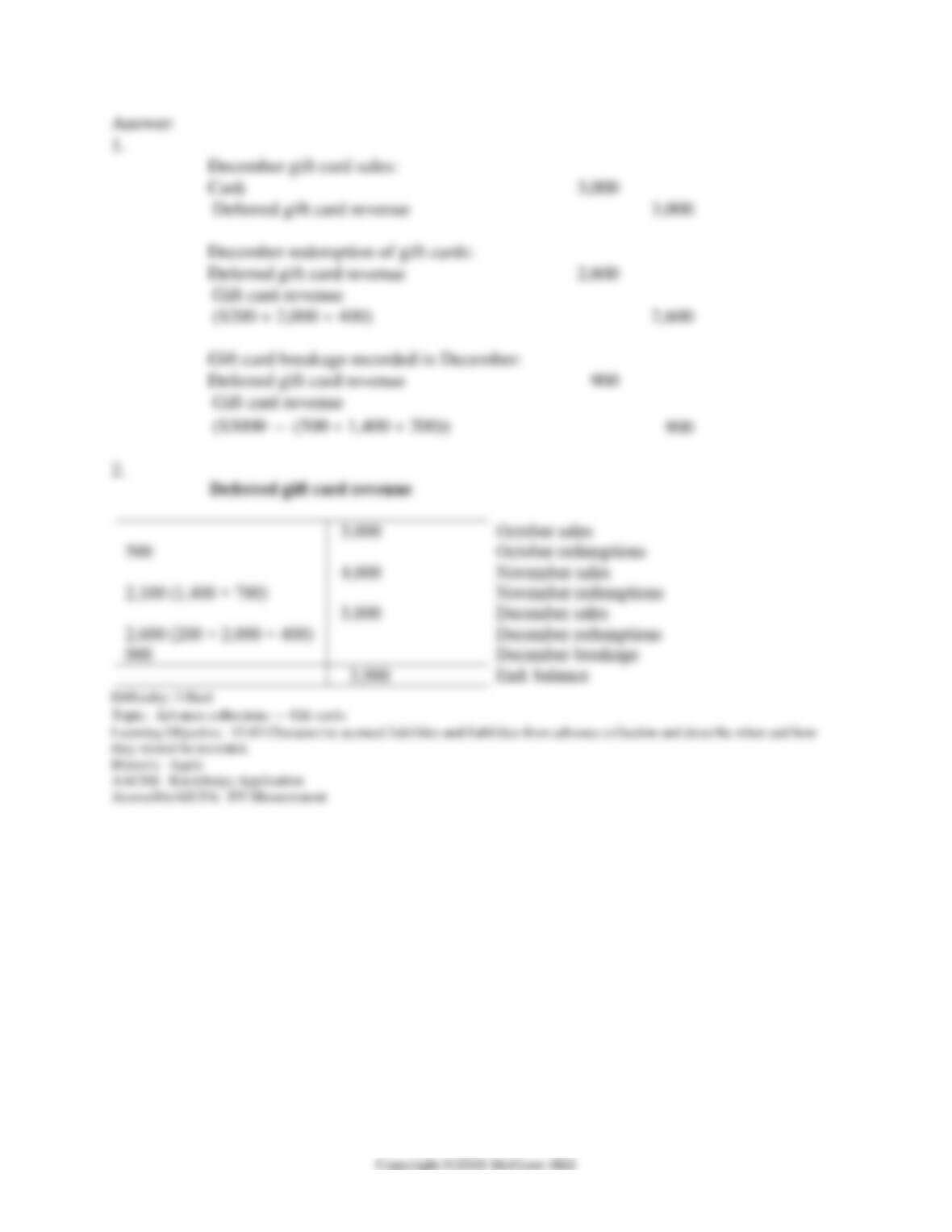
1. Prepare all journal entries appropriate to be recorded only during the month of December
2018 relevant to gift card sales, gift card redemptions, and gift card breakage.
2. Determine the balance of the deferred revenue liability to be reported in the December 31,
2018, balance sheet. Show the relevant T-account information to support your answer.
84
85
182) Diversified Industries sells perishable electronic products. Some must be shipped in
reusable containers. Customers pay a deposit for each container. The deposit is equal to the
container’s cost. Customers receive a refund when the container is returned. During 2018,
deposits collected on containers shipped were $700,000. Deposits are forfeited if containers are
not returned in 18 months. Containers held by customers on January 1, 2018, were $330,000.
During 2018, $410,000 was refunded and deposits of $25,000 were forfeited.
Required:
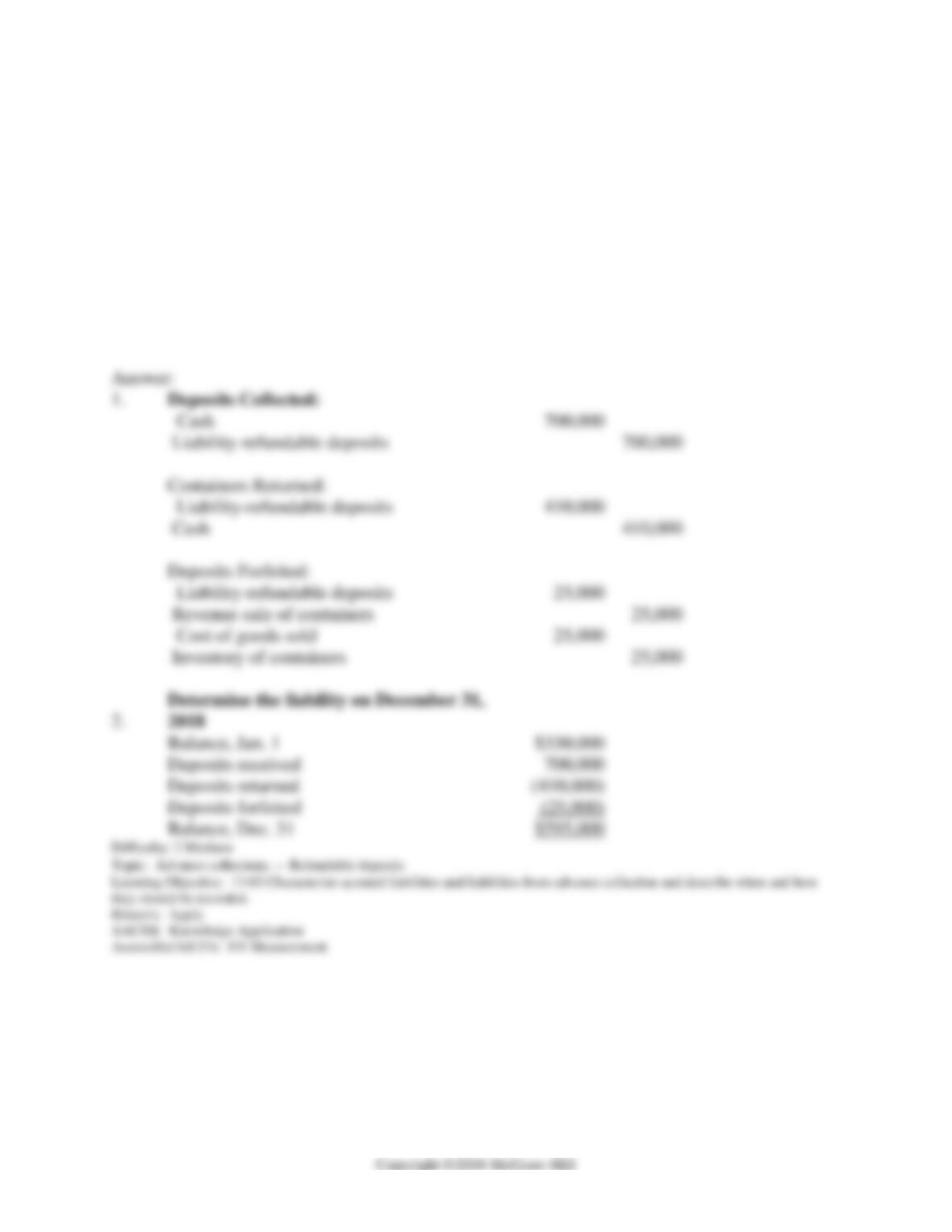
1. Prepare the appropriate journal entries for the deposits received and returned during 2018.
2. Determine the liability for refundable deposits to be reported in the December 31, 2018,
balance sheet.
86
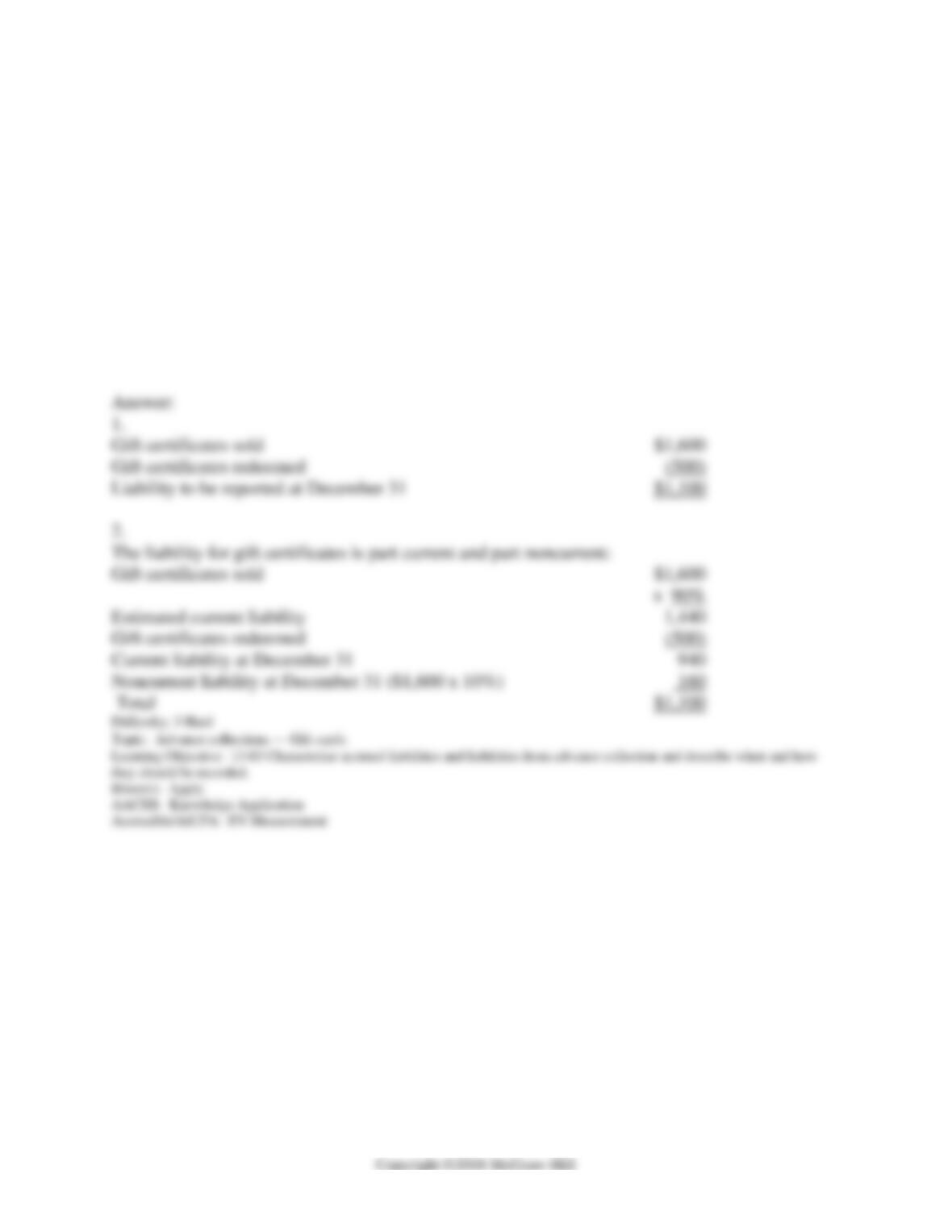
183) At December 31, 2018, Cordova Leather’s liabilities include the following:
1. $15 million of noncallable 9% notes were issued for $15 million on August 31, 1994. The
notes mature on July 31, 2019. Sufficient cash is expected to be available to retire the notes at
maturity.
2. $30 million of 8% notes were issued for $30 million on May 31, 2014. The notes mature on
May 31, 2024, but investors have the option of calling (demanding payment on) the notes on
June 30, 2019. However, the call option is not expected to be exercised, given prevailing market
conditions.
3. $18 million of 10% notes are due on March 31, 2020. A debt covenant requires Cordova to
maintain current assets at least equal to 150% of its current liabilities. On December 31, 2018,
Cordova is in violation of this covenant. Cordova obtained a waiver from Village Bank until
June 2019, having convinced the bank that the company’s normal 2 to 1 ratio of current assets to
current liabilities will be reestablished during the first half of 2019.
Required:
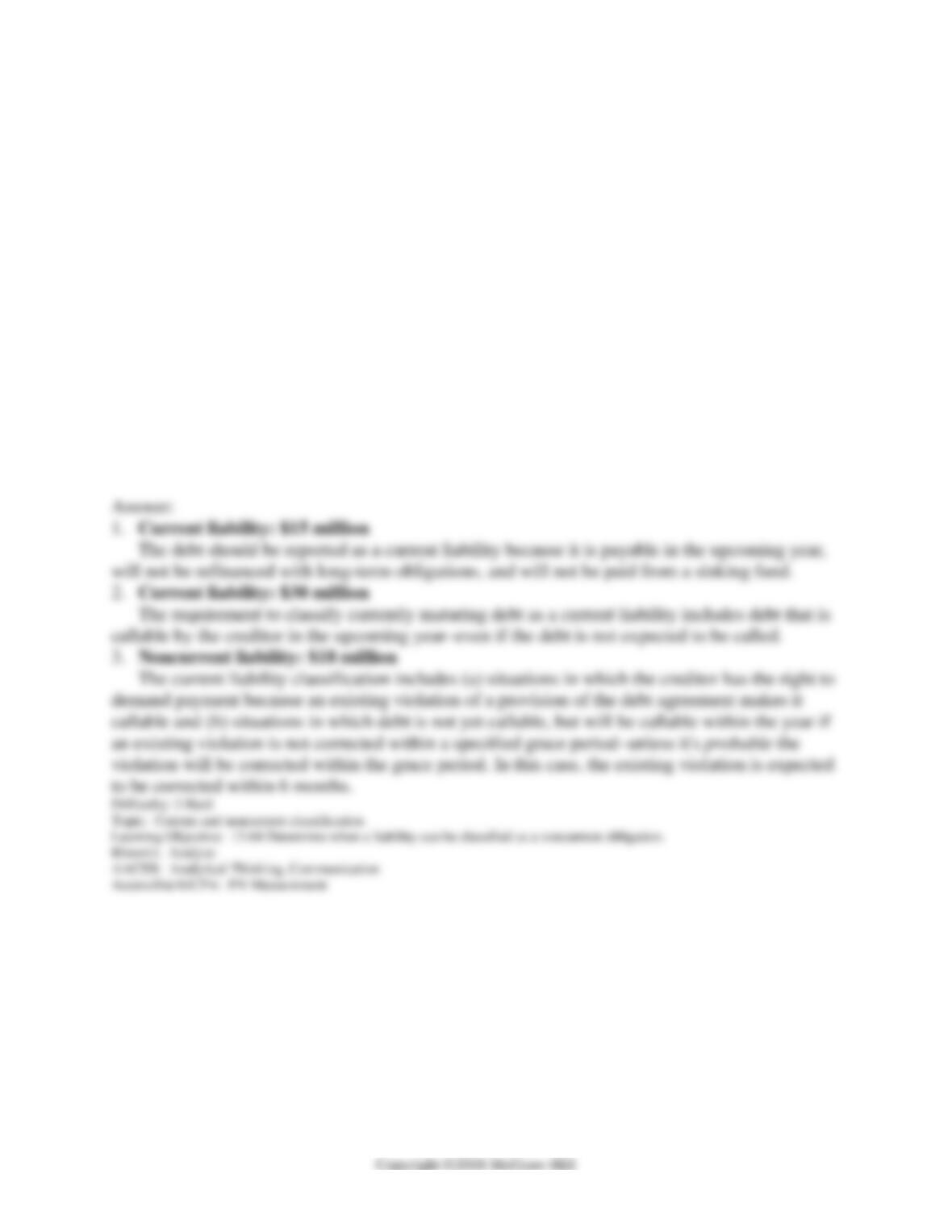
For each of the three liabilities, indicate the portion of the debt that can be excluded from
classification as a current liability (that is, reported as a noncurrent liability). Explain.
184) In its 2018 annual report to shareholders, Border Airlines Inc. presented the following
balance sheet information about its liabilities:
2018
2017
CURRENT LIABILITIES
Accounts payable
$1,717,000,000
$1,178,000,000
Accrued salaries and wages
$681,000,000
$924,000,000
Accrued liabilities
$1,336,000,000
$1,143,000,000
Air traffic liability
$2,763,000,000
$2,696,000,000
Payable to affiliates, net
$66,000,000
$511,000,000
Current maturities of long-term debt
$421,000,000
$108,000,000
Current obligations under capital leases
$189,000,000
$201,000,000
Total current liabilities
$7,173,000,000
$6,761,000,000
LONG-TERM DEBT, LESS CURRENT MATURITIES
$6,530,000,000
$2,601,000,000
In addition, Border presented the following among its note disclosures:
Maturities of long-term debt (including sinking fund requirements) for the next five years are:
2019 — $421 million; 2020 — $212 million; 2021 — $273 million; 2022 — $1.0 billion; 2023
— $777 million.
Required:
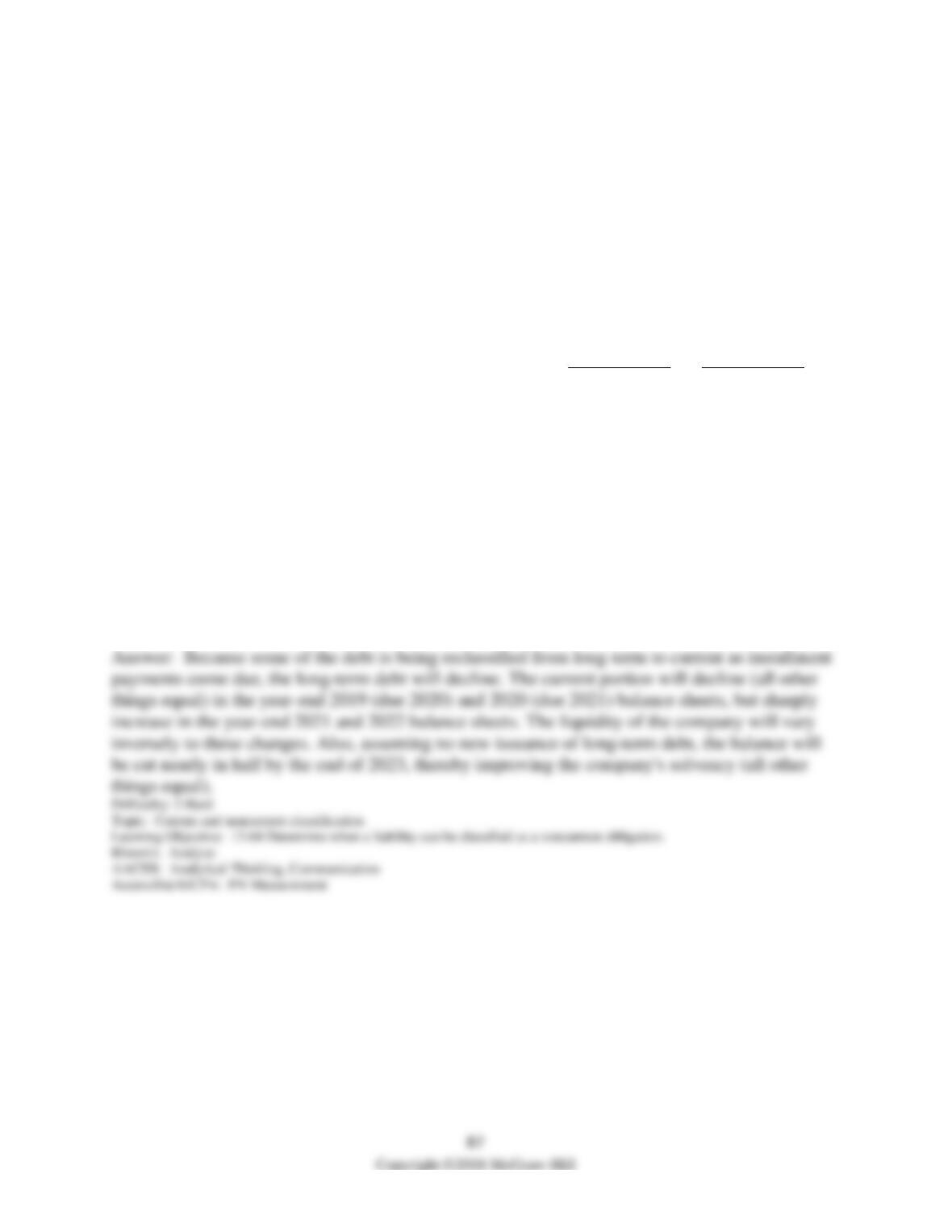
Consider the appropriate classification of these long-term debt obligations. Assuming no more
long-term debt will be issued, what are the implications of the information above for Border’s
liquidity and solvency risk in 2018 and the following years?
88
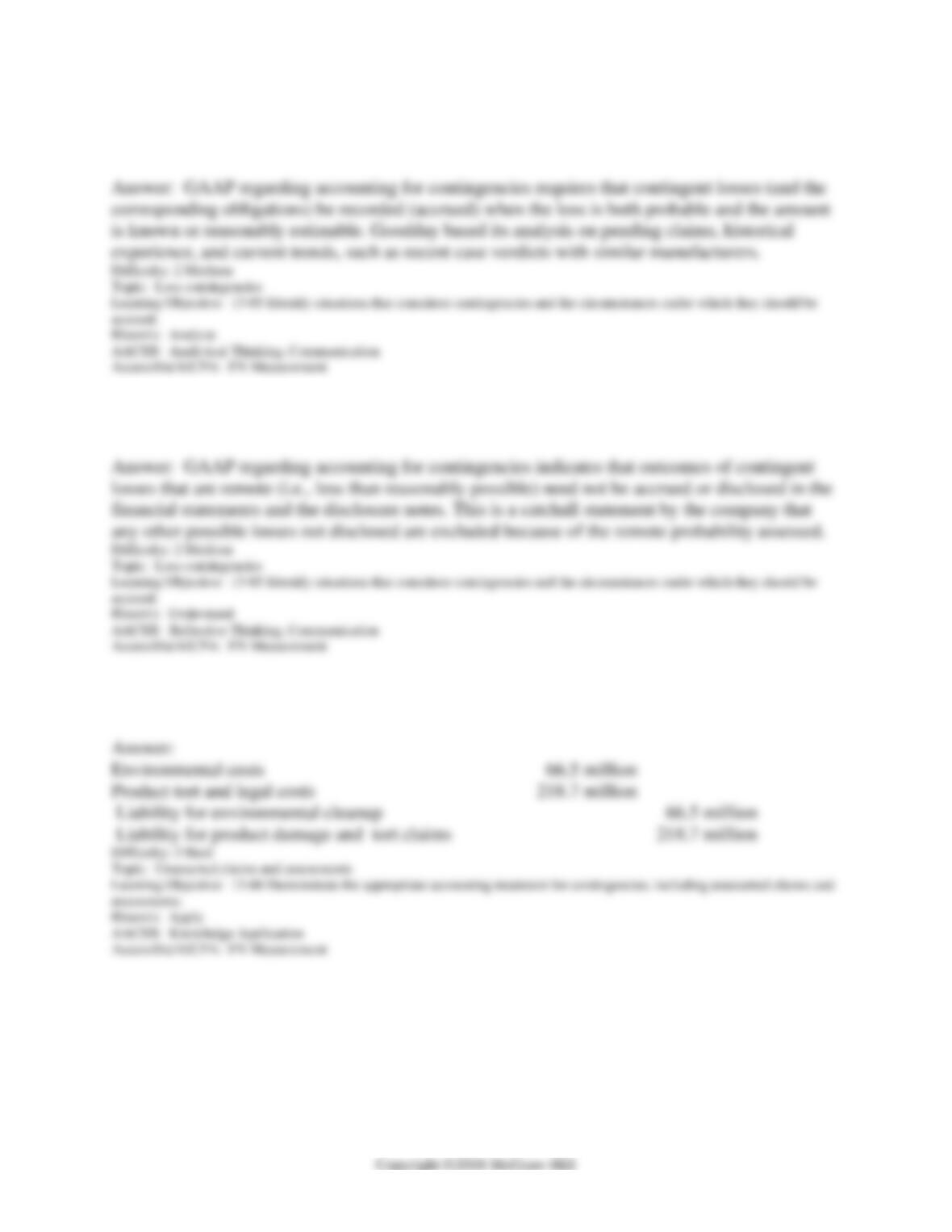
185) Mozart Music Co. began operations in December of 2018. The company sold gift
certificates during December in various amounts totaling $1,600. The gift certificates are
redeemable for merchandise within three years of the purchase date. However, experience within
the industry predicts that 90% of gift certificates will be redeemed within one year. Certificates
totaling $500 were presented for redemption during 2018 as part of merchandise purchases
having a total retail price of $750.
Required:
1. Determine the liability for gift certificates to be reported in the December 31, 2018, balance
sheet.
2. What is the appropriate classification (current or noncurrent) of the liabilities at December
31, 2018? Show calculations.

89
Use the following to answer the question(s) below:
In its 2018 annual report to shareholders, the Goodday Chemical Company included the
following disclosure note excerpts on CONTINGENCIES in its annual report to shareholders:
At December 31, 2018, Goodday had recorded liabilities aggregating $66.5 million for
anticipated costs related to various environmental matters, primarily the remediation of
numerous waste disposal sites and certain properties sold by Goodday. These costs include legal
and consulting fees, site studies, the design and implementation of remediation plans, post-
remediation monitoring and related activities and will be paid over several years. The amount of
Goodday’s ultimate liability in respect of these matters may be affected by several uncertainties,
primarily the ultimate cost of required remediation and the extent to which other responsible
parties contribute.
At December 31, 2018, Goodday had recorded liabilities aggregating $218.7 million for potential
product liability and other tort claims, including related legal fees expected to be incurred,
presently asserted against Goodday. The amount recorded was determined on the basis of an
assessment of potential liability using an analysis of available information with respect to
pending claims, historical experience, and, where available, current trends.
Goodday is a defendant in numerous lawsuits involving at December 31, 2018, approximately
63,000 claimants alleging various asbestos-related personal injuries purported to result from
exposure to asbestos in certain rubber-coated products manufactured by Goodday in the past or
in certain Goodday facilities. Typically, these lawsuits have been brought against multiple
defendants in state and federal courts. In the past, Goodday has disposed of approximately
22,000 cases by defending and obtaining the dismissal thereof or by entering into a settlement.
Goodday has policies and coverage-in-place agreements with certain of its insurance carriers that
cover a substantial portion of estimated indemnity payments and legal fees in respect of the
pending claims. At December 31, 2018, Goodday has recorded an asset in the amount it expects
to collect under the policies and coverage-in-place agreements with certain carriers related to its
estimated asbestos liability. Goodday has also commenced discussions with certain of its excess
coverage insurance carriers to establish arrangements in respect of their policies.
Subject to the uncertainties referred to above, Goodday has concluded that in respect of any of
the above described liabilities, it is not reasonably possible that it would incur a loss exceeding
the amount recognized at December 31, 2018, with respect thereto which would be material
relative to the consolidated financial position, results of operations, or liquidity of Goodday.
90
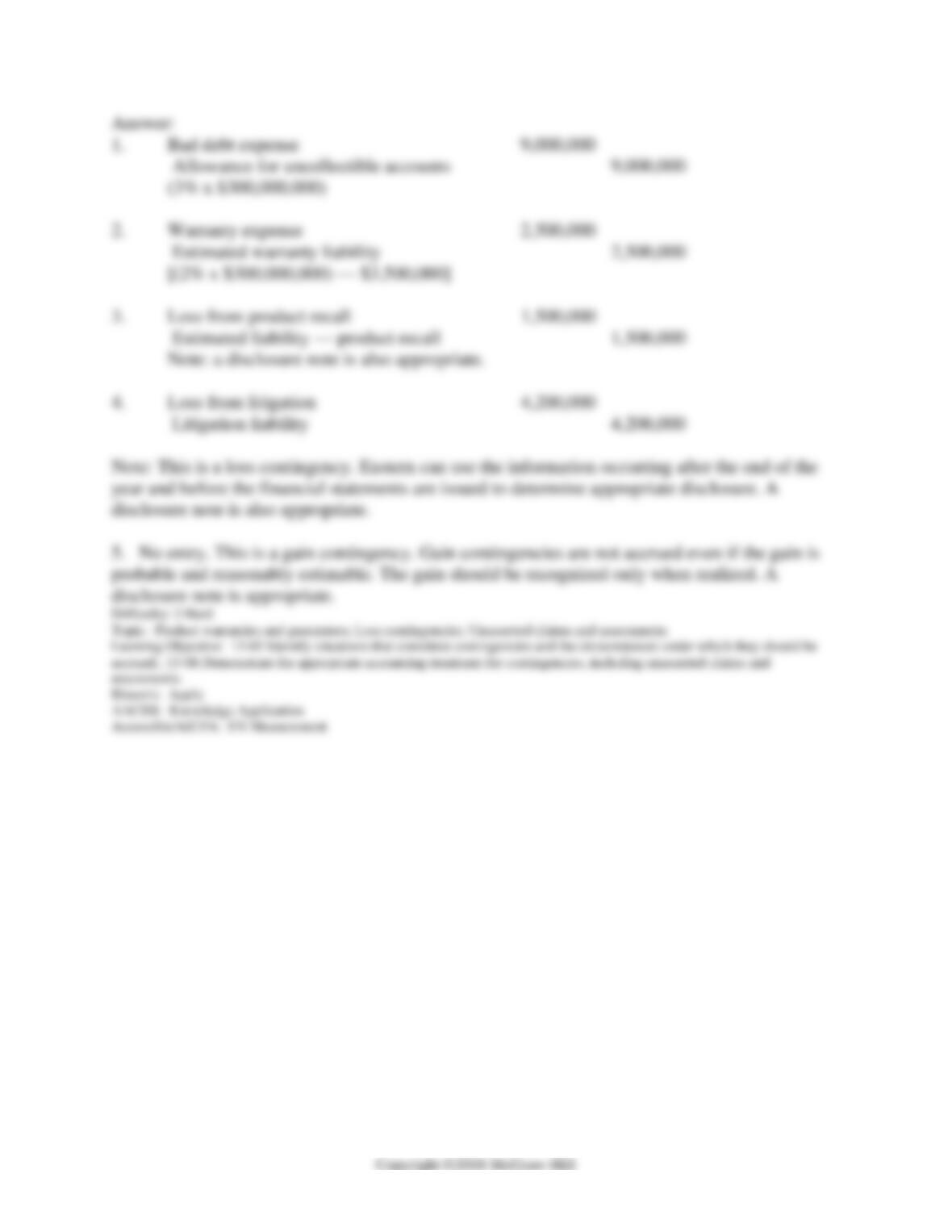
186) Briefly explain the GAAP requirement from which the costs/obligations for environmental
cleanup and product liability/tort claim matters were accrued in the financial statements.
187) What is the point of the last paragraph of the Goodday disclosure? Explain in terms of
authoritative GAAP.
188) Prepare the summary journal entry that Goodday recorded for the environmental cleanup
and product liability/tort claim matters, described in the note disclosure.

91
189) The following selected transactions relate to contingencies of Eastern Products Inc., which
began operations in July 2018. Eastern’s fiscal year ends on December 31. Financial statements
are published in April 2019.
1. No customer accounts have been shown to be uncollectible as yet, but Eastern estimates that
3% of credit sales will eventually prove uncollectible. Sales were $300 million (all credit) for
2018.
2. Eastern offers a one-year warranty against manufacturer’s defects for all its products.
Industry experience indicates that warranty costs will approximate 2% of sales. Actual warranty
expenditures were $3.5 million in 2018 and were recorded as warranty expense when incurred.
3. In December 2018, Eastern became aware of an engineering flaw in a product that poses a
potential risk of injury. As a result, a product recall appears inevitable. This move would likely
cost the company $1.5 million.
4. In November 2018, the State of Vermont filed suit against Eastern, asking civil penalties and
injunctive relief for violations of clean water laws. Eastern reached a settlement with state
authorities to pay $4.2 million in penalties on February 3, 2019.
5. Eastern is the plaintiff in a $40 million lawsuit filed against a customer for costs and lost
profits from contracts rejected in 2018. The lawsuit is in final appeal and attorneys advise that it
is virtually certain that Eastern will be awarded $30 million.
Required:
Prepare the appropriate journal entries that should be recorded as a result of each of these
contingencies. If no journal entry is indicated, state why.
92

93
190) The following selected transactions relate to contingencies of Bowe-Whitney Inc. Bowe-
Whitney’s fiscal year ends on December 31, 2018, and financial statements are published in
March 2019.
1. Bowe-Whitney is involved in a lawsuit resulting from a dispute with a customer over a 2018
transaction. At December 31, attorneys advised that it was probable that Bowe-Whitney would
lose $3 million in an unfavorable outcome. On February 12, 2019, judgment was rendered
against Bowe-Whitney in the amount of $14 million plus interest, a total of $15.2 million. Bowe-
Whitney does not plan to appeal the judgment.
2. Since August of 2018, Bowe-Whitney has been involved in labor disputes at two of its
facilities. Negotiations between the company and the unions have not produced a settlement and,
since January 2018, strikes have been ongoing at these facilities. It is virtually certain that
material costs will be incurred but the amount of resultant costs cannot be adequately predicted.
3. Bowe-Whitney is the defendant in a lawsuit filed in January 2019 in which Access Company
seeks $10 million as an adjustment to the purchase price related to the sale of Bowe-Whitney’s
hardwood division in 2018. The lawsuit alleges that Bowe-Whitney misrepresented the division’s
assets and liabilities. Legal counsel advises that it is reasonably possible that Bowe-Whitney
could lose $5 million, but that it’s extremely unlikely it could lose the $10 million asked for.
4. At March 1, 2019, the EPA is in the process of investigating the possibility of environmental
violations at one of Bowe-Whitney’s sites, but has not proposed a penalty assessment.
Management feels an assessment is reasonably possible, and if an assessment is made, a
settlement of up to $33 million is probable.
Required:
Prepare journal entries that should be recorded as a result of each of the above contingencies.
94
95
191) Concept 1 Office Products sells office electronics that carry a 60-day manufacturer’s
warranty. At the time of purchase, customers are offered the opportunity to also buy a 1-year or
2-year extended warranty for an additional charge.
Required:
1. Does the sale of the extended warranty represent a loss contingency?
2. Provide journal entries for the extended warranty sales and revenue recognition.
192) In its 2018 annual report to shareholders, Hyer Aviation Group Inc. included the following
disclosure:
On October 6, 2017, the company’s subsidiary, Pyro Aeroplex, filed suit against Syntex, an
unincorporated division of Bright American Corporation, for breach of contract and fraud with
regard to the supply of deficient wire rope that is installed as aircraft flight control cables on
WD-50 aircraft. The case, filed in the circuit court of Bell County, Arkansas, was brought to trial
and on September 20, 2018, a jury returned with a verdict in favor of the company in the amount
of $17.5 million. The Court, upon a post-judgment motion filed by Pyro, reduced the judgment
to $4.5 million. Pyro has appealed that Order to the Supreme Court of Arkansas. The company
believes the appeal is without merit and will continue to pursue final judgment on the Order. The
company, pending appeal, has not recorded the $4.5 million favorable judgment.
Required:
What journal entries, if any, has Hyer recorded regarding this contingency? Explain its rationale.
97
Use the following to answer the question(s) below:
The following facts apply to TinyPart Toy Company’s pending litigation as of December 31,
2018:
a. TinyPart is defending against a lawsuit and believes there is a 51% chance it will lose in
court. If it loses, TinyPart estimates that damages will be $100,000.
b. TinyPart is defending against another lawsuit for which management believes it is virtually
certain to lose in court. If it loses the lawsuit, management estimates damages will fall
somewhere in the range of $30,000 to $50,000, with each amount in that range equally likely to
occur.
c. TinyPart is defending against another lawsuit that is identical to item (b), but the relevant
losses will only occur far into the future. The present values of the endpoints of the range are
$15,000 and $25,000. TinyPart’s management believes the effects of time value of money on
these amounts are material, but also believes the timing of these amounts is uncertain.
d. TinyPart is defending against a fourth lawsuit and believes there is only a 25% chance it will
lose in court. If TinyPart loses, it believes damages will fall somewhere in the range of $35,000
to $40,000, with each amount in that range equally likely to occur.
193) Indicate how TinyPart would disclose or account for the lawsuit described in part (a) under
U.S. GAAP and under IFRS in the financial statements for the year ended December 31, 2018.
194) Indicate how TinyPart would disclose or account for the lawsuit described in part (b) under
U.S. GAAP and under IFRS in the financial statements for the year ended December 31, 2018.
98
195) Indicate how TinyPart would disclose or account for the lawsuit described in part (c) under
U.S. GAAP and under IFRS in the financial statements for the year ended December 31, 2018.
196) Indicate how TinyPart would disclose or account for the lawsuit described in part (d) under
U.S. GAAP and under IFRS in the financial statements for the year ended December 31, 2018.