Chapter 13: Budgeting and Standard Cost Systems
The standard factory overhead rate of Quaker Inc. is $10 per direct labor hour ($8 for variable
factory overhead and $2 for fixed factory overhead) based on 100% capacity of 30,000 direct
labor hours. The standard cost and the actual cost of factory overhead for the production of
5,000 units during May were as follows:
Standard:
25,000 hours at $10
$250,000
Actual:
Variable factory overhead
202,500
Fixed factory overhead
60,000
149. Refer to the information provided for Quaker Inc. What is the amount of the fixed factory
overhead volume variance?
a. $12,500 favorable
b. $10,000 unfavorable
c. $12,500 unfavorable
d. $10,000 favorable
150. Refer to the information provided for Quaker Inc. What is the amount of the variable factory
overhead controllable variance?
a. $10,000 favorable
b. $2,500 unfavorable
c. $10,000 unfavorable
d. $2,500 favorable
151. The cost of available but unused productive capacity is indicated by the:
a. fixed factory overhead volume variance.
b. direct labor cost time variance.
c. direct labor cost rate variance.
d. variable factory overhead controllable variance.
Chapter 13: Budgeting and Standard Cost Systems
152. The standard factory overhead rate is $7.50 per machine hour ($6.20 for variable factory
overhead and $1.30 for fixed factory overhead) based on 100% capacity of 80,000 machine
hours. The standard cost and the actual cost of factory overhead for the production of 15,000
units during August were as follows:
Actual:
Variable factory overhead
$360,000
Fixed factory overhead
104,000
Standard:
60,000 hours at $7.50
450,000
What is the amount of the variable factory overhead controllable variance?
a. $12,000 unfavorable
b. $12,000 favorable
c. $14,000 unfavorable
d. $26,000 unfavorable
153. Incurring actual indirect factory wages in excess of budgeted amounts for actual production
results in a:
a. unfavorable quantity variance.
b. unfavorable controllable variance.
c. favorable volume variance.
d. favorable labor rate variance.
154. The variable factory overhead controllable variance measures:
a. operating results at less than normal capacity.
b. the efficiency of using variable overhead resources.
c. operating results at more than normal capacity.
d. control over fixed overhead costs.
155. The unfavorable volume variance may be due to all of the following factors except:
a. failure to maintain an even flow of work.
b. machine breakdowns.
c. unexpected increases in the cost of utilities.
d. failure to obtain enough sales orders.
Chapter 13: Budgeting and Standard Cost Systems
156. Standard Corporation uses a standard cost system. The following information was provided for
the period that just ended:
Standard time per completed unit 3 hrs.
Actual total factory overhead $108,000
Fixed factory overhead $60,000
Standard fixed factory overhead rate $2.00 per labor hour
Standard variable factory overhead rate $1.50 per labor hour
Normal capacity 30,000 hours
Plant operated during the period 28,000 hours
Units completed during the period 9,000
The fixed factory overhead volume variance is
a. $6,000 favorable.
b. $3,000 favorable.
c. $3,000 unfavorable.
d. $6,000 unfavorable.
157. Favorable volume variances may be harmful when:
a. machine repairs cause work stoppages.
b. supervisors fail to maintain an even flow of work.
c. production in excess of normal capacity cannot be sold.
d. there are insufficient sales orders to keep the factory operating at normal capacity.
158. Assuming that the standard fixed overhead rate is based on full capacity, the cost of available
but unused productive capacity is indicated by the:
a. factory overhead cost volume variance.
b. direct labor cost time variance.
c. direct labor cost rate variance.
d. factory overhead cost controllable variance.
159. Which of the following doesn’t result in an unfavorable fixed overhead volume variance?
a. Sales orders at a low level
b. Machine breakdowns
c. Employee inexperience
d. Increase in utility costs
Chapter 13: Budgeting and Standard Cost Systems
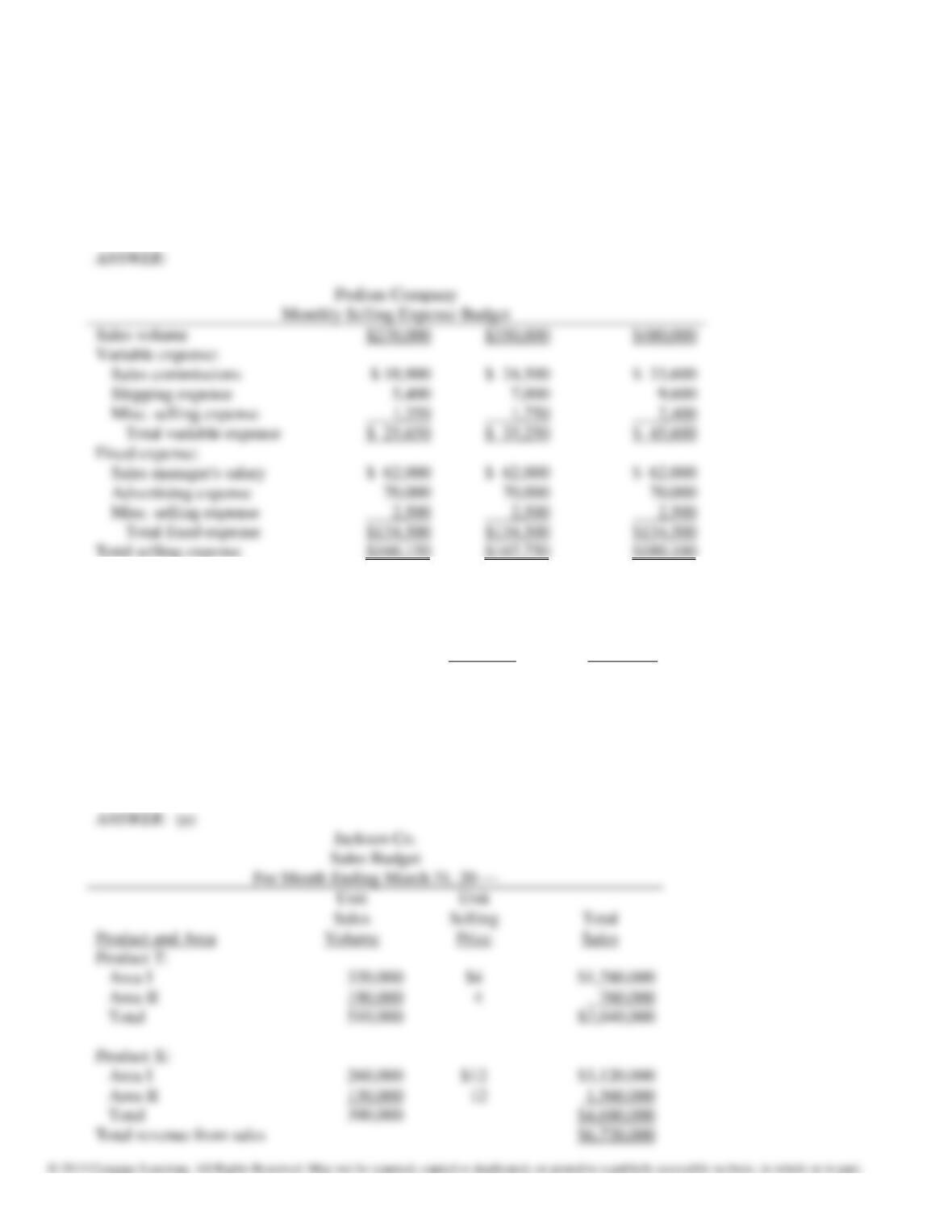
160. Prepare a monthly flexible selling expense budget for Podism Company for sales volumes of
$270,000, $350,000, and $480,000, based on the following data:
Sales commissions
7% of sales
Sales manager’s salary
$62,000 per month
Advertising expense
$70,000 per month
Shipping expense
2% of sales
Miscellaneous selling expense
$2,500 per month plus 1/2% of sales
Sales volume
Variable expense:
Sales commissions
Shipping expense
Misc. selling expense
Total variable expense
Fixed expense:
Sales manager’s salary
Advertising expense
Misc. selling expense
Total fixed expense
Total selling expense
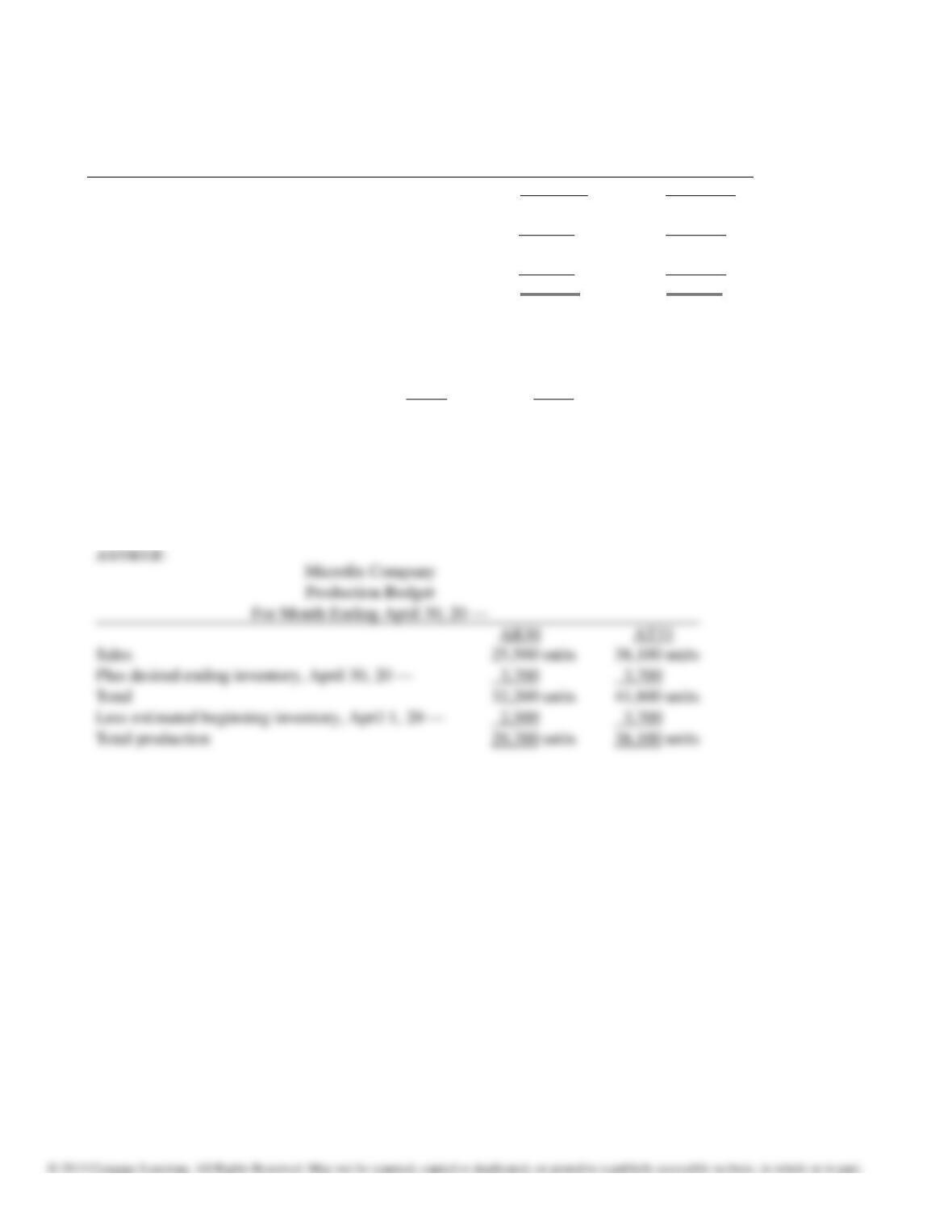
161. Based on the following production and sales data of Jackson Co. for March of the current year,
prepare (a) a sales budget and (b) a production budget.
Product T Product X
Estimated inventory, March 1 26,000 units 18,000 units
Desired inventory, March 31 32,000 units 15,000 units
Expected sales volume:
Area I 320,000 units 260,000 units
Area II 190,000 units 130,000 units
Unit sales price $4 $12
Product and Area
Area I
Area II
Total
Product X:
Area II
Total
Chapter 13: Budgeting and Standard Cost Systems
(b)
Jackson Co.
Production Budget
For Month Ending March 31, 20 —
Product T
Product X
Sales
510,000 units
390,000 units
Plus desired ending inventory, March 31, 20 —
32,000
15,000
Total
542,000 units
405,000 units
Less estimated beginning inventory, March 1, 20 —
26,000
18,000
Total production
516,000 units
387,000 units
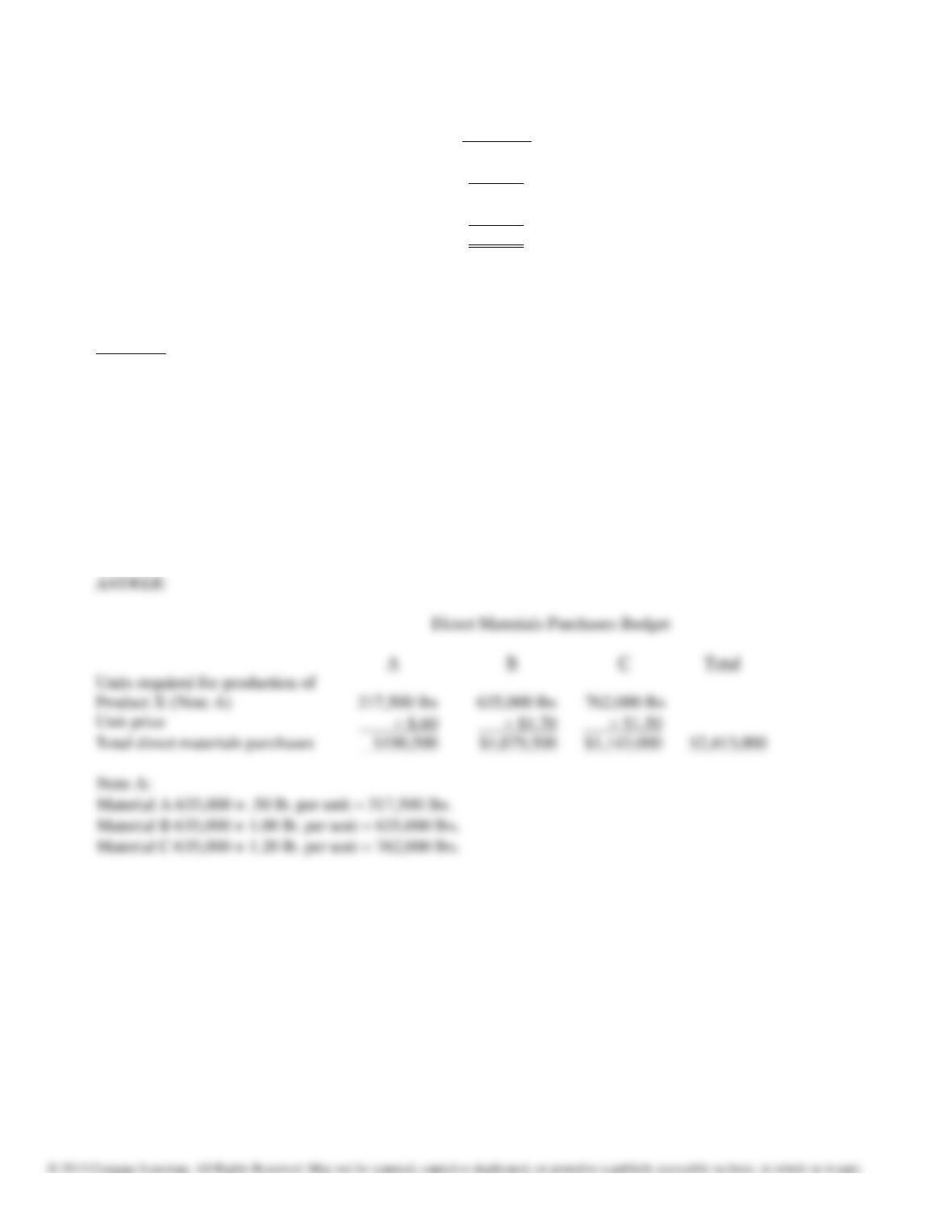
162. Microfix Company manufactures two models of Television, AR30 and AR33. Based on the
following production data for April of the current year, prepare a production budget for April.
AR30
AR33
Estimated inventory (units), April 1
2,500
3,700
Desired inventory (units), April 30
Expected sales volume (units):
3,700
3,700
Eastern zone
8,200
11,500
Midwest zone
13,000
17,500
Western zone
7,300
9,100
Chapter 13: Budgeting and Standard Cost Systems
163. Brown Inc.’s production budget for Product X for the year ended December 31 is as follows:
Product X
Sales 640,000 units
Plus desired ending inventory 85,000
Total 725,000
Less estimated beginning inventory, Jan. 1 90,000
Total production 635,000
In Brown’s production operations, Materials A, B, and C are required to make Product X. The
quantities of direct materials expected to be used for each unit of product are as follows:
Product X
Material A .50 pound per unit
Material B 1.00 pound per unit
Material C 1.20 pound per unit
The prices of direct materials are as follows:
Material A $0.60 per pound
Material B $1.70 per pound
Material C $1.50 per pound
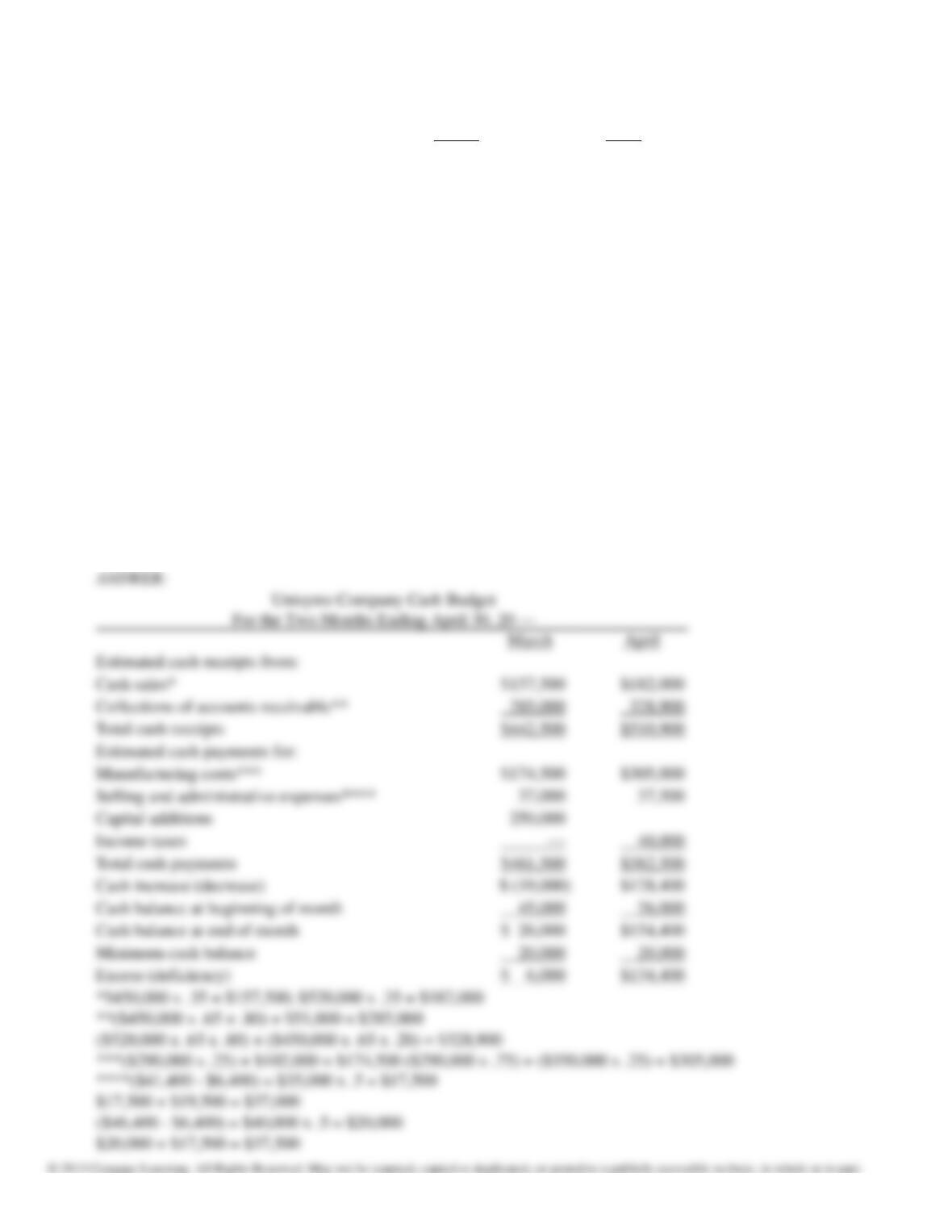
Prepare a direct materials purchases budget for Product X.
Chapter 13: Budgeting and Standard Cost Systems
164. The treasurer of Unisyms Company has accumulated the following budget information for the
first two months of the coming year:
March
April
Sales
$450,000
$520,000
Manufacturing costs
290,000
350,000
Selling and administrative expenses
41,400
46,400
Capital additions
250,000
—
The company expects to sell about 35% of its merchandise for cash. Of sales on account, 80%
are expected to be collected in full in the month of the sale and the remainder in the month
following the sale. One-fourth of the manufacturing costs are expected to be paid in the month
in which they are incurred and the other three-fourths in the following month. Depreciation,
insurance, and property taxes represent $6,400 of the probable monthly selling and
administrative expenses. Insurance is paid in February, and a $40,000 installment on income
taxes is expected to be paid in April. Of the remainder of the selling and administrative
expenses, one-half are expected to be paid in the month in which they are incurred, with the
balance paid in the following month. Capital additions of $250,000 are expected to be paid in
March.
Current assets as of March 1 are composed of cash of $45,000 and accounts receivable of
$51,000. Current liabilities as of March 1 are composed of accounts payable of $121,500
($102,000 for materials purchases and $19,500 for operating expenses). Management desires
to maintain a minimum cash balance of $20,000.
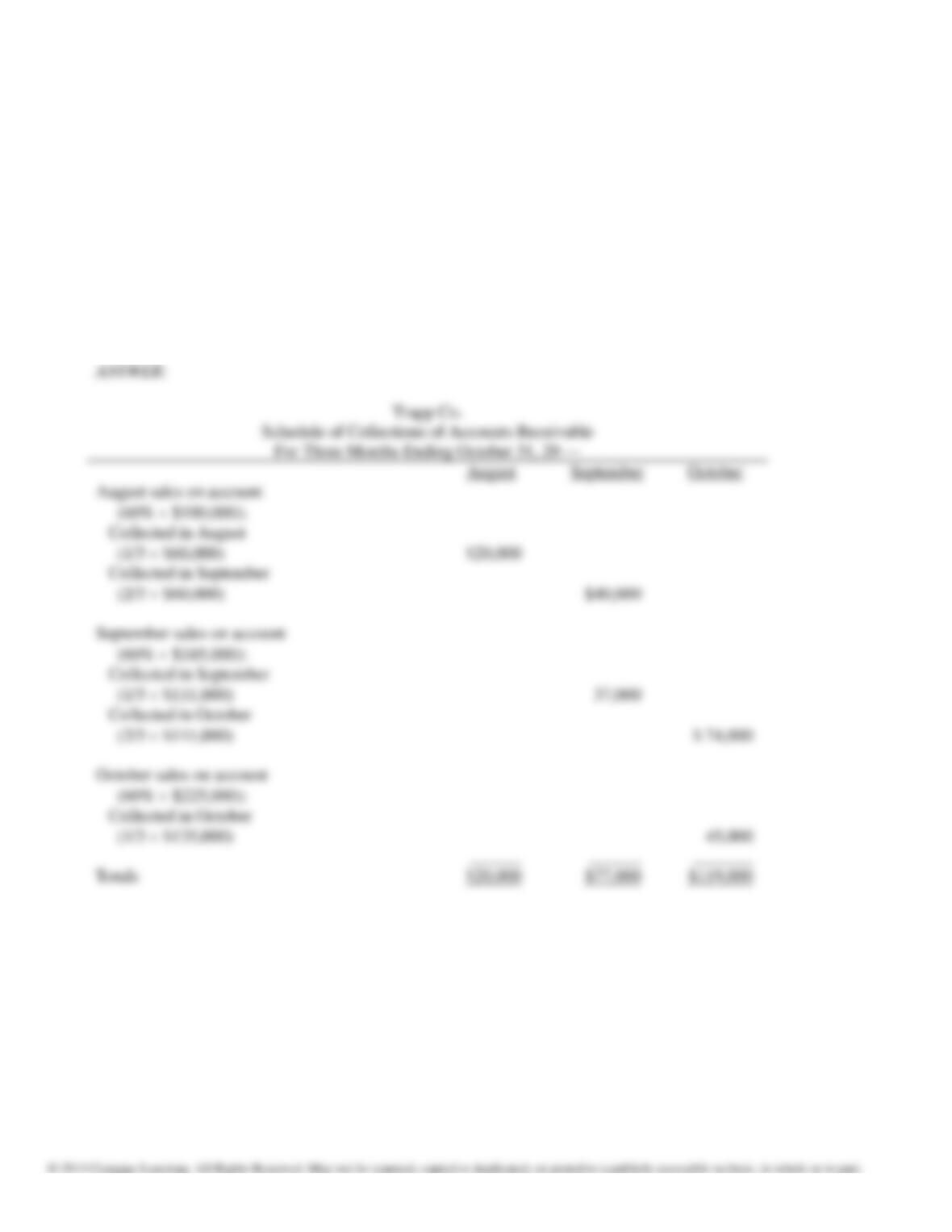
Prepare a monthly cash budget for March and April.
Chapter 13: Budgeting and Standard Cost Systems
165. Trapp Co. was organized on August 1 of the current year. Projected sales for the next three
months are as follows:
August
$100,000
September
185,000
October
225,000
The company expects to sell 40% of its merchandise for cash. Of the sales on account, one
third are expected to be collected in the month of the sale and the remainder in the following
month.
Prepare a schedule indicating cash collections of accounts receivable for August, September,
and October.
Chapter 13: Budgeting and Standard Cost Systems
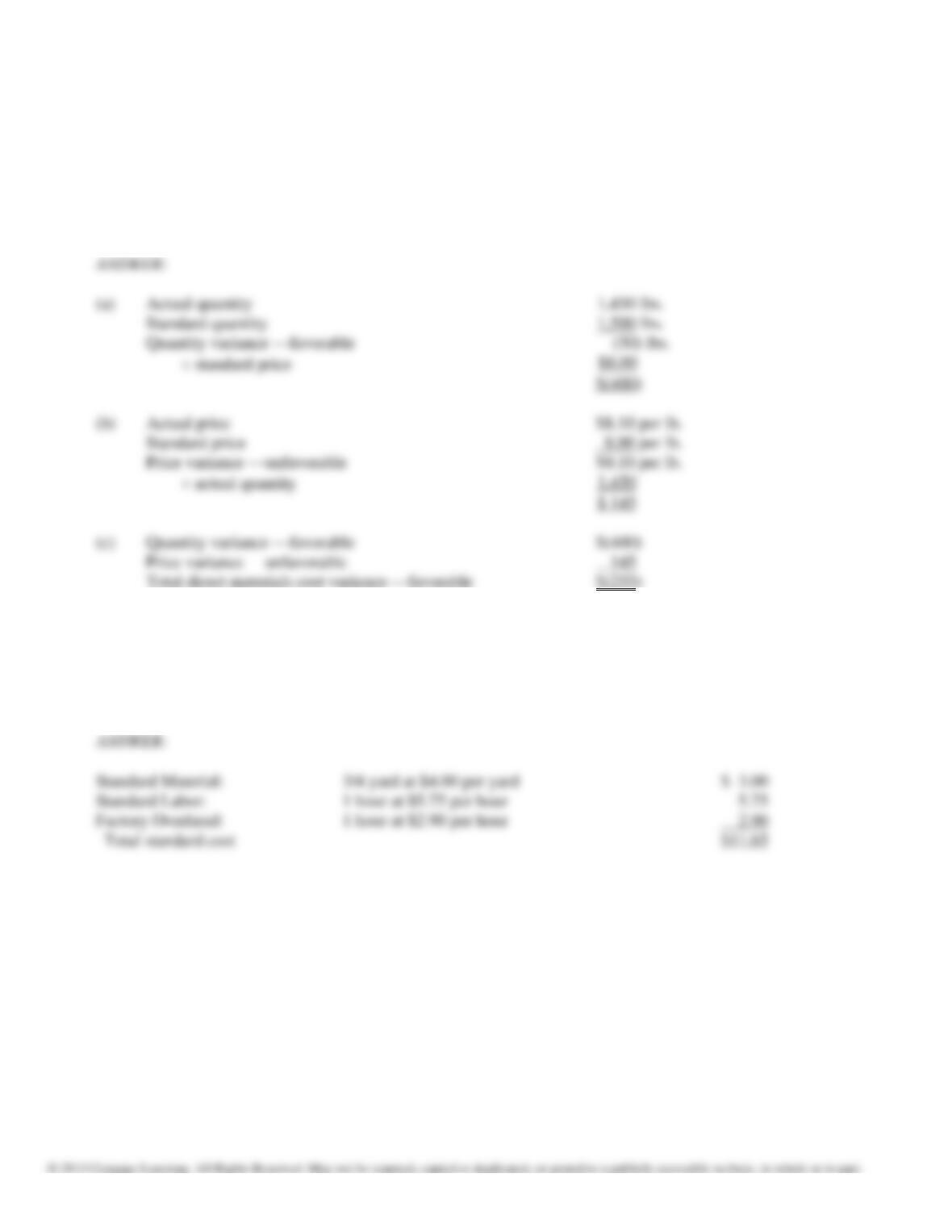
166. Standard and actual costs for direct materials for the manufacture of 1,000 units of product
were as follows:
Actual costs 1,450 lbs. @ $8.10
Standard costs 1,500 lbs. @ $8.00
Determine the (a) quantity variance, (b) price variance, and (c) total direct materials cost
variance.
167. Compute the standard cost for one hat, based on the following standards for each hat:
Standard Material Quantity: 3/4 yard of fabric at $4.00 per yard
Standard Labor: 1 hour at $5.75 per hour
Factory Overhead: $2.90 per direct labor hour
Chapter 13: Budgeting and Standard Cost Systems
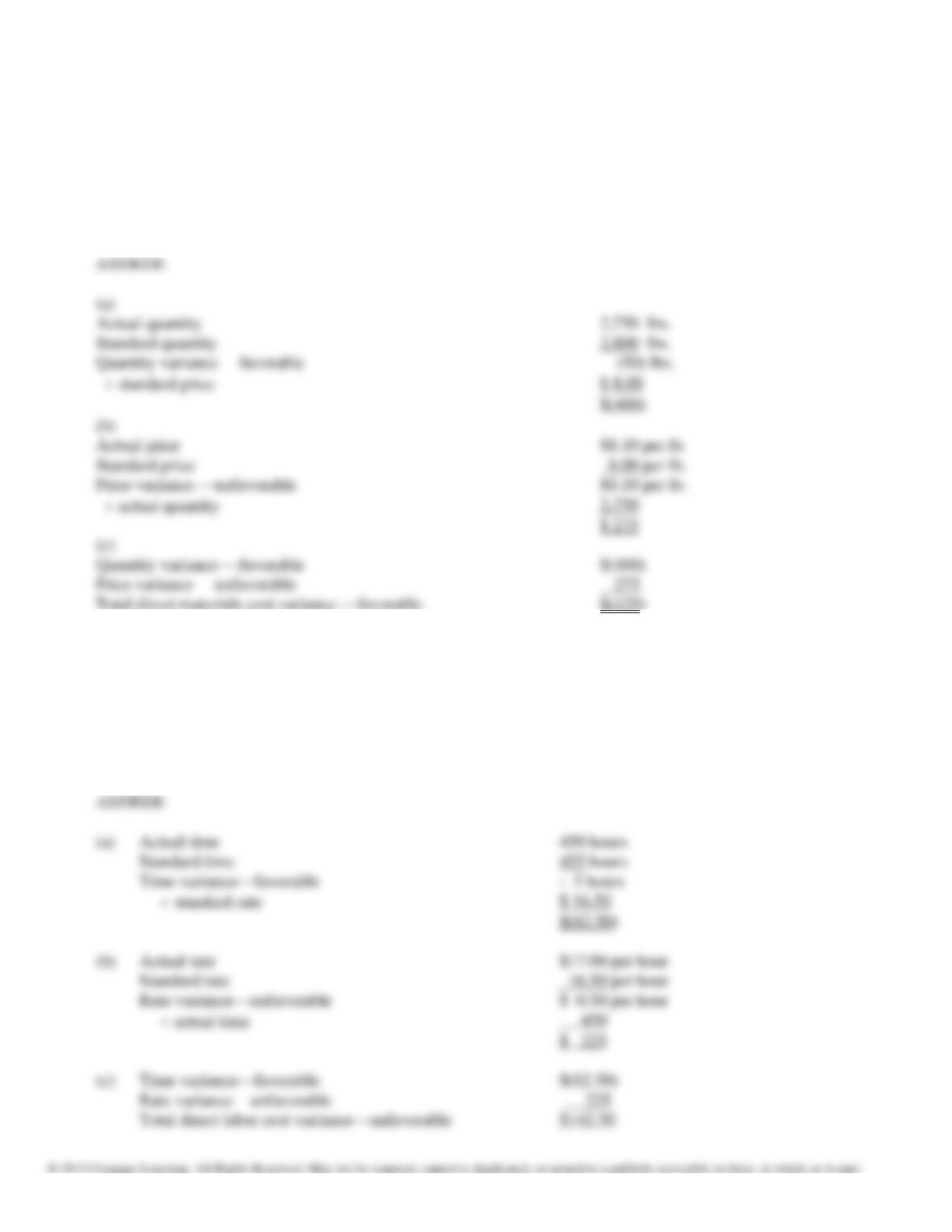
168. Standard and actual costs for direct materials for the manufacture of 2,000 units of product
were as follows:
Actual costs 2,750 lbs. @ $8.10
Standard costs 2,800 lbs. @ $8.00
Determine the (a) quantity variance, (b) price variance, and (c) total direct materials cost
variance.
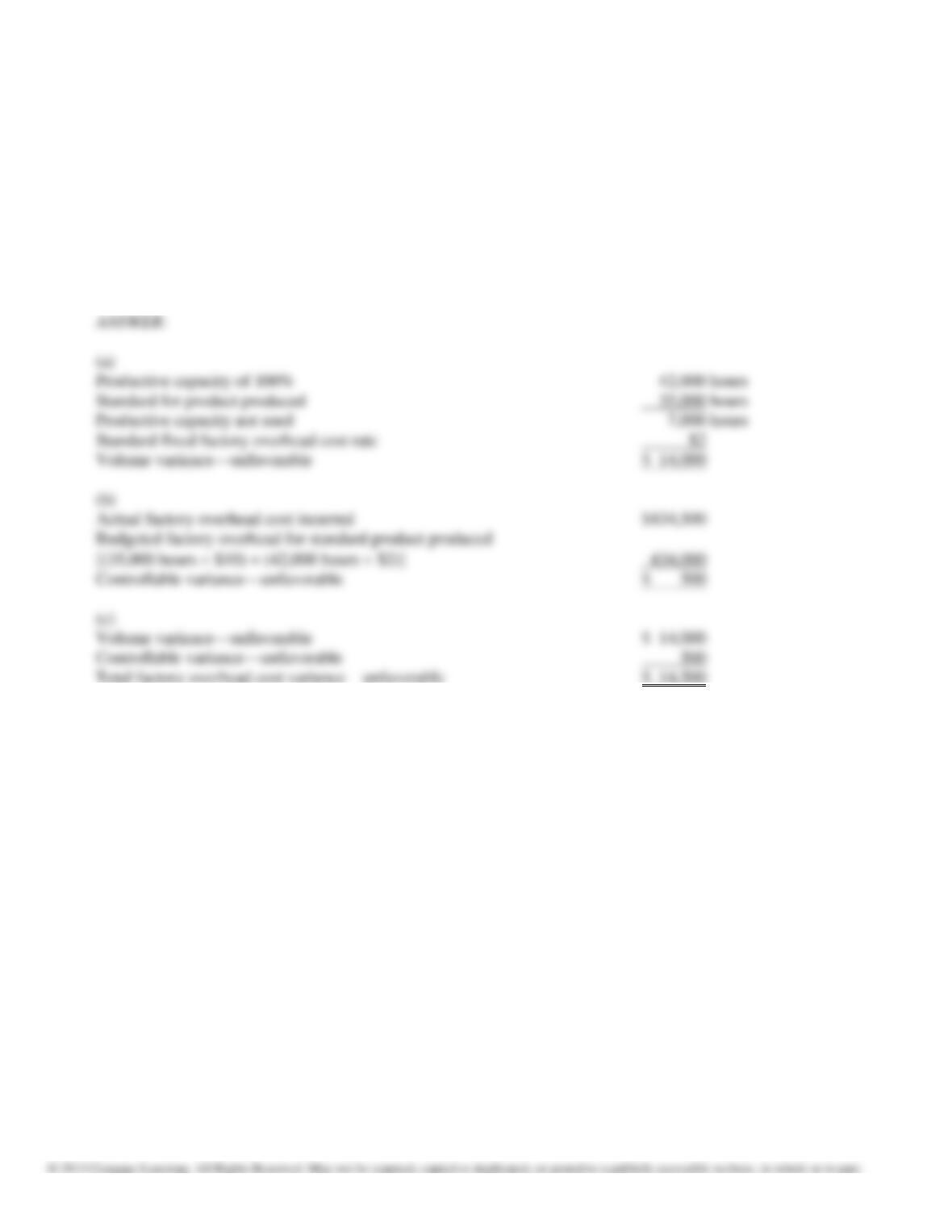
169. Standard and actual costs for direct labor for the manufacture of 1,500 units of product were as
follows:
Actual costs 450 hours @ $17.00
Standard costs 455 hours @ $16.50
Determine the (a) time variance, (b) rate variance, and (c) total direct labor cost variance.
Chapter 13: Budgeting and Standard Cost Systems
170. The standard factory overhead rate is $12 per machine hour ($10 for variable factory overhead
and $2 for fixed factory overhead) based on 100% capacity of 42,000 machine hours. The
standard cost and the actual cost of factory overhead for the production of 2,000 units were as
follows:
Actual: Variable factory overhead $350,500
Fixed factory overhead 84,000
Standard: 35,000 hours @ $12 420,000
Determine the (a) volume variance, (b) controllable variance, and (c) total factory overhead
cost variance.