139) The management of Hansley Corporation is investigating an investment in equipment that
would have a useful life of 5 years. The company uses a discount rate of 18% in its capital
budgeting. Good estimates are available for the initial investment and the annual cash operating
outflows, but not for the annual cash inflows and the salvage value of the equipment. The net
present value of the initial investment and the annual cash outflows is –$273,300. (Ignore income
taxes.)
See separate Exhibit 13B-1 and Exhibit 13B-2, to determine the appropriate discount factor(s)
using the tables provided.
Ignoring any salvage value, to the nearest whole dollar how large would the annual cash inflow
have to be to make the investment in the equipment financially attractive?
A) $54,660
B) $49,194
C) $87,400
D) $273,300
140) The management of Hansley Corporation is investigating an investment in equipment that
would have a useful life of 5 years. The company uses a discount rate of 18% in its capital
budgeting. Good estimates are available for the initial investment and the annual cash operating
outflows, but not for the annual cash inflows and the salvage value of the equipment. The net
present value of the initial investment and the annual cash outflows is –$273,300. (Ignore income
taxes.)
See separate Exhibit 13B-1 and Exhibit 13B-2, to determine the appropriate discount factor(s)
using the tables provided.
Ignoring the cash inflows, to the nearest whole dollar how large would the salvage value of the
equipment have to be to make the investment in the equipment financially attractive?
A) $625,400
B) $1,518,333
C) $273,300
D) $49,194
141) The management of Hibert Corporation is considering three investment projects-W, X, and
Y. Project W would require an investment of $21,000, Project X of $66,000, and Project Y of
$95,000. The present value of the cash inflows would be $22,470 for Project W, $73,920 for
Project X, and $98,800 for Project Y. (Ignore income taxes.)
The profitability index of investment project X is closest to:
A) 0.11
B) 0.88
C) 1.12
D) 0.12
142) The management of Hibert Corporation is considering three investment projects-W, X, and
Y. Project W would require an investment of $21,000, Project X of $66,000, and Project Y of
$95,000. The present value of the cash inflows would be $22,470 for Project W, $73,920 for
Project X, and $98,800 for Project Y. (Ignore income taxes.)
Rank the projects according to the profitability index, from most profitable to least profitable.
A) Y, W, X
B) X, Y, W
C) X, W, Y
D) W, Y, X
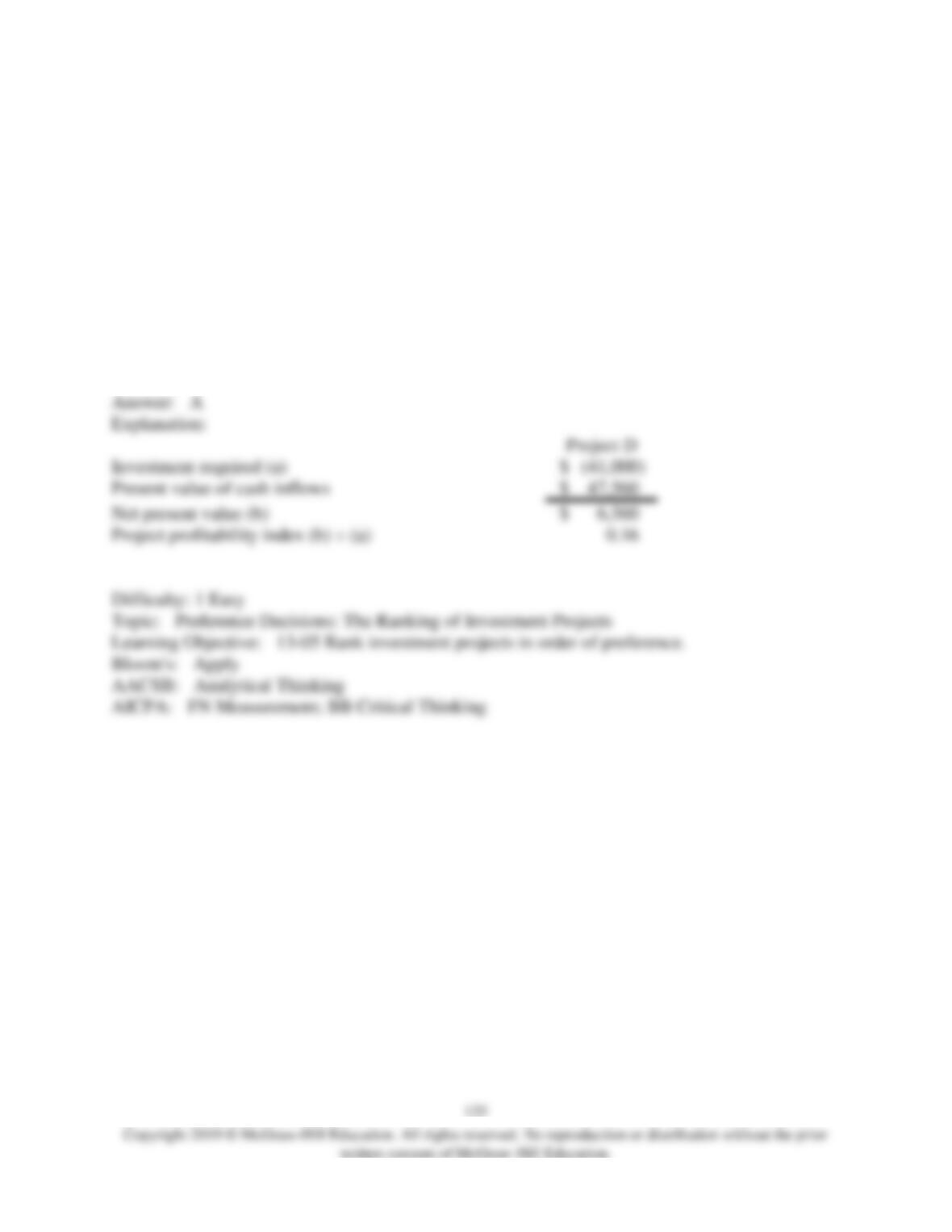
143) Eddie Corporation is considering the following three investment projects (Ignore income
taxes.):
Project C
Project D
Project E
Investment required
$
36,000
$
41,000
$
85,000
Present value of cash inflows
$
39,960
$
47,560
$
92,650
The profitability index of investment project D is closest to:
A) 0.16
B) 0.84
C) 0.14
D) 1.16
Investment required (a)
$
(41,000
)
Present value of cash inflows
$
Net present value (b)
$
Project profitability index (b) ÷ (a)
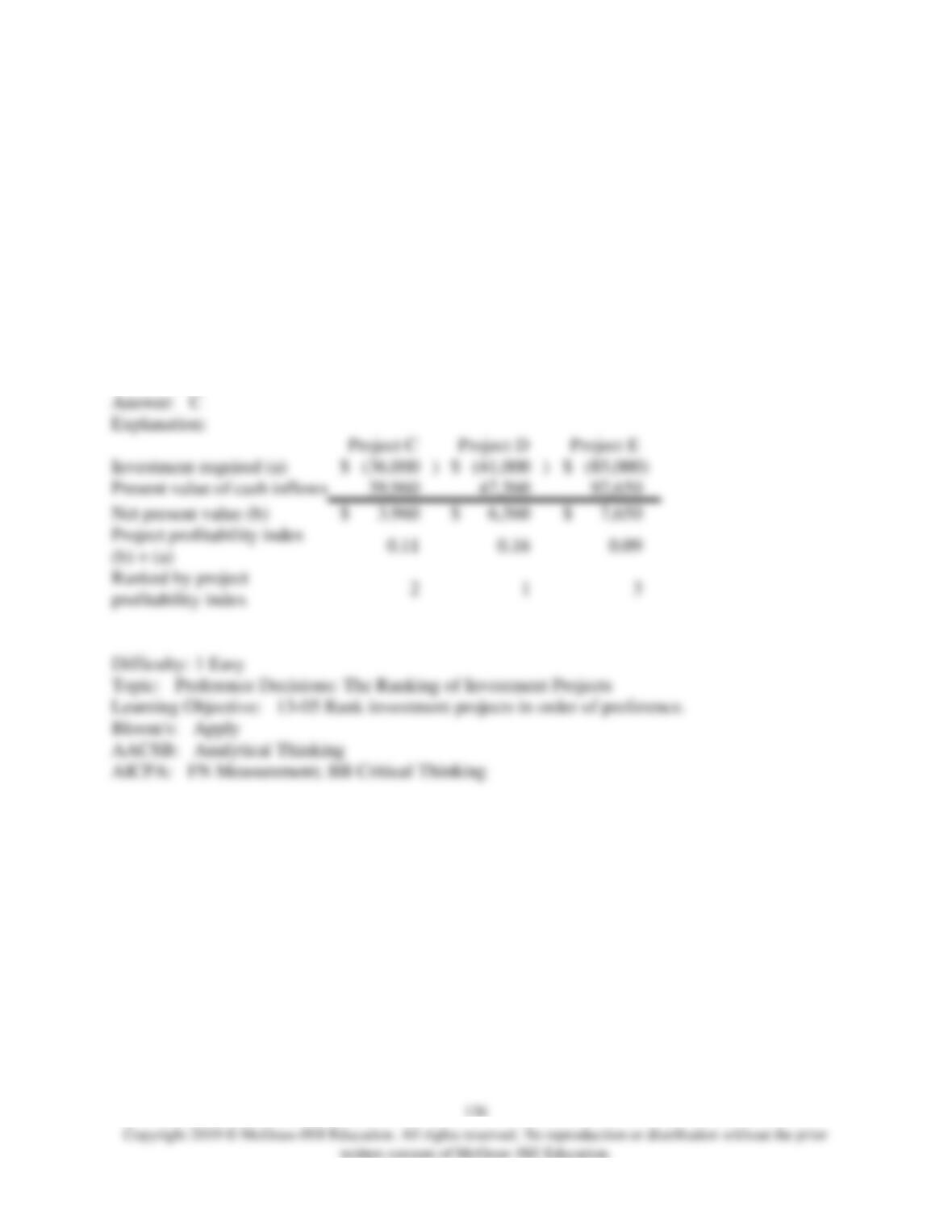
144) Eddie Corporation is considering the following three investment projects (Ignore income
taxes.):
Project C
Project D
Project E
Investment required
$
36,000
$
41,000
$
85,000
Present value of cash inflows
$
39,960
$
47,560
$
92,650
Rank the projects according to the profitability index, from most profitable to least profitable.
A) E, C, D
B) E, D, C
C) D, C, E
D) C, E, D
Investment required (a)
$
(36,000
)
$
(41,000
)
$
(85,000
)
Present value of cash inflows
Net present value (b)
$
$
$
(b) ÷ (a)
profitability index
145) Ostermeyer Corporation is considering a project that would require an initial investment of
$247,000 and would last for 7 years. The incremental annual revenues and expenses for each of the
7 years would be as follows (Ignore income taxes.):
Sales
$
198,000
Variable expenses
46,000
Contribution margin
152,000
Fixed expenses:
Salaries
$
22,000
Rents
32,000
Depreciation
33,000
Total fixed expenses
87,000
Net operating income
$
65,000
At the end of the project, the scrap value of the project’s assets would be $16,000.
Required:
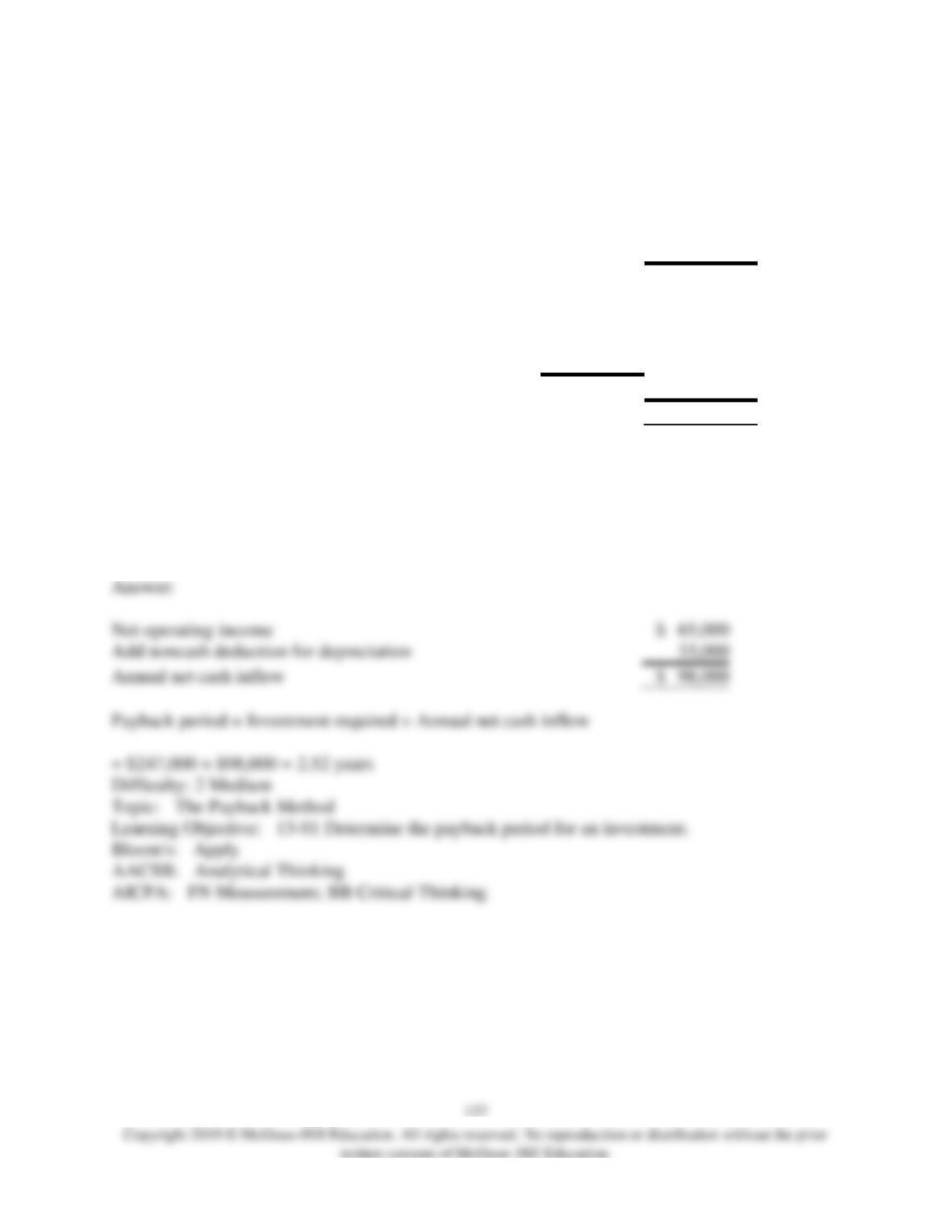
Determine the payback period of the project.
Net operating income
$
65,000
Add noncash deduction for depreciation
33,000
Annual net cash inflow
$
98,000
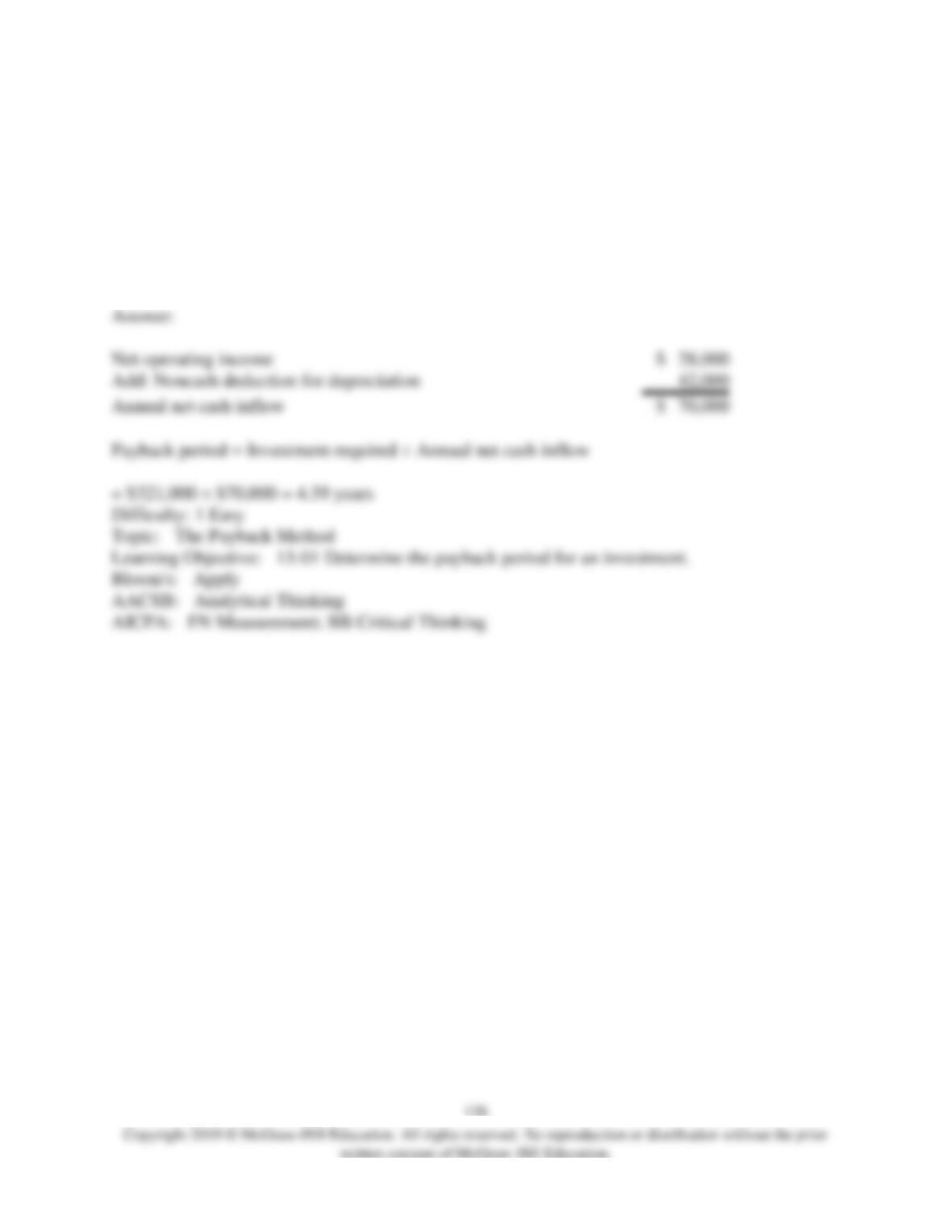
146) The management of Truelove Corporation is considering a project that would require an
initial investment of $321,000 and would last for 7 years. The annual net operating income from
the project would be $28,000, including depreciation of $42,000. At the end of the project, the
scrap value of the project’s assets would be $27,000. (Ignore income taxes.)
Required:
Determine the payback period of the project.
129
147) Ursus, Inc., is considering a project that would have a ten-year life and would require a
$1,000,000 investment in equipment. At the end of ten years, the project would terminate and the
equipment would have no salvage value. The project would provide net operating income each
year as follows (Ignore income taxes.):
Sales
$
2,000,000
Variable expenses
1,400,000
Contribution margin
600,000
Fixed expenses:
Fixed out-of-pocket cash expenses
$
300,000
Depreciation
100,000
400,000
Net operating income
$
200,000
All of the above items, except for depreciation, represent cash flows. The company’s required rate
of return is 12%.
See separate Exhibit 13B-1 and Exhibit 13B-2, to determine the appropriate discount factor(s)
using the tables provided.
Required:
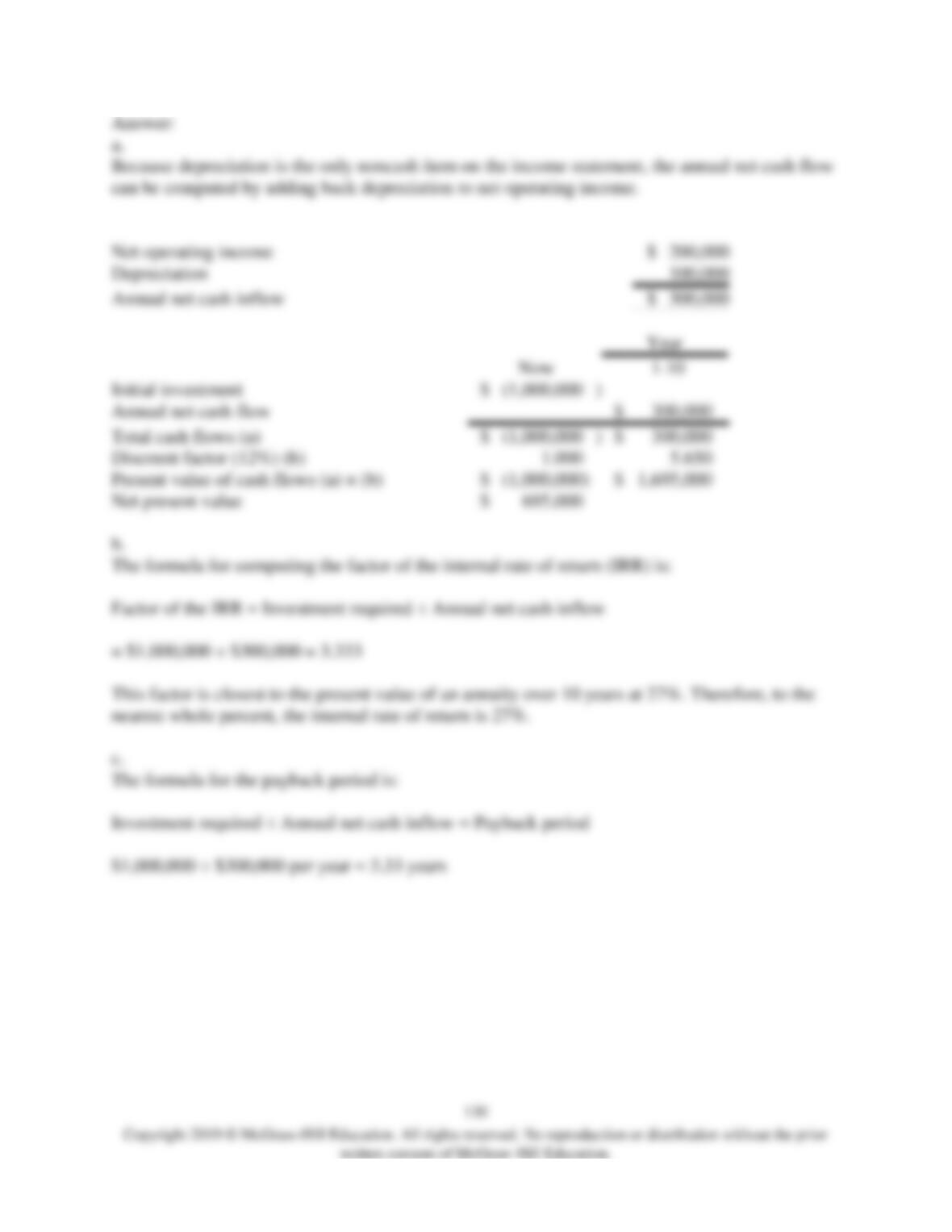
a. Compute the project’s net present value.
b. Compute the project’s internal rate of return to the nearest whole percent.
c. Compute the project’s payback period.
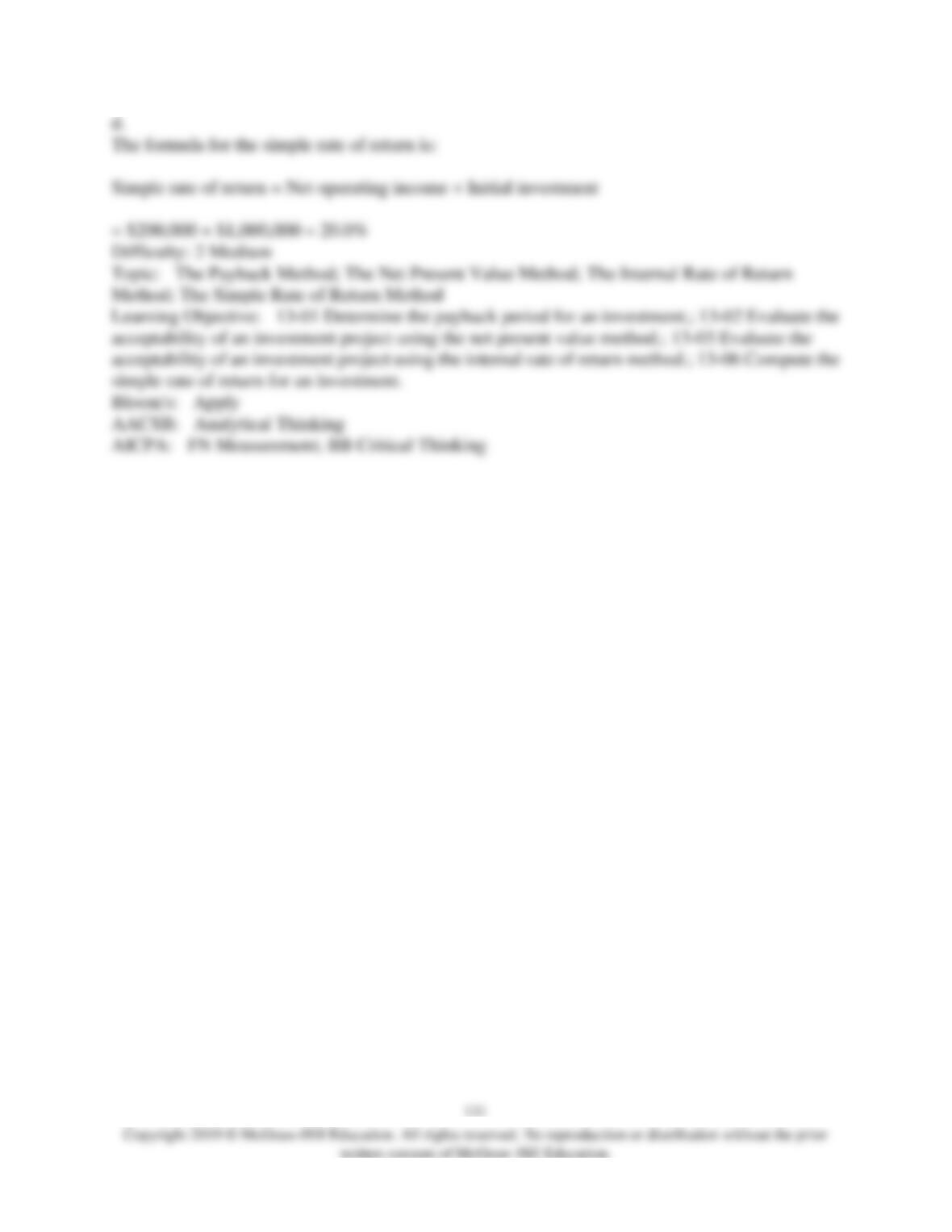
d. Compute the project’s simple rate of return.
148) Hady Corporation is considering purchasing a machine that would cost $688,800 and have a
useful life of 7 years. The machine would reduce cash operating costs by $118,759 per year. The
machine would have no salvage value. (Ignore income taxes.)
Required:
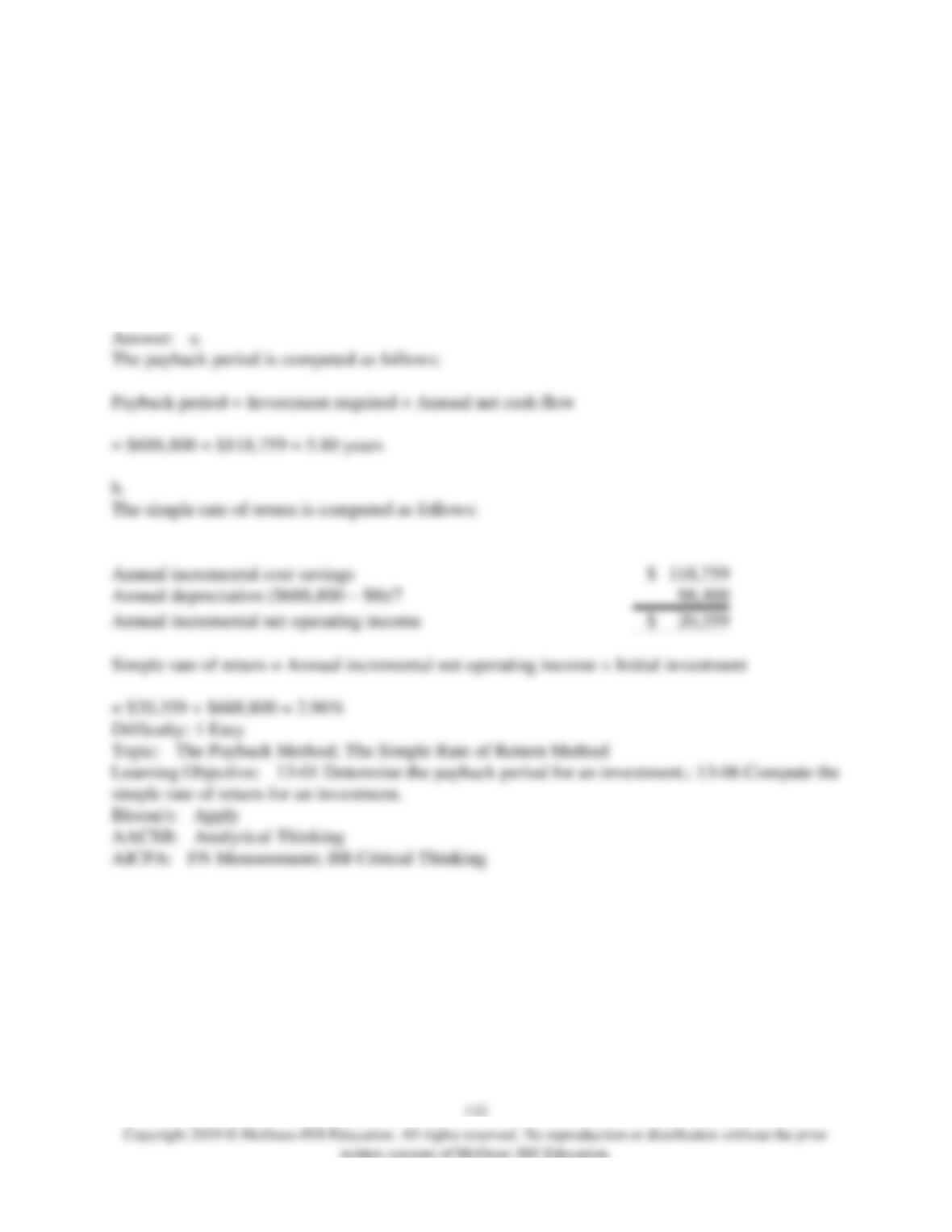
a. Compute the payback period for the machine.
b. Compute the simple rate of return for the machine.
149) Bied’s Pharmacy has purchased a small auto for delivery of prescriptions. The auto cost
$28,000 and will be usable for seven years. Delivery of prescriptions (which the pharmacy has
never done before) should increase revenues by at least $25,000 per year. The cost of these
prescriptions will be about $18,000 per year. The pharmacy depreciates all assets by the
straight-line method. (Ignore income taxes.)
Required:
a. Compute the payback period on the new auto.
b. Compute the simple rate of return of the new auto.
150) Cardinal Pharmacy has purchased a small auto for delivery of prescriptions. The auto cost
$28,000 and will be usable for four years. Delivery of prescriptions (which the pharmacy has never
done before) should increase revenues by at least $40,000 per year. The cost of these prescriptions
will be about $30,000 per year. The pharmacy depreciates all assets by the straight-line method.
(Ignore income taxes.)
Required:
a. Compute the payback period on the new auto.
b. Compute the simple rate of return of the new auto.
151) Ramson Corporation is considering purchasing a machine that would cost $756,000 and have
a useful life of 8 years. The machine would reduce cash operating costs by $132,632 per year. The
machine would have a salvage value of $151,200 at the end of the project. (Ignore income taxes.)
Required:
a. Compute the payback period for the machine.
b. Compute the simple rate of return for the machine.
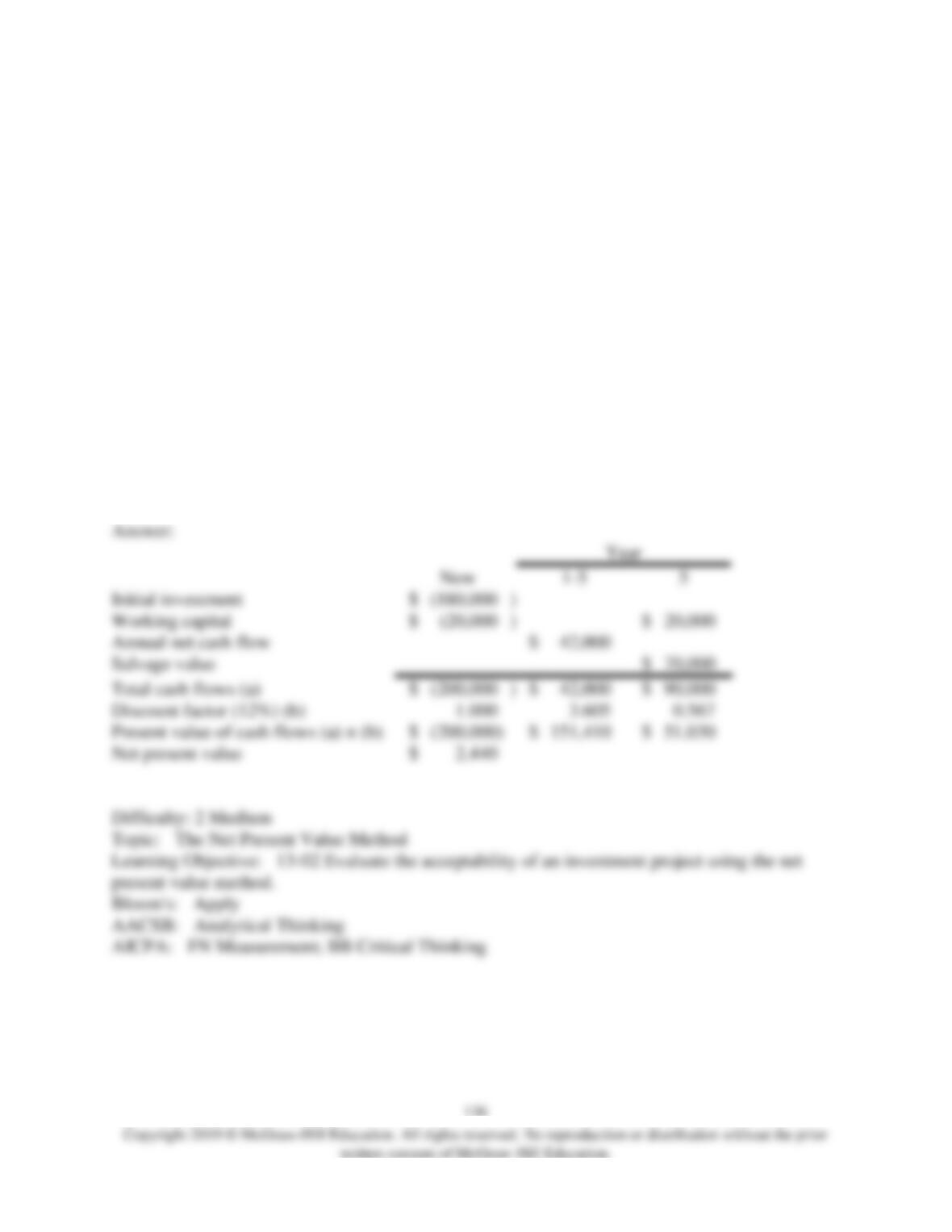
152) The following data concern an investment project (Ignore income taxes.):
Investment in equipment
$
180,000
Annual net cash inflows
$
42,000
Salvage value of the equipment
$
70,000
Working capital required
$
20,000
Life of the project
5
years
Required rate of return
12
%
The working capital will be released for use elsewhere at the conclusion of the project.
See separate Exhibit 13B-1 and Exhibit 13B-2, to determine the appropriate discount factor(s)
using the tables provided.
Required:
Compute the project’s net present value.
Now
Initial investment
(180,000
)
Working capital
(20,000
)
20,000
Annual net cash flow
$
42,000
Salvage value
70,000
Total cash flows (a)
(200,000
)
$
42,000
90,000
Discount factor (12%) (b)
0.567
Present value of cash flows (a) × (b)
(200,000
)
$
151,410
51,030
Net present value
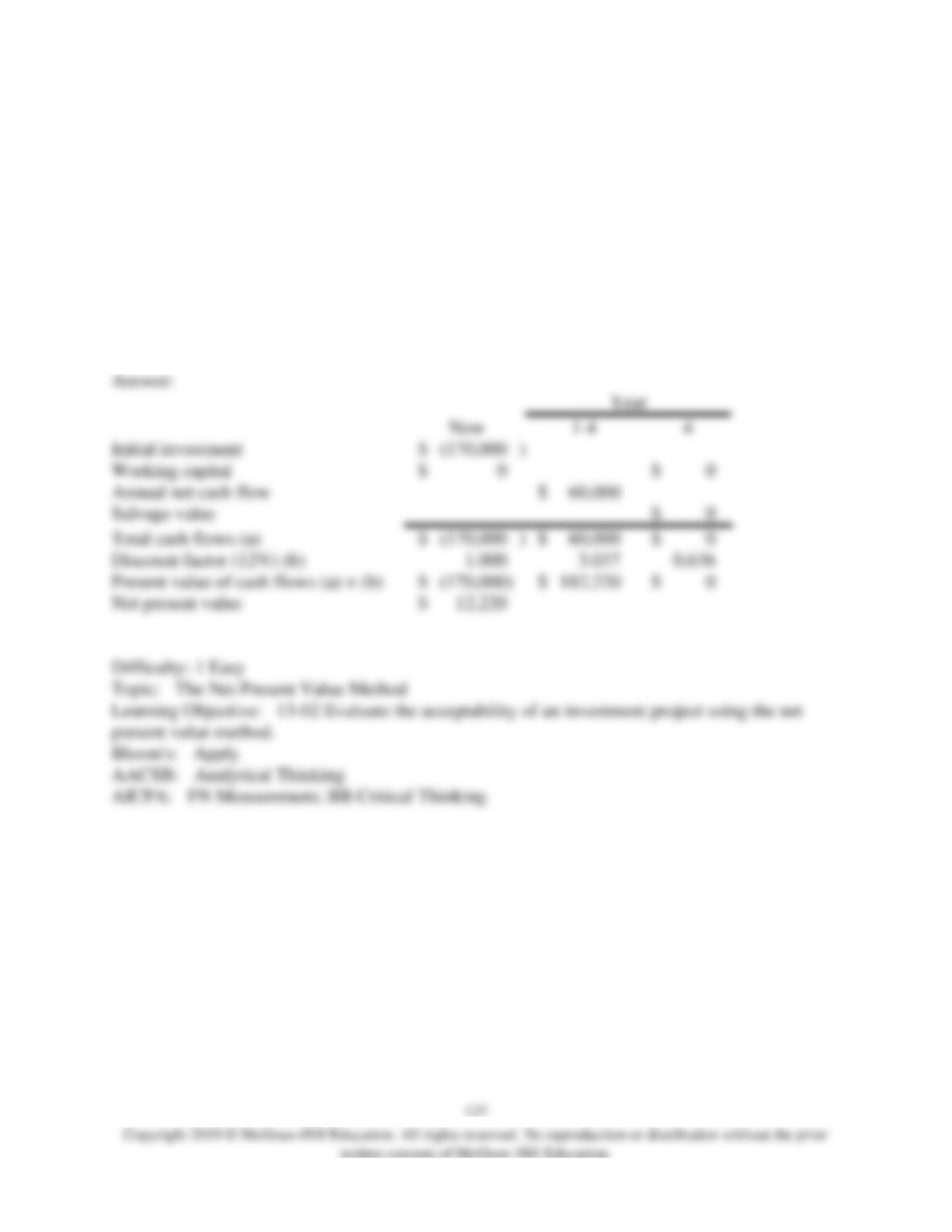
153) The management of Kinion Corporation is considering the purchase of a machine that would
cost $170,000, would last for 4 years, and would have no salvage value. The machine would
reduce labor and other costs by $60,000 per year. The company requires a minimum pretax return
of 12% on all investment projects. (Ignore income taxes.):
See separate Exhibit 13B-1 and Exhibit 13B-2, to determine the appropriate discount factor(s)
using the tables provided.
Required:
Determine the net present value of the project.
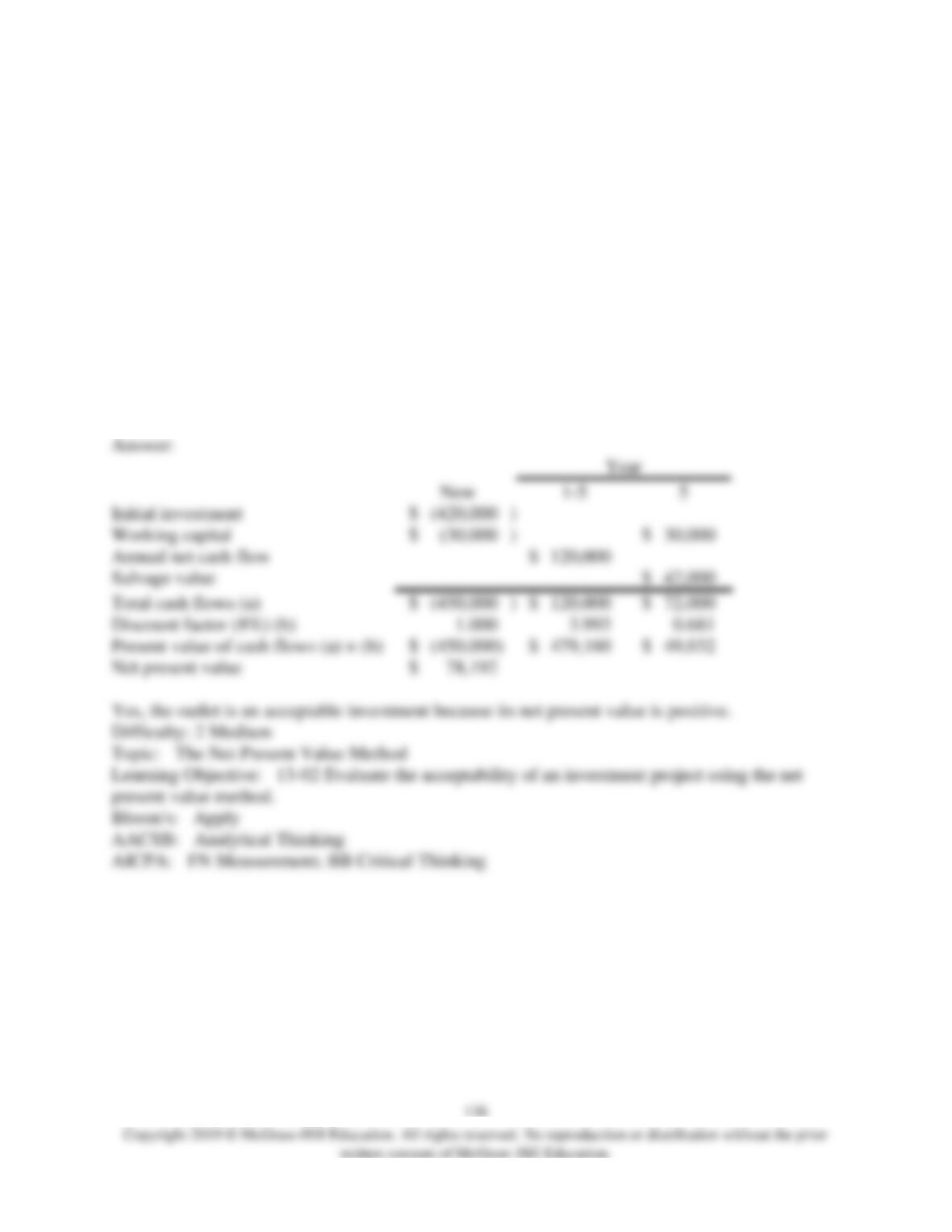
154) Bill Anders is considering investing in a franchise in a fast-food chain. He would have to
purchase equipment costing $420,000 to equip the outlet and invest an additional $30,000 for
inventories and other working capital needs. Other outlets in the fast-food chain have an annual net
cash inflow of about $120,000. Mr. Anders would close the outlet in 5 years. He estimates that the
equipment could be sold at that time for about 10% of its original cost and the working capital
would be released for use elsewhere. Mr. Anders’ required rate of return is 8%. (Ignore income
taxes.)
See separate Exhibit 13B-1 and Exhibit 13B-2, to determine the appropriate discount factor(s)
using the tables provided.
Required:
What is the investment’s net present value? Is this an acceptable investment?
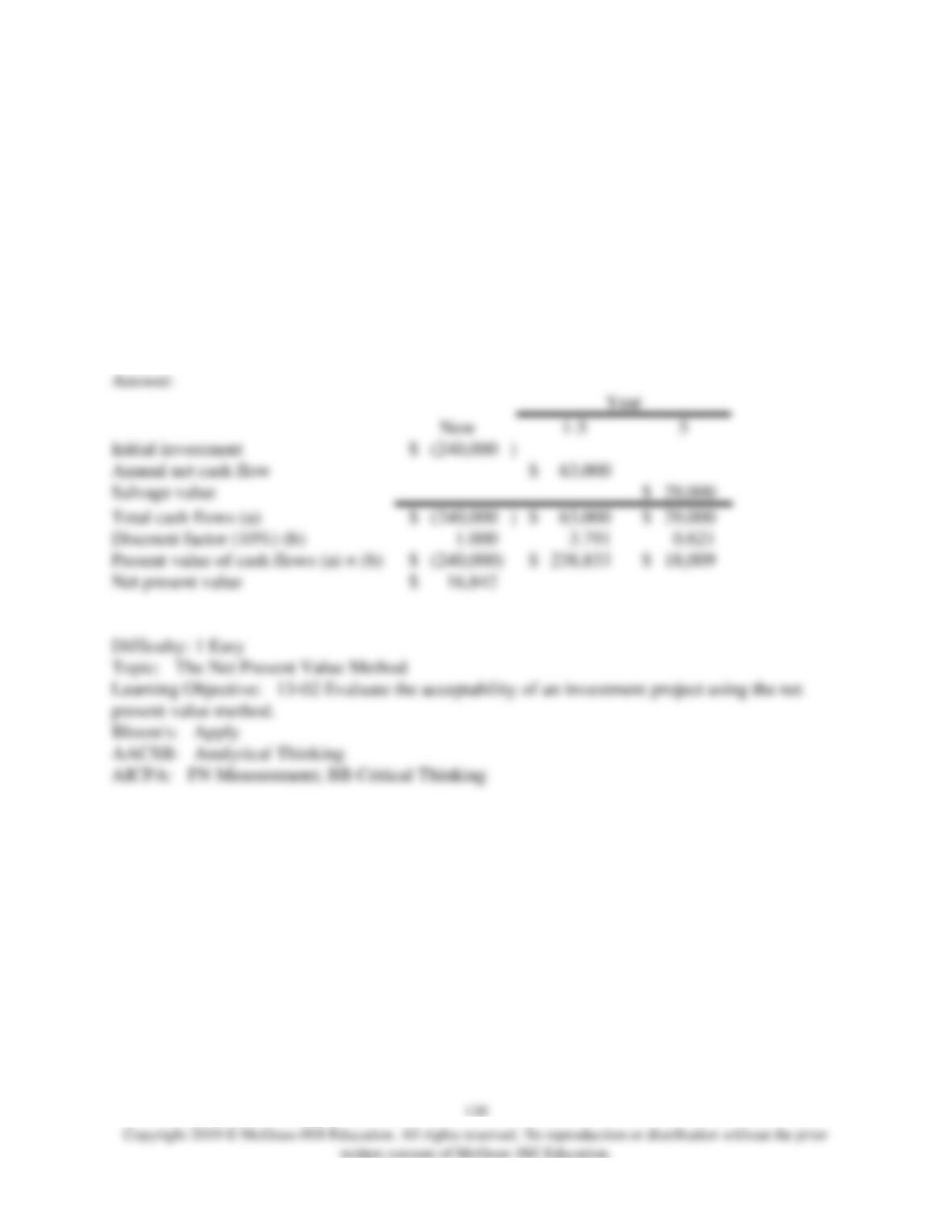
155) Wary Corporation is considering the purchase of a machine that would cost $240,000 and
would last for 5 years. At the end of 5 years, the machine would have a salvage value of $29,000.
The machine would reduce labor and other costs by $63,000 per year. The company requires a
minimum pretax return of 10% on all investment projects. (Ignore income taxes.)
See separate Exhibit 13B-1 and Exhibit 13B-2, to determine the appropriate discount factor(s)
using the tables provided.
Required:
Determine the net present value of the project.
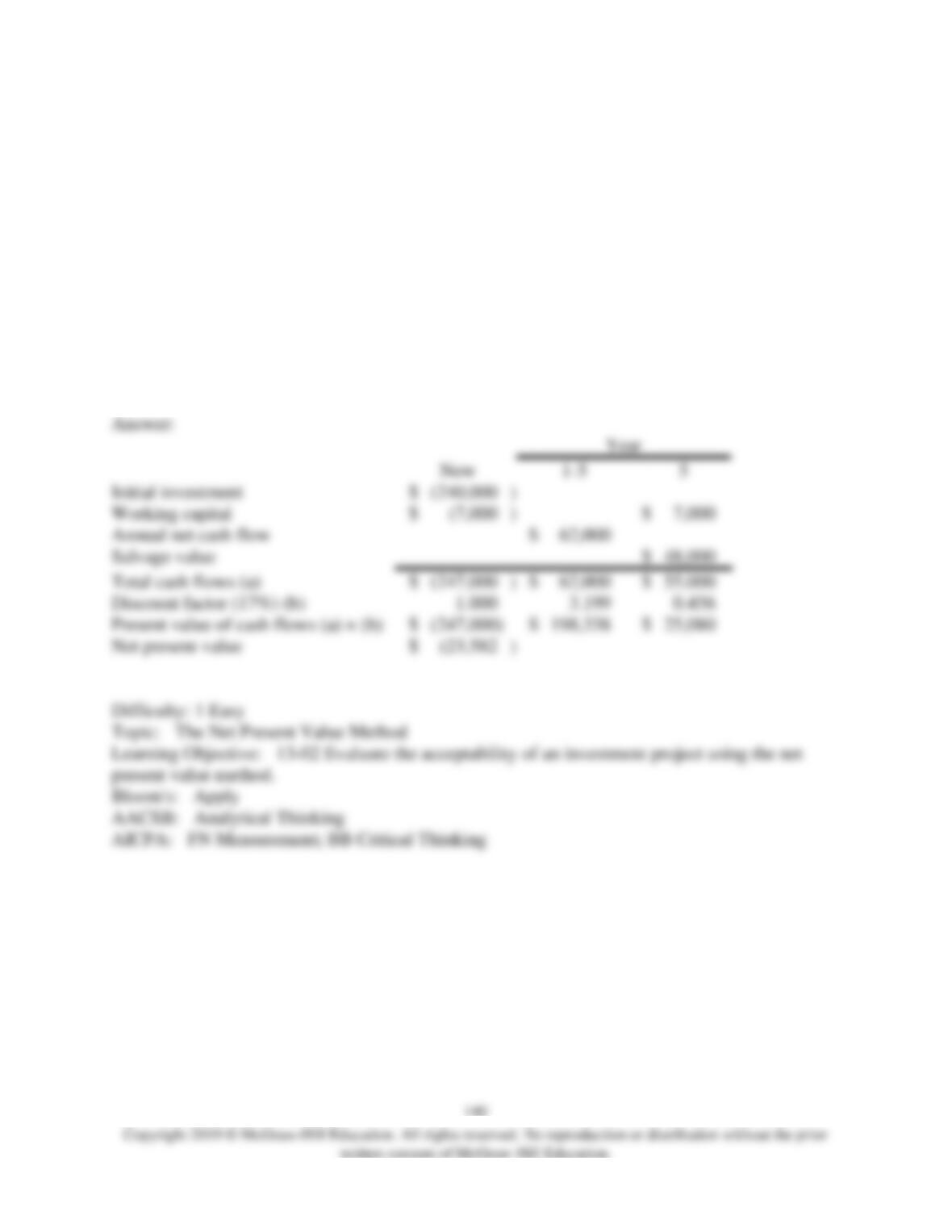
156) Joanette, Inc., is considering the purchase of a machine that would cost $240,000 and would
last for 5 years, at the end of which, the machine would have a salvage value of $48,000. The
machine would reduce labor and other costs by $62,000 per year. Additional working capital of
$7,000 would be needed immediately, all of which would be recovered at the end of 5 years. The
company requires a minimum pretax return of 17% on all investment projects. (Ignore income
taxes.)
See separate Exhibit 13B-1 and Exhibit 13B-2, to determine the appropriate discount factor(s)
using the tables provided.
Required:
Determine the net present value of the project.