a.
Return on equity
b.
Return on assets
c.
Asset turnover
d.
Quick ratio
57. Free cash flow is measured in terms of
a.
a percentage.
b.
dollars.
c.
days.
d.
times.
58. The price/earnings (P/E) ratio is measured in terms of
a.
dollars.
b.
days.
c.
a percentage.
d.
times.
59. Net income is needed to calculate all of the following ratios, except
a.
return on assets.
b.
profit margin.
c.
return on equity.
d.
asset turnover.
60. Cost of goods sold is needed to calculate
a.
payables turnover.
b.
the quick ratio.
c.
days’ payable.
d.
days’ sales uncollected.
61. Market strength refers most closely to the ability to
a.
increase the wealth of stockholders.
b.
pay bills when they fall due.
c.
survive for many years.
d.
earn a satisfactory net income.
62. A quick ratio that is much smaller than the current ratio indicates that
a.
inventories represent a large portion of current assets.
b.
the company has a low inventory turnover.
c.
the company has a high inventory turnover.
d.
inventories represent a small portion of current assets.
63. A high receivable turnover indicates that
a.
the company’s inventory is moving very quickly.
b.
a large proportion of the company’s sales is on credit.
c.
many customers are defaulting on their debts.
d.
customers are making payments very quickly.
64. The receivable turnover amount is needed to calculate the
a.
inventory turnover.
b.
days’ sales uncollected.
c.
days’ inventory on hand.
d.
interest coverage ratio.
65. A company that is leveraged is one that
a.
has a high earnings per share.
b.
contains equity financing.
c.
has minimized its risk of loss by acquiring a portfolio of investments.
d.
contains debt financing.
66. The length of the operating cycle equals the days’ sales uncollected plus the
a.
receivable turnover.
b.
days’ payable.
c.
days’ inventory on hand.
d.
payables turnover.
67. An increase in which of the following ratios is considered unfavorable?
a.
Cash flow yield
b.
Current ratio
c.
Price/earnings (P/E) ratio
d.
Debt to equity ratio
68. An increase in which of the following ratios is considered unfavorable?
a.
Interest coverage ratio
b.
Cash flows to assets
c.
Quick ratio
d.
Days’ sales uncollected
69. Following are the financial statements for Starman Corporation for the year ended December 31, 2013.
Assume that all balance sheet amounts represent both average and ending figures.
Starman Corporation
Balance Sheet
December 31, 2013
Assets
Cash
$ 20,000
Marketable securities
30,000
Accounts receivable
50,000
Inventory
100,000
Long-term receivables
35,000
Property, plant, and equipment
65,000
Total assets
$300,000
Liabilities and Stockholders’ Equity
Current liabilities
$100,000
Long-term liabilities
60,000
Stockholders’ equity
140,000
Total liabilities and stockholders’ equity
$300,000
Starman Corporation
Income Statement
For the Year Ended December 31, 2013
Net sales
$400,000
Cost of goods sold
240,000
Gross margin
$160,000
Operating expenses
40,000
Income before income taxes
$120,000
Income taxes expense
30,000
Net income
$ 90,000
What is the current ratio for this corporation?
a.
1.70 times
b.
1.54 times
c.
1.00 times
d.
2.00 times
70. Following are the financial statements for Starman Corporation for the year ended December 31, 2013.
Assume that all balance sheet amounts represent both average and ending figures.
Starman Corporation
Balance Sheet
December 31, 2013
Assets
Cash
$ 20,000
Marketable securities
30,000
Accounts receivable
50,000
Inventory
100,000
Long-term receivables
35,000
Property, plant, and equipment
65,000
Total assets
$300,000
Liabilities and Stockholders’ Equity
Current liabilities
$100,000
Long-term liabilities
60,000
Stockholders’ equity
140,000
Total liabilities and stockholders’ equity
$300,000
Starman Corporation
Income Statement
For the Year Ended December 31, 2013
Net sales
$400,000
Cost of goods sold
240,000
Gross margin
$160,000
Operating expenses
40,000
Income before income taxes
$120,000
Income taxes expense
30,000
Net income
$ 90,000
What is the receivable turnover for this corporation?
a.
6.0 times
b.
1.8 times
c.
4.8 times
d.
8.0 times
71. Following are the financial statements for Starman Corporation for the year ended December 31, 2013.
Assume that all balance sheet amounts represent both average and ending figures.
Starman Corporation
Balance Sheet
December 31, 2013
Assets
Cash
$ 20,000
Marketable securities
30,000
Accounts receivable
50,000
Inventory
100,000
Long-term receivables
35,000
Property, plant, and equipment
65,000
Total assets
$300,000
Liabilities and Stockholders’ Equity
Current liabilities
$100,000
Long-term liabilities
60,000
Stockholders’ equity
140,000
Total liabilities and stockholders’ equity
$300,000
Starman Corporation
Income Statement
For the Year Ended December 31, 2013
Net sales
$400,000
Cost of goods sold
240,000
Gross margin
$160,000
Operating expenses
40,000
Income before income taxes
$120,000
Income taxes expense
30,000
Net income
$ 90,000
What is the inventory turnover for this corporation?
a.
1.6 times
b.
1.2 times
c.
2.4 times
d.
4.0 times
72. Following are the financial statements for Starman Corporation for the year ended December 31, 2013.
Assume that all balance sheet amounts represent both average and ending figures.
Starman Corporation
Balance Sheet
December 31, 2013
Assets
Cash
$ 20,000
Marketable securities
30,000
Accounts receivable
50,000
Inventory
100,000
Long-term receivables
35,000
Property, plant, and equipment
65,000
Total assets
$300,000
Liabilities and Stockholders’ Equity
Current liabilities
$100,000
Long-term liabilities
60,000
Stockholders’ equity
140,000
Total liabilities and stockholders’ equity
$300,000
Starman Corporation
Income Statement
For the Year Ended December 31, 2013
Net sales
$400,000
Cost of goods sold
240,000
Gross margin
$160,000
Operating expenses
40,000
Income before income taxes
$120,000
Income taxes expense
30,000
Net income
$ 90,000
What is the return on assets for this corporation?
a.
30.0 percent
b.
75.0 percent
c.
40.0 percent
d.
53.3 percent
73. Following are the financial statements for Starman Corporation for the year ended December 31, 2013.
Assume that all balance sheet amounts represent both average and ending figures.
Starman Corporation
Balance Sheet
December 31, 2013
Assets
Cash
$ 20,000
Marketable securities
30,000
Accounts receivable
50,000
Inventory
100,000
Long-term receivables
35,000
Property, plant, and equipment
65,000
Total assets
$300,000
Liabilities and Stockholders’ Equity
Current liabilities
$100,000
Long-term liabilities
60,000
Stockholders’ equity
140,000
Total liabilities and stockholders’ equity
$300,000
Starman Corporation
Income Statement
For the Year Ended December 31, 2013
Net sales
$400,000
Cost of goods sold
240,000
Gross margin
$160,000
Operating expenses
40,000
Income before income taxes
$120,000
Income taxes expense
30,000
Net income
$ 90,000
What is the profit margin for this corporation?
a.
53.3 percent
b.
40.0 percent
c.
22.5 percent
d.
30.0 percent
74. Holiday Corporation provided these figures for the year ended December 31, 2013:
Cost of goods sold, $516,117; change in inventory, $67,483 decrease; average accounts payable,
$64,599.
What is the company’s payables turnover? Round your answer to one decimal place.
a.
9.3 times
b.
6.4 times
c.
6.9 times
d.
7.5 times
75. The following information pertains to Jasmin Corporation. Assume that all balance sheet amounts
represent both average and ending figures.
Jasmin Corporation
Partial Balance Sheet
December 31, 2013
Liabilities and Stockholders’ Equity
Current liabilities
$ 60,000
Long-term liabilities
90,000
Stockholders’ equity
150,000
Total liabilities and stockholders’ equity
$300,000
Jasmin Corporation
Income Statement
For the Year Ended December 31, 2013
Net sales
$80,000
Cost of goods sold
45,000
Gross margin
$35,000
Operating expenses
15,000
Income before income taxes
$20,000
Income taxes expense
5,000
Net income
$15,000
Jasmin Corporation had 6,000 shares of common stock issued and outstanding. The market price of
Jasmin common stock on December 31, 2013, was $20. Jasmin paid dividends of $0.90 per share
during 2013.
What is the return on assets for this corporation?
a.
5.0 percent
b.
11.7 percent
c.
26.7 percent
d.
10.0 percent
76. The following information pertains to Jasmin Corporation. Assume that all balance sheet amounts
represent both average and ending figures.
Jasmin Corporation
Partial Balance Sheet
December 31, 2013
Liabilities and Stockholders’ Equity
Current liabilities
$ 60,000
Long-term liabilities
90,000
Stockholders’ equity
150,000
Total liabilities and stockholders’ equity
$300,000
Jasmin Corporation
Income Statement
For the Year Ended December 31, 2013
Net sales
$80,000
Cost of goods sold
45,000
Gross margin
$35,000
Operating expenses
15,000
Income before income taxes
$20,000
Income taxes expense
5,000
Net income
$15,000
Jasmin Corporation had 6,000 shares of common stock issued and outstanding. The market price of
Jasmin common stock on December 31, 2013, was $20. Jasmin paid dividends of $0.90 per share
during 2013.
What is the return on equity for this corporation?
a.
10.0 percent
b.
23.3 percent
c.
53.5 percent
d.
5.0 percent
77. The following information pertains to Jasmin Corporation. Assume that all balance sheet amounts
represent both average and ending figures.
Jasmin Corporation
Partial Balance Sheet
December 31, 2013
Liabilities and Stockholders’ Equity
Current liabilities
$ 60,000
Long-term liabilities
90,000
Stockholders’ equity
150,000
Total liabilities and stockholders’ equity
$300,000
Jasmin Corporation
Income Statement
For the Year Ended December 31, 2013
Net sales
$80,000
Cost of goods sold
45,000
Gross margin
$35,000
Operating expenses
15,000
Income before income taxes
$20,000
Income taxes expense
5,000
Net income
$15,000
Jasmin Corporation had 6,000 shares of common stock issued and outstanding. The market price of
Jasmin common stock on December 31, 2013, was $20. Jasmin paid dividends of $0.90 per share
during 2013.
What is the debt to equity ratio for this corporation?
a.
1.0 times
b.
2.5 times
c.
0.4 times
d.
0.6 times
78. The following information pertains to Jasmin Corporation. Assume that all balance sheet amounts
represent both average and ending figures.
Jasmin Corporation
Partial Balance Sheet
December 31, 2013
Liabilities and Stockholders’ Equity
Current liabilities
$ 60,000
Long-term liabilities
90,000
Stockholders’ equity
150,000
Total liabilities and stockholders’ equity
$300,000
Jasmin Corporation
Income Statement
For the Year Ended December 31, 2013
Net sales
$80,000
Cost of goods sold
45,000
Gross margin
$35,000
Operating expenses
15,000
Income before income taxes
$20,000
Income taxes expense
5,000
Net income
$15,000
Jasmin Corporation had 6,000 shares of common stock issued and outstanding. The market price of
Jasmin common stock on December 31, 2013, was $20. Jasmin paid dividends of $1.55 per share
during 2013.
What is the dividends yield of this corporation?
a.
9.30 percent
b.
7.75 percent
c.
4.65 percent
d.
6.20 percent
a.
9.30 percent
b.
7.75 percent
c.
4.65 percent
d.
6.20 percent
79. The following information pertains to Jasmin Corporation. Assume that all balance sheet amounts
represent both average and ending figures.
Jasmin Corporation
Partial Balance Sheet
December 31, 2013
Liabilities and Stockholders’ Equity
Current liabilities
$ 60,000
Long-term liabilities
90,000
Stockholders’ equity
150,000
Total liabilities and stockholders’ equity
$300,000
Jasmin Corporation
Income Statement
For the Year Ended December 31, 2013
Net sales
$80,000
Cost of goods sold
45,000
Gross margin
$35,000
Operating expenses
15,000
Income before income taxes
$20,000
Income taxes expense
5,000
Net income
$15,000
Jasmin Corporation had 6,000 shares of common stock issued and outstanding. The market price of
Jasmin common stock on December 31, 2013, was $20. Jasmin paid dividends of $0.90 per share
during 2013.
What is the price/earnings (P/E) ratio for this corporation?
a.
6.2 times
b.
7.2 times
c.
8.2 times
d.
9.7 times
80. How would the collection of an account receivable affect the current ratio and the quick ratio,
respectively?
a.
Increase in current ratio; increase in quick ratio
b.
No effect on current ratio; no effect on quick ratio
c.
No effect on current ratio; increase in quick ratio
d.
Decrease in current ratio; decrease in quick ratio
81. What is the effect of the payment of an account payable on the current ratio and the quick ratio,
respectively? (Assume the current ratio was 2.3 times and the quick ratio was 2.1 times before this
transaction.)
a.
Increase in current ratio; increase in quick ratio
b.
Decrease in current ratio; no effect on quick ratio
c.
Decrease in current ratio; decrease in quick ratio
d.
No effect on current ratio; no effect on quick ratio
82. Assuming that the current ratio was 1.6 times and the quick ratio was 1.4 times, the entry to record the
payment of a previously declared and recorded cash dividend will
a.
decrease the current ratio and the quick ratio.
b.
have no effect on the current ratio or the quick ratio.
c.
increase the current ratio and the quick ratio.
d.
increase the current ratio but have no effect on the quick ratio.
83. A company with a current ratio of 2.4 times will see that ratio decrease when the company
a.
converts a short-term liability to a long-term liability.
b.
borrows cash by issuing a short-term note payable.
c.
declares a 10 percent stock dividend on its common stock.
d.
pays a large current liability.
84. During the year, Dempsey Corporation’s current ratio increased while its quick ratio decreased. Which
of the following could help explain this situation?
a.
The sale of short-term investments during the year
b.
A decrease in accounts receivable during the year
c.
An increase in accounts payable during the year
d.
An increase in inventory levels during the year
85. A company with $50,000 in current assets, $25,000 in quick assets, and $30,000 in current liabilities
makes a payment of a $1,500 current debt. As a result of this transaction, the current ratio and quick
ratio will
a.
both increase.
b.
both decrease.
c.
increase and decrease, respectively.
d.
remain the same and decrease, respectively.
MATCHING
Match each definition with the correct term below.
a.
The time that it takes to purchase inventory, sell it, and collect cash for it.
b.
The relationship of the more liquid current assets (cash, marketable securities or
short-term investments, and receivables) to current liabilities.
c.
A technique for analyzing financial statements that uses percentages to show the
relationship of the different parts to the total in a single statement.
d.
The substance of earnings and their sustainability into future accounting periods.
e.
All the techniques used to show important relationships in financial statements and to
relate them to important financial objectives.
f.
A technique for analyzing financial statements that involves the computation of dollar
amount changes and percentage changes from the previous to the current year.
g.
Large companies that have multiple segments and operate in more than one industry.
h.
Segments that are no longer a part of a company’s operations.
i.
A technique for analyzing financial statements in which meaningful relationships between
components of the financial statements are shown.
j.
The measure of investors’ confidence in a company.
1. Financial performance measurement
2. Diversified companies
3. Quality of earnings
4. Discontinued operations
5. Horizontal analysis
6. Ratio analysis
7. Vertical analysis
8. Operating cycle
9. Price/earnings (P/E) ratio
10. Quick ratio
SHORT ANSWER
1. Does the existence of conglomerates make financial performance evaluation easier or more difficult?
Why?
2. For each of the performance objectives listed below, state the related financial objective term.
a.
To use debt effectively without jeopardizing the company’s future.
b.
To earn a satisfactory net income.
c.
To be able to pay bills when due and meet unexpected needs for cash.
d.
To use all of the company’s assets in a way that maximizes revenues while minimizing
investment.
e.
To use current assets and current liabilities in a way that supports growth in revenues
with minimum investment.
3. Define quality of earnings and identify the factors that affect quality of earnings.
4. State whether each of the items below is an accounting method, an accounting estimate, or a one-time
item.
a.
Loss on sale of investments
b.
Length of useful life on long-term assets
c.
Straight-line versus accelerated depreciation
d.
Costs of restructuring
e.
FIFO versus LIFO
f.
Discontinued operations
g.
Percentage of net sales versus aging of accounts receivable
h.
Residual value of long-term assets
i.
Amortization periods
5. What is vertical analysis, and why is it useful in performing financial performance measurement?
6. What is horizontal analysis, and why is it useful in performing financial performance measurement?
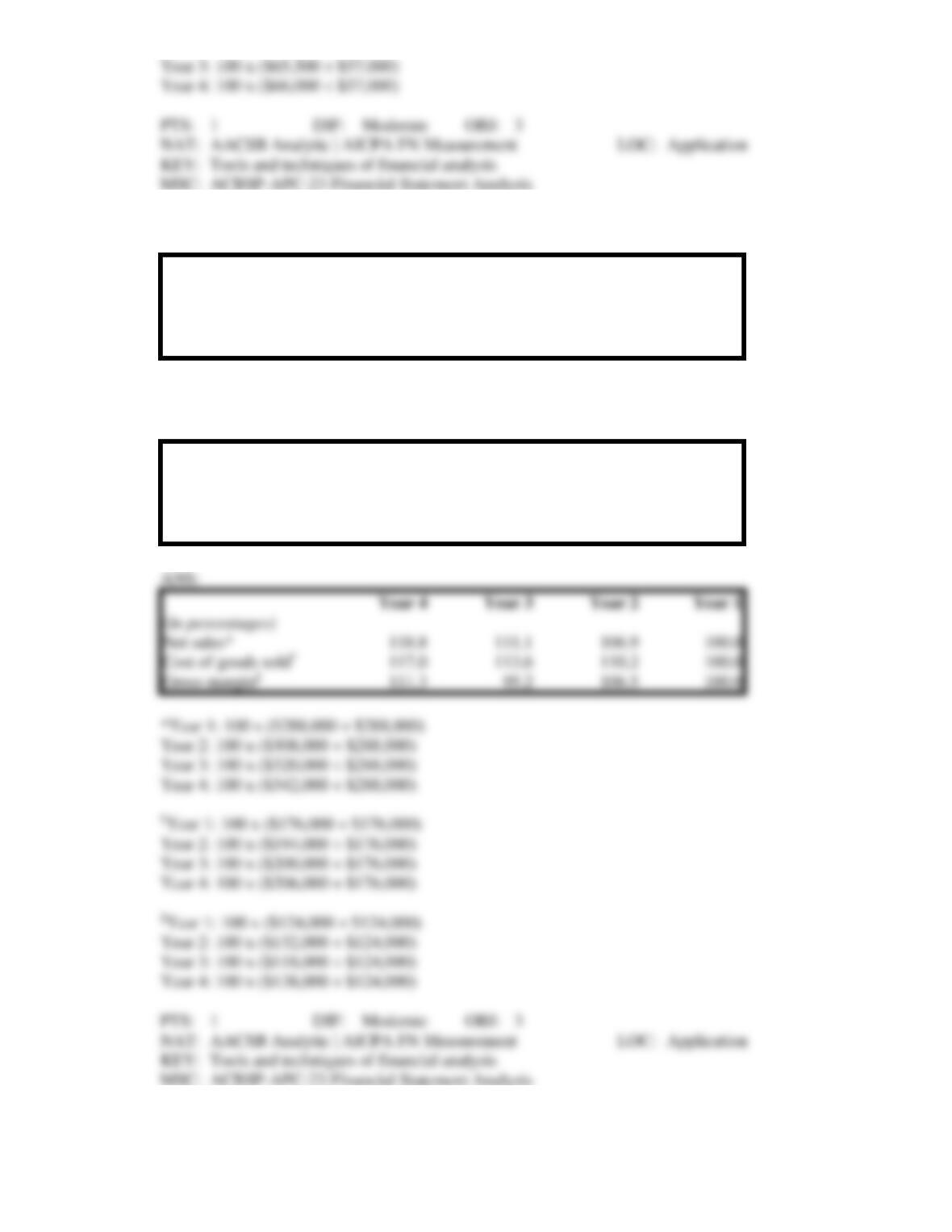
7. The following selected amounts were extracted from the financial statements of Flamingo Corporation.
Year 4
Year 3
Year 2
Year 1
Net sales
$175,000
$170,000
$165,000
$150,000
Cost of goods sold
109,000
104,500
100,500
93,000
Gross margin
66,000
65,500
64,500
57,000
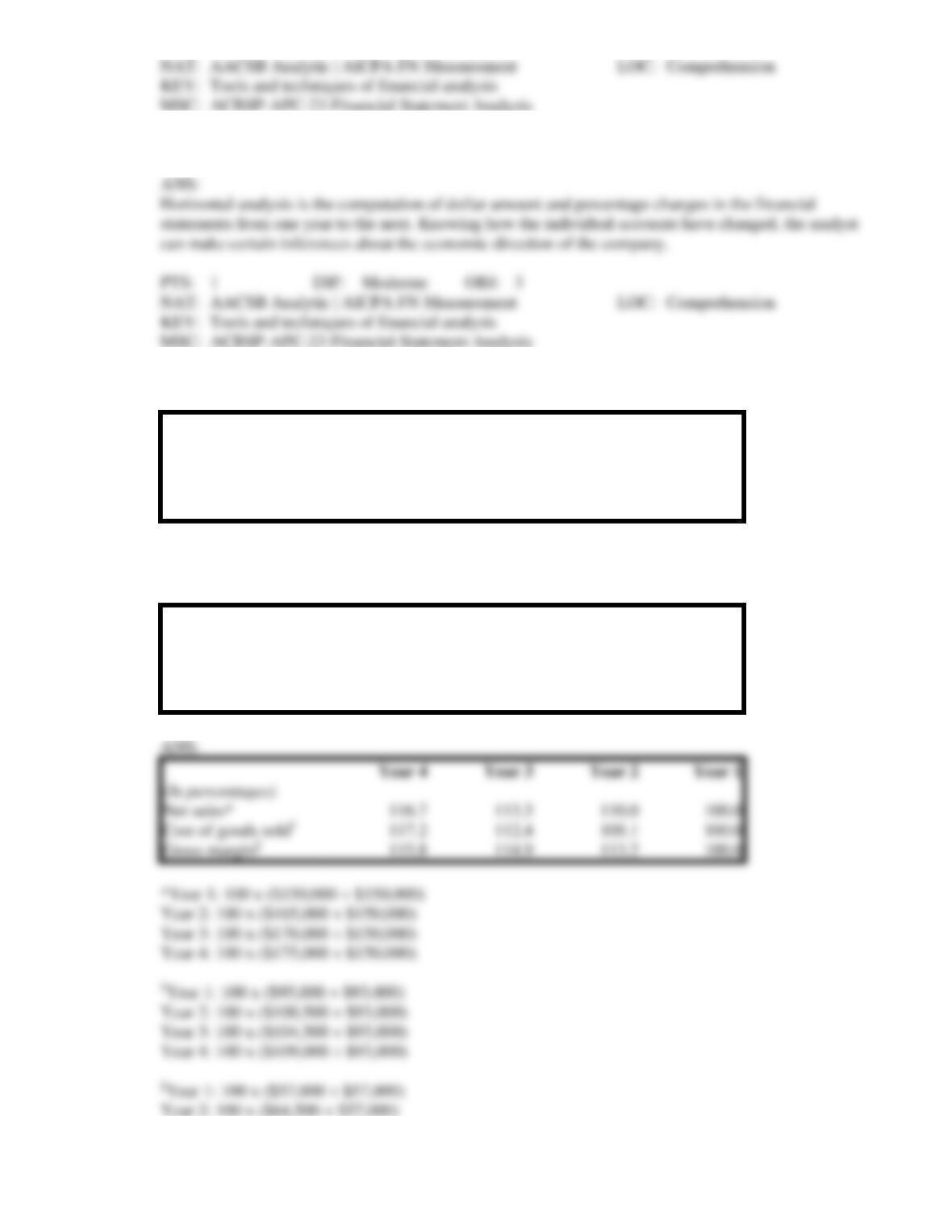
Prepare a trend analysis for net sales, cost of goods sold, and gross margin. (Round answers to the
nearest tenth of 1 percent.) Use Year 1 as the base year.
Year 4
Year 3
Year 2
Year 1
(In percentages)
Net sales
Cost of goods sold
Gross margin
(In percentages)
Net sales*
8. The following selected amounts were extracted from the financial statements of Bandera Corporation.
Year 4
Year 3
Year 2
Year 1
Net sales
$342,000
$320,000
$308,000
$288,000
Cost of goods sold
206,000
200,000
194,000
176,000
Gross margin
138,000
118,000
132,000
124,000
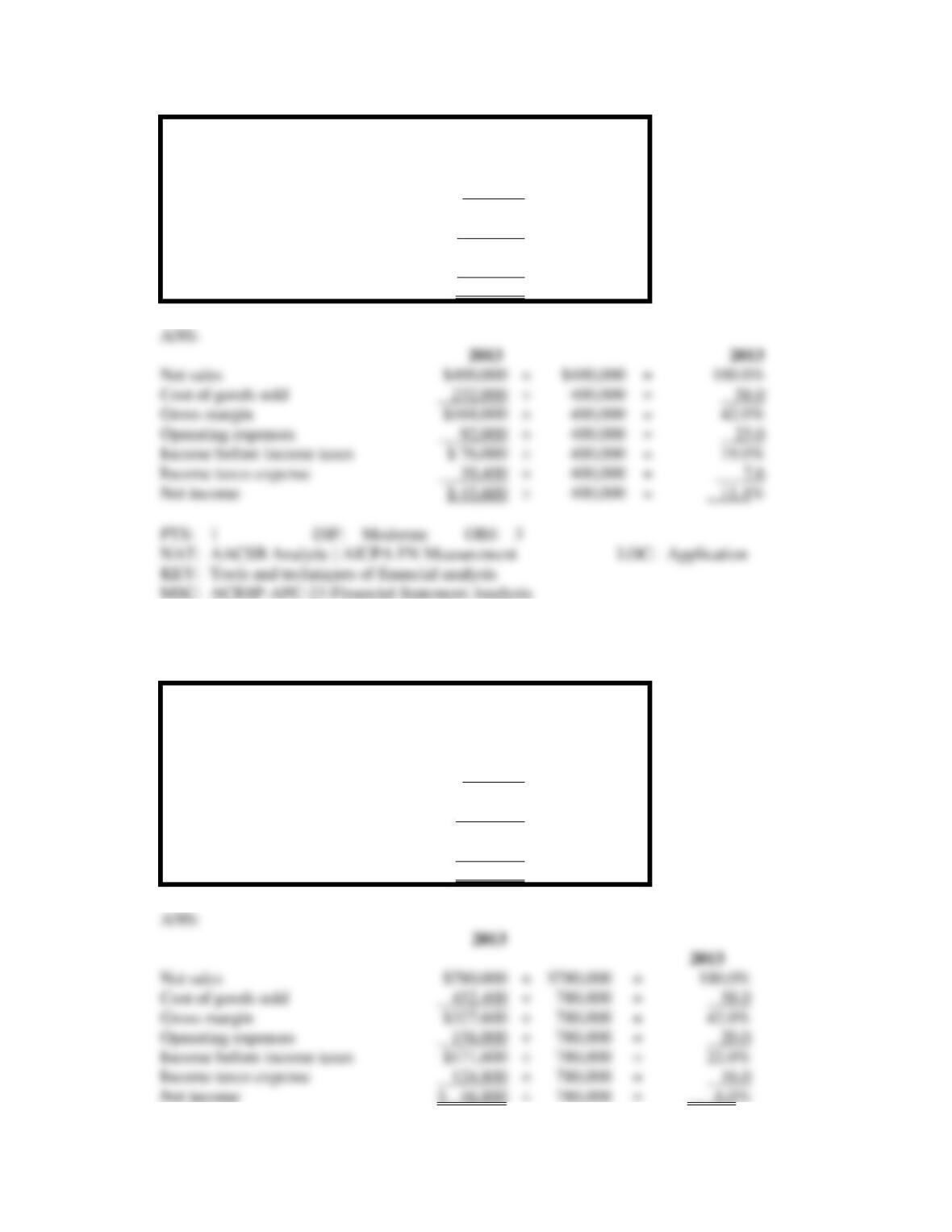
Prepare a trend analysis for net sales, cost of goods sold, and gross margin. (Round answers to the
nearest tenth of 1 percent.) Use Year 1 as the base year.
Year 4
Year 3
Year 2
Year 1
(In percentages)
Net sales
Cost of goods sold
Gross margin
Year 4
Year 3
Year 2
Year 1
(In percentages)
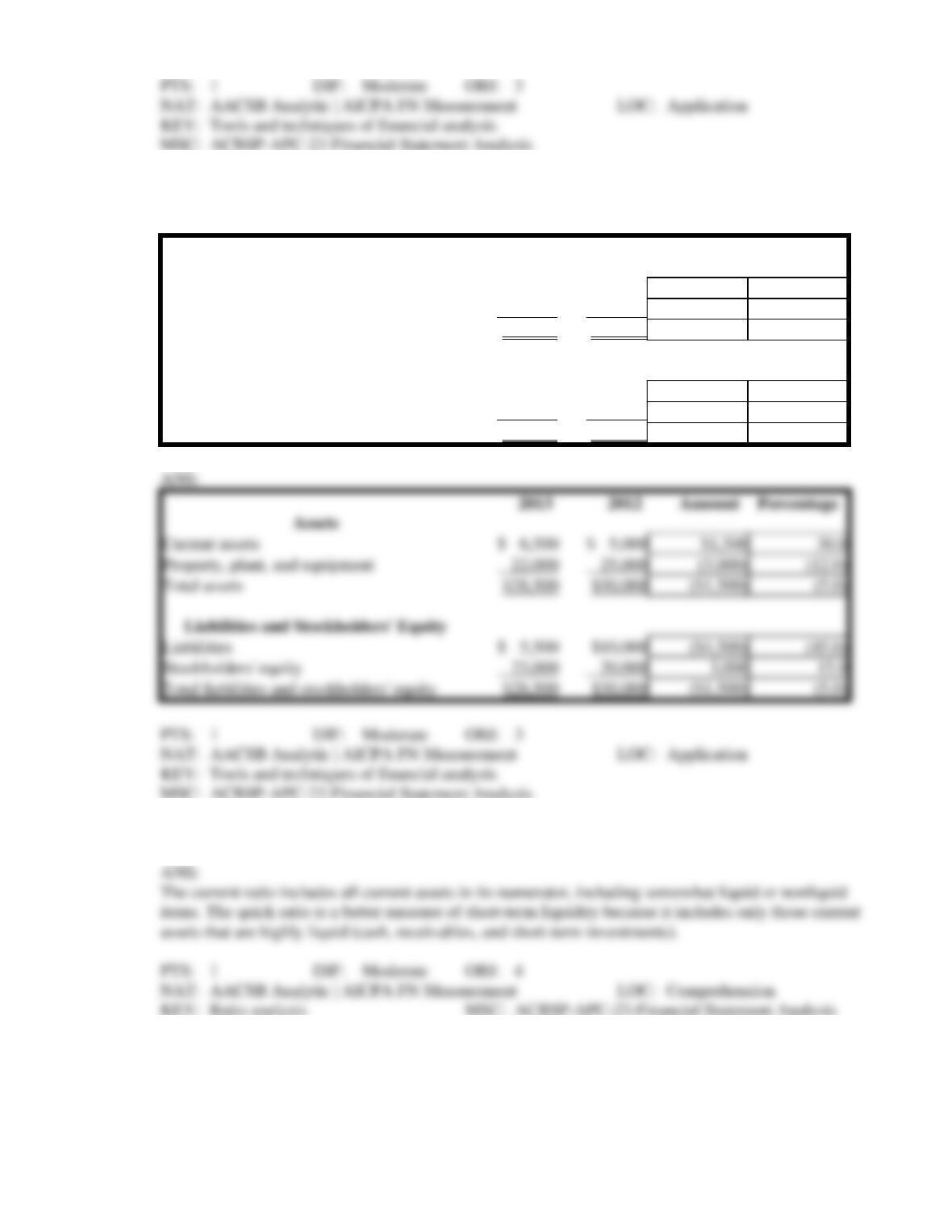
9. Using the income statement below, develop a common-size statement by filling in the blanks provided.
Show your work. Round to one decimal place.
2013
2013
Net sales
$400,000
_________
Cost of goods sold
232,000
_________
Gross margin
$168,000
_________
Operating expenses
92,000
_________
Income before income taxes
$ 76,000
_________
Income taxes expense
30,400
_________
Net income
$ 45,600
_________
10. Using the income statement below, develop a common-size statement by filling in the blanks provided.
Show your work. Round to one decimal place.
2013
2013
Net sales
$780,000
_________
Cost of goods sold
452,400
_________
Gross margin
$327,600
_________
Operating expenses
156,000
_________
Income before income taxes
$171,600
_________
Income taxes expense
124,800
_________
Net income
$ 46,800
_________
Net sales
Cost of goods sold
Gross margin
Operating expenses
Income before income taxes
Net income
Net sales
Cost of goods sold
Gross margin
42.0%
Operating expenses
Income before income taxes
19.0%
Income taxes expense
Net income
11. Prepare a horizontal analysis by computing the amounts and percentage changes for the following
balance sheet items; place your answers in the blanks provided.
2013
2012
Amount
Percentage
Assets
Current assets
$ 6,500
$ 5,000
Property, plant, and equipment
22,000
25,000
Total assets
$28,500
$30,000
Liabilities and Stockholders’ Equity
Liabilities
$ 5,500
$10,000
Stockholders’ equity
23,000
20,000
Total liabilities and stockholders’ equity
$28,500
$30,000
2013
2012
Amount
Percentage
Assets
Current assets
$ 6,500
$ 5,000
Property, plant, and equipment
22,000
25,000
Total assets
$28,500
$30,000
Liabilities and Stockholders’ Equity
Liabilities
$ 5,500
$10,000
Stockholders’ equity
23,000
20,000
Total liabilities and stockholders’ equity
$28,500
$30,000
12. Why is the quick ratio probably better than the current ratio as a measure of short-term liquidity?
13. Given the following information, calculate the payables turnover and days’ payable. Round to two
decimal places.
Net sales
$20,000,000
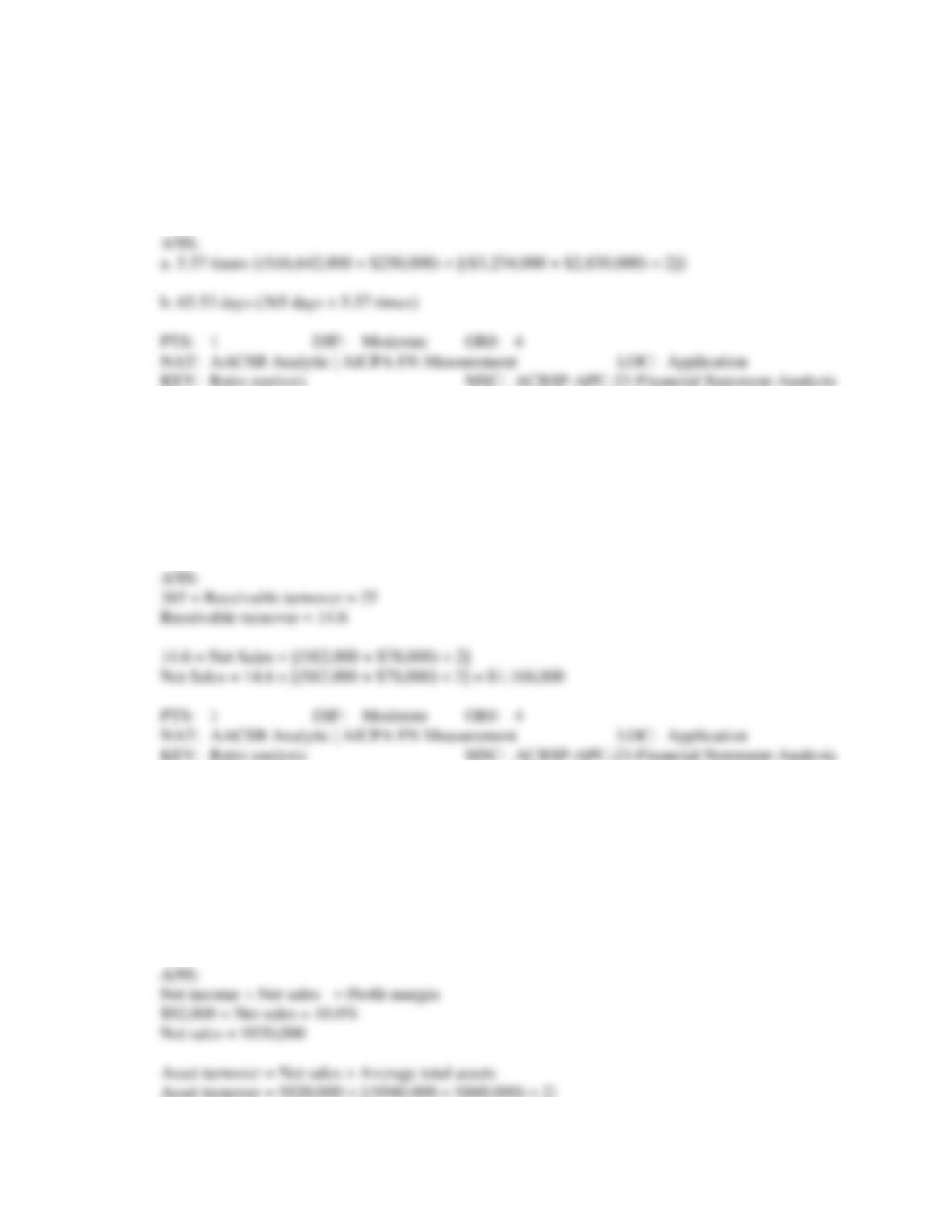
Cost of goods sold
16,642,000
Operating expenses
6,000,000
Inventory increase
250,000
Accounts payable, beginning
3,234,000
Accounts payable, ending
2,830,000
a. Payables turnover
b. Days’ payable
14. The following data pertain to Bexar Corporation:
Days’ sales uncollected for 2013
25
Accounts receivable, 12/31/12
$78,000
Accounts receivable, 12/31/13
$82,000
Calculate the amount of net sales reported for 2013. Use 365 days per year.
15. The following information pertains to Briscoe Corporation:
Profit margin for 2013
10.0%
Total assets, 12/31/12
$860,000
Total assets, 12/31/13
$940,000
Net income, 2013
$92,000
Calculate the asset turnover ratio for 2013. Round your answer to two decimal places.