
Name:
Class:
Date:
chapter 13
Indicate whether the statement is true or false.
1. Setups are a significant time-consuming activity in traditional production environments.
a.
True
b.
False
2. In a lean environment, the journal entry to record conversion costs would include a debit to the manufacturing overhead
control account.
a.
True
b.
False
3. In a lean environment, operations only respond to customer orders.
a.
True
b.
False
4. A nonfinancial measure is operating information that has not been translated into dollars.
a.
True
b.
False
5. Lean manufacturing favors organizing work around products rather than around processes.
a.
True
b.
False
6. In a pull manufacturing system, production is based on estimated customer demand.
a.
True
b.
False
7. The cell conversion cost rate is very similar to the predetermined factory overhead rate because both include only
factory overhead costs.
a.
True
b.
False
8. Lean manufacturing is also called make to stock manufacturing.
a.
True
b.
False
9. In a lean environment, raw materials are delivered more frequently than in a traditional environment.
a.
True
b.
False
10. Pull manufacturing is also called make to order manufacturing.
a.
True
b.
False
11. Employee involvement does not include performing any indirect manufacturing functions.
a.
True

Name:
Class:
Date:
chapter 13
b.
False
12. In a push manufacturing system, production is based on estimated customer demand.
a.
True
b.
False
13. Lead time includes both value-added time and non-value-added time.
a.
True
b.
False
14. Large batch sizes increase lead time.
a.
True
b.
False
15. In a push manufacturing system, production is based on actual customer orders.
a.
True
b.
False
16. Pull manufacturing companies produce mainly to stock inventory.
a.
True
b.
False
17. In a lean environment, the journal entry to record raw materials purchases would include a credit to the raw materials
inventory account.
a.
True
b.
False
18. Reducing wait time is not linked to reducing inventory.
a.
True
b.
False
19. The lean philosophy views inventory as a necessary buffer to protect against process problems.
a.
True
b.
False
20. By spending more in costs of controlling quality, the costs of failing to control quality will decrease.
a.
True
b.
False
21. Lead time reduction can be a cost-saving goal for any processed item.
a.
True
b.
False
22. One inherent risk to using lean principles is that companies are at higher risk of inventory shortages during volatile
times caused by strikes, adverse weather, etc., than when using traditional manufacturing principles.
a.
True

Name:
Class:
Date:
chapter 13
b.
False
23. In a lean environment, raw materials are delivered less frequently than in a traditional environment.
a.
True
b.
False
24. Long setups and large batch sizes result in smaller inventories and reduced lead times.
a.
True
b.
False
25. In a lean environment, the journal entry to record conversion costs would include a debit to the raw and in process
inventory account.
a.
True
b.
False
26. Prevention costs and appraisal costs are considered costs of controlling quality.
a.
True
b.
False
27. With lean manufacturing, employees are trained to be experts in one operation.
a.
True
b.
False
28. Push manufacturing (or make to stock) is a traditional approach to manufacturing.
a.
True
b.
False
29. A setup is the effort spent preparing an operation or process for production.
a.
True
b.
False
30. Lean practices and activity analyses are not suitable for adaptation to service businesses or administrative processes.
a.
True
b.
False
31. In a lean accounting system, there are more transactions to record than there are in a traditional accounting system.
a.
True
b.
False
32. In a pull manufacturing system, production is based on actual customer orders.
a.
True
b.
False
33. With lean manufacturing, financial accounting information is used more often for long-term operating decisions and
nonfinancial measures are used more often for day-to–day decisions.
a.
True

Name:
Class:
Date:
chapter 13
b.
False
34. Costs of failing to control quality include prevention costs and external failure costs.
a.
True
b.
False
35. Push manufacturing is also referred to as “make to order” processing.
a.
True
b.
False
36. Lean manufacturing values labor for contributions beyond labor tasks, using employee involvement that grants
employees the responsibility and authority to make decisions about operations.
a.
True
b.
False
37. It is easier to quantify costs of controlling quality than the costs of failing to control quality.
a.
True
b.
False
38. In a lean accounting system, indirect labor is traced directly to product cells.
a.
True
b.
False
39. A backflush accounting system uses work in process inventories as control points between each process step.
a.
True
b.
False
40. The lean manufacturing philosophy views inventory as an unnecessary waste of resources.
a.
True
b.
False
41. Reducing wait time is directly linked to reducing inventory.
a.
True
b.
False
42. Pull manufacturing companies typically produce in small batch sizes.
a.
True
b.
False
43. In a lean accounting system, the work in process and raw materials inventory accounts are combined.
a.
True
b.
False
44. In a lean environment, the journal entry to record raw materials purchases would include a debit to the raw and in
process inventory account.
a.
True

Name:
Class:
Date:
chapter 13
b.
False
45. With lean manufacturing, nonfinancial measures are used more often for long-term operating decisions than are
financial accounting measures.
a.
True
b.
False
46. Lead time is the elapsed time between starting a unit of product into the beginning of a process and its completion.
a.
True
b.
False
47. In a lean environment, process problems are more visible than they are in a traditional environment.
a.
True
b.
False
48. Within-batch wait time increases total lead time.
a.
True
b.
False
49. In a lean accounting system, the costs of direct labor are recorded in the conversion costs account.
a.
True
b.
False
50. In a lean accounting system, there are fewer transactions to record than there are in a traditional accounting system.
a.
True
b.
False
51. All lead times are considered to be value-added.
a.
True
b.
False
52. Costs of controlling quality include prevention costs and internal failure costs.
a.
True
b.
False
53. A pull manufacturing company matches its production schedules to actual customer orders.
a.
True
b.
False
54. In a lean environment, process problems are less visible than they are in a traditional environment.
a.
True
b.
False
55. Lean manufacturing favors organizing work around processes rather than around products.
a.
True
b.
False

Name:
Class:
Date:
chapter 13
56. In the lean principles philosophy, unexpected downtime is the result of unreliable processes.
a.
True
b.
False
57. When performing activity analysis on administrative processes, the “product” is often information.
a.
True
b.
False
58. Lean manufacturing focuses on reducing time, cost, and poor quality in processes.
a.
True
b.
False
Indicate the answer choice that best completes the statement or answers the question.
Sifton Electronics Corporation manufactures and assembles electronic motor drives for video cameras. The company
assembles the motor drives for several accounts. The process consists of a lean cell for each customer. The following
information relates to only one customer’s lean cell for the coming year. For the year, projected labor and overhead was
$7,370,000 and materials costs were $28 per unit. Planned production included 4,000 hours to produce 27,500 motor
drives. Actual production for August was 1,600 units, and motor drives shipped amounted to 1,380 units. Conversion
costs are applied based on units of production
59. From the foregoing information, determine the production costs transferred to Finished Goods during August.
a.
$369,840
b.
$408,480
c.
$428,800
d.
$473,600
60. Which of the following is an example of value-added time?
a.
processing time
b.
wait time during inspection
c.
wait time in inventory
d.
none of these choices
61. How are the objectives of lean manufacturing achieved?
a.
product-oriented production layout
b.
employee involvement
c.
supplier partnering
d.
all of these choices
Schedule of Activity Costs
Quality Control Activities
Activity Cost
Process audits
$50,000
Training of machine operators
28,000
Processing returned products
19,000
Scrap processing (disposal)
25,000

Name:
Class:
Date:
chapter 13
Rework
8,000
Preventive maintenance
30,000
Product design
46,000
Warranty work
12,000
Finished goods inspection
23,000
62. From the provided schedule of activity costs, determine the external failure costs.
a.
$39,000
b.
$19,000
c.
$12,000
d.
$31,000
63. _____ manufacturing principles emphasize quality and zero defects.
a.
Traditional
b.
Lean
c.
Zero-based
d.
Chinese
64. Setup time is disregarded as an improvement priority under _____ manufacturing principles.
a.
traditional
b.
lean
c.
total quality management
d.
product cost
65. Which of the following underlying problems may be hidden by high raw materials, work in process, and finished
goods inventory levels?
a.
machine breakdowns
b.
poor quality
c.
unreliable suppliers
d.
all of these choices
66. Lean manufacturing philosophy reduces all of the following except
a.
inventory
b.
setup time
c.
lead time
d.
conversion costs
67. The cell conversion cost rate includes which of the following?
a.
only factory overhead
b.
only direct labor and direct materials
c.
direct labor, direct materials, and factory overhead
d.
only direct labor and factory overhead
68. Which of the following is related to long lead times?
a.
long setup times

Name:
Class:
Date:
chapter 13
b.
large batch sizes
c.
large inventories
d.
all of these choices
69. Which of the following is not a prevention cost?
a.
preventive maintenance
b.
operator training
c.
design engineering
d.
testing finished products
70. Which of the following is an example of a nonfinancial measure of performance used in lean manufacturing?
a.
lead time
b.
setup time
c.
number of units scrapped
d.
all of these choices
71. Which of the following is best suited to providing timely and focused performance information?
a.
nonfinancial information
b.
financial accounting information
c.
cost accounting information
d.
variance analysis
72. Actions that transform a traditional manufacturing environment to a lean environment include all of the following
except
a.
form partnerships with reliable suppliers
b.
reorganize manufacturing around products rather than processes
c.
train employees to perform various operations
d.
increase raw materials and finished goods inventories
73. Under a lean environment, employees have the responsibility and authority to
a.
purchase inventory
b.
determine output amounts
c.
make decisions about operations, rather than waiting for management
d.
make engineering changes
Schedule of Activity Costs
Quality Control Activities
Activity Cost
Process audits
$50,000
Training of machine operators
28,000
Processing returned products
19,000
Scrap processing (disposal)
25,000
Rework
8,000
Preventive maintenance
30,000
Product design
46,000
Warranty work
12,000

Name:
Class:
Date:
chapter 13
d.
correcting invoice errors
Finished goods inspection
23,000
74. From the provided schedule of activity costs, determine the non-value-added costs.
a.
$30,000
b.
$50,000
c.
$64,000
d.
$85,000
75. Which of the following is considered non-value-added lead time?
a.
packing
b.
moving from process to process
c.
converting raw materials to finished product
d.
all of these choices
76. Traditional manufacturing emphasizes all of the following except
a.
team-oriented employee involvement
b.
process-oriented layout
c.
push manufacturing
d.
cost accumulation by department
Sifton Electronics Corporation manufactures and assembles electronic motor drives for video cameras. The company
assembles the motor drives for several accounts. The process consists of a lean cell for each customer. The following
information relates to only one customer’s lean cell for the coming year. For the year, projected labor and overhead was
$7,370,000 and materials costs were $28 per unit. Planned production included 4,000 hours to produce 27,500 motor
drives. Actual production for August was 1,600 units, and motor drives shipped amounted to 1,380 units. Conversion
costs are applied based on units of production
77. From the foregoing information, determine the amount of the conversion costs charged to Raw and In Process
Inventory during August.
a.
$369,840
b.
$408,480
c.
$428,800
d.
$473,600
78. Accounting for lean operations requires fewer transactions because
a.
large batches of inventory are combined into a smaller number of transactions
b.
costs are accumulated in one department and then transferred to the next department
c.
combined materials and conversion costs are transferred to finished goods
d.
costs are transferred from department to department allowing for better control of costs
79. Which of the following is not an external failure cost?
a.
warranty work
b.
processing returned merchandise
c.
rework

Name:
Class:
Date:
chapter 13
80. Which of the following statements best describes the relationship among the costs of quality?
a.
Spending more on prevention and appraisal costs will reduce the total overall costs of quality.
b.
Spending more on prevention and appraisal costs will increase the total overall costs of quality.
c.
Adequate spending on prevention and appraisal costs will eliminate all internal and external failure costs.
d.
The amount spent on prevention and appraisal costs has no impact on the amount spent on internal and
external failure costs.
81. Squirrel Co. operates in a lean manufacturing environment. For June production, Squirrel purchased 6,000 units of
raw materials at $6.00 per unit on account. The journal entry required to record this transaction is
a.
Raw and In Process Inventory 36,000
Accounts Payable 36,000
b.
Cost of Goods Manufactured 36,000
Accounts Payable 36,000
c.
Finished Goods 36,000
Accounts Payable 36,000
d.
Raw Materials Inventory 36,000
Accounts Payable 36,000
Sifton Electronics Corporation manufactures and assembles electronic motor drives for video cameras. The company
assembles the motor drives for several accounts. The process consists of a lean cell for each customer. The following
information relates to only one customer’s lean cell for the coming year. For the year, projected labor and overhead was
$7,370,000 and materials costs were $28 per unit. Planned production included 4,000 hours to produce 27,500 motor
drives. Actual production for August was 1,600 units, and motor drives shipped amounted to 1,380 units. Conversion
costs are applied based on units of production
82. From the foregoing information, determine the manufacturing cost per unit.
a.
$240.00
b.
$268.00
c.
$296.00
d.
$1,870.50
83. Inventory reduction is a(n) _____ principle.
a.
lean
b.
traditional processing
c.
economic
d.
wait time
Schedule of Activity Costs
Quality Control Activities
Activity Cost
Process audits
$50,000
Training of machine operators
28,000
Processing returned products
19,000
Scrap processing (disposal)
25,000
Rework
8,000
Preventive maintenance
30,000
Product design
46,000

Name:
Class:
Date:
chapter 13
89. Which of the following is a value-added activity?
Warranty work
12,000
Finished goods inspection
23,000
84. From the provided schedule of activity costs, determine the prevention costs.
a.
$30,000
b.
$74,000
c.
$76,000
d.
$104,000
Sifton Electronics Corporation manufactures and assembles electronic motor drives for video cameras. The company
assembles the motor drives for several accounts. The process consists of a lean cell for each customer. The following
information relates to only one customer’s lean cell for the coming year. For the year, projected labor and overhead was
$7,370,000 and materials costs were $28 per unit. Planned production included 4,000 hours to produce 27,500 motor
drives. Actual production for August was 1,600 units, and motor drives shipped amounted to 1,380 units. Conversion
costs are applied based on units of production
85. From the foregoing information, determine the cell conversion cost rate.
a.
$240.00 per unit
b.
$268.00 per unit
c.
$296.00 per unit
d.
$1,842.50 per unit
86. When using lean principles and activity analyses with service businesses, the “product” is normally
a.
an employee
b.
information
c.
the customer
d.
the supplies used in providing the service
87. Which of the following is a characteristic of a lean accounting system?
a.
fewer work in process account transactions
b.
work in process and raw materials accounts combined
c.
elimination of the direct labor account
d.
all of these choices
88. Conan Electronics Corporation manufactures and assembles electronic motor drives for video cameras. The company
assembles the motor drives for several accounts. The process consists of a lean cell for each customer. The following
information relates to only one customer’s lean cell. For the year, planned labor and overhead was $80,000,000 and
materials costs were $25 per unit. Planned production included 9,600 hours to produce 76,800 motor drives. Actual
production for the month of August was 5,200 units, and motor drives shipped amounted to 5,040 units. From the
foregoing information, determine the cell conversion cost rate for applying conversion costs.
a.
$8,025 per hour
b.
$800 per hour
c.
$7,200 per hour
d.
$8,333 per hour

Name:
Class:
Date:
chapter 13
a.
scrap processing
b.
rework
c.
preventive maintenance
d.
warranty work
90. What do lean manufacturers demand from their vendors?
a.
high-quality materials
b.
low-cost materials
c.
on-time deliveries
d.
all of these choices
Sifton Electronics Corporation manufactures and assembles electronic motor drives for video cameras. The company
assembles the motor drives for several accounts. The process consists of a lean cell for each customer. The following
information relates to only one customer’s lean cell for the coming year. For the year, projected labor and overhead was
$7,370,000 and materials costs were $28 per unit. Planned production included 4,000 hours to produce 27,500 motor
drives. Actual production for August was 1,600 units, and motor drives shipped amounted to 1,380 units. Conversion
costs are applied based on units of production
91. From the foregoing information, determine the production costs transferred to Cost of Goods Sold during August.
a.
$369,840
b.
$408,480
c.
$428,800
d.
$473,600
92. The lean philosophy attempts to reduce setup times, which will
a.
increase batch sizes
b.
not affect batch sizes
c.
increase within-batch wait time
d.
decrease within-batch wait time
93. Which of the following is an objective of lean manufacturing?
a.
eliminating waste
b.
increasing inventory levels
c.
increasing lead time
d.
all of these choices
94. Kilbuck Company operates in a lean manufacturing environment. Kilbuck applies conversion costs at a rate of $25 per
unit. Kilbuck produced 12,000 units during May. Kilbuck’s actual conversion costs for the month of May were:
Direct and indirect labor
$150,000
Machine depreciation
85,000
Maintenance and supplies
60,000
Total conversion costs
$295,000
The journal entry to record applied conversion costs for May will include a
a.
credit to Work in Process Inventory for $300,000
Name:
Class:
Date:
chapter 13
b.
debit to Conversion Costs for $300,000
c.
credit to Raw and In Process Inventory for $295,000
d.
debit to Raw and In Process Inventory for $300,000
Schedule of Activity Costs
Quality Control Activities
Activity Cost
Process audits
$50,000
Training of machine operators
28,000
Processing returned products
19,000
Scrap processing (disposal)
25,000
Rework
8,000
Preventive maintenance
30,000
Product design
46,000
Warranty work
12,000
Finished goods inspection
23,000
95. From the provided schedule of activity costs, determine the value-added costs.
a.
$177,000
b.
$191,000
c.
$156,000
d.
$104,000
96. Which of the following is characteristic of a lean production layout?
a.
decentralized maintenance and small production batches
b.
decentralized maintenance and organization around processes
c.
organization around processes and small production batches
d.
large production batches and organization around processes
97. _____ manufacturing treats suppliers and customers as “arm’s–length” independent entities.
a.
Traditional
b.
Lean
c.
Economic
d.
Productivity improvement
Schedule of Activity Costs
Quality Control Activities
Activity Cost
Process audits
$50,000
Training of machine operators
28,000
Processing returned products
19,000
Scrap processing (disposal)
25,000
Rework
8,000
Preventive maintenance
30,000
Product design
46,000
Warranty work
12,000
Finished goods inspection
23,000
Name:
Class:
Date:
chapter 13
98. From the provided schedule of activity costs, determine the appraisal costs.
a.
$50,000
b.
$23,000
c.
$73,000
d.
$104,000
99. Which of the following results in fewer transactions in lean accounting?
a.
All manufacturing costs are combined into one account called Raw and In Process Inventory.
b.
The distinction between direct and indirect costs is eliminated.
c.
There is less movement of inventory between departments.
d.
all of these choices
Schedule of Activity Costs
Quality Control Activities
Activity Cost
Process audits
$50,000
Training of machine operators
28,000
Processing returned products
19,000
Scrap processing (disposal)
25,000
Rework
8,000
Preventive maintenance
30,000
Product design
46,000
Warranty work
12,000
Finished goods inspection
23,000
100. From the provided schedule of activity costs, determine the total activity cost.
a.
$62,000
b.
$179,000
c.
$94,000
d.
$241,000
101. In a lean environment, process problems are more visible than they are in a traditional environment because
a.
inventories are maintained at higher levels
b.
process problems cause production to shut down immediately
c.
the push manufacturing system leads to increased inventory levels
d.
the lack of work in process inventory creates problems
102. A customer service department has the following resolution response time data:
Average Response Time
First contact 0.25 hr.
Service scheduling 0.50 hr.
Wait for service 24.00 hrs.
Service 1.50 hrs.
Total resolution time 26.25 hrs.
What is the value-added ratio (rounded to one decimal place) in this process?
a.
5.7%
Name:
Class:
Date:
chapter 13
b.
8.6%
c.
28.6%
d.
91.4%
Schedule of Activity Costs
Quality Control Activities
Activity Cost
Process audits
$50,000
Training of machine operators
28,000
Processing returned products
19,000
Scrap processing (disposal)
25,000
Rework
8,000
Preventive maintenance
30,000
Product design
46,000
Warranty work
12,000
Finished goods inspection
23,000
103. From the provided schedule of activity costs, determine the internal failure costs.
a.
$37,000
b.
$25,000
c.
$8,000
d.
$33,000
Match each of the following quality control activities with the appropriate classification (a or b).
a.
Value-added
b.
Non-value-added
104. Disposing of scrap material
105. Processing returned materials
106. Reworking defective product
107. Inspecting finished goods
108. Maintaining equipment
109. Providing customer service calls
110. Design engineering
111. Inspecting materials
Match each of the following activities with the appropriate quality cost classification (a–d).
a.
Prevention cost
b.
Appraisal cost
c.
Internal failure cost
Name:
Class:
Date:
chapter 13
d.
External failure cost
112. Disposing of scrap
113. Recalling defective products
114. Performing warranty work
115. Testing products
116. Controlling vendor quality
117. Processing returned merchandise
118. Maintaining equipment
119. Training operators
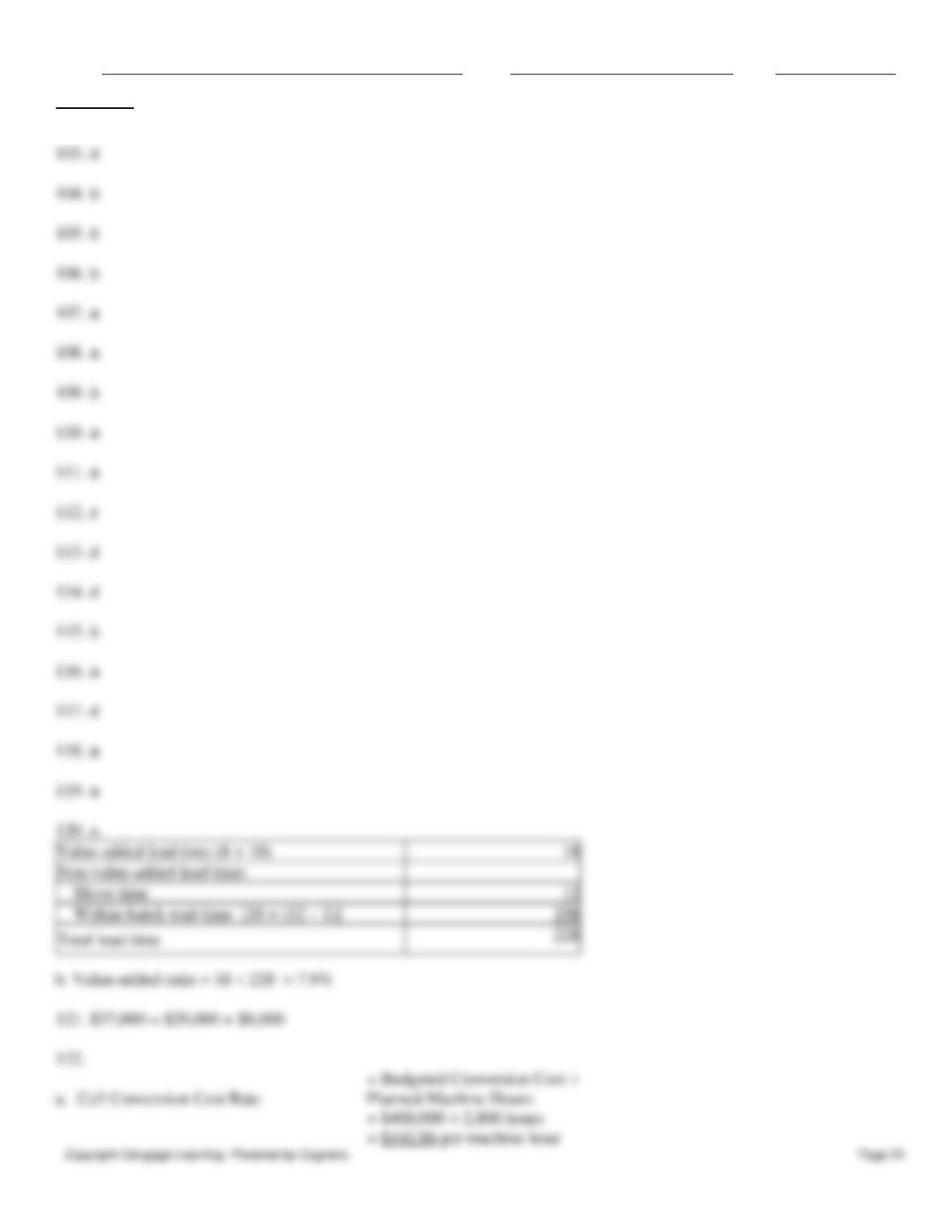
120. Christmas Express makes wreaths in batch sizes of 12. The cutting and assembly process takes 8 minutes per wreath,
and the decorating process time is 10 minutes per wreath. It takes 12 minutes to move the wreaths from the cutting and
assembly process to the decorating process.
a. Compute the value-added, non-value-added, and total lead times of the wreath process.
b. Compute the value-added ratio. Round to one decimal place.
Schedule of Activity Costs
Quality Control Activities
Activity Cost
Product testing
$55,000
Assessing vendor quality
26,000
Recalls
18,000
Rework
29,000
Scrap disposal
8,000
Product design
30,000
Training machine operators
46,000
Warranty work
12,000
Process audits
22,000
121. From the provided schedule of activity costs, determine the internal failure costs.
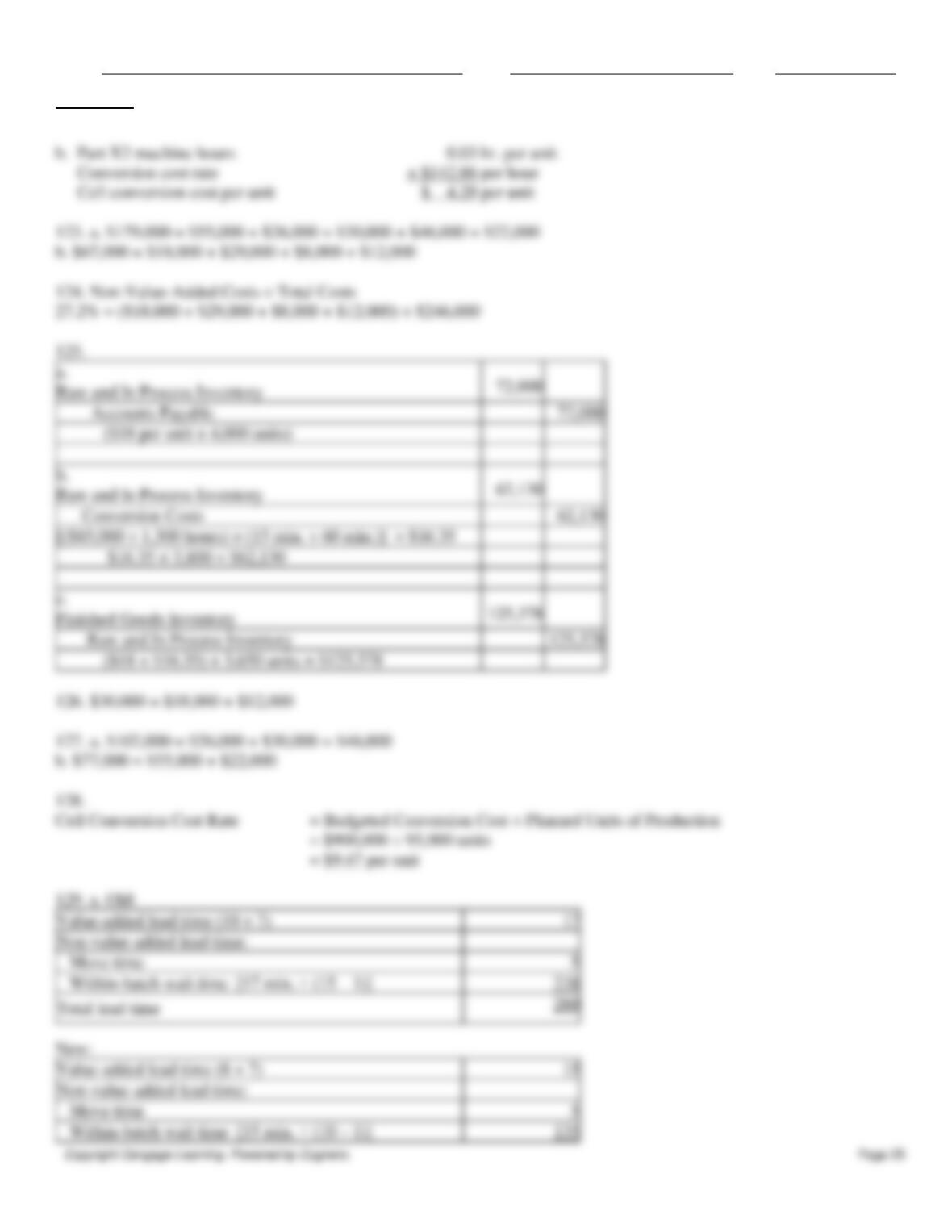
122. Axelgold Company produces parts for the auto industry. Part X2 is machined in Department 1, which has the
following budgeted conversion costs:
Labor
$330,000
Depreciation
32,000
Maintenance
12,000
Supplies
26,000
Total
$400,000
All costs are driven by machine hours. Total planned hours for the year are 2,800. It takes 0.03 hour to machine one unit
Name:
Class:
Date:
chapter 13
of Part X2.
a.
Compute Department 1’s budgeted cell conversion cost rate for the current year.
Round to the nearest cent.
b.
Compute Part X2’s budgeted cell conversion cost per unit. Round to the nearest
cent.
Schedule of Activity Costs
Quality Control Activities
Activity Cost
Product testing
$55,000
Assessing vendor quality
26,000
Recalls
18,000
Rework
29,000
Scrap disposal
8,000
Product design
30,000
Training machine operators
46,000
Warranty work
12,000
Process audits
22,000
123. From the provided schedule of activity costs, determine the (a) value-added and (b) non-value-added costs.
124. From the provided schedule of activity costs, compute the percentage of non-value-added activities. Round to one
decimal place.
125. Bright Lamp Company has budgeted its conversion cost for small lamp production as $85,000 for 1,300 production
hours. Each unit produced by the cell requires 15 minutes of process time. During the month, 3,800 units are
manufactured in the cell. The estimated materials cost is $18 per unit. Journalize entries for the following:
a. Materials are purchased to produce 4,000 units.
b. Conversion costs are applied to 3,800 units of production. Round to the nearest cent.
c. The cell completes 3,650 units, which are placed into finished goods. Round to the nearest dollar.
Schedule of Activity Costs
Quality Control Activities
Activity Cost
Product testing
$55,000
Assessing vendor quality
26,000
Recalls
18,000
Rework
29,000
Scrap disposal
8,000
Product design
30,000
Training machine operators
46,000
Warranty work
12,000
Process audits
22,000
126. From the provided schedule of activity costs, determine the external failure costs.
127. From the provided schedule of activity costs, determine the (a) prevention and (b) appraisal costs.
128. Peters Manufacturing Co. operates in a lean manufacturing environment. The company had scheduled production of
95,000 units during February in its Y12 cell. Actual February production totaled 88,200 units. Peters had budgeted
Name:
Class:
Date:
chapter 13
conversion costs for February totaling $900,000 and budgeted production hours totaling 2,000. Conversion costs are
applied based on units of production.
Compute Peters’ cell conversion cost rate for Cell Y12. Round to the nearest cent.
129. Extreme Wreaths, Inc., makes wreaths in batch sizes of 15 at a time. The cutting and assembly process takes 10
minutes per wreath, and the decorating process time is 7 minutes per wreath. It takes 5 minutes to move the wreaths from
the cutting and assembly process to the decorating process.
In an effort to improve the lead time, the company has tried reducing the batch size to 10 units. The new process is as
follows: cutting and assembly process—8 minutes. The decorating process is still 7 minutes per wreath. It takes 5 minutes
to move the wreaths from the cutting and assembly process to the decorating process.
a. Compute the value-added, non-value-added, and the total lead times of the wreath process for both the old and new
manufacturing processes.
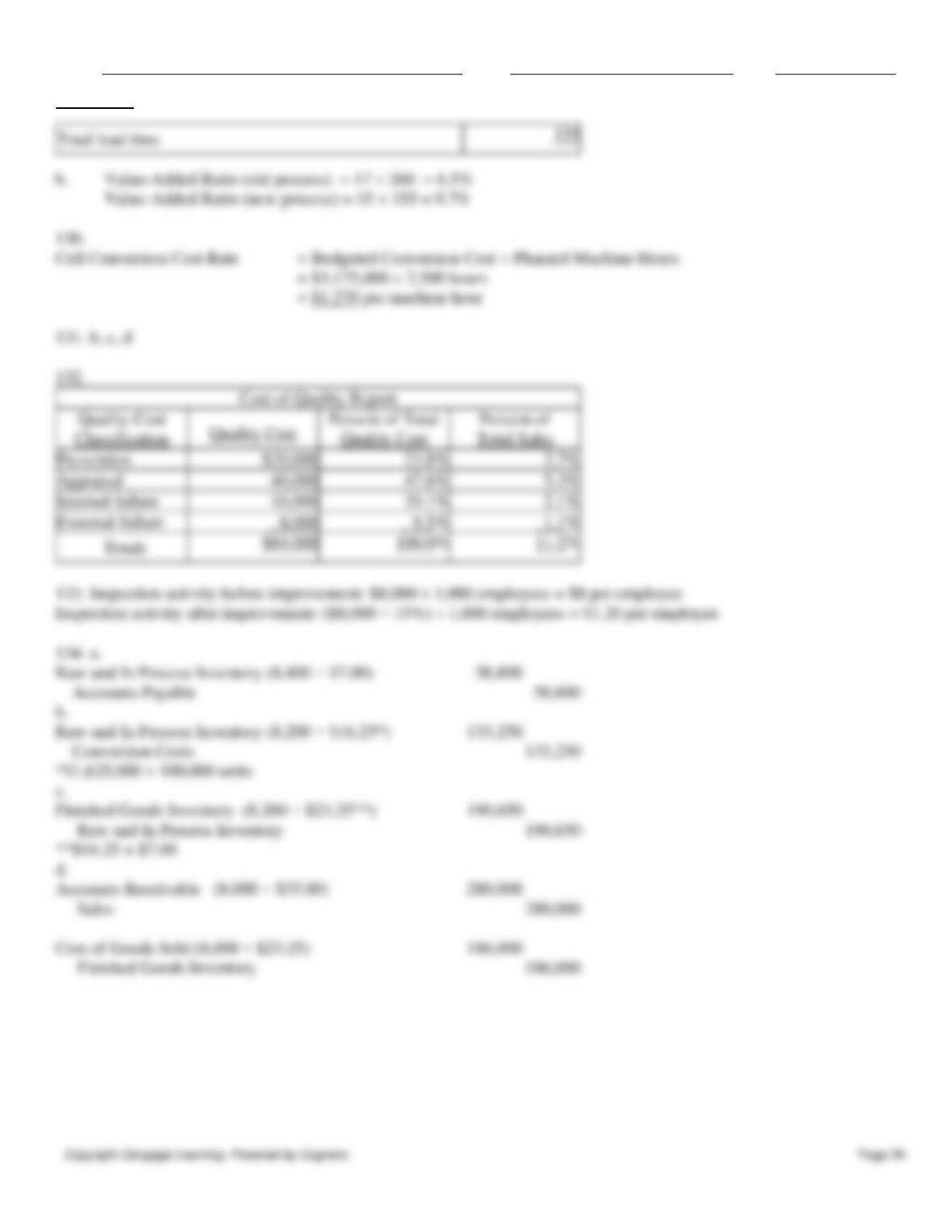
b. Compute the value-added ratio for both the old and new processes. Round to one decimal place.
130. Alaskan Pattern Company makes dressmakers’ patterns using a machine that stamps the pattern outline onto tissue
paper. The stamping center produced 40,000 patterns in August, with a machine time per pattern of 20 seconds. Annual
budgeted cell conversion costs were as follows:
Maintenance and supplies
$1,650,000
Depreciation
700,000
Supporting labor
825,000
Total
$3,175,000
Alaskan planned 2,500 total machine hours for the year.
Compute Alaskan’s budgeted cell conversion cost rate for the year.
131. Which of the following are features of lean manufacturing?
a. Maintaining excess inventory to ensure that products will always be available
b. Cross-training of employees
c. Giving employees additional authority and responsibility
d. Product-oriented layout
e. Increased setup time
132. A quality control activity analysis indicated the following four activity costs of a hotel.
Verifying credit card information
$40,000
Customer service training
20,000
Discounting room rates due to poor customer service
16,000
Correcting charges to customer invoices
8,000
Total
$84,000
Sales are $750,000 for the year. Prepare a cost of quality report.
133. Connally Company’s Payroll Department required that every time card be checked twice to ensure pay accuracy. The
company has 1,000 employees and has determined that the checks cost the company $8,000 per year. It has decided to
change this policy and only check those names that appear on the exceptions report and a random check on the entire
payroll. Currently, only 15% of the payroll is evaluated each payroll. Determine the inspection activity cost per employee
on the 1,000 employees both before and after the improvement.

Name:
Class:
Date:
chapter 13
134. Kwanika Co. operates in a lean manufacturing environment. During its first year of operations, Kwanika budgeted
for 40,000 hours in the production of 100,000 units in its Cell X-22. Materials costs were $7.00 per unit. Cell X-22
conversion costs were budgeted for the year as follows:
Direct and indirect labor
$ 900,000
Machine depreciation
125,000
Maintenance and supplies
375,000
Utilities
225,000
Total
$1,625,000
During January, materials for 8,400 units were purchased on account. There were 8,200 units manufactured and 8,000
were sold and shipped to customers for $35 each. Conversion costs are applied based on units of production. Journalize
(a) the materials purchases, (b) the application of conversion costs, (c) the transfer from work in process to finished goods,
and (d) the sales (all made on account) and associated cost of goods sold for the month of January.
Name:
Class:
Date:
chapter 13
Answer Key

Name:
Class:
Date:
chapter 13

Name:
Class:
Date:
chapter 13
Name:
Class:
Date:
chapter 13
Name:
Class:
Date:
chapter 13
Name:
Class:
Date:
chapter 13
Name:
Class:
Date:
chapter 13